Parliamentary questions on lead ammunition & medicated grit on grouse moors

The Scottish Greens just keep piling on the pressure.

Some interesting Parliamentary questions from Mark Ruskell MSP on the toxic hazard of lead ammunition and the use of medicated grit on grouse moors:

Question S5W-29820, Date Lodged: 09/06/2020

To ask the Scottish Government what proportion of the active ingredient in the medicated grit that is used on managed grouse moors is excreted by the birds. [Expected answer date 24/6/2020]

Question S5W-29821, Date Lodged: 09/06/2020
To ask the Scottish Government what assessment SEPA has made regarding the wider environmental impacts of the medicated grit that is used on grouse moors. [Expected answer date 24/6/2020]
Question S5W-29822, Date Lodged: 09/06/2020
To ask the Scottish Government what testing is carried out on the levels in the human food chain of the active ingredient in the medicated grit that is used on grouse moors. [Expected answer date 24/6/2020]
Question S5W-29823, Date Lodged: 09/06/2020
To ask the Scottish Government when it expects the use of lead ammunition to be entirely phased out on (a) public and (b) private land. [Expected answer date 24/6/2020]
Question S5W-29824, Date Lodged: 09/06/2020
To ask the Scottish Government what level of lead from shot gameboards [sic] is present in the human food chain, and what regular analysis it carries out of this. [Expected answer date 24/6/2020]
The Scottish Government is going to struggle not to look completely incompetent and/or wholly unconcerned about the unregulated toxic hazards that feature on driven grouse moors. This can be stated with confidence because the answers to Mark’s questions are already known.
The active ingredient in medicated grit is Flubendazole, a drug that has been identified as ‘an emerging environmental contaminant of acute and chronic toxicity’ and has been shown to be particularly toxic to aquatic organisms. Previous Freedom of Information requests submitted by this blog have revealed that the Scottish Government is not monitoring the impact of medicated grit, even though it’s known that some in the industry are using a super-strength dose up to twenty times the original dose! Surveillance undertaken by the Veterinary Medicines Directorate (VMD), responsible for the national (UK) monitoring of veterinary drugs in food products, has been woefully inadequate, and that’s being kind. In a country that shoots an estimated three quarters of a million red grouse each year, the VMD proposed to test just ten birds in 2018 (see here).
The use of lead ammunition to shoot gamebirds in the UK is unregulated, despite the well-documented high toxicity of this metal and the consequential health implications of consuming it. With most of the previously significant sources of lead in the environment now having been eliminated decades ago (e.g. lead-based paints and leaded petrol), lead-based ammunition is the most significant unregulated source of lead deliberately emitted in to the environment. It’s a poison, it’s as simple as that.
If that wasn’t bad enough, the most jaw-dropping revelation is that all gamebirds (including red grouse) appear to be exempt from statutory testing for lead shot, in sharp contrast to other meat types destined for human consumption. Research (here) has shown that shot red grouse destined for the food chain may contain excessive amounts of toxic poisonous lead (over 100 times the lead levels that would be legal for other meat)!
Talk about vested interests! The law makers of the day clearly put their own pleasure and convenience above the health and welfare of the general public and the environment. It’s an absolute shocker that this continues.
The game shooting industry knows that time is up on this issue and earlier this year we saw a high profile media campaign suggesting that the industry supported a ‘voluntary ban’ on the use of lead ammunition (yeah, because this industry’s adherence to voluntary restraint is legendary, right?) and wanted to see it phased out within five years. Unfortunately, not everybody in the industry was singing from the same hymn sheet and it turned in to a bit of a car crash when the Scottish Gamekeepers Association refused to sign up (see here).
It’ll be interesting to see how the Scottish Government responds to Mark’s questions.
For those who want to find out more about the use of medicated grit and lead ammunition, download fully referenced summary report (here) from Revive, the coalition for grouse moor reform.
UPDATE 13 July 2020: Disingenuous parliamentary answers from Scot Gov on toxic hazards of grouse moor management (here)
YOUR vote to end mass slaughter of mountain hares on Scottish grouse moors

As you know, Scottish Greens MSP Alison Johnstone has recently lodged an amendment to the Animals & Wildlife Bill, which would make mountain hares a protected species, effectively ending the mass slaughter on grouse moors (see earlier blog here).

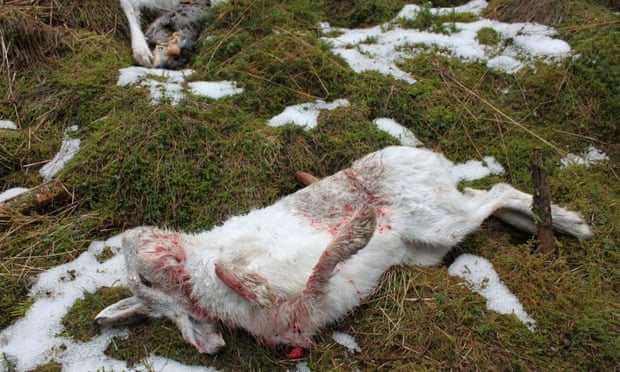
An estimated 26,000 mountain hares are killed on grouse moors every year. Here’s one of them, shot and left to rot on Glenogil Estate in the Angus Glens. Photo by OneKind:

Alison’s amendment is due to be debated and then voted upon by the Scottish Parliament on Wednesday 17 June 2020.

There has been a LOT of activity on social media since the amendment was announced, with many constituents contacting their MSPs and asking for an indication of how they intend to vote on this issue.

As a further demonstration of public support for the amendment, the Scottish Greens have launched a public petition where YOU can have your say. It has gathered over 7,000 votes in the last two days. If you’d like to sign it, please click HERE

For those who want to learn more about the mass killing of mountain hares on Scottish grouse moors, this 2017 report (here) provides a good introduction, as does this video:

Scottish Parliament to vote on banning mass slaughter of mountain hares on grouse moors

Press release from the Scottish Greens (10 June 2020)

Parliament to vote on mountain hare mass killing ban

The controversial practice of mass killing of mountain hares may finally end thanks to a proposal from Scottish Green MSP Alison Johnstone, who has lodged an amendment to the Animals and Wildlife Bill. The amendment would make mountain hares a protected species, effectively ending recreational killing and mass killing on grouse moors.

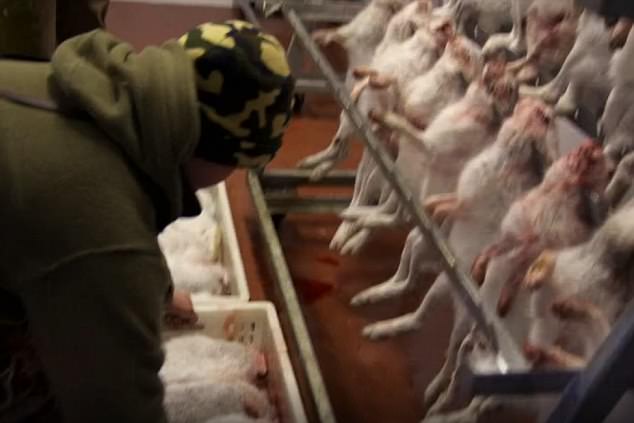
[Shot mountain hares strung up in a chilling larder, screen-grabbed from a controversial feature on Countryfile (2018) showing mountain hares being shot on a Scottish grouse moor]

The Lothians MSP has a proposed member’s bill to end the killing of the iconic animal but will seek to introduce the protections sooner in stage 3 of the Animals and Wildlife (Penalties, Protections and Powers) (Scotland) Bill.

Alison Johnstone said: “Mountain hares are iconic animals, native to the Highlands. Yet rather than being treasured they are barely protected by the Scottish Government, and persecution and mass killings are rife. This is our chance to end the killing and protect this species for future generations.

In 2019 the conservation status of the mountain hare was downgraded to ‘unfavourable’ after new data published by the EU revealed populations have experienced a major decline [see here]. This followed shocking evidence of large-scale killing on shooting estates [here] apparently to increase the numbers of grouse available.

Mountain hares are routinely being killed in huge numbers on grouse moors in particular, with an average of 26,000 killed every year. Efforts to get shooting estate managers to practice voluntary restraint has failed.

I hope that the SNP and other parties will ignore special pleading from the shooting lobby and do the right thing next week. Either this amendment passes and mountain hares are protected, or Parliament turns a blind eye to the continued slaughter of a native species

ENDS

Stage 3 of the Animals & Wildlife Bill will take place next Wednesday and MSPs will vote on Alison Johnstone’s amendment to make the mountain hare a protected species.

If you’d like to encourage your MSP to support this amendment, please contact them now. If you’re not sure who your MSP is, you can find out by typing in your postcode here.

Scottish Greens call for increased enforcement as wildlife crime continues during lockdown

Press release from Scottish Greens (3 June 2020)

Concerns over wildlife crime during lockdown

‘Concerning’ wildlife crime during lockdown shows why greater protection and enforcement is needed, the Scottish Greens have said.

Speaking to Scottish Green environment spokesperson Mark Ruskell at Holyrood’s Environment, Climate Change and Land Reform Committee, Francesca Osowska, Chief Executive of Scottish Natural Heritage, said there has been reports of incidents concerning nesting birds, badgers and freshwater mussels during lockdown.

That is a concern,” she said, pointing out SNH have not been able to respond in normal ways due to restrictions and have been referring cases to Police Scotland.

Commenting, Mark Ruskell said: “We’ve seen reports across the UK of criminals exploiting the lack of normal monitoring during lockdown to kill animals. I agree with SNH that this is extremely concerning.

This is why current attempts to strengthen the law around wildlife needs to be stronger. I have proposed stronger protection for badgers and giving the SSPCA powers to investigate wildlife crime, both of which would prevent further crimes and make convictions more likely.

We’ve also heard that the RSPB has been ‘overrun’ by reports of birds of prey being illegally killed by those emboldened by the absence of walkers and hikers. Travel restrictions are necessary, but they also apply to private estates. This crisis is not carte blanche for wholesale slaughter of Scotland’s wild animals.”

ENDS

On the topic of increased powers for the SSPCA, a subject that’s been covered extensively on this blog, Common Weal journalist Sean Bell has written an excellent synposis which includes this comment, hitting the nail on the head:

More broadly, the suggestion that, after nearly a decade of discussion and debate regarding expanded powers for the SSPCA, it is still somehow unclear “why the powers would be needed or what they are for” indicates either a severe lack of interest on the Scottish Government’s part, or an active attempt to roadblock progress on the matter‘.

You can read his article in full here

The Scottish Government chose not to expand the SSPCA’s powers in May 2017 (apparently based on ‘legal advice’) and this decision was buried in amongst an announcement that a review on grouse moor management would be undertaken (this later became known as the Werritty Review), for which we’re still waiting for a Government response.

With raptor persecution showing no sign of decrease since then (e.g. see here) and even continuing through lockdown, it’s good to see the Scottish Greens bringing the issue of increased SSPCA powers back to the Parliamentary table.

Scottish Government denies ‘negotiating’ with gamekeepers on new offences for trap damage

In early May we blogged about a claim made by the Scottish Gamekeepers Association (SGA) that it was ‘negotiating with Government for a new offence to be created for damage to legal predator control tools‘, i.e. traps and snares (see here).

[A spring (Fenn) trap set on a log, designed to catch and kill any animal that stands on the trigger plate. Gamekeepers argue that traps like these, and others, are routinely damaged by members of the public. Photo from the Untold Suffering report published by the Revive Coalition last year. NB: It is no longer legal to use Fenn traps for killing stoats in the UK as they have been ruled inhumane – new trap designs have recently been approved (see here)]

This claim led to Scottish Greens MSP Mark Ruskell posing two Parliamentary questions earlier this week, asking the Government for details of these alleged ‘negotiations’ (see here).

Environment Cabinet Secretary Roseanna Cunningham has now responded and her answers are hilarious:

Mark Ruskell MSPTo ask the Scottish Government what discussions it has had with the Scottish Gamekeepers Association regarding creating offences and sanctions in relation to animal trap damage, broken down by (a) date and (b) location of discussion. (S5W-28828).

Roseanna CunninghamThe Scottish Government has not had any recent discussions with the Scottish Gamekeepers Association about creating offences and sanctions in relation to animal trap damage.

Mark Ruskell MSPTo ask the Scottish Government how it plans to change the law in relation to the wilful damage of animal traps. (S5W-28829).

Roseanna CunninghamUnder existing legislation and common law a person interfering with a legally set snare or trap may be committing one of a number of possible offences.

The Independent Review of Grouse Moor Management report which was published in December recommended changes to legislation on the use of animal traps. The Scottish Government is currently considering all of the recommendations in the report and will publish a response in due course.

So, in essence then, no, the Scottish Government is not involved in ‘negotiations’ with the SGA as the SGA has claimed, and no, the Scottish Government does not appear to be considering new legislation for the provision of a new offence for alleged trap damage.

Roseanna Cunningham mentions the Government’s ongoing consideration of the recommendations made in the Werritty Review but that review did not include a recommendation for the provision of a new offence for alleged trap damage. What it did recommend, however, was new legislation for trap operators to have to undertake mandatory training before being allowed to set traps!

This begs the question then, why did the SGA claim to be ‘negotiating with Government’ when apparently it is doing no such thing?!

If the SGA could put aside its delusional posturing for a second it’d do well to be spending some time reminding its members of the current legislation on trap use. According to the RSPB this week, ‘the police are following up several raptor persecution cases and multiple reports of illegal trap use on grouse moors‘ (see here). Let’s hope that none of those traps alleged to be being used illegally, belong to an SGA member.

Werritty Review: First Minister Nicola Sturgeon says early licensing is ‘a serious consideration’

Further to yesterday’s long-awaited publication of the Werritty Review on grouse moor management (here), Nicola Sturgeon received two related questions during First Minister’s Questions in the chamber yesterday afternoon (available to watch on ScotParlTV here and read full transcript here).

Andy Wightman (Lothian) (Green):

A month ago, the First Minister said to Alison Johnstone: “We will continue to take the right steps to protect wildlife, and will do that without fear or favour with regard to any vested interests or other interests.” [Official Report, 21 November 2019; c 21.]

We have waited more than two years for the Werritty review. Is the First Minister surprised that the representatives of the grouse shooting lobby she appointed to a review of grouse shooting have used their effective veto to sabotage what would otherwise be a clear recommendation to license grouse shooting?

The First Minister (Nicola Sturgeon):

The Werritty review has been published and all members can look at its recommendations. The central recommendation on the timescale for moving to greater regulation was not unanimous—Andy Wightman is right to point to that. That is one of the reasons why the Government will take time to consider the recommendation. I want to be very clear that part of that consideration will be looking at whether we move to regulation on a much quicker timeframe. We will take the views of stakeholders before coming to a final view on that.

The option of a licensing scheme needs to be considered. If that is the view of stakeholders and we consider that necessary—as I said, that is a serious consideration—we will move to implement that earlier than the five-year timeframe that was suggested by the review group.

[Thanks to Mr Carbo for this illustration]

Claudia Beamish (South Scotland) (Lab):

Further to Andy Wightman’s question on the long-awaited Werritty report, and recognising the complexity of the issue and the need for sustainable development for rural Scotland—let us all recall that a fifth of Scotland is driven grouse moors—Scottish Labour is very disappointed that the report recommends a five-year delay, in a climate emergency and a biodiversity emergency, before consideration is given to licensing. Does the First Minister agree that now is the time to consult on licensing; the possibility of the ban on burning deep peat, with appropriate exemptions as one of a range of options; the outlawing of particular types of snares and the mass mountain hare cull; and a range of other issues? Now is the time to do it—not in five years.

The First Minister (Nicola Sturgeon):

I answered that specific question in response to Andy Wightman, but I am happy to do so again. First, the Werritty review was independent of Government. It has made a set of recommendations, not all of which were unanimous, as has already been pointed out. We will give careful consideration to all the recommendations alongside other evidence before we issue a full response. As part of that, we will meet key stakeholders to discuss the review’s findings.

Secondly, on licensing, as I said very clearly to Andy Wightman, part of our consideration will be to move to a licensing scheme much earlier than the five-year timeframe that was suggested by the review group. We welcome the input of everyone who has an interest in the matter. We will issue our response to the Werritty recommendations as soon as we are able to do so.

ENDS

The First Minister’s words are encouraging and welcome, just like those of her Cabinet Secretary yesterday (see here) but to be perfectly frank, the early implementation of a licensing scheme for grouse shooting should really be ‘a no-brainer’ rather than being ‘a serious consideration’. The Scottish Government has promised action for years and years and years (see here for a timeline) – NOW’s the time to deliver.

Scottish Government ‘actively considering’ additional enforcement action on wildlife crime

On Tuesday (17 December 2019) the Scottish Rural Affairs & Environment Minister, Mairi Gougeon, gave evidence to the cross-party Environment, Climate Change & Land Reform (ECCLR) committee which is currently considering Stage 1 of the Animals and Wildlife (Penalties, Protections and Powers) (Scotland) Bill.

The transcript can be read here (wildlife crime discussed from page 20 onwards): ECCLR report_17December2019

The archived video can be watched here

We’ve already blogged about one aspect of that evidence, where rather than committing to a mandatory custodial sentence for possession of banned deadly poisons, just as there is for those caught in possession of illegal firearms, yet another poisons amnesty was being considered instead (see here).

The rest of the session covered a lot of ground with some well-informed questions posed by some members of the ECCLR committee, especially Mark Ruskell MSP and Claudia Beamish MSP. In addition to an increase in penalties for wildlife crimes, which is part of the core text of the proposed Bill, other topics discussed included the Werritty review (due before the end of the year), the Government’s annual wildlife crime report (apparently due to be published ‘by the end of the year’ and we expect it will show an increase in confirmed raptor persecution crimes), vicarious liability, increasing SSPCA powers to tackle wildlife crime, the ineffectiveness of General Licence restrictions because estates can simply apply for Individual licences instead, covert video surveillance, the failure of the Police Special Constables pilot scheme in the Cairngorms National Park and a question about why the General Licence restriction at Leadhills Estate, imposed after Police Scotland provided ‘clear evidence of wildlife crime’, has been reinstated during the appeals process. Government officials committed to submitting a written response to Claudia Beamish’s question on this legally complicated issue.

The discussion on increasing powers for the SSPCA during Stage 2 of the Bill was quite telling. The Minister said the SSPCA had approached the Government in recent weeks to request additional powers to help tackle wildlife crime but she seemed to go to great lengths to argue that although she is committed to considering options she didn’t forsee anything happening in this particular Bill because the Government ‘needs the chance to fully discuss the issue’ and to ‘assess the ramifications of increasing those powers’.

Yeah, she’s right, so far the Government has only taken six years and five different Environment Ministers to fully discuss the issue and consider the ramifications – see here for a jaw-dropping timeline. And after all that it then concluded that accepting the offer of free resources from an expert and experienced reporting agency like the SSPCA wasn’t the right option for tackling serious organised crime and, inexplicably, chose instead to launch a £28k pilot scheme for five part-time voluntary Police Special Constables to potter around in the Cairngorms National Park and ‘meet stakeholders’; a scheme which, unsurprisingly, has been a complete flop. Even though Mairi Gougeon wasn’t in post as one of those five Environment Ministers during that six-year stalling exercise, her advisors should know all about those shenanigans. Honestly, the extent of the feet dragging is astonishing.

Mark Ruskell MSP again raised the issue of the ineffectiveness of General Licence restrictions and other sanctions, and asked the Minister if other sanctions were available? She responded by saying that she thought it was ‘important that other deterrents are available‘ and “We are actively considering the need for an additional level of enforcement, which would not require referral to the procurator fiscal or involvement of the Scottish courts but would still provide a penalty that would act as a deterrent. We will be happy to consider the evidence and consider whether measures are as effective as they can be“.

When Mark asked her whether she would be interested in discussing with the Westminster Government the withdrawal of a firearms certificate as a potential sanction, she responded,

Absolutely. I know that there were two recommendations around that in the Poustie review, so we will happily engage in discussions with the UK Government. I believe that the matter falls under the justice portfolio, so I would also be happy to raise it with justice colleagues and see how we can get some movement on the recommendations with the UK Government“.

Good, but if this was in the Poustie review on wildlife crime penalties published in 2015, why haven’t those discussions already taken place? That’s not Mairi Gougeon’s fault – she wasn’t in post then – but come on Scottish Government, five years on and discussions haven’t even started? This is like pulling teeth.

It’s not clear what other potential sanctions the Scottish Government is ‘actively considering’ to tackle wildlife crime but the long-awaited Werritty review should have some suggestions.

Gamekeepers caught with banned poisons should receive mandatory jail sentence

Yesterday the Scottish Rural Affairs & Environment Minister, Mairi Gougeon, gave evidence to the cross-party Environment, Climate Change & Land Reform (ECCLR) committee which is currently considering Stage 1 of the Animals and Wildlife (Penalties, Protections and Powers) (Scotland) Bill.

We’ll come back to the wider evidence session in another blog because there were some interesting and important discussions but one point raised deserves an immediate reaction:

Possession of banned poisons.

Here’s the mini transcript:

ECCLR Committee Member Rachael Hamilton MSP: I will go back to the categorisation of wildlife offences and the different tiers of the penalty system. We heard evidence that perhaps possession of illegal pesticides should be categorised as a tier 1 offence, because they are currently illegal anyway. Do you have any comments on that point and do you have any plans to have an amnesty on illegal pesticides prior to the bill being passed? People should not possess illegal pesticides anyway, so using them in connection with animal crimes should attract the highest and severest category of penalty.

Environment Minister Mairi Gougeon: That has been the feeling behind that issue. As you said, possession of such pesticides is already illegal and there are offences in place to deal with that individual issue separately. Using such pesticides as part of another offence would attract the higher penalty. As they are already illegal and there are offences attached to them, using them in relation to any other offences could well attract severe penalties.

In relation to your amnesty point, I would be happy to consider looking at the matter.

Scottish Government Wildlife Management Team leader Leia Fitzgerald: Just to clarify, there was a previous amnesty, which was quite successful and resulted in a lot of pesticides being handed in. We could speak to stakeholders about whether that is something that could be done again. We would hope that we got all of what we needed after the last amnesty, but we can look at the matter.

Environment Minister Mairi Gougeon: I will happily get back to the committee and let you know how we get on with that.

ENDS

Is the Scottish Government seriously considering yet another amnesty for banned poisons, which would be the third amnesty in the 15 years since it became an offence to even possess these deadly toxins, let alone use them? (The Possession of Pesticides (Scotland) Order 2005).

The first amnesty took place in 2011 (see here), six years after the ban was first introduced. The second amnesty came four years later in 2015 (see here).

Since then poisoning crimes have certainly dropped in Scotland, probably thanks to the increase in satellite-tagged raptors, whose tags lead researchers to the poisoned corpses that would otherwise remain undetected, and also due to the introduction of vicarious liability legislation in 2012 which made it possible for landowners to be prosecuted for raptor persecution crimes committed by their gamekeeper employees. However, these poisoning crimes haven’t been totally eradicated and we’re still reading reports about illegally-poisoned birds (and some dogs) that have died after ingesting banned poisons in Scotland including some that were killed this year, and some even inside the Cairngorms National Park (e.g. see here, here, here, here, here, here, here, here, here, here, here, here).

[An illegally-poisoned buzzard found on the boundary of a sporting estate in Perthshire. Contributed photo]

How many more chances is the Scottish Government planning on giving to these criminals? How many more get-out-of-jail-free cards will be dished out?

Why can’t the Scottish Government, 15 years on, implement a zero tolerance policy on this vile and primitive crime that not only risks the lives of wildlife and domestic animals but puts humans at risk as well? In the most recent criminal case, a Scottish gamekeeper was found with two cartons containing the banned poison Carbofuran. He was carrying one of these containers in his bum bag – presumably he wasn’t just taking the container out for company every day – and yet 180 schoolchildren were put at risk when they attended the grouse shooting estate on an officially-sanctioned school trip. Can you believe that? The gamekeeper was convicted for possession (along with a litany of other wildlife offences) and received a community payback order. No fine, no jail sentence, no deterrent whatsoever. Compare and contrast to how illegal poisoners are dealt with in Spain (see here, here and here).

The criminals who persist with such reckless activity in Scotland deserve a mandatory custodial sentence – there can be no more excuses, no more discussion and certainly no more amnesties.

Enough.

Scottish Parliament evidence session on proposed wildlife crime penalties increase

Raptor Persecution UK was one of a number of organisations giving evidence to the Scottish Parliament’s Environment, Climate Change & Land Reform (ECCLR) Committee last week on the proposed increase in penalties for wildlife crime.

The Animals and Wildlife (Penalties, Protections & Powers) (Scotland) Bill was introduced by Environment Cabinet Secretary Roseanna Cunningham on 30th September 2019 (see here for associated docs) and will, amongst other things, increase the maximum available penalties for the most serious animal welfare and wildlife offences.

See here for an earlier blog on this subject.

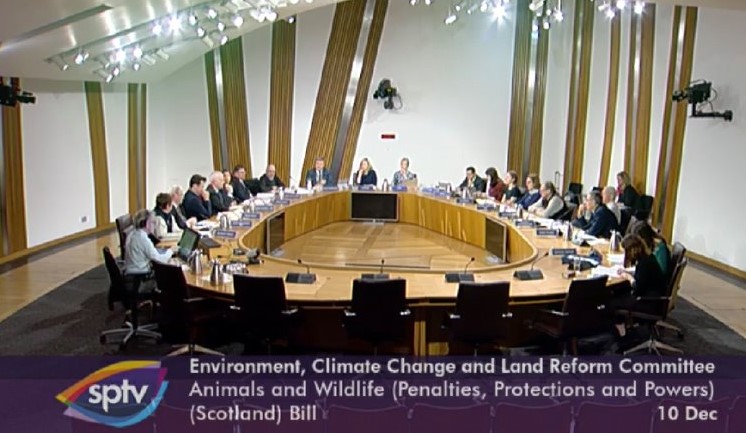
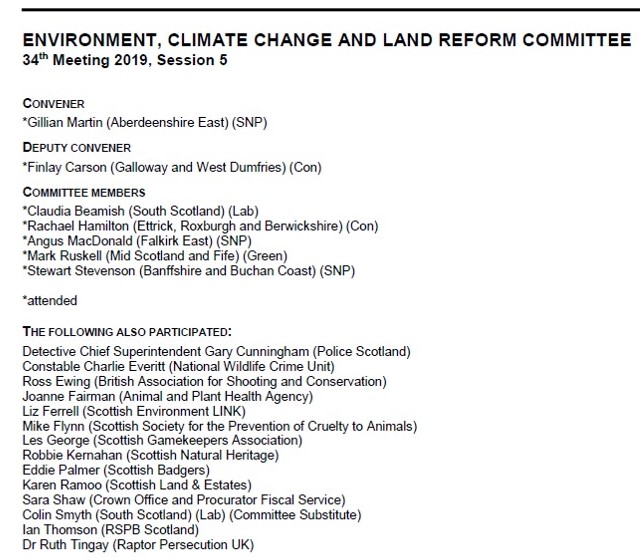
The Bill is currently at Stage 1 and the ECCLR Committee has been taking evidence from a wide range of authorities and organisations. Last Tuesday saw representatives from the grouse shooting industry, conservation organisations, Police Scotland, SNH and the Crown Office sharing their opinions in an informal round-table discussion:

The transcript can be read here: ECCLR report_10Dec2019

The archived video can be watched here

We’ll come back to some of the detail of this discussion in further blogs, particularly about some of the claims made by BASC in relation to the supposed effectiveness of general licence restrictions, where the evidence simply doesn’t support some of the assertions made.

We’ll also be considering the claim from the Scottish Gamekeepers Association that “A five-year jail term will mean that more people will go to jail than has been previously the case“. Really? Why’s that, then? Are more gamekeepers at it than are currently being caught? Surely not. And how will an increased penalty mean more offenders are jailed? You’ve got to catch them first and then have sufficient evidence to get them in to court.

This Bill is very welcome as it stands, but perhaps more importantly it also has the potential to include some pretty useful amendments as it progresses through Parliament. Of particular interest to us is that increased powers for the SSPCA is back on the table. Given the complete failure of the Scottish Government’s alternative course of action (Police Special Constables in the Cairngorms National Park – a scheme that failed to report a single wildlife crime), it seems the timing is just right.

Environment Minister Mairi Gougeon will be giving evidence to the ECCLR Committee tomorrow and will no doubt face questions about some of the proposals already heard.

First Minister ‘hopes to publish Werritty Review before the end of the year’

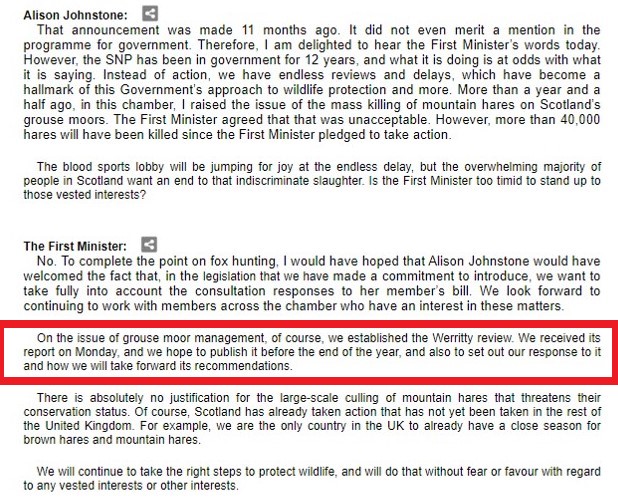
At today’s First Minister’s Question Time in the Scottish Parliament Nicola Sturgeon confirmed that the Government had received Professor Werritty’s grouse moor management review on Monday (18th Nov) and said “we hope to publish it before the end of the year, and also to set out our response to it and how we will take forward its recommendations“.

You can watch the video here (starts 23.59 min, ends 27.35 min).

The topic came up in response to a question posed by Alison Johnstone MSP who had already made the very valid point that ‘endless reviews and delays had become a hallmark of the Scottish Government’s attitude towards wildlife protection’ and she asked whether Nicola Sturgeon was “too timid to stand up to vested interests“.

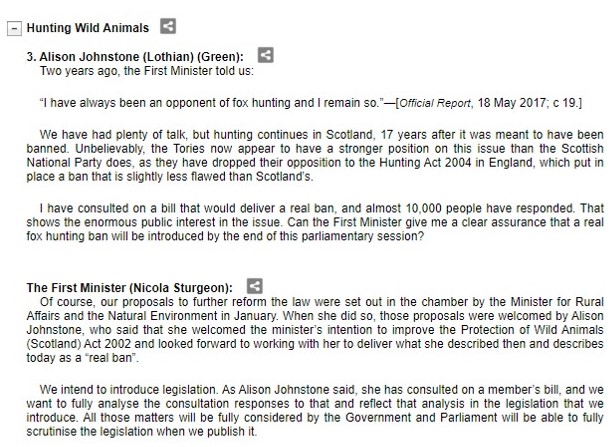
Here’s the transcript:

The Scottish Parliament breaks for recess on 22 December 2019 to 6 January 2020 inclusive. It’s not clear from Ms Sturgeon’s comment whether the Government hopes to publish the report (and the Govt’s response) before the end of the Parliamentary term by 5pm on 21 December or whether some poor civil servant will be tasked with the job between Xmas and New Year but hopefully in five and a half weeks at the very most we’ll finally have an opportunity to read Professor Werritty’s long-awaited report.