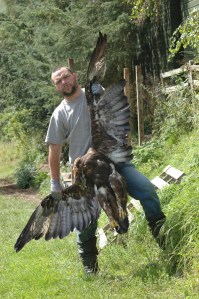
Landowners demand right to kill protected birds

Not content with the annual mass slaughter of millions of animals across Scotland (e.g. hares, rabbits, foxes, crows, stoats), landowners are pushing the Scottish government to issue licences to kill protected birds, including raptors.

According to an article in today’s Scotsman, in a forthcoming documentary on illegal raptor persecution in Scotland, Douglas McAdam of the SRPBA puts forward the argument for licences, claiming that they will reduce the incentive for landowners and gamekeepers to illegally poison and shoot protected species.

So what’s wrong with this logic? Well, in my opinion, nothing if you are a criminal, wanting to commit a crime but not be prosecuted for it. Perhaps we should all ask the government for a licence to walk into shops and take what we want? It would certainly be an incentive to stop the criminal activity of shoplifting but the only ones to benefit would be the shoplifters, not society as a whole. Who would benefit from the licensed killing of protected birds? The landowners. The rest of society would be left all the poorer for the loss of our magnificent species.

There’s nothing illegal about the SRPBA asking for the issue of licences – they are perfectly entitled to do this, and there is even a provision in the Scottish legislation to allow for the issue of licences. Fortunately, so far, our government has not been swayed by the argument and has called instead for a reduction in raptor persecution. So far this year there isn’t any evidence that raptor persecution is on the decline – the discovery of poisoned buzzards, poisoned bait, and most recently another poisoned golden eagle, tells us that these filthy criminal activities are continuing with impunity on Scottish shooting estates.

Of course, this isn’t the first time we have heard about the call for licences. The SGA has been campaigning for over ten years for the right to kill protected raptors, including hen harriers and buzzards. We have covered this topic extensively – see herehere, here, here, here, herehere and here.

No doubt these licence requests will persist – regardless of all the scientific evidence that shows how badly damaged our raptor populations already are thanks to the efforts of landowners and gamekeepers across Scotland.

Scotsman article about forthcoming documentary: http://www.scotsman.com/environment/Landowners-demand-right-to-cull.6764420.jp

BBC news: http://www.bbc.co.uk/news/uk-scotland-13339288

Poisoned buzzards and bait reportedly found on Edradynate Estate

Following blog posts on 6, 7 and 11 April….

The name of the Perthshire sporting estate raided by Tayside Police earlier this month, following the discovery of poisoned buzzards and poisoned bait in March 2011, has been recently reported on the raptor study group website as Edradynate Estate.

Described by Tayside Police Wildlife Crime Officer Alan Stewart in 2005, “Edradynate Estate, which is owned by an absentee landlord from Hampshire, has probably the worst record in Scotland for poisoning incidents, going back more than a decade. In 14 separate incidents since 1998, 16 poisoned victims (nine buzzards, a cat, a tawny owl, two sparrowhawks, a common gull, a polecat and a crow) and 12 poisoned baits (rabbits, woodpigeons and a pheasant) have been found, with traces of the pesticides mevinphos, carbofuran and alphachloralose”.

His comments were made after the collapse of a trial concerning two gamekeepers from the estate, who were charged with various offences involving the alleged poisoning and trapping of birds of prey. The case was dropped by the Procurator Fiscal, reportedly because of the time taken for the case to be heard. Full story here: http://www.rspb.org.uk/Images/legaleagle43_tcm9-132966.pdf

Since his comments, there have been more discoveries of poisoned birds on this estate, and public denials in the media of any involvement by estate gamekeepers, who claim the dead birds must have been ‘planted’ by someone else. Nobody has ever been convicted for wildlife crime offences on this estate and still the poisoning continues. Let’s hope that Tayside Police are able to detect the perpetrator(s) of the most recent poisoning incident.

Interestingly, it is also reported on the raptor study group website that Edradynate Estate is believed to be a member of the SRPBA and that at least one gamekeeper is a self-confessed member of the SGA. This is difficult to verify though as, conveniently, neither group publicises the names of their members. Both of these groups have made many public statements about how they deplore illegal raptor persecution and how they are working hard to eradicate it. They are both also members of PAW Scotland. It was reported last year that the CEO of the SRPBA paid a visit to Edradynate Estate – perhaps to apply some much needed ‘peer pressure’. If he did, then he is to be congratulated for his efforts, although judging by recent events it would appear that peer pressure was unsuccessful. Or perhaps it was successful, and the latest deaths were attributable to those pesky carcass planters – you know, the ones who have never been seen or heard but who are managing to plant poisoned birds on sporting estates up and down the country…

Wishy Washy WANE Bill

We can expect to see more images like this in the coming years

The long-debated WANE Bill (Wildlife and Natural Environment [Scotland] Bill) was finally passed by the Scottish Parliament on Wednesday 2nd March 2011. Talk about a missed opportunity to crack down on an industry that continues to flout the law when it comes to wildlife crime! “The Scottish Government is not prepared to tolerate continued persecution of our magnificent birds of prey. This government is prepared to act to introduce new measures to combat wildlife crime”, said a pig as it flew over Inverness Police Station.

A concise overview of how the final Bill relates to the continuing illegal persecution of our so-called protected raptors can be found here:

http://www.scottishraptorgroups.org/news.php

While some aspects of the new Bill are to be welcomed, including the introduction of vicarious liability, other measures that could have had a greater impact were refused. One such measure, estate licensing, was turned down in favour of allowing the sporting estates an opportunity to introduce voluntary self-regulation. This manifests itself in the form of the ‘Wildlife Estates Initiative’, dreamt up by the SRPBA in the later stages of the WANE Bill proceedings when it looked like they were under threat from the introduction of a licensing system. Who believes that this ‘initiative’ will work? Isn’t it crystal clear, after five decades of systematic raptor persecution, that the shooting industry has proven itself incapable of voluntary self-regulation? Will the new ‘initiative’ be as lacking in credibility as their May 2010 letter to the Environment Minister that 200+ estate owners signed to say that they opposed raptor poisoning? (The same letter that proved to be highly embarrassing just a few weeks later when multiple poisoned raptors were found on Moy Estate, one of the letter’s signatories). We look forward to watching how their latest ‘initiative’ rolls out, and particularly whether they actually publicise the names of the estates that have signed up to it (information that they have so far failed to make public). If they wish to be taken seriously then transparency will be essential.

In summary, there is as much chance of the current WANE Bill being an effective deterrent to illegal raptor persecution as there is of the SGA opening a wildlife sanctuary. However, full credit should go to Peter Peacock MSP for doing his utmost to secure a safe future for our declining raptor populations. He will be sorely missed when he steps down from politics in May, although we are pleased to note that he intends to lobby his colleagues from the sidelines. RSPB Scotland and the SRSGs also deserve credit for their lobbying efforts throughout the WANE Bill process. Some credit should be given to Roseanna Cunningham for sticking to her guns on the vicarious liability issue, although she loses points for stamping all over some of the other proposals that really could have made a difference.

As we approach the Scottish elections in May, you may want to know how your MSP voted on the raptor persecution issue during the WANE Bill. Check out the official report here:

http://www.scottish.parliament.uk/apps2/business/orsearch/ReportView.aspx?r=6146&mode=html#iob_55286

Silence over hen harrier carnage – now updated

One week on from the publication of the Hen Harrier Conservation Framework, leaked by investigative journalist Rob Edwards on 16 January 2011, here are the published responses from the shooting lobby and from those with a statutory duty to protect this species of high conservation concern:

Scottish Gamekeeper’s Association – silence

Scottish Rural Properties & Business Association (SRPBA) – silence

Scottish Estates Business Group (SEBG) – silence

Scotland’s Moorland Forum – silence

Game and Wildlife Conservation Trust (GWCT) – silence

Scottish Natural Heritage (SNH) – silence

Partnership Against Wildlife Crime Scotland (PAWS) – silence

National Wildlife Crime Unit (NWCU) – silence

Interesting. Perhaps they’re all hoping that if they keep quiet, everyone will forget about the damning evidence presented in the report? It is, after all, only the 5th scientific study published since 1997 to demonstrate the indisputable link between hen harrier persecution and heather moorland that’s managed for red grouse shooting. Here’s a quick summary for anyone who missed the latest scientific facts:

  • The potential national Hen Harrier population for Scotland is estimated to be within the range 1505 – 1790 pairs.
  • The most recent national survey of Hen Harriers in Scotland (2004) was estimated to include 633 pairs.
  • This means that 872 – 1,157 harrier pairs (1,744 – 2,314 individuals) are missing.
  • The areas from where these birds are missing are areas managed as grouse moors.
  • Illegal persecution of hen harriers is particularly prevalent in five areas, where the majority of breeding attempts fail. These five areas are: Central Highlands, Cairngorm Massif, Northeast Glens, Western Southern Uplands and Inner Solway, and Border Hills.
  • At a national scale, the hen harrier in Scotland is not in favourable conservation status, largely due to illegal persecution. Ditto the English hen harrier population.

So, up to 2,314 hen harriers are missing in Scotland, and no-one has anything to say about it? Think about that number. It’s not 23, it’s not even 213 – it is two thousand, three hundred and fourteen birds. This is wholesale destruction on a massive scale! Are we to believe that “just a few rogues” are responsible?

How much more scientific evidence is required before we see the effective enforcement of our wildlife legislation? How can those people who own and manage the sporting estates still be getting away with this level of illegal activity? Why is the Environment Minister still set against the licensing of sporting estates, when it is blindingly obvious that they are unable to self-regulate?

In light of the contents of the leaked report, it is to be hoped that the Scottish Government’s Rural Affairs & Environment Committee will once again push for an amendment to the WANE Bill for estate licensing. Stage 2 of the Bill was completed on Wednesday 19 January and there was no mention of the Hen Harrier Framework during that meeting, probably because the RAE Committee hadn’t had time to read the report in full. Stage 3 begins in several weeks and by that time the Committee and the Environment Minister should be fully conversant with the extent of illegal raptor persecution on Scottish grouse moors.

UPDATE: 28 January 2011. SRPBA denies extent of persecution (yawn)

The SRPBA has written a letter of response to The Sunday Herald, dated 16 January 2011. I’m not sure if it was actually published by The Herald, but here it is as a PDF – SRPBA response to killing fields article 16 Jan 2011

UPDATE: 19 February 2011. See our blog entry on 19 Feb 2011 for an update on this story.

Hen Harrier Conservation Framework – leaked!

Follow this link to journalist Rob Edward’s website, where a leaked copy of the Hen Harrier Conservation Framework report is available to download – http://www.robedwards.com/2011/01/revealed-scotlands-bird-killing-fields.html#more

Hen harriers and gamekeepers – ‘damning evidence’ soon to be published

Following the blog posts of December 18th and 24th 2010 about the delayed publication of the long-awaited Hen Harrier Conservation Framework report, one of our readers emailed the Environment Minister, Roseanna Cunningham. Thank you Mike Price for sending us the government’s response:

Thank you for your email of December 24th, to Roseanna Cunningham MSP, Minister for Environment and Climate Change, regarding the Conservation Framework for Hen Harriers. I have been asked to respond on behalf of the Scottish Government.

We are aware of the report and of the delays that it has experienced on its way to publication. Although my understanding is that SNH have arranged meetings with stakeholders to go through their scientific concerns, I appreciate that this is frustrating for those who have an interest in raptors in Scotland and are waiting for the report’s conclusions to be made public.

We have been assured by SNH that the report will be published before the Parliament has completed consideration of the Wildlife and Natural Environment (Scotland) Bill and will be made available to the Rural Affairs and Environment Committee. While I can’t comment on the content of a report that is yet to be published, I assure you that the Minister and her officials look forward to reading its conclusions with great interest.

Kind regards

Catherine Murdoch

Natural Resources Division

Rural and Environment Directorate

The Scottish Government

Phone: 0131-244 7140

Mail: 1-D North, Victoria Quay, Edinburgh EH6 6QQ

For information on wildlife crime and PAW Scotland, please visit http://www.PAW.Scotland.gov.uk

Meanwhile back in Gamekeeper World, the SGA has announced it is conducting a national wildlife survey on sporting estates, focusing on birds. SGA Chairman Alex Hogg says on his blog: “We know from extensive scientific studies that land which is managed by gamekeepers has some of the most prolific wildlife in the country“. Hmm, we also know from extensive scientific studies that land which is managed by gamekeepers is where raptors are persistently and illegally persecuted. The forthcoming Hen Harrier Framework report provides very clear evidence that the land where hen harriers are absent (despite it being apparently suitable breeding habitat) also just happens to be land that is managed as grouse moors. What an amazing coincidence! In fact, isn’t that also what the Golden Eagle Conservation Framework reported in 2008? Yes, I think it is. A cynic may conclude that the SGA’s national wildlife survey is simply their latest public relations offensive in an attempt to bury the devastating evidence of hen harrier persecution on Scottish sporting estates that will shortly be published for all to read. And yes, we have read the report – and it most certainly does contain damning evidence. We’ve considered posting it on this site but we will wait and hope that SNH keeps its promise and publishes the report sometime this month.

Alex goes on to encourage SGA members to participate in the forthcoming bird survey, and tells them that the survey form will only take “a short time” to fill in. Is that because most of the native birds have been illegally poisoned, or shot, or clubbed to death after being caught in a trap….?

Alex Hogg Blog here: http://www.scottishgamekeepers.co.uk/content/gamekeepers-conduct-national-wildlife-survey

Alex Hogg blames conservationists for depleting golden eagle population

Alex Hogg, Chairman of the Scottish Gamekeepers’ Association (SGA), has today spouted yet another ill-informed attack on the Irish Golden Eagle Project  http://www.scottishgamekeepers.co.uk/content/another-scottish-eagle-killed-ireland claiming that it makes “absolutely no sense” for Scotland to continue providing golden eagle chicks to augment the growing Irish golden eagle population.

He fails to comprehend that eagle chicks are only collected in Scotland from nests with twins (where more often than not, only one chick will naturally survive), and that chicks are only collected in areas of Scotland where scientists believe the species has a favourable conservation status (this means that chicks are collected from very few areas).

Yes, persecution in Ireland is a problem, as we have seen in recent months, but it is nowhere near the problem levels here in Scotland. I think that Alex makes such ridiculous claims against the Irish Project because he’s either very stupid, or because he’s trying to deflect attention away from the Scottish poisoning events. Or both. I wish he would make such a fuss about the eagle poisoning incidents in Scotland – six confirmed poisoned this year alone, and a further four from this year currently under investigation. Have we heard an outcry from Alex and his SGA chums about these, plus all the other confirmed raptor poisonings in Scotland this year and in previous years? What we have heard from him is his continual bleatings about how gamekeepers need to be given licences to kill protected raptors.

Perhaps he should read this report into the Irish Golden Eagle Project – it provides all the information he’ll need so that his next commentary on golden eagle conservation can be based on facts, not fiction. Irish Golden Eagle Project Review 2009

Bert’s Briefs….

An artist's impression of Bert's briefs. WARNING: may contain hazardous waste

In their latest attempt to gain support as the Wildlife and Natural Environment Bill reaches a critical stage, the Scottish Gamekeepers’ Association (SGA) has published, by their own description, ” a series of briefing notes for MSPs, setting the record straight on the most contentious issues as attacks escalate on the Scottish shooting industry”.

These notes are entitled “Bert’s Briefs” and have been prepared by none other than the SGA’s own Bert Burnett.

If you would like to have a wee look at Bert’s Briefs, have a peek here – http://www.scottishgamekeepers.co.uk/content/campaigning-stepped

SGA announces new vice-chairman

The Scottish Gamekeepers’ Association has announced the appointment of a new Vice-Chairman – Peter Fraser. According to the SGA website, Peter has been employed as a stalker on the Invercauld Estate, Aberdeenshire, for 41 years and “is highly regarded throughout the industry for his knowledge and experience of the hill environment and the countryside“. He’s probably also well aware of the continuing problem of illegal raptor persecution, especially as Invercauld Estate has been reported to be at the centre of several allegations over the years. Although as only one of these allegations ever resulted in a conviction, it could be argued that the others were all scurrilously and falsely levelled at Invercauld Estate employees. We all know that Invercauld Estate is against the illegal poisoning of raptors, because they signed the SRPBA letter to say so.

Peter has made a good start to his new role as Vice-Chair, as he apparently has argued ‘that in order to move forward the industry has to abide by the rules set by government’. Great insight. All that thinking time while stalking animals across the Scottish hills for 41 years has obviously been well used.

Peter is no stranger to voicing his opinions in the media either. In a televised interview with STV, he speaks fondly of golden eagles, saying: “A beautiful bird, part of our natural heritage and must always remain so“. Unfortunately, it appears he doesn’t feel the same way about goshawks, as he calls them “ruthless killers” and says they “kill for fun“. Perhaps Peter doesn’t view goshawks as part of our natural heritage, or understand that as a predator, they kill to survive, because, er, that’s what predators do?

Never mind. Peter and his colleague, SGA Chairman Alex Hogg, will make an entertaining formidable debating team in the Scottish political arena and we look forward to hearing about their efforts to stop the continued illegal killing of raptors by people within the shooting industry.

Here is the SGA announcement of Peter’s appointment: http://www.scottishgamekeepers.co.uk/content/new-sga-vice-chairman-elected

Here is Peter’s interview on STV: http://video.stv.tv/bc/scotland-outdoors-20080530-gamekeeping-in-the-highlands/

Hogg-wash and the WANE Bill at Langholm.

As most readers of this blog will be aware the Scottish Government introduced the Wildlife and Natural Environment (Scotland) bill to parliament on 9th June 2010.

The purpose of this bill is to modernise game law, abolish the designation ‘areas of special protection’, improve snaring practice, regulate invasive non-native species, change the licensing system for protected species, amend current arrangements for deer management and deer stalking, strengthen protection of badgers, change how muirburn can be practised, and make operational changes to the management of Sites of Special Scientific Interest.

The bill (as introduced) can be seen here.

http://www.scottish.parliament.uk/s3/bills/52-WildNatEnv/b52s3-introd.pdf

The Rural Affairs and Environment Committee has been appointed the lead committee to scrutinise the bill and as such has called on various bodies to provide views on the general principles of the bill.

Written submissions can be read here.

http://www.scottish.parliament.uk/s3/committees/rae/bills/WANE/writtensubmissions.htm

Naturally the most important issue on this bill, from a raptor conservation aspect, will be any change to the licensing system for protected species which could theoretically pave the way for the licensed killing of raptors in Scotland.

In a change to the usual passage of such bills the 18th meeting was held in The Buccleuch Centre in Langholm on 7th September 2010 . A full transcript of the meeting can be viewed here.

http://www.scottish.parliament.uk/s3/committees/rae/or-10/ru10-1802.htm#Col2967

(The most relevant discussion involving raptors commences at col 2991)

Alex Hogg (chairman of the Scottish Gamekeepers Association) had much to say on the subject of the licensed killing of raptors and ravens. Mr Hogg pleaded his case saying –

I only have a problem with young rogue buzzards. If I could deal with those specific ones, the problem would stop, I am quite sure. A lot of money would be lost to the rural economy if every shoot in Scotland ended up losing poults. A pheasant poult is worth the same as a lamb—it is worth about £35 when it is shot, and that is a huge amount of income for the rural economy. All that we are asking for is something to deal with specific rogue birds. We do not feel that a huge number would be involved,

Mr Hogg forgot to mention that his last application to the Scottish Government was to kill 12 buzzards on his estate alone, is that a few rogues? And that multiplied by the number of shooting estates in Scotland! Mr Hogg also omitted to expand upon his valuation of his pheasant poults. On an average pheasant shoot the number of pheasants shot is (optimistically) around 50% of the number of poults released so Mr Hogg’s pheasant poult is actually worth £17.50 As he already stated that his employers shoot is a small family operation, i.e. non commercial, it could be argued that they are in fact worth considerably less.

Mr Hogg went on to comment about the “fantastic”number of raptors in Scotland. He obviously fails to mention the vast tracts of Scotland’s uplands where raptors could be expected to be found, but invariably aren’t, these areas being generally termed “grouse moors”

  We have worked hard to reduce wildlife crime, and anybody who is caught poisoning any birds of prey will be thrown out of the SGA. Nevertheless, I point out that the numbers of birds of prey in Scotland are at a fantastic high. We have 440 pairs of golden eagles and more than 700 pairs of harriers, whereas there is nothing in England at all. Our raptor population has not stopped rising since the 1960s. The incidence of bird poisoning rose last year, but I am sure that, through peer pressure over the next couple of years, it will go down to nearly zero, although we will not get rid of poisoning. It is like rape and murder—it will always be there. We will try our hardest to drive it out of the country. However, we also need some means of managing the raptor population, the raven population or whatever population we are trying to balance with our work in the countryside.

Mr Hogg is often telling us that poisoned raptors are planted on shooting estates and gamekeepers are blameless scapegoats, therefore it’s hard to understand why he thinks that peer pressure will stop raptor poisoning. Is this an admission that gamekeepers are carrying out raptor persecution crimes?

Mr Hogg’s finale was his roadmap to stop wildlife crime in Scotland which can basically be summarised as “give me my licence to shoot buzzards and wildlife crime is a thing of the past” !

  I feel that wildlife crime would stop in the next two or three years if we could address the question that Mike Russell asked, which was how many is too many. How many hen harriers does Langholm need? How many raptors, ravens, rabbits or whatever does an estate need? An estate needs to be managed and kept in balance with nature. It is dead easy to make a political decision about enforcement—to say, “We should jail people for 20 years”—but we should try to get people around a table to try to get them to come to a commonsense solution that everyone will benefit from. People who are involved in wildlife tourism, grouse shooting and the private estates all want the same thing, so we must be able to get around a table and thrash out the issues until we get an answer.

Is anyone fooled by Alex Hogg’s apparent willingness to negotiate? Certainly, the Rural Affairs and Environment Committee asked some very well-informed and revealing questions.  Mr Hogg and the SGA appear to be desperately trying to drum up some support for the licensed killing of raptors. We can only hope that the committee recognises and appreciates the damage that this proposed legislation could cause Scotland’s reputation across the world as an environmentally responsible, modern and forward thinking country.