Environment Secretary’s message to Scottish gamekeepers re: raptor persecution

roseanna-cunninghamLast week, Environment Cabinet Secretary Roseanna Cunningham gave a speech at the Scottish Raptor Study Group’s annual conference, where she described, with feeling, her ‘contempt‘ for the continued illegal persecution of birds of prey (see here).

Her speech was warmly welcomed by those in the audience and many were hoping she would deliver the same message when she spoke at the Scottish Gamekeepers’ Association AGM, six days later on 3 March.

It seems as though she did. According to this article in the Courier, her speech to the SGA was similarly-worded and hopefully it was delivered with the same strength of feeling she gave at the SRSG conference.

Here are some quotes from her SGA speech:

Not only are you valuable eyes and ears in the Scottish countryside, but you are stakeholders in the Partnership for Action Against Wildlife Crime, with a vital role to play.”

We also need to continue to work together to change attitudes and every person in this room can help“.

The successful reintroductions of red kite and white-tailed eagle, and the recent 15% increase – which is in real terms a recovery – in golden eagle numbers, from the results of the last national survey – is welcome progress“.

For many people seeing these magnificent birds is a rare event. Many of you here today are in the fortunate position of seeing them regularly and I envy you that“.

Unhappily however the illegal killing of raptors is still with us“.

I have no patience at all with old fashioned attitudes towards these birds that linger on in this day and age. We all have to abide by the law, and must do so every day“.

I have no truck with any excuse that raptors damage driven grouse shooting interests – such damage is a business risk that grouse moor owners have to live with, and manage for – and this has to be done within the law“.

I note and welcome your chairman Alex Hogg’s reiteration of the pledge to ensure SGA members only consider legal routes to conflict resolution and he has made it clear that those committing wildlife crime will be removed from the SGA.

Although it looks like she didn’t go as far as directly pointing the finger at the SGA, it is to be hoped that the sub-text was clear enough to have some people squirming in their seats.

As several commentators have mentioned on this blog, although the Environment Secretary’s words were welcome, we have heard them all before, not only from her but also from three previous Environment Ministers, and yet raptor persecution continues. For now though, we’re cautiously giving Roseanna Cunningham the benefit of the doubt.

Yes, her words to the SGA are a big improvement on the words her predecessor gave to the SGA (see here) and yes, she’s bought herself and the Scottish Government a bit more time with these two speeches, but society’s patience is not limitless. We expect to see further measures enacted, and soon. There will be a lot of attention placed on the Cabinet Secretary’s response to the recently-published game bird licensing review, the forthcoming review of satellite tagged raptors, and the decision on whether to give increased investigatory powers to the SSPCA.

There’ll also be a great deal of attention paid this year to whether SNH grants licences to gamekeepers allowing them to kill protected raptors and if so, on what grounds? Roseanna has been clear that any perceived damage by raptors to grouse moor management should be a ‘business risk’ that has to be ‘managed within the law’. The SGA will no doubt argue that applying for licences to kill raptors would be ‘managing the business risk within the law’ and technically, they’d be correct, in as much as the provision is there to apply for such licences but whether protecting artificially high numbers of game birds is justification for legally killing protected raptors, especially when illegal raptor persecution continues, is an argument that will dominate MSPs’ inboxes if licences are given this year.

Interesting times ahead.

Scottish Gamekeepers chairman attacks Raptor Study Group

hogg-shiteAlex Hogg, Chairman of the Scottish Gamekeepers’ Association, has a long track record of talking out of his backside.
Previous missives directly attributable to the SGA’s esteemed leader have included lines such as, “Professional gamekeepers do not poison raptors” (here), “It is unfair to accuse gamekeepers of wildlife crime” (here), “In the last ten years we have stamped out poisoning” (here), “We kill animals because probably we’re the doctors and nurses of the countryside” (here) and, when asked whether gamekeepers are involved in the poisoning, shooting and trapping of raptors: “No they aren’t. We would dispute that” (here).

In the latest edition of the Shooting Times, he accuses the Scottish Raptor Study Group of ‘driving [gamekeepers’] wives, children and grandchildren from their homes‘. Here’s part of the article to provide the context to his claim:

One of the reasons the SGA was set up was to stop the police raiding our houses without proper evidence of wrongdoing. Wives and children were being subjected to dawn raids, houses were being pulled to pieces; in some cases children’s cough mixture was confiscated in case poison was being hidden in the bottle.

Hopefully these bad old days are gone. The SGA has worked extremely hard with our members to drive the poisoning incidents almost off the map. We have been very successful and last year it looks as if we had only two incidents of poisoning that involved a raptor. If the police had these results in any other form of crime it would be in all the news media for months.

Still, all we hear from the RSPB is that this can only be the tip of the iceberg. The Scottish Raptor Study Group, along with the RSPB, has launched a petition calling for the licensing of Scottish shooting estates. This group has been publicly funded since inception and has taken access on estates for years without even having to inform the keeper or landowner. In this regard it is unaccountable as it can log whatever it wishes, with little or no checks or balances on the process or the effects of its monitoring.

It seems strange that a group lacking in accountability is calling for shoots to be licensed. We will not stand by and allow double standards to drive wives, children and grandchildren from their homes. Everybody who works and lives in the countryside must now be wary that compliance with such organisations, sadly, is compliance with people who are attacking our jobs and way of life. It should never have got to this stage.

If the SGA had not been formed 20 years ago, what we live for would have been swallowed up by different government bodies. Some people hate the truth, but we will always tell it. It is that honesty which has gained us the respect that we have’.

ENDS

It seems that Alex hasn’t read the Scottish Moorland Group’s recently proposed ‘four point plan‘ for eradicating illegal raptor persecution, as presented to the Scottish Parliament’s Environment Committee last December. Point four was, “We would very much like to see greater cooperation between ourselves, the Raptor Study Groups and the RSPB“. Oops.

A few other points for Alex to consider:

  1. The police are not allowed to raid houses on a whim. They first have to apply for a search warrant from a Sheriff (via the Crown Office) and this will only be granted if there are reasonable grounds to assume that evidence of criminal activity may be uncovered during a search.
  2. It’s no surprise if children’s cough mixture has been confiscated during a raid. It has not been uncommon to find illegal poison stored in everyday household containers (particularly coffee jars!) and on at least one search a banned, highly toxic poison was found in a container on a shelf within a child’s reach.
  3. Raptor persecution has not stopped. Poisoning reports may have dropped, but other methods (particularly shooting and trapping) have not. Stop pretending otherwise.
  4. Members of the Scottish Raptor Study Group, just like every other member of the public, are entitled to access land without having to inform the keeper or landowner. Get over it.
  5. Members of the Scottish Raptor Study Group are individually licensed to visit the nests of Schedule 1 birds. They are accountable for their actions as they have to submit data returns to the Government’s licensing authority on an annual basis as a condition of the licence. If you want to discuss unaccountability, contrast this licensing regime with that of gamekeepers, who are not individually licensed and do not have to submit annual returns detailing any of their activities, which mostly involves killing wildlife.
  6. It’s not clear to us how launching a petition calling for a licensing scheme for gamebird shooting is going to ‘drive wives, children and grandchildren from their homes’. What will drive them from their homes is if gamekeepers get caught illegally killing raptors and lose their jobs (and tied house) as a result of a conviction.
  7. The SGA is supposedly a partner organisation in the Partnership Against Wildlife Crime (PAW), and notably, the PAW Raptor Group. Quite how publicly slagging off and warning SGA members to be wary of cooperating with another PAW partner (the Scottish Raptor Study Group) is evidence of good partnership working is beyond us. Perhaps the SGA will be asked to explain this at the next PAW Raptor Group meeting.

Alex’s article also touched on some other issues, including how the SGA is this year going to push for the Scottish Government to issue licences to ‘control’ (kill) protected species such as badgers, buzzards and ravens. He mentions that Environment Cabinet Secretary Roseanna Cunningham will be a guest speaker at the SGA’s annual conference in March and how staff members from SNH’s licensing team will also be in attendance to answer questions about this issue.

Interestingly, this subject was raised during Roseanna Cunningham’s address to the Scottish Raptor Study Group’s annual conference last Saturday. If she tells the SGA conference what she told the SRSG conference, there’ll be tears at bedtime for Alex and his wildlife-killing colleagues. (We’ll be blogging about the Cabinet Secretary’s speech to SRSG members in the next day or so, highlighting several points she made about raptor persecution and her full endorsement and gratitude for the “dedicated high quality fieldwork” of the SRSG).

Here is a copy of the Shooting Times article in full: alex-hogg-article_shooting-times_23feb2017

ECCLR session 2: the SGA and their ‘alternative facts’

Two weeks ago the Scottish Parliament’s Environment, Climate Change & Land Reform (ECCLR) Committee held an evidence session to scrutinise the Government’s 2015 annual wildlife crime report.

The evidence session was divided in to two parts – we’ve blogged about session 1 [evidence from Police Scotland and the Crown Office] here.

This blog is about session 2, where witnesses from RSPB Scotland, Scottish Gamekeepers’ Association (SGA), Scottish Badgers and the Bat Conservation Trust were invited to speak.

The video of the session can be watched here and the full transcript can be read here.

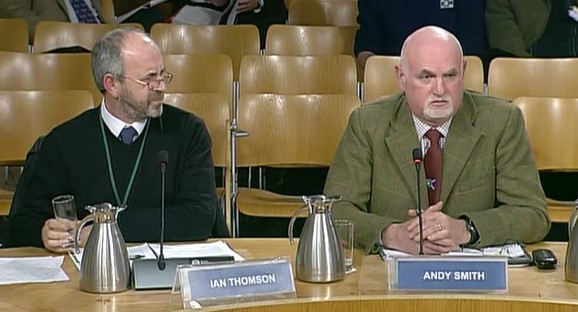
This session was fascinating and we’d really encourage you to read the transcript – and even better, watch the video. There’s too much to blog about here so we’ll just focus on the SGA’s ‘evidence’, which turned out to be a series of ‘alternative facts’, which perhaps isn’t all that surprising although it is of concern when you realise Andy Smith, the SGA rep, was a former police officer for 30 years and so he should be well versed in dealing with actual facts, not made-up ones.

Here are some of the SGA’s alternative facts. This is not an exhaustive list, just the ones that amused us the most:

Alternative Fact #1

According to Andy Smith, the SGA doesn’t support the proposal that the SSPCA should be given increased powers to help investigate wildlife crime because he was told that the SSPCA’s Chief Superintendent traveled to London to listen to the Westminster debate on driven grouse shooting, which, according to Andy Smith, means the SSPCA has an anti-shooting agenda.

The logic Andy Smith used to reach this conclusion is, well, illogical, because plenty of people attended the Westminster debate, including GWCT staff members, who most definitely are not anti-shooting. Anyway, as it turns out, the SSPCA’s Chief Superintendent did NOT travel to London to attend the debate, as he clearly explains in a recent letter to the ECCLR Committee that has been published on the Scottish Parliament’s website:  20170111_mike_flynn_to_convener_regarding_ecclr_meeting_10_january_2017

Alternative Fact #2

According to Andy Smith, “There are places in this country that should have birds of prey – raptors – but do not have them. That includes some RSPB reserves that have the perfect conditions. For example, I do not think that there are very many in Abernethy“.

Oops. There are at least eight species of breeding raptors at the RSPB’s Abernethy Reserve (perhaps more, we haven’t checked), including, er, the world famous ospreys at Loch Garten.

Alternative Fact #3

According to Andy Smith, “We should remember that the Cairngorms National Park has the highest density of eagles in the world“. [Interruption]. “Am I not right in thinking that?“.

Ian Thomson (RSPB Scotland): “No, you are not“.

Andy Smith: “It is certainly where the highest density of eagles is in the UK“.

Ian Thomson: “Harris has the highest density of golden eagles“.

Another commonly repeated myth from Andy Smith. It’s nothing new (e.g. see here, and it was also repeated in the SGA’s most recent edition of its in-house rag Scottish Gamekeeper), but it doesn’t matter how many times it’s repeated, it doesn’t make it factual. The Cairngorms National Park does NOT have the highest density of eagles in the world, nor in the UK. As Ian Thomson correctly pointed out, golden eagle density in the Western Isles (i.e. nowhere near a driven grouse moor) is among the highest recorded, although a few populations in North America have an equally high density.

The truth is that golden eagles in the Cairngorms National Park have one of the lowest rates of site occupancy in the whole of Scotland. Sure, there are breeding golden eagles in the CNP, but as was described in the authoritative Golden Eagle Conservation Framework, the vast majority of those sites are associated with open woodland (i.e. deer forest) where they are generally left alone; they are, with a handful of exceptions, absent from the extensive areas of open moorland managed for driven grouse shooting.

ge-vacant-territories-2003The data in the above table were derived from the 2003 national golden eagle survey. Since then, a 2015 national survey has been undertaken and we await publication of the detailed results, although the preliminary findings have shown that there have been improvements in occupancy in some regions, but not, unfortunately, in the Eastern Highlands, which includes large parts of the Cairngorms National Park and North East Glens, where intensively managed moorland for driven grouse shooting remains the dominant land practice and where illegal persecution continues to constrain the golden eagle population, as well as a number of other raptor populations including peregrine and hen harrier.

The SGA should watch out. With a performance like Andy Smith’s, the Trump administration may well try to headhunt him to join The White House press team.

Edward Mountain MSP – the fiercest critic of those committing wildlife crime?

Edward Mountain MSP is a new member of the Scottish Parliament (Scottish Conservative & Unionist Party, Highlands & Islands).

Edward recently wrote a guest article for the Scottish Gamekeepers’ Association’s quarterly rag, Scottish Gamekeeper (Issue 71, winter 2017, page 20). We’re going to reproduce part of that article:

I believe that challenging the ‘spectre’ [of land management reform] is vital, if the very countryside we all value and love is to be maintained. The way to do this is by standing tall and laying out a stall, for all to see the benefits positive management has to offer. The problem is that every time it looks like the right story is being delivered another case of wildlife crime comes to light. If there is any chance of moving forward we must stop these idiots, who believe illegally killing raptors is acceptable.

I therefore would urge all organisations that represent country folk to stand up and let people know all the good work that is being done for conservation. At the same time, they also need to vilify those that break the law.

Over the next 4.5 years I look forward to working with the SGA and I will do all I can to defend the values you and your members believe in. However, I must also say that I will be the fiercest critic of those that jeopardise these values by breaking the law‘.

Good strong words, but will he put them in to action?

His article for the SGA was probably written before he hosted a parliamentary reception at Holyrood for the Scottish Country Sports Tourism Group in mid December 2016 (see here). The reception was to launch the ‘Game for Growth’ initiative that is using public funds to promote country sports providers in Scotland.

We now know that these public funds are being used to promote a sporting agent with a conviction for raptor persecution (see here) and two estates where illegally-set traps have been discovered (see here).

Now’s your chance, Edward – it’s been put on a plate for you. As you’re so publicly supportive of this Game for Growth scandal, are you going to stand up and be “the fiercest critic” of the associated wildlife crimes?

We’ll see.

Gamekeepers want sea eagles, kites, buzzards, sparrowhawks & ravens added to General Licences

Further to this morning’s blog about RSPB Scotland’s damning response to SNH’s General Licence consultation (see here), we said we’d write a separate blog about some of the other responses that SNH received.

SNH has now published all the responses, and they’re well worth a read: all-responses-to-snh-general-licence-consultation-2016

There are many organisations and individuals calling for ravens to be added to the General Licences (no surprise) and, yet again, there are a number of requests for buzzards and sparrowhawks to also be added, which would allow these species to be casually killed across Scotland without any monitoring or regulation, although some have suggested these raptors should be on ‘regional’ General Licences to limit the casual killing to a particular area. How thoughtful.

One of the reasons given for adding ravens and buzzards to the General Licences was this: “There are arguably too many of them around and they cloud the skies in our local area“.

Here’s a photograph of some ravens and buzzards clouding the skies:

Actually, this is a photograph (by Richard Barnes) of Dunlin flocking on the coast of North America but it could just as easily be a plague of swarming raptors over a Scottish grouse moor, if you happen to be a pathological raptor hater stuck with an 18th century attitude, that is.

Take a look at the consultation response from Garry MacLennan. Surely not the same Garry MacLennan, Head Gamekeeper at Invermark Estate? Aren’t raptors supposed to be ‘thriving’ there? Perhaps the headline should have read ‘Raptors are thriving on Scottish grouse moors and we want licences to kill them’.

Also have a look at the responses from Iain Hepburn (the same Iain Hepburn as the head gamekeeper at Dunmaglass Estate?), Duncan Mackenzie and Calum Kippen (the same Corrybrough Estate gamekeepers who attended the recent meeting between the Cairngorms National Park Authority & the Scottish Gamekeepers’ Association?). Aren’t these the gamekeepers who want licences to monitor and ring raptors? Don’t they see a bit of a conflict of interest there if they also want licences to kill these raptors?

Best of all though, is the response from Bert Burnett (presumably of the SGA). Bert suggests that ravens should be added to the General Licences and argues that regional general licences “could be rolled out for various species that may start to cause problems like sea eagles and kites etc“. Ah yes, that very serious problem of sea eagles mistaking small children for prey.

Of course, these calls for licences to cull raptors are nothing new. Scottish (and English) gamekeepers and land owners have been asking for these for 20 years (see here, here, here, here, hereherehere). So far, SNH has resisted but given Natural England’s recent capitulation on buzzard-killing licences, how much longer before we see the same in Scotland?

Minutes of meeting between Cairngorms National Park Authority & Scottish Gamekeepers’ Association

ALMDLast month we blogged about a comment that had been made during an official meeting between the Cairngorms National Park Authority (CNPA) and the SGA. The comment came from a CNPA Board member (Eleanor Mackintosh) who was advising the gamekeepers to ‘cover up’ dead mountain hares so that photographs of the corpses couldn’t be published on social media (see here).

That meeting between the CNPA and the SGA was triggered by the SGA’s anger over a blog that had been written by Will Boyd Wallis (CNPA’s Head of Land Management & Conservation) in August, where Mr Boyd Wallis had raised legitimate concerns about some aspects of intensive grouse moor management (see here).

The SGA was furious about that CNPA blog, for a number of reasons (see below). The SGA asked for a meeting with the CNPA to discuss these concerns and the meeting was arranged, apparently after the ‘intervention‘ of Fergus Ewing MSP, who is Cabinet Secretary for the Rural Economy & Connectivity, but whose remit does not cover the National Parks (Cabinet Secretary Roseanna Cunningham has responsibility for the National Parks).

Chairman of the SGA, Alex Hogg, wrote to the CNPA requesting a meeting. We got a copy of his letter via an FoI request and here it is: sga-letter-requesting-mtg-with-cnpa-sept-2016

It’s an entertaining read. In it, Alex claims there’s no need for concern about the potential environmental harm of dumping tonnes of medicated grit on to the grouse moors because there’s no scientific evidence to show any damage. He also suggests that if the CNPA was concerned about potential environmental damage then the CNPA would be looking at the issue of dogs and livestock (which have also been wormed) defecating all over the Park. Hmm. If dogs and livestock had been wormed every day with a drug that was 10-20 x the strength permitted for use in the UK, and those piles of faeces were placed at every 100 metres across the grouse moor, for up to eight months of the year, as are piles of medicated grit put out for red grouse, then he might have had a valid point. Unfortunately for Alex, there is growing scientific evidence that the drug used in medicated grit (Flubendazole) is actually highly toxic to some aquatic organisms (e.g. see here) and, given the extent of its use on intensively managed grouse moors, this is exactly why Leeds University is offering a PhD scholarship to examine this issue in more detail (see here).

Anyway, on to the actual meeting itself. This took place on 29 September 2016 at Glenlochy in the National Park (an interesting choice of venue given the raptor persecution crimes that have been recorded in the area). In attendance were several representatives of the CNPA, several from the SGA, including Bert Burnett, some gamekeepers, and local SNP councillor Geva Blackett, who used to work as the SGA’s Parliamentary Officer many moons ago and who is married to Simon Blackett, the (now retired) Estate Factor at Invercauld Estate.

The minutes can be downloaded here: minutes-cnpa-sga-mtg-29-sept-2016

These minutes are well worth a read, not just because they expose the buffoonery of the SGA, but also because they provide an insight to the astonishing display of deference from the CNPA officials towards the SGA.

The meeting covered many topics and we won’t go in to all of them here because you can read them for yourselves and have a good giggle (whatever you do, don’t diss red grouse by calling them willow grouse!). The main thing we want to focus on is the discussion about gamekeepers getting licences to monitor and ring raptors and waders within the National Park.

Geva Blackett is pushing the CNPA to support this idea, and according to Bert Burnett, “no training is needed”. He really doesn’t have a clue, does he?!  The CNPA seems equally as ignorant, claiming that they’d like to support this initiative because they’d like to know about raptor numbers within the Park. Er, have they not heard of the award-winning Scottish Raptor Monitoring Scheme? A multi-partner scheme that holds all the raptor monitoring data collected across Scotland? Apparently not.

What’s even funnier about the SGA’s demands to get licences is that just this week, Bert Burnett and a couple of his cronies (including a convicted falcon thief) have launched a social media campaign designed to portray raptor fieldworkers in a negative light. They’ve trawled the internet and come up with some old photographs of raptor tagging activities (one photo is at least 13 years old!) and have made wholly unsubstantiated allegations about the behaviour of those featured in the photographs (unbeknownst to Bert, one of the photographs is actually from a project in North America, not from Scotland!). Apparently, these nest visits cause birds to desert. Hmm. And the evidence for that is where, exactly?

Bert has also claimed that raptor monitoring, ringing and tagging is “completely unregulated and those doing it are totally non accountable for their actions”. This exposes Bert’s lack of knowledge about the training and qualifications needed for this work, and also his ignorance about the high level of reporting required by the licensing authorities.

Strange, isn’t it, that if Bert thinks all this monitoring and ringing is ‘bad’, that at this meeting with the CNPA he is pushing for gamekeepers to be issued with licences to do the same work!

And if Bert/the SGA and co are so upset about satellite-tagging, why are they not kicking off about the GWCT’s woodcock satellite-tagging project?

And if Bert/the SGA and co are so upset about the ‘welfare’ of satellite-tagged golden eagles, why do we never see them kicking off about eagles that have been found poisoned, shot or trapped on driven grouse moors?

What is obviously going on here is a desperate little smear campaign designed to coincide with the forthcoming review of raptor satellite tag data, as requested by Cabinet Secretary Roseanna Cunningham (see here). This review, due out in the spring, is expected to be damning. We already know that many satellite-tagged raptors ‘disappear’ on grouse moors, and we also know that many satellite-tagged raptors have turned up either poisoned, shot or trapped on grouse moors. This review will pull all of those data together and it is predicted to be a shocking read.

The SGA knows this, hence these latest tactics to try and discredit the raptor workers.

Now, what was it that Tim (Kim) Baynes of the Scottish Moorland Group told that parliamentary committee last week? Ah yes, it was this:

We would very much like to see greater cooperation between ourselves, the Raptor Study Groups and the RSPB“.

It’s pretty clear the SGA has not received this message, or if it has, it’s chosen to ignore it.

But you carry on, Bert, because what you’re doing is political suicide. By asking your cronies to send (no doubt illiterate, baseless rants) to Roseanna Cunningham, complaining about Scottish Raptor Study Group members, she will see that the SGA is trying to undermine her review of the satellite tag data, and she’ll also recognise that the SGA’s claims of ‘partnership working’ with other members of the PAW Raptor Group are nothing more than lip service. PAW partners? Piss-poor partners, more like.

Photograph: dead golden eagle ‘Alma’, found poisoned on a grouse moor on Millden Estate in the Angus Glens. Her corpse was only found because she was wearing a satellite tag, fitted by Scottish Raptor Study Group member and internationally-recognised expert Roy Dennis. It’s no surprise then, that the SGA wants to put a stop to satellite-tagging.

Gift of grouse: their propaganda exposed

The Gift of Grouse – a campaign run by the Scottish grouse-shooting industry to promote the so-called ‘benefits’ of driven grouse shooting, have been well and truly caught with their pants down.

(Gift of Grouse for you anagram fans: to fog figures]

Some of you may remember a story from last year, where the Gift of Grouse made great claims about the number of bird species that had been recorded on three driven grouse moors – Invermark & Glenogil (both in the Angus Glens) and Glenturret in Perthshire. We blogged about these claims (here) and have since made repeated requests to see the actual data/reports (as have others – e.g. Andy Wightman here), but all to no avail. The Gift of Grouse refused to publish the reports and instead pointed everyone to a summary, written by The Gift of Grouse and not by the ecological consultants who had conducted the surveys.

Pay attention to some of the specific claims made in that Gift of Grouse summary about the survey undertaken on Invermark Estate:

The consultants “used a variety of techniques to record birds, butterflies, mammals and other species across 80 sq km of upland habitats which are specifically managed for grouse“.

And

“…..with an overall total of 81 bird species recorded as either breeding on the site or using the area as a valuable feeding resource“.

The clear intention from these statements was for people to believe that these three driven grouse moors support a wide range of avian biodiversity.

Indeed, on the back of these apparent survey results, the Gift of Grouse even held a prestigious Parliamentary reception at Holyrood, hosted by Graeme Dey MSP on 23 November 2015,  with wide media coverage, to “celebrate diversity through grouse moor management“.

The Gift of Grouse have been pumping out this so-called success for a year now, and only the other day they referred to these survey results in another press release (here) when they claimed that ‘raptors are thriving on Scottish grouse moors’ – a press release that was dismissed by RSPB Scotland as “a pile of risible, make-believe tosh” (see here).

Well guess what? It turns out that the Gift of Grouse had good reason not to release the actual survey report from Invermark Estate because if they had, their misinterpretation (we’re being kind) of the data would have been exposed.

Unfortunately for the Gift of Grouse, a new summary report, written by the ecological consultants (Taylor Wildlife) has now been published and it makes for very interesting reading indeed.

Download it here: invermark-wildlife-audit-2015-and-2016

According to the Taylor Wildlife report, there were NOT81 bird species recorded as either breeding on the site or using the area as a valuable feeding resource” in 2015 as the Gift of Grouse had claimed. There were actually only “52 species considered to be breeding on site, 19 additional species noted during surveys as flying over and 10 species documented as incidental sightings“. How on earth can birds recorded as “flying over” a site be listed as “either breeding on the site or using the area as a valuable feeding resource“?!

Furthermore, the survey was not conducted “across 80 sq km of upland habitats which are specifically managed for grouse” as the Gift of Grouse had claimed. According to the Taylor Wildlife report, the habitats surveyed included “blanket bog, bracken, broadleaved and mixed woodland, coniferous woodland, dwarf shrub heath, improved grassland, inland rock and montane heath“. Since when has broadleaved and mixed woodland, coniferous woodland, improved grassland and inland rock been “managed specifically for grouse“?!

That RSPB Scotland quote, “a pile of risible, make-believe tosh” springs to mind.

It looks very much like the Gift of Grouse have misled everyone, including Graeme Dey MSP, doesn’t it? You can make up your own minds whether this misinterpretation of the Invermark survey results was a deliberate and cynical ploy to portray driven grouse shooting in a favourable environmental light, or whether it was just an honest inability to grasp the simple interpretation of bird survey data.

As an aside, it’s also interesting to note that these surveys were conducted as a requirement of the estate claiming Basic Payments. Funny that. Didn’t the grouse shooting industry claim that no public subsidies were used to support driven grouse shooting?

We should make it clear here that we are not having a go at Taylor Wildlife. On the contrary, we thank them for publishing this summary report. This morning, Andrew Whitelee, one of the ecological consultants involved in the survey, wrote a comment on one of our earlier blogs. We’re reproducing it here:

Hello everyone,

I work for Taylor Wildlife, who have been subject to a lot of speculation on this website recently. As with any other ecological consultancy, client confidentiality would normally prevent us from discussing specific surveys and data. However, in this instance the client (Invermark) have made the data public which means I can take this opportunity to clarify a few points. The Taylor Wildlife summary report can be found on this link.

Over the past two field seasons (2015 and 2016) Taylor Wildlife staff have been surveying on the Invermark Estate as part of the Basic Payment Scheme Farm Environment Surveys. This Government scheme requires us to undertake bird surveys using a modified version of the Brown and Shepherd methodology. This methodology is usually used for recording upland waders but for the purposes of the scheme we are required to record all species we encounter on surveys. We are not required to disturb the nests of Schedule 1 birds and our surveyors work completely within the law. The SGRPID/SNH guidelines we (and any other consultancy undertaking surveys) are bound by for the scheme are on the link below (page down to Annex A).

https://www.ruralpayments.org/publicsite/futures/topics/all-schemes/basic-payment-scheme/basic-payment-scheme-full-guidance/eligible-hectares-and-minimum-activity—bps/

As I am sure you will all appreciate, we have no control over how our data is interpreted by others once it is published, so I would ask you to take a look and make up your own mind. At the end of each survey season we are required to submit our data and report to SNH/SGRPID for review. We also give our data to the relevant organisations such as Butterfly Conservation, The Mammal Society or Birdtrack (via the bulk upload option).

There seems to be a misconception that Taylor Wildlife provided the majority of the data used in the Gift of Grouse statement. However, we only collected data on Invermark so that is the only part I can pass comment on. Two years of Invermark data starts to give us a baseline, more data collected in the coming years may help us to identify trends and hopefully provide useful data for informed land management decisions in the future. In my opinion the more data collected in upland environments the better.

If anyone wants to contact me to discuss the above, then please feel free to do so, my email address is andrew@taylorwildlife.co.uk

Andrew Whitelee
Senior Ecologist
Taylor Wildlife

Illegally-set traps on Invercauld Estate: not another cover up?

Cairngorms Invercauld - CopyIn July we blogged about the discovery in June of a critically-injured Common gull that had been found caught in two illegally-set spring traps on Invercauld Estate in the Cairngorms National Park (see here).
We also blogged about a bizarre press statement from Invercauld Estate (issued via the GWCT’s twitter feed) in which they denied any illegal activity had taken place or if it had, it was perhaps a set-up ‘intended to discredit the grouse industry‘ (see here).

We also blogged about the Scottish Gamekeepers’ Association’s response, which was an announcement that they would conduct their own enquiry before commenting further (see here).

We also blogged about Police Scotland’s view that a Common gull had been found caught in an illegally-set trap but ‘despite a thorough investigation‘, Police enquiries had failed to find further evidence to proceed with a potential prosecution and ‘there are at present no further investigative opportunities available‘ (see here).

In September, through a series of FoIs, we uncovered a very interesting letter, dated 27 July 2016 and written by Angus McNicol, who identified himself as the Estate Manager for Invercauld Estate. The letter was addressed to the Cabinet Secretary for the Environment, Roseanna Cunningham. A copy of the letter was also sent to the Cairngorms National Park Authority (CNPA). It was written, in our view, to reassure the Cabinet Secretary and the CNPA that Invercauld Estate takes wildlife crime very seriously and that they’d ‘taken action’ in this case. The specific action taken was unknown (to us) because that part of the letter had been redacted. We’ll come back to this.

Since then, it all went quiet, apart from a persistent rumour (we’ve been told this by five separate, well-informed sources) that a gamekeeper had been sacked as a result of this incident. This claim has also been made on the ParksWatchScotland blog (here), which says: ‘Unusually, the gamekeeper in this case has been dismissed, although he apparently has not been charged‘.

Hmm. Naturally, we wanted to find out if this rumour had any basis.

We knew that Grant Moir (CNPA Chief Executive) had asked for a meeting with Invercauld Estate and the sporting partner ‘to discuss the issue’ of the illegally-set traps – he had said so in a press statement in July (here). Perhaps the minutes from that meeting would reveal whether a gamekeeper had been sacked, so we asked, via FoI, for a copy of those minutes.

We received a response from the CNPA in mid-November which confirmed that two meetings had indeed taken place:

Meeting 1 (22 August 2016) with the following people present: Peter Argyle (CNPA Convener), Grant Moir (CNPA Chief Executive), Hamish Trench (CNPA Director of Conservation & Visitor Experience) and Invercauld Estate’s sporting partner from the Micras beat (his name was not given).

Meeting 2 (25 August 2016) with the following people present: Peter Argyle (CNPA Convener), Grant Moir (CNPA Chief Executive), Hamish Trench (CNPA Director of Conservation & Visitor Experience), the Chair of Trustees for Invercauld Estate (name not given) and the Manager for Invercauld Estate (name not given but presumably this was Angus McNicol, the author of the letter from Invercauld Estate to the Environment Cabinet Secretary).

According to the CNPA’s response to our FoI, ‘The purpose of both meetings was to discuss the recent incident and understand the actions taken by the estate and sporting partner. As a result of the meetings we will now be meeting with the other sporting partners on Invercauld Estate‘.

Interestingly, according to the CNPA, there isn’t a record of the minutes from either of these meetings.

So, we’re still none the wiser about whether a gamekeeper was sacked by Invercauld Estate, which brings us back to that redacted letter from Invercauld Estate to the Cabinet Secretary. Was the readacted part of that letter a statement from Invercauld Estate, saying that they’d sacked a gamekeeper as a result of this incident?

If so, that’s incredible. A wildlife crime took place on Invercauld Estate in June 2016 (that’s undeniable). Has Invercauld Estate identified a suspect and sacked him/her? And if so, does the Scottish Government know about it, does the Cairngorms National Park Authority know about it, and does the Scottish Gamekeepers’ Association know about it (given they were conducting their ‘own enquiry’ in to this incident back in July)?

The question then becomes, does Police Scotland know about it, and if so, will they be prosecuting? If not, why not?

Some transparency about this case wouldn’t go amiss.

Cairngorms National Park mountain hare cover up denied

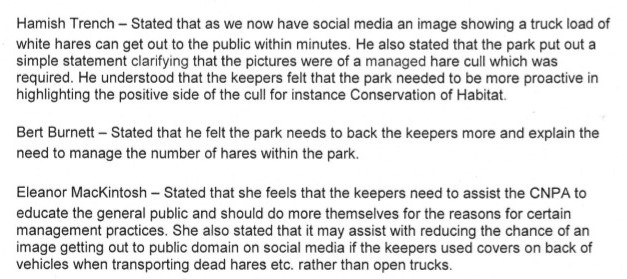
Last week we blogged (here) about an extraordinary comment attributed to Eleanor Mackintosh, a Board member of the Cairngorms National Park Authority (CNPA). During a discussion with the Scottish Gamekeepers’ Association on 29 September 2016, Ms Mackintosh apparently suggested they use covers on the back of vehicles to hide the evidence of mountain hare culls rather than risk photographs being taken of piles of dead hares being transported on open-backed vehicles:

Naturally, most people would expect the CNPA to be clamping down on the mass slaughter of mountain hares on grouse moors within the National Park, not suggesting to gamekeepers that they instead just hide the evidence, so Ms Mackintosh’s comments didn’t go down too well. One of our blog readers, Andy Holden, wrote to Ms Mackintosh to express his disgust and she duly replied as follows:

Dear Mr Holden

Thank you for your recent email in relation to mountain hares in the Cairngorms National Park.

It is my opinion that what I said has been taken completely out of context I am very clear on, and whole heartedly support the CNPA current position on hare culls.

The Cairngorms National Park Authority is clear in its position on mountain hare culling. The CNPA does not support ‘hiding’ in any way the number of hares culled. On the contrary, our advice to land managers is to be more open about the number of hares culled. We recognise that culling hares is legal and that culls can be undertaken for a number of reasons. We do not support large scale culling and endorse the call for restraint made by SNH. We support the ongoing work to develop best practice in counting mountain hare numbers being developed by the James Hutton Institute and GWCT. In the meantime our advice to land managers is to set out clearly why culls are undertaken, share information on the numbers of hares culled and where possible to count hare numbers consistently while waiting for the recommendations on counting methodology from the current research.

The information you refer to is a note by the Scottish Gamekeepers Association of a meeting with CNPA to discuss a number of aspects of the recent National Park Partnership Plan consultation.

Regards

Eleanor Mackintosh

END

Interesting. So Ms Mackintosh doesn’t deny that she made the suggestion, but instead she claims her remarks were taken “completely out of context“. Really? By whom? Not by us – we posted the notes from the CNPA/SGA meeting exactly as they were presented in the FoI response (see photo above).

Perhaps she meant that the notes from the meeting (prepared by the SGA) hadn’t been written up accurately and had reported her comments ‘out of context’? That’s entirely possible, of course, but in this case it seems unlikely.

Why would we say that seems unlikely? Well, because the notes from the meeting, as prepared by the SGA, were emailed to the CNPA on 4 October 2016. The recipients of that email included Will Boyd Wallis (CNPA), Hamish Trench (CNPA), Mike Cottam (CNPA) and someone listed as ‘Eleanor’. Will, Hamish and Mike had all attended the meeting with the SGA, so we assume the person named as ‘Eleanor’ was Eleanor Mackintosh, who was also present at that meeting.

Later that same day, Hamish Trench (CNPA) sent an email back to the SGA (also copied to Will, Mike and ‘Eleanor’) acknowledging receipt of the notes but not accepting them as an accurate reflection of what was said during the meeting by him, Will and Mike. Hamish offered to amend the notes before they were circulated more widely.

On 6 October, Will Boyd Wallis (CNPA) sent an amended version of the notes back to the SGA, and copied in Hamish, Mike and ‘Eleanor’. In this amended version, Will had made several editorial changes to some of the comments, but did not amend the comments attributed to Eleanor. Presumably, as ‘Eleanor’ had been in receipt of all this correspondence, if she thought her comments had been placed ‘completely out of context’ here was the perfect opportunity for her to say so.

She didn’t.

You can read the correspondence between the SGA and CNPA here: cnpa-sga-mtg-29-sept-2016-amendment-of-notes

Now, maybe Ms Mackintosh was away, maybe her internet was down, maybe she didn’t see the notes until they were published on this blog.

Or, maybe, she did suggest that gamekeepers should hide dead mountain hares under covers and now she’s in the middle of a shit storm and she’s looking for a way out.

Statement from Wildlife Estates Scotland on membership status of Newlands Estate

Those of you who’ve been following the long drawn-out saga of prosecutions relating to the wildlife crime that took place on Newlands Estate, Dumfriesshire in 2015 will know that we’ve been asking questions of various organisations associated with this estate.

One of those questions has been about the membership status of the Newlands Estate in the ‘Wildlife Estates Scotland (WES)’ scheme, administered by Scottish Land & Estates. Since Newlands Estate gamekeeper Billy Dick’s conviction (for killing a buzzard) was upheld in July this year, we’ve asked this:

‘Will the Newlands Estate’s accredited membership of Wildlife Estates Scotland (WES) now be revoked? The conditions of membership of this scheme include: “the requirements to maintain best practice standards of animal welfare and comply with all legal requirements and relevant Scottish codes of practice”. At the time of Mr Dick’s conviction, a spokesperson for WES said the Newlands Estate’s membership and accreditation of WES had been ‘voluntarily suspended’ pending the outcome of legal proceedings. Well, now the gamekeeper’s criminal conviction for wildlife offences has been upheld, how about answering the question?’

Four months on, and thanks to blog readers for writing to WES, the following statement has appeared on the WES website this morning:

wes-statement-newlands

So, Newlands Estate is still a member of WES, albeit in a suspended state. Presumably, WES is waiting to find out whether the allegation of vicarious liability is proven against landowner Andrew Duncan during forthcoming legal proceedings.

That’s an interesting position for WES to take. A wildlife crime did take place on Newlands Estate and a Newlands Estate employee was convicted for it. Why isn’t that sufficient cause for WES to expel Newlands Estate? Two conditions of WES membership were clearly breached (“the requirements to maintain best practice standards of animal welfare and comply with all legal requirements and relevant Scottish codes of practice“). Whether Mr Duncan is subsequently convicted or acquitted of vicarious liability is irrelevant and will not erase these facts.

Let’s imagine, for example, that Mr Duncan is exonerated and WES decides to lift the suspension on membership. WES will still have a wildlife crime estate on its membership list. How does that ‘protect the reputation of its membership, as well as the integrity of accreditation itself’? Here’s a hint, WES: IT DOESN’T.

Other questions we’ve been asking since Newlands Estate gamekeeper Billy Dick’s failed appeal in July 2016 are yet to be answered:

  1. Is/was criminal gamekeeper William (Billy) Dick a member of the Scottish Gamekeepers’ Association? The SGA refused to comment on Mr Dick’s membership status at the time, saying they ‘wanted to wait until the legal process had concluded’. Well, now Mr Dick’s criminal conviction for wildlife offences has been upheld, how about answering the question? Emails to: info@scottishgamekeepers.co.uk
  2. Will Scottish Land & Estates now expel the Newlands Estate from the ranks of SLE membership? SLE said at the time that Newlands Estate’s membership of SLE had been ‘voluntarily suspended’ pending on-going legal proceedings. Well, now the gamekeeper’s criminal conviction for wildlife offences has been upheld, how about answering the question? Emails to: info@scottishlandandestates.co.uk