Ross-shire Massacre: “The worst 2 weeks of my life”, says red kite officer

Brian EtheridgeBrian Etheridge should have been celebrating this week; it’s the 19th anniversary of his work as the RSPB’s Red Kite Officer in the Black Isle area. Instead, he’s witnessed one of the worst mass poisoning incidents in recent times: 12 red kites and 4 buzzards found to date. The 12 red kite victims were birds that he’s known for years.

Brian said: “This has been the worst two weeks of my life. I have worked with all of the birds – each one was ringed and tagged by me. I was there at the very beginning when they were only a few weeks old and I was there at the end when I went to collect their bodies. It’s a huge mix of emotions; I’ve gone from being very, very angry to extremely sad. Some of these birds I’ve known very well and for a very long time.”

One of the dead birds was a 16-year-old female that Brian first tagged in 1998. She had been breeding in the Black Isle for 14 years and had raised between 25 to 30 young – one of which, an eight-year-old female, was also among the dead.

Brian said: “I’ve gone to her nest every year since she first bred back in 2000 and I’ve climbed up to her nest so she probably knew me quite well. She was like an old friend and a very familiar sight so I will miss her this year. She had mated with one male for 13 years and he was so faithful. He has been sitting on their nest, waiting for her to come back.

Something like this can just wipe out so many birds and so many years of work. This is by far the worst example I’ve ever witnessed. There has been a huge reaction from the public. The community has really taken these birds to its heart. This was the very first reintroduction programme in Scotland so most people are very proud of their red kites.”

Many of the poisoned birds will have been regular visitors at the nearby Tollie Red Kite Visitor Centre – an initiative between RSPB Scotland the Brahan Estate – where the general public can go and watch the daily feeding of the kites. Some of the volunteers from the project have also been talking about their reaction to this latest atrocity – see here.

Previous blogs on the Ross-shire Massacre here, here, here, here and here.

Ross-shire Massacre: death toll rises to 16

A total of 12 red kites and four buzzards have now been retrieved in the Ross-shire Massacre – one of the worst mass poisoning incidents to have been uncovered in recent years.

The victims have all been recovered from a very small area near Conon Bridge in the Highlands. They include breeding adults and juvenile birds – the impact of these deaths on the already-struggling Black Isle red kite population will be significant.

This mass poisoning comes on the back of the news that reported poisoning incidents in Scotland in 2013 doubled from 2012 figures. Other types of persecution were also reported, including shooting, trapping, nest-tree felling and birds that were trapped and then beaten to death.

We await the Scottish Government’s response to this latest outrage with great interest.

The RSPB has put up a £5K reward for information leading to a successful conviction.

Previous blogs on the Ross-shire Massacre here, here, here and here.

Photo of red kites at Gigrin Farm, Wales, by David Bowman.


Death toll rises again in Ross-shire massacre as £5k reward offered

The death toll in what we are calling the Ross-shire Massacre has risen again today with the discovery of another poisoned raptor. Today’s dead red kite is the 10th to be discovered in the last fortnight in a small area in Conon Bridge, along with four buzzards, bringing the total found to date to fourteen.

RSPB Scotland is offering a £5,000 reward for any information that leads to a successful conviction. Their money is probably quite safe.

Chairman of the Scottish Gamekeepers’ Association, Alex Hogg, has put out the following statement:

The discovery of so many birds in one area is unprecedented and alarming“.

He’s either deliberately lying to make out that the mass killing of raptors in one area has never happened before or he has a very short memory:

In 2004, a gamekeeper on the Barns Estate in the Scottish Borders was convicted of poisoning 20 raptors (18 buzzards, 1 goshawk and 1 tawny owl). 25 dead raptors had been discovered but five were too badly decomposed to establish their cause of death (see here).

In 2013, gamekeeper Colin Burne was convicted of killing seven buzzards at the Whinfell Plantation, Penrith, Cumbria. A total of 12 dead birds had been found but five were too badly decomposed to establish their cause of death (see here).

This year, there is an on-going court case against a gamekeeper from the Stody Estate, Norfolk, after the discovery of 16 dead raptors (14 buzzards, 1 sparrowhawk and 1 tawny owl). Allen Lambert has admitted to storing two banned pesticides but he has denied killing the raptors. His trial begins in May (see here).

So far from this current incident being ‘unprecedented’, there are examples dating from 10 years ago right up to the present day of multiple dead raptors being found in a single incident – a telling indictment of just how little progress has been made in addressing this disgusting crime.

There’s also a statement on the SGA facebook page that includes this:

Articles in the Telegraph and Herald this week indicated, through research, that there is little or no shooting interests in the area” [Conon Bridge, Ross-shire, where the latest atrocity is gradually being revealed].

That’s also inaccurate. There may not be a driven grouse moor in the immediate area but there certainly are shooting interests…

Photo of red kites at Gigrin Farm, Wales, by David Bowman.

Previous blogs on the Ross-shire Massacre here, here and here.

Ross-shire raptor death toll rises to 13….and counting

In what looks increasingly to be a mass poisoning incident, the number of dead raptors found in the Conon Bridge /Muir of Ord area has now reached 13, including at least 9 red kites, according to RSPB Scotland’s Director.

It’s not over by a long way…

Previous blogs here and here

UPDATE 1300hrs: Police Scotland has confirmed the first six of these birds to be tested (so far) have come back as positive for having been poisoned.


Raptor poisoning incidents doubled in 2013

The Partnership for Action against Wildlife Crime (PAW Scotland) has published the latest ‘official’ maps showing the distribution of reported raptor persecution incidents in Scotland during 2013.

Remember 2013? That was the government’s much heralded Year of Natural Scotland.

How disgraceful then, to see that reported incidents of raptor poisoning in 2013 doubled from the previous year. The victims this time around included a golden eagle, a red kite and four buzzards. And these were just the ones that were discovered – how many went undiscovered?

Not only did the reported poisoning incidents double, but other methods of illegal persecution were also reported, including disturbance, nest destruction, shooting and trapping, and these incidents numbered nearly three times the number of reported poisoning incidents.

It is clear, once again, that despite all the claims to the contrary, the illegal persecution of birds of prey in Scotland is still taking place with impunity. This has been vividly illustrated by the unfolding news from Ross-shire this week that at least 11 raptors have been found dead, including at least 8 red kites, all strongly suspected to be the victims of illegal poisoning. We fully expect this figure to rise…

This year, for the first time, the maps are now not just restricted to showing reported poisoning incidents; also included are the other types of persecution. This approach has to be applauded, especially as there is a real concern that the raptor killers are changing tactics in an attempt to show that the game-shooting industry is cleaning up its act (i.e. if they can keep poisoning figures low, they can point to this as an indication that persecution is dropping because they know that poisoning is the only method that is regularly mapped and monitored). Not any more, so well done to the Environment Minister for ensuring the other methods are also now ‘officially’ mapped and monitored.

However, the new and improved maps are still not showing the full picture.

For example, the recorded incidents shown on the new maps are limited to those where a dead or dying raptor has also been discovered:

The maps DO NOT show incidents where other birds/animals have been found poisoned with banned substances that have been categorised by SASA as ‘abuse’. Why not?

The maps DO NOT show incidents where an illegally-set trap has been found without an injured or dead raptor in/on it. Why not?

The maps DO NOT show the locations where satellite-tracked raptors have ‘mysteriously disappeared’ without trace. Why not?

But most significantly of all, the maps DO NOT show incidents where poisoned baits have been discovered, and have been categorised by SASA as ‘abuse’, unless a poisoned raptor was also found at the scene. Why not?

In our view, this is the most serious of all the omissions. The Scottish Government explains this away by saying that if there isn’t a dead/dying raptor at the scene then the discovery of poisoned baits can’t be classified as ‘raptor persecution’. Eh? Everybody knows that these poisons are routinely used to target birds of prey. To deliberately leave them off these poisoning maps is astonishing. In whose interest is it to exclude these incidents?

A good example of this sort of incident came last year when a massive stash of pre-prepared poisoned baits was found inside two game bags in woodland next to a grouse moor on Leadhills estate. Leadhills has a long and sorry history of poisoned baits and poisoned raptors having been found there, dating back several decades. A Leadhills gamekeeper was convicted in 2010 for er, laying out a poisoned bait on the moor. There were 36 baits in total in the 2013 stash; chopped up into bite-size pieces and sprinkled with Carbofuran. What on earth does the Government think those baits were going to be used for if not for poisoning raptors?

We think this particular stash of pre-prepared poisoned baits is the largest ever discovered in Scotland. The Leadhills baits are not included in the latest maps. Why? Because no poisoned raptors were found at the scene. Probably because the police failed to conduct any level of search when they turned up, in marked vehicles, to collect the baits.

If we, the BBC and Project Raptor had not reported on that incident, nobody would be any the wiser to it today. The police failed to issue a press release and now we find that the incident has been excluded from the ‘official’ poisoning maps. There’s now no doubt at all that the incident will also be excluded from the Scottish Government’s ‘official’ raptor persecution report that they’ll publish later this year.

‘Discovery of a massive stash of poisoned baits on a sporting estate? Where? When? Nope, we can’t find it in the ‘official’ statistics, you must be mistaken, it can’t have happened’.

Compare this approach with that used by the government/police to report on drug seizures. They regularly report on the recovery of big stashes of heroin, whether the heroin has actually found its way onto the street or not. They don’t say, ‘Oh, we can’t include that in our official stats because we didn’t find a junkie laying next to the stash”, do they? No, it all gets recorded as part of their official drug crimes statistics. What’s so different about the discovery of big stashes of banned poisons that are known to be used to illegally target birds of prey?

So, all in all then, situation normal in Scotland. Reported poisoning incidents have doubled from the previous year, other methods of killing raptors are being utilised with disturbing regularity, the game-shooting industry is still trying to spin the story into something positive (Doug McAdam is quoted in the Scotsman article as saying: ‘Good progress has been made on reducing illegal poisoning incidents’!!), the Scottish Government is still trying to spin the story into something positive (by comparing the 2013 figures with  figures from 2009 [the highest reported poisoning figures in 20 years] rather than focusing on the doubling of reported incidents from 2012 to 2013) and the ‘official’ statistics are still not showing the full scale of the problem.

See you all same place, same time, next year, when, judging by the recent Ross-shire news, once again we’ll be reporting that raptor poisoning incidents have increased over the last year. The only surprise will be by how much.

To view the ‘official’ maps on the PAW Scotland website see here.

Article in the Scotsman ‘Birds of prey spared poison – to be stamped to death’ – see here.

Article on BBC website ‘Number of birds of prey poisoned in Scotland doubles’ – see here.

Article on STV news ‘Rise in number of birds of prey illegally poisoned ‘very worrying” – see here.

Ross-shire raptor death toll rises to 11….and counting

The incident we blogged about two days ago concerning the discovery of five dead red kites and two buzzards in Ross-shire, north Scotland (see here) has just got a lot worse.

The current figure is 11 corpses, according to the BBC, and we suspect more may yet to be found.

We know that at least eight of these corpses are red kites.

This is the worst single persecution incident to have been discovered for several years. Poisoning is strongly suspected.

More on this soon.

Red kite photo by Mali Halls.


Six dead raptors found in suspicious circumstances in Ross-shire

Five red kites and a buzzard have been found dead in suspicious circumstances in Ross-shire in the last week.

The birds were reportedly found at different but nearby locations in the Conon Bridge and Muir of Ord area between 18-24 March 2014.

Police Scotland say it is currently unclear how the birds died but it was likely the deaths involved “some form of criminality”.

A local source has told us that poisoning is suspected, although toxicology results are not yet available to confirm this.

This is a surprisingly fast response from Police Scotland. Anyone with information about these dead birds is encouraged to contact the police on Tel: 101.

BBC news article here

Photo of a red kite by Mali Halls

SGA donor owns estate ‘among the worst in Scotland for wildlife crime’

SGA donors 2014 EdradynateThe Scottish Gamekeepers’ Association publishes a quarterly magazine for its members. The latest edition (winter/spring 2014) includes a list of recent donors. We were intrigued to see the following entry:

MDCC Campbell Edradynate Estate (Donation: £1720)

Could this be Michael David Colin Craven Campbell, who resides in Hampshire but owns Edradynate Estate? So why would this entry be intriguing? Why wouldn’t they accept funding from Mr Campbell, who was awarded an MBE in 2008 for services to charity, was appointed by the Queen to become High Sheriff of Hampshire 2008-2009 and has an entry in Debretts? No reason whatsoever to reject a generous donation from such an upstanding and distinguished gentleman whose Debrett’s entry lists ‘shooting’ and ‘escaping to Scotland’ amongst his recreational activities. Right?

Edradynate Estate near Aberfeldy in Perthshire was described in 2004 by the then RSPB Investigations Officer Dave Dick as being “among the worst in Scotland for wildlife crime” (see here).

In January 2005, the then Police Wildlife Crime officer for Tayside Police, Alan Stewart, described Edradynate Estate as follows:

Edradynate Estate, which is owned by an absentee landlord from Hampshire, has probably the worst record in Scotland for poisoning incidents, going back more than a decade. In 14 separate incidents since 1998, 16 poisoned victims (9 buzzards, 1 cat, 1 tawny owl, 2 sparrowhawks, 1 common gull, 1 polecat and 1 carrion crow) and 12 poisoned baits (rabbits, wood pigeons and a pheasant) have been found, with traces of the pesticides Mevinphos, Carbofuran and Alphachloralose” (see here, page 3).

These two prominent wildlife crime investigators were commenting following the collapse of a case against two gamekeepers from Edradynate Estate. In 2002, the Head gamekeeper and an under keeper had been charged with nine offences relating to the alleged use of poisoned baits and bird cruelty, including the use of spring traps. These charges followed a police raid on Edradynate Estate where three rabbit baits, a dead buzzard and a dead crow had been found. Lab tests detected Carbofuran and Alphachloralose. A game bag and a knife seized during the search showed traces of these poisons when swabbed.

On 22 July 2004, two years after the original arrests and 13 court hearings later, the Fiscal dropped the case following a series of adjournments called by both the defence and the prosecution. A Crown Office spokeswoman admitted that the time taken to prepare the case for trial had been a major factor in the decision to drop the case.

The 2002 raid was the second police search on Edradynate Estate. In Alan Stewart’s book, Wildlife Detective, he writes the following:

This would be our second major search of the estate under warrant and we hoped this time to find sufficient evidence to bring to an end the catalogue of poisoned baits and victims that had turned up on the estate with the worst record by far not just in Tayside but in Scotland”.

The crimes didn’t end there.
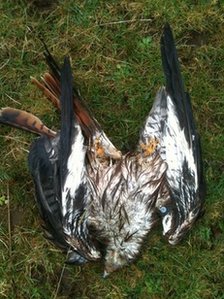
a dead red kiteIn July 2010 a poisoned red kite was discovered in the area (see here). According to Tayside Police, ‘five buzzards and a tawny owl met with the same fate in the same area in the last year’.

In September 2010, an un-named gamekeeper from Edradynate Estate, a self-proclaimed member of the SGA, talked to the Courier about the discovery of the poisoned red kite:

As a member of the Scottish Gamekeepers’ Association, I am against anything illegal. Anybody who does this should be jailed because it’s not on and I have never done anything like this in my life. To find a poisoned bird on my ground is just wrong because I don’t use poison and wouldn’t know how to.

There is something funny about this and I think someone else has killed this bird and planted it on my estate. Why they have done that, I don’t know. We have never seen a red kite, living or dead, in the Strathtay valley so I don’t know where this has come from. The laird is so upset about it, as am I, because it besmirches our reputation and it’s reflecting badly on me.

I am a professional person and I have worked hard for all these years on the estate and never had anything against my name. This is causing me a lot of stress and strain because I don’t know what is going to happen next. I’ve never been involved in anything like this before.

It’s very reassuring to know that I have the full support of the laird because this job is something I love doing.” (see here).

In March 2011 two poisoned buzzards and two poisoned crows were discovered, along with two poisoned pheasant baits. Carbofuran was detected this time. Tayside Police conducted another search (their third on this estate?) and it was reported that a 62 year old man was taken in for questioning but was released pending further enquiries (see here). We’re not aware of any other media statements about this incident.

In September 2013, the Crown deserted a case against Edradynate Estate’s Head gamekeeper on alleged firearms and explosives charges. The reason for this desertion was not made public (see here).

Nobody has ever been convicted for any of the alleged offences on Edradynate Estate.

Alan Stewart wrote about a 1995 incident on Edradynate Estate in his Wildlife Detective book, concerning the discovery of a poisoned cat belonging to the occupier of a cottage on Edradynate Estate. A search in a nearby wood had recovered a poisoned pheasant bait and a poisoned tawny owl – later all found to contain traces of Mevinphos. A further search had recovered two wood pigeon baits and a poisoned sparrowhawk, all found inside a pheasant pen. They all contained traces of Mevinphos. Stewart wrote:

I visited a number of residents on the estate and was absolutely shocked at what I learned. According to the interviews I carried out, my suspect had, at various times, set up a gun with a string attached to the trigger to pepper with wheat any intruder who brushed against the string. He had allegedly driven into Perth to the workplace of a person who lived on the estate, to remonstrate with him after a pheasant had been knocked down and killed by the person’s car. He had allegedly poisoned a tenant farmer’s collie, and also shot dead the dog of a visitor to a neighbouring estate after the dog had run off and was being pursued by its owner. I was taken aback by the vitriol these people had for my suspect but their hatred was tempered with fear and all interviews were ‘strictly off the record’. All those I spoke to were in tied houses and none wanted to become involved in a prosecution. News of my investigation had travelled fast and out of the blue I received a telephone call from a former factor for the estate. He had anticipated the reluctance of those who could potentially help, wished me the best of luck, but doubted that my enquiry would ever result in court proceedings”.

A prosecution in this case was attempted but the case was deserted after it became time-barred due to a lack of available evidence to link the individual suspect to the alleged offences.

Alan Stewart wrote:

The following week [just after the case had been deserted] I learned that another employee had borrowed the suspect’s Land Rover but it had broken down. In his search for tools to repair it, he had lifted up the passenger seat to search the compartment underneath as the most likely place for tools to be stored. Instead of tools there were three dead sparrowhawks. I am sure this would have clinched the case but naturally the employee wanted to keep his job and his house and the information came to me via a third party”.

Stewart wrote about another incident in 2001 – the discovery of a poisoned buzzard on the estate that had been killed by Carbofuran:

The usual enquiries were made and the usual suspect interviewed, but his involvement could not be established……..In the investigations on Edradynate Estate, we could prove beyond reasonable doubt that baits and dead birds and animals were being found with monotonous regularity on the estate. We could prove beyond reasonable doubt that the baits were laced with particular pesticides and that the victims had been poisoned after having consumed part of these baits. What we were so far unable to prove was who set the baits”.

Wildlife protection laws have had little impact on driven grouse moors

Fearnan Angus Glens Dec 2013There’s an excellent article in the Scotsman today, written by Duncan Orr-Ewing, Head of Species and Land Management at RSPB Scotland.
He discusses the failure of wildlife protection laws to aid the recovery of several raptor species, including the hen harrier, golden eagle, red kite and peregrine, on land managed for driven grouse shooting.

Read the article here.

On a related issue, Mark Avery’s blog today is all about the e-petition for the licensing of grouse moors and gamekeepers (which ends today) – and hints at the growing frustration of those who have been relying on the authorities to ‘sort out’ the illegal persecution of raptors on driven grouse moors. There’s a particularly pertinent comment from Pete Cosgrove:

Has anyone assessed what other criminal enterprises get ignored by Government in this kind of way?

There’s a definite ‘something’ in the air…


Red kite shot dead in West Yorkshire – police appeal 4 months later

Red Kite shot N Yorks Oct 2013Police are appealing for information four months after the discovery of a dead red kite in West Yorkshire.

The one year old bird was found by a footpath on the River Wharfe between Wetherby and Harewood last October. It had been shot.

The news about this bird’s death emerged via the BBC Look North (Yorkshire) Facebook page a couple of days ago (as highlighted on the Birders Against Wildlife Crime Facebook page).

We’ve looked elsewhere for a press release but can’t find anything, either from October or now, including on the West Yorks Police website and police local community news sites.

What’s the point of waiting for four months before appealing for information? Why, after all the reassurances that ‘wildlife crime is a police priority’, are we still seeing these poor responses?

West Yorks Police have previously been applauded for their reaction to suspected raptor persecution in their area, and deservedly so (see here).