Raeshaw Estate, in the Scottish Borders, has lost its appeal against its latest three-year General Licence restriction.
The restriction was imposed by NatureScot on 10 February 2026 in relation to the disappearance of Golden Eagle ‘Merrick’, who Police believe was ‘shot & killed‘ in October 2023.
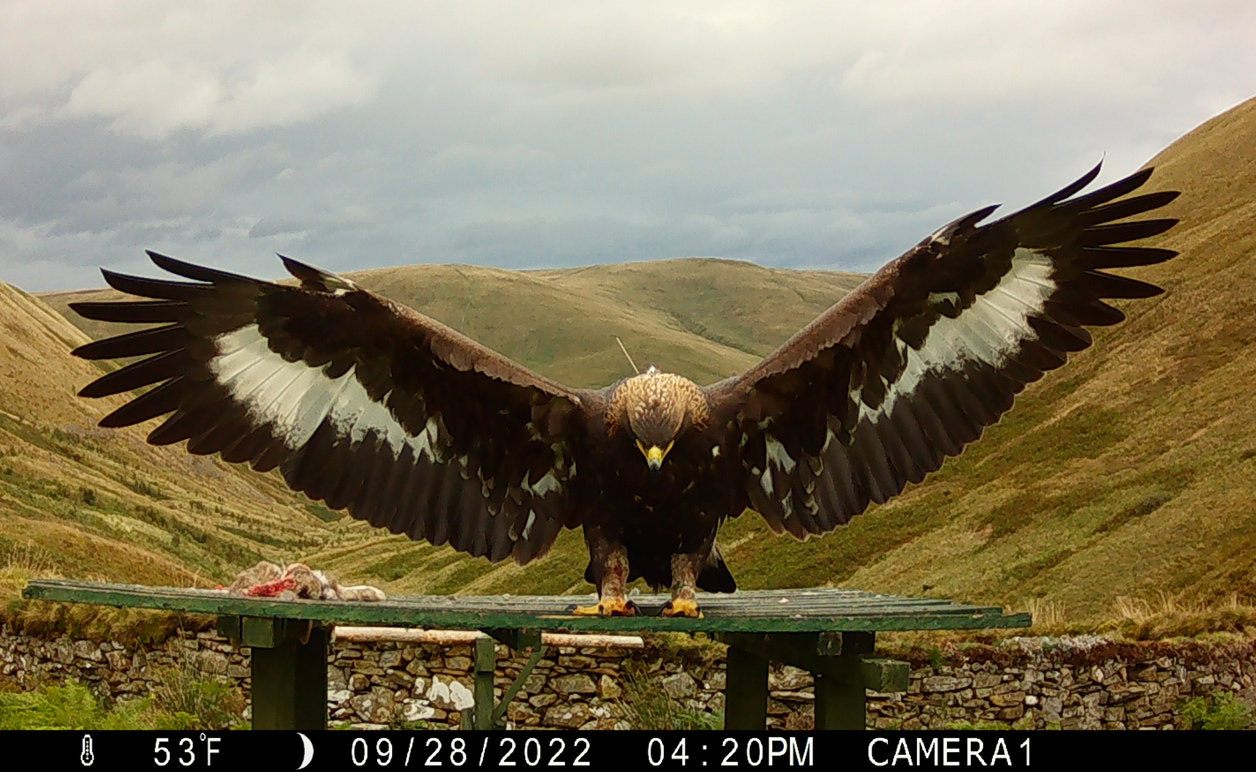
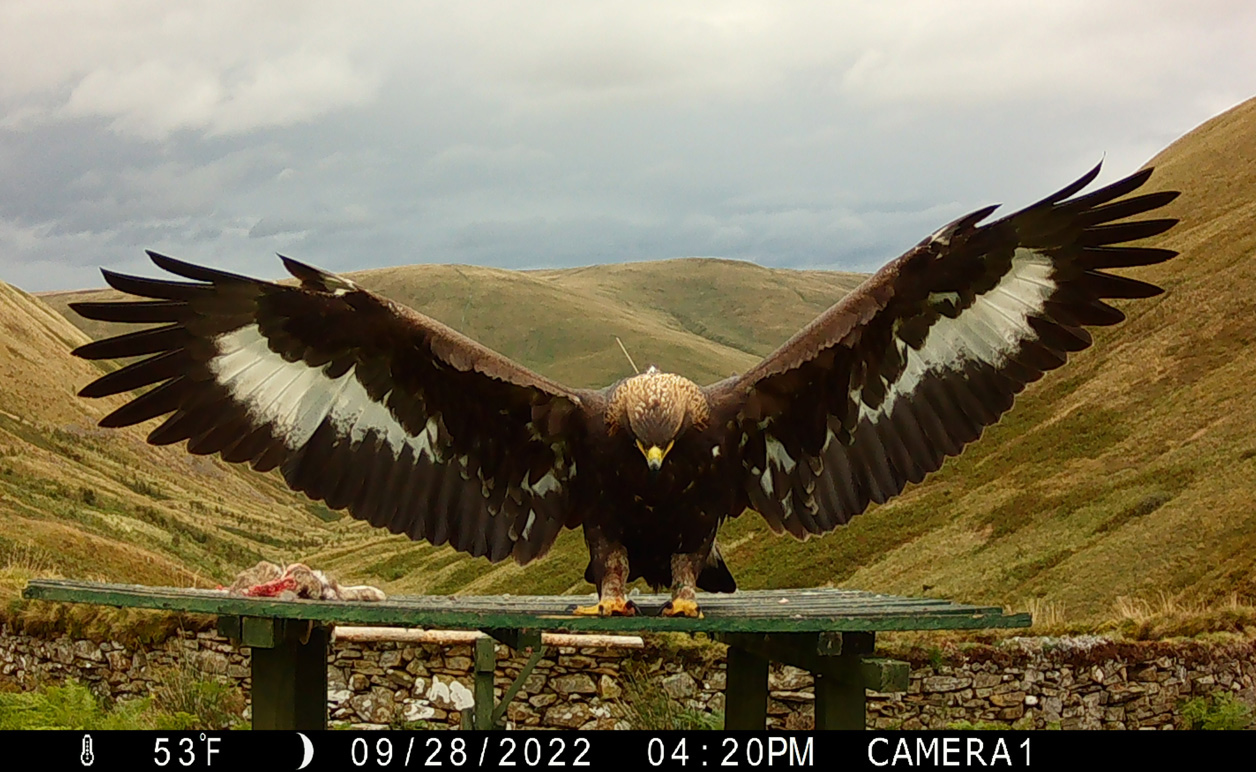
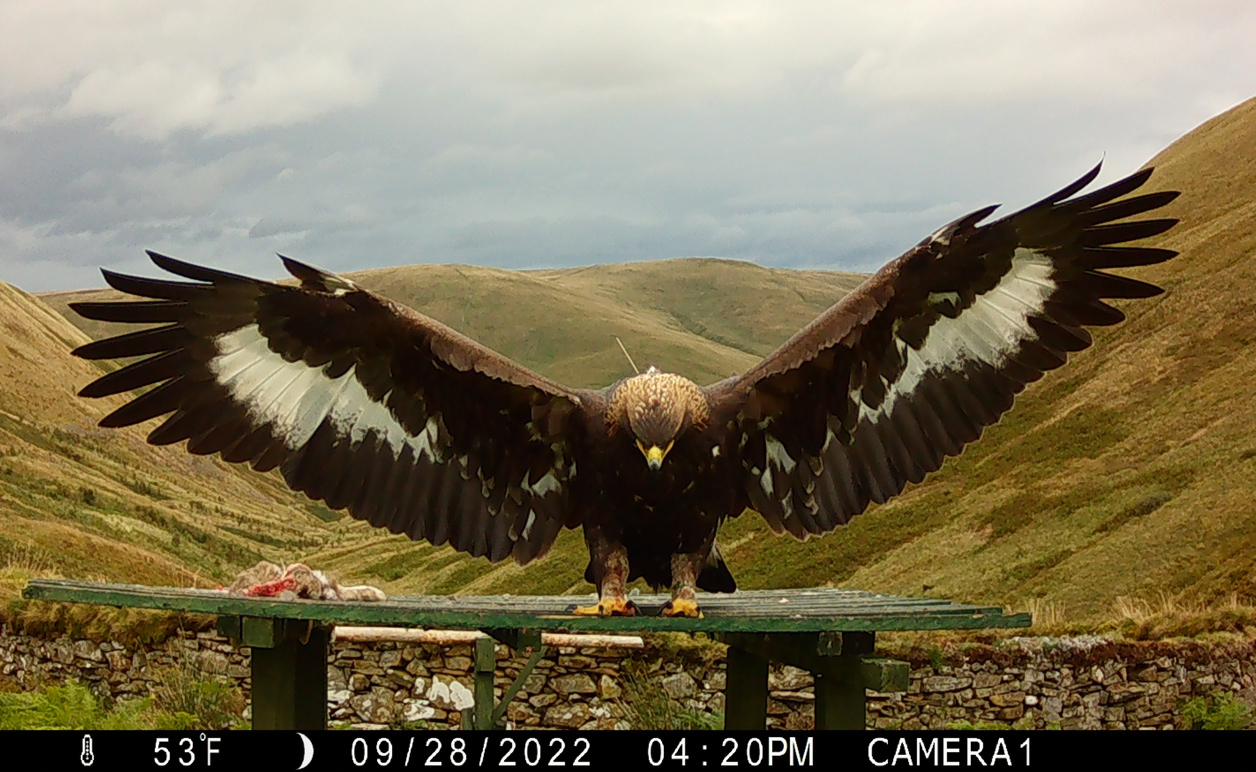
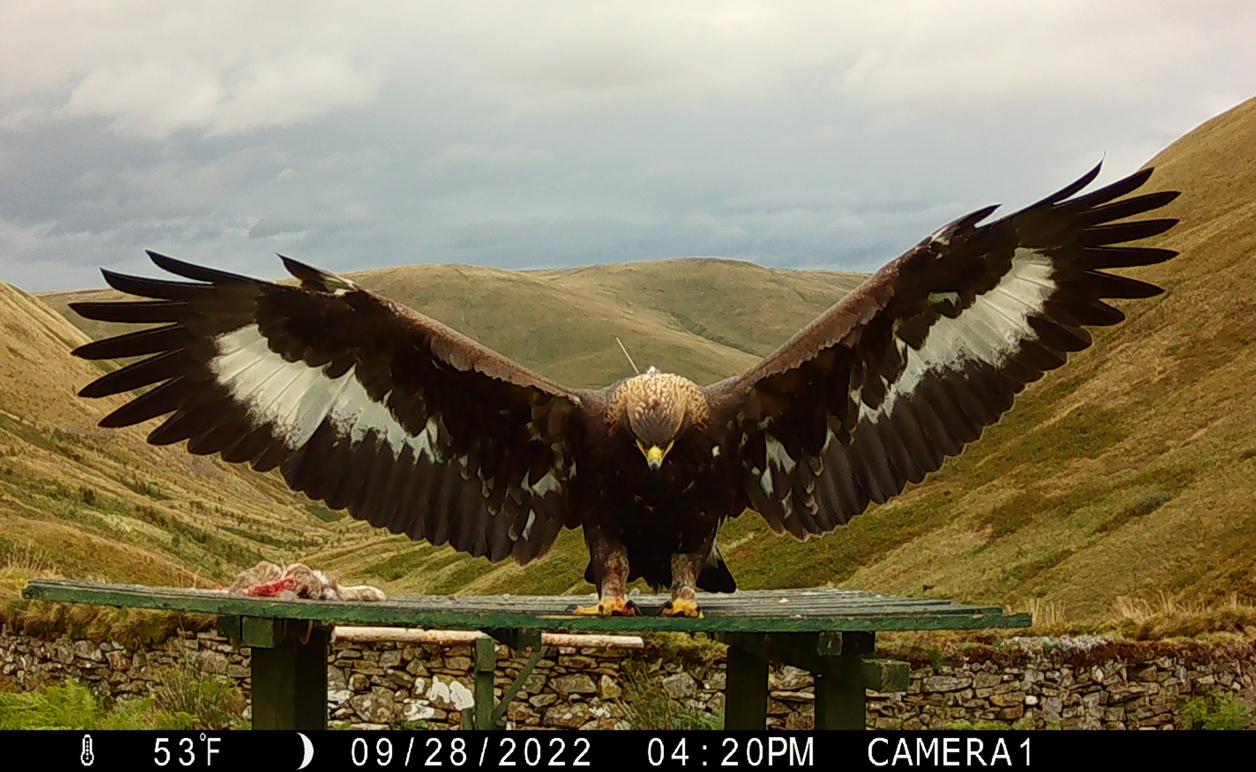
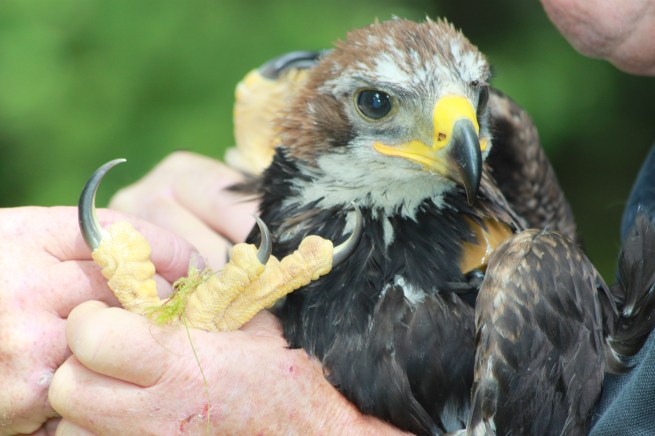
Camera trap photo of golden eagle Merrick, from South Scotland Golden Eagle Project
Regular blog readers will know that General Licence restrictions, which have been available to NatureScot since 2014, are based on the civil burden of proof and are issued when NatureScot receives information from Police Scotland about wildlife crimes but where there is insufficient evidence to identify an individual offender for prosecution. (GL restrictions can also be imposed on estates where gamekeepers have been convicted of wildlife crimes).
General Licence restrictions do not prevent an estate from game-shooting, nor do they prevent an estate from carrying out [lawful] predator control – this can still be undertaken if the estate applies for an ‘individual licence’ which may restrict the amount of predator control, the estate may be subject to compliance spot checks, and the licence holder must provide NatureScot with licence returns (i.e. indicate how many birds were killed, where, and when etc).
General Licence restrictions are not perfect as an effective sanction – they are nowhere near, as I’ve written about many times before (e.g. see here and links within). They do, however, work as a ‘reputational driver’, although in some cases reputation is apparently not an issue of concern.
Regular blog readers will also know that NatureScot had been considering this particular decision for Raeshaw Estate since April 2024 (see here) when it first received information from Police Scotland about the shooting/killing of Merrick in October 2023. That’s almost two years of procrastination (e.g. see here, here).
When the decision was finally made by NatureScot to impose the three-year GL restriction, starting on 10 February 2026, a spokesperson for Raeshaw Estate, believed to be under the management of a company owned by ‘grouse moor guru’ Mark Osborne, was quoted the following day in various newspapers as saying the restriction was “wholly unjustified” and that the estate intended to appeal (see here).
Under NatureScot’s Framework for GL restrictions, Raeshaw Estate had to submit its appeal, in writing, within 14 days of the notification. That submission would have the effect of suspending the GL restriction, and given that the formal notification of the restriction had been removed from NatureScot’s website by 3 March 2026, it was assumed (and later confirmed) that Raeshaw Estate had indeed submitted an appeal.
Today, I noticed that the formal notification of the restriction has been put back on to NatureScot’s website, which indicates that the appeal has been considered, and formally rejected.
It’s also apparent that the representatives of neighbouring Watherston Wood also lodged an appeal against its three-year restriction, which has also been rejected. Although as far as I’m aware, the killing of so-called ‘pest’ bird species doesn’t take place in the wood anyway so perhaps the appeal was made as a matter of principle rather than an attempt to reinstate the use of General Licences 1, 2 and 3.
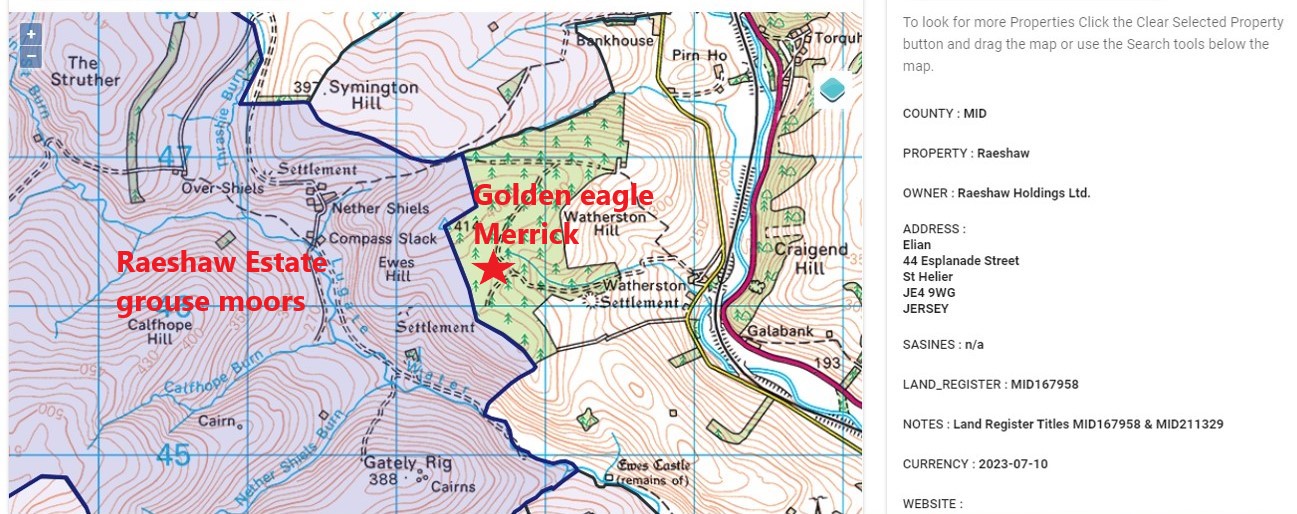
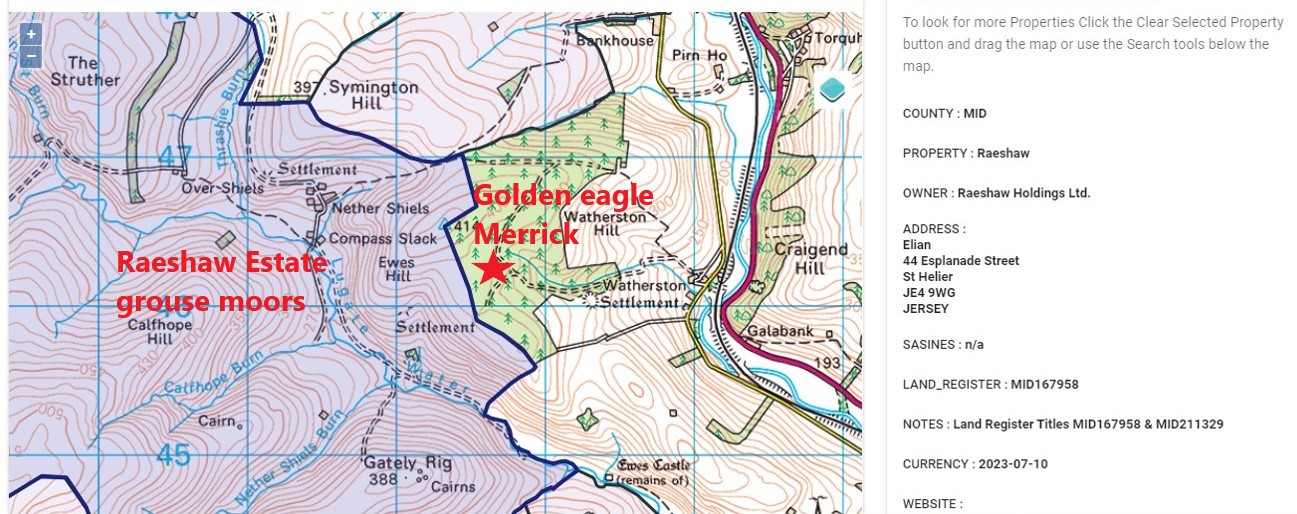
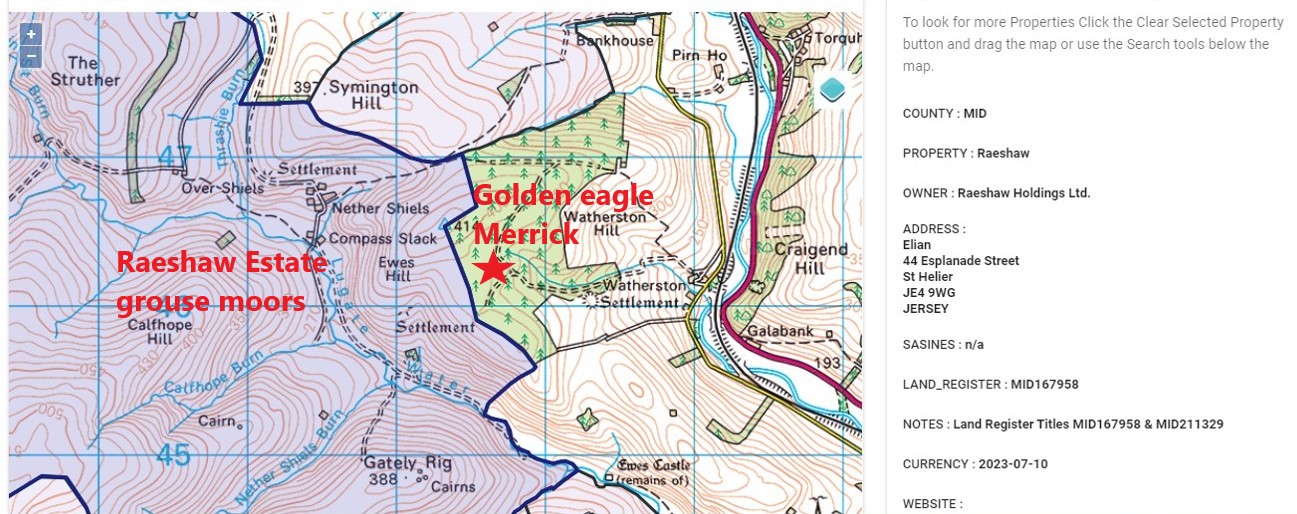
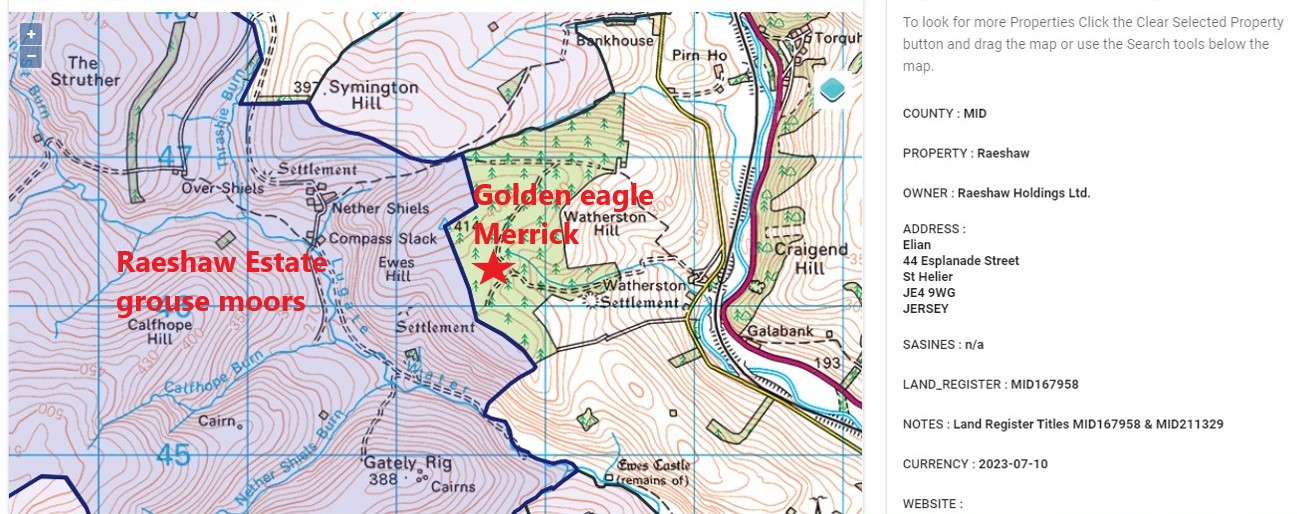
Screen grab from Who Owns Scotland website, annotated by RPUK, showing the proximity of Merrick’s last known location and the Raeshaw Estate (shaded in blue)
This is an unprecedented second General Licence restriction for Raeshaw Estate. It was one of the first estates to receive a General Licence restriction in 2015, based on clear police evidence that wildlife crimes had been committed although, just as with the latest GL restriction, there was insufficient evidence to prosecute any individual (see here).
Representatives of Raeshaw Estate applied for a judicial review of NatureScot’s 2015 decision but the Court of Session upheld NatureScot’s procedures and ruled the process was lawful (here).
Whilst under that first General Licence restriction, Raeshaw Estate applied for, and was granted, a number of ‘individual licences’ so the gamekeepers could continue to kill certain species as part of the estate’s grouse moor management plan (quite a lot of birds were lawfully killed – see here).
However, in 2017 the individual licence was revoked by NatureScot due to non-compliance issues and more suspected wildlife crime offences (see here). Not that the revocation made any difference whatsoever, as the estate could simply apply for another individual licence!
Inexplicably to many of us, NatureScot did not extend the length of the original General Licence restriction, which it had the authority to do, in light of the non-compliance issues on the estate’s individual licence (see here).
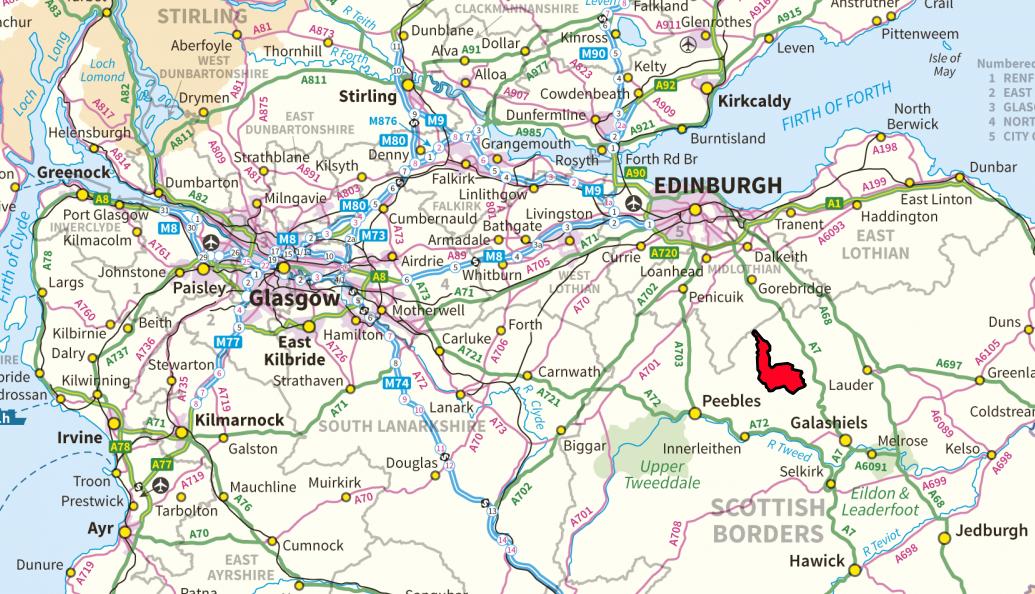
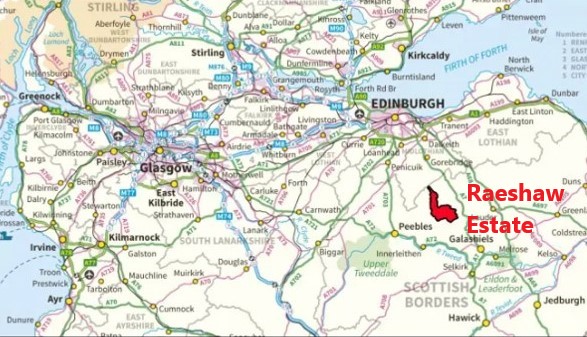
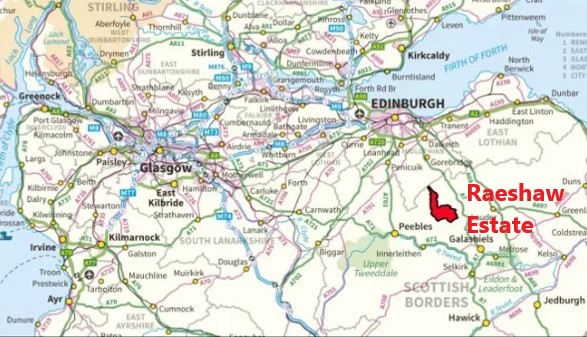
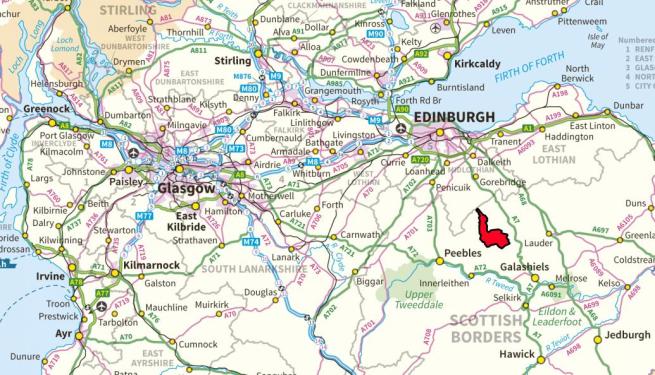
Raeshaw Estate in the Scottish borders. Data sourced from Who Owns Scotland website.
On 10 February 2026, NatureScot imposed a three-year General Licence restriction on Raeshaw Estate in the Scottish Borders (and on neighbouring Watherston Wood, which is understood to be under separate management to Raeshaw), in relation to the shooting/killing of Golden Eagle ‘Merrick’ in October 2023.
Camera trap photo of golden eagle Merrick, from South Scotland Golden Eagle Project
Following the announcement, a representative of Raeshaw Estate, believed to be under the management of a company owned by ‘grouse moor guru’ Mark Osborne, claimed the restriction was “wholly unjustified” and said the estate intended to appeal the decision (see here).
According to NatureScot’s Framework for implementing General Licence restrictions,
‘Where a decision is made to impose a restriction, the Affected Parties will be entitled to appeal the decision within 14 days of the date of the decision. An appeal must be made in writing to the Head of Licensing and must set out the grounds upon which it is proposed that the appeal be allowed.
‘An appeal shall have the effect of suspending the restriction from the date the appeal is received by the Head of Licensing until the date of the Decision on Appeal’.
As the restriction notification has now been removed from NatureScot’s website, I assume that Raeshaw Estate has lodged a written appeal and did so within the 14 day time limit.
This means that Raeshaw Estate can, until further notice, go back to using General Licences 1, 2 & 3 to lawfully kill hundreds if not thousands of certain bird species (e.g. crows) on the estate without having to report its activities to anybody.
NatureScot’s Framework states that the Head of Licensing will seek to make a decision on the appeal within four weeks. Let’s hope it doesn’t drag on any longer than that.
It is also apparent that the representatives of Watherston Wood have also lodged an appeal, although as far as I’m aware, the killing of so-called ‘pest’ bird species doesn’t take place in the wood anyway so perhaps the appeal has been made as a matter of principle rather than an attempt to reinstate the use of General Licences 1, 2 and 3.
Screen grab from Who Owns Scotland website, annotated by RPUK, showing the proximity of Merrick’s last known location and the Raeshaw Estate (shaded in blue)
General Licence restrictions, which are based on a civil burden of proof if there is insufficient evidence for a criminal prosecution, were introduced by then Environment Minister Paul Wheelhouse in 2014 as a way of tackling the continuing persecution of birds of prey on gamebird shooting estates across Scotland.
These restrictions don’t stop the sanctioned estates from shooting gamebirds, nor do they limit their gamebird management activities other than requiring the estate to complete a bit of paperwork, but they were specifically designed to act as a ‘reputational driver’. I think it’s fair to say that Wheelhouse’s intentions were good but ultimately have proved ineffective.
This is an unprecedented second General Licence restriction imposed on Raeshaw Estate.
Raeshaw Estate was one of the first estates to receive a General Licence restriction in 2015, based on ‘clear police evidence’ that wildlife crimes had been committed there although there was insufficient evidence to prosecute any individual (see here). Representatives of Raeshaw Estate applied for a judicial review of NatureScot’s decision but the Court of Session upheld NatureScot’s procedures and ruled them lawful (here).
Whilst under that first General Licence restriction, Raeshaw Estate applied for, and was granted, a number of ‘individual licences’ so the gamekeepers could continue to kill certain species as part of the estate’s grouse moor management plan (quite a lot of birds were lawfully killed – see here).
However, in 2017 the individual licence was revoked by NatureScot due to non-compliance issues and more suspected wildlife crime offences (see here).
I await NatureScot’s decision on Raeshaw Estate’s latest appeal with interest.
UPDATE 7 April 2026: Raeshaw Estate loses appeal against 3-yr General Licence restriction in relation to Golden Eagle Merrick being ‘shot & killed’ (here)
Following yesterday’s news that NatureScot has imposed a(nother) three-year General Licence restriction on Raeshaw Estate in south Scotland (here), based on evidence provided by Police Scotland about the disappearance of satellite-tagged Golden Eagle ‘Merrick’, who police believe was ‘shot and killed’ (here), Raeshaw Estate has announced its intention to appeal NatureScot’s decision.
Camera trap photo of golden eagle Merrick, from South Scotland Golden Eagle Project
The following statement, attributed to a spokesperson for Raeshaw Estate, was reported in several newspapers yesterday:
‘The decision by NatureScot to restrict the estate’s general licence is wholly unjustified. We will challenge it vigorously through an appeal.
We share the frustration felt by many about Merrick’s disappearance but there is no evidence the estate or any of its employees were in any way responsible.
The estate has zero tolerance for raptor persecution and remains fully committed to respecting wildlife, nature and the environment.
Merrick’s last established position was not on land owned or managed by our estate. The location was in a nearby wood where other parties have access and are permitted to shoot.
No employee of the estate was charged as a result of a lengthy police investigation which concluded nearly 20 months ago.
NatureScot has conceded there was an unacceptable delay in dealing with this case. We also provided expert veterinary testimony to NatureScot stating there was insufficient evidence to ascertain the bird had been killed by criminal means and that DNA analysis was inconclusive.
In reaching its decision NatureScot confirmed the estate was not suspected of any other contraventions of land management regulations.
This decision is even more disappointing given that NatureScot has acknowledged the estate is a supporter of the South of Scotland Golden Eagle Project.
So much so, the estate recorded the presence of eagles on many occasions foraging and enjoying the safety and serenity of Raeshaw – something we dearly welcome.
We also provided NatureScot with video evidence of these frequent visits‘.
ENDS
My commentary:
A lot of this reads like PR-bluster -damage-limitation-mumbo-jumbo to me.
It’s difficult to comment in detail about the specifics of the evidence collected by Police Scotland and provided to NatureScot, as much of it isn’t in the public domain, although presumably has been provided to the representatives of Raeshaw Estate, which probably includes the estate’s management agency, which I believe is JM Osborne (and the estate is also listed on the William Powell Sporting website), both companies are owned by ‘grouse guru’ Mark Osborne.
However, there are several aspects of the statement that can be discussed.
For example:
‘Merrick’s last established position was not on land owned or managed by our estate. The location was in a nearby wood where other parties have access and are permitted to shoot’.
It’s true that Merrick’s last established position (sleeping in a tree) was ‘not on land owned or managed’ by Raeshaw Estate, but it was close by. And it is known that some gamekeepers will trespass onto neighbouring land to commit an offence (e.g. see here). Now that doesn’t mean that somebody from Raeshaw did do that, that’s not what I’m saying, but given the proximity to the estate boundary, it’s not inconceivable that this scenario could have happened.
Screen grab from Who Owns Scotland website, annotated by RPUK, showing the proximity of Merrick’s last known location and the Raeshaw Estate (shaded in blue)
‘No employee of the estate was charged as a result of a lengthy police investigation which concluded nearly 20 months ago‘.
So what? A General Licence restriction isn’t reliant on somebody being charged. Indeed, GL restrictions were introduced by the Scottish Government in 2014 for the many situations where police evidence confirmed that raptor persecution had taken place but where there was insufficient evidence to bring a prosecution against a named individual. There’s no requirement for NatureScot to link an alleged offence to a specific individual; indeed, NatureScot always issues GL restrictions with an accompanying statement that says, ‘Please note that this restriction does not imply responsibility for the commission of crimes on any individuals’.
‘NatureScot has conceded there was an unacceptable delay in dealing with this case’.
So what? Yes, NatureScot did take far too long to reach this decision, but there isn’t a time limit for NatureScot to make a decision on GL restrictions so this statement is irrelevant.
‘We also provided expert veterinary testimony to NatureScot stating there was insufficient evidence to ascertain the bird had been killed by criminal means and that DNA analysis was inconclusive’.
Er, I’m not sure how an ‘expert veterinary testimony’ could conclude anything about whether the eagle was ‘killed by criminal means’, or not, given that there wasn’t a body to examine! And from what I’ve heard, DNA analysis of the blood found at the scene came back as a match with Merrick’s DNA profile, so quite how that makes the analysis ‘inconclusive’ I don’t know! There was likely a 1 in several million chance/probability that the blood wasn’t Merrick’s.
‘In reaching its decision NatureScot confirmed the estate was not suspected of any other contraventions of land management regulations’.
Again, so what? It doesn’t need multiple ‘contraventions’ for a GL restriction to be imposed. This statement is irrelevant.
‘…the estate recorded the presence of eagles on many occasions foraging and enjoying the safety and serenity of Raeshaw – something we dearly welcome.We also provided NatureScot with video evidence of these frequent visits‘.
Providing videos of eagles flying over an estate doesn’t prove anything other than that eagles are sometimes present. But we already knew that because Merrick’s satellite tag data showed she’d been there. It doesn’t mean that she couldn’t have been killed that night when roosting in a tree a few metres from the estate boundary. In the same way that the Conistone & Grassington Estate could have shown videos of Hen Harriers ‘enjoying the safety and serenity‘ of the estate, or the Hovingham Estate could have shown videos of Buzzards ‘enjoying the safety and serenity‘ of the estate, or the Moy Estate could have shown videos of Sparrowhawks ‘enjoying the safety and serenity‘ of the estate, or Fengate Farm could have shown videos of Buzzards and Goshawks ‘enjoying the safety and serenity‘ of the estate….I could go on but I’m sure you get the idea.
‘The estate has zero tolerance for raptor persecution and remains fully committed to respecting wildlife, nature and the environment’.
Marvellous.
Nevertheless, although it is true that nobody has ever been prosecuted for raptor persecution incidents on Raeshaw Estate, and I have no doubt that JM Osborne, as an experienced sporting agency, has a written policy, maybe even a contractual obligation, for the need for its employees to comply with the law, it is still a fact that there have been a substantial number of confirmed/suspected raptor persecution incidents recorded in the area (see list created in 2017, here), dating back over a 25-year period.
As part of NatureScot’s decision-making process for General Licence Restrictions (the Framework), one of the criteria assessed is, ‘Any history of previous, similar instances’. Given that Raeshaw Estate has already served one previous General Licence restriction (2015-2018, see here), then it seems reasonable to me that NatureScot is entitled to consider those earlier incidents when deciding whether to impose another GL restriction on this estate, regardless of whatever claims an estate makes about loving wildlife. It doesn’t mean that NatureScot is stating that someone/an individual connected to Raeshaw Estate is responsible for shooting/killing Merrick – it simply means that NatureScot has lost confidence in the use of light-touch regulation (the General Licences) on the estate.
Of course, Raeshaw Estate is fully entitled to appeal NatureScot’s latest decision. That, too, is enshrined in NatureScot’s GL Restriction Framework. Other estates with General Licence Restrictions imposed have appealed those decisions over the years but as far as I’m aware, none of the appeals have been upheld. For example:
Leadhills Estate loses appeal (this is hilarious – here)
Leadhills Estate loses another appeal (this time against an extension to its GL restriction) (here)
If Raeshaw Estate is going to appeal, it will have to do so in writing to Naturescot within 14 days. According to the GL Restriction Framework, ‘An appeal shall have the effect of suspending the restriction from the date the appeal is received by the Head of Licensing until the date of the Decision on Appeal…‘. NatureScot advises that it will seek to make a decision on an appeal within four weeks of receipt.
UPDATE 7 April 2026: Raeshaw Estate loses appeal against 3-yr General Licence restriction in relation to Golden Eagle Merrick being ‘shot & killed’ (here)
Camera trap photo of golden eagle Merrick, from South Scotland Golden Eagle Project
Here is Naturescot’s statement:
10 February 2026
NatureScot has restricted the use of general licences at Raeshaw Estate and Watherston Wood in the Scottish Borders.
The decision was made based on evidence provided by Police Scotland of wildlife crime against birds.
This evidence included the sudden disappearance of a satellite-tagged golden eagle named Merrick in October 2023 as well as golden eagle blood, feathers and shotgun cartridge wadding recovered from the same location.
Chris Dailly, NatureScot’s Head of Licensing, said: “We have decided, in discussion with Police Scotland, to suspend the use of general licences on this land for three years until January 2029. The police have recorded Merrick’s disappearance as a crime and have provided robust evidence to NatureScot to support this.
“We are committed to using all the tools we have available to tackle wildlife crime. This measure will help to protect wild birds in the area, while still allowing necessary land management activities to take place.
“We believe this is a proportionate response to protect wild birds and prevent further wildlife crime. We will continue to work closely with Police Scotland and consider information they provide on cases which may warrant restricting general licences.”
Individual licences may still be applied for, but these will be subject to strict record-keeping and reporting requirements and will be closely monitored to ensure licence conditions are met.
General licences allow landowners or land managers to carry out control of common species of wild birds, such as crows and magpies, to protect crops or livestock, without the need to apply for an individual licence.
In addition to this restriction, there are currently two other restrictions in place in Scotland: on Millden Estate in Angus and Lochindorb Estate in Highland.
ENDS
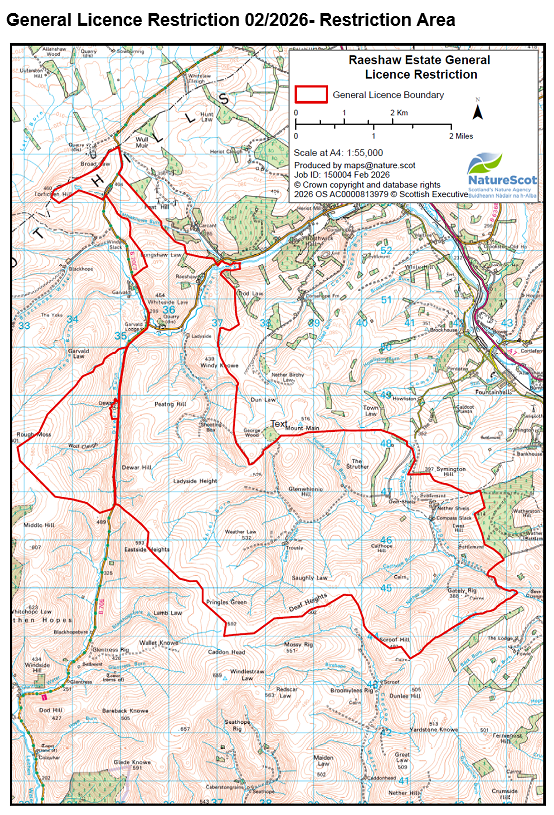
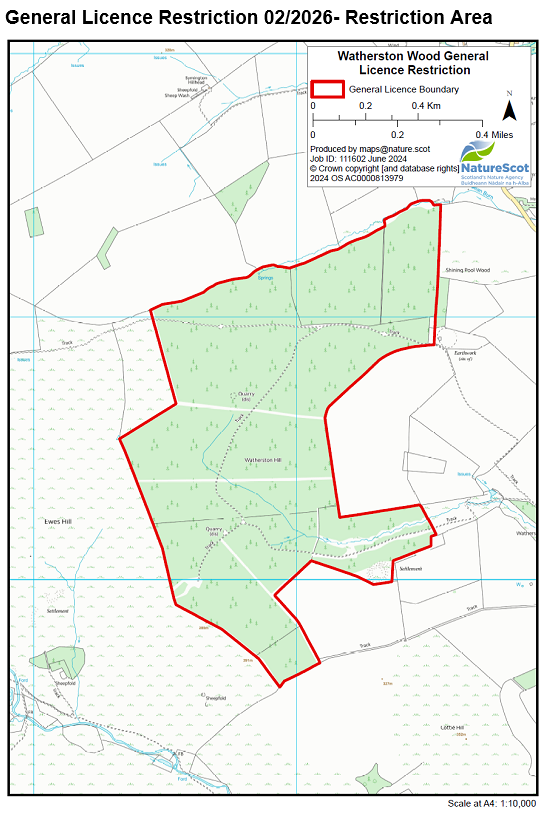
Here are the maps provided by NatureScot showing the restriction areas on Raeshaw Estate and Watherston Wood, and an accompanying statement of clarification:
In line with NatureScot’s published General Licence restrictions: Framework for Implementing Restrictions we hereby give notice that a restriction has been applied to the land outlined in red overleaf. This restriction prohibits the use of General Licences 01, 02 and 03 on that land from 10th February 2026 up to and including 9th February 2029.
Please note that this restriction does not imply responsibility for the commission of crimes on any individuals.
My commentary:
There’s a lot to say about this latest General Licence restriction. Some of it will have to wait for another blog because I’m short on time at the moment, but some of it I’ll say now.
General Licence restrictions, which have been available to NatureScot since 2014, are based on the civil burden of proof and are issued when NatureScot receives information from Police Scotland about wildlife crimes but where there is insufficient evidence to identify an individual offender for prosecution. (GL restrictions can also be imposed on estates where gamekeepers have been convicted of wildlife crimes).
General Licence restrictions do not prevent an estate from game-shooting, nor do they prevent an estate from carrying out [lawful] predator control – this can still be undertaken if the estate applies for an ‘individual licence’ which may restrict the amount of predator control, the estate may be subject to compliance spot checks, and the licence holder must provide NatureScot with licence returns (i.e. indicate how many birds were killed, where, and when etc).
General Licence restrictions are not perfect as an effective sanction – they are nowhere near, as I’ve written about many times before (e.g. see here and links within). They do, however, work as a ‘reputational driver’, although in some cases reputation is apparently not an issue of concern.
Whilst today’s decision is very welcome news, it’s taken NatureScot far too long to reach it. Regular blog readers will know that NatureScot has been considering this decision since April 2024 (see here) when it first received information from Police Scotland about the shooting/killing of Merrick. That’s almost two years of procrastination (e.g. see here, here). It’s nowhere near good enough.
This is the second General Licence restriction imposed on Raeshaw Estate.
Raeshaw Estate boundary derived from Andy Wightman’s Who Owns Scotlandwebsite
Raeshaw Estate was one of the first estates to receive a General Licence restriction in 2015, based on clear police evidence that wildlife crimes had been committed although there was insufficient evidence to prosecute any individual (see here). Representatives of Raeshaw Estate applied for a judicial review of NatureScot’s decision but the Court of Session upheld NatureScot’s procedures and ruled them lawful (here).
Whilst under that first General Licence restriction, Raeshaw Estate applied for, and was granted, a number of ‘individual licences’ so the gamekeepers could continue to kill certain species as part of the estate’s grouse moor management plan (quite a lot of birds were lawfully killed – see here).
However, in 2017 the individual licence was revoked by NatureScot due to non-compliance issues and more suspected wildlife crime offences (see here). Not that the revocation made any difference whatsoever, as the estate could simply apply for another individual licence!
Inexplicably to many of us, NatureScot did not extend the length of the original General Licence restriction, which it has the authority to do, in light of the non-compliance issues on the estate’s individual licence (see here).
And now here we are again, with a second General Licence restriction imposed, this time in relation to the illegal shooting and killing of Golden Eagle ‘Merrick’ in October 2023.
As a colleague pointed out to me today, General Licence restrictions have been useful in as much as they have provided a framework for imposing a licence restriction based on the civil burden of proof, and this has clearly influenced the new system of grouse moor licensing in Scotland, introduced as a new sanction under the Wildlife Management & Muirburn Act 2024, whereby licences to shoot Red Grouse can be revoked, based on the civil burden of proof, if evidence of wildlife crime is provided to NatureScot by Police Scotland.
In this latest case relating to Raeshaw Estate, I doubt very much whether a grouse shooting licence will be revoked because Merrick was shot in October 2023, before the introduction of grouse shoot licences, and a licence revocation can’t be applied retrospectively. I’m not even sure whether Raeshaw Estate has a grouse shooting licence; there isn’t a public register to consult. If it doesn’t currently have a grouse shooting licence, but applies for one during this three-year General Licence restriction, it’d be interesting to see what happens.
More commentary to come soon…
UPDATE 11 February 2026: Raeshaw Estate claims General Licence restriction “wholly unjustified” and intends to appeal (here)
UPDATE 7 April 2026: Raeshaw Estate loses appeal against 3-yr General Licence restriction in relation to Golden Eagle Merrick being ‘shot & killed’ (here)
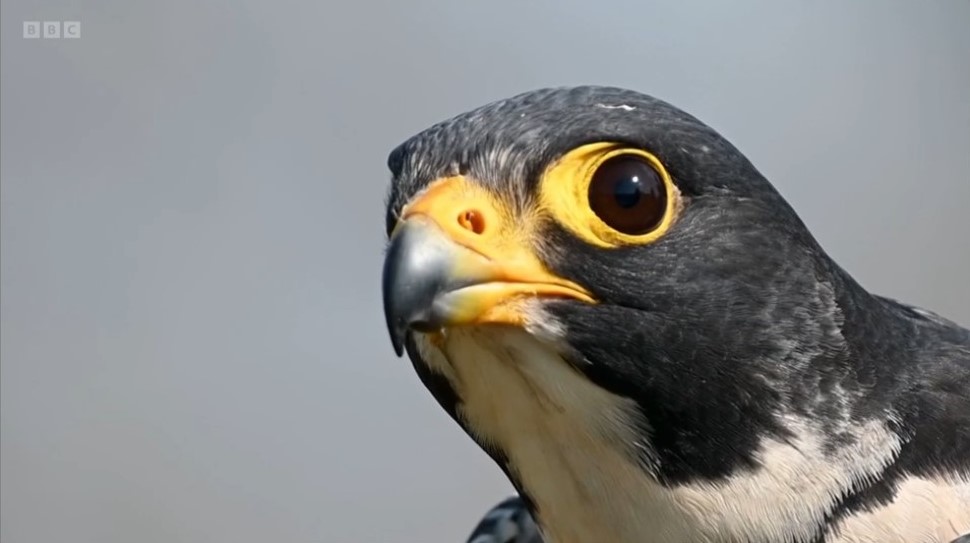
Two mainstream BBC TV programmes, Landward and Countryfile, last week included features on raptor conservation projects in south Scotland – both worth watching on BBC iPlayer if you missed them.
Landward featured the brilliant George Smith, a volunteer from the Scottish Raptor Study Group, who has been monitoring peregrines across south Scotland for almost 40 years. He’s filmed visiting peregrine nest sites to ring chicks (under licence) and to collect DNA samples (also under licence).
It was a direct result of George’s dedicated and meticulous research that led to the recent conviction of part-time gamekeeper Timothy Hall and his son, Lewis Hall, for the illegal laundering of wild peregrines that were stolen from nests in south Scotland and then sold on to falconers in the Middle East, allegedly for enormous profit according to the Crown.
Worryingly, some more peregrine nests that George is monitoring this year have failed in suspicious circumstances and Police Scotland are currently investigating.
This episode of Landward is available on BBC iPlayer here (peregrine segment starts at 7 min 48 sec) and is available for the next 11 months.
Countryfile had two features of interest to readers of this blog. First was an overview of the conservation restoration work going on at the Tarras Valley Nature Reserve, the former Langholm grouse moor that was bought out from Buccleuch Estates by the Langholm community in 2022. Tarras Valley NR Estate Manager Jenny Barlow provides a commentary on the significance of the reserve and describes some of the projects underway.
Then Dr Cat Barlow from the South Scotland Golden Eagle Project took a presenter out into the hills in search of one of the satellite-tagged golden eagles that had previously been translocated to south Scotland to boost the formerly tiny remnant population. Cat discusses the project’s successes as well as the ongoing threat of illegal persecution, highlighted by what Police believe was the illegal shooting and killing of golden eagle ‘Merrick‘ last October, very close to the boundary of the Raeshaw Estate in south Scotland. Unfortunately Cat didn’t discuss the suspicious disappearances of a number of the translocated sub-adult eagles from the Western Isles that are rumoured to have ‘vanished’ when they dispersed north from southern Scotland. The piece also includes some of the important educational work the project is undertaking with local school children in south Scotland in an attempt to improve the future protection of eagles in this region.
This episode of Countryfile is available on BBC iPlayer here (Tarras Valley segment starts at 39 min 10 sec and South Scotland Golden Eagle Project segment starts at 46 min 30 sec). This episode is only available for another 26 days.
Cast your mind back to November 2023 when Police Scotland issued an appeal for information about the suspicious disappearance of a satellite-tagged golden eagle in the Scottish Borders in October 2023, which Police said at the time they believed “has come to harm” (see here).
We later learned that this young golden eagle, called ‘Merrick’, was part of the South Scotland Golden Eagle Project, a lottery-funded conservation initiative which is translocating young golden eagles from various sites across Scotland to boost the tiny remnants of the golden eagle breeding population in south Scotland (see here).
Camera trap photo of golden eagle Merrick, from South Scotland Golden Eagle Project
Recent research has demonstrated the need for these translocations as golden eagles from further north in Scotland rarely visit south Scotland of their own accord (see here) so without translocations the golden eagle population in south Scotland was at serious risk of extirpation, especially with the ongoing persecution of these local eagles (e.g. see here), despite the desperate denial of the Scottish Gamekeepers Association (see here).
Today there has been a further update about the police investigation into the disappearance of golden eagle Merrick, with a press release issued by the South Scotland Golden Eagle Project. It is revealed that Police Scotland believe Merrick was “shot and killed” whilst sleeping in a tree before “someone then removed her body and destroyed her satellite tag“.
I’m going to reproduce the press release below, but then I’m going to discuss what wasn’t said in the press release because I always find the omissions more interesting.
Bear in mind when you read this press release that it was constructed by all the project partners involved in the South Scotland Golden Eagle Project, including those from the grouse-shooting lobby, who, unsurprisingly, appear to have used it as a vehicle to pump out some gratuitous pro-grouse shooting material.
I’m told by other project partners that this press release has been argued over for months, presumably because some partners wanted to do a damage-limitation job on it. Kudos to the Project team though for at least getting something out and providing a good deal of transparency about the circumstances of this eagle’s disappearance.
Here’s the press release – all photos supplied by South Scotland Golden Eagle Project. My comments will follow underneath:
PERSECUTION SUSPECTED IN DISAPPEARANCE OF GOLDEN EAGLE MERRICK
Following an investigation by Police Scotland, representatives for a groundbreaking conservation initiative, which attributes its success to overwhelming support from the public, raptor workers and land managers, have today (Wednesday 1 May 2024) confirmed that they are confident Merrick the golden eagle’s disappearance is due to persecution.
Merrick (F43), a female golden eagle that the project team translocated to southern Scotland in 2022, was reported missing in autumn 2023. With permission from Police Scotland, further information about the circumstances of Merrick’s disappearance and the evidence left behind can now be revealed.
Sharing further details, Project Manager, Dr Cat Barlow said: “We can confirm that Police Scotland has found clear evidence that a wildlife crime has been committed. They are confident Merrick’s disappearance was due to persecution.
“The South of Scotland Golden Eagle Project is incredibly angry, upset and disappointed that her disappearance appears to have been at the hands of an individual or individuals who consider themselves above the law.
“The Project’s translocated eagles have captured the hearts and minds of all our supporters, from conservationists, and raptor workers to landowners and the wider community, including children, visitors and business operators, who all share in our utter shock and disappointment.
“However, this incident, and the staunch support we have had, makes us utterly determined to fight the persecution of golden eagles and continue our successful translocation work to reinstate a resilient population of golden eagles across southern Scotland.”
Chair of the South of Scotland Golden Eagle Project, Dumfriesshire farmer Michael Clarke added: “Whoever committed this deplorable wildlife crime should hang their heads in shame. Golden eagles are back to stay in the South of Scotland, and we very much hope they continue to spread from here to all parts of the UK.
“We thank everyone for their support at this tough time. We are grateful to Police Scotland for their support and using all the resources at their disposal to establish the full circumstances. We remain more determined than ever to establish a sustainable population of golden eagles in the South of Scotland.”
Merrick (F43) originated from Rottal Estate near Kirriemuir in the Angus Glens, a traditional sporting estate, which is accredited by Wildlife Estates Scotland (WES) for its commitment to protecting and restoring wildlife and biodiversity. Speaking about her disappearance, estate owner and Chair of Scottish Land & Estates (SLE) Dee Ward said: “We utterly condemn raptor persecution in the strongest possible terms and it is right and proper that anyone who commits such an act is prosecuted and convicted.
“Merrick is an eagle our own family estate donated to the project and we’re incredibly proud of the part we and many other estates, land managers and gamekeepers have played in the success of the South of Scotland Golden Eagle Project. Indeed, the project has otherwise been an incredible success built on respect and co-operation between keepers, farmers, foresters and raptor conservationists.
“This incident makes us all the more passionate about continuing that support and we will do all we can to prevent, detect and condemn anyone who thinks this kind of abhorrent behaviour is acceptable.”
Merrick was the fifth eagle collected in the summer of 2022, the last to leave the aviaries, and the heaviest eagle translocated that summer, at 5.2 kg. She was named after the highest peak in the Southern Uplands, by the South of Scotland Golden Eagle Project’s host charity, the Southern Uplands Partnership (SUP).
The project team has followed Merrick’s journey since her release using round-the-clock surveillance techniques, alongside reports of sightings from the Moorland Association and shooting estates across the country. She was thriving before her disappearance and exploring widely across the south of Scotland and Northern England. She was even photographed on a trip to Weardale and filmed in Nidderdale Area of Outstanding Natural Beauty.
Each of the project’s eagles are fitted with a state-of-the-art satellite tag which transmits regular, reliable and accurate information about the birds’ wellbeing and movements. Until her disappearance, Merrick’s tag had been transmitting normally. During the eight days before her disappearance, she was exploring the Moorfoot Hills. Then on 12 October, her tag suddenly stopped transmitting, indicating “no malfunction”, which strongly suggested human interference.
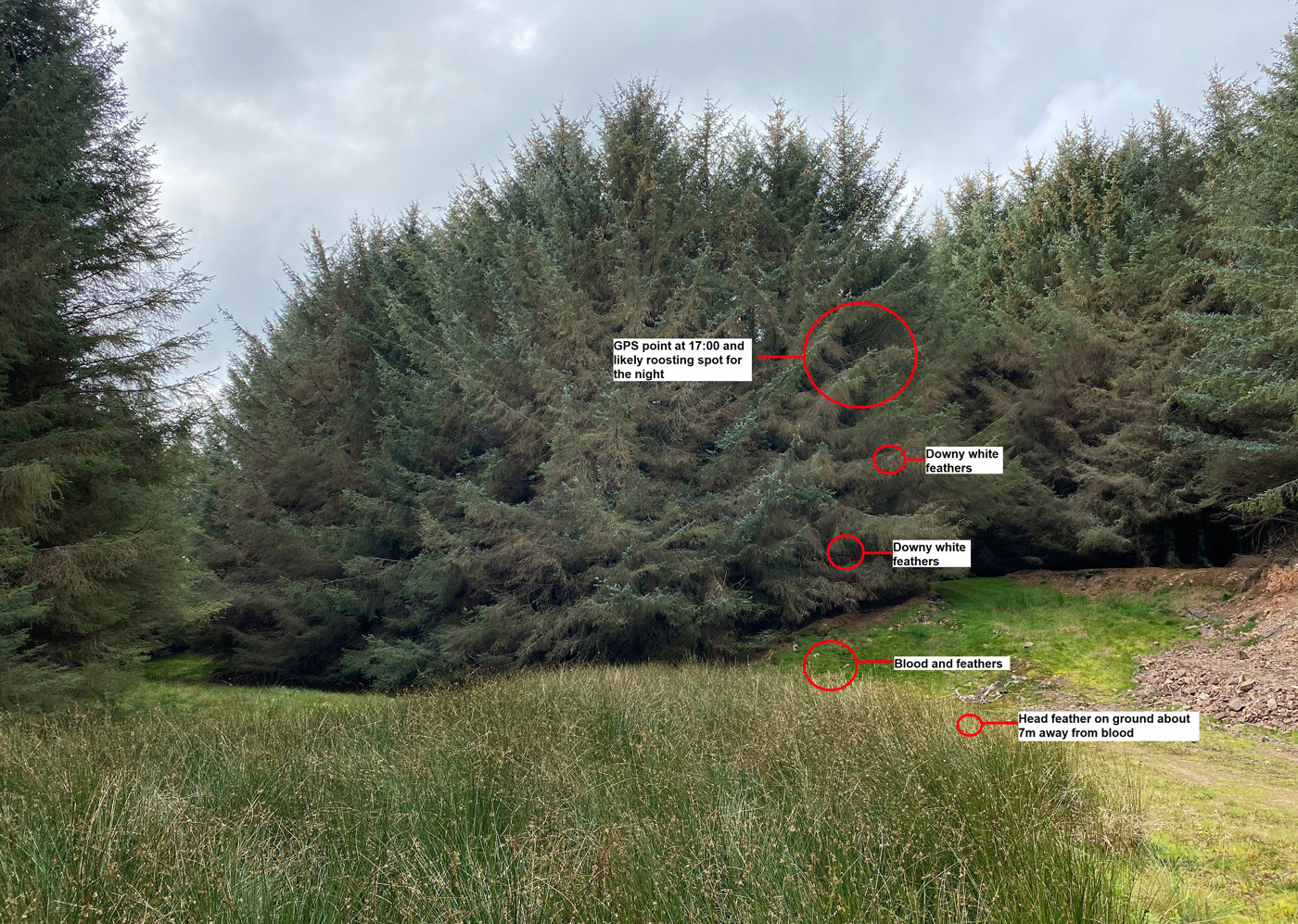
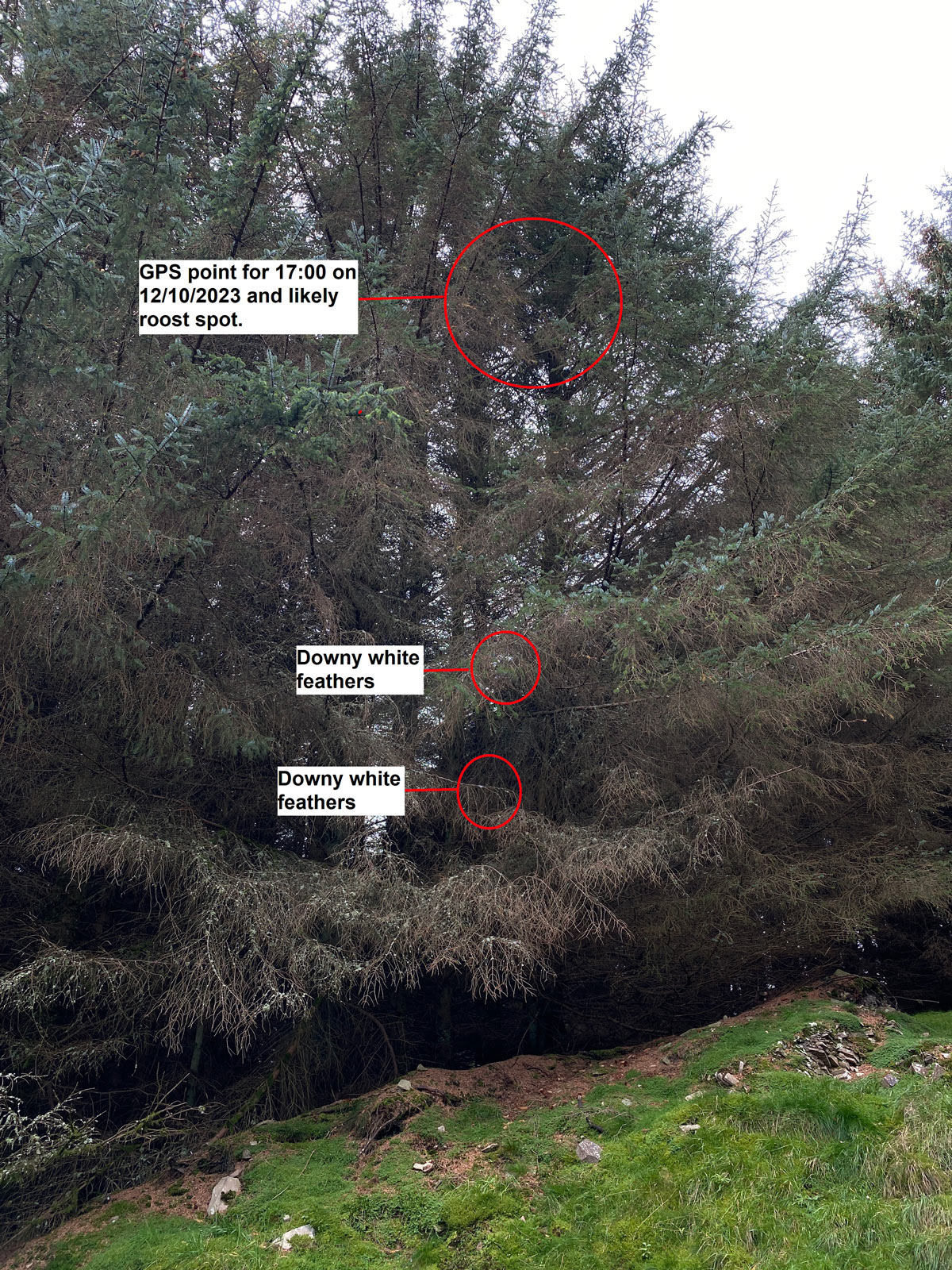
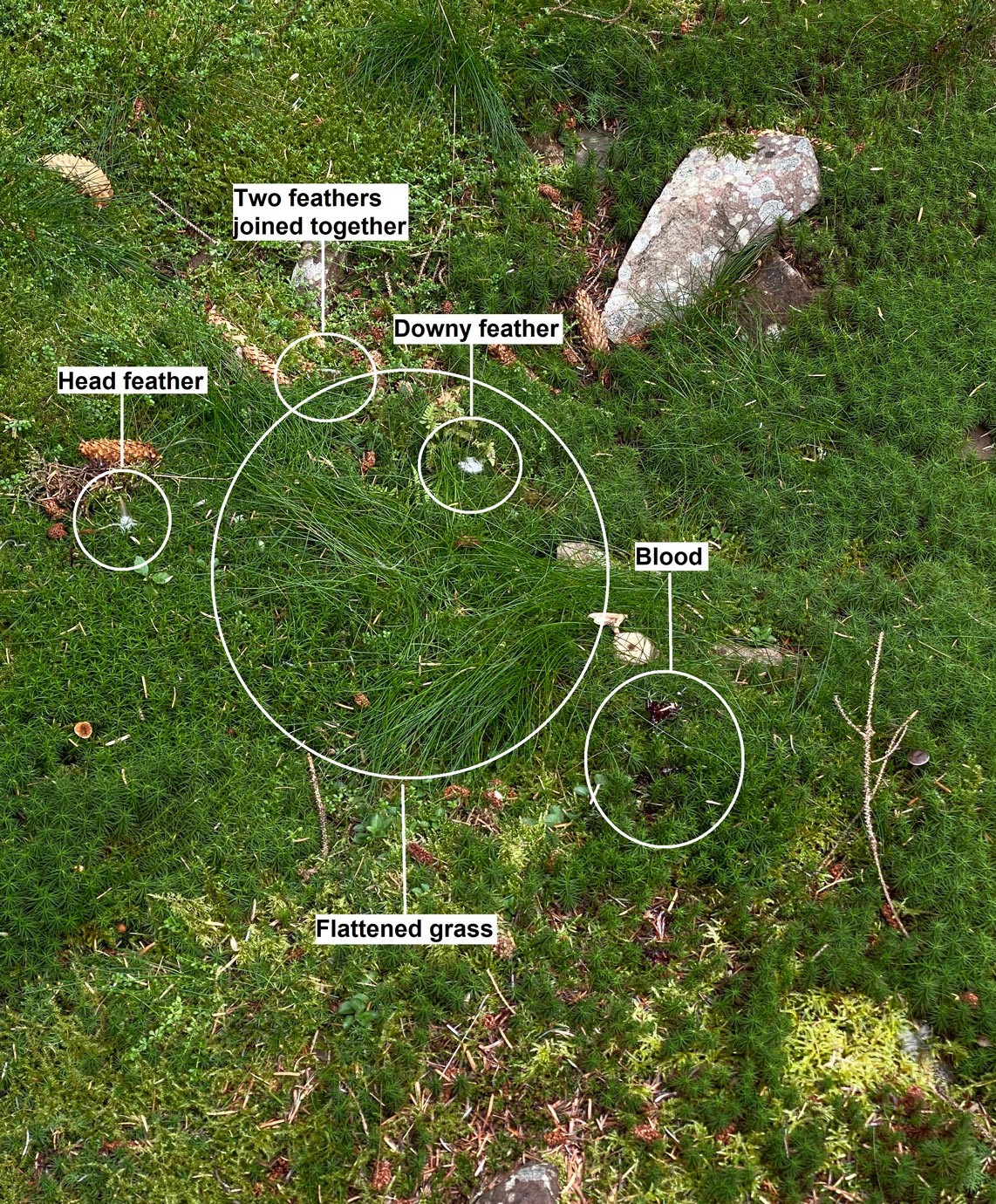
On a visit to check on a juvenile eagle in the area, Eagle Officer, John Wright, inspected the relatively bare branches of a Sitka Spruce, Merrick’s last known roosting spot. He very quickly noticed a small golden lanceolate shaped head feather, two small wing coverts and some white under-down laying on the moss directly below the tree. Recalling his visit to the site, John said: “I saw a film of blood stretched across the grass stems. It subsequently turned out that a considerable amount of blood was present in and below the moss layer. As I stood back from the feather and blood location, I could see small downy feathers scattered in the dense spruce foliage below the roosting branches.
“Merrick had been roosting (sleeping perched) in a tree when her tag stopped transmitting. Golden eagles, as apex predator, have very few natural predators and so fears that Merrick had been fatally injured whilst roosting were quickly dismissed. Police Scotland have told us that they are confident humans were involved in the demise of this eagle.”
The Project team contacted Police Scotland, who promptly reached the site before weather destroyed any evidence to investigate the incident. This allowed them to confidently eliminate most other potential causes of death or disappearance. The nature and pattern of feathers and blood, and all other evidence, indicated to the Police that Merrick was shot and killed.
Dr Cat Barlow said: “Looking at the evidence, Police Scotland believe she was shot then fell to the ground, where she bled considerably through a single wound. Police Scotland believe that someone then removed her body and destroyed her satellite tag.”
In November, Police Scotland issued a statement stating that they believed she had “come to harm” and were treating her disappearance as “suspicious.”
Detective Sergeant David Lynn, Police Scotland Wildlife Crime Coordinator, said: “Since the report was made, officers have been working with a range of partner agencies to establish more details and gather further information to establish the circumstances.
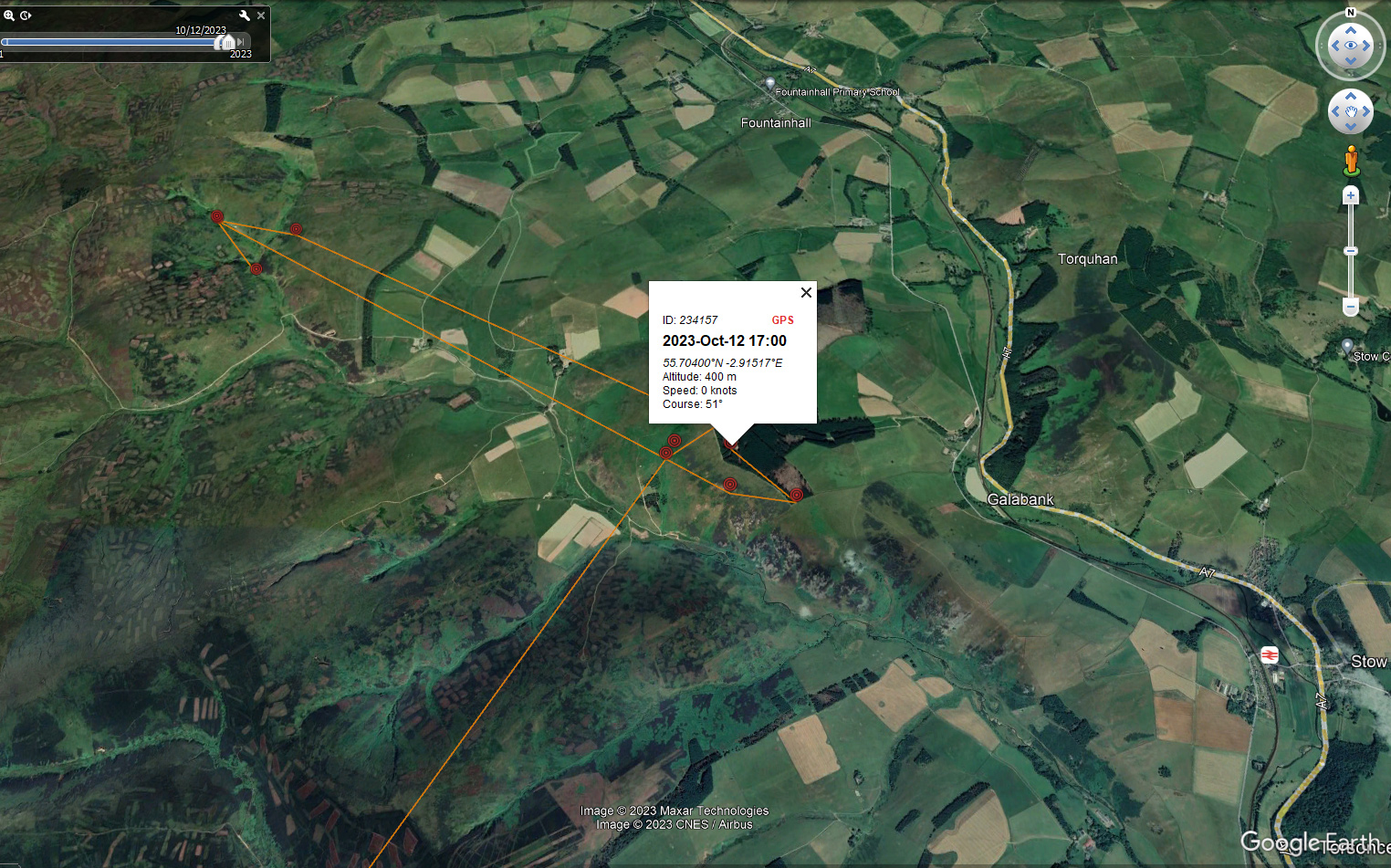
“The bird was last seen in the area to the west of Fountainhall, between Heriot and Stow on Thursday, 12 October. A full search of this area was carried out and officers believe the bird has come to harm and are treating its disappearance as suspicious.
“We are determined to protect these magnificent birds. We work closely with a number of partners to tackle wildlife crime, which can be challenging and complex to investigate. I urge anyone with any information to contact us through 101 quoting reference number 1193 of 18 October. Alternatively, please contact Crimestoppers though 0800 555 111, where anonymity can be maintained.”
The South of Scotland Golden Eagle Project partners the Southern Uplands Partnership, RSPB Scotland, Scottish Land & Estates, Scottish Forestry, GWCT and NatureScot all share in the bitter disappointment of today’s news.
Since the first chicks were released in 2018, the project has had significant success, quadrupling the local population of golden eagles to the highest number seen in the area for centuries. Survival rates of the translocated birds are 90%, which is incredibly high.
The translocated golden eagles regularly and safely visit upland areas, which are managed for shooting and are a natural habitat for the golden eagle. The project has had excellent support from shooting estates in the area, who have worked with the team in many ways to ensure golden eagles thrive in southern skies – from the provision of chicks to supporting the development of artificial eyries in a safe place on their land.
That last image is what I want to focus on. It shows the location of Merrick’s last known roost spot and where her blood and feathers were found.
According to Andy Wightman’s fantastic Who Owns Scotland website (if you don’t already subscribe I recommend you do), this location is several metres from the boundary of Raeshaw Estate in the Moorfoot Hills.
RPUK map showing the boundary of Raeshaw Estate, derived from data on the Who OwnsScotland website
Screen grab from Who Owns Scotland website, annotated by RPUK, showing the proximity of Merrick’s last known location and the Raeshaw Estate (shaded in blue)
It struck me as odd that in the press release, although there are frequent references to how great ‘traditional sporting estates’ are for golden eagle conservation (and in the case of Rottal Estate where Merrick hatched, justifiably so), nobody seemed to want to mention the proximity of Merrick’s last known location and the discovery of her feathers and blood to the ‘traditional sporting estate’ known as Raeshaw. Why is that?
It would seem quite a significant piece of information to me, given that government-funded scientific research has identified a link between the proximity of some driven grouse moors and golden eagle persecution in Scotland. Not all driven grouse moors, but some.
Regular blog readers will recognise the name of Raeshaw Estate. I’ve blogged about it many times before as this was one of the first estates to be hit with a General Licence restriction back in 2015 based on ‘evidence provided by Police Scotland of wildlife crime against birds‘ although there was insufficient evidence to link the crimes to a named individual (see here), hence the GL restriction as opposed to a prosecution.
Raeshaw took NatureScot to court to challenge the decision under judicial review but lost the case after the court considered NatureScot’s decision to be lawful (here).
During the time Raeshaw was serving a General Licence restriction, employees applied for an individual licence to permit the continued (lawful) killing of so-called ‘pest’ birds on the estate (e.g. 1,000 birds reported killed under one of these licences, see here), but then even the individual licence was later revoked after NatureScot found ‘multiple instances of breaches of conditions of an individual licence that had been granted to cover essential management activities‘ (see here).
NatureScot also said, ‘These breaches may also constitute offences under the Wildlife and Countryside Act, so SNH has reported the details to Police Scotland‘. I’m not aware of any subsequent prosecution in relation to those alleged offences.
It’s worth pointing out here that as far as I’m aware, nobody from the Raeshaw Estate has ever been prosecuted for any of the alleged wildlife crimes reported from this area.
It’s also worth pointing out that, just because Merrick’s last known location and the discovery of her blood and feathers was just several metres from Raeshaw Estate’s boundary, that doesn’t mean we can automatically assume that anyone associated with Raeshaw Estate was involved. There’s no direct evidence to demonstrate a link. Indeed, I heard on the grapevine that Police Scotland was refused permission to obtain a search warrant because the Crown Office didn’t consider there was sufficient evidence to justify it.
According to Andy Wightman’s research, Raeshaw Estate is owned by an overseas entity called Raeshaw Holdings Ltd, which according to Companies House is registered in the tax haven of Jersey (here). Last year it was reported that the beneficial owner of Raeshaw was billionaire Tory donor Louis Moore Bacon.
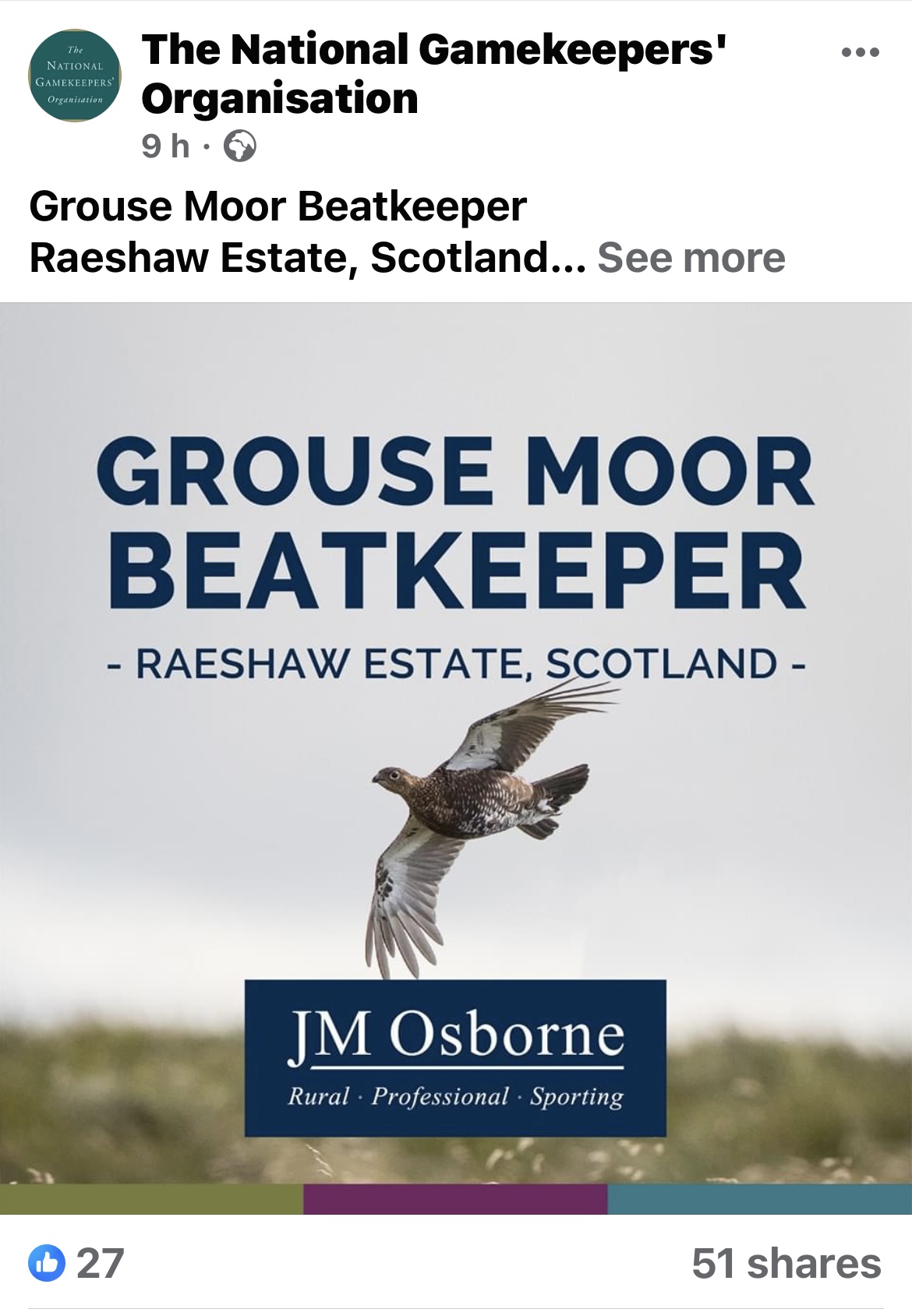
The sporting elements of the estate are managed by one of ‘grouse moor guru’ Mark Osborne’s companies, a sporting agency called ‘JM Osborne Rural and Sporting‘. Members of the grouse shooting industry, who you’ll recall routinely profess to have a zero tolerance policy towards raptor persecution, even in the press release above, clearly do not consider there to be any link with the apparent shooting and killing of Merrick and anyone employed on Raeshaw Estate. If they did, various gamekeeping organisations such as the Scottish Gamekeepers Association, National Gamekeepers Organisation, Southern Uplands Moorland Group and the Angus Glens Moorland Group wouldn’t this week be promoting on social media the latest gamekeeper vacancy on what is described as the ‘prestigious’ and ‘cracking’ Raeshaw Estate:
Screen grab from the Scottish Gamekeepers Association’s Facebook page, 30 April 2024
Screen grab from the National Gamekeepers Organisation’s Facebook page, 29 April 2024
Screen grab from the Facebook pages of gamekeeping organisations the Angus Glens Moorland Group & Southern Uplands Moorland Group, 29 April 2024
And grouse moor lobby group Scottish Land & Estates certainly wouldn’t be providing regular, full page advertising space in its quarterly LandBusiness magazine to any of Mr Osborne’s companies (JM Osborne Rural & Sporting and his gun-making company William Powell) if it considered there was any link:
Screen grab from SLE’s LandBusiness Magazine, Autumn 2022
Screen grab from SLE’s LandBusiness Magazine, Spring 2024
And pro-game shooting charity Game and Wildlife Conservation Trust (GWCT) certainly wouldn’t be accepting generous raffle prizes worth a value of tens of thousands of pounds from any company even suspected of having a link to raptor persecution – see here and:
Screen grab from GWCT website
And surely neither would the British Association for Shooting & Conservation (BASC) be accepting generous raffle prizes worth £13,000:
Screen grab from BASC website
To summarise then:
Golden eagle Merrick, like so many satellite-tagged golden eagles before her, ‘disappeared’ in suspicious circumstances in October 2023.
Some of her feathers were found next to pools of her blood at her last known roost site.
Police Scotland believe she was ‘shot and killed’.
Although this incident took place in close proximity to the boundary of Raeshaw Estate, there is no suggestion whatsoever that anyone there was involved.
Police Scotland found no evidence to allow them to arrest and charge anyone in connection with Merrick’s disappearance or death.
In late November 2019 Scottish Natural Heritage (SNH) imposed a three-year General Licence restriction on Leadhills Estate, South Lanarkshire, after receiving what it described as “clear evidence” of wildlife crimes from Police Scotland (see here, here and here).
Those alleged offences included the ‘illegal killing of a short-eared owl, two buzzards and three hen harriers’ that were ‘shot or caught in traps’ on Leadhills Estate since 1 January 2014 (when SNH was given the power to impose a General Licence restriction on estates or individuals in Scotland). SNH has also claimed that ‘wild birds’ nests have also been disturbed’, although there is no further detail on this. The estate has consistently denied responsibility.
[The body of a shot short-eared owl that was found shoved under some heather on Leadhills Estate in May 2017. Photo by RSPB Scotland]
The General Licence restriction was imposed on Leadhills Estate on 26 November 2019.
It lasted for just 14 days.
On 10 December 2019, a notice appeared on SNH’s website announcing that the restriction had been lifted due to an on-going appeal:
This means that Leadhills Estate can, until further notice, go back to using General Licences 1, 2 & 3 to lawfully kill hundreds if not thousands of certain bird species (e.g. crows) on the estate without having to report its activities to anybody.
Leadhills Estate is perfectly entitled to appeal SNH’s decision to impose the General Licence restriction. SNH has a clearly-explained policy on its appeals procedure, which states an appeal must be made within 14 days of SNH’s decision to impose the restriction and that appeal must be in writing. From the information available in the public domain it looks like Leadhills Estate has met this deadline.
An appeal has the immediate effect of suspending the General Licence restriction from the date SNH receives the appeal letter. SNH now has to consider the appeal and must notify the estate of the appeal outcome in writing, setting out the reasons behind the decision. SNH says it will seek do this within four weeks of receiving the appeal letter.
We’ll be monitoring this case very carefully.
There’s quite a lot of deja vu going on here. You might remember that Raeshaw Estate (Scottish Borders) was one of the first to be slapped with a General Licence restriction back in November 2015 (see here). That restriction only lasted for six days before the estate appealed (see here). The appeal failed and two and half months later the General Licence restriction was re-imposed on the estate (see here).
However, a couple of months later the General Licence restriction was suspended again when Raeshaw Estate took SNH to judicial review (see here). Raeshaw lost the judicial review when the court decided SNH had acted fairly so the General Licence restriction was re-instated on the estate, again, approximately one year later (see here). Interestingly, SNH did not backdate the restriction order so effectively Raeshaw Estate didn’t serve a full three-year restriction at all, thanks to all the legal disruption.
During this time Raeshaw employees also applied for individual licences to permit the continued killing of birds on the estate (e.g. 1,000 birds reported killed under one of these licences, see here), but then even the individual licence was revoked after SNH found ‘multiple instances of breaches of conditions of an individual licence that had been granted to cover essential management activities‘ (see here). SNH also said ‘These breaches may also constitute offences under the Wildlife and Countryside Act, so SNH has reported the details to Police Scotland‘. We’re not aware of any pending prosecution in relation to these alleged offences. And SNH chose not to extend the General Licence restriction further, in light of these breaches, even though it had the powers to do so (see here).
The link between Raeshaw Estate and Leadhills Estate, apart from them both being grouse shooting estates and the subject of a General Licence restriction for ‘clear evidence of wildlife crime’? Leading sporting agent and grouse moor ‘guru’ Mark Osborne, whose company J M Osborne & Co is believed to be involved at both estates (involved as in ‘present’, not involved as in ‘guilty of wildlife crime’ – SNH has made clear that a General Licence restriction does not infer responsibility for the commission of crimes on any individuals).
Also of interest, to us at least, is the ownership of Leadhills Estate, which has belonged to the same family (the Hopetouns) for more than 300 years, according to the estate’s website:
It’s also of great interest that not only is Leadhills Estate a member of Scottish Land & Estates (who, incidentally, have said absolutely nothing about this General Licence restriction so far), but that Lord Hopetoun is chair of Scottish Land & Estate’s Scottish Moorland Group:
If Leadhills Estate’s appeal fails and SNH re-instates the General Licence restriction, we’ll be expecting a full response from both Scottish Land & Estates and the Scottish Moorland Group.
UPDATE 9 January 2020: Decision due on General Licence restriction for Leadhills Estate (here)
The project to translocate golden eagles from the Scottish Highlands to south Scotland has finally got underway this year, with news out today that three eagles have been successfully released this year.
There’s an article about it on BBC Scotland (here) including some video footage.
Unbelievably, Professor Des Thompson, Principal Advisor for Biodiversity and Science at SNH, is quoted in both in the video and in the article as follows:
“This is the icon of wild Scotland. We are on the threshold of giving something very exciting back to the south of Scotland. Scotland has just over 500 pairs, just two to four breeding pairs in the south of Scotland where they are really struggling.
Young golden eagles are heavily persecuted. A third of them have been killed either through shooting or poisoning.
Down here in the south of Scotland we’ve been able to reassure ourselves persecution is not an issue. It’s just a small fragmented population that needs this helping hand from us. We have been overwhelmed by the support we are getting from landowners and we are reassured these birds are going to be welcome“.
Did he actually just say that? “We’ve been able to reassure ourselves persecution is not an issue“. What, you mean in the same way that SNH reassured itself that the scientific justification for the Strahbraan raven cull was sound?
You couldn’t make this up. Has he switched jobs and is now representing Scottish Land & Estates? He might as well be as this is exactly the line they were trying to spin several years ago (see here).
The south of Scotland is well known for the illegal persecution of raptors, including golden eagles. Only this year a young satellite-tagged golden eagle (Fred) ‘disappeared’ in the Pentland Hills in highly suspicious circumstances (here) in an area where previously a merlin nest had been shot out and breeding ravens had also ‘disappeared’.
[Golden eagle Fred, by Ruth Tingay]
Then there’s Raeshaw Estate, currently operating under a General Licence restriction and an Individual Licence restriction, due to evidence of alleged ongoing raptor persecution (here); there’s a forthcoming prosecution of a gamekeeper in the Borders for a long list of alleged wildlife crime (here); there’s the land managed for driven grouse shooting in South Lanarkshire (close to the golden eagle translocation area) where over 50 confirmed reported incidents of dead raptors and poisoned baits have been recorded since 2003, including a shot golden eagle in 2012 (it didn’t survive, here), the reported shooting of a short-eared owl in 2017 (here), the reported shooting of a hen harrier in 2017 (here), and the reported shooting of a buzzard in 2018 (here); and then there’s been at least four raptor poisonings in south Scotland this year alone (here).
But don’t worry, folks, despite all evidence to the contrary, Professor Thompson is “reassured” that raptor persecution won’t be an issue for these young golden eagles.
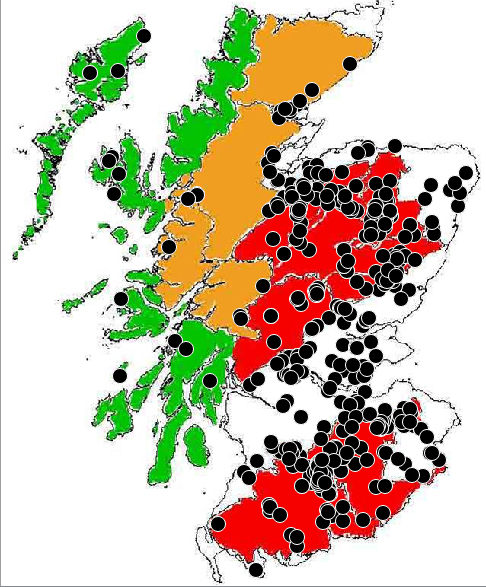
Here’s a map from the 2008 Golden Eagle Conservation Framework showing the conservation status of golden eagles in Scotland (red = unfavourable conservation status), overlaid with ten years of raptor persecution data (all species, 2005-2015) gleaned from ‘official’ persecution maps. It doesn’t include data from the last three years. Does it look to you like raptor persecution isn’t an issue in southern Scotland?
We’ve blogged about the South Scotland Golden Eagle Project several times over the years (e.g. here, here, here) and we still have mixed feelings about it. On the one hand the south Scotland golden eagle population is in dire straits, and has been for some time, and urgently needs a boost. Translocating eagles from other parts of the Scottish range seems a decent strategy.
However, fundamental to translocation and reintroduction projects is the need to identify and resolve the underlying cause(s) of the species’ decline in that area. The authorities have not come anywhere near to resolving this issue, either in south Scotland or beyond. The chances remain high that these young eagles will be killed. Having said that, they’re just as likely to be illegally killed further north in Scotland so in that sense, moving them a few hundred km south probably won’t make much difference to their chance of being illegally killed.
At least these three young eagles have been satellite-tagged so their movements can be followed. The question is, if/when each eagle goes off the radar in suspicious circumstances, who will decide whether this news is suppressed or publicised?
Good grief. Just when you thought this pantomime couldn’t get any more ridiculous….
As many of you will know, Raeshaw Estate in the Scottish Borders was one of the first in Scotland to be subjected to a General Licence restriction, issued in 2015, based on clear police evidence that wildlife crimes had been committed although there was insufficient evidence to prosecute any individual (see here). The estate contested the legality of SNH’s decision and this was seen as a test case, which went to Judicial Review in 2016. In March this year, the Court of Session upheld SNH’s decision and the General Licence restriction was considered lawful (here).
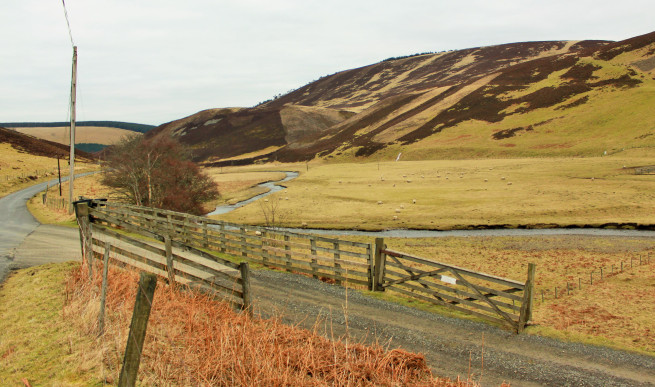
Here is a map showing the location of Raeshaw Estate, near Heriot in south Scotland (estate boundary details sourced from Andy Wightman’s Who Owns Scotlandwebsite).
For background, there’s been a long history of raptor persecution “nr Heriot“, dating back to at least 2001. Here’s a list we’ve compiled of confirmed raptor persecution crimes, listed in RSPB annual reports and / or the press:
2001 May: poisoned buzzard (Carbofuran) “Heriot Dale”. No prosecution
2003 Feb: poisoned buzzard (Carbofuran) “Heriot”. No prosecution
2003 Mar: poisoned buzzard (Carbofuran) “Heriot”. No prosecution
2003 Apr: poisoned buzzard (Carbofuran) “Heriot”. No prosecution
2003 Nov: poisoned buzzard (Carbofuran) “Heriot”. No prosecution
2004 Feb: Carbofuran (possession for use) “Heriot”. No prosecution
2004 Feb: two poisoned buzzards (Carbofuran) “Heriot”. No prosecution
2004 Oct: poisoned buzzard (Carbofuran) “Heriot”. No prosecution
2005 Dec: poisoned buzzard & raven (Carbofuran) “Heriot”. No prosecution
2006 Sep: poisoned buzzard (Carbofuran) “Heriot”. No prosecution
2006 Oct: poisoned buzzard (Carbofuran) “Heriot”. No prosecution
2009 Mar: two poisoned buzzards (Carbofuran) “nr Heriot”. No prosecution
2009 Jun: poisoned red kite (Carbofuran) “nr Heriot”. No prosecution
2009 Jun: 4 x poisoned baits (2 x rabbits; 2 x pigeons) (Carbofuran) “nr Heriot”. No prosecution
2010 Nov: poisoned buzzard (Carbofuran) “nr Heriot”. No prosecution
2011 Jan: poisoned buzzard (Carbofuran) “nr Heriot” No prosecution
2014 May: crow trap baited with two live pigeon decoys “nr Heriot”. No prosecution (but General Licence restriction applied in Nov 2015)
2014 May: four set spring traps beside live pigeon decoy “nr Heriot”. No prosecution (but General Licence restriction applied in Nov 2015)
2014 May: four shot buzzards “nr Heriot” No prosecution
2015 Jul: shot buzzard “found by side of road between Heriot and Innerleithen” according to media reports (see here). No prosecution
Interestingly, also not included in the RSPB’s annual reports but reported by the Southern Reporter (here) and the Guardian (here), a police raid on Raeshaw Estate in 2004 uncovered nine dead birds of prey, including five barn owls, two buzzards, a kestrel and a tawny owl, described as being “poisoned or shot“. In addition, “a number of illegal poisons were discovered but no-one was ever prosecuted“. According to both these articles, during a further police raid on Raeshaw Estate in 2009 ‘three injured hunting dogs were seized by the SSPCA on suspicion of involvement with badger baiting’. We don’t know whether that resulted in a prosecution.
Also not included in the above list is the sudden ‘disappearance’ of a young satellite-tagged hen harrier in October 2011. This bird had fledged from Langholm and it’s last known signal came from Raeshaw Estate. A search failed to find the body or the tag.
Raeshaw Estate (photo by RPUK)
Once the General Licence restriction was in place in 2015, Raeshaw Estate applied for, and was granted, a number of individual licences, allowing them to continue to carry out various ‘management’ activities (killing corvids and other so-called ‘pest’ species) but under closer scrutiny than they would have been subjected to under the General Licence. We know that between July and August 2016, at least 1,000 birds (294 rooks, 706 jackdaws) were lawfully killed under the auspices of these individual licences (see here). It looked like business as usual for this grouse-shooting estate, even with a General Licence restriction in place.
In 2017 Raeshaw Estate successfully applied for more individual licences that would allow them to continue this lawful wildlife-killing spree. However, in May 2017 after a spot check on the estate by SNH staff, SNH announced it had revoked an individual licence on Raeshaw Estate following the discovery that the terms of the individual licence had allegedly been breached (see here). SNH also reported suspected wildlife crimes to Police Scotland; we await news on this.
Good, we thought. The General Licence restriction was still in place (until Nov 2018) and now the individual licence had been revoked, so we assumed, naively, that Raeshaw Estate would no longer be permitted to kill wild birds during this period.
How wrong we were.
In early October 2017 we submitted an FoI to SNH to ask a series of questions about this issue. Amongst other things, we wanted to know for how long the individual licence had been revoked, and we also wanted to know whether the Estate’s General Licence restriction would be extended beyond the initial three-year period (Nov 2015-Nov 2018) given that further alleged breaches, and suspected wildlife crimes, had been discovered. SNH’s framework for dealing with General Licence restrictions explicitly states that a restriction may be extended in these circumstances:
“Where, during a period of restriction, new evidence is received by SNH which provides reason to believe that wild birds have been killed and / or taken, there is intention to do so, other than in accordance with the terms of a Licence and the Licensing manager considers that the existing restriction should be extended, the Licensing Manager will recommend to the Wildlife Operations Manager that the existing restriction be extended“.
Well, guess what? Raeshaw Estate’s original General Licence restriction has NOT been extended – why the hell not?
And even more jaw-dropping, it turns out that even though SNH has revoked one individual licence, Raeshaw Estate can simply apply for another one, and another one, and another one, ad infinitum!!!
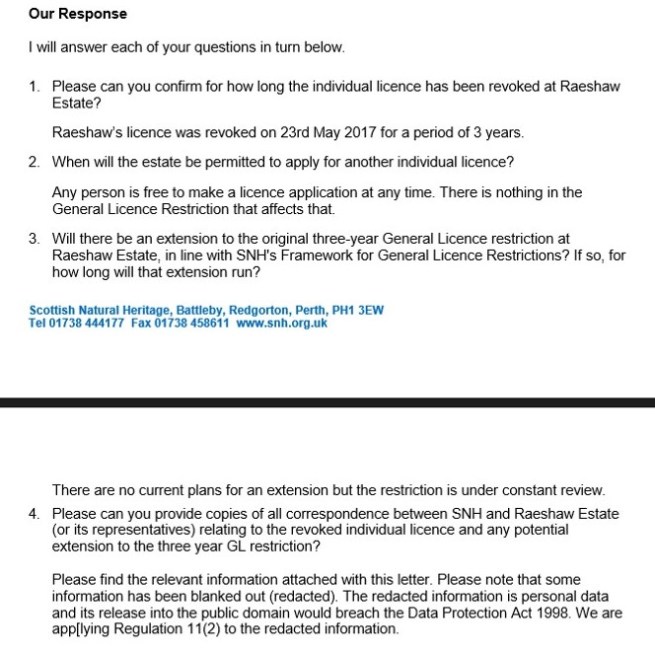
Here’s SNH’s response to our FoI:
How on earth is this allowed to go on?
It could be argued that SNH is simply following the General Restriction framework guidelines (in terms of considering further individual licence applications), and we have some sympathy with that, but, presumably SNH was involved in the drafting of these guidelines and even if they hadn’t noticed this glaring loophole at the time of drafting, it’s surely apparent now and SNH should be pushing for an urgent revision. And it does not explain why SNH has not extended Raeshaw Estate’s original General Licence restriction. If SNH has identified alleged breaches that were considered sufficient evidence to result in a revocation of an individual licence, why are these alleged breaches not considered sufficient evidence to extend the original General Licence restriction, as per the SNH guidelines?
It could also be argued that even though Raeshaw Estate is allowed to apply for as many individual licences as it likes (despite these repeated alleged licence breaches and alleged wildlife crimes), SNH may refuse to grant any more. We do know, from correspondence between Raeshaw Estate’s lawyer and SNH, released as part of our FoI resonse, that Raeshaw Estate was planning to submit another individual licence application “for 3 cage traps in order to control rooks in particular which were spoiling feeders for pheasants“. We have submitted another FoI to determine whether SNH has granted any further individual licences, even though there is yet another on-going criminal police investigation in to alleged wildlife crimes on this estate.
As many of you will know, SNH has the ability to impose a three-year General Licence restriction order on land, or on an individual, where there is sufficient evidence, substantiated by Police Scotland, that raptor persecution has taken place (see SNH framework here).
This measure, based on a civil burden of proof, was introduced by then Environment Minister Paul Wheelhouse in 2013 in response to the continuing difficulties of meeting a criminal burden of proof to facilitate a criminal prosecution. The measure became available for incidents that occured on or after 1 January 2014.
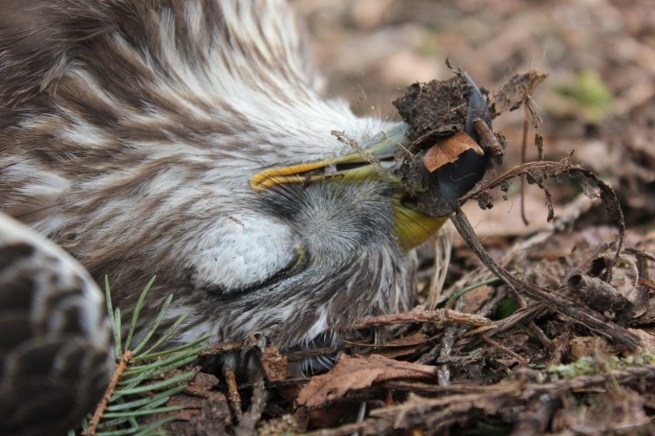
Photo of a poisoned buzzard (RPUK)
Since then, only two restriction orders have been imposed, both in November 2014: one for the Raeshaw/Corsehope Estates in the Scottish Borders, and one for the Burnfoot/Wester Cringate Estates in Stirlingshire (see here for details, and an explanation of what a General Licence restriction actually means).
As you’ll also probably be aware, Raeshaw Estate and Corsehope Estate made a legal challenge to SNH’s decision and this resulted in a judicial review. The judicial review dragged on for some time but eventually concluded in March this year, and the court found that SNH had acted fairly and that the General Licence restriction at Raeshaw Estate and Corsehope Estate should remain in place (see here).
While this legal challenge was underway, SNH, quite reasonably, did not impose any further General Licence restrictions, even though there were plenty of candidate estates to consider. Once the legal argument had been settled, we expected SNH to open the floodgates and impose many more restriction orders for offences that had taken place since January 2014. We asked SNH about this in June 2017 and we were told that two notifications were underway, relating to offences in Perthshire and Aberdeenshire, although no further details were given at that time, presumably as SNH was giving the affected parties time to respond/appeal. Fair enough.
Today, SNH has announced that two General Licence restriction orders have been imposed in two separate cases.
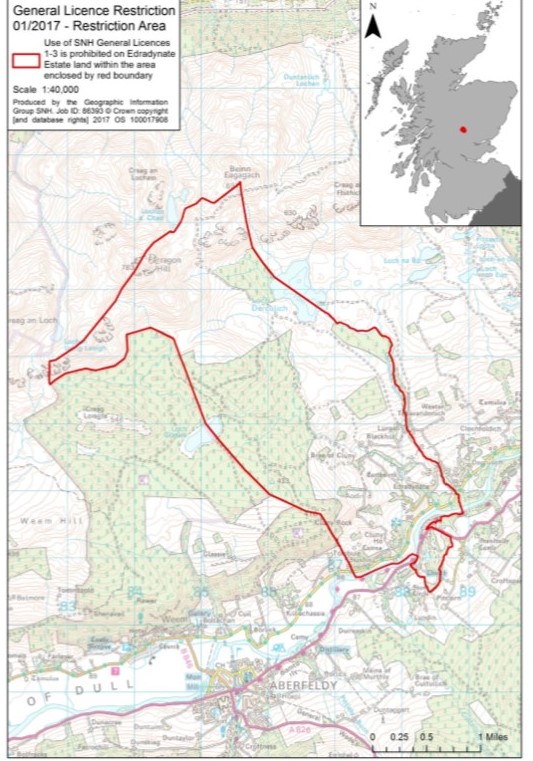
And here is the estate boundary map to which the General Licence restriction applies for the next three years:
For the next three years, Edradynate Estate will no longer be able to enjoy the privilege of using General Licences 1, 2 or 3, but the estate will be entitled to apply for the use of an Individual Licence that will allow them to kill certain bird species but under closer scrutiny than if the estate was using a General Licence. We’ll be monitoring the use of any Individual Licences that SNH approves for this estate, and, if there is any breach of the licence conditions, we fully expect SNH to revoke the Individual Licence just as they did for Raeshaw Estate earlier this year.
SNH has not provided any information about the Police Scotland evidence used as the basis for this General Licence restriction order on Edradynate Estate. However, it’s probably a fair assumption that it relates to the alleged poisoning of several buzzards in 2015. This is one of the five prosecution cases that the Crown Office dropped earlier this year, without explanation. The case did not involve video evidence, as some of the others did, and the case was dropped by the Crown despite a plea from Police Scotland to proceed (see here).
We’ve been blogging about Edradynate Estate for a very long time. It’s well worth reading an earlier summary we wrote (here) which includes some fascinating commentary about the estate by former RSPB Investigator Dave Dick, who claimed as far back as 2004 that the estate was “among the worst in Scotland for wildlife crime“, and commentary by former Police Wildlife Crime Officer Alan Stewart, who said in 2005, “Edraynate Estate has probably the worst record in Scotland for poisoning incidents, going back more than a decade“. The details involve a disturbingly high number of poisoned birds and poisoned baits that were found over the years, as well as a number of dropped prosecution cases (nobody has ever been convicted for any of the alleged offences). The summary also includes information about links between the estate and the Scottish Gamekeepers’ Association.
Now, whether you think a General Licence restriction order is a sufficient sanction against this estate is open to debate. However, while we wait for the Scottish Government to get on with estate licensing, a General Licence restriction order is all that is currently available, so well done to SNH for imposing the General Licence restriction order on this particular estate and for being semi-transparent about the details.
Unfortunately, we can’t say the same about the second General Licence restriction order that SNH has just imposed. We’ll be blogging about that one in the next blog…..it’s an absolute shocker.












 Raptor Persecution UK