Press statement from Norfolk Constabulary (2 January 2024):
APPEAL AFTER BIRD OF PREY POISONED
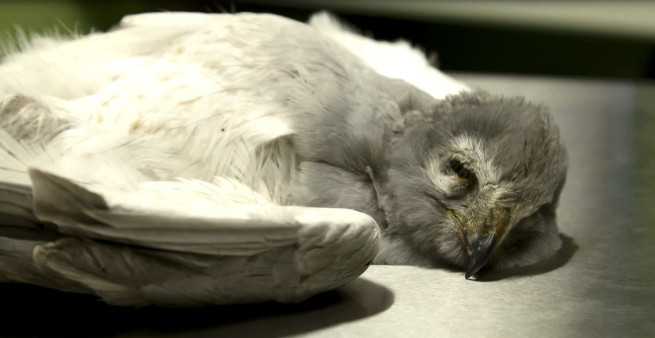
Police are appealing for information after further tests revealed a Red Kite discovered dead in North Creake had died from suspected insecticide poisoning.
Officers from Norfolk Police’s Op Randall team have been investigating the death of the protected bird of prey, which was found dead by a member of the public in a field in North Creake in August 2023, and had suffered no obvious physical injuries.
Further tests were ordered to establish the cause of death and a post-mortem examination carried out through the Wildlife Incident Investigation Scheme (WIIS) at the end of November has subsequently detected a number of pesticides and insecticides, including very high levels of Bendiocarb which has been concluded as the likely cause of death.
Searches carried out out by police alongside National Wildlife Crime Unit officers and the RSPB investigation team to find the source of the substance have so far proved negative and now officers are keen to speak to anyone with information that may help their investigation or who has witnessed anything similar in the area.
Wildlife officer PC Chris Shelley said: “We’ve been waiting for the results of the toxicological analysis, and now know the levels of Bendiocarb contained within the samples taken from the bird have not come from the approved use of such a product.
“I have to conclude that this product has been used illegally in very close proximity to where the bird was recovered.
“Bendiocarb has been the active ingredient in a number of insecticide products in the past approved to deal with wasps and ants. In more recent years the number of products including this ingredient has reduced and its approved use has been to tackle such species inside buildings. Products containing this ingredient can only be purchased and used by professional pesticide users, and only then can they use the product inside a building to reduce the risk to non-target species.
“Red Kites are listed under Schedule 1 of the Wildlife and Countryside Act. We have a zero tolerance approach to the persecution of birds of prey and I’d appeal to anybody who knows anything that may help get to the bottom of what happened here or indeed has any information about anything similar happening, please get in touch with us.”
Anyone with any information is asked to get in touch via the following channels, quoting reference 38/82207/23:
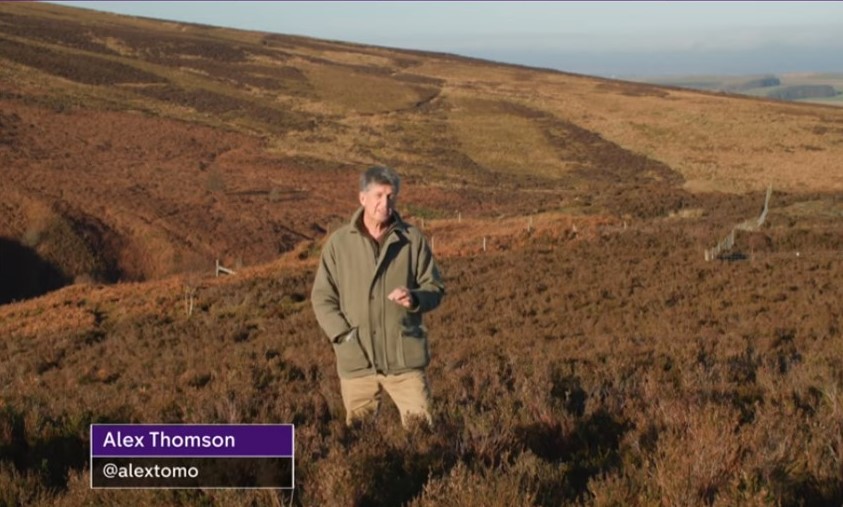
Channel 4 News aired an exclusive seven-minute report this evening about raptor persecution on gamebird shooting estates across the UK.
Fronted by Chief Correspondent Alex Thomson, this was a pre-cursor to the publication tomorrow of the RSPB’s latest Birdcrime report (2022) and the film featured two case studies that are included in that report – the illegal shooting of a hen harrier found dead on the Knarsdale Estate in Northumberland earlier this year, and the illegal poisoning of a red kite and a white-tailed eagle found on a pheasant shoot in West Sussex in October 2021. A beater’s gundog also died from the same poison, on the same estate, within a few days.
I’ll be writing in detail about both these cases and others, once Birdcrime has been published. There’s a lot to say.
In the meantime, I thoroughly recommend you watch the Channel 4 report here:
Anyone who’s been following this blog for any length of time will be aware that the illegal killing of raptors takes place all over the UK, although there are some counties where crimes against birds of prey occur more frequently than in others.
In the most recent Birdcrime report (2021) published by the RSPB, the top three counties with the highest number of confirmed raptor persecution crimes that year were Norfolk (13 incidents), Dorset (12) and North Yorkshire (10). Over a ten-year period, by far the worst county for raptor-killing is North Yorkshire, which is hardly a surprise given its large size that includes vast areas managed for gamebird shooting, including in the lowlands and uplands:
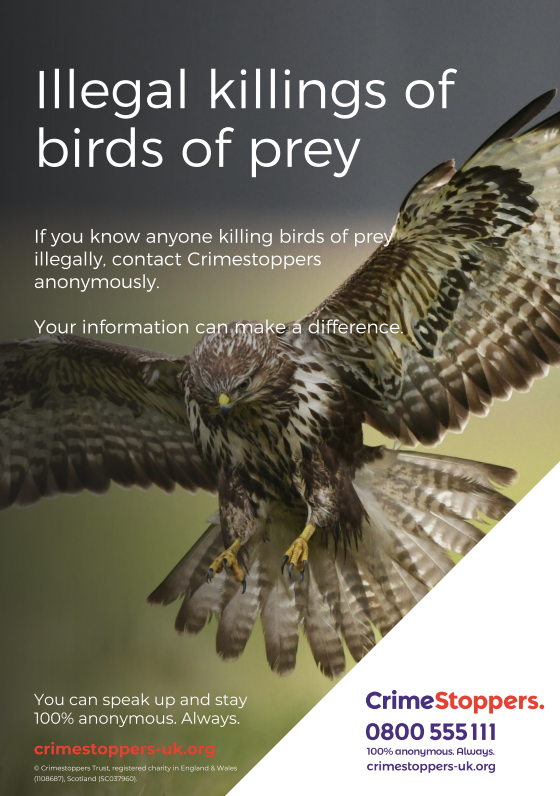
So it was good to see a campaign last week by the charity Crimestoppers, focusing on the illegal killing of raptors in Yorkshire. They published a webpage (here) with information about what signs to look out for and how to report these offences, and this poster was doing the rounds on social media:
A similar awareness-raising campaign featured in Derbyshire Police’s Rural Crime Team newsletter in the summer, re-published on Derbyshire Wildlife Trust’s website (here).
In the article, the Police downplayed the significance of raptor persecution on driven grouse moors, claiming it was ‘historical’, but the information about other aspects of raptor persecution were quite relevant, especially the theft of peregrine eggs and chicks, which Derbyshire sees a fair bit of (e.g. Derbyshire Police recently charged a man with disturbance and egg theft at a peregrine site and he’s due in court next month – here).
It was amusing to see the list of partners that Derbyshire Police claim to be working with to tackle raptor persecution – I wonder how many times members of the Moorland Association and the National Gamekeepers Organisation have assisted police enquiries other than giving ‘no comment’ interviews – but it was good to see the police acknowledge the use of night vision equipment to target roosting raptors:
‘Most offences of shooting birds of prey involve the use of shotguns, although rifle shooting using powerful scopes or night vision aids is also used to kill perched birds at considerable distances‘.
Earlier this month, an RSPB claim that some gamekeepers were using night vision equipment to kill roosting birds of prey made the headlines (here), much to the consternation of the game-shooting industry. Derbyshire Police’s ‘partner’, the National Gamekeepers Organisation, had this to say about it:
‘There is no proof whatsoever that night vision has been used to target raptors; no proof that gamekeepers have been involved in any way, and indeed no proof that the birds are in fact dead. This is simply another attack by the RSPB on gamekeepers and the shooting sector more widely‘ (see here).
But then the game-shooting industry still denies that raptor persecution is even a thing, so they’re hardly going to acknowledge the more devious tactics used by the raptor-killers in their midst, are they?
For anyone who still wants to pretend that the grouse shooting industry isn’t responsible for the systematic extermination of hen harriers on grouse moors across the UK, here’s the latest catalogue of crime that suggests otherwise.
[This male hen harrier died in 2019 after his leg was almost severed in an illegally set trap that had been placed next to his nest on a Scottish grouse moor (see here). Photo by Ruth Tingay]
This is the blog I now publish after every reported killing or suspicious disappearance.
“They disappear in the same way political dissidents in authoritarian dictatorships have disappeared” (Stephen Barlow, 22 January 2021).
Today the list has been updated to include the nine most recently reported victims, all gone since May 2023 (see here and here).
I’ve been compiling this list only since 2018 because that is the year that the grouse shooting industry ‘leaders’ would have us believe that the criminal persecution of hen harriers had stopped and that these birds were being welcomed back on to the UK’s grouse moors (see here).
This assertion was made shortly before the publication of a devastating new scientific paper that demonstrated that 72% of satellite-tagged hen harriers were confirmed or considered likely to have been illegally killed, and this was ten times more likely to occur over areas of land managed for grouse shooting relative to other land uses (see here). Incidentally, a further scientific paper published in 2023 by scientists at the RSPB, utilising even more recent data, echoed these results – see here).
2018 was also the year that Natural England issued a licence to begin a hen harrier brood meddling trial on grouse moors in northern England. For new blog readers, hen harrier brood meddling is a conservation sham sanctioned by DEFRA as part of its ludicrous ‘Hen Harrier Action Plan‘ and carried out by Natural England (NE), in cahoots with the very industry responsible for the species’ catastrophic decline in England. For more background see here and for a critical evaluation of the trial after 5 years see this report by Wild Justice.
Brood meddling has been described as a sort of ‘gentleman’s agreement’ by commentator Stephen Welch:
“I don’t get it, I thought the idea of that scheme was some kind of trade off – a gentleman’s agreement that the birds would be left in peace if they were moved from grouse moors at a certain density. It seems that one party is not keeping their side of the bargain“.
With at least 110 hen harriers gone since 2018, there is no question that the grouse shooting industry is simply taking the piss. Meanwhile, Natural England pretends that ‘partnership working’ is the way to go and DEFRA Ministers remain silent.
Data compiled by RPUK. *No hen harriers brood meddled in 2018
‘Partnership working’ according to Natural England appears to include authorising the removal of hen harrier chicks from a grouse moor already under investigation by the police for suspected raptor persecution (here) and accepting a £75k ‘donation’ from representatives of the grouse shooting industry that prevents Natural England from criticising them or the sham brood meddling trial (see here). This is in addition to a £10k ‘donation’ that Natural England accepted, under the same terms, in 2021 (here).
So here’s the latest gruesome list. Note that the majority of these birds (but not all) were fitted with satellite tags. How many more [untagged] harriers have been killed?
February 2018: Hen harrier Saorsa ‘disappeared’ in the Angus Glens in Scotland (here). The Scottish Gamekeepers Association later published wholly inaccurate information claiming the bird had been re-sighted. The RSPB dismissed this as “completely false” (here).
5 February 2018: Hen harrier Marc ‘disappeared’ on a grouse moor in Durham (here).
9 February 2018: Hen harrier Aalin ‘disappeared’ on a grouse moor in Wales (here).
March 2018: Hen harrier Blue ‘disappeared’ in the Lake District National Park (here).
March 2018: Hen harrier Finn ‘disappeared’ near Moffat in Scotland (here).
18 April 2018: Hen harrier Lia ‘disappeared’ in Wales and her corpse was retrieved in a field in May 2018. Cause of death was unconfirmed but police treating death as suspicious (here).
8 August 2018: Hen harrier Hilma ‘disappeared’ on a grouse moor in Northumberland (here).
16 August 2018: Hen harrier Athena ‘disappeared’ on a grouse moor in Scotland (here).
26 August 2018: Hen Harrier Octavia ‘disappeared’ on a grouse moor in the Peak District National Park (here).
29 August 2018: Hen harrier Margot ‘disappeared’ on a grouse moor in Scotland (here).
29 August 2018: Hen Harrier Heulwen ‘disappeared’ on a grouse moor in Wales (here).
3 September 2018: Hen harrier Stelmaria ‘disappeared’ on a grouse moor in Scotland (here).
24 September 2018: Hen harrier Heather ‘disappeared’ on a grouse moor in Scotland (here).
2 October 2018: Hen harrier Mabel ‘disappeared’ on a grouse moor on the edge of the Yorkshire Dales National Park (here).
3 October 2018: Hen Harrier Thor ‘disappeared’ next to a grouse moor in Bowland, Lanacashire (here).
23 October 2018: Hen harrier Tom ‘disappeared’ in South Wales (here).
26 October 2018: Hen harrier Arthur ‘disappeared’ on a grouse moor in the North York Moors National Park (here).
1 November 2018: Hen harrier Barney ‘disappeared’ on Bodmin Moor (here).
10 November 2018: Hen harrier Rannoch ‘disappeared’ on a grouse moor in Scotland (here). Her corpse was found nearby in May 2019 – she’d been killed in an illegally-set spring trap (here).
14 November 2018: Hen harrier River ‘disappeared’ on a grouse moor in the Nidderdale AONB (here). Her corpse was found nearby in April 2019 – she’d been illegally shot (here).
16 January 2019: Hen harrier Vulcan ‘disappeared’ in Wiltshire close to Natural England’s proposed reintroduction site (here).
28 January 2019: Hen harrier DeeCee ‘disappeared’ in Glen Esk, a grouse moor area of the Angus Glens (see here).
7 February 2019: Hen harrier Skylar ‘disappeared’ next to a grouse moor in South Lanarkshire (here).
22 April 2019: Hen harrier Marci ‘disappeared’ on a grouse moor in the Cairngorms National Park (here).
26 April 2019: Hen harrier Rain ‘disappeared’ on a grouse moor in Nairnshire (here).
11 May 2019: An untagged male hen harrier was caught in an illegally-set trap next to his nest on a grouse moor in South Lanarkshire. He didn’t survive (here).
7 June 2019: An untagged hen harrier was found dead on a grouse moor in Scotland. A post mortem stated the bird had died as a result of ‘penetrating trauma’ injuries and that this bird had previously been shot (here).
5 September 2019: Wildland Hen Harrier 1 ‘disappeared’ on a grouse moor nr Dalnaspidal on the edge of the Cairngorms National Park (here).
11 September 2019: Hen harrier Romario ‘disappeared’ on a grouse moor in the Cairngorms National Park (here).
14 September 2019: Hen harrier (Brood meddled in 2019, #183704) ‘disappeared’ in the North Pennines (here).
23 September 2019: Hen harrier (Brood meddled in 2019, #55149) ‘disappeared’ in North Pennines (here).
24 September 2019: Wildland Hen Harrier 2 ‘disappeared’ on a grouse moor at Invercauld in the Cairngorms National Park (here).
24 September 2019: Hen harrier Bronwyn ‘disappeared’ near a grouse moor in North Wales (here).
10 October 2019: Hen harrier Ada ‘disappeared’ on a grouse moor in the North Pennines AONB (here).
12 October 2019: Hen harrier Thistle ‘disappeared’ on a grouse moor in Sutherland (here).
18 October 2019: Member of the public reports the witnessed shooting of an untagged male hen harrier on White Syke Hill in North Yorkshire (here).
November 2019: Hen harrier Mary found illegally poisoned on a pheasant shoot in Ireland (here).
November 2019: Hen harrier Artemis ‘disappeared’ near Long Formacus in south Scotland (RSPB pers comm).
14 December 2019: Hen harrier Oscar ‘disappeared’ in Eskdalemuir, south Scotland (here).
December 2019: Hen harrier Ingmar ‘disappeared’ in the Strathbraan grouse moor area of Perthshire (RSPB pers comm).
January 2020: Members of the public report the witnessed shooting of a male hen harrier on Threshfield Moor in the Yorkshire Dales National Park (here).
23 March 2020: Hen harrier Rosie ‘disappeared’ at an undisclosed roost site in Northumberland (here).
1 April 2020: Hen harrier (Brood meddled in 2019, #183703) ‘disappeared’ in unnamed location, tag intermittent (here).
5 April 2020: Hen harrier Hoolie ‘disappeared’ on a grouse moor in the Cairngorms National Park (here)
8 April 2020: Hen harrier Marlin ‘disappeared’ on a grouse moor in the Cairngorms National Park (here).
19 May 2020: Hen harrier Fingal ‘disappeared’ on a grouse moor in the Lowther Hills, Scotland (here).
21 May 2020: Hen harrier (Brood meddled in 2019, #183701) ‘disappeared’ on a grouse moor in Cumbria shortly after returning from wintering in France (here).
27 May 2020: Hen harrier Silver ‘disappeared’ on a grouse moor on Leadhills Estate, Scotland (here).
2020: day/month unknown: Unnamed male hen harrier breeding on RSPB Geltsdale Reserve, Cumbria ‘disappeared’ while away hunting (here).
9 July 2020: Unnamed female hen harrier (#201118) ‘disappeared’ from an undisclosed site in Northumberland (here).
25 July 2020: Hen harrier Harriet ‘disappeared’ on a grouse moor in the Yorkshire Dales National Park (here).
14 August 2020: Hen harrier Solo ‘disappeared’ in confidential nest area in Lancashire (here).
7 September 2020: Hen harrier Dryad ‘disappeared’ on a grouse moor in the Yorkshire Dales National Park (here).
16 September 2020: Hen harrier Fortune ‘disappeared’ from an undisclosed roost site in Northumberland (here).
19 September 2020: Hen harrier Harold ‘disappeared’ on a grouse moor in the Yorkshire Dales National Park (here).
20 September 2020: Hen harrier (Brood meddled in 2020, #55152) ‘disappeared’ next to a grouse moor in North Yorkshire (here).
24 February 2021: Hen harrier Tarras ‘disappeared’ next to a grouse moor in Northumberland (here)
12th April 2021: Hen harrier Yarrow ‘disappeared’ near Stockton, County Durham (here).
18 May 2021: Adult male hen harrier ‘disappeared’ from its breeding attempt on RSPB Geltsdale Reserve, Cumbria whilst away hunting (here).
18 May 2021: Another adult male hen harrier ‘disappeared’ from its breeding attempt on RSPB Geltsdale Reserve, Cumbria whilst away hunting (here).
24 July 2021: Hen harrier Asta ‘disappeared’ at a ‘confidential site’ in the North Pennines (here). We learned 18 months later that her wings had been ripped off so her tag could be fitted to a crow in an attempt to cover up her death (here).
14th August 2021: Hen harrier Josephine ‘disappeared’ at a ‘confidential site’ in Northumberland (here).
17 September 2021: Hen harrier Reiver ‘disappeared’ in a grouse moor dominated region of Northumberland (here)
24 September 2021: Hen harrier (Brood meddled in 2021, R2-F-1-21) ‘disappeared’ in Northumberland (here).
15 November 2021: Hen harrier (brood meddled in 2020, #R2-F1-20) ‘disappeared’ at the edge of a grouse moor on Arkengarthdale Estate in the Yorkshire Dales National Park (here).
19 November 2021: Hen harrier Val ‘disappeared’ in the Lake District National Park in Cumbria (here).
19 November 2021: Hen harrier Percy ‘disappeared’ in Lothian, Scotland (here).
12 December 2021: Hen harrier Jasmine ‘disappeared’ on a grouse moor (High Rigg Moor on the Middlesmoor Estate) in the Nidderdale AONB in North Yorkshire (here).
9 January 2022: Hen harrier Ethel ‘disappeared’ in Northumberland (here).
26 January 2022: Hen harrier Amelia ‘disappeared’ in Bowland (here).
10 February 2022: An unnamed satellite-tagged hen harrier ‘disappeared’ in a grouse moor dominated area of the Peak District National Park (here). One year later it was revealed that the satellite tag/harness of this young male called ‘Anu’ had been deliberately cut off (see here).
12 April 2022: Hen harrier ‘Free’ (Tag ID 201121) ‘disappeared’ at a ‘confidential site’ in Cumbria (here). It later emerged he hadn’t disappeared, but his mutilated corpse was found on moorland in the Yorkshire Dales National Park. A post mortem revealed the cause of death was having his head twisted and pulled off. One leg had also been torn off whilst he was still alive (here).
April 2022: Hen harrier ‘Pegasus’ (tagged by the RSPB) ‘disappeared’ on a grouse moor at Birkdale in the Yorkshire Dales National Park (here).
May 2022: A male breeding hen harrier ‘disappeared’ from a National Trust-owned grouse moor in the Peak District National Park (here).
May 2022: Another breeding male hen harrier ‘disappeared’ from a National Trust-owned grouse moor in the Peak District National Park (here).
14 May 2022: Hen harrier ‘Harvey’ (Tag ID 213844) ‘disappeared’ from a ‘confidential site’ in the North Pennines (here).
20 June 2022: Hen harrier chick #1 stamped to death in nest on a grouse moor in the Yorkshire Dales National Park (here).
20 June 2022: Hen harrier chick #2 stamped to death in nest on a grouse moor in the Yorkshire Dales National Park (here).
20 June 2022: Hen harrier chick #3 stamped to death in nest on a grouse moor in the Yorkshire Dales National Park (here).
20 June 2022: Hen harrier chick #4 stamped to death in nest on a grouse moor in the Yorkshire Dales National Park (here).
17 August 2022: Hen harrier (brood meddled in 2022, #R1-M1-22) ‘disappeared’ on moorland in the Yorkshire Dales National Park (here).
September 2022: Hen harrier ‘Sullis’ (tagged by the RSPB) ‘disappeared’ on a grouse moor in Cumbria (here).
5 October 2022: Hen harrier (brood meddled in 2022, #R3-M2-22) ‘disappeared’ on moorland in the Yorkshire Dales National Park (here).
10 October 2022: Hen harrier ‘Sia’ ‘disappeared’ near Hamsterley Forest in the North Pennines (here).
October 2022: Hen harrier (brood meddled in 2021, #R1-F1-21) ‘disappeared’ in the North Sea off the North York Moors National Park (here).
December 2022: Hen harrier female (brood meddled in 2020, #R2-F2-20) ‘disappeared’ on moorland in Cumbria (here).
1 December 2022: Hen harrier male (brood meddled in 2021, #R1-M1-21) ‘disappeared’ on moorland in the Yorkshire Dales National Park (here).
14 December 2022: Hen harrier female (brood meddled in 2022, #R3-F1-22) ‘disappeared’ on moorland in the North Pennines AONB (here).
15 December 2022: Hen harrier female (brood meddled in 2022, #R2-F1-22) ‘disappeared’ on moorland in the Yorkshire Dales National Park (here).
30 March 2023: Hen harrier female (brood meddled in 2022, #R1-F3-22) ‘disappeared’ in Yorkshire (here). Notes from NE Sept 2023 spreadsheet update: “Final transmission location temporarily withheld at police request“.
1 April 2023: Hen harrier male (brood meddled in 2022, #R2-M1-22) ‘disappeared’ in Yorkshire (here). Notes from NE Sept 2023 spreadsheet update: “Final transmission location temporarily withheld at police request“.
April 2023: Hen harrier ‘Lagertha’ (tagged by RSPB) ‘disappeared’ in North Yorkshire (here).
April 2023: Hen harrier ‘Nicola’ (Tag ID 234078) ”disappeared’ in North Yorkshire (here).
April 2023: Untagged male hen harrier ‘disappeared’ from an active nest on RSPB Geltsdale Reserve in Cumbria (here).
April 2023: Another untagged male hen harrier ‘disappeared’ from an active nest on RSPB Geltsdale Reserve in Cumbria (here).
April 2023: Untagged male hen harrier ‘disappeared’ from an active nest in Durham (here).
4/5 May 2023: Satellite-tagged male hen harrier called ‘Rush’ ‘disappeared’ from a grouse moor in Bowland AONB in Lancashire (here).
17 May 2023: Satellite-tagged hen harrier called ‘Wayland’ ‘disappeared’ in the Clapham area of North Yorkshire, just north of the Bowland AONB (here).
31 May 2023: Hen harrier male (brood meddled in 2022, tag #213932, name: R2-M3-22) ‘disappeared’ in Northumberland (grid ref: NY765687) (here).
11 June 2023: Hen harrier male (brood meddled in 2021, tag #213922, name: R2-M1-21) ‘disappeared’ at a confidential site in the Yorkshire Dales National Park. Notes from the NE spreadsheet: “Final transmission location temporarily withheld at police request“ (here).
12 June 2023: Hen harrier male (brood meddled in 2020, tag #203004, name: R1-M2-20) ‘disappeared’ on a grouse moor in Co. Durham (grid ref: NY976322) (here).
6 July 2023: Satellite-tagged female hen harrier named ‘Rubi’ (tag #201124a) ‘disappeared’ on a grouse moor in Co. Durham (grid ref: NY911151) (here).
23 July 2023: Hen harrier female (brood meddled in 2023, tag #55154a, name: R1-F1-23) ‘disappeared’ on a grouse moor in Co. Durham (close to where ‘Rubi’ vanished), grid ref: NY910126 (here).
29 July 2023: Hen harrier female (brood meddled in 2020, tag #55144, name: R2-F2-20) ‘disappeared’ at a confidential site in the North Pennines. Notes from the NE spreadsheet: “Dead. Recovered – awaiting PM results. Final transmission location temporarily withheld at police request“ (here).
9 August 2023: Satellite-tagged hen harrier called ‘Martha’ ‘disappeared’ on a grouse moor (Westburnhope Moor) near Hexham in the North Pennines (here).
11 August 2023: Satellite-tagged hen harrier called ‘Selena’ ‘disappeared’ on a grouse moor (Mossdale Moor) in the Yorkshire Dales National Park (here).
11 August 2023: Hen harrier female (brood meddled in 2023, tag #201118a, name: R3-F1-23) ‘disappeared’ in Co. Durham (grid ref: NZ072136) (here).
15 August 2023: Satellite-tagged hen harrier called ‘Hepit’ ‘disappeared’ on a grouse moor (Birkdale Common) near Kirkby Stephen in the Yorkshire Dales National Park (here).
24 August 2023: Hen harrier female (brood meddled in 2023, tag #55155a, name: R1-F2-23) ‘disappeared’ at a confidential site in Northumberland. Notes from the NE spreadsheet: “Final transmission location temporarily withheld at police request“ (here).
August-Sept 2023: Satellite-tagged hen harrier called ‘Harmonia’ ‘disappeared’ in the Yorkshire Dales National Park (here).
To be continued…….
Not one of these 110 incidents has resulted in an arrest, let alone a prosecution. I had thought that when we reached 30 dead/missing hen harriers then the authorities might pretend to be interested and at least say a few words about this national scandal. We’ve now reached ONE HUNDRED AND TEN hen harriers, and still Govt ministers remain silent. They appear not to give a monkey’s. And yes, there are other things going on in the world, as always. That is not reason enough to ignore this blatant, brazen and systematic destruction of a supposedly protected species, being undertaken to satisfy the greed and bloodlust of a minority of society.
And let’s not forget the response from the Moorland Association Chair (and owner of Swinton Estate) Mark Cunliffe-Lister, who told BBC Radio 4 last month that, “Clearly any illegal [hen harrier] persecution is not happening” (here).
WHITE-TAILED EAGLE CHICKS SPREAD THEIR WINGS FURTHER INTO IRISH SKIES
24 white-tailed eagle chicks were released in August around the country, as part of an ongoing National Parks and Wildlife Service (NPWS) programme to reintroduce this once extinct species
A total of 171 white-tailed eagles have now been released through the programme to date
A small, established population of eagles is now fledging chicks around the country and has even produced triplets
Over the past week, twenty-four white-tailed eagle chicks have been released in locations around Lough Derg, the Shannon Estuary and the west of Ireland, as part of a long term reintroduction programme managed by the NPWS.
White-tailed eagles are predators who play an important role in nature and the ecosystem.
Once native to Ireland, they became extinct in the nineteenth century. Since 2007, the NPWS has been working with partners in Norway along with farmers and communities around the country to reintroduce the white-tailed eagle to Ireland.
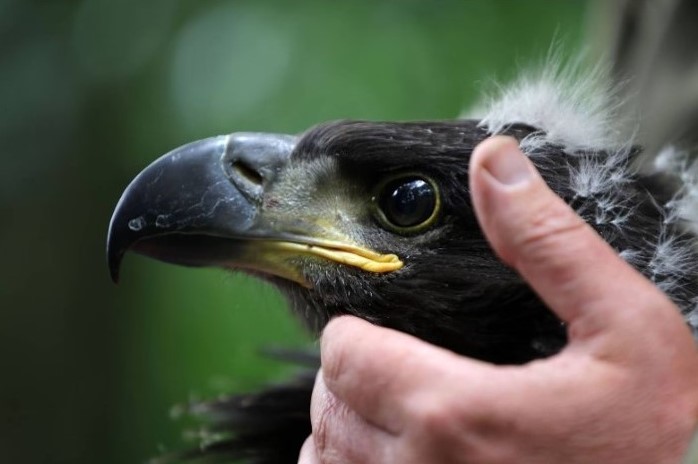
Young White-tailed eagle. Photo: Valerie O’Sullivan
Minister of State for Heritage and Electoral Reform, Malcolm Noonan TD, who released four chicks at Killarney National Park as part of the release programme, said:
“The juvenile white-tailed eagles we have released this week are joining a growing population across our island. This incredible endeavour is the result of 16 years’ work and collaboration, not just on the reintroduction programme, but also on habitat restoration and engagement with landowners to secure their ongoing protection.
These apex predators perform a vital role in our ecosystems and the sight of them soaring in the thermals is a privilege that everyone who lives in or visits Ireland will now have the opportunity to enjoy. I would like to pay tribute to NPWS staff for their commitment and dedication to this initiative, our international partners from Norway, and the communities around the country who are embracing the return of the white-tailed eagle to our landscapes.”
A comprehensive satellite tagging system is now in place so that the birds can be monitored as they disperse around the country.
Minister for Housing, Local Government and Heritage, Darragh O’Brien who also participated in the release of chicks at in the vicinity of Lough Derg added:
“This reintroduction programme is the result of a combined effort by my Department’s National Parks and Wildlife Service, participating landowners and communities and endangered species experts. I commend each of them for the role they are playing in protecting these iconic birds of prey“.
Niall Ó Donnchú, Director General with the NPWS said:
“This programme is one of several initiatives underway in the NPWS to protect endangered species in Ireland and prevent their decline. This work takes time, and calls for a partnership approach if it is to be sustainable in the long term. Collaboration with the science community and international partners, along with the involvement of our expert staff and communities around the country has been key to the success we have seen so far“.
Eamonn Meskell, Divisional Manager NPWS, Killarney National Park who heads up the white-tailed eagle reintroduction Programme added:
“There is huge interest from the public in the white-tailed eagle programme. Locations where they are spotted attract many visitors and local interest and we love to hear about sightings of the birds around Ireland and further afield. There are great stories to tell about the project. For example, the first Irish bred female to breed in over a hundred years has fledged seven chicks in three years! In Lough Derg this year for the second time a nesting pair fledged triplets. This is incredibly unusual – even in the wilds of Norway, and it shows how well suited Ireland really is for the white-tailed eagle from both a habitat and a feeding perspective. We’ll be watching this year’s chicks with interest as they mature and hopefully go on to fledge more chicks“.
Bente Lyngstad, chargé d’affaires at the Norwegian Embassy in Ireland said:
“Watching the release of the white-tailed sea eagles is a truly extraordinary and mighty experience. Over the years more than 150 eagle chicks have been collected in Norway and released in Ireland. Today’s stock in Ireland is the result of a long-term collaboration between Norway and Ireland, which again stems from our deep friendship and our shared values. I would like to acknowledge all volunteers whose efforts have been imperative to make this happen“.
The retention of species is essential for maintaining the intricate web of life and the functioning of ecosystems. It contributes to the sustainable use of natural resources and the well-being of both present and future generations. Yet we now see a rapid loss of species world-wide. This development must be halted. The reintroduction of white-tailed sea eagles into their natural habitat is a great example of how we can work together against biodiversity loss.”
ENDS
These releases form part of phase two of the reintroduction project. Phase one involved releasing 100 White-tailed eagles into Killarney National Park in County Kerry, between 2007-2011. A scientific review of the project in 2019 suggested that the small population was still vulnerable to issues such as Avian Influenza, extreme weather events and illegal poisoning so phase two began in 2020, to reintroduce more young birds and release them in different parts of the country.
Unfortunately some of the eagles released in phase two have already been killed illegally after consuming poisoned bait (see here and here).
Twin brothers Alexander and Robert McKellar have today been sentenced at the High Court in Glasgow for their roles in knocking down cyclist Tony Parsons and burying his body in a stink pit on the notorious Auch Estate near the Bridge of Orchy, where their father had previously been convicted for the illegal possession of two hand guns and a banned pesticide (Carbofuran) after the discovery of a poisoned golden eagle (see here).
Alexander & Robert McKellar. Photos: Police Scotland
Alexander McKellar, who had previously been charged with murder but pleaded guilty to a lesser charge of culpable homicide, was sentenced to 12 years in prison.
Robert McKellar was sentenced to five years and three months for attempting to defeat the ends of justice by assisting his brother in covering up the crime by burying Mr Parsons in a remote spot on the Auch Estate.
Aerial view of Auch Estate. Photo: COPFS
Mr Parsons was knocked off his bicycle by Alexander McKellar’s vehicle, part-way through a charity ride on a rainy night in September 2017. Instead of providing him with assistance, the McKellar twins drove back to Auch Estate, switched vehicles, and returned to collect Mr Parsons and his possessions and then hid everything under a tarpaulin in some woods on the estate. Mr Parson’s body was later moved to a stink pit on the estate where he was buried, and the McKellar twins burned his possessions.
Their hideous crimes only came to light in 2021 after Alexander McKellar confessed to his then girlfriend, who went to the police. That they’d been able to conceal these offences for so long, despite major searches by Police Scotland officers, mountain rescue teams, police dogs, police air support unit, as well as volunteers, and with repeated media appeals, is a clear demonstration of how easy it is for criminal evidence to be hidden on vast, remote sporting estates. Makes you think, doesn’t it?
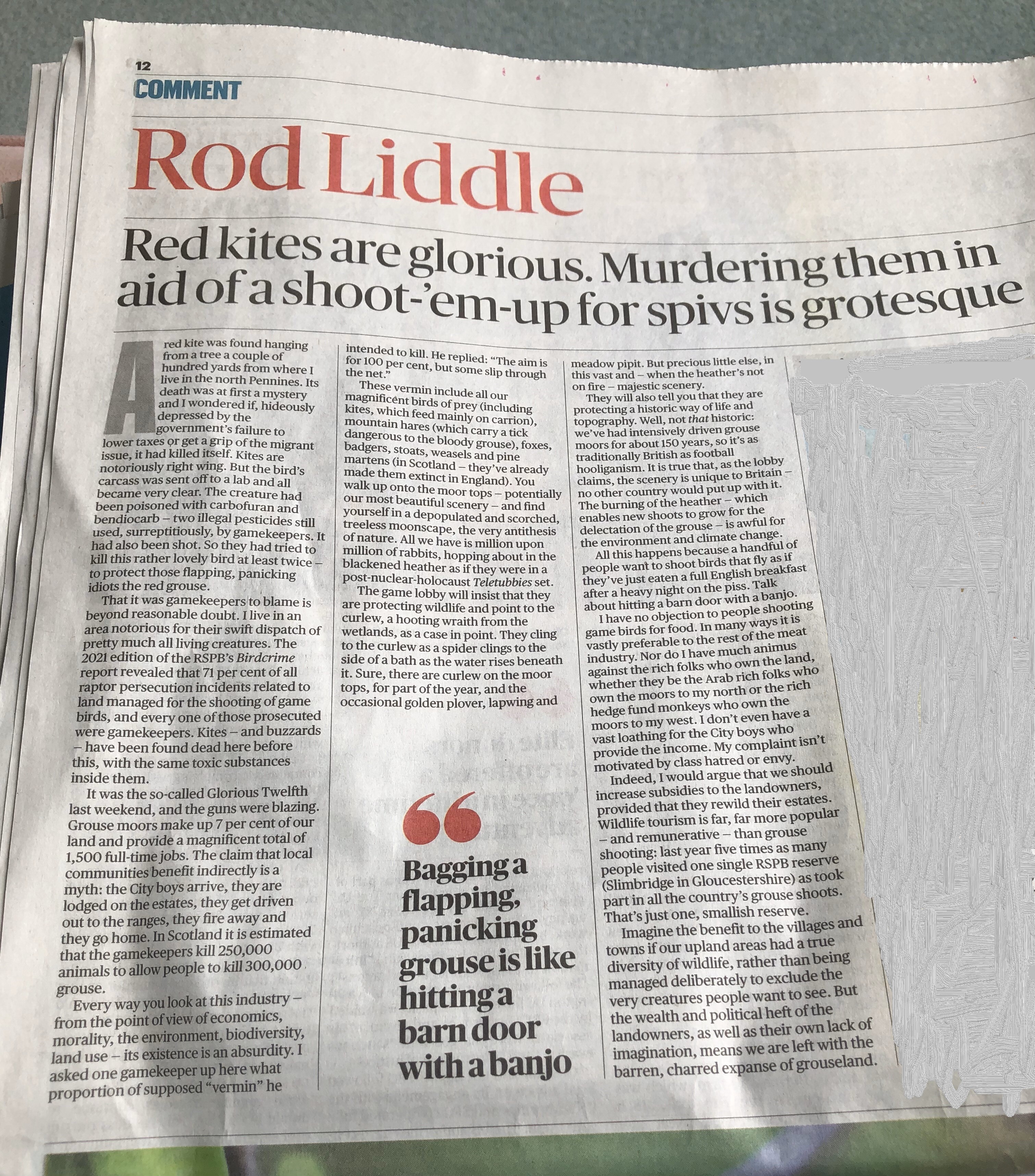
Journalist Rod Liddle has taken another swipe at grouse shooting with the following article in The Sunday Times yesterday:
It’s not the first time – last year his criticism of grouse shooting prompted furious responses from the Countryside Alliance and GWCT, although BASC bizarrely used it as an opportunity to hurl abuse at Megan McCubbin (you can read their full-on attack here).
Liddle doesn’t appear to be a fan of the Countryside Alliance in general, writing an article for the Guardian in 2002 about the London march to save fox hunting, which ultimately led to his resignation from the BBC after a backlash accusing him of not being impartial (see here and here).
Hmm, given this trophy scalp perhaps it explains why the nasty brigade keeps urging the BBC to sack Chris Packham. ‘If they got rid of Liddle, why not Packham?’, is what they’ll be telling themselves.
Here’s the text of Liddle’s latest piece published in The Sunday Times yesterday:
RED KITES ARE GLORIOUS. MURDERING THEM IN AID OF A SHOOT-‘EM-UP FOR SPIVS IS GROTESQUE
Rod Liddle
A red kite was found hanging from a tree a couple of hundred yards from where I live in the north Pennine. Its death was at first a mystery and I wondered if, hideously depressed by the government’s failure to lower taxes or get a grip of the migrant issue, it had killed itself. Kites are notoriously right wing. But the bird’s carcass was sent off to a lab and all became very clear. The creature had been poisoned with carbofuran and bendiocarb – two illegal pesticides still used, surreptitiously, by gamekeepers. It had also been shot. So they had tried to kill this rather lovely bird at least twice – to protect those flapping, panicking idiots the red grouse.
That it was gamekeepers to blame is beyond reasonable doubt. I live in an area notorious for their swift dispatch of pretty much all living creatures. The 2021 edition of the RSPB’s Birdcrime report revealed that 71 per cent of all raptor persecution incidents related to land managed for the shooting of game birds, and every one of those prosecuted were gamekeepers. Kites – and buzzards – have been found dead here before this, with the same toxic substances inside them.
It was the so-called Glorious Twelfth last weekend, and the guns were blazing. Grouse moors make up 7 per cent of our land and provide a magnificent total of 1,500 full-time jobs. The claim that local communities benefit indirectly is a myth: the City boys arrive, they are lodged on the estates, they get driven out to the ranges, they fire away and they go home. In Scotland is is estimated that the gamekeepers kill 250,000 animals to allow people to kill 300,000 grouse.
Every way you look at this industry – from the point of view of economics, morality, the environment, biodiversity, land use – its existence is an absurdity. I asked one gamekeeper up here what proportion of supposed “vermin” he intended to kill. He replied: “The aim is for 100 per cent, but some slip through the net”.
These vermin include all our magnificent birds of prey (including kites, which feed mainly on carrion), mountain hares (which carry a tick dangerous to the bloody grouse), foxes, badgers, stoats, weasels and pine martens (in Scotland – they’ve already made them extinct in England). You walk up onto the moor tops – potentially our most beautiful scenery – and find yourself in a depopulated and scorched, treeless moonscape, the very antithesis of nature. All we have is million upon million of rabbits, hopping about in the blackened heather as if they were in a post-nuclear-holocaust Teletubbies set.
The game lobby will insist that they are protecting wildlife and point to the curlew, a hooting wraith from the wetlands, as a case in point. They cling to the curlew as a spider clings to the side of a bath as the water rises beneath it. Sure, there are curlew on the moor tops, for part of the year, and the occasional golden plover, lapwing and meadow pipit. But precious little else, in this vast and – when the heather’s not on fire – majestic scenery.
They will also tell you that they are protecting a historic way of life and topography. Well, not that historic: we’ve had intensively driven grouse moors for about 150 years, so it’s as traditionally British as football hooliganism. It is true that, as the lobby claims, the scenery is unique to Britain – no other country would put up with it. The burning of the heather – which enables new shoots to grow for the delectation of the grouse – is awful for the environment and climate change.
All this happens because a handful of people want to shoot birds that fly as if they’ve just eaten a full English breakfast after a heavy night on the piss. Talk about hitting a barn door with a banjo.
I have no objection to people shooting game birds for food. In many ways it is vastly preferable to the rest of the meat industry. Nor do I have much animus against the rich folks who own the land, whether they be the Arab rich folks who own the moors to my north or the rich hedge fund monkeys who own the moors to my west. I don’t even have a vast loathing for the City boys who provide the income. My complaint isn’t motivate by class hatred or envy.
Indeed, I would argue that we should increase subsidies to the landowners, provided that they rewild their estates. Wildlife tourism is far, far more popular – and remunerative – than grouse shooting: last year five times as many people visited one single RSPB reserve (Slimbridge in Gloucestershire) as took part in all the country’s grouse shoots. That’s just one, smallish reserve.
Imagine the benefit to the villages and towns if our upland areas had a true diversity of wildlife, rather than being managed deliberately to exclude the very creatures people want to see. But the wealth and political heft of the landowners, as well as their own lack of imagination, means we are left with the barren, charred expanse of grouseland.
Just how stupid/arrogant do you have to be to go on record saying, “Clearly, any illegal [hen harrier] persecution is not happening“, when it so demonstrably is?!
This is what Mark Cunliffe-Lister, Chair of the grouse moor owners’ lobby group, the Moorland Association, told BBC Radio 4’s Farming Today programme this morning.
It’s an astonishing claim to make when the evidence to refute such a claim is so readily available, and even more so on the day when we learned that at least 101 hen harriers have now gone ‘missing’ / been illegally killed since 2018 (see here).
Although Cunliffe-Lister does have a history of ‘forgetting’ to mention things when it comes to hen harrier persecution (see here). Oh, and he also forgot to mention this morning the poisoned red kite that was discovered on his estate (Swinton) in 2021 – the one that North Yorkshire Police refused to investigate (see here).
When Cunliffe-Lister was called out on his claim by the interviewer Caz Graham, he had the brass neck to argue that there “do seem to beisolated incidents“. Does he think that 101 missing/killed hen harriers are ‘isolated incidents’?? Oh, and some of those 101 include brood meddled hen harriers.
Also interviewed on this morning’s programme was John Holmes, Director of Strategy at Natural England and who oversees the hen harrier brood meddling sham. Holmes was questioned at length about Wild Justice’s criticisms of the hen harrier brood meddling sham, including the unimpressive scientific approach to the trial. Holmes argued that Natural England was being advised by an independent panel of ornithologists and statisticians. What he didn’t say, as Mark Avery pointed out on Twitter, is that the identities of those ornithologists and statisticians is being kept a secret, as is their scientific advice.
Holmes also argued that Natural England has ‘expert social scientists’ to examine whether brood meddling has changed the opinion of grouse moor owners and managers towards hen harriers. NE don’t need ‘expert social scientists’ to find an answer, the illegal persecution statistics tell us all we need to know.
The interview is available on BBC iPlayer for the next 29 days (here, starts at 4.59 mins) but I’ve produced a transcript for posterity:
Presenter Caz Graham: Hen harriers are beautiful birds that live in the uplands across the UK but their numbers are precariously low, particularly in England.
These low numbers are blamed on predation and on persecution by gamekeepers who illegally target birds of prey because they feed on grouse eggs and chicks. Most hen harrier nests in England are on land managed as grouse moor.
To try and rebuild the population a Government-led Hen Harrier Recovery Plan began in 2016. One element of it is a trial of what’s called ‘brood management’, where eggs and chicks are taken from hen harrier nests, raised in captivity and re-released later back in to the wild so their parents take fewer grouse chicks to feed them.
The Moorland Association, one of several partners in the brood management trial say that this year has been a real success with 24 chicks released. The population of hen harriers in England is now at the highest it’s been for 100 years, they say.
The wildlife campaign group Wild Justice welcomes the increase in hen harrier numbers but is critical of brood management. I put some of their points to Mark Cunliffe-Lister, the Chair of the Moorland Association who first gave me his response to these latest figures.
Chair of Moorland Association Mark Cunliffe-Lister: It’s been a fantastic success, we’ve shown that as a dedicated team we can take the chicks from the nest, we can breed them in captivity, we can re-release them on another site and they can live a perfectly good wild life going forwards.
Caz Graham: How have the birds that have been reared this way in previous years fared? Presumably they’re all tagged, they’re all tracked, you know how they’re doing?
Mark Cunliffe-Lister: Yep, no, absolutely. So, I mean like everything in the wild, they look around for different territories, they move about. I think one of the interesting things has been when we release them is they’re not necessarily, quite a lot of hen harriers will come back to exactly where they were born and bred, these ones will look around for other territories so that’s been very successful as they’ve taken on different territories and gone to different areas.
Caz Graham: Have they bred themselves?
Mark Cunliffe-Lister: Yes, they’ve bred themselves as well so they’ve shown breeding technique,sadly some of them have died but that’s the same in the wild, you have mortality going on in the wild.
Caz Graham: Wild Justice is very critical of brood management, in fact they call it brood meddling rather than management and they published a report last week saying it is a waste of money. They argue that that money could be spent in other conservation areas and that there isn’t really robust scientific evidence to prove that it’s doing any good.
Mark Cunliffe Lister: The figures speak for themselves in terms of how successful it’s been, so going from hardly any hen harriers now to having hundreds of hen harrier chicks that have been bred through the scheme and through the wild, so in terms of Wild Justice, clearly they’re anti-grouse shooting and that’s their agenda and that’s fine, but as a conservation programme I’d say it’s been an incredible success and very happy to sit down and go through the numbers and compare that with other schemes and we can see, can compare that.
Caz Graham: How would you respond to their claim that really this is just a delaying tactic to put off more stringent and effective measures against those gamekeepers who break the law by either shooting or poisoning birds of prey?
Mark Cunliffe-Lister: Yeah, well it’s clearly not about that and clearly it’s dealing with any conflict there so we’re seeing birds every day flying around grouse moors, with keepers, we’re seeing them on, by tag data, we’re seeing them in the air so clearly any illegal killing is not happening. They would like to say it is but you can see that for your own eyes that it isn’t happening.
Caz Graham: Oh well there is evidence that illegal killing happens, we do report on cases where gamekeepers have been convicted, even, for shooting or for poisoning birds of prey.
Mark Cunliffe-Lister: Yeah, there, sadly do seem to be isolated incidents.
Caz Graham: And where do you see brood management going in the future because some would say it’s not a very sustainable kind of way forward is it?
Mark Cunliffe-Lister: Oh I’d say it’s very sustainable. As I say, we’re clear that there is a conflict between hen harriers and grouse, we’re not hiding away from that and this allows it to be managed, so it’s a job that people came together, decided what the best way forward was, brood management was the way they thought would work best, we put that in to practice, we’ve shown it does work and yeah, I’d say it’s very sustainable moving forwards.
Caz Graham: Mark Cunliffe-Lister from the Moorland Association. We asked Wild Justice to come on this morning’s programme but without seeing more extensive data from Natural England, they declined. Well, Natural England, the Government’s advisor on nature is also a partner in the brood management trial project. John Holmes, a strategy director for Natural England oversees it.
Natural England Strategy Director John Holmes: The purpose of the brood management trial is to test the significance of the availability of brood management to moorland managers in achieving that increase.
Caz Graham: And Natural England lead the monitoring for this project. The Moorland Association tell us that they have reared and released 24 chicks this year, does that figure tally with what you have?
John Holmes: That’s absolutely right, we work alongside them in that work and that’s spot on.
Caz Graham: Can you explain to us who funds this project and how much it’s cost so far?
John Holmes: Part of it is funded by the industry itself through the Moorland Association so actually all the practical work to do brood management is funded by them, release aviaries, buying tags for monitoring and things. Natural England we estimate has spent around £800,000 since the trial started but that will be on things like staff to undertake sound assessment of the science that underlines the licences to allow it to happen and alongside that some work on persecution and investigations.
Caz Graham: £800,000, that sounds like an awful lot really.
John Holmes: Well I would say that sounds good value for recovering of a species that’s been completely extinct. Years and years of way more money than that being spent on investigation but no successful prosecutions whatsoever. We know that illegal persecution goes on and we’re continuing to investigate it. We certainly know that it would cost hundred of thousands for protection of a single nest by the police year round so actually in terms of the increase we’ve got that’s really good value for money.
Caz Graham: Isn’t just cracking down on the criminal element who persecute raptors, birds of prey, isn’t that really where the focus should be?
John Holmes: The simple answer is it hasn’t worked, you know, enforcement was tried and it still goes on, you know, we absolutely back enforcement and work with the police to try and find those criminals but it simply didn’t work. The other thing is to say cracking down on criminals assumes that everybody who manages a moor, or owns a moor, is a criminal and the simple fact is that if landowners and gamekeepers come to us and say, ‘Look, we want to have hen harriers, we want to look after hen harriers’, we’re gonna work with them because the results are clear.
Caz Graham: A point that Wild Justice might well make though is that you’re dealing with a criminal act by perhaps just removing the temptation rather than arresting the perpetrators, you know it’s a bit like ignoring car thieves in an area but paying for a few cars to be stuck in a garage.
John Holmes: I think a better analogy would be to assume that if you’re having your car stolen you’re assuming everyone you meet near your car is gonna steal it and that’s simply not the case.
Caz Graham: I want to put to you another questions as well about Wild Justice’s claims. They say they’re really unimpressed by the standard of scientific enquiry that’s evident in Natural England’s brood management study. How would you respond to that?
John Holmes: Well we’ve got an independent panel that advises us on that science, made up of ornithological and statistical experts, it is a trial, things aren’t always perfect in both the planning and execution, you have to react to real situations on the ground. One of the things we’re trying to measure is how the availability of brood management has influenced people’s opinions of hen harriers and may have resulted in less persecution. That’s really hard to do, it’s not easy to figure out what questions you ask but we’ve got expert social scientists who know how to ask those sorts of questions and we’re still part way through the trial.
Caz Graham: I mean the trial’s been going on for five years, it’s had an extra two years added to it, I mean, gosh, is it still a trial, can you still call it a trial at that length?
John Holmes: It’s still a trial because we don’t actually know the answer to the significance of brood management in achieving the outcome that we’ve got so far.
Caz Graham: So how many years can the trial go on? When will you be able to say whether it does work?
John Holmes: Well it’ll go on until we get a scientifically robust answer. We’re hoping that these next two years will significantly increase our information and lead to some better answers and where we might take hen harrier management in the future.
For anyone who still wants to pretend that the grouse shooting industry isn’t responsible for the systematic extermination of hen harriers on grouse moors across the UK, here’s the latest catalogue of crime that suggests otherwise.
[This male hen harrier died in 2019 after his leg was almost severed in an illegally set trap that had been placed next to his nest on a Scottish grouse moor (see here). Photo by Ruth Tingay]
This is the blog I now publish after every reported killing or suspicious disappearance.
“They disappear in the same way political dissidents in authoritarian dictatorships have disappeared” (Stephen Barlow, 22 January 2021).
Today the list has been updated to include the three most recently reported victims, all going missing on grouse moors (see here): hen harrier Martha who ‘vanished’ on Westburnhope Moor nr Hexham in the North Pennines on 9th August 2023; hen harrier Selena who ‘vanished’ on Mossdale Moor in the Yorkshire Dales National Park on 11th August 2023; hen harrier Hepit who ‘vanished’ on Birkdale Common nr Kirkby Stephen in the Yorkshire Dales National Park on 15th August 2023.
I’ve been compiling this list only since 2018 because that is the year that the grouse shooting industry ‘leaders’ would have us believe that the criminal persecution of hen harriers had stopped and that these birds were being welcomed back on to the UK’s grouse moors (see here).
This assertion was made shortly before the publication of a devastating new scientific paper that demonstrated that 72% of satellite-tagged hen harriers were confirmed or considered likely to have been illegally killed, and this was ten times more likely to occur over areas of land managed for grouse shooting relative to other land uses (see here). Incidentally, a further scientific paper published in 2023 by scientists at the RSPB, utilising even more recent data, echoed these results – see here).
2018 was also the year that Natural England issued a licence to begin a hen harrier brood meddling trial on grouse moors in northern England. For new blog readers, hen harrier brood meddling is a conservation sham sanctioned by DEFRA as part of its ludicrous ‘Hen Harrier Action Plan‘ and carried out by Natural England (NE), in cahoots with the very industry responsible for the species’ catastrophic decline in England. For more background see here and for a critical evaluation of the trial after 5 years see this report by Wild Justice.
Brood meddling has been described as a sort of ‘gentleman’s agreement’ by commentator Stephen Welch:
“I don’t get it, I thought the idea of that scheme was some kind of trade off – a gentleman’s agreement that the birds would be left in peace if they were moved from grouse moors at a certain density. It seems that one party is not keeping their side of the bargain“.
With at least 101 hen harriers gone since 2018, there is no question that the grouse shooting industry is simply taking the piss. Meanwhile, Natural England pretends that ‘partnership working’ is the way to go and DEFRA Ministers remain silent.
‘Partnership working’ according to Natural England appears to include authorising the removal of hen harrier chicks from a grouse moor already under investigation by the police for suspected raptor persecution (here) and accepting a £75k ‘donation’ from representatives of the grouse shooting industry that prevents Natural England from criticising them or the sham brood meddling trial (see here). This is in addition to a £10k ‘donation’ that Natural England accepted, under the same terms, in 2021 (here).
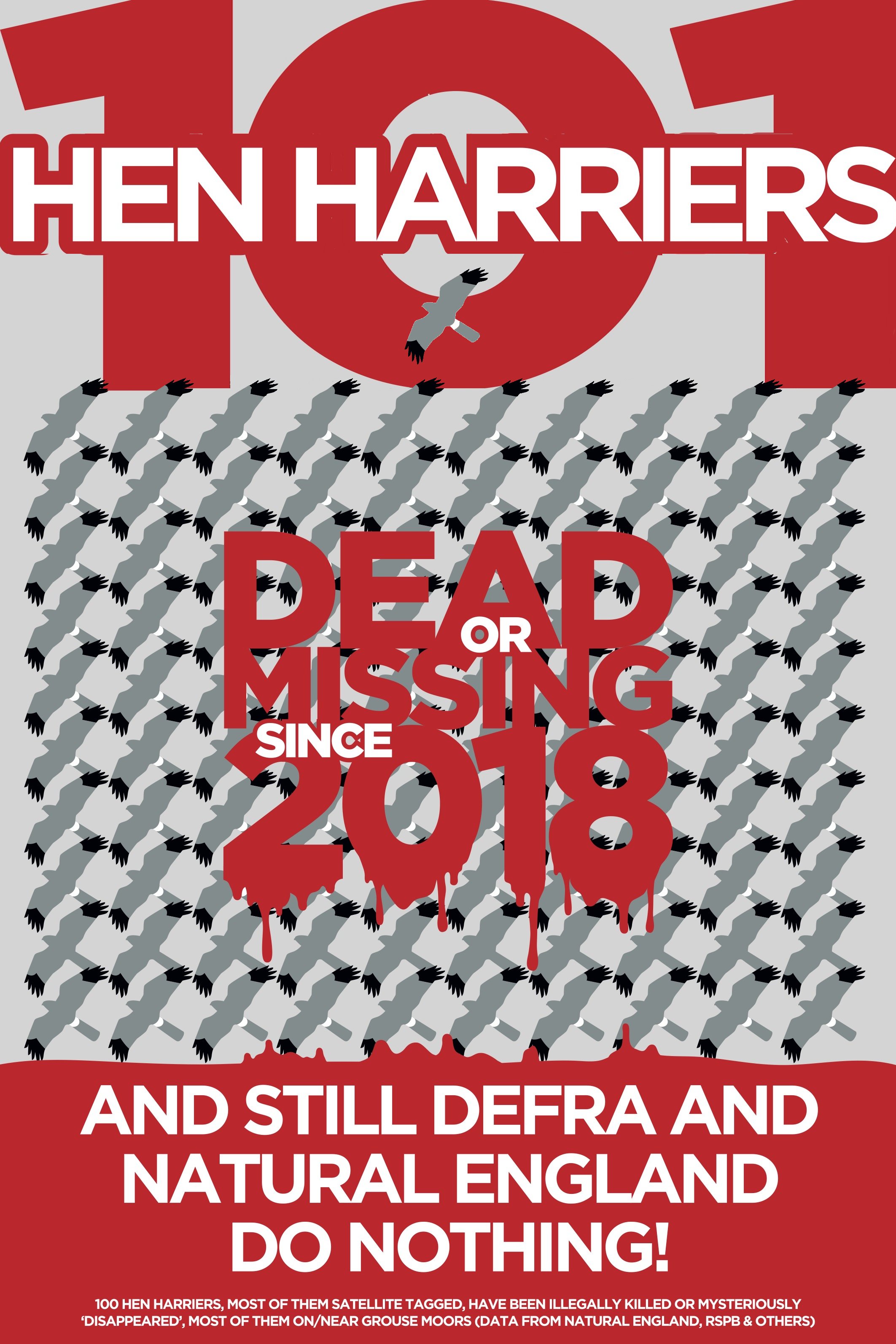
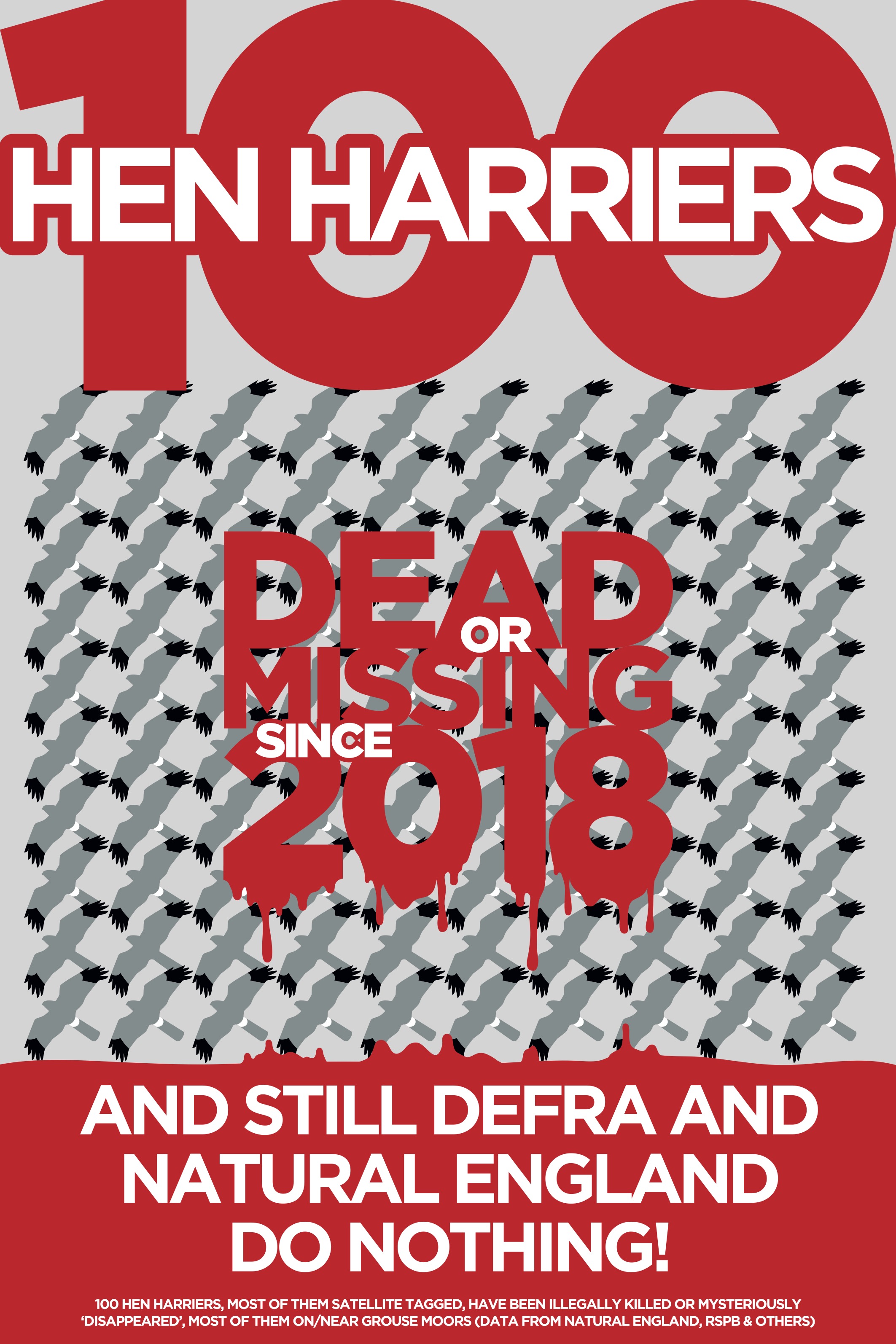
Wild Justice designed this poster in preparation for marking the 100th hen harrier to go ‘missing’/be killed since 2018. But the grouse shooting industry is killing harriers faster than we can make graphics….we’re now up to 101 hen harriers (actually we’re well past that figure but the other cases are yet to be publicised).
So here’s the latest gruesome list. Note that the majority of these birds (but not all) were fitted with satellite tags. How many more [untagged] harriers have been killed?
February 2018: Hen harrier Saorsa ‘disappeared’ in the Angus Glens in Scotland (here). The Scottish Gamekeepers Association later published wholly inaccurate information claiming the bird had been re-sighted. The RSPB dismissed this as “completely false” (here).
5 February 2018: Hen harrier Marc ‘disappeared’ on a grouse moor in Durham (here).
9 February 2018: Hen harrier Aalin ‘disappeared’ on a grouse moor in Wales (here).
March 2018: Hen harrier Blue ‘disappeared’ in the Lake District National Park (here).
March 2018: Hen harrier Finn ‘disappeared’ near Moffat in Scotland (here).
18 April 2018: Hen harrier Lia ‘disappeared’ in Wales and her corpse was retrieved in a field in May 2018. Cause of death was unconfirmed but police treating death as suspicious (here).
8 August 2018: Hen harrier Hilma ‘disappeared’ on a grouse moor in Northumberland (here).
16 August 2018: Hen harrier Athena ‘disappeared’ on a grouse moor in Scotland (here).
26 August 2018: Hen Harrier Octavia ‘disappeared’ on a grouse moor in the Peak District National Park (here).
29 August 2018: Hen harrier Margot ‘disappeared’ on a grouse moor in Scotland (here).
29 August 2018: Hen Harrier Heulwen ‘disappeared’ on a grouse moor in Wales (here).
3 September 2018: Hen harrier Stelmaria ‘disappeared’ on a grouse moor in Scotland (here).
24 September 2018: Hen harrier Heather ‘disappeared’ on a grouse moor in Scotland (here).
2 October 2018: Hen harrier Mabel ‘disappeared’ on a grouse moor on the edge of the Yorkshire Dales National Park (here).
3 October 2018: Hen Harrier Thor ‘disappeared’ next to a grouse moor in Bowland, Lanacashire (here).
23 October 2018: Hen harrier Tom ‘disappeared’ in South Wales (here).
26 October 2018: Hen harrier Arthur ‘disappeared’ on a grouse moor in the North York Moors National Park (here).
1 November 2018: Hen harrier Barney ‘disappeared’ on Bodmin Moor (here).
10 November 2018: Hen harrier Rannoch ‘disappeared’ on a grouse moor in Scotland (here). Her corpse was found nearby in May 2019 – she’d been killed in an illegally-set spring trap (here).
14 November 2018: Hen harrier River ‘disappeared’ on a grouse moor in the Nidderdale AONB (here). Her corpse was found nearby in April 2019 – she’d been illegally shot (here).
16 January 2019: Hen harrier Vulcan ‘disappeared’ in Wiltshire close to Natural England’s proposed reintroduction site (here).
28 January 2019: Hen harrier DeeCee ‘disappeared’ in Glen Esk, a grouse moor area of the Angus Glens (see here).
7 February 2019: Hen harrier Skylar ‘disappeared’ next to a grouse moor in South Lanarkshire (here).
22 April 2019: Hen harrier Marci ‘disappeared’ on a grouse moor in the Cairngorms National Park (here).
26 April 2019: Hen harrier Rain ‘disappeared’ on a grouse moor in Nairnshire (here).
11 May 2019: An untagged male hen harrier was caught in an illegally-set trap next to his nest on a grouse moor in South Lanarkshire. He didn’t survive (here).
7 June 2019: An untagged hen harrier was found dead on a grouse moor in Scotland. A post mortem stated the bird had died as a result of ‘penetrating trauma’ injuries and that this bird had previously been shot (here).
5 September 2019: Wildland Hen Harrier 1 ‘disappeared’ on a grouse moor nr Dalnaspidal on the edge of the Cairngorms National Park (here).
11 September 2019: Hen harrier Romario ‘disappeared’ on a grouse moor in the Cairngorms National Park (here).
14 September 2019: Hen harrier (Brood meddled in 2019, #183704) ‘disappeared’ in the North Pennines (here).
23 September 2019: Hen harrier (Brood meddled in 2019, #55149) ‘disappeared’ in North Pennines (here).
24 September 2019: Wildland Hen Harrier 2 ‘disappeared’ on a grouse moor at Invercauld in the Cairngorms National Park (here).
24 September 2019: Hen harrier Bronwyn ‘disappeared’ near a grouse moor in North Wales (here).
10 October 2019: Hen harrier Ada ‘disappeared’ on a grouse moor in the North Pennines AONB (here).
12 October 2019: Hen harrier Thistle ‘disappeared’ on a grouse moor in Sutherland (here).
18 October 2019: Member of the public reports the witnessed shooting of an untagged male hen harrier on White Syke Hill in North Yorkshire (here).
November 2019: Hen harrier Mary found illegally poisoned on a pheasant shoot in Ireland (here).
November 2019: Hen harrier Artemis ‘disappeared’ near Long Formacus in south Scotland (RSPB pers comm).
14 December 2019: Hen harrier Oscar ‘disappeared’ in Eskdalemuir, south Scotland (here).
December 2019: Hen harrier Ingmar ‘disappeared’ in the Strathbraan grouse moor area of Perthshire (RSPB pers comm).
January 2020: Members of the public report the witnessed shooting of a male hen harrier on Threshfield Moor in the Yorkshire Dales National Park (here).
23 March 2020: Hen harrier Rosie ‘disappeared’ at an undisclosed roost site in Northumberland (here).
1 April 2020: Hen harrier (Brood meddled in 2019, #183703) ‘disappeared’ in unnamed location, tag intermittent (here).
5 April 2020: Hen harrier Hoolie ‘disappeared’ on a grouse moor in the Cairngorms National Park (here)
8 April 2020: Hen harrier Marlin ‘disappeared’ on a grouse moor in the Cairngorms National Park (here).
19 May 2020: Hen harrier Fingal ‘disappeared’ on a grouse moor in the Lowther Hills, Scotland (here).
21 May 2020: Hen harrier (Brood meddled in 2019, #183701) ‘disappeared’ on a grouse moor in Cumbria shortly after returning from wintering in France (here).
27 May 2020: Hen harrier Silver ‘disappeared’ on a grouse moor on Leadhills Estate, Scotland (here).
2020: day/month unknown: Unnamed male hen harrier breeding on RSPB Geltsdale Reserve, Cumbria ‘disappeared’ while away hunting (here).
9 July 2020: Unnamed female hen harrier (#201118) ‘disappeared’ from an undisclosed site in Northumberland (here).
25 July 2020: Hen harrier Harriet ‘disappeared’ on a grouse moor in the Yorkshire Dales National Park (here).
14 August 2020: Hen harrier Solo ‘disappeared’ in confidential nest area in Lancashire (here).
7 September 2020: Hen harrier Dryad ‘disappeared’ on a grouse moor in the Yorkshire Dales National Park (here).
16 September 2020: Hen harrier Fortune ‘disappeared’ from an undisclosed roost site in Northumberland (here).
19 September 2020: Hen harrier Harold ‘disappeared’ on a grouse moor in the Yorkshire Dales National Park (here).
20 September 2020: Hen harrier (Brood meddled in 2020, #55152) ‘disappeared’ next to a grouse moor in North Yorkshire (here).
24 February 2021: Hen harrier Tarras ‘disappeared’ next to a grouse moor in Northumberland (here)
12th April 2021: Hen harrier Yarrow ‘disappeared’ near Stockton, County Durham (here).
18 May 2021: Adult male hen harrier ‘disappeared’ from its breeding attempt on RSPB Geltsdale Reserve, Cumbria whilst away hunting (here).
18 May 2021: Another adult male hen harrier ‘disappeared’ from its breeding attempt on RSPB Geltsdale Reserve, Cumbria whilst away hunting (here).
24 July 2021: Hen harrier Asta ‘disappeared’ at a ‘confidential site’ in the North Pennines (here). We learned 18 months later that her wings had been ripped off so her tag could be fitted to a crow in an attempt to cover up her death (here).
14th August 2021: Hen harrier Josephine ‘disappeared’ at a ‘confidential site’ in Northumberland (here).
17 September 2021: Hen harrier Reiver ‘disappeared’ in a grouse moor dominated region of Northumberland (here)
24 September 2021: Hen harrier (Brood meddled in 2021, R2-F-1-21) ‘disappeared’ in Northumberland (here).
15 November 2021: Hen harrier (brood meddled in 2020, #R2-F1-20) ‘disappeared’ at the edge of a grouse moor on Arkengarthdale Estate in the Yorkshire Dales National Park (here).
19 November 2021: Hen harrier Val ‘disappeared’ in the Lake District National Park in Cumbria (here).
19 November 2021: Hen harrier Percy ‘disappeared’ in Lothian, Scotland (here).
12 December 2021: Hen harrier Jasmine ‘disappeared’ on a grouse moor (High Rigg Moor on the Middlesmoor Estate) in the Nidderdale AONB in North Yorkshire (here).
9 January 2022: Hen harrier Ethel ‘disappeared’ in Northumberland (here).
26 January 2022: Hen harrier Amelia ‘disappeared’ in Bowland (here).
10 February 2022: An unnamed satellite-tagged hen harrier ‘disappeared’ in a grouse moor dominated area of the Peak District National Park (here). One year later it was revealed that the satellite tag/harness of this young male called ‘Anu’ had been deliberately cut off (see here).
12 April 2022: Hen harrier ‘Free’ (Tag ID 201121) ‘disappeared’ at a ‘confidential site’ in Cumbria (here). It later emerged he hadn’t disappeared, but his mutilated corpse was found on moorland in the Yorkshire Dales National Park. A post mortem revealed the cause of death was having his head twisted and pulled off. One leg had also been torn off whilst he was still alive (here).
April 2022: Hen harrier ‘Pegasus’ (tagged by the RSPB) ‘disappeared’ on a grouse moor at Birkdale in the Yorkshire Dales National Park (here).
May 2022: A male breeding hen harrier ‘disappeared’ from a National Trust-owned grouse moor in the Peak District National Park (here).
May 2022: Another breeding male hen harrier ‘disappeared’ from a National Trust-owned grouse moor in the Peak District National Park (here).
14 May 2022: Hen harrier ‘Harvey’ (Tag ID 213844) ‘disappeared’ from a ‘confidential site’ in the North Pennines (here).
20 June 2022: Hen harrier chick #1 stamped to death in nest on a grouse moor in the Yorkshire Dales National Park (here).
20 June 2022: Hen harrier chick #2 stamped to death in nest on a grouse moor in the Yorkshire Dales National Park (here).
20 June 2022: Hen harrier chick #3 stamped to death in nest on a grouse moor in the Yorkshire Dales National Park (here).
20 June 2022: Hen harrier chick #4 stamped to death in nest on a grouse moor in the Yorkshire Dales National Park (here).
17 August 2022: Hen harrier (brood meddled in 2022, #R1-M1-22) ‘disappeared’ on moorland in the Yorkshire Dales National Park (here).
September 2022: Hen harrier ‘Sullis’ (tagged by the RSPB) ‘disappeared’ on a grouse moor in Cumbria (here).
5 October 2022: Hen harrier (brood meddled in 2022, #R3-M2-22) ‘disappeared’ on moorland in the Yorkshire Dales National Park (here).
10 October 2022: Hen harrier ‘Sia’ ‘disappeared’ near Hamsterley Forest in the North Pennines (here).
October 2022: Hen harrier (brood meddled in 2021, #R1-F1-21) ‘disappeared’ in the North Sea off the North York Moors National Park (here).
December 2022: Hen harrier female (brood meddled in 2020, #R2-F2-20) ‘disappeared’ on moorland in Cumbria (here).
1 December 2022: Hen harrier male (brood meddled in 2021, #R1-M1-21) ‘disappeared’ on moorland in the Yorkshire Dales National Park (here).
14 December 2022: Hen harrier female (brood meddled in 2022, #R3-F1-22) ‘disappeared’ on moorland in the North Pennines AONB (here).
15 December 2022: Hen harrier female (brood meddled in 2022, #R2-F1-22) ‘disappeared’ on moorland in the Yorkshire Dales National Park (here).
30 March 2023: Hen harrier female (brood meddled in 2022, #R1-F3-22) ‘disappeared’ in Yorkshire (here). Notes from NE Sept 2023 spreadsheet update: “Final transmission location temporarily withheld at police request“.
1 April 2023: Hen harrier male (brood meddled in 2022, #R2-M1-22) ‘disappeared’ in Yorkshire (here). Notes from NE Sept 2023 spreadsheet update: “Final transmission location temporarily withheld at police request“.
April 2023: Hen harrier ‘Lagertha’ (tagged by RSPB) ‘disappeared’ in North Yorkshire (here).
April 2023: Hen harrier ‘Nicola’ (Tag ID 234078) ”disappeared’ in North Yorkshire (here).
April 2023: Untagged male hen harrier ‘disappeared’ from an active nest on RSPB Geltsdale Reserve in Cumbria (here).
April 2023: Another untagged male hen harrier ‘disappeared’ from an active nest on RSPB Geltsdale Reserve in Cumbria (here).
April 2023: Untagged male hen harrier ‘disappeared’ from an active nest in Durham (here).
4/5 May 2023: Satellite-tagged male hen harrier called ‘Rush’ ‘disappeared’ from a grouse moor in Bowland AONB in Lancashire (here).
17 May 2023: Satellite-tagged hen harrier called ‘Wayland’ ‘disappeared’ in the Clapham area of North Yorkshire, just north of the Bowland AONB (here).
9 August 2023: Satellite-tagged hen harrier called ‘Martha’ ‘disappeared’ on a grouse moor (Westburnhope Moor) near Hexham in the North Pennines (here).
11 August 2023: Satellite-tagged hen harrier called ‘Selena’ ‘disappeared’ on a grouse moor (Mossdale Moor) in the Yorkshire Dales National Park (here).
15 August 2023: Satellite-tagged hen harrier called ‘Hepit’ ‘disappeared’ on a grouse moor (Birkdale Common) near Kirkby Stephen in the Yorkshire Dales National Park (here).
To be continued…….
Not one of these 101 incidents has resulted in an arrest, let alone a prosecution. I had thought that when we reached 30 dead/missing hen harriers then the authorities might pretend to be interested and at least say a few words about this national scandal. We’ve now reached ONE HUNDRED AND ONE hen harriers, and still Govt ministers remain silent. They appear not to give a monkey’s. And yes, there are other things going on in the world, as always. That is not reason enough to ignore this blatant, brazen and systematic destruction of a supposedly protected species, being undertaken to satisfy the greed and bloodlust of a minority of society.
UPDATE 18.30hrs: Moorland Association Chair claims: “Clearly any illegal [hen harrier] persecution is not happening” (here).
I wrote an opinion piece for The National which was published yesterday (here) about the grouse shooting industry’s supposedly sincere claim of having ‘zero tolerance’ for the illegal killing of birds of prey.
It’s reproduced below:
It is widely acknowledged that the illegal killing of birds of prey has long been synonymous with driven grouse shooting in Scotland, even though raptors have had supposed legal protection for almost 70 years. Birds of prey such as buzzards, red kites, hen harriers and golden eagles are perceived to be a threat to red grouse and thus are ruthlessly shot, poisoned or trapped to protect the estates’ lucrative sporting interests.
Prosecutions are rare given the remoteness of the vast, privately-owned shooting estates where these crimes are committed; there are few witnesses and gamekeepers go to great lengths to hide the evidence, as demonstrated when a ‘missing’ golden eagle’s satellite tag was found wrapped in lead sheeting and dumped in a river, presumably in an attempt to block the transmitter.
The Scottish Government has tried various sanctions to address these crimes over the years, including the introduction in 2014 of General Licence restrictions, which are based on a civil burden of proof if there is insufficient evidence for a criminal prosecution. These restrictions don’t stop the sanctioned estates from shooting grouse but do partially limit their moorland management activities and were specifically designed to act as a ‘reputational driver’. Unfortunately they have been proven to be wholly ineffective.
In 2017 a scientific report into the fate of satellite-tracked golden eagles in Scotland highlighted the extent of the ongoing killing on some grouse moors (almost one third of 141 tracked eagles disappeared in suspicious circumstances, none of which resulted in a prosecution). In response, the Government commissioned a review (the Werritty Review) of the sustainability of grouse moor management, which led to the Government finally committing to introducing a full licensing scheme for grouse shooting in 2020. The threat of having an estate licence completely revoked if raptor persecution is detected may now act as a suitable deterrent, as long as the law is adequately enforced.
This long-awaited legislation is currently on passage through Parliament as the Wildlife Management and Muirburn (Scotland) Bill. Unsurprisingly, the grouse shooting lobby is working hard to influence proceedings and minimise the Bill’s impact, questioning its legality and proportionality, even making threats to take the Government to the European Court of Human Rights. Instead of welcoming legislation that should protect the innocent and rid the industry of those who continue to bring it into disrepute, industry representatives maintain that a voluntary approach is sufficient and deny that persecution is even an issue, despite the suspicious disappearance of at least 35 more satellite-tagged hen harriers and golden eagles since the 2017 report was published.
Grouse-shooting representatives maintain they have a ‘zero tolerance’ stance against illegal raptor persecution and argue that they can’t do anything more. But talk is cheap and this industry should be judged by its actions, not by superficial pronouncements from its leaders.
I would argue that there is much more the industry could, and should, be doing if it wants to be seen as a credible force for change.
For example, let’s look at the Moy Estate in Inverness-shire. Two estate gamekeepers have been convicted for raptor persecution offences here (one in 2011 and one in March this year) and the estate has been at the centre of multiple police investigations many times in between. Indeed, it is currently serving a three-year General Licence restriction imposed by NatureScot in 2022 on the basis of police evidence of wildlife crime against birds of prey, including the discovery of a poisoned red kite and various trapping offences.
Moy Estate is believed to be a member of the Scottish landowners’ lobby group, Scottish Land & Estates (SLE). Has SLE expelled the estate from its membership? If it hasn’t, why not? If it has, why hasn’t it done so publically?
Why are SLE, the Scottish Gamekeepers Association and others from the shooting industry, still attending the Moy Country Fair held annually on the Moy Estate? Why hasn’t this estate been boycotted and blacklisted by industry representatives? Surely that would send a strong message of ‘zero tolerance’ for raptor persecution?
Screen grab from SLE website, August 2023
It’s not just Moy Estate, either. There are a number of other grouse-shooting estates, some very high profile and often described as ‘prestigious’ in the shooting press, that are also either currently, or have previously, served three-year General Licence restrictions.
How many of those estates and/or their sporting agents have been blacklisted by industry organisations? None of them, as far as I can see.
Zero tolerance should mean exactly that. Anything less simply isn’t credible.
Dr Ruth Tingay writes the Raptor Persecution UK blog and is a founder member of REVIVE, the coalition for grouse moor reform.











 Raptor Persecution UK