golden eagle found poisoned on Dinnet & Kinnord Estate, Ballater, Aberdeenshire

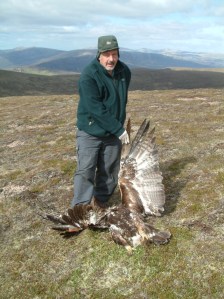
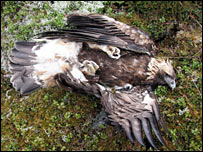
The poisoned eagle found on the Dinnet Estate

A golden eagle found dead by a hillwalker in June 2006 had been poisoned with Carbofuran. The bird was found on the Dinnet & Kinord Estate near Ballater, Aberdeenshire. No arrests have been made. http://news.bbc.co.uk/1/hi/scotland/north_east/5086162.stm

The eagle, in adult plumage, was likely to have been part of a breeding pair. The region holds approximately 18 pairs of breeding golden eagles, although if persecution wasn’t so high here, there is suitable habitat to support at least twice that number.

Poisoned golden eagle found on isle of lewis

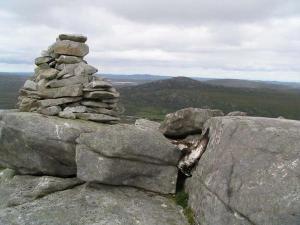
During July 2005 a dead golden eagle was discovered by a hillwalker on top of a hill in Morsgail on the Isle of Lewis.

The poisoned eagle at Morsgail, Isle of Lewis

Analysis showed that it had been poisoned with the banned pesticide carbofuran. Carbofuran is one of eight compounds listed on the Possession of Pesticides (Scotland) Order 2005. Anyone in possession of these poisons commits an offence under section 15 of the Wildlife and Countryside Act.

Staff from Scottish Executive Environment and Rural Affairs Department (SEERAD), and Northern Constabulary police officers conducted searches on four premises on the island. No arrests have been made but enquiries are continuing.

http://www.rspb.org.uk/Images/legaleagle48_tcm9-132971.pdf

Gamekeeper guilty of poisoning at Blythe Farm, nr lauder, Scottish Borders

In August 2006, a police raid on Blythe Farm, near Lauder in the Scottish Borders, led to the discovery of pheasant baits laced with poison (carbofuran) as well as several illegal cage traps baited with live pigeons to lure in birds of prey.

In April 2007, gamekeeper George “Doddie” Aitken was found guilty at Selkirk Sheriff Court. Sheriff Kevin Drummond sentenced him to 220 hours community service. A gamekeeper for 20 years, Aitken, who had turned up to court wearing a black balaclava, was allowed to keep his job. http://news.bbc.co.uk/1/hi/scotland/south_of_scotland/6719505.stm

In January 2008, the owner of Blythe Farm, James McDougal, became the first landowner to be punished for the crimes committed by his gamekeeper. His agricultural subsidies were cut by £7,919 for his failure to protect wildlife. http://www.guardian.co.uk/uk/2008/jan/07/ruralaffairs.scotland

2 golden eagles poisoned in Kingussie, Strathspey

An adult female golden eagle and her chick were found dead on the nest in Kingussie, Strathspey in August 1999. Post mortem results revealed they had been posioned by Carbofuran.

No arrests have been made.

http://news.bbc.co.uk/1/hi/scotland/422629.stm

Golden eagle & buzzard found poisoned on West Glenalmond Estate, Perthshire

In October and December 1998, a dead golden eagle and a buzzard were found on the Glenalmond Estate in Perthshire. The carcass of a red grouse was found close by, and tests later showed it had been used as a poisoned bait. The golden eagle had been killed by ingesting the illegal pesticide, Yaltox.

In Perth Sheriff Court in December 2000, a local gamekeeper was acquitted of all charges. He was also acquitted of further charges related to laying poisoned baits for either a peregrine or a golden eagle.

News story here

white-tailed sea eagle found poisoned on Turnalt Farm, Kilmelford, Argyll

The dead sea eagle lies slumped over the posioned lamb bait

A dead white-tailed sea eagle was found slumped over a lamb carcass on Turnalt Farm, Kilmelford, Argyll, in May 2002. Tests showed it had been posioned with chloralose. http://news.bbc.co.uk/1/low/scotland/1971648.stm

http://news.scotsman.com/news/Rare-sea-eagle-was-poisoned.2324749.jp

A golden eagle was found poisoned on the same farm in February 2002. http://news.bbc.co.uk/1/hi/scotland/1971648.stm

gin traps and a poisoned buzzard found on balmanno estate, perthshire

After several poisoning incidents in the Glenfarg area of Perthshire over a number of years, a buzzard poisoned by carbofuran was found on the Balmanno Estate in November 2001.

Tayside Police, the Scottish Executive Environment and Rural Affairs Department and the RSPB searched the shooting estate, as well as the premises of the gamekeeper, on 15 March 2002, under powers of the Food and Environment Act. On the estate, they found a freshly dead crow, which was later found to contain carbofuran. At the keeper’s premises they found a small quantity of carbofuran, a small egg collection and several gin traps with pieces of fur on the jaws. The keeper was detained and admitted that he had used the gin traps to take fox cubs. Admissions were also made in relation to the buzzard’s egg.

A poisoned buzzard

After many hearings, stretching back to an original trial date of 19 November 2002, the keeper changed his pleas to guilty. On 12 November 2003, at Perth Sheriff Court, he pleaded guilty to charges of possession of carbofuran in an unlabelled container, possession of several gin traps for use against foxes and possession of one buzzard egg.

The Procurator Fiscal accepted a ‘not guilty’ plea to poisoning a crow with carbofuran. The keeper was fined £250.


In Scotland, gin traps were only banned for use against foxes in 1974; in England and Wales, they were banned in 1958.

http://www.rspb.org.uk/Images/23-0617-03-04_legal%20eagle40%20v2_tcm9-132963.pdf

Gamekeeper convicted of poisoning 5 buzzards at tillyrie farm, perthshire.

On 21st November 2001, at Perth Sheriff Court, a gamekeeper was convicted of placing a bait containing carbofuran at Tillyrie Farm, Milnathort, Perthshire,  poisoning five buzzards and a carrion crow and possessing the banned substance carbofuran for the purpose of committing offences against the Wildlife and Countryside Act 1981. He was also convicted of illegal carbofuran storage under the Control of Pesticides Regulations 1986.

He was fined a total of £2,400.

 At the time of the offence, the keeper leased the shooting rights at Tillyrie Farm and ran it as a pheasant shoot. Tillyrie Farm is owned by racehorse trainer Dorothy Thompson, who praised her gamekeeper by saying, “He makes a very good job of rearing the birds [pheasants] and wildlife on the estate has increased for the better”.

The keeper subsequently appealed his conviction at the High Court of Judiciary Appeal, Edinburgh, in September 2003. The appeal was unsuccessful and the keeper was ordered to pay the original £2,400 imposed by the Court.

http://www.telegraph.co.uk/news/uknews/1339741/Gamekeeper-denies-coffee-jar-poisoning-of-buzzards.html

Golden eagle found poisoned on Cawdor Estate, Invernesshire

A golden eagle found dead on Cawdor Estate, Invernesshire, on 6 August 2001 had been poisoned by Carbofuran. The dead eagle’s decomposed remains were found by a hillwalker.

Cawdor Estate Factor John Higson and Head Gamekeeper Roddy Forbes denied any wrong-doing and suggested that the dead eagle could have been brought in by someone in their rucksack and planted on the estate to cause trouble. This explanation is commonly used by Alex Hogg, Chairman of the Scottish Gamekeepers Association, to account for the numbers of dead raptors that turn up on shooting estates. Our sources suggest that recent DNA evidence has proven these claims unfounded.

Since 1988, there have been six other incidents involving the illegal use of poisons connected to the Cawdor Estate. These include:

1988: A pet labrador dies after consuming the deadly poison, strychnine, while walking on Cawdor estate.

1992: A buzzard, magpie and sheep all laced with strychnine are discovered on the estate.

1993: A buzzard found poisoned by the toxin, alphachloralose, on Forestry Commission land 100 metres from the boundary of Cawdor estate.

1994: Three buzzards and rabbit bait found poisoned by alphachloralose on Cawdor.

1996: Three baits discovered containing poisons: a hare laced with alphachloralose, a goat with aldicarb and a wigeon with strychnine.

1996: A hidden pit containing a suspected birds of prey poisoning kit uncovered by investigators three miles from Cawdor Castle.

1999: A report sent to the procurator fiscal alleging that mountain hares were illegally persecuted in snares.

2000: A second report submitted to the fiscal claiming mistreatment of hares.

2001: A dead eagle found on Cawdor estate confirmed to contain the lethal poison, carbofuran.

No convictions have been made as it has not been possible to identify the individual who laid the bait.

For further information: http://findarticles.com/p/articles/mi_qn4156/is_20010826/ai_n13961693/?tag=content;col1

2nd white-tailed sea eagle poisoned nr Mallaig, western Scotland

This is the second poisoned eagle found at this site in little over a year

In February 2003, a hillwalker found the corpse of a white-tailed sea eagle on the Morar peninsular near Mallaig, Western Scotland. Tests revealed this was the female of a nearby breeding pair and she had been poisoned. Her mate had been poisoned in the same area a year earlier, on land farmed by the Mackay family. Both birds were part of the sea eagle reintroduction project in Western Scotland.

Further information: http://www.snh.org.uk/publications/on-line/magazines/teachdantir/seaeagle.asp

Although many members of the local community welcome sea eagles (and especially the revenue they generate from tourism), there is a small group of sheep farmers who want the government to remove the eagles because they consider them a threat to their lambs. No convictions have been secured for this incident.