26 year-old Ben Walker, a gamekeeper on the Sufton Estate, Herefordshire, has been convicted of 17 (yes, 17) charges relating to killing protected species with poisonous baits.
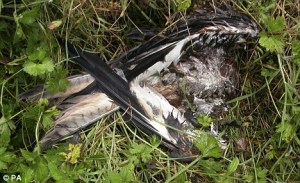
After a tip off, an undercover team from the RSPB spent several weeks in October and November 2009 making covert surveillance videos of Walker tending to his illegal baits on the Estate. He killed two buzzards and five ravens and told police he did it because they were a ‘threat’ to the birds he was rearing for a commercial shoot.
Walker received a £1,000 fine at Hereford Magistrates Court on 21 April 2010. Once again, a judge has not imposed a custodial sentence, even though this option is available for these types of wildlife crime.
Well done to the Sufton Estate though, who sacked Walker for these offences. A second former employee is currently under investigation for wildlife crimes on this Estate.
The red kite population in Scotland is under severe threat from illegal poisoning a new RSPB study has revealed.
An equal number of red kites were released in the Chiltern Hills in southern England and in The Black Isle near Inverness as part of a reintroduction project which began in 1989
The birds in the Chiltern Hills have flourished and numbers of breeding pairs had reached 320 pairs by 2006. In stark contrast the Black Isle birds have struggled to establish a viable breeding population and had only reached 46 pairs over the same period. Both populations of red kites have been closely monitored and productivity from successful nests in both studies were found to be similar and amongst the highest in Europe.
Red kites are mainly scavengers and their diet of carrion makes them extremely vulnerable to illegal poisoning. Although they pose absolutely no threat to game shooting interests they are all too often killed by gamekeepers illegally targeting other species.
Between 1989 and 2009, 64 red kites have been found poisoned in Scotland. Naturally considering the remote locations where these birds live, only a small proportion of poisoned birds will ever have been found.
Scottish Environment Minister Roseanna Cunningham said,
“Poisoning is an arbitrary method of killing which poses serious risks to other wildlife, and potentially people, in our countryside.
“The protection of Scotland’s wildlife has never before occupied such a prominent position politically or in terms of the law. I hope that our continued joint action to tackle raptor persecution across Scotland will reduce this threat to red kites.”
With sentences such as we have recently seen in the Redmyre Estate case, where gamekeeper Graham Barclay Kerr was fined a derisory £400 for shooting a buzzard with a high velocity rifle and admonished for possession of illegal and deadly poisons I don’t think Roseanna’s words will have the perpetrators of these crimes quaking in their plus fours.
Pressure to control the poison Alphachloralose, available over the counter in Ireland, is intensifying following the poisoning of two more red kites in County Wicklow. The young birds were part of an Irish reintroduction project and had only been released in July 2009.
Alphachloralose has been used to kill red kites, golden eagles and white-tailed eagles across Ireland in recent years. The Golden Eagle Trust, a local NGO attempting to re-introduce all three species back to ireland, have lodged a formal complaint with the European Commission over the State’s failure to protect the birds.
Gamekeeper Graham Barclay Kerr (53) of Mary Findlay Drive, Dundee, who had earlier pleaded guilty to shooting a buzzard and being in possession of illegal and deadly poisons on the Redmyre Estate, Abernyte, Perthshire on 9 September 2009, has now been sentenced.
His punishment? A pathetic £400 fine for shooting the buzzard with a .243 rifle, and an even more pathetic ‘admonishment’ (which means a telling off) for being in possession of Carbofuran and Alphacloralose. Sentencing him at Perth Sheriff Court on 24 March 2010, Sheriff Robert McCreadie told Kerr, “You may not have appreciated how serious the courts take the illegal destruction of wildlife. I think you will be aware of that now”.
Really? A £400 fine for deliberately shooting a protected species is not what I would call a deterrent for other gamekeepers or their employers. And an admonishment for the possession of illegal and highly toxic poisons is nothing but lamentable. When oh when will the public see the full force of the law being handed down to convicted wildlife criminals? The Scottish judiciary has been given the powers to impose large fines or custodial sentences for convicted wildlife criminals, because that is the punishment that society deems fitting for these crimes. The Scottish government claims to be ‘stamping out’ wildlife crime. Perhaps the government and the judiciary need to get together and make sure they are reading from the same book, let alone the same page, because so far their actions speak louder than their words. This case speaks volumes.
Police are investigating the death of a red kite found in North Yorkshire last week, amid concerns that it may have been poisoned. The kite was found by a farmer in a field and police have now organised for toxicology tests to be conducted.
The kite was found in an area where numerous poisoning incidents have taken place.
16th March 2010. The Scottish Gamekeepers’ Association (SGA) chairman Alex Hogg, has condemned the “appalling statistics” regarding the poisoning of raptors on the official SGA website. The figures he refers to were collated by Science and Advice for Scottish Agriculture (SASA) and recently published by the Partnership for Action Against Wildlife Crime (PAW) They report that a total of 27 birds of prey were found poisoned in Scotland in 2009, including 19 buzzards, four red kites one white tailed sea eagle and two golden eagles. Unfortunately the report does not “name and shame” estates, farms, individuals etc involved.
In what would appear to be a complete change of heart, Alex Hogg has stated “There is no place for raptor persecution in modern land management”.
Does this mean that Alex has seen the light and will not be pursuing his application to kill 12 buzzards on the Portmore estate where he is employed as a gamekeeper?
The SGA website also reports that Environment Minister Roseanna Cunningham has condemned the figures, saying the protection of Scotland’s wildlife has never before occupied such a prominent position politically or in terms of the law, adding “this continued persecution of our precious wildlife is simply incomprehensible.”
With Sheriff Drummond still chairing the PAW Scotland Legislation, Regulation and Guidance Sub-group after his reported admission of the low priority in which he regards raptor persecution and the pathetic, lenient sentences for these crimes it’s hard to think of a reason why these disgraceful figures should improve.
As reported on this blog yesterday, the latest figures of confirmed bird of prey poisoning events in Scotland were just released and guess what? Poisoning in 2009 was at an all time high, despite the succession of statements from the Scottish government over the last 40 years that they are “determined to stamp out” wildlife crime. By anybody’s standards, the government has failed miserably, along with the judiciary, who have never given a custodial sentence to a convicted poisoner, even though they have the sentencing powers to do so. It’s pathetic.
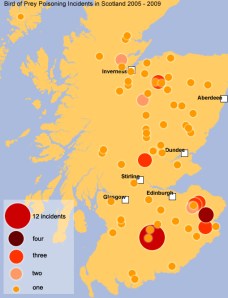
The latest ‘map of shame’ is a pointless piece of work in its current format. What does it tell us? It tells us that raptor poisoning is widespread in Scotland. We already knew that. What it doesn’t tell us is which Estates were responsible. A carefully-worded explanation for this lack of detail goes like this:
“Exact locations of incidents are not shown, in recognition of the fact that birds may travel some distance after ingesting poison. The map therefore randomises precise locations of incidents to produce a variation of around 1km. This avoids any inference being drawn from the exact point of discovery of the bird, but still allows an overview of the worst affected areas“.
Now, I’m no expert geographer, but I’m fairly certain that most Estates in Scotland are bigger than a kilometre. So if a poisoned raptor has been found on an estate where the boundary fence is greater than 1km away, we can be fairly certain that the bird has been poisoned on the estate where it was found, can’t we? And where did this arbitrary distance of 1km originate from anyway? Surely, a forensic expert would be able to calculate the distance a poisoned bird could travel based on the type, amount and toxicity of the poison used? Just look at some of the images on this blog – many dead raptors are found in very close proximity to the actual poisoned bait, sometimes even slumped over it, leaving no doubt whatsoever how and where the bird was killed. Why are these locations not published?
Leaving the dead raptors aside for one moment, why is there not a map showing the location of poisoned baits that have been found? There can be none of this hiding behind concern over an ‘incorrect inference’ for these cases – a posioned bait can’t “travel some distance” from where it was laid, so why are we not seeing the names of the Estates where these baits have been found (with the exception of Glenogil Estate in Tayside, which we all know about)? According to the latest figures released yesterday, 63 poison baits were discovered between 2005 and 2009. And these only relate to incidents involving birds of prey. A quick scan of SASA poisoning reports shows that there are plenty more poisoned baits out there in the countryside that do not get mentioned in the lastest government report. Isn’t it in the public’s interest to know where these baits have been found? I certainly wouldn’t want my children or my pets to be walking in these areas. It only takes one granule of the commonly-used (but illegal) pesticide Carbofuran to kill a human. Why should my children and pets be put at risk, just because the government is too weak and timid to stand up to the (highly rich and influential) members of the SRPBA (Scottish Rural Property & Business Association), who are allegedly behind the secrecy of poisoning locations in Scotland. Not good enough.
If you share this view and wish to express your disgust and concern, you can email the Scottish Environment Minister, Roseanna Cunningham, to let her know your thoughts: ministerforenvironment@scotland.gsi.gov.uk
Two recently-fledged peregrines were found poisoned on the Scottish Wildlife Trust’s Longhaven Reserve, Aberdeenshire, in July 2004. They were found by two climbers and tests proved they had been poisoned by eating from a pesticide-laced bait.
Police wildlife crime officer, George Sangster, said peregrines had been the victims of illegal persecution for many years, and he and his colleagues had seen “a worrying trend in the last few years in the north east of Scotland, with an increase in the persecution of peregrines”. Full story: http://news.bbc.co.uk/1/hi/scotland/3896793.stm
Six years later, not much has changed. According to a 2009 RSPB report, recent estimates suggest that 27% of nests in southeast Scotland, 24% of nests in northeast Scotland and over 10% of examined sites in Cumbria were subject to interference or killing. More info: http://www.birdguides.com/webzine/article.asp?a=1674
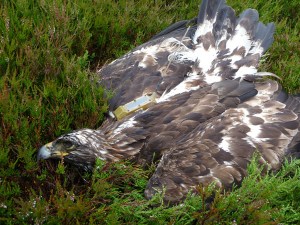
Local residents are outraged at the poisoning of golden eagle ‘Alma’, who was found dead on the Millden Estate in Glen Esk in July 2009.
Members of Inveresk Community Council are now writing to the three Estates in Glenesk (Millden Estate, Gannochy Estate and Invermark Estate), as well as the Scottish Environment Minister, Roseanna Cunningham and the Chair of Scottish Natural Heritage, Andrew Thin, to express their concern about the alleged use of lethal illegal poisonous baits in the area.
Brechin Community Council vice-convenor, David Adam, who was at the meeting and raised the issue, said: “I think we are all quite shocked about this. I think it is fairly conclusive that the bird was poisoned and that the bird was poisoned in Glen Esk. These birds are an extremely important part of our heritage”.
Inveresk Community Council chairperson, Charlie Simpson, commented: “To poison such creatures goes totally against the nature of Scotland”.
At the time of the discovery of the dead eagle, police conducted searches, under warrant, of gamekeepers’ cottages and vehicles on the Millden Estate. No arrests have been made. Tayside Police claim this is an on-going investigation, which probably means this crime will remain unsolved and the criminal(s) unpunished, like so many other reported poisoning incidents in this region and elsewhere in Scotland.
This is Alma as a chick, at her nest on the Glenfeshie Estate in 2007, being tagged by Roy Dennis
Two years later, Alma is dead after visiting grouse moors in Glen Esk
It is often said that gamekeepers only persecute raptors because they are acting upon the orders of their employer, and fear losing their job and often a tied cottage if they refuse. Here is an example of an estate manager who refused.
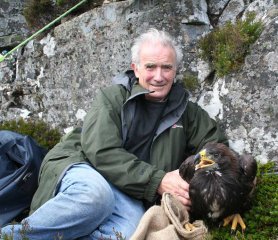
Ian Thomas (42) had worked on the Fordie Estate near Comrie, Perthshire for 15 years, when the estate was bought by former banker Lord Anthony Tryon (former husband of Lady ‘Kanga’ Tryon). During an inspection of his newly-acquired grouse moor, Lord Tryon allegedly became irritated at finding piles of grouse feathers indicating kills by birds of prey. According to Ian Thomas, Lord Tryon allegedly said, “Eagles have no place on my grouse moor” and “I have bought an estate and I will do what I like”.
Thomas claims that he was instructed by Lord Tryon to shoot a golden eagle and use illegal poisons to rid the estate of other raptors. Thomas refused and reported him to the authorities, saying he felt “morally obliged” to blow the whistle. Thomas claimed he was constructively dismissed after being branded a trouble-maker by Tryon and took his claim to an employment tribunal.
To avoid giving evidence in court, Tryon made an undisclosed settlement to his former estate manager in 2004.
The Fordie Estate was bought from Lord Tryon in 2009 and is now owned by designer luggage tycoon, Luis Vuitton. The Fordie Estate is one of eight estates in Perthshire who have joined the Countrywatch Partnership, working to protect three key raptor species in the area (golden eagle, hen harrier and peregrine).
Thomas has gone on to establish his own forestry consultancy business. Here is a man with whom it’s worth doing business.

 After a tip off, an undercover team from the RSPB spent several weeks in October and November 2009 making covert surveillance videos of Walker tending to his illegal baits on the Estate. He killed two buzzards and five ravens and told police he did it because they were a ‘threat’ to the birds he was rearing for a commercial shoot.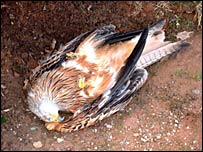

 Raptor Persecution UK