Significant haul of poisoned baits found on Leadhills Estate

leadhills estateA significant haul of pre-prepared poisoned meat baits has been found on Leadhills Estate, South Lanarkshire. And when we say significant, that’s what we mean. We’re not talking about one or two baits here; we’re talking a considerable number that, if used, would have been part of a comprehensive poisoning campaign.

The poisoned baits were discovered on 8th March 2013. Yes, that’s right, over three months ago. We’ve waited patiently for Police Scotland or NWCU or PAW Scotland to issue a press release about this, but, true to form, they’ve remained silent. During this period they even launched the 2012 poisoning maps, making much of what they called a ‘sharp fall’ in the number of poisoning incidents, even though they were well aware of what had just been uncovered at Leadhills Estate.

Because this is an on-going police investigation there is only limited detail that we’re prepared to publish at this stage. However, in due course, the full story will emerge. It’s worth keeping an eye on a forthcoming website (http://projectraptor.org.uk/) where photographs and film footage will probably appear.

This incident raises many of the usual concerns. Firstly, why has it been kept covered up? Why didn’t Police Scotland (“Keeping People Safe,” according to their website) issue a public safety warning about the discovery of these highly toxic poisoned meat baits that have the potential to kill anyone coming into contact with them? Many people, not just local residents but tourists too, visit the moors around Leadhills for recreational pursuits. Why were they not informed about the risks? That’s not ‘Keeping People Safe’ by any stretch of imagination.

Secondly, why are Police Scotland still making the same fundamental errors that they were making ten years ago in investigations of this type? They sent two marked police vehicles to collect the evidence – thus alerting the would-be poisoners that their stash had been discovered and allowing them an opportunity to hide any other incriminating evidence. This is basic stuff! Did they conduct a search of the surrounding moorland to see if any baits had already been placed? You probably can guess the answer to that.

Why didn’t they attend the scene covertly and install hidden cameras at the site where the poisoned baits were discovered? We all know that without evidence linking a specific person to the baits, a conviction would be virtually impossible to secure. So why not use cameras to film the person(s) coming to the poison storage site and either picking up the baits or replenishing the stash with new baits?

Nobody will be surprised to learn that Leadhills Estate is once again at the centre of another wildlife crime investigation; the latest in a long list dating back at least a decade. The following incidents are known, confirmed persecution incidents (data from RSPB Scotland & Scottish Government) from 2003-2011 (2012 & 2013 data not yet published). This list does not include ‘probable’ or ‘possible’ incidents such as the discovery of buried decomposing carcasses too decayed for analysis:

2003 April: hen harrier shot

2003 April: hen harrier eggs destroyed

2004 May: buzzard shot

2004 May: short-eared owl shot

2004 June: buzzard poisoned (Carbofuran)

2004 June: 4 x poisoned rabbit baits (Carbofuran)

2004 June: crow poisoned (Carbofuran)

2004 July: poisoned rabbit bait (Carbofuran)

2004 July: poisoned rabbit bait (Carbofuran)

2005 February: poisoned rabbit bait (Carbofuran)

2005 April: poisoned buzzard (Carbofuran)

2005 June: poisoned rabbit bait (Carbofuran)

2005 June: poisoned rabbit bait (Carbofuran)

2006 February: poisoned buzzard (Carbofuran)

2006 March: poisoned buzzard (Carbofuran)

2006 March: poisoned pigeon bait (Carbofuran)

2006 April: dead buzzard (persecution method unknown)

2006 May: poisoned rabbit bait (Carbofuran)

2006 May: poisoned rabbit bait (Carbofuran)

2006 May: poisoned egg baits (Carbofuran)

2006 June: poisoned buzzard (Carbofuran)

2006 June: poisoned raven (Carbofuran)

2006 June: 6 x poisoned rabbit baits (Carbofuran)

2006 June: poisoned egg bait (Carbofuran)

2006 September: 5 x poisoned buzzards (Carbofuran)

2006 September: poisoned rabbit bait (Carbofuran)

2006 September: poisoned rabbit bait (Carbofuran)

2007 March: poisoned buzzard (Carbofuran)

2007 April: poisoned red kite (Carbofuran)

2007 May: poisoned buzzard (Carbofuran)

2008 October: poisoned buzzard (Carbofuran) [listed as ‘Nr Leadhills’]

2008 October: poisoned rabbit bait (Carbofuran) [listed as ‘Nr Leadhills’]

2008 November: 3 x poisoned ravens (Carbofuran) [listed as ‘Nr Leadhills’]

2009 March: poisoned rabbit bait (Carbofuran)

2009 March: poisoned raven (Carbofuran)

2009 April: poisoned rabbit bait (Carbofuran)

2009 April: poisoned magpie (Carbofuran)

2009 April: poisoned raven (Carbofuran)

2010 October: short-eared owl shot

2011 March: illegally-set clam trap

2011 December: buzzard shot

2012 October: golden eagle shot (just over boundary with Buccleuch Estate)

The evidence is clear. Poisoning is taking place with virtually total impunity (some would say immunity) on this estate. As far as we can tell, there has only been one successful prosecution for poisoning – a gamekeeper convicted in 2010 for laying out a poisoned rabbit bait (see here).

So why is it that the poisoners, whoever they may be, can keep getting away with it?

Is Leadhills Estate (part of the Hopetoun Estates) a member of the landowners’ organisation, Scottish Land & Estates (SLE)? The Chairman of Hopetoun Estates, the Earl of Hopetoun, is a Director of SLE. If Leadhills Estate is a member, then all of SLE’s talk about condemning illegal raptor persecution and stamping it out is utter hypocrisy. The question of whether Leadhills Estate is an SLE member is one that needs to be raised by the members of the Partnership for Action Against Wildlife Crime (Scotland). SLE plays a prominent role in PAW Scotland and earns considerable kudos for that role (kudos that the organisation is not afraid to use for PR purposes). It is now high time that SLE is asked to provide some transparency about its relationship with Leadhills Estate.

We’d also like to ask Environment Minister Paul Wheelhouse what action he intends to take in light of the latest discovery of poisoned baits at Leadhills Estate? He may well try and dodge the question by saying ‘It’s an on-going police investigation so I can’t comment’. But we’re not asking him to comment on the actual investigation – what we’re asking is whether he’ll keep his earlier promises about introducing new measures to combat raptor persecution if evidence comes to light to demonstrate it is still a problem. Well Paul, here’s your filthy evidence. Now what are you going to do about it? Emails to: ministerforenvironment@scotland.gsi.gov.uk

UPDATE 18.45hrs: BBC journalist David Miller has just posted an article on this incident on the BBC News website (great to see another high profile journalist willing to discuss illegal raptor persecution). You can read his article here.

The article contains the following hilarious quotes:

From Police Scotland: “Police officers, including a wildlife crime liaison officer, were dispatched to the area the same day and following an extensive search, items were found and seized. A number of people were detained by police in connection with this inquiry, which is currently ongoing“.

Hmm, an ‘extensive search’, eh? That’s not what we’d heard!

From Scottish Land and Estates: “It would be inappropriate to comment while the facts of the matter have still to be established. As an organisation, we are actively involved in the Partnership for Action Against Wildlife Crime and our membership undertakes an enormous amount of positive work in this area“.

Er, the facts of the matter have been established. A significant haul of pre-prepared meat baits were found stashed on this estate and government scientists have confirmed the presence of Carbofuran.

Wouldn’t it be ‘inappropriate’ for SLE to remain in the government-led PAW Scotland group, and in the government-led Scottish Raptor Persecution Priority Delivery Group, if it was found that Leadhills Estate was a member of their organisation? Come on PAW Scotland members and SRPPDG members, ask them the bloody question!

From Scottish Gamekeepers’ Association: “Because this appears to be subject of a live investigation, it would not be appropriate to comment other than to reiterate that the Scottish Gamekeepers’ Association does not condone illegal poisoning“.

Perhaps they’ll consider conducting their own investigation again, just as they did with the Deeside eagle case, and let us know what really happened….my money’s on the real culprits being either badgers, buzzards, sparrowhawks, pine martens or goshawks.

 

Buzzard euthanised after caught in illegal leg-hold trap

More than nine weeks ago, a buzzard was caught in an illegal leg-hold trap. According to local sources this happened on land part-managed for gamebird shooting in central Scotland. The buzzard’s injuries were such that it had to be euthanised.

Police Scotland have still not informed the public about this incident. Why not?

It happened in March, before the Easter Bank Holiday. They’ve had almost ten weeks to inform the public. In whose interest is it to keep this incident a dirty little secret?

We’ve blogged about this a million times before. They don’t have to give away details that might compromise an investigation – all they need to say is that an illegally trapped buzzard has been discovered, it didn’t survive its injuries, and a police investigation is underway. It’s really that simple. Here’s a recent example:

Police Wildlife Crime Officers in Devon & Cornwall Police blogged on 27th May 2013 that two dead buzzards, found in suspicious circumstances, had been reported to them that day. A couple of days later they provided an update to say the birds had been retrieved and had been sent off for toxicology analysis.

Here’s another example:

On 22nd May 2013, Gwent Police appealed for information after a shot peregrine falcon had to be euthanised. The shooting had been reported to the police only two days previously, on 20th May 2013 (see here).

Here’s another example:

On 6th April 2013, Norfolk Constabulary issued a press statement to say that a man had been arrested on suspicion of a number of wildlife crime offences after the discovery of over a dozen dead birds of prey. He had been arrested just two days earlier on 4th April 2013 (see here). [Incidentally, this man’s bail expired on 22nd May and we’re waiting to hear the latest development in this case].

So you see it’s quite possible for police forces to release information in a timely manner when they want to. It’s not as though the public aren’t interested in buzzard conservation in Scotland – a recent petition urging the Scottish Government not to licence a buzzard cull has now reached over 20,000 signatures in about a week (see here and please sign it if you haven’t already done so).

 We’ll repeat the question posed earlier: in whose interest is it for Police Scotland to remain silent about this illegally-trapped buzzard?

Environment Minister’s response to continuing raptor persecution

On October 10th 2012, one month into his job, Environment Minister Paul Wheelhouse made the following statement in response to the huge public uproar about the death of the Deeside eagle (see here) –

The unlawful killing of any raptors has no place in today’s Scotland and we will continue to work hard to eradicate this criminal activity. We believe that the partnership approach with the Partnership for Action Against Wildlife Crime (PAW) Scotland, is bringing the reduction in bird of prey poisoning that can be seen in the statistics in recent years. However we are not complacent and if there is evidence of a switch to other methods of persecution we will take action to bear down on those methods“.

He made a further statement on 28th November 2012 following the discovery on an Aberdeenshire estate of a hen harrier that had been shot dead (see here) –

We will not tolerate the illegal persecution of protected species such as the hen harrier and, as I have said recently in relation to another shooting [presumably the shot golden eagle found critically injured on an estate in south west Scotland – see here] I am prepared to look at further measures to strengthen and assist enforcement if we continue to see this flouting of the law in respect of protected species“.

Since then a number of further persecution incidents have taken place, some of which have made it into the public domain, whereas others are still being treated as closely-guarded secrets by Police Scotland (why is that, several months after the crimes were discovered?). The ones that have been publicised include:

1. A dead buzzard at Glasserton Estate, Whithorn that was discovered in December 2012 but not reported in the media until 6 March (see here). The press release was vague but we assume this buzzard had been poisoned judging by the location of known poisoning incidents that were included in the PAW Scotland 2012 poisoning maps.

2. A dead buzzard that had been found by the side of a road in Stirlingshire in early February 2013 – later tests showed it had been shot (see here).

3. A dead buzzard that had been found near St Mary’s Loch in the Borders in early March – it had been shot (see here). Following this incident, we tweeted Paul Wheelhouse and asked him if he was ready to take the action he’d promised (see here). He replied: “I will say more when I have a full briefing but my first reaction is instinctive – I’m both disgusted and very much angered“. Seven weeks later we’re still waiting for his statement.

In early April it was reported that the shot golden eagle that had been found on a grouse moor in south west Scotland had finally succumbed to its injuries (see here). This news prompted us to encourage readers to write to Paul Wheelhouse, again, and ask him whether he was now ready to take the action he’d promised. We know that over 100 of you sent emails to him. In early May he responded. The following email is an example of one of the generic responses that were sent out by his aide:

Thank you for your letter to the Minister for Environment and Climate Change, Mr Paul Wheelhouse. I have been asked to respond.

The Minister was saddened to hear that the golden eagle in the care of the SSPCA had to be put to sleep on veterinary advice, due to underlying health conditions as it had been hoped initially that the eagle would make a full recovery. This case involves an ongoing Police and SSPCA investigation, so further comment on that incident is inappropriate.

The Minister welcomed a reduction in confirmed poisoning figures for raptors in March 2013, however he did recognise that other forms of persecution do exist and he has already committed to looking at the development of further measures to end raptor persecution if other methods of persecution prove to be on the increase. Vicarious Liability provisions which came into force in 2012 are still to be tested in court and it is critical to assess the impact of the legislation by this means.

The difficulties in prosecuting wildlife crimes are well documented. Recognising the specialist nature of the investigations required, and legislation covering such criminality, the Crown Office and Procurator Fiscal Service created specialist wildlife and environmental fiscals in 2011. Police reform has also implemented changes with regard to the structure and coordination of wildlife crime officers with a net increase in officers with relevant responsibilities. These changes combined will continue to shape improvements in wildlife crime detection, investigations and prosecutions.

Tackling wildlife crime is a priority for the Minister and he stands by previous comments that he is not prepared to allow these crimes to continue unabated, and without consequence. Partnership working via the Partnership for Action Against Wildlife Crime (PAW) Scotland, which is chaired by the Minister, is key to progress and this path will also continue to be used to deliver a reduction in wildlife crime.

Yours faithfully,

Karen Hunter

Wildlife Crime Policy Officer

It seems to us that Paul Wheelhouse is good on rhetoric but not so good on action. Very disappointing but not at all surprising. It’ll be interesting to see how he responds when he hears about the other examples of ‘continued flouting of the law’, that have happened right under his nose. He might want to have a chat with Police Scotland and ask them what they’re keeping from public view, and why……

Sea eagle chicks hatched in Ireland – first for over 100 years!

An historic conservation success has been achieved in Ireland as two pairs of white-tailed eagles have produced chicks in the last week – the first for over 100 years!

The chicks are the result of a long-term project to reintroduce sea eagles to Ireland after they were ruthlessly persecuted to extinction in the early 20th century. Beginning in 2007, the Golden Eagle Trust, an Irish conservation charity, in collaboration with the National Parks and Wildlife Service, began to release young sea eagles that had been donated by the Norwegian government. One hundred sea eagles were released in Killarney National Park, County Kerry, between 2007-2011 (see photo).

Last year one pair successfully laid eggs but unfortunately they failed to hatch. This is quite common for young, inexperienced eagles and this year, along with another pair, they’ve managed to produce chicks.

The project has not been without problems – many of the birds were wing-tagged and radio-tagged to follow their movements from the release site and this revealed that a number of them became victims of poisoning, shooting and windfarm collision. Others fared better though and a number have been reported in Northern Ireland and further afield in Scotland.

Many many congratulations to Project Manager Dr Allan Mee and his colleagues at the Golden Eagle Trust. These people are making history, not just with the sea eagle reintroduction but with similar projects for golden eagles and red kites too; species that also became extinct in Ireland as a direct result of persecution.

Golden Eagle Trust press release here

Golden eagle protection discussed in parliament

Great to see more MSPs raising questions about golden eagles in the Scottish Parliament….

Joan McAlpine (South Scotland) (SNP): To ask the Scottish Government what steps it is taking to protect golden eagles. (S4O-02010).

The Minister for Environment and Climate Change (Paul Wheelhouse): All wild birds are protected in Scotland under the Wildlife and Countryside Act 1981. Golden eagles are listed in schedule 1 to the 1981 act, which provides further protection measures to prevent disturbance to nesting birds. Last month, we added golden eagles to schedules A1 and 1A to the 1981 act, to provide year-round protection for nest sites and protect birds from harassment.

Since 2008, we have broadened and developed the partnership for action against wildlife crime in Scotland—PAW Scotland; strengthened the legal framework by introducing vicarious liability; provided funding for the national wildlife crime unit; and supported initiatives to tag and satellite track golden eagles. Recent police reform has increased the number of specialist wildlife crime officers.

We have been active in the fight against raptor persecution, and poisoning has reduced significantly. However, we are in no way complacent and we are actively considering whether other methods of persecution are being deployed. Some of the new wildlife crime measures that we have put in place are yet to be tested, but we know that there is still a problem in some parts of Scotland, and I reiterate to people outside the Parliament that we stand ready to introduce further measures, should that be necessary.

May2012 GE tayside grampianJoan McAlpine: As the minister acknowledged, there have been a number of shocking incidents across Scotland during the past year. Earlier this month, a golden eagle was shot on the southern upland way. In light of that, will the minister reassure the Parliament that investigations into the illegal killing of eagles are carried out quickly and effectively? Is he willing to update the Parliament on the investigation into the killing of the golden eagle that was found on Deeside in May 2012?

Paul Wheelhouse: As I said, police reform has resulted in a revised structure for wildlife crime, which will improve co-ordination and support for wildlife crime officers. I have every confidence in Assistant Chief Constable Graham, who has been appointed to lead the work. We also have a specialist unit in the Crown Office, which ensures that there is greater understanding of the complexities of this area of the law, in and out of the courtroom. That is a major development, which should not be underestimated and which will increase the focus on wildlife crime.

I assure the member and the Parliament that such measures, along with robust working in the partnership for action against wildlife crime in Scotland, will ensure that investigations are carried out as quickly and effectively as possible. PAW Scotland is looking at making the evidential trail on issues such as raptor persecution more robust, if it is possible to do so, which involves working closely with the Scottish raptor persecution priority delivery group.

I am not in a position to update the Parliament on the 2012 Deeside eagle case. There is an on-going police investigation and it would be entirely inappropriate for me to comment at this point.

[Ed: this issue about when is a case still ‘live’ is of great interest to us. How do you define when a case is still live/on-going? We would expect the definition to mean that active leads are still being followed up and/or a court case is pending. However, we are suspicious that the regularly-heard phrase ‘it’s an on-going police investigation and therefore can’t be discussed’ is a convenient excuse for the police/government to avoid answering serious questions about the effectiveness of these investigations. Take the Deeside eagle case as an example. That golden eagle was found dead almost one year ago. Are we expected to believe that the police are still following up active leads? Come on, let’s be realistic here. How about some of the other 26 cases of either dead or ‘missing’ eagles in the past seven years (see here), for which no-one has been prosecuted? Are they still ‘on-going’ investigations as well? Are the police still investigating the death of Alma, the golden eagle found poisoned on Millden Estate in 2009? How about the poisoning of the last remaining breeding golden eagle in the Borders in 2007? We would like to see much more transparency about these cases – obviously not while they’re genuinely on-going – but when a case is clearly going nowhere shouldn’t there be a point when questions can be asked, and answered, no? We would be very interested to hear from anyone who can tell us the official definition of how an ‘active case’ is defined and at what point, if any, can the police/government be questioned about an incident?]

Graeme Pearson (South Scotland) (Lab): I am sure that members welcome the drop in reported poisonings of birds of prey, but I am concerned that there has been no decline in other forms of raptor persecution. The Wildlife and Natural Environment (Scotland) Act 2011 introduced vicarious liability, to combat raptor persecution. Will the minister indicate what the next steps will be? Now that Police Scotland has been established, what new approaches will be introduced?

Paul Wheelhouse: Graeme Pearson is right to say that vicarious liability is a significant development in the law on wildlife crime. The provisions came into force on 1 January 2012 and the legislation has not yet been tested in court, as he is aware. I believe, however, that the legislation has had the welcome effect of encouraging responsible land managers to examine the training of and procedures for their staff. I have no doubt that, if a land manager or owner is prosecuted under the provisions, it will have a salutary effect on others who have been content to turn a blind eye to unlawful practices that are carried out on their land.

More generally, the Government is doing everything that it can to encourage good practice. Recently, Scottish Land & Estates launched the wildlife estates Scotland initiative, which I hope will gather arms and legs and cover an ever-greater share of landowners. In theory, that will enable the promotion of the most proactive and progressive conservation measures by land managers. However, I reassure the member that, if the measures under vicarious liability prove to be ineffective, I will take further action.

Jamie McGrigor (Highlands and Islands) (Con): The RSPB states that one of the key problems for the survival of golden eagles is the lack of live prey that is available to the species. Does the minister agree that a healthy supply of food species in golden eagle areas, such as rabbits and mountain hares, is a factor in the maintenance of healthy numbers of golden eagles? Is he, through the appropriate agencies, doing something about the decline of those species in some areas?

Paul Wheelhouse: The member raises an important point about the need for golden eagles to have adequate food supplies. It is not as simple as saying that it is all about raptor persecution; we know that there are multiple influences on the sad decline in the populations of a number of our key, iconic species of birds. Clearly, mountain hares are a species that we want to protect. If there was any persecution of those animals by land managers, we would be concerned about it. If the member has constructive proposals that he would like me to consider, I would be happy to meet him to discuss the issues.

Pathetic fine for convicted poisoner

poisonsignlPaul Unsworth, a 48-year-old pigeon fancier from Sunderland has pleaded guilty to three charges of illegally using and storing the highly toxic and banned pesticide, Carbofuran.
His sentence? A £200 fine for each offence. Seriously, it’s got to be time to bring in mandatory and hard-hitting sentences for these offences, hasn’t it? What deterrent is a £200 quid fine?

Well done to Northumbria Police, Natural England and RSPB Investigations Team for at least securing the conviction today at Newcastle Crown Court, despite an astonishingly pathetic fine from the judge.

Full details of what poisoner Paul Unsworth (of Newbold Avenue, Monkwearworth) got up to can be read here.

 It had previously been reported that he was initially charged with four offences relating to the alleged possession of Carbofuran between December 2006 and February 2012 (see here).

John Dodd sells Glenogil Estate

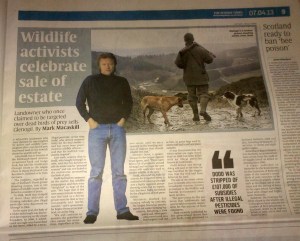
Sunday Times 7th April 2013 Glenogil saleJohn Dodd, the multi-millionaire owner of the controversial Glenogil Estate, has ‘quietly sold up’, according to an article in the Sunday Times.

The new owner is reported to be Baron Ferdinand von Baumbach, someone we know little about. Although we’re not sorry to see Dodd leave, it’s not so much who owns the estate that interests us, but rather whether (a) they intend to maintain it as a driven grouse moor and if so, (b) who will be advising on grouse moor ‘management’.

It’s been widely reported that Dodd took management advice from ‘grouse wizard’ Mark Osborne (e.g. see here) and indeed Glenogil is promoted on Osborne’s William Powell Sporting website as ‘one of the finest shooting estates in Scotland’ (see here), as well as on the William Powell Country website (here). It’s not just Osborne who rates this estate: last year The Field magazine included Glenogil in an article called ‘Britain’s 50 Great Shoots’ (see here) and in 2008 The Telegraph described it as a thriving grouse moor (see here).

However, for those of us with more of an interest in the area’s wildlife rather than with the artificially-high number of grouse that can be killed, you have to look elsewhere for information. A good place to start is the RSPB’s annual persecution reports. Below is a list of confirmed incidents recorded at Glenogil and ‘Nr Noranside’  from 2006-2010, sourced from these reports and also from Scottish Government data. Not one of these reported incidents has resulted in a criminal prosecution and Dodd has repeatedly and strenuously stated his staff are innocent. Dodd had his farming subsidy cut by £107,650 in 2008 when the Scottish Executive suspected that poisoned baits found on and near to the estate in 2006 were being used to target birds of prey (see here).

2006 March: poisoned rabbit bait (Carbofuran)

2006 April: poisoned buzzard (Alphachloralose)

2006 April: poisoned tawny owl (Alphachloralose)

2006 May: poisoned rabbit bait (Carbofuran)

2006 June: poisoned woodpigeon bait (Carbofuran)

2008 May: poisoned white-tailed eagle (Carbofuran, Isophenfos, Bendiocarb) [‘Nr Noranside’]

2008 May: poisoned buzzard (Bendiocarb) [‘Nr Noranside’]

2008 May: poisoned mountain hare bait (Carbofuran, Isophenfos, Bendiocarb) [‘Nr Noranside’]

2008 May: 32 x poisoned meat baits on fenceposts (Carbofuran, Isophenfos, Bendiocarb) [‘Nr Noranside’]

2008 Oct:  poisoned meat bait (Carbofuran) [‘Nr Noranside’]

2009 March: poisoned buzzard (Carbofuran)

2009 March: poisoned buzzard (Carbofuran)

2009 August: poisoned white-tailed eagle (Carbofuran)

2010 May: poisoned red kite (Carbofuran) [‘Nr Noranside’]

2010 September: poisoned buzzard (Chloralose)

2010 October: poisoned buzzard (Carbofuran)

2010 October: poisoned pigeon bait (Carbofuran)

2010 October: poisoned pigeon bait (Carbofuran)

John Dodd was the co-founder of Artemis Investment Management Ltd., a company that has sponsored the GWCT’s Scottish Game Fair (see here).

The Sunday Times article can be read in two parts:

Part 1 Glenogil sale Sunday Times 7 April 2013

Part 2 Glenogil sale Sunday Times 7 April 2013

Going to the Scottish Birdfair? Read this first

PrintThere’s an article today in the Sunday Herald about the RSPB’s controversial choice of venue for next month’s Scottish Birdfair. For the second year running, the RSPB has chosen to hold this event at Hopetoun House, the stately home of Lord Hopetoun whose family also owns the Leadhills (Hopetoun) Estate in South Lanarkshire, a grouse moor that has been at the centre of raptor persecution allegations for years. Sunday Herald article here.

Regular blog readers will know we’ve commented on this issue at length: see here, here, here, here, here and especially here.

In today’s article, veteran Scottish Raptor Study Group member Ronnie Graham urges potential Birdfair attendees to “make an informed decision” about going.

The following information might help. This is a list of confirmed persecution incidents listed at Leadhills/Abington between 2003-2011. This information has been sourced from the RSPB’s own annual persecution reports, in addition to Scottish Government data. The list does not include other ‘unconfirmed’ or ‘probable’ incidents, such as the discovery of skeletal raptor bodies found buried in forestry or dead raptors found shoved inside rabbit holes. Data are only available up to 2011, so any incidents that might have occured in 2012 or the first quarter of 2013 are not included. There are 41 confirmed incidents on this list; of these, only a couple have been successfully prosecuted (see here for a good example of why prosecutions fail). The list is a good example of why conviction rates should not be used to indicate the extent of criminal activity.

2003 April: hen harrier shot

2003 April: hen harrier eggs destroyed

2004 May: buzzard shot

2004 May: short-eared owl shot

2004 June: buzzard poisoned (Carbofuran)

2004 June: 4 x poisoned rabbit baits (Carbofuran)

2004 June: crow poisoned (Carbofuran)

2004 July: poisoned rabbit bait (Carbofuran)

2004 July: poisoned rabbit bait (Carbofuran)

2005 February: poisoned rabbit bait (Carbofuran)

2005 April: poisoned buzzard (Carbofuran)

2005 June: poisoned rabbit bait (Carbofuran)

2005 June: poisoned rabbit bait (Carbofuran)

2006 February: poisoned buzzard (Carbofuran)

2006 March: poisoned buzzard (Carbofuran)

2006 March: poisoned pigeon bait (Carbofuran)

2006 April: dead buzzard (persecution method unknown)

2006 May: poisoned rabbit bait (Carbofuran)

2006 May: poisoned rabbit bait (Carbofuran)

2006 May: poisoned egg baits (Carbofuran)

2006 June: poisoned buzzard (Carbofuran)

2006 June: poisoned raven (Carbofuran)

2006 June: 6 x poisoned rabbit baits (Carbofuran)

2006 June: poisoned egg bait (Carbofuran)

2006 September: 5 x poisoned buzzards (Carbofuran)

2006 September: poisoned rabbit bait (Carbofuran)

2006 September: poisoned rabbit bait (Carbofuran)

2007 March: poisoned buzzard (Carbofuran)

2007 April: poisoned red kite (Carbofuran)

2007 May: poisoned buzzard (Carbofuran)

2008 October: poisoned buzzard (Carbofuran) [listed as ‘Nr Leadhills’]

2008 October: poisoned rabbit bait (Carbofuran) [listed as ‘Nr Leadhills’]

2008 November: 3 x poisoned ravens (Carbofuran) [listed as ‘Nr Leadhills’]

2009 March: poisoned rabbit bait (Carbofuran)

2009 March: poisoned raven (Carbofuran)

2009 April: poisoned rabbit bait (Carbofuran)

2009 April: poisoned magpie (Carbofuran)

2009 April: poisoned raven (Carbofuran)

2010 October: short-eared owl shot

2011 March: illegally-set clam trap

2011 December: buzzard shot

Two dead buzzards found in suspicious circumstances in North Wales

Police in North Wales are investigating the discovery of two dead buzzards found at a nature reserve at Oakenholt, on the Dee Estuary near Flint Marsh.

The birds were found by a member of the public on Friday (5th April) and police suspect foul play, saying “It is highly likely they have been shot or poisoned“. The birds have been taken for post mortems and toxicology tests.

Well done to Sgt Rob Taylor, Wildlife Crime Officer for North Wales Police, who is warning the public not to touch dead birds and to keep their dogs away from carcasses in case poison has been used. Great to see a press release appear so quickly after the discovery of the birds.

Full details available here

Shot golden eagle finally succumbs to its injuries

The golden eagle that was found shot and critically injured on a grouse moor last autumn has finally succumbed to its injuries. The bird apparently died last week, although as far as we can tell there’s been no publicity, which seems a bit surprising given the public interest in this incident. We understand the Environment Minister Paul Wheelhouse was informed.

This eagle was discovered ‘barely alive’ last October, on a grouse moor belonging to Buccleuch Estate, close to the boundary with Leadhills Estate (see here). Its death now completes a grisly trilogy of golden eagle killings in Scotland in 2012: one poisoned, one trapped and one shot. And these are just the ones that were discovered.

It’s highly unlikely anyone will be prosecuted for killing these eagles if past incidents are anything to go by. We’ve been keeping a list of known dead or ‘missing’ eagles and any subsequent prosecutions. At last count it was 26 eagles, 6 years, 0 prosecutions (see here).

It’s now 27 eagles, 7 years, 0 prosecutions.

If you want to express your disgust to the Environment Minister and ask him when he’s going to make good on the promise he made last year to consider further measures to bring the raptor killers to justice, please email him at: ministerforenvironment@scotland.gsi.gov.uk

The shot golden eagle ungergoing surgery