Your help is needed to ensure a petition, calling for a ban on the possession of dangerous, raptor-killing pesticides in Northern Ireland, passes the target of 50,000 signatures before next week.
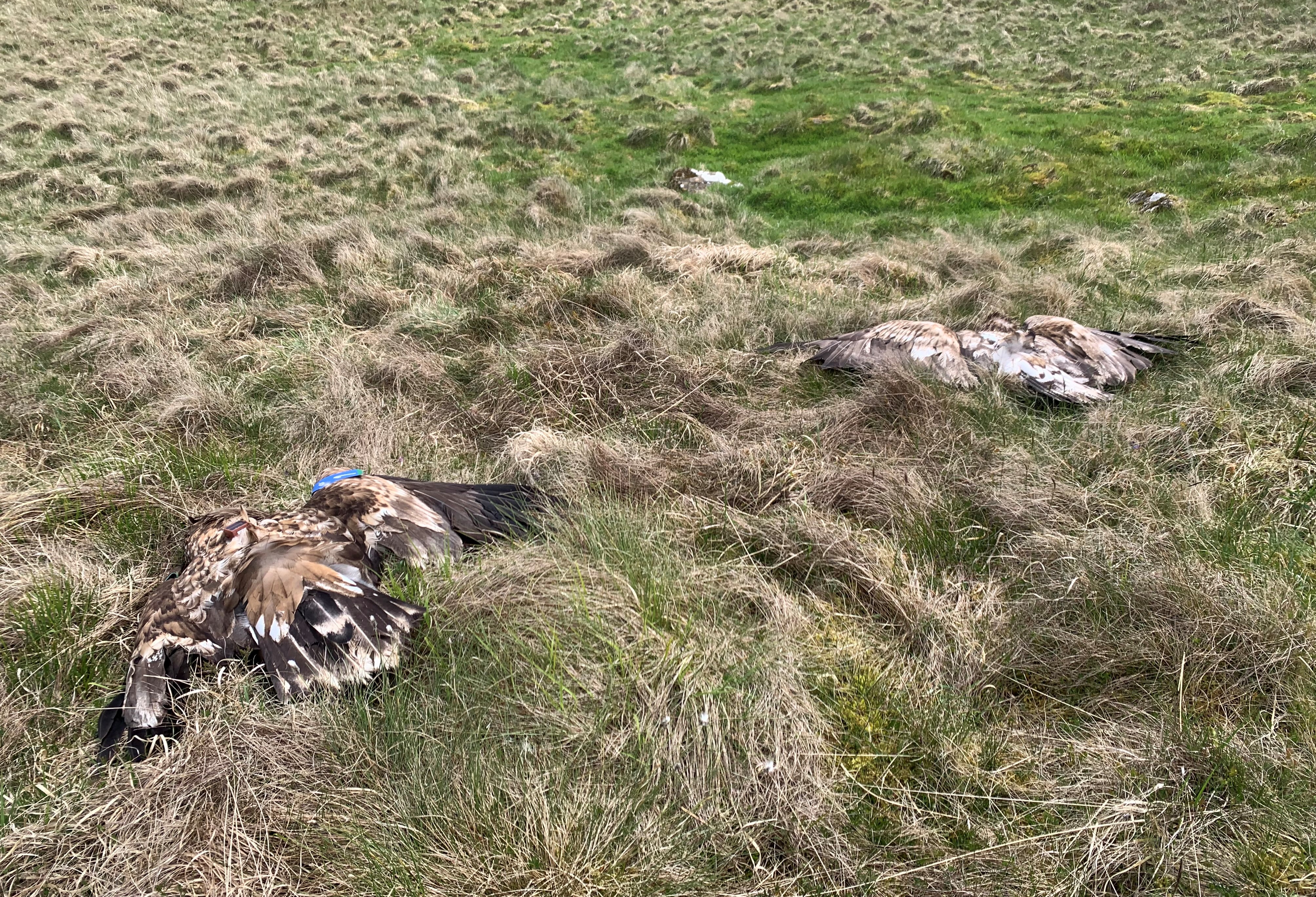
The petition was launched by the award-winning Northern Ireland Raptor Study Group (NIRSG) in July 2023 following the illegal poisoning of two young White-tailed Eagles that were found dead, side by side, on Northern Ireland’s only driven grouse moor at Glenwherry, in the Antrim Hills.
The two poisoned white-tailed eagles. Photo: Northern Ireland Raptor Study Group
The eagles had both ingested the highly toxic insecticide, Bendiocarb, which is currently only licensed for indoor use in Northern Ireland. This chemical is so dangerous that it’s an offence to even possess it in Scotland, let alone place it out in the open on a bait to attract any passing predators.
The petition calling for a ban on the possession of Bendiocarb and a range of other dangerous chemicals used to illegally target birds of prey currently has 46,206 signatures. The target is 50,000 signatures and ideally this target can be met before next week, when the NI Raptor Study Group will be announcing Phase 2 of its campaign to get these pesticides out of circulation. A petition with 50,000+ signatures will help get the attention of the politicians the NIRSG will be approaching.
You don’t need to be a NI resident to sign the petition; any decent human being with an interest in protecting birds of prey and other wildlife can sign it.
If you haven’t already signed, and want to help this important campaign, please sign the petition HERE.
In the build up to a forthcoming decision by the DEFRA Secretary of State (and his counterparts in the devolved governments) whether to accept the HSE’s recommendations to ban the use of toxic lead ammunition (see here), the Wildfowl & Wetlands Trust (WWT) has today released a spoof video highlighting the dangers of poisonous lead shot to the environment, wildlife and human health.
The video is set in a fictional restaurant called the Duck and Cover and features Megan McCubbin ordering the toxic lead roast pheasant…
This is a welcome new campaigning approach by the WWT, using humour to get across an important message about toxic lead ammunition, an issue with which this organisation has long-standing interest and expertise.
The idea is not only to educate the public about the harm caused by toxic lead ammunition, but also to encourage people to join in with the wider campaign to send a strong message to DEFRA Environment Secretary Steve Reed MP urging him to make lead history (see here for how you can help).
Predictably, not everyone is happy with the campaign, and particularly the spoof video. The British Association for Shooting and Conservation (BASC) has published the following apoplectic statement on its website:
The BASC statement is actually funnier than the spoof video.
‘BASC considers the video to be damaging to the reputation of game shooting and food-related businesses linked to sustainable shooting“.
Really? I’d argue the damage being caused to the reputation of game shooting and food-related businesses lies firmly with the game shooting industry’s embarrassing failure to (a) comply with the legislation that forbids the use of toxic lead ammunition in sensitive wetland environments in England (e.g. see here) and in Scotland (e.g. see here), and (b) to meet its own commitment to a five-year voluntary transition away from toxic lead ammunition across the whole of the UK, as evidenced by the continued sale of lead-contaminated gamebirds in supermarkets and other stockists (e.g. see here and here).
‘BASC is also astounded that the video can be released by an organisation whose Chief Executive – Sarah Fowler – enjoyed an evening as a guest of the sector-leading Eat Game Awards in 2024‘.
‘Astounded‘? Why? Does BASC think that just because someone attended an industry event in a professional capacity that should prevent her organisation from ever criticising that industry’s ongoing criminality and dirty, dangerous practices? Just because Natural England signed up to such an agreement doesn’t mean that the silence of others in the conservation sector can also be bought so easily.
And by the way, the ‘sector-leading’ Eat Game Awards gave the prize of ‘Best Large Game Retailer‘ in 2024 to Waitrose, you know, the supermarket that has claimed for at least three years not to be selling game meat contaminated with toxic lead ammunition but has been caught with its pants down three times, leading to an official complaint being made to the Competition and Marketing Authority about Waitrose’s untruthful and inaccurate advertising.
Garry Doolan, BASC’s Deputy Director of Communications & Public Affairs said (amongst other things), “The inclusion of species such as pheasants and grouse – neither of which are wetland birds – further highlights the lack of focus and accuracy in their [WWT’s] messaging“.
That’s hilarious, Garry. An ex- tabloid hack from the Daily Mail telling a highly-respected conservation charity to stay in its lane and stick to ‘accuracy’! Besides, its perfectly legitimate for the WWT to focus on pheasants and grouse because the shooting of these species is a significant source of the dumping of 7,000 tonnes of toxic lead ammunition into the environment every year (not that the WWT needs the approval of BASC for its campaign output).
At least he didn’t attack Megan this time – perhaps he’s learned from his previous outburst of targeted, abusive and aggressive commentary.
Garry also claims that the video “has only served to diminish WWT’s reputation“. Actually, I’d argue it’s done the exact opposite. I applaud WWT’s willingness to put its head above the parapet and shine a big spotlight on the atrocities of the game-shooting industry and the charity has gone up in my estimation because of it.
This WWT video will likely reach a new audience who were previously blissfully unaware of the damage being caused by gamebird shooting and that’s probably what BASC is afraid of, hence it’s attack.
If you’ve enjoyed the spoof video and want to join over 10,000 others who have already sent an e-action to Steve Reed MP urging him to accept the HSE’s recommendation to ban the use of toxic lead ammunition, you can take action here.
For anyone who still wants to pretend that the grouse shooting industry isn’t responsible for the systematic extermination of hen harriers on grouse moors across the UK, here’s the latest catalogue of crime that suggests otherwise.
This male hen harrier died in 2019 after his leg was almost severed in an illegally set trap that had been placed next to his nest on a Scottish grouse moor (see here). Photo by Ruth Tingay
This is the blog I now publish after every reported killing or suspicious disappearance.
“They disappear in the same way political dissidents in authoritarian dictatorships have disappeared” (Stephen Barlow, 22 January 2021).
Today the list has been updated to include the most recently reported victims, three more satellite-tagged hen harriers that ‘disappeared’ in Lanarkshire and Northumberland during October 2024 (here).
I’ve been compiling this list only since 2018 because that is the year that the grouse shooting industry ‘leaders’ would have us believe that the criminal persecution of hen harriers had stopped and that these birds were being welcomed back on to the UK’s grouse moors (see here).
This assertion was made shortly before the publication of a devastating new scientific paper that demonstrated that 72% of satellite-tagged hen harriers were confirmed or considered likely to have been illegally killed, and this was ten times more likely to occur over areas of land managed for grouse shooting relative to other land uses (see here). A further scientific paper published in 2023 by scientists at the RSPB, utilising even more recent data, echoed these results – see here.
2018 was also the year that Natural England issued a licence to begin a hen harrier brood meddling trial on grouse moors in northern England. For new blog readers, hen harrier brood meddling was a conservation sham sanctioned by DEFRA as part of its ludicrous ‘Hen Harrier Action Plan‘ and carried out by Natural England (NE), in cahoots with the very industry responsible for the species’ catastrophic decline in England. For more background see here and for a critical evaluation of the trial after 5 years see this report by Wild Justice. In 2024 the brood meddling trial appeared to collapse for reasons which are not yet clear (see here) and the licence for the so-called ‘scientific trial’ expired. Natural England is currently undertaking a review of the ‘trial’ and a report is expected soon.
Brood meddling has been described as a sort of ‘gentleman’s agreement’ by commentator Stephen Welch:
“I don’t get it, I thought the idea of that scheme was some kind of trade off – a gentleman’s agreement that the birds would be left in peace if they were moved from grouse moors at a certain density. It seems that one party is not keeping their side of the bargain“.
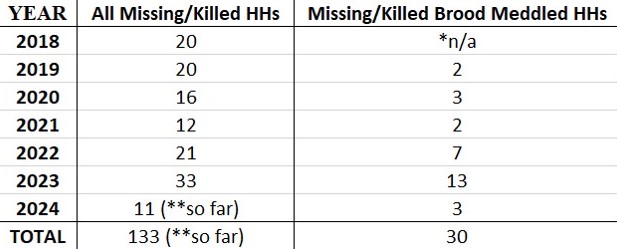
With at least 133 hen harriers gone since 2018, and 30 of those being brood meddled birds, there is no question that the grouse shooting industry is simply taking the piss. Meanwhile, Natural England pretends that ‘partnership working’ is the way to go and consecutive DEFRA Ministers have remained silent.
*n/a – no hen harriers were brood meddled in 2018. **Post mortem reports on a further six hen harriers found dead in 2024 are awaited.
‘Partnership working’ according to Natural England appears to include authorising the removal of hen harrier chicks from a grouse moor already under investigation by the police for suspected raptor persecution (here) and accepting a £75k ‘donation’ from representatives of the grouse shooting industry that prevents Natural England from criticising them or the sham brood meddling trial (see here). This is in addition to a £10k ‘donation’ that Natural England accepted, under the same terms, in 2021 (here).
Thankfully, the Scottish Government finally decided to act by introducing a grouse moor licensing scheme under the Wildlife Management & Muirburn (Scotland) Act 2024. The intention behind this new legislation is that grouse shooting estates could have their licences suspended/revoked if, on the balance of probability, it is shown that any raptor persecution crimes (& some other associated offences) are linked with grouse moor management on that estate. There, are, however, ongoing issues with the licence as it’s been significantly watered-down after an intervention from the grouse shooting industry (see here). Work is underway to address this.
In England a new Hen Harrier Taskforce was established in 2024, led by the National Wildlife Crime Unit, to use innovative techniques to target hen harrier persecution hotspots (locations where hen harriers repeatedly ‘disappear’ or are found illegally killed). It’s too early to judge the Taskforce’s success and it’s been met with resistance from the Moorland Association, the grouse moor owners’ lobby group (here) and so far, illegal persecution continues.
So here’s the latest gruesome list of ‘missing’/illegally killed hen harriers since 2018. Note that the majority of these birds (but not all) were fitted with satellite tags. How many more [untagged] harriers have been killed? We now have evidence that gamekeepers are specifically targeting untagged hen harriers, precisely to avoid detection (see here).
February 2018: Hen harrier Saorsa ‘disappeared’ in the Angus Glens in Scotland (here). The Scottish Gamekeepers Association later published wholly inaccurate information claiming the bird had been re-sighted. The RSPB dismissed this as “completely false” (here).
5 February 2018: Hen harrier Marc ‘disappeared’ on a grouse moor in Durham (here).
9 February 2018: Hen harrier Aalin ‘disappeared’ on a grouse moor in Wales (here).
March 2018: Hen harrier Blue ‘disappeared’ in the Lake District National Park (here).
March 2018: Hen harrier Finn ‘disappeared’ near Moffat in Scotland (here).
18 April 2018: Hen harrier Lia ‘disappeared’ in Wales and her corpse was retrieved in a field in May 2018. Cause of death was unconfirmed but police treating death as suspicious (here).
8 August 2018: Hen harrier Hilma ‘disappeared’ on a grouse moor in Northumberland (here).
16 August 2018: Hen harrier Athena ‘disappeared’ on a grouse moor in Scotland (here).
26 August 2018: Hen Harrier Octavia ‘disappeared’ on a grouse moor in the Peak District National Park (here).
29 August 2018: Hen harrier Margot ‘disappeared’ on a grouse moor in Scotland (here).
29 August 2018: Hen Harrier Heulwen ‘disappeared’ on a grouse moor in Wales (here).
3 September 2018: Hen harrier Stelmaria ‘disappeared’ on a grouse moor in Scotland (here).
24 September 2018: Hen harrier Heather ‘disappeared’ on a grouse moor in Scotland (here).
2 October 2018: Hen harrier Mabel ‘disappeared’ on a grouse moor on the edge of the Yorkshire Dales National Park (here).
3 October 2018: Hen Harrier Thor ‘disappeared’ next to a grouse moor in Bowland, Lanacashire (here).
23 October 2018: Hen harrier Tom ‘disappeared’ in South Wales (here).
26 October 2018: Hen harrier Arthur ‘disappeared’ on a grouse moor in the North York Moors National Park (here).
1 November 2018: Hen harrier Barney ‘disappeared’ on Bodmin Moor (here).
10 November 2018: Hen harrier Rannoch ‘disappeared’ on a grouse moor in Scotland (here). Her corpse was found nearby in May 2019 – she’d been killed in an illegally-set spring trap (here).
14 November 2018: Hen harrier River ‘disappeared’ on a grouse moor in the Nidderdale AONB (here). Her corpse was found nearby in April 2019 – she’d been illegally shot (here).
16 January 2019: Hen harrier Vulcan ‘disappeared’ in Wiltshire close to Natural England’s proposed reintroduction site (here).
28 January 2019: Hen harrier DeeCee ‘disappeared’ in Glen Esk, a grouse moor area of the Angus Glens (see here).
7 February 2019: Hen harrier Skylar ‘disappeared’ next to a grouse moor in South Lanarkshire (here).
22 April 2019: Hen harrier Marci ‘disappeared’ on a grouse moor in the Cairngorms National Park (here).
26 April 2019: Hen harrier Rain ‘disappeared’ on a grouse moor in Nairnshire (here).
11 May 2019: An untagged male hen harrier was caught in an illegally-set trap next to his nest on a grouse moor in South Lanarkshire. He didn’t survive (here).
7 June 2019: An untagged hen harrier was found dead on a grouse moor in Scotland. A post mortem stated the bird had died as a result of ‘penetrating trauma’ injuries and that this bird had previously been shot (here).
5 September 2019: Wildland Hen Harrier 1 ‘disappeared’ on a grouse moor nr Dalnaspidal on the edge of the Cairngorms National Park (here).
11 September 2019: Hen harrier Romario ‘disappeared’ on a grouse moor in the Cairngorms National Park (here).
14 September 2019: Hen harrier (Brood meddled in 2019, #183704) ‘disappeared’ in the North Pennines (here).
23 September 2019: Hen harrier (Brood meddled in 2019, #55149) ‘disappeared’ in North Pennines (here).
24 September 2019: Wildland Hen Harrier 2 ‘disappeared’ on a grouse moor at Invercauld in the Cairngorms National Park (here).
24 September 2019: Hen harrier Bronwyn ‘disappeared’ near a grouse moor in North Wales (here).
10 October 2019: Hen harrier Ada ‘disappeared’ on a grouse moor in the North Pennines AONB (here).
12 October 2019: Hen harrier Thistle ‘disappeared’ on a grouse moor in Sutherland (here).
18 October 2019: Member of the public reports the witnessed shooting of an untagged male hen harrier on White Syke Hill in North Yorkshire (here).
November 2019: Hen harrier Mary found illegally poisoned on a pheasant shoot in Ireland (here).
November 2019: Hen harrier Artemis ‘disappeared’ near Long Formacus in south Scotland (RSPB pers comm).
14 December 2019: Hen harrier Oscar ‘disappeared’ in Eskdalemuir, south Scotland (here).
December 2019: Hen harrier Ingmar ‘disappeared’ in the Strathbraan grouse moor area of Perthshire (RSPB pers comm).
27 January 2020: Members of the public report the witnessed shooting of a male hen harrier on Threshfield Moor in the Yorkshire Dales National Park (here).
23 March 2020: Hen harrier Rosie ‘disappeared’ at an undisclosed roost site in Northumberland (here).
1 April 2020: Hen harrier (Brood meddled in 2019, #183703) ‘disappeared’ in unnamed location, tag intermittent (here).
5 April 2020: Hen harrier Hoolie ‘disappeared’ on a grouse moor in the Cairngorms National Park (here)
8 April 2020: Hen harrier Marlin ‘disappeared’ on a grouse moor in the Cairngorms National Park (here).
19 May 2020: Hen harrier Fingal ‘disappeared’ on a grouse moor in the Lowther Hills, Scotland (here).
21 May 2020: Hen harrier (Brood meddled in 2019, #183701) ‘disappeared’ on a grouse moor in Cumbria shortly after returning from wintering in France (here).
27 May 2020: Hen harrier Silver ‘disappeared’ on a grouse moor on Leadhills Estate, Scotland (here).
2020: day/month unknown: Unnamed male hen harrier breeding on RSPB Geltsdale Reserve, Cumbria ‘disappeared’ while away hunting (here).
9 July 2020: Unnamed female hen harrier (#201118) ‘disappeared’ from an undisclosed site in Northumberland (here).
25 July 2020: Hen harrier Harriet ‘disappeared’ on a grouse moor in the Yorkshire Dales National Park (here).
14 August 2020: Hen harrier Solo ‘disappeared’ in confidential nest area in Lancashire (here).
7 September 2020: Hen harrier Dryad ‘disappeared’ on a grouse moor in the Yorkshire Dales National Park (here).
16 September 2020: Hen harrier Fortune ‘disappeared’ from an undisclosed roost site in Northumberland (here).
19 September 2020: Hen harrier Harold ‘disappeared’ on a grouse moor in the Yorkshire Dales National Park (here).
20 September 2020: Hen harrier (Brood meddled in 2020, #55152) ‘disappeared’ next to a grouse moor in North Yorkshire (here).
24 February 2021: Hen harrier Tarras ‘disappeared’ next to a grouse moor in Northumberland (here)
12th April 2021: Hen harrier Yarrow ‘disappeared’ near Stockton, County Durham (here).
18 May 2021: Adult male hen harrier ‘disappeared’ from its breeding attempt on RSPB Geltsdale Reserve, Cumbria whilst away hunting (here).
18 May 2021: Another adult male hen harrier ‘disappeared’ from its breeding attempt on RSPB Geltsdale Reserve, Cumbria whilst away hunting (here).
24 July 2021: Hen harrier Asta ‘disappeared’ at a ‘confidential site’ in the North Pennines (here). We learned 18 months later that her wings had been ripped off so her tag could be fitted to a crow in an attempt to cover up her death (here).
14th August 2021: Hen harrier Josephine ‘disappeared’ at a ‘confidential site’ in Northumberland (here).
17 September 2021: Hen harrier Reiver ‘disappeared’ in a grouse moor dominated region of Northumberland (here)
24 September 2021: Hen harrier (Brood meddled in 2021, R2-F-1-21) ‘disappeared’ in Northumberland (here).
15 November 2021: Hen harrier (brood meddled in 2020, #R2-F1-20) ‘disappeared’ at the edge of a grouse moor on Arkengarthdale Estate in the Yorkshire Dales National Park (here).
19 November 2021: Hen harrier Val ‘disappeared’ in the Lake District National Park in Cumbria (here).
19 November 2021: Hen harrier Percy ‘disappeared’ in Lothian, Scotland (here).
12 December 2021: Hen harrier Jasmine ‘disappeared’ on a grouse moor (High Rigg Moor on the Middlesmoor Estate) in the Nidderdale AONB in North Yorkshire (here).
9 January 2022: Hen harrier Ethel ‘disappeared’ in Northumberland (here).
26 January 2022: Hen harrier Amelia ‘disappeared’ in Bowland (here).
10 February 2022: An unnamed satellite-tagged hen harrier ‘disappeared’ in a grouse moor dominated area of the Peak District National Park (here). One year later it was revealed that the satellite tag/harness of this young male called ‘Anu’ had been deliberately cut off (see here).
12 April 2022: Hen harrier ‘Free’ (Tag ID 201121) ‘disappeared’ at a ‘confidential site’ in Cumbria (here). It later emerged he hadn’t disappeared, but his mutilated corpse was found on moorland in the Yorkshire Dales National Park. A post mortem revealed the cause of death was having his head twisted and pulled off. One leg had also been torn off whilst he was still alive (here).
April 2022: Hen harrier ‘Pegasus’ (tagged by the RSPB) ‘disappeared’ on a grouse moor at Birkdale in the Yorkshire Dales National Park (here).
May 2022: A male breeding hen harrier ‘disappeared’ from a National Trust-owned grouse moor in the Peak District National Park (here).
May 2022: Another breeding male hen harrier ‘disappeared’ from a National Trust-owned grouse moor in the Peak District National Park (here).
14 May 2022: Hen harrier ‘Harvey’ (Tag ID 213844) ‘disappeared’ from a ‘confidential site’ in the North Pennines (here).
20 June 2022: Hen harrier chick #1 stamped to death in nest on a grouse moor in the Yorkshire Dales National Park (here).
20 June 2022: Hen harrier chick #2 stamped to death in nest on a grouse moor in the Yorkshire Dales National Park (here).
20 June 2022: Hen harrier chick #3 stamped to death in nest on a grouse moor in the Yorkshire Dales National Park (here).
20 June 2022: Hen harrier chick #4 stamped to death in nest on a grouse moor in the Yorkshire Dales National Park (here).
17 August 2022: Hen harrier (brood meddled in 2022, #R1-M1-22) ‘disappeared’ on moorland in the Yorkshire Dales National Park (here).
September 2022: Hen harrier ‘Sullis’ (tagged by the RSPB) ‘disappeared’ on a grouse moor in Cumbria (here).
5 October 2022: Hen harrier (brood meddled in 2022, #R3-M2-22) ‘disappeared’ on moorland in the Yorkshire Dales National Park (here).
10 October 2022: Hen harrier ‘Sia’ ‘disappeared’ near Hamsterley Forest in the North Pennines (here).
October 2022: Hen harrier (brood meddled in 2021, #R1-F1-21) ‘disappeared’ in the North Sea off the North York Moors National Park (here).
1 December 2022: Hen harrier male (brood meddled in 2021, #R1-M1-21) ‘disappeared’ on moorland in the Yorkshire Dales National Park (here).
7 December 2022: Hen harrier female (brood meddled in 2020, #R2-F2-20) ‘disappeared’ from winter roost (same as #R3-F1-22) on moorland in North Pennines AONB (here). Later found dead with 3 shotgun pellets in corpse.
14 December 2022: Hen harrier female (brood meddled in 2022, #R3-F1-22) ‘disappeared’ from winter roost (same as #R2-F2-20) on moorland in the North Pennines AONB (here). Later found dead with two shotgun pellets in corpse.
15 December 2022: Hen harrier female (brood meddled in 2022, #R2-F1-22) ‘disappeared’ on moorland in the Yorkshire Dales National Park (here).
30 March 2023: Hen harrier female (brood meddled in 2022, #R1-F3-22) ‘disappeared’ in Yorkshire (here). Notes from NE Sept 2023 spreadsheet update: “Final transmission location temporarily withheld at police request“.
1 April 2023: Hen harrier male (brood meddled in 2022, #R2-M1-22) ‘disappeared’ in Yorkshire (here). Notes from NE Sept 2023 spreadsheet update: “Final transmission location temporarily withheld at police request“.
April 2023: Hen harrier ‘Lagertha’ (tagged by RSPB) ‘disappeared’ in North Yorkshire (here).
April 2023: Hen harrier ‘Nicola’ (Tag ID 234078) ”disappeared’ in North Yorkshire (here).
April 2023: Untagged male hen harrier ‘disappeared’ from an active nest on RSPB Geltsdale Reserve in Cumbria (here).
April 2023: Another untagged male hen harrier ‘disappeared’ from an active nest on RSPB Geltsdale Reserve in Cumbria (here).
April 2023: Untagged male hen harrier ‘disappeared’ from an active nest in Durham (here).
4/5 May 2023: Satellite-tagged male hen harrier called ‘Rush’ ‘disappeared’ from a grouse moor in Bowland AONB in Lancashire (here).
9/10 May 2023: Hen harrier male called ‘Dagda’, tagged by the RSPB in Lancashire in June 2022 and who was breeding on the RSPB’s Geltsdale Reserve in 2023 until he ‘vanished’, only to be found dead on the neighbouring Knarsdale grouse moor in May 2023 – a post mortem revealed he had been shot (here).
17 May 2023: Satellite-tagged hen harrier called ‘Wayland’ ‘disappeared’ in the Clapham area of North Yorkshire, just north of the Bowland AONB (here).
31 May 2023: Hen harrier male (brood meddled in 2022, tag #213932, name: R2-M3-22) ‘disappeared’ in Northumberland (grid ref: NY765687) (here).
11 June 2023: Hen harrier male (brood meddled in 2021, tag #213922, name: R2-M1-21) ‘disappeared’ at a confidential site in the Yorkshire Dales National Park. Notes from the NE spreadsheet: “Final transmission location temporarily withheld at police request“ (here).
12 June 2023: Hen harrier male (brood meddled in 2020, tag #203004, name: R1-M2-20) ‘disappeared’ on a grouse moor in Co. Durham (grid ref: NY976322) (here).
6 July 2023: Satellite-tagged female hen harrier named ‘Rubi’ (tag #201124a) ‘disappeared’ on a grouse moor in Co. Durham (grid ref: NY911151) (here).
23 July 2023: Hen harrier female (brood meddled in 2023, tag #55154a, name: R1-F1-23) ‘disappeared’ on a grouse moor in Co. Durham (close to where ‘Rubi’ vanished), grid ref: NY910126 (here).
29 July 2023: Hen harrier female (brood meddled in 2020, tag #55144, name: R2-F2-20) ‘disappeared’ at a confidential site in the North Pennines. Notes from the NE spreadsheet: “Dead. Recovered – awaiting PM results. Final transmission location temporarily withheld at police request“ (here).
9 August 2023: Satellite-tagged hen harrier called ‘Martha’ ‘disappeared’ on a grouse moor (Westburnhope Moor) near Hexham in the North Pennines (here).
11 August 2023: Satellite-tagged hen harrier called ‘Selena’ ‘disappeared’ on a grouse moor (Mossdale Moor) in the Yorkshire Dales National Park (here).
11 August 2023: Hen harrier female (brood meddled in 2023, tag #201118a, name: R3-F1-23) ‘disappeared’ in Co. Durham (grid ref: NZ072136) (here).
15 August 2023: Satellite-tagged hen harrier called ‘Hepit’ ‘disappeared’ on a grouse moor (Birkdale Common) near Kirkby Stephen in the Yorkshire Dales National Park (here).
24 August 2023: Hen harrier female (brood meddled in 2023, tag #55155a, name: R1-F2-23) ‘disappeared’ at a confidential site in Northumberland. Notes from the NE spreadsheet: “Final transmission location temporarily withheld at police request“ (here).
August-Sept 2023: Satellite-tagged hen harrier called ‘Harmonia’ ‘disappeared’ in the Yorkshire Dales National Park (here).
September 2023: Hen harrier female ‘Saranyu’, tagged by the RSPB in Cumbria in June 2023, ‘disappeared’ in Durham in September 2023 (no further details available yet – just outline info provided in 2022 Birdcrime report) (here).
September 2023: Hen harrier female ‘Inger’, a female tagged by the RSPB in Perthshire in July 2022, ‘disappeared’ on a grouse moor in the Angus Glens in September 2023 (here).
15 September 2023: Hen harrier male called ‘Rhys’, tagged in Cumbria on 1st August 2023, ‘disappeared’ on a grouse moor in the Yorkshire Dales National Park. Grid ref: SD798896 (here).
24 September 2023: Hen harrier female (brood meddled in 2023, name: ‘R2-F2-23’) ‘disappeared’ in the North Pennines, grid ref: NY888062 (here).
25 September 2023: Hen harrier female (brood meddled in 2022, name: ‘R1-F4-22’) ‘disappeared’ on a grouse moor in the Yorkshire Dales National Park, grid ref: SE077699 (here).
26 September 2023: Hen harrier female called ‘Hope’, tagged in Cumbria on 21 July 2023, ‘disappeared’ next to a grouse moor in the Yorkshire Dales National Park, grid ref: SD801926 (here).
4 October 2023: Hen harrier male (brood meddled in 2020, name: ‘R1-M3-20’) ‘disappeared’ in Co Durham, grid ref: NY935192 (here).
4 October 2023: Hen harrier female (brood meddled in 2023, name: ‘R4-F1-23’) ‘disappeared’ on a grouse moor in the Yorkshire Dales National Park, grid ref: SE003981 (here).
14 October 2023: Hen harrier male called ‘Cillian’, tagged in Cumbria on 1 August 2023, ‘disappeared’ in south west Scotland, grid ref: NY051946 (here).
15 November 2023: Hen harrier female called ‘Hazel’, tagged in Cumbria on 21 July 2023, ‘disappeared’ on the Isle of Man, grid ref: SC251803 (here).
27 November 2023: Hen harrier female called ‘Gill’, tagged in Northumberland on 10 July 2023, ‘disappeared’ at a confidential location in Teeside (here).
12 February 2024: Hen harrier female called ‘Susie’, Tag ID 201122, found dead at a confidential location in Northumberland and the subject of an ongoing police investigation (here).
15 February 2024: Hen harrier female called ‘Shalimar’, tagged on the National Trust for Scotland’s Mar Lodge estate in 2023, ‘disappeared’ in suspicious circumstances on a grouse moor in the notorious Angus Glens (here).
7 March 2024: Hen harrier male (brood meddled in 2023, name R2-M1-23) found dead in Devon. According to an FoI response from Natural England in June 2024 this death is the subject of an ongoing police investigation (here).
24 April 2024: Hen harrier male called ‘Ken’, Tag ID 213849a, ‘disappeared’ in suspicious circumstances close to a grouse moor in Bowland, grid ref SD 684601 (here).
17 May 2024: Hen harrier male (brood meddled in 2023, name R2-M2-23) ‘disappeared’ in suspicious circumstances next to Middlesmoor grouse moor in Nidderdale, grid ref SE043754 (here).
25 June 2024: Hen harrier female (brood meddled in 2023, name R2-F1-23) ‘disappeared’ in suspicious circumstances on a grouse moor in Yorkshire Dales National Park, grid ref NY985082 (here).
July 2024: Hen harrier female named ‘Helius’ satellite tagged by the RSPB ‘disappeared’ in suspicious circumstances in Bowland (here).
October 2024: An un-tagged hen harrier was shot on a grouse moor by one of three gamekeepers being secretly filmed by the RSPB (here).
1 October 2024: Hen harrier female named ‘Dreich’, Tag ID: 254842, ‘disappeared’ in Lanarkshire. Listed by NE as ‘Missing Fate Unknown, site confidential – ongoing investigation‘ (here).
15 October 2024: Hen harrier male named ‘Baldur’, Tag ID: 240291, ‘disappeared’ in Northumberland. Listed by NE as ‘Missing Fate Unknown, site confidential – ongoing investigation‘ (here).
19 October 2024: Hen harrier female named ‘Margaret’, Tag ID: 254844, ‘disappeared’ in Northumberland. Listed by NE as ‘Missing Fate Unknown, site confidential – ongoing investigation‘ (here).
To be continued…….
Not one of these 133 incidents has resulted in an arrest, let alone a prosecution. I had thought that when we reached 30 dead/missing hen harriers then the authorities might pretend to be interested and at least say a few words about this national scandal. We’ve now reached ONE HUNDRED AND THIRTY THREE hen harriers, and still Govt ministers remain silent on the illegal persecution issue. They appear not to give a monkey’s. And yes, there are other things going on in the world, as always. That is not reason enough to ignore this blatant, brazen and systematic destruction of a supposedly protected species, being undertaken to satisfy the greed and bloodlust of a minority of society.
And let’s not forget the response from the (now former) Moorland Association Chair (and owner of Swinton Estate) Mark Cunliffe-Lister, who told BBC Radio 4 in August 2023 that, “Clearly any illegal [hen harrier] persecution is nothappening” (here), in the year when a record 33 hen harriers had been confirmed ‘missing’ and/or illegally killed.
Nor should we forget the response from the Game and Wildlife Conservation Trust’s (GWCT) Director of Policy Dr Alistair Leake who wrote a letter to the Guardian newspaper in November 2023 stating that the hen harrier brood management [meddling] scheme “is surely a shining example of human / wildlife conflict resolution that would be the envy of other countries trying to find similar solutions“ (I kid you not – here).
Wild Justice has launched another petition calling for a ban on driven grouse shooting. This latest petition is intended to gauge the view of the new Labour Government, as previous petitions were all lodged under the Conservative Government with its well-documented vested interests. Labour issued an appalling pathetic interim response to the petition in January 2025, via DEFRA, which indicated it had no intention of banning driven grouse shooting (see here).
The petition is live until 22 May 2025 and needs 100,000 signatures to qualify for a debate in Westminster Hall. It’s currently on 53,000 signatures. If you haven’t yet signed it, it’s here.
The National newspaper published a special report on Monday 16 December 2024 entitled, ‘Why are birds of prey still being killed in Scotland despite new legislation?’, with a particular focus on the Cairngorms National Park.
It’s reproduced below.
SCOTLAND passed the Wildlife Management and Muirburn (Scotland) Bill earlier this year, introducing a licensing scheme for the grouse shooting industry in a bid to end the illegal killing of birds of prey.
The first licenses were issued this past summer, and while considered a blueprint for tougher legislation across the UK – people are still killing birds of prey on grouse moors, which is not an easy thing to do.
Guilty parties must have access to a vehicle, equipment such as a firearm, opportunity and motive.
“This isn’t people traveling from towns and cities going up onto our hills and randomly killing birds of prey. These are targeted offences,” Ian Thomson, investigations manager for the RSPB, told The National.
But why? And who would do this?
Why are grouse moor shootings still taking place?
A Hen Harrier disappeared in February. A buzzard was shot in Perthshire in mid-May. An osprey was shot in the Glen Doll area in August. A dead golden eagle was found in a plastic bag near Loch Rusky in November.
In the last 15 years, more than 1500 birds of prey have been killed, with 57 convictions. However, the majority of these sentences are suspended, and only one person has been jailed.
Most of the evidence gathered by investigators is from satellite tags, fitted to allow conservationists to monitor the movements around the country.
The technology is estimated to be about 97% reliable, and “very rarely suffers some sort of technical function”, according to Thomson.
“Often we believe that there is strong evidence that supports the fact that these birds are being shot often at night, the tags destroyed, and the carcass is disposed of,” Thomson said.
The RSPB investigations team assists Police Scotland by speaking to local land managers and liaising with the community if a tag stops working. When asked why anyone would target the birds, even with the new legislation in place, Thomson said: “The killings are being undertaken by people who are working on the land.
“That’s the reality, and the vast majority of raptor persecution offenses occurring in Scotland are linked to management for kind of game bird shooting and particularly grouse shooting.
“There are many layers of evidence that support that.
“First of all, the location of the incidents that are found. Whether its birds shot, birds poisoned, or nests destroyed, these are all subject to police investigations.
“A significant proportion of people convicted for raptor persecution offenses have been gamekeepers,” Thomson shared.
RSPB data shows that at least 54% of all confirmed incidents in the last 10 years (2014-2023) have been linked to land managed for pheasant, partridge and grouse shooting.
The association of these crimes with the gamebird industry is also evidenced by criminal court records. Of all individuals convicted of bird of prey persecution related offences from 2009 to 2023, 75% were connected to the gamebird shooting industry and 68% were gamekeepers.
The Angus Glens crime hotspot
Angus Glens in the Cairngorms is a hotspot for the number of raptor persecution in Scotland, with the Highlands having 69 since 2009.
There have been multiple confirmed incidents occurring on several estates in the area. This includes many poisoning incidents using chemicals whose possession was long banned, repeated illegal misusing abuse of crow traps and pole traps, shootings and destruction of nests.
Earlier this year, NatureScot placed restrictions on an estate on the edge of the Cairngorms National Park for three years following evidence of bird poisoning on the property.
Thomson said there had been 10 suspicious disappearances of satellite tags on birds of prey in the Angus Glen in the last 15 years.
There has been a peregrine, and an osprey shot since the start of the shooting season in Angus Glens this year, which Thomson described as “worrying”.
The law as it has stood since 2012 has been serious liability, which means landowners are responsible for the actions of their employees and the land.
So are landowners aware of the circumstances surrounding raptor persecutions on their land?
A wall of silence
The first licenses under the new bill were approved this past July, but Thomson noted there would have been no need for it had the industry “taken possession of this problem decades ago”.
He added: “I think had the industry rooted out criminals, then we wouldn’t have needed this sort of legislation moved on.
“We are in a situation where some Victorian management practices towards birds of prey persist. It really is time that the shooting industry got into the 21st century.”
Thomson said it was rare for estates to report raptor persecutions.
When asked whether estates may be protecting or turning a blind eye to those who target birds of prey, Thomson said he could not confirm but he and his team frequently hear of peer pressure within estates to keep reporting low, adding that crimes are rarely reported by the industry.
“The problem is the game keeping industry is used to operating a bit like a closed shop,” Thomson said.
“It’s very difficult. There is no whistleblowing culture, and it would be fantastic if organizations representing gamekeepers set up a scheme where people could report incidents taking place and those are passed on to the police.
“But that just never seems to happen. Exceedingly rare truths are told.”
Thomson revealed that gamekeepers come to the team sharing their worries and are “terrified” to come forward.
“They say to us this information can’t come from me because I may lose my job and I may lose my friends and I may lose my hobby. People are under considerable pressure to keep their mouths shut,” he said.
“Either people won’t see anything or there is just a culture of denial.”
Thomson described “efforts to deny or downplay” incidents, and said that when satellite tags start to disappear, people blame “imaginary wind farms” or factors, dismissing science and evidence of crimes.
“It’s a mix of cultural misinformation, a wall of silence and complete denial”, Thomson added.
ENDS
For those who are sick to the back teeth of birds of prey being illegally killed on grouse moors, you might want to sign this new petition from Wild Justice calling for a ban on driven grouse shooting – HERE.
Nottinghamshire Police have issued an appeal for information after the discovery of ‘several dead birds of prey that were seen in suspicious and unnatural circumstances‘ near to the village of Bunny, in the Rushcliffe borough of south Nottinghamshire on Tuesday 10th December 2024.
They said: “We are appealing for the public’s help if you have seen any suspicious animal carcasses while out walking please report them to police and do not allow dogs or other animals to touch them as they may be poisoned.
If you have any information which might assist enquiries it can be reported online or via 101 quoting occurrence number 24000745675“.
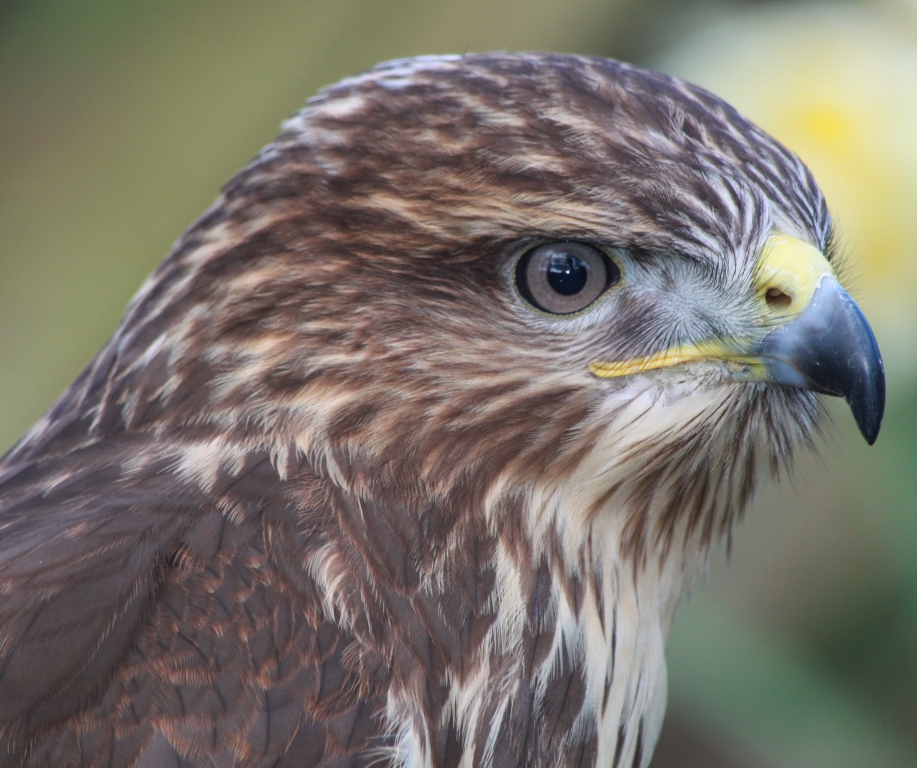
They haven’t provided any further detail such as the species involved although their social media post was illustrated with an image of a buzzard.
Buzzard photo by Ruth Tingay
This is an excellent response from Nottinghamshire Police, not only to gather information during the early phase of an investigation but especially to warn the public of the risk of potential poisons being used that could be a danger to people and their pets.
Hopefully Nottinghamshire Police will provide an update once post mortems and toxicology tests have been undertaken.
Over the last 17 years or so, satellite-tracking technology has revolutionised our understanding of not only hen harrier ecology, but also the persistent, illegal killing of these birds on driven grouse moors across the UK.
Two organisations have been at the forefront of hen harrier satellite tracking – Natural England and the RSPB (with significant help from raptor study groups and others).
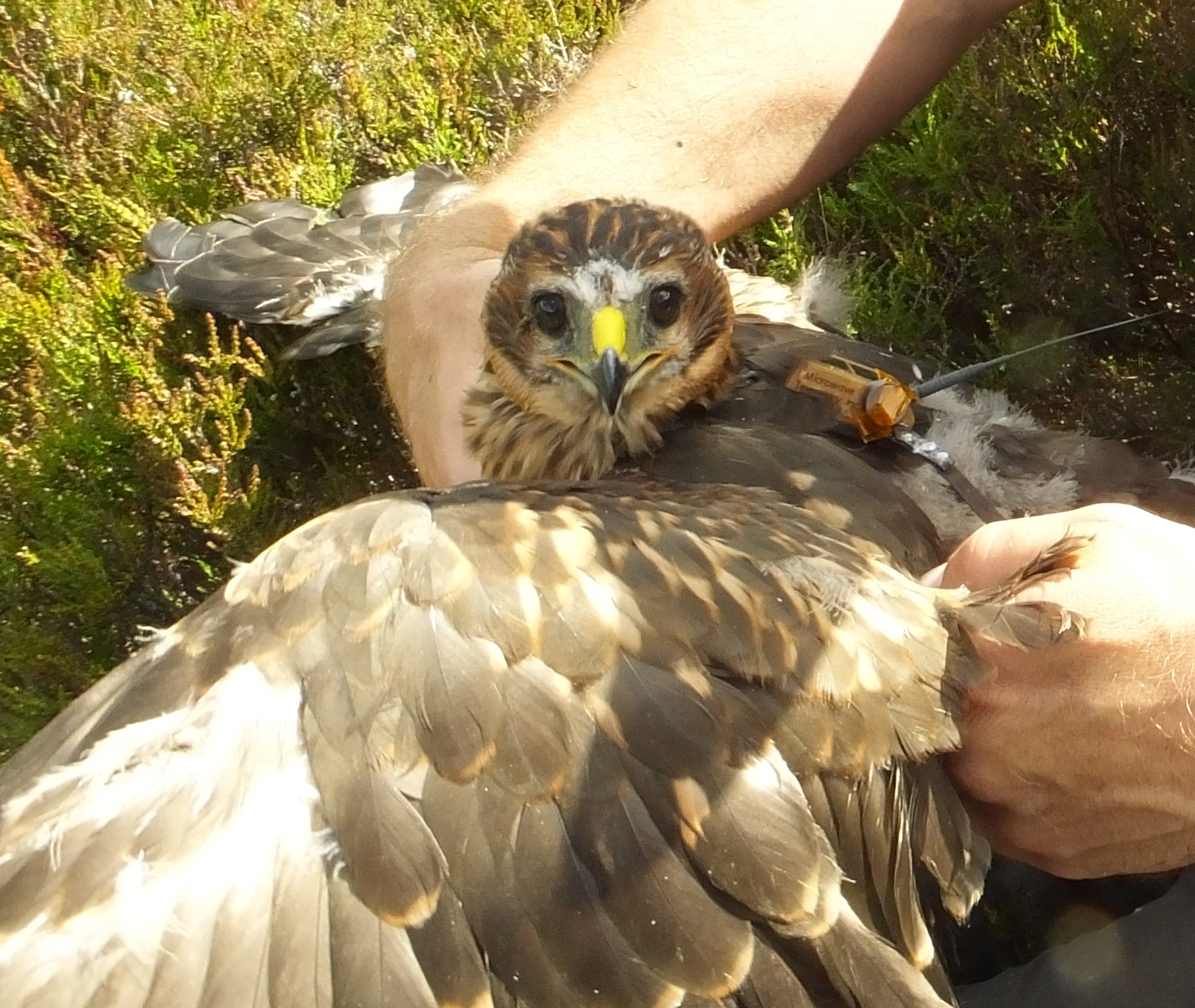
Satellite-tagged hen harrier. Photo by RSPB
For several years now, Natural England has been intermittently publishing the fates of the hen harriers it’s team has tagged (see here), but only with vague explanations about its definition of the category, ‘Missing, Fate Unknown’ (e.g. see here).
Of course, since then, a significant academic paper published in 2019 demonstrated what we all already knew – that patterns of satellite-tagged hen harrier disappearances suggested widespread illegal killing on British grouse moors (see here).
A further paper, published in 2023 and this time analysing the fates of hen harriers tagged by the RSPB, reached the same conclusion (see here).
Since 2018, I have been publishing details about the confirmed/suspected deaths of satellite-tagged (and a few untagged) hen harriers using data from both Natural England and the RSPB (this list currently stands at 130 illegally killed/’missing’ hen harriers although there are still more to add; those data are currently being withheld from the public – see here).
Now, for the first time, the RSPB has launched an interactive map hub showing the fates of hen harriers its team has satellite-tagged since 2014 (currently up to October 2024).
The RSPB’s interactive database includes the fates of 178 of the 226 hen harriers satellite-tagged so far. Some dead hen harriers are not included as they are subject to ongoing police investigations. The hen harriers that are still alive and are currently being tracked are also not included, for what should be obvious reasons.
Screen grab of the RSPB’s new interactive HH map hub
The interactive map hub allows users to filter the ‘fates’ of the RSPB’s tagged hen harriers into five different categories:
Confirmed Illegal persecution
Stop no malfunction (where the bird has disappeared in suspicious circumstances)
Natural
Unknown
Tag failure/expired
Detailed explanations of each of these categories are provided on the hub.
Users are also able to zoom in to the map to show the general area where a harrier died and you can manipulate the map to show terrain etc.
This facility is a useful and welcome addition to the public record on the fates of individual satellite-tracked hen harriers in the UK. I’m not sure it provides us with any wider, big-picture information that we don’t already know but that’s probably not the intention behind this interactive hub anyway. What it does do is provide the public with a level of detail to help them understand the scale of satellite-tagging efforts on the UK’s hen harriers and thus the veracity of the extent of the ongoing illegal killing of this species on many driven grouse moors.
Press release from PSNI (Police Service for Northern Ireland), 13 December 2024
POLICE CONFIRM BIRD POISONING IN ARMAGH
Police have confirmed that an adult bird of prey was found dead in the Forkhill area of Armagh in June of this year was poisoned.
It was reported on the 12th June that a Peregrine Falcon was found dead in the Forkhill area. The bird was retrieved by our search and rescue team and underwent testing to ascertain the exact circumstances, with enquiries ongoing the last number of months.
Constable Millen said: “We can now confirm the Peregrine Falcon found was poisoned with Carbofuran which is very concerning. This is not only a dangerous substance but it has been banned since 2001.
“We would remind the public if there is a suspicion of a crime, such as poisoning on any bird of prey in their local area, to leave the bird(s) and/or bait in situ and to call the police as soon as possible for officers to action.
“We have been working closely with our partners in Northern Ireland Environment Agency and National Wildlife Crime Unit and Northern Ireland Raptor Study Group regarding the matter and will continue to do so, in the hope to find those responsible.
“Police would appeal to anyone who has information on any suspected bird poisoning to please make contact via our non-emergency number 101, or online at http://www.psni.police.uk/makeareport/ or you can contact Crimestoppers anonymously on 0800 555 111 or online at http://crimestoppers-uk.org/.
ENDS
As far as I’m aware, nobody has ever been prosecuted for the illegal poisoning of any wildlife in Northern Ireland, which might explain why poisoning offences, especially against birds of prey, continue.
The Police waiting for six months before issuing an appeal for information about a poisoning crime won’t help, either.
Following the illegal poisoning of two white-tailed eagles in May 2023, found dead together on Northern Ireland’s only driven grouse moor at Glenwherry in the Antrim Hills (here), the Northern Ireland Raptor Study Group launched a petition calling for a ban on the possession of dangerous pesticides (here).
This petition is still live and has attracted almost 46,000 signatures. If you’d like to support it, please click here (you don’t have to be a resident/citizen of NI to sign – it’s open to anyone).
To learn more about recent raptor persecution incidents in Northern Ireland, this excellent report is well worth a read. It covers incidents reported in 2021 and 2022 (published May 2024).
South Yorkshire Police have issued the following press release (dated 9 December 2024):
WITNESS APPEAL AFTER BIRD SHOT IN PEAK DISTRICT
We are appealing for information after a protected bird was reportedly shot in Bradfield, near Sheffield.
On 25 August, a dead raven was found in a field near Agden Side Road, Bradfield, in the Peak District.
The incident was reported to the RSPB who collected the bird. An x-ray of the bird showed that it had been shot.
It is believed the bird was shot between 24 August and 25 August.
Since the incident, officers have been following several lines of enquiry and we are now appealing for anybody who may have any information about the incident to contact us.
You can report information to us online via live chat or by calling 101, quoting incident number 662 of 9 September 2024.
The Agden Side Road lies just beyond the boundary of two grouse moors (Strines and Broomhead) in the Peak District National Park.
This part of the Peak District National Park, dominated by land managed for driven grouse shooting, has a long and sordid history of raptor persecution incidents (e.g. see here, here, here, here, here etc).
Prosecutions are rare, largely due to the difficulty of identifying a named individual to link to a crime that has taken place in a relatively remote landscape with few witnesses.
This is certainly not helped by South Yorkshire Police, who rarely cover themselves in glory with timely investigations, although to be fair unless the shooting of this raven was witnessed and recorded, the police have little to go on.
Yes, the usual suspects will be in the frame but for a prosecution the police need evidence – they can’t just prosecute on the basis of recurrent past criminal behaviour in the area. Although waiting three and a half months to issue an appeal for witnesses, as they’ve done in this case, won’t help.
This scenario happens over and over again in areas managed for driven grouse shooting, even inside our National Parks, and has been happening for decades. Raptors are routinely shot, trapped and poisoned and the criminals get away with their crimes time after time after time.
This is one (of several) reasons why Wild Justice is currently running a petition calling for a ban on driven grouse shooting. The petition currently stands at 30,000 signatures but it needs 100,000 to trigger a parliamentary debate. If you’d like to sign it, please click HERE.
UPDATE 9 June 2025: Another Raven found shot dead next to grouse moor in notorious persecution hotspot in Peak District National Park (here)
Last month conservation campaign group Wild Justice published a detailed report on the impact of the mis-use and abuse of second generation rodenticides (SGARs) on red kites and buzzards in England and the failure of the Government’s Rodenticide Stewardship Scheme, which had been set up in 2016 to reduce the amount of rodenticides in wildlife (see here for press release and a copy of the Wild Justice report, ‘Collateral Damage‘).
Brodifacoum bait station illegally set on the edge of a grouse moor in the Yorkshire Dales National Park. Photo by Ruth Tingay
Brodifacoum. Photo by Ruth Tingay
On the back of the publication of Wild Justice’s report, Scottish Greens MSP Ariane Burgess lodged the following parliamentary question on 19th November 2024:
Question reference S6W-31459
To ask the Scottish Government, in light of the latest report, Collateral Damage, by the UK campaign group, Wild Justice, which states that the Rodenticide Stewardship Scheme in England “is a failed scheme”, and other reports that have indicated increased exposure to anticoagulant rodenticides in common buzzards in Scotland, whether it has assessed the effectiveness of the rodenticide scheme in Scotland.
The question was answered by Agricultural Minister Jim Fairlie on 3rd December 2024:
The Scottish Government continues to contribute to UK-wide monitoring of rodenticide use and exposure in wildlife. There is evidence that many users of rodenticides are complying with the Campaign for Responsible Rodenticide Use’s (CRRU) Rodenticide Stewardship Scheme (RSS), and that in Scotland rodenticide use in agriculture has substantially declined since the introduction of the scheme. But, despite this, recent environmental data for Scotland indicate that it has not yet achieved the aim of significantly reducing wildlife exposure.
Both the UK Government Oversight Group, which includes Scottish Government representation, and CRRU have acknowledged that rodenticide residues in UK wildlife have not declined as hoped. The RSS is being updated firstly to ban the use of second generation anticoagulant rodenticides (SGARs) bromadiolone and difenacoum for open area use from the end of this year. This means no SGARs will be available for open area use; this is also intended to reduce accidental or deliberate misuse of other products in open areas. Secondly, training requirements for the farming sector are also being brought in line with other sectors from end 2025 to ensure a consistent level of professional training across all sectors and reduce the risk of poor practice.
Whilst it’s true that legal authorisation is being rescinded for the use of the SGARs Bromadiolone and Difenacoum in open areas (see press release on this from June 2023, here), it is very clear from the Wild Justice report that the total increase of SGAR exposure in red kites and buzzards in England is being driven by a dramatic increase in the use/mis-use of Brodifacoum, not by Bromadiolone or Difenacoum.
Fig 3 from Wild Justice’s Collateral Damage report (p8) showing the percentage of buzzards and red kites analysed by the WIIS that contained different concentrations of Brodifacoum, Bromadiolone and Difenacoum.
Brodifacoum is the dominant SGAR being found in birds of prey and is more toxic than Bromadiolone and Difenacoum. It used to be restricted to internal use only, until the Government decided to relax that regulation and permit its use ‘in and around buildings’ – a regulation that is obviously being breached routinely given the high levels of exposure in birds of prey (e.g. here).
From January 2025, Bromadiolone and Difenacoum will also be permitted for use ‘in and around buildings’, but there are no proposed tighter rules on the use of Brodifacoum.
Minister Fairlie suggests that a restriction against any use in open areas of any SGAR is intended to reduce accidental or deliberate mis-use of other products in open areas and that new training requirements for all users (not just professional pest controllers) will ‘reduce the risk of poor practice’.
I suppose he’s thinking that this standardisation will remove any supposed ‘confusion’ between the use of different products. However, given that Brodifacoum is already supposedly restricted to use only ‘in and around buildings’, yet has been used with increasing frequency by gamekeepers for targeting birds of prey, Wild Justice argues that the new legal restrictions are unlikely to improve things significantly.
The Wild Justice report suggests that a better option is to return Brodifacoum to its pre-April 2016 approval status, so that it can be used in strict ‘internal areas’ within buildings, and to limit its use to professional pest control companies.
For those who might have missed it, Wild Justice’s Collateral Damage report can be read/downloaded here:
Further to the blog on 30 September 2024 (here) and 17 October 2024 (here), a trial date has been set for a Lincolnshire man in relation to the discovery of a poisoned red kite and two buzzards between 2017 and 2022.
Buzzard photo by Ruth Tingay
John Bryant, 40, of West Ashby, Horncastle, appeared at Boston Magistrates Court on 20 November 2024 where he pleaded not guilty to two charges of using a trap to kill or take a wild bird, six charges of possessing an article capable of being used to commit a summary offence, and two charges of contravening health & safety regulations.
Mr Bryant was released on unconditional bail and a trial date was set for 6 March 2025.
NB: As this case is live comments are turned off until criminal proceedings have concluded.
UPDATE 12 March 2025: Lincolnshire gamekeeper guilty of multiple offences in relation to deaths of red kite and buzzards (here)






 Raptor Persecution UK