Ross-shire Massacre: the pig’s ear of an investigation continues

RK5Ten days ago we blogged about the progress (or apparent lack of) being made in the Ross-shire Massacre case, four months on from the discovery of 22 dead raptors in one of Scotland’s worst raptor poisoning incidents (see here).

A couple of days ago, somebody told us that the ‘official’ number of birds confirmed poisoned was now 16 (12 red kites + 4 buzzards), according to Police Scotland.

We found this news intriguing. Did it mean that the remaining six carcasses (4 red kites + 2 buzzards) had not been poisoned?

No. What it turned out to mean was that toxicology tests on those remaining birds are still “continuing”, according to a news report in The Press and Journal (see here).

Still continuing, four months after discovery? Is that because the poison is proving difficult to detect, or is it because the tests have not been given priority? If not, why not?

What a shambles. And that’s only the start of it…..

Previous posts on the Ross-shire Massacre here

Ross-shire Massacre: 4 months on

It’s been four months since 22 birds of prey (sixteen red kites and six buzzards) were killed in one of the worst poisoning incidents uncovered in Scotland in recent years.

Here’s the latest information about how the police investigation is progressing:

nothing 2

Great, eh?

The Untouchables get away with it. Again.

Tune in next month for more of the same. Probably.

For previous posts on the Ross-shire Massacre click here.

Golden eagles in southern Scotland: the facts and the fiction

A new report has been published today detailing the recovery prospects for golden eagles in southern Scotland.

The SNH-commissioned report has been written by two undisputed experts (Alan Fielding and Paul Haworth), both of whom were involved with the impressive Golden Eagle Conservation Framework report that was published in 2008.

The report has only just been made available on SNH’s website so we’ve not had a chance to thoroughly digest its findings – although we intend to come back to it in due course.

Having skimmed through it, it looks like a very detailed analysis of the various issues that could affect the recovery of this tiny population (see here for a previous blog entry on the perilous state of the golden eagle population in southern Scotland), including, of course, the effect of illegal persecution. This photo below shows the graphic effect of persecution on golden eagles in south Scotland – this one was found shot and critically injured on a driven grouse moor in 2012 – it later died from its injuries – see here.
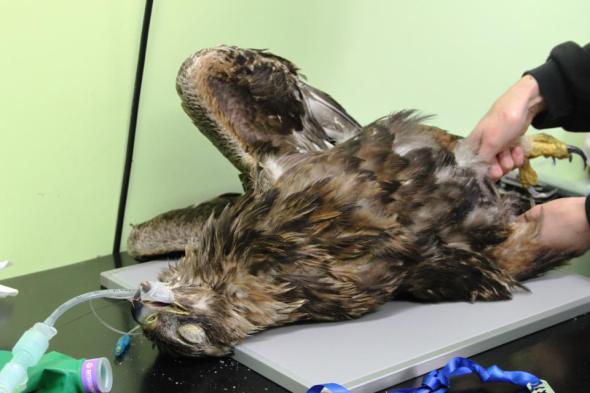
Wanlock Head GE Oct 2012

If you haven’t read the new report (and let’s face it, not many people will), you might just base your opinion of it on what has been written in the mainstream media, which would be fine if the media reports were accurate, balanced and didn’t contain any lies.

For example, if you read the BBC report, you’d be forgiven for thinking that golden eagles in southern Scotland are only constrained by impoverished habitat and potentially by climate change, lack of prey (apparently due to a loss of gamekeepers!) and afforestation. You’d read that illegal persecution ‘may have been an historical factor’ but apparently it isn’t any more.

Hmm. Is that what the report actually says? Er, no. The report mentions persecution in several areas (Lowther Hills, Tweedsmuir Hills, Ettrick Hills and Moorfoot Hills) and suggests that it needs to be brought under control if golden eagles are to once again survive in these areas.

So if the report didn’t say that illegal persecution ‘may have been an historical factor’ but apparently isn’t any more, then who did?
McAdam 1No surprises…..Doug McAdam, CEO of the landowners’ organisation, Scottish Land and Estates. We  blogged about SLE’s persistent denial of raptor persecution only yesterday (see here) in relation to comments made by SLE’s Moorland Director Tim (Kim) Baynes during a radio debate. It looks like McAdam was sent the same memo – just deny, deny, deny.

This time, however, we intend to do more than just make fun of him – we’re going to complain to the BBC about publishing such nonsense and we’d encourage as many of you as possible to join in. We’ve even prepared some suggested text that you can simply cut and paste if you’re short of time or not sure what to write. Here it is:

Dear BBC,

I wish to make a complaint about the content of an online article about a new report about Golden Eagles in the south of Scotland:

http://www.bbc.co.uk/news/uk-scotland-south-scotland-28320168

In my opinion, a disproportionate amount of space in the written article is given over to comments made by Mr Doug McAdam, the chief executive of Scottish Land and Estates. This is in complete contrast to the amount of space given to the comments by Prof Des Thompson “who led the research” and Mr Ian Thomson of RSPB Scotland.

In addition I am very concerned that the comments attributed to Mr McAdam reflect a falsehood that is frequently stated by his organisation and others who have a long-term political agenda to downplay the issue of persecution of birds of prey. Mr McAdam is quoted as saying, “Where persecution may have been a historical factor, it is clear from the official government data – published alongside our partners in PAW Scotland in March – that the number of such incidents has dropped significantly in recent years.”

In fact, the figures published by the Scottish Government show the opposite to be the case. In the Scottish Government’s wildlife crime report for 2012:  http://www.scotland.gov.uk/Resource/0043/00434716.pdf thirteen birds of prey are listed as being the victims of persecution.

In 2013, twenty three birds of prey were listed as victims:  http://www.scotland.gov.uk/Topics/Environment/Wildlife-Habitats/paw-scotland/types-of-crime/crimes-against-birds/Poisoninghotspotmaps/2009-2013

These figures are nowhere near being indicative of “a significant” decline – in fact they are wholly contradictory of such a claim.

I urge the BBC to remove these erroneous comments from the article, given that they suggest to its readers a picture which is patently untrue.

Yours faithfully, (your name).

Here’s where to send your complaint: https://ssl.bbc.co.uk/complaints/forms/?reset=#anchor  [click on ‘Make a complaint’]

Some links:

BBC news article (and accompanying video) here

SNH press release about the new golden eagle report here

RSPB Scotland press release here

Download the new report here: Fielding & Haworth 2014_Golden Eagles in south Scotland an overview

UPDATE 17.40: Interestingly, the BBC appears to have retracted some of McAdam’s quote, but not the offending part! (Many thanks to those of you have already complained – we can see from our site stats that quite a few of you have done so).

Here’s McAdam’s quote from this morning:

Douglas McAdam, chief executive of Scottish Land & Estates, said: “We have been involved with Scottish Natural Heritage and other partners in this study since its inception as we felt it was crucial to understand the real underlying reasons why Golden Eagles were struggling in certain parts of Scotland.

This thorough and detailed study makes clear that SNH believes that habitat improvements are needed to encourage more breeding golden eagle pairs in the south of the country. We fully support this conclusion and we will encourage land managers to work in partnership with SNH and other bodies to make improvements to these habitats wherever possible.

Other factors, including climate change, lack of availability of prey base for eagles – often because these areas are no longer actively managed by gamekeepers – as well as expansion of forestry and changing land use may also be inhibiting eagle presence in these areas. Where persecution may have been a historical factor, it is clear from the official government data – published alongside our partners in PAW Scotland in March – that the number of such incidents has dropped significantly in recent years. However, everyone remains resolute that where persecution exists it must be eradicated.

Golden Eagles are iconic Scottish birds, adding greatly to Scotland’s natural landscape and welcomed by estates as part of our natural heritage. This study will add greatly to our understanding of what limits the presence of these magnificent birds and should therefore help us to understand how best they can be conserved.”

And here’s what’s currently online at 17.40: 

Scottish Land and Estates chief executive Douglas McAdam said: “Where persecution may have been a historical factor, it is clear from the official government data – published alongside our partners in PAW Scotland in March – that the number of such incidents has dropped significantly in recent years.

However, everyone remains resolute that where persecution exists it must be eradicated.

Golden Eagles are iconic Scottish birds, adding greatly to Scotland’s natural landscape and welcomed by estates as part of our natural heritage.

This study will add greatly to our understanding of what limits the presence of these magnificent birds and should therefore help us to understand how best they can be conserved.”

Come on BBC editors, get your act together!

Dog dies after consuming poisoned bait

dyfed_powysA dog has died after consuming a bait that had been laced with the banned pesticide, Aldicarb.

The dog was being exercised in a popular dog-walking area in the Tanat Valley in Powys, mid-Wales, in May. It suddenly became ill and died within minutes.

Toxicology results have now confirmed the dog had been killed from ingesting Aldicarb on the body of a black-winged bird believed to have been used as a poisoned bait, probably for targeting birds of prey. A red kite was found poisoned with Aldicarb less than a mile away in March 2013 and the police believe the two incidents are connected.

Police are appealing for information and warning dog-walkers in the area to be extra vigilant.

Article in the Shropshire Star here.

Wheelhouse responds to latest raptor killings….by doing nothing

Paul-Wheelhouse-MSP Earlier today we blogged about the latest poisoning victim to have been uncovered in Scotland….a dead buzzard that was found in Fife in April (see here).
This evening, Environment Minister Paul Wheelhouse has issued the following statement:

I have been hugely angered to learn about another case of a poisoned buzzard following on from a separate incident involving the illegal death of a hen harrier in Ayrshire. I have made it very clear that I will not tolerate these criminal and selfish acts and this form of criminality has also been roundly condemned by parliament in a recent debate.

These crimes are not the actions of people who value Scotland’s wildlife and natural environment and I encourage anyone with any information on these despicable crimes to contact Police Scotland on 101.

My officials are working on a pesticide disposal scheme to rid illegal substances from our countryside and I hope to see this up and running very soon while the implementation of changes to the General Licences is in the process of implementation.

Our ongoing review of wildlife crime penalties is due by December and these latest incidents only add to the evidence supporting a toughening of sanctions and penalties on perpetrators.

We don’t doubt that he’s “hugely angered” – we all are – but we most certainly do question his commitment to taking meaningful action against the raptor killers.

A year ago, give or take a few days, the Minister introduced a series of what he described as ‘further measures’ to combat raptor persecution (see here). Since then, not one of these measures has yet been fully implemented. Also since then, we’ve seen examples, over and over again, of how these crimes are still taking place right across Scotland. Here are some of them:

June 2013: Shot buzzard in the Borders (see here), later revealed to also have been poisoned (see here)

July 2013:  Buzzard shot in the throat in North Ayrshire (see here)

August 2013: Red kite found shot at Leadhills (see here)

September 2013: Poisoned buzzard found in Stirlingshire (see here)

October 2013: Langholm hen harrier ‘Blue’ disappears (see here)

October 2013: Half-made raptor trap discovered in Angus (see here)

December 2013: Buzzard died of ‘unnatural causes’ near Tomatin (see here) [we now know it had been shot]

December 2013: Golden eagle ‘Fearnan’ found poisoned on Angus grouse moor (see here)

January 2014: Man reported for hen harrier death in Aberdeenshire (see here)

January 2014: Dead bird (species unknown) & suspected poisoned bait found in South Lanarkshire (see here)

February 2014: Poisoned peregrine found near Leadhills (see here)

March 2014: 22 poisoned raptors (16 red kites + 6 buzzards) found in Ross-shire (see here)

April 2014: Man arrested for alleged attempted raptor trapping in Aberdeenshire (see here)

April 2014: ‘Illegally-killed’ peregrine found near Stirling (see here) [we now know it had been shot]

April 2014: East Scotland sea eagle chick ‘disappears’ on Aberdeenshire grouse moor (see here)

April 2014: Gamekeeper charged for allegedly shooting, bludgeoning & stamping on buzzard in Dumfries (see here)

April 2014: Poisoned buzzard found in Fife (see here)

June 2014: Allegations emerge of ‘coordinated hunt & shooting’ of a hen harrier in Aberdeenshire last year (see here)

June 2014: Hen harrier died “as result of criminal act” near Muirkirk (see here)

These are just the ones that have been made public – we expect there to be a number of others that have not yet been revealed to the public.

Each time, we’ve asked Wheelhouse to act. Each time, he’s told us we need to ‘wait’ for the new measures to take effect but he has adamantly refused to give a time-frame of how long that wait should be. It’s crystal clear, even to a child, that The Untouchables are out of control and waiting for them to stop of their own accord is ridiculous.

The Minister’s response this evening is simply not good enough. A ‘poisoning amnesty’? It sounds good, but the truth is it’s been done before and with no effect. Carbofuran has been banned since 2001 – that’s 13 years ago! Does he really think that these disgusting poisoners are going to hand over their private stashes of poison when they know full well they can continue to use them without fear of consequence? The whole industry denies that poisoning is even happening!

We think the amnesty is being implemented so the Government can be seen to be doing ‘something’ but actually it’s just a bit of cynical window dressing in an attempt to delay taking the proper action that is needed. It’s just another excuse to do nothing.

And actually, this amnesty hasn’t been announced as a reaction to the recently-reported killing of the buzzard and the hen harrier. He announced his intention to launch an amnesty in his speech at the Police Wildlife Crime Conference several months ago. So what has he actually announced in response to the poisoned buzzard and the illegally-killed (probably shot) hen harrier? Absolutely nothing.

The Minister says he “won’t tolerate these criminal and selfish acts“. Sorry, Minister, but that is exactly what you’re doing.

If you feel strongly about this and agree that this government is still failing to address the widespread persecution of protected raptor species, we’d encourage you to email Mr Wheelhouse, cite the list of crimes (above) and demand he takes meaningful action or resign his position as Environment Minister. Email: ministerforenvironment@scotland.gsi.gov.uk

Another poisoned buzzard in Scotland

buzzard 3Scotland’s shameful catalogue of illegally-killed raptors continues to rise, with news today of yet another poisoned bird – this time a buzzard in Fife.
Here’s a press release from Police Scotland:

Police in Fife are conducting investigations after a dead buzzard was found in woods to the north of Ballingry in late April.

Enquiries at that time suggested the bird had died of natural causes but this was further explored by means of toxicology tests carried out by a Scottish Government laboratory.

This week it has been confirmed the bird died from ingesting a banned pesticide, and the matter has now been referred to the Police.

Detective Inspector Colin Robson, who is leading the inquiry, said: “The bird was found on land in an area commonly used by dog walkers. From the toxicology results, I believe it is probable that the bird has fed on an animal carcass deliberately laced with this poison. Such an act is both illegal and highly irresponsible in an area regularly used by members of the public, and the placing out of poison baits like this is indiscriminate in its victims. This illegal chemical is highly toxic, and the ingestion of even minute quantities by a wild animal or a pet is likely to have fatal consequences. Although relatively remote, I would urge anyone who frequents this area to contact the Police if they saw anyone or anything suspicious around this time or have knowledge of this or similar incidents. Since the discovery there have been no reported linked incidents locally and the area where the bird was found has been searched and there has no trace of the poison or other carcasses. Police Scotland are committed to tackling wildlife crime and this matter is being robustly investigated in close collaboration with partner agencies.”

Ian Thomson, Head of Investigations at RSPB Scotland said: “The recent incident on the Black Isle, where 22 birds of prey were killed, showed very clearly the horrendous impact that the illegal use of poisons can have on wildlife. It is of great concern that someone has placed a bait laced with this illegal chemical out in the countryside in an area well-used by the public and close to our own nature reserve at Loch Leven. I urge anyone who has information about this incident to contact the police as soon as possible.”

Brent Meakin, Forestry Commission Scotland’s district manager for the Lowlands said: “It is appalling that individuals are carrying out this illegal and barbaric practice. The persecution of raptors must stop. Any poisoning of these birds is one too many, no matter the species. We will continue to work with the Police and other agencies to stamp out this activity. The Commission would also like to ask the public for their help as they too can be our eyes and ears and report any suspicious activity.”

Ends

So, once again the name of the banned poison has not been made public, although from the comments made by Det Insp Robson, it sounds suspiciously like it was Carbofuran.

Shall we ask Environment Minister Paul Wheelhouse what he intends to do in response to this, and the other recently-reported raptor crimes from Scotland? It’s yet another illegally-killed raptor on his watch. Shall we ask him when he intends to actually address this issue, instead of making trite old threats that he’ll ‘deal with it if things don’t improve’? Things are not improving, despite the introduction of his ‘new measures’ a year ago, so it’s not unreasonable for us to ask our elected representative whether he’s as good as his word. Emails to: ministerforenvironment@scotland.gsi.gov.uk

UPDATE 15.00hrs: The specific location where the poisoned bait is suspected to have been laid out has been named as Benarty Wood, managed by Forestry Commission Scotland. Dog-walkers beware – see here for site info.

Members of public foil attempt to poison peregrine family

dalkey_quarryAn attempt to poison a family of peregrines (two adults and four youngsters) at Dalkey Quarry, part of the Killiney Hill Park in Co. Dublin, has been foiled thanks to three observant members of the public.

On the evening of 11th June, three walkers noticed two pigeons in distress at the quarry, close to the well-known peregrine’s nest ledge. On closer inspection, the pigeons were found to be tethered with fishing line and had had their wings clipped to prevent them from flying. While rescuing the pigeons, a wet substance was noticed on the back of their necks. It is suspected that this was poison, placed there in a deliberate attempt to kill the peregrines. The substance is being tested at a specialist lab.

If it was poison, those members of the public are lucky not to have been affected.

Full details of the story can be found on the BirdWatch Ireland website here.

It wouldn’t be the first time this barbaric method has been used to kill raptors. In 2011, two buzzards and a sparrowhawk were killed in Ireland after being attracted to live tethered pigeons that had been smeared with the banned poison Carbofuran (see here).

Another suspected red kite poisoning incident in Northern Ireland

There’s more grim news from Northern Ireland this week with the discovery of a dead adult red kite on her nest, along with two chicks. Poisoning is strongly suspected.

RKBLUE13_NIJune2014

The authorities were alerted to a potential problem at the Katesbridge nest in Co. Down by a sharp-eyed local resident who had been watching the nest from her house and was worried something had happened to the female.

The site was subsequently visited by members of the Northern Ireland Raptor Study Group, RSPB and the Police Service of Northern Ireland where they found the adult (wingtagged ‘Blue 13’) slumped on the nest, along with the two chicks. Their bodies have been sent for toxicology tests.

These birds were part of the small breeding population in Northern Ireland, reintroduced (with donor birds from Wales) between 2008-2010. The population is still tiny and is extremely vulnerable to illegal poisoning.

In 2013 alone, six dead red kites were recovered. Tests revealed that two had been poisoned with Carbofuran, three with Alphachloralose, and one was too decomposed for analysis but was found in the same (very small) geographical area as three of the others.

At least this time the police have issued a very quick alert (within 24 hours of the discovery), in sharp contrast to the 13-month delayed announcement about a poisoned white-tailed eagle that we blogged about a couple of days ago (see here).

As a side issue, this is our 1,000th blog entry. It’s a milestone, but unfortunately not one to celebrate.


Ross-shire Massacre: police confirm banned poison involved

RK7The following statement has just been released by Police Scotland:

Police Scotland Highland and Islands Division are seeking to reassure the public that enquiries are still ongoing into a wildlife crime investigation regarding the death of birds of prey in the Ross-shire area.

The 22 birds (sixteen red kites and six buzzards) were located in the Conon Bridge area and following analysis of the birds’ remains, fifteen have been confirmed as having digested an illegally-held poisonous substance (twelve red kites and three buzzards). Post mortem examinations and toxicology work continues into all the birds seized.

Police Scotland is continuing to work in close collaboration with partner agencies. Landowners and farmers in the local area are also continuing to assist police with their ongoing enquiries.

Police are keen to speak to anyone who has any information about the incident and would encourage them to contact Police on 101 or Crimestoppers anonymously on 0800 555 111 or online at http://www.crimestoppers-uk.org/. No personal details are taken, information is not traced or recorded and you will not go to court.

ends

So, finally, they’ve managed to confirm that a banned poison was involved. About time, too. They still haven’t named it, but the “illegally-held poisonous substance” will be one (or more) of those named on the Possession of Pesticides (Scotland) Order 2005. These are:

Aldicarb, Alphachloralose, Aluminium Phosphide, Bendiocarb, Carbofuran, Mevinphos, Sodium Cyanide, and Strychnine.

Now, which industry hates raptors and is known to have a close association with these banned poisons…let’s think hard….erm….

It actually doesn’t matter that the police haven’t named the poison(s). Just knowing it’s a banned poison and not a ‘mystery virus’ or an ‘accidental poisoning’ is enough to put a halt to what has recently looked increasingly like a coordinated campaign to associate the deaths with the feeding regime at the RSPB’s Tollie Kite Feeding Station rather than focus attention on the specific area where the poisoned victims, along with poisoned bait, had been found.

It’s funny, isn’t it, that of all the speculation that’s been aired, nobody seems to have wondered about whether there’s any (legal) ‘vermin control’ being done on those farms around Conon Bridge. Perhaps done on a casual basis in return for access for a spot of pheasant shooting by a small shooting syndicate? But then that’s such an obvious angle of inquiry, the police must have covered it months ago…..right?

The number of confirmed poison victims has reached 15 (it really is like pulling teeth trying to get information about this incident) and the police ‘investigation’ continues…..

Previous blog posts on the Ross-shire Massacre here

Ross-shire Massacre: RSPB denies ‘accidental poisoning’ claims

The Ross-shire Massacre fiasco continues, with yet another claim that the 22 dead red kites and buzzards were ‘accidentally poisoned’ by contaminated meat put out at the Tollie Red Kite Feeding Station.

This latest claim was made by a local farmer (who wishes to remain anonymous) who believes the birds were fed sheep carcasses containing legal treatments used to prevent fluke, which can be toxic to birds.

The claim has been strongly denied by RSPB Scotland (see here).

It’s not the first time this claim has been made. Jamie McGrigor MSP gave credence to it when he mentioned it during a parliamentary debate last month (see here), although he did admit it was based purely on rumour.

We think the claim is as plausible as the ‘mystery virus spoof‘ we wrote in response to Conon Bridge farmer Ewan MacDonald’s suggestion that the birds had been killed by a ‘mystery virus’. Incredibly, there were some people who actually believed the spoof, and thus it follows that there will be some who are gullible enough to believe the ‘accidental poisoning’ claim, just as there are those who believe the ridiculous claims that gamekeepers don’t put out poison baits – they’re just the victims of an elaborate set-up designed to blacken their reputations; set-ups that apparently include planting poisoned carcasses as well as planting jars of poison in gamekeepers’ vehicles, game bags, out-buildings and even in their homes.

Far more plausible is the suggestion put forward by the RSPB’s Red Kite Officer, Brian Etheridge, that the Ross-shire Massacre was caused by “somebody who knew what they were doing” when they placed small poisoned baits in various locations around Conon Bridge (see here). It has previously been reported that poisoned bait had been found at the crime scene, and, given the small area of farmland in which the majority of the birds were discovered, the poison was obviously fast-acting and highly toxic. Hmm, whatever could it be?

Meanwhile, as speculation rages, Police Scotland remain tight-lipped about their ‘investigation’. Two weeks ago they managed to say that 14 of the 22 dead raptors were now confirmed to have been “illegally poisoned” (11 red kites and three buzzards) but they were still apparently waiting for post mortem results on the remaining eight victims – see here. They are still refusing to name the poisons discovered by SASA scientists during their toxicology analyses, because the investigation is apparently ‘ongoing’.

Two and a half months down the line, nobody has been charged.

Previous blogs on the Ross-shire Massacre here.