Appeal for information from Police Scotland (10th October 2024)
APPEAL FOLLOWING DEATH OF PEREGRINE FALCON IN ANGUS
Wildlife officers are appealing for information following the death of a peregrine falcon in the Angus area.
On Tuesday, 3 September, 2024, the injured bird was found in distress by a member of the public in the Glen Esk area near to Tarfside. The SSPCA was called, and the bird taken to the wildlife resource centre in Fishcross for treatment. Due to the severity of the injuries, the bird had to be euthanised on Wednesday, 11 September, 2024.
Following further investigations, it was established that it had been shot and police were contacted.
Constable Craig Savage, Wildlife Crime Officer, said: “Peregrine falcons are protected under the Wildlife and Countryside Act and it is illegal to kill any protected species.
“Since this matter was reported to police, we have been carrying out enquiries and working with our partner agencies to establish the full circumstances.
“We would appeal to anyone with any information that may assist our investigation to please contact us. Your information could be vital in in establishing what has happened. If you were in the Glen Esk area around Tuesday, 3 September and saw anything suspicious or have any information about shooting activity in the area, please come forward.
“Anyone with information is urged to contact Police Scotland on 101 quoting reference CR/0368615/24.”
Ian Thomson, RSPB Scotland’s Head of Investigations said “The news of this crime comes only a few weeks after an Osprey was shot in an adjacent glen [Ed: see here] but hearing about ongoing raptor persecution incidents in the Angus Glens will come as no surprise to anyone with an interest in the fortunes of Scotland’s birds of prey.
There has been a catalogue of cases of poisoning, shooting and illegal trap use in this area dating back decades. As with many previous cases, there will be very few people in the local area who have the motivation, access, requisite firearms and opportunity to shoot and fatally injure one of our most iconic bird of prey species.
We trust that if this latest crime is found to be linked to local grouse moor management, that NatureScot utilise the powers give to them by the Wildlife Management and Muirburn Bill to impose the most robust sanctions possible.”
ENDS
I’ll comment on this case shortly, in relation to Scotland’s new grouse moor licensing scheme.
Thanks to the blog reader who alerted me to the following notice in Border Telegraph, dated 31 July 2024:
FRAUD CHARGE
A police officer will face trial at Jedburgh Sheriff Court accused of a fraud involving almost £10,000.
Forty-six year-old Suzanne Hall is charged with pretending she had just moved into her home at Lamberton Holdings in Berwickshire with her family in December 2020 after previously staying in a house in Chirnside.
But the charge alleges the Lamberton house had been her sole or main residence since August 2015 and she was due Scottish Borders Council £9,613 in back-dated council tax.
Hall pleaded not guilty to the charge and a trial date was fixed for November 19th 2024.
This looks to be the same WPC Suzanne Hall from Lamberton Holdings who was previously charged, along with her husband Timothy and son Lewis, with offences linked to the alleged laundering of wild peregrines that were later sold for profit to falconers in the Middle East. Her husband and son pleaded guilty but Suzanne Hall’s not guilty plea to five charges was accepted by the Crown in December 2023, although it was reported at the time that, “a fraud charge was deserted with the Crown reserving the right to re-raise the case at a future date” (see here).
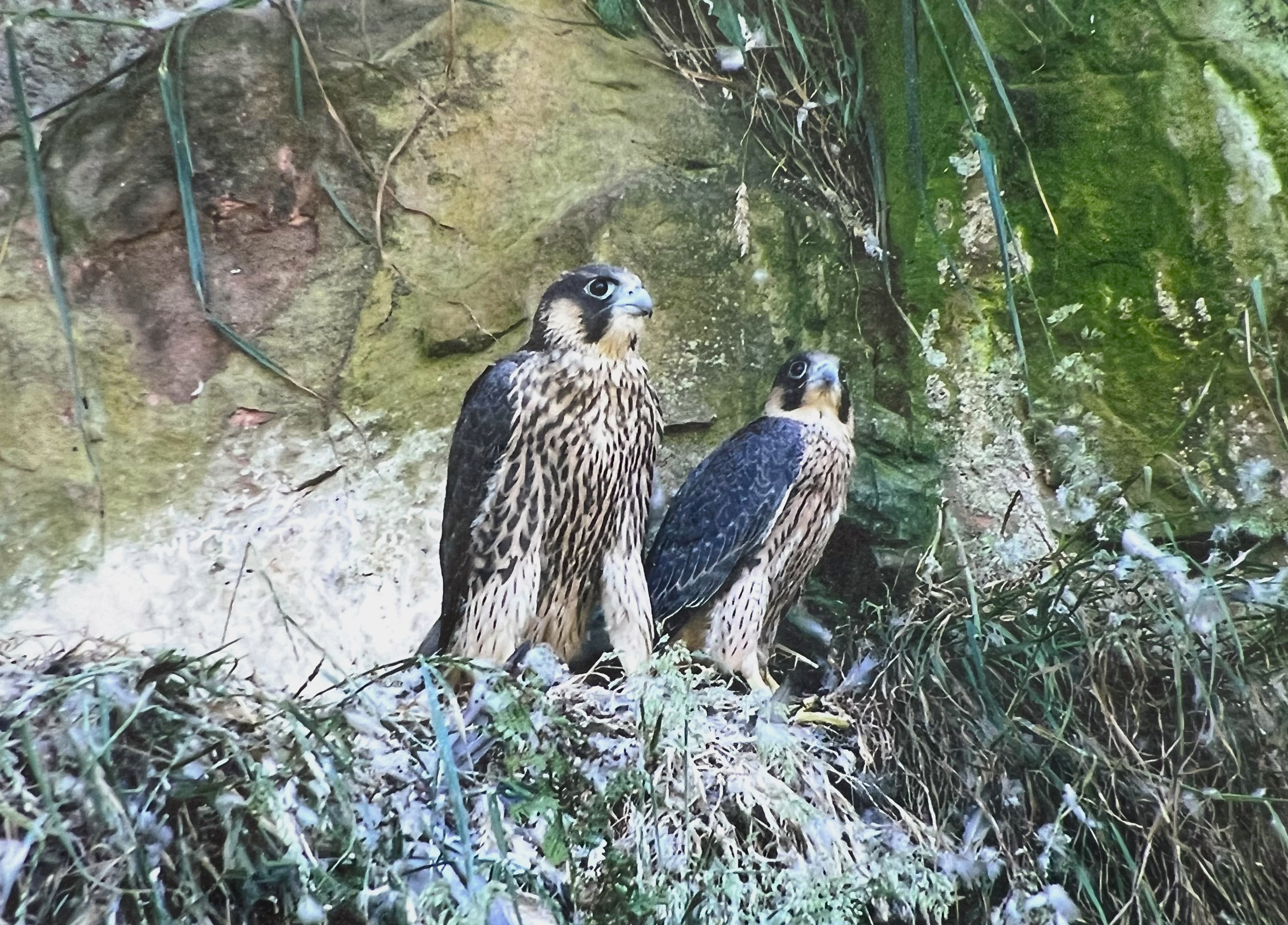
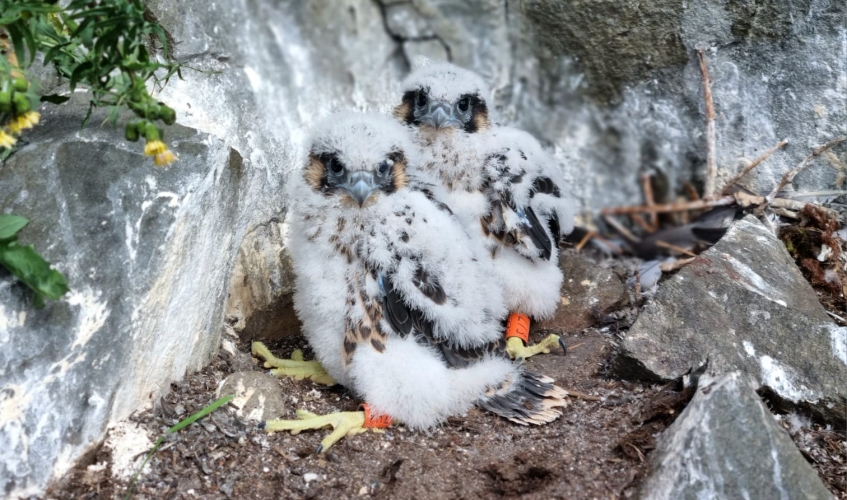
Juvenile peregrines. Photo by Ruth Tingay
It’s not clear whether the latest fraud charge alleged against Suzanne Hall relates to the previously deserted charge or whether this is a different one.
NB: As this case is live, comments are turned off until proceedings have concluded.
Convicted peregrine launderer Lewis Hall, 23, is due to appear at Jedburgh Sheriff Court on 4th September 2024 in relation to action being taken by the Crown to recover £164,028.80 under the Proceeds of Crime Act (see here).
UPDATE 12 October 2024: I’ve received an unconfirmed report that the case against WPC Suzanne Hall has been dropped. I’m seeking confirmation of this and will report in due course.
UPDATE 17 November 2024: Fraud charge dropped? The weird case of WPC Suzanne Hall, wife & mother of convicted peregrine launderers (here)
Two mainstream BBC TV programmes, Landward and Countryfile, last week included features on raptor conservation projects in south Scotland – both worth watching on BBC iPlayer if you missed them.
Landward featured the brilliant George Smith, a volunteer from the Scottish Raptor Study Group, who has been monitoring peregrines across south Scotland for almost 40 years. He’s filmed visiting peregrine nest sites to ring chicks (under licence) and to collect DNA samples (also under licence).
It was a direct result of George’s dedicated and meticulous research that led to the recent conviction of part-time gamekeeper Timothy Hall and his son, Lewis Hall, for the illegal laundering of wild peregrines that were stolen from nests in south Scotland and then sold on to falconers in the Middle East, allegedly for enormous profit according to the Crown.
Worryingly, some more peregrine nests that George is monitoring this year have failed in suspicious circumstances and Police Scotland are currently investigating.
This episode of Landward is available on BBC iPlayer here (peregrine segment starts at 7 min 48 sec) and is available for the next 11 months.
Countryfile had two features of interest to readers of this blog. First was an overview of the conservation restoration work going on at the Tarras Valley Nature Reserve, the former Langholm grouse moor that was bought out from Buccleuch Estates by the Langholm community in 2022. Tarras Valley NR Estate Manager Jenny Barlow provides a commentary on the significance of the reserve and describes some of the projects underway.
Then Dr Cat Barlow from the South Scotland Golden Eagle Project took a presenter out into the hills in search of one of the satellite-tagged golden eagles that had previously been translocated to south Scotland to boost the formerly tiny remnant population. Cat discusses the project’s successes as well as the ongoing threat of illegal persecution, highlighted by what Police believe was the illegal shooting and killing of golden eagle ‘Merrick‘ last October, very close to the boundary of the Raeshaw Estate in south Scotland. Unfortunately Cat didn’t discuss the suspicious disappearances of a number of the translocated sub-adult eagles from the Western Isles that are rumoured to have ‘vanished’ when they dispersed north from southern Scotland. The piece also includes some of the important educational work the project is undertaking with local school children in south Scotland in an attempt to improve the future protection of eagles in this region.
This episode of Countryfile is available on BBC iPlayer here (Tarras Valley segment starts at 39 min 10 sec and South Scotland Golden Eagle Project segment starts at 46 min 30 sec). This episode is only available for another 26 days.
In February this year, part-time gamekeeper Timothy Hall, 48, and his son Lewis Hall, 23, were sentenced after they’d pleaded guilty to the illegal laundering of wild peregrines that had been stolen from sites across southern Scotland and were sold on to falconers in the Middle East (see here).
Young peregrines at a nest site in Scotland. Photo (taken under licence) by Ruth Tingay
Not guilty pleas were accepted by the court in December 2023 from wife and mother Suzanne Hall, a serving officer with Police Scotland, but she had a reserved fraud charge against her and was at the time reportedly suspended from Police Scotland on full pay (see here). I don’t know whether that situation has changed.
Despite their offences passing the threshold for a custodial sentence, Timothy Hall was ordered to complete 220 hours of unpaid work and Lewis Hall was ordered to complete 150 hours. These sentences were considered to be staggeringly inadequate given the extent of the Halls’ offending (see here).
However, the Crown Office reported that Lewis Hall would also be subject to action under the Proceeds of Crime Act, where profits from criminal activity can be confiscated.
Last week a hearing took place at Jedburgh Sheriff Court where it was revealed the Crown is seeking to recover £164,028.80 from Lewis Hall.
Hall’s defence lawyer, Liam Alexander, requested a further hearing to allow his client to pass on documentation to a forensic accountant to support Hall’s defence.
Sheriff Peter Anderson allowed the continuation but said as there had already been several of these, he set a proof hearing date of 4th September 2024, where all the available evidence will be heard and the sheriff will decide the outcome.
UPDATE 10 October 2024: Scottish court orders convicted peregrine launderer Lewis Hall to pay back thousands under Proceeds of Crime Act (here)
Derbyshire Constabulary’s Rural Crime Team has today issued the following appeal for information:
‘We are currently looking into reports of a recent Peregrine Falcon nest disturbance at Belper Mill and would like to advertise that a live investigation is currently being completed with partner agencies to establish the circumstances of how this happened. We would also like to hear from anyone who may have information. Please quote occurrence number 24*283748 when doing so‘.
Photo provided by Derbyshire Constabulary’s Rural Crime Team
This isn’t the first time that peregrines at Belper Mill have been at the receiving end of criminal activity. In March 2015 the adult breeding male was found shot (here) and another breeding male was found shot in March 2020 (here).
A local resident has informed me that peregrines have been breeding at Belper Mill East since at least 2011 and it’s estimated that almost 40 fledglings have been produced at this site. The peregrines’ breeding attempt has failed this year.
Comments on social media suggest this latest incident is believed to relate to the alleged disturbance of the breeding pair by contractors carrying out groundwork nearby.
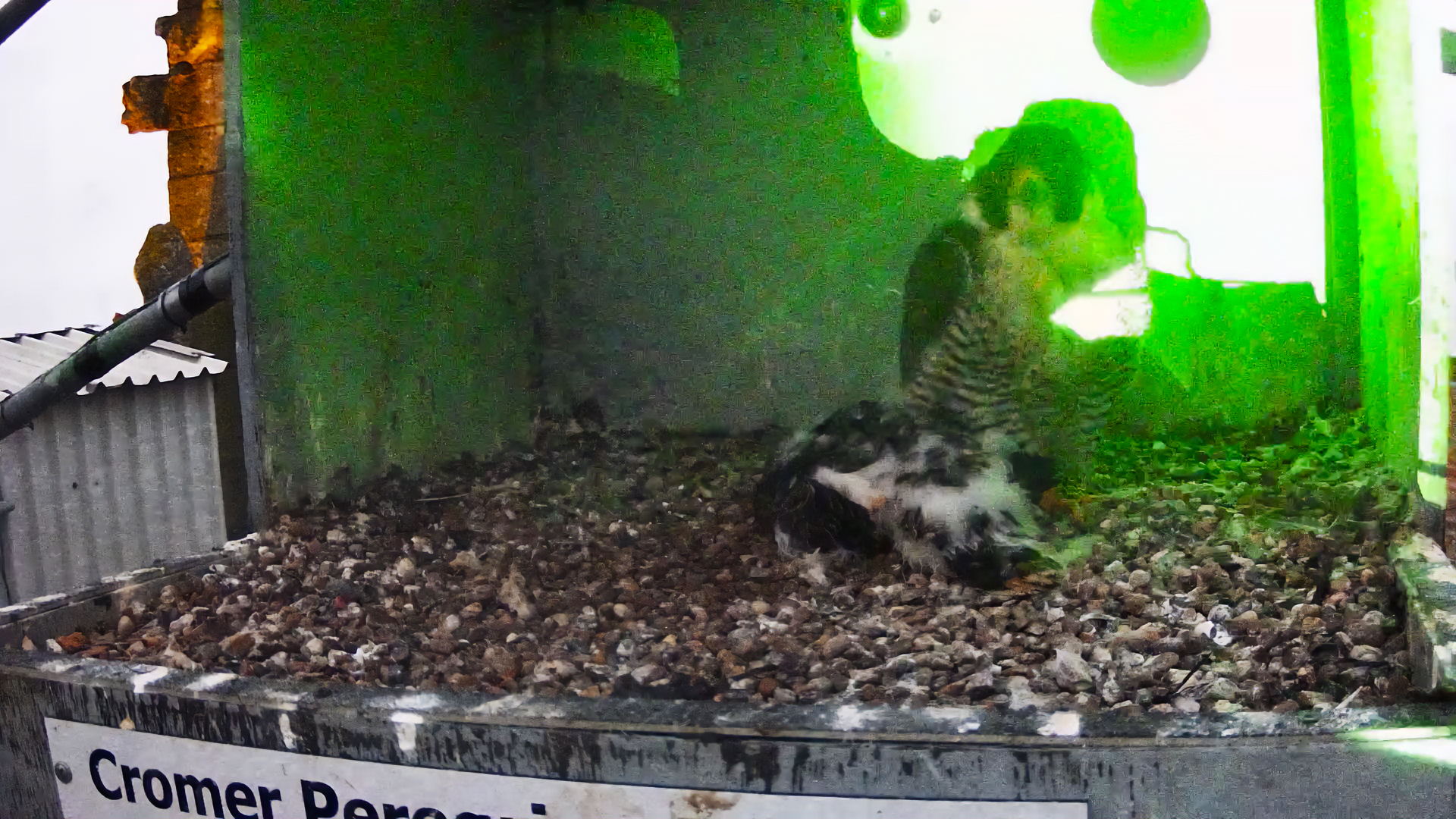
Further to last week’s news that Norfolk Police were appealing for information after a laser was shone directly into a peregrine’s nest box at Cromer disturbing the breeding female (here), the BBC News website is today reporting that a man has handed himself in.
Green laser being shone directly into Peregrine nest. Photo by Cromer Peregrine Project
According to the article, a man in his 40s from the Cromer area, who has not been identified by police, turned himself in at Cromer Police Station on Saturday. He apologised and said he’d made a genuine mistake.
A spokeswoman for Norfolk Police said the incident was dealt with by way of a community resolution and it was agreed the laser would be destroyed.
The man also agreed to make a donation to the Cromer Peregrine Project and would engage in a formal discussion with a police officer about the safe use of lasers.
Officers from Norfolk Police’s rural crime team are appealing for information after a laser was shone directly into a peregrine’s nest box disturbing the breeding female.
The incident was caught on cctv by the Cromer Peregrine Project although no date has been provided.
[Photos by Cromer Peregrine Project, via Norfolk Police]
Writing on X yesterday, Norfolk Police said this:
We are currently investigating a report of the @CromerPeregrine Peregrines having a laser shone straight into the box disturbing the female making her leave the nest for an extended period of time leaving the chick. This is a criminal offence to disturb any nesting bird.
We are appealing for any information in regards to this matter. These birds are on Schedule 1 of the Wildlife Countryside Act and anyone found disturbing these birds could be subject to significant consequences. #CromerPeregrines#BirdsofPrey#OPRandall
If anyone has any information please contact Norfolk Constabulary on Tel 101.
UPDATE 4th June 2024: Man hands himself in over laser disturbance at Peregrine site in Norfolk (here)
SHOT PEREGRINE FOUND ON DOVE STONE NATURE RESERVE IN PEAK DISTRICT NATIONAL PARK
A shot Peregrine was found in early April on Dove Stone nature reserve, landowned by United Utilities and managed in partnership with the RSPB
Due to the severity of its injuries the Peregrine was euthanised
This is the latest incident in catalogue of raptor persecution incidents in the Peak District
The RSPB is appealing to the public for information relating to this incident
The RSPB has offered a £5,000 reward for information which leads to a successful conviction for this wildlife crime. This amount has been matched by the Peak District National Park Authority, taking the reward to £10,000.
The shot peregrine. Photo supplied by RSPB
On 4 April an adult female Peregrine was found on Dove Stone nature reserve north of Woodhead reservoir, near Crowden, in the Peak District National Park. The bird was taken to a local veterinary practice where they confirmed it had been shot and due to the extent of its injuries, it was euthanised. The incident was immediately reported to Derbyshire Police.
The grounded peregrine. Photo supplied by RSPB
X-rays showed shotgun pellets lodged in the elbow and shoulder of the bird’s left wing. An expert post-mortem also revealed a puncture wound in the bird’s chest caused by shotgun pellets and concluded that the bird was shot at or near the location it was found, as the injuries it sustained would have prevented it from flying.
X-ray showing shot gun pellets lodged in the peregrine’s body. Image supplied by RSPB
Although Peregrine populations are recovering in many lowland areas across the UK, breeding Peregrines are missing from some upland areas in England due to illegal persecution. The RSPB has recorded 182 confirmed incidents of Peregrine persecution across the UK from 2003 to 2022. Between 2018 and 2022 alone, 30 Peregrines were killed or injured in England, including 19 which were shot. Data shows that nationally a significant proportion of raptor persecution incidents are linked to land managed for gamebird shooting. In 2022 at least 64% of confirmed incidents of raptor persecution in the UK were associated with land managed for gamebird shooting.
Mark Thomas, RSPB Head of Investigations UK: “To think that this stunning bird was found shot at Dove Stone – a place which we help manage for the benefit and safety of species such as the Peregrine – is shocking.
“This is just the latest incident of raptor persecution in the Dark Peak, a notorious blackspot for birds of prey, where these species should naturally be thriving. If anyone has any information about this crime, please contact us or the police.”
Chief Executive of the Peak District National Park Authority, Phil Mulligan added: “It’s deeply concerning to see a species as iconic as the Peregrine shot within our National Park, and so much more distressing during the crucial breeding season for many of our birds of prey. This is therefore not just the loss of a single bird of prey, but impacting on a potential further generation when every one of these charismatic raptors counts.
“Our birds of prey of all shapes and sizes have a right to call the Peak District home without fear of falling victim to acts of wildlife crime. That’s why we have committed to supporting the reward for information in this case, and I would urge anyone to contact the police regarding this or other potential incidents that may be putting wildlife at risk.”
Chris Wilkinson, Derbyshire Police Rural Crime Team “It is a sad fact that bird of prey crime is still prevalent in Derbyshire and particularly concerning is that this incident appears to have occurred on an RSPB reserve. We are keen to speak with anyone who may have information about this crime”.
If you have any information, please call Derbyshire Police on 101 and quote crime reference number: 24000198336. Alternatively, you can call the RSPB anonymously on their dedicated Raptor Crime Hotline on 0300 999 0101.
The Scottish Parliament’s Rural Affairs & Islands Committee met again on Wednesday 21st February to undertake its second day of consideration of the Stage 2 amendments of the Wildlife Management (grouse moor reform) Bill.
For new readers, this is proposed new legislation to regulate grouse shooting and its associated management practices by way of licensing schemes, introduced because of the continued illegal persecution of birds of prey on many Scottish grouse moors.
A report on what happened during the first day of consideration that took place two weeks ago can be found here.
Newly appointed Agriculture Minister Jim Fairlie MSP was in the hot seat. Screengrab from Scottish Parliament TV, 21 Feb 2024
Two separate sessions were required on Wednesday (one in the morning and one in the evening) to get through all the amendments, bringing Stage 2 of this Bill to a close.
Newly-appointed Agriculture Minister Jim Fairlie MSP led the Government’s response, taking over from Gillian Martin MSP whose Ministerial responsibilities have been moved elsewhere after the recent mini-reshuffle.
There were two other new faces on the Committee – Emma Harper MSP (SNP) who replaces former Committee member Jim Fairlie, and Elena Whitham MSP (SNP) who replaces former Committee member Karen Adam MSP who left after taking on commitments on a different Committee.
Other MSPs in attendance were Edward Mountain MSP (Conservative), Jamie Halco Johnstone MSP (Conservative, representing Stephen Kerr MSP) and Colin Smyth MSP (Labour), none of whom were eligible to vote on the Stage 2 amendments but who were present to speak to amendments they had lodged.
Wednesday’s two sessions were straight forward and once again there weren’t any big surprises with Committee members mostly voting along party lines, which meant that the numerous wrecking amendments put forward by the Conservatives, designed to weaken the Bill, were not supported by the majority. It also meant that various amendments put forward by Colin Smyth MSP (Labour), designed to strengthen the Bill, were also unsupported by the majority. Overall, the Bill passed Stage 2 pretty much in the format that the Government had introduced it, which is what had been anticipated.
I won’t go through the amendments one by one because there were too many. For those interested in proceedings the archive video of the two meetings are linked below, as is the meeting transcript.
The big ‘wins’ from our perspective were as follows:
There was majority support for Ministers to be given the power to add additional gamebird species to the licence if there is evidence that wildlife crime, such as raptor persecution, is taking place to facilitate the management of gamebirds such as pheasants and red-legged partridge. Ministers will have the authority to take evidence, consult and then vote on adding those species to the licence at a later date, if deemed appropriate.
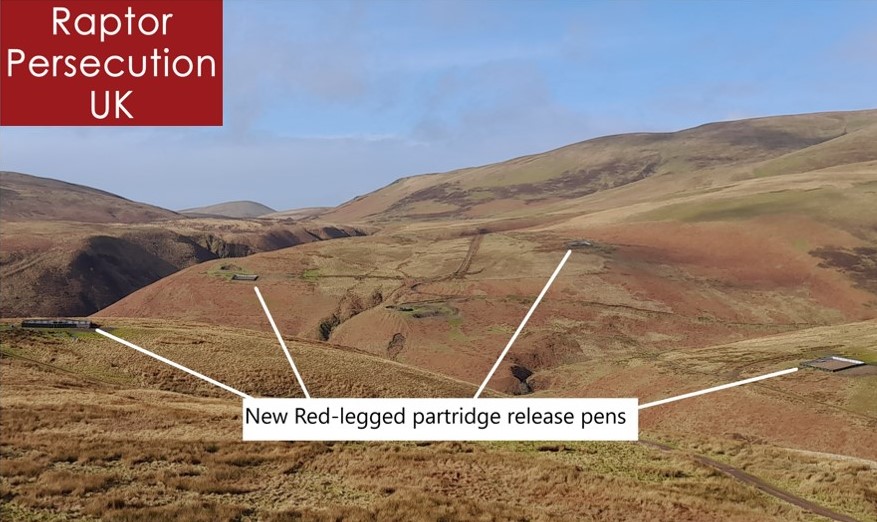
This is a very important amendment especially given the recent trend in the release of red-legged partridge on grouse moors where shooting red grouse is no longer a viable commercial activity. Red-legged partridge and/or pheasants may be used by some grouse shooting estates as an alternative quarry if their licence for shooting red grouse has been revoked so having the power to include these additional species on the licence will close the loophole that some grouse moor managers may have sought to exploit in order to continue killing raptors without consequence. Amendments seeking to exclude this provision were lodged by Conservatives Edward Mountain and Rachael Hamilton but they were not supported.
Red-legged partridge pens placed on a moor in south Scotland
There was support for an amendment that provides a requirement for the use of medicated grit to be included in the Code of Practice being developed to support the new legislation. This is a timely amendment given the research published last week by the League Against Cruel Sports and Wild Justice that demonstrated widespread bad practice and the complete lack of monitoring of medicated grit use (see here).
REVIVE, the coalition for grouse moor reform has just released a campaign video to highlight those findings:
The details of what requirements will be made in the Code of Practice in relation to the use of medicated grit are still to be determined but the Government’s support for medicated grit use to be included is very good news indeed, especially when some grouse shooting organisations have been arguing against its inclusion.
The Minister discussed his intention to introduce a requirement in the Bill to undertake monitoring and reporting of raptor populations – specifically golden eagle, hen harrier and peregrine, species identified in the Werritty Review as being significantly impacted by raptor persecution crimes on grouse moors.
This monitoring would provide a key measure of success (or failure) of the Bill to tackle raptor persecution, which is one of its primary objectives, and whether the new legislation has been effective in this respect. The Minister said he would return to this issue at Stage 3 after discussions with NatureScot and the Scottish Raptor Study Group about the resources required to undertake monitoring and reporting. Rachael Hamilton lodged an amendment that called for a limit on the reporting of some raptor persecution incidents – she wanted to only include crimes that had been proven by conviction. In other words, to exclude incidents described as ‘suspicious’ such as those relating to the suspicious disappearance of satellite-tagged raptors on grouse moors. Her amendment was not supported.
One of the most significant ‘wins’ came from the majority vote to support the introduction of additional powers for the Scottish SPCA to allow them to investigate offences under the Wildlife & Countryside Act – an extension of their current powers to investigate offences under the Animal Health & Welfare Act. As regular blog readers will know, this issue has been kicked down the road repeatedly by the Scottish Government over a 13-year period (see here for timeline) so getting support after so long is particularly satisfying.
Of course there were the usual inaccurate and non-sensical objections from the Conservatives, with Edward Mountain claiming this “would give powers to people who have never had such powers before” and “It should be the police, not other people, who implement the law” and “It would give powers to third parties who I do not believe are qualified or have the legal training to exercise such powers“.
These continued claims about the SSPCA’s supposed inexperience and inability to investigate wildlife crime are laughable, given that they’re already an official specialist reporting agency to the Crown Office so know all about due process, they already work in partnership with Police Scotland and other agencies in raptor persecution investigations, and through their skill, experience and expertise routinely bring some of the most sadistic wildlife-abusers to justice, including badger baiters such as the recent case against a depraved gamekeeper employed on the Millden Estate in the Angus Glens (here). Edward Mountain should be thanking the Scottish SPCA for its tireless and often challenging work, and its willingness to undertake even more of it under this new legislation at no cost to the tax payer. Seriously, who would want to oppose the addition of more expert professionals to bring the wildlife criminals to justice?
Another big win came via Kate Forbes’s amendment to see the closing of the muirburn season brought forward to 31st March. Currently, gamekeepers can burn heather up until 15th April, and in some cases even to the 30th April where landowner discretion allows. This late season burning overlaps with the breeding season of various moorland bird species, and when that breeding season is predicted to get earlier in response to climate change it’s obviously idiotic to allow burning to continue during that period, just on the precautionary principle alone.
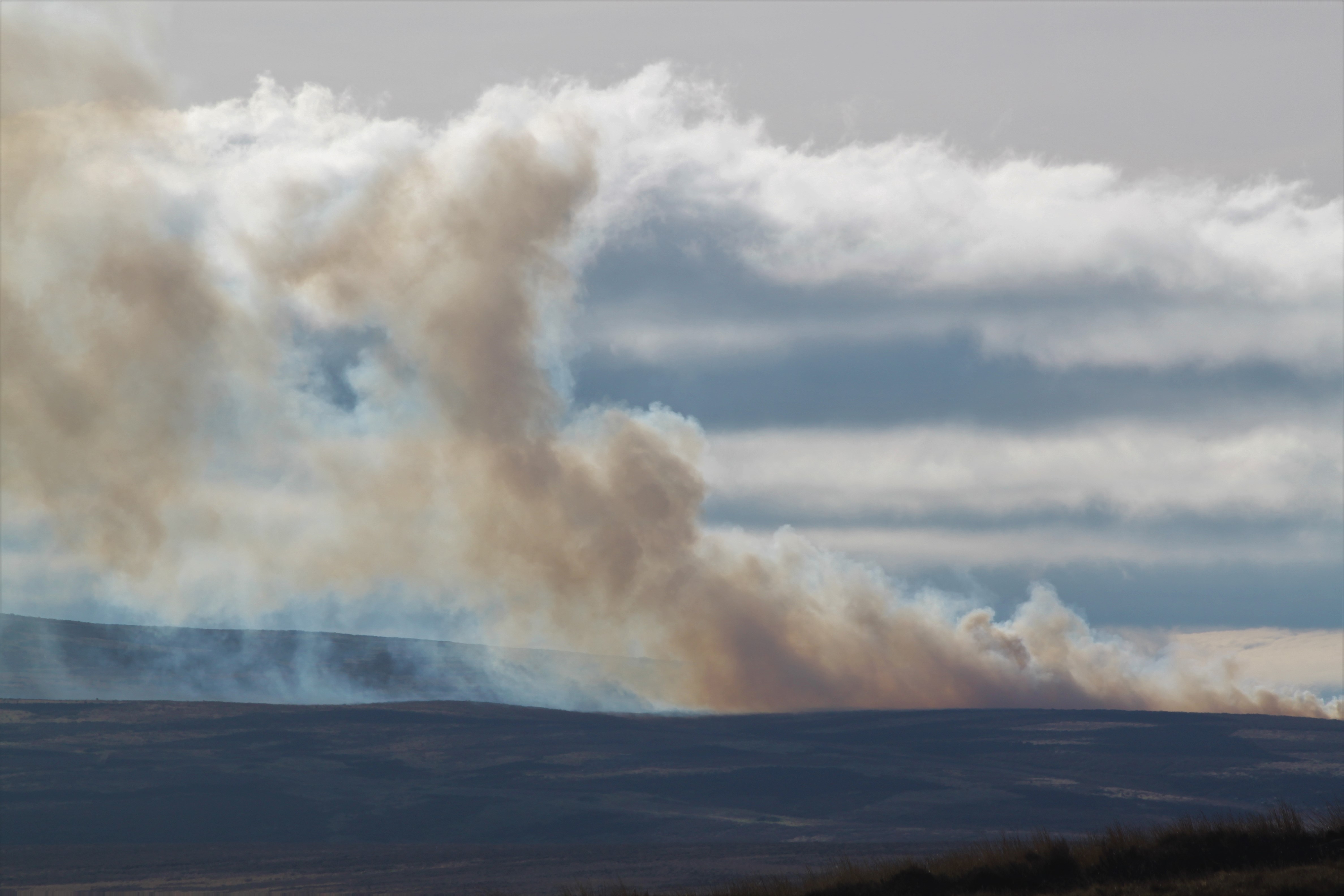
Grouse moor muirburn. Photo: Ruth Tingay
The 31st March was seen as a compromise as Conservatives Edward Mountain and Rachael Hamilton wanted burning to be permitted until 30th April whereas Green MSP Ariane Burgess suggested 15th March. There will be powers in the Bill to allow Ministers to review the 31st March cut off date to take account of future research findings.
Given that the majority of muirburn in Scotland currently takes place in April, the grouse shooting industry will not be at all happy with this new restriction. They’ve lobbied hard against it, including taking the newly-appointed Minister Jim Fairlie out to visit a muirburn site at the beginning of the week, but their lobbying influence is clearly not as powerful as they like to suggest it is.
They do have some influence, of course. Bizarrely, Kate Forbes found support amongst the Committee for another, related amendment, which will allow the beginning of the muirburn season to start two weeks earlier (i.e. 15th September as opposed to the current start date of 1st October). There is no justification for this other than to appease the grouse shooters by not shortening the overall muirburn season. In a climate emergency, this is bonkers. It suggests that the Scottish Government thinks that burning the moors to facilitate excessively large numbers of red grouse for a few selfish people to shoot for fun is more important than the global climate crisis. Actually it does more than suggest it – the Scottish Government was clear in its argument against Colin Smyth’s amendment (#143) that it thinks muirburn is acceptable for the sole purpose of maintaining & increasing red grouse so they can be shot for ‘sport’.
Although how much muirburn will actually take place in September remains to be seen – the heather will still be green-ish so won’t burn well and grouse shooting will be well underway so gamekeepers may have limited time to run around lighting fires. Let’s see.
A ‘sort-of’ win came with the acceptance of a change to the definition of ‘peatland’ as being ‘land where the soil has a layer of peat with a thickness of more than 40 centimetres’ (where “peat” means soil which has an organic content of more than 60%). The current definition of peatland in the Muirburn Code is peat with at least 50 centimetres depth, so dropping this down to 40cm is obviously good news as it means a larger area of peatland will now be protected (landowners will not be issued a licence to undertake muirburn for the purpose of grouse moor management where the peat depth is 40cm or greater). Edward Mountain’s amendment to increase the definition of peatland to 60cm peat depth, and Rachael Hamilton’s amendment for it to remain at 50cm, were unsupported. The Bill will also include a provision for Ministers to keep the definition of peatland under review as further research emerges.
The new peatland definition of 40cm peat depth will probably have a significant impact on the management practices of many grouse moors, particularly in Eastern Scotland where new research has shown a widespread disregard by grouse moor managers for the Muirburn Code restriction of burning on peatland with a 50cm depth (see here). The difference going forward will be that if they disregard the new 40cm depth restriction it will lead to the revocation of their muirburn licence. Having a serious consequence like that should encourage behavioural compliance (again, let’s see!).
I’ve described this one as a ‘sort-of’ win because although the change in definition is welcome (and long overdue), it could have gone so much further. The new definition of peatland could have been lowered to 30cm depth in line with the UK Peatland Strategy‘s definition (also followed by many countries internationally). Or, the definition of peatland could have removed the artificial construct of any peat depth altogether, as eloquently argued by Green MSP Ariane Burgess. There’s a very strong argument against using peat depth as a valid definition of peatland, to properly protect all peatland, including critically important shallow peatland, as explained recently in an excellent guest blog (here). However, the Minister didn’t support this approach.
Other amendments that passed during Wednesday’s sessions included a decision that falconers will not need to apply for a licence to hunt red grouse – that seems reasonable given the low number of people engaged in this sport and the lack of associated raptor persecution offences linked to it.
There was also a decision that grouse moor licences should be issued for a five-year period instead of the one-year period originally suggested in the Bill. The grouse shooting industry wanted a ten-year licence but five years was seen as more suitable to provide oversight and review capability by the regulating authority. In essence, the length of the licensing period is pretty inconsequential to us because the most important aspect is that the regulator (NatureScot) will still have the capacity to suspend or revoke a grouse moor management licence at any time during that five period if offences occur.
So, Stage 2 of the Bill is now complete and it moves on to the final Stage 3. This is when further amendments can be lodged and some will be selected (by the Presiding Officer) for a debate by the whole Parliament in the main chamber. Until Stage 3 is complete we won’t know for sure how strong this Bill is but it’s reasonable to think that there won’t be any catastrophic changes given the dominant voting power of the SNP and Greens. A date hasn’t yet been set for the Stage 3 debate but it is anticipated that it’ll take place in March.
After that, the development of the various Codes of Practice designed to support the new legislation will pick up speed and the details of those will take on great significance. A watchful eye will be kept on these to ensure that they are robust and fit for purpose.
Here is a copy of the Bill as amended after Stage 2:
The SSPCA has issued the following press release in response to the recent conviction and sentencing of part-time gamekeeper Timothy Hall and his son, Lewis Hall, for the illegal laundering of Scottish peregrines which they were selling for high prices to buyers in the Middle East.
This press release contains details about the poor conditions provided by Timothy Hall for the raptors found at his address, and the subsequent return to the wild of the stolen peregrine chicks.
Young peregrines returned to the wild. Photo via SSPCA
Berwick men receive ban for illegally selling peregrine falcons
Timothy Hall previously pled guilty to the charges and was sentenced to a five-year ban from possessing or breeding birds of prey and 220 hours of community service at Jedburgh Sheriff Court today.
His son Lewis Hall was sentenced to 150 hours community service.
48-year-old Timothy Hall of Lamberton, Berwick Upon Tweed pled guilty in December to being responsible for nine birds of prey of various breeds. Failing to ensure a suitable environment, allowing a build-up of faeces and urates, and not providing an appropriate supply of water for bathing or drinking and did thereby expose the birds to disease or injury.
Lewis Hall, 23, of Fordyce Cottage, Duns, pled guilty to acquiring for commercial purposes, keeping for sale, and selling wild peregrine falcon chicks between 2020 and 2021.
Scottish SPCA specialist investigator, Mark Rafferty, said, “These birds are a protected species and it is illegal to disturb their nests or illegally breed them.
“During April 2021, information came to light that several Peregrine Falcon nesting sites around the Scottish Borders and East Lothian had seen thefts of eggs and chicks over a prolonged period of time.
“We carried out a raid, alongside the Police National Wildlife Crime Unit (WECU), where we found a number of peregrine falcon chicks and a number of adult birds at Hall’s address in Berwick.
“The entire housing/aviary situation was completely unsuitable in terms of size and design for the species being held in each unit. The lack of clean water, and failure to remove the excessive accumulation of faecal and animal tissue waste posed unacceptable health risks to the birds housed within.
“None of the birds were presented with an environment where breeding was likely either naturally or artificial insemination.
“Our team were able to take the peregrine falcon chicks to surrogate nests and monitor them from a distance. Once they had developed fully they were able to return to the wild safely.
“We are extremely disappointed at the sentencing result today. This was a specialised case which has taken years to appear in court. Our team, along with the Police Wildlife Crime Unit and David Anderson, Raptor ecologist from the Scottish Raptor Study Group , worked hard to provide sufficient evidence and DNA testing to get a better result.”
“If anyone is concerned about an animal, they can contact our confidential animal helpline on 03000 999 999.”






 Raptor Persecution UK