
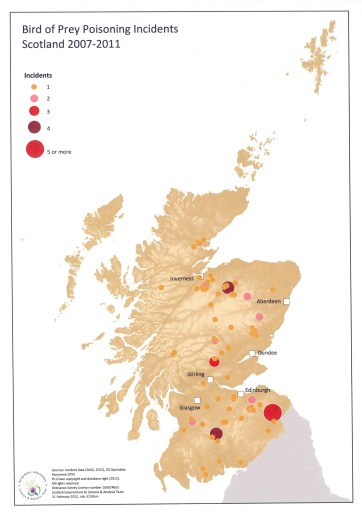
 The Scottish Government has today published the 2011 poisoning map (otherwise known as Scotland’s map of shame).
The newspapers are heralding the figures as a success story, as the numbers show an apparent drop in poisoning incidents (“only [only??!] 16 raptors were killed as a result of being illegally poisoned in Scotland – 12 fewer than in 2010 and the lowest death toll since the first maps were published six years ago“, says The Scotsman). The victims included seven buzzards, four red kites, two peregrines, two sparrowhawks and a golden eagle.
On a superficial level this does look like convincing progress, but let’s scratch the surface and see what’s underneath…
The official Scottish government poisoning map only shows the places where poisoned birds were discovered. Given the remote areas involved and the fact that most of these poisoned birds were found by chance (by passing hillwalkers etc.), the official figures can in no way represent the actual number of raptors that were poisoned (but undetected) during 2011.
The figures behind the map also do not show the areas where poisoned baits (but no dead birds) were discovered during 2011. Nor do they show the other incidents of raptor persecution that were discovered during 2011, including shooting, trapping and nest destruction incidents. According to an article in today’s Guardian, it is claimed that last year’s illegal shooting, trapping and nest destruction incidents “have remained constant with previous years“. We’ll have to wait a good few months for the RSPB Birdcrime Report to see the actual figures. (Incidentally, how come the 2011 poisoning figures, as compiled by SASA, have not yet been released to the public? They’re obviously available as they were used to construct the poisoning map. So far they’ve only published data up to September 2011. Isn’t it in the public interest to release them? Why all the secrecy?).
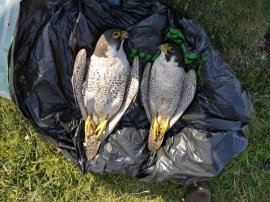
It seems plausible that some shooting estates are doing their best to distance themselves from any sign of illegal raptor persecution, especially in light of the new law on vicarious liability. A likely example of this behaviour was an incident in the Borders in September 2011. A dog walker discovered a bag full of dead raptors by the side of the busy A68 road (see here for earlier blog on this). The police were alerted and the birds were sent to SASA for toxicology tests. The results showed that the two sparrowhawks and two buzzards had been poisoned with the banned pesticide Carbofuran. Because the dead birds had been dumped away from any shooting estate or farm, without being seen, it was virtually impossible for the police to prosecute anyone (SASA reports that the police have now closed the case due to a lack of positive leads – see here). What is the probablity that other estates up and down the country are poisoning raptors on their land and then removing the evidence as far from their location as possible? It was pure chance that this bag of poisoned raptors was discovered. How many more are left rotting and undiscovered across the country?
 But let’s suppose, just for a minute, that the latest map IS an accurate representation of all raptor poisoning incidents that took place in 2011. Should we then accept that shooting estates are cleaning up their act and they’ve all suddenly decided, after over 100 years of persecution, that raptors are actually ok and shouldn’t be killed? The only way to measure that will be to look at LONG-TERM TRENDS of poisoning incidents as well as LONG-TERM TRENDS of raptor populations. We’ve blogged about this before (see here) but it’s worth repeating some of it to show the bigger picture. The graph (adapted from the RSPB’s excellent report: The Illegal Killing of Birds of Prey in Scotland in 2010, see here) shows the long-term trend of poisoning incidents in Scotland from 1989-2010. Look carefully at the graph and you’ll see peaks and troughs in the numbers recorded. Yes, there certainly have been previous drops in the number of poisoning incidents, but then look what happened in the following years – another increase, and then another drop, then another increase etc. Before the game-shooting lobby starts its self-congratulatory back-slapping, we need to see a continuous decline in the number of recorded incidents, AND we need to see raptor populations recovering in those areas where persecution has been endemic. This will take time, but could arguably be judged in about five years’ time.
Of course we all hope that the 2011 figures are the start of a new era in raptor conservation in Scotland. As Environment Minister Stewart Stevenson has said in today’s media: “I hope this proves to be the beginning of a continuing reduction in such cases, leading to the end of this outdated, dangerous and cruel practice“. It is notable that his statement contains more than a hint of caution. That man’s no fool.
See an excellent article about the latest figures in today’s Guardian here
Article in The Scotsman here
 In a bid to tackle increasing levels of wildlife crime, Devon & Cornwall Police have teamed up with the RSPB to launch ‘Operation Wilderness’, a new scheme that will see 24 hr nest cameras installed at vulnerable sites across the region.
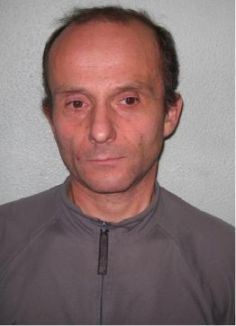 Following earlier posts about four-times jailed egg thief Matthew Gonshaw (see
 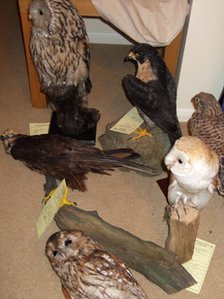 A Bedfordshire man has been sentenced to eight months in prison for the illegal sale of stuffed birds of prey.
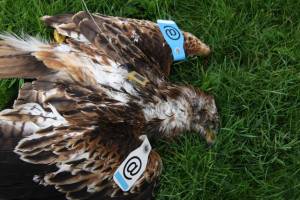 Following the successful release of red kites during the summer in Dublin and Wicklow, it is with disappointment that we report further recent kite deaths in Fingal. Since the release in July, this year, a total of eight (8) kites have now been recovered dead in Fingal since November.
 The substance used to kill the other four kites that have been discovered since November has yet to be confirmed – toxicology tests are on-going. It’s possible they were also unintentionally killed by secondary rat poison, but it’s equally possible that they have been deliberately (and illegally) killed by other poisons. For example, at the beginning of November 2011, it was reported that a red kite and a buzzard had been illegally poisoned in County Wicklow by alphachloralose (see
  Hot off the press from the team who brought you Eagles Could Eat Children (see
 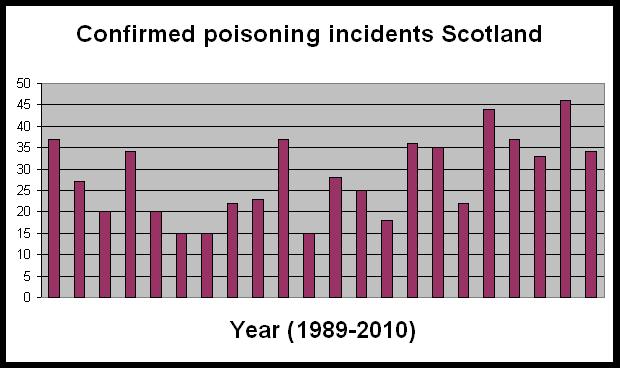 If you look closely at the graph, you will see a great deal of variation between years in the number of confirmed poisoning incidents. Of particular interest are the years 1994 and 1995 – in these two years, confirmed poisoning incidents dropped to a low of 15 from a previous high of 35+. However, if you then look at the following three years, the number of confirmed incidents steadily rose until they reached 35+ again. In 1999, the figure dropped again to 15, and from then until 2010, that figure has steadily risen and fallen, although never reaching the low of 15 again. So what does that tell us? I’m fairly sure that in the years 1994 and 1995, the game shooting lobby would have declared a ‘victory’ as the figures had dropped so much, and would have shouted from the hilltops that they’d changed their ways. I’m also fairly sure that in the following three years when the figures rose again, the conservationists would have declared a ‘victory’ and pronounced that their claims of widespread persecution had been vindicated. Either way, it is clear that neither ‘side’ can draw conclusions just based on an annual figure; for a trend to be detected, we need to see long-term figures.
 Raptor Persecution UK