Press release from Police Scotland and RSPB (23 April 2025)
POLICE & RSPB SCOTLAND APPEAL FOR INFORMATION AFTER PROTECTED SPARROWHAWK FATALLY SHOT
The bird was found dead in Inverness and was later confirmed to have been shot with a shotgun.
Anyone with information which could help identify a suspect is encouraged to contact Police Scotland and the RSPB.
POLICE Scotland and RSPB Scotland are appealing for information after a male Sparrowhawk was found shot in the Cradlehall area of Inverness.
On 6 March 2025 a member of the public reported to the RSPB Scotland that they had noticed a bird of prey dead on the ground. The next day, in agreement with Police Scotland, an RSPB Scotland Investigations Officer then collected the bird’s body and sent it for testing to establish the cause of death.
A post-mortem by a vet revealed a pellet lodged within the bird’s chest, and concluded that the bird had been shot with a shotgun. It added that the bird could have died some distance from where it was shot, before later dying from an infection and starvation as a result of the shooting.
The shot Sparrowhawk. Photo RSPB Scotland
All wild birds are legally protected under the Wildlife and Countryside Act 1981. Anyone found to have killed or injured a bird of prey faces an unlimited fine or even jail.
Police Scotland are appealing to anyone with information in connection with this incident to come forward.
Ian Thomson, RSPB Scotland’s Head of Investigations, said:
“Sparrowhawks are one of the birds of prey you or I are most likely to encounter, as they live alongside us in parks and gardens. They hunt small birds by stealth and can be identified by their brilliantly piercing yellow eyes. The presence of Sparrowhawks and other birds of prey is a good indicator of a healthy and balanced ecosystem. This bird was shot with a shotgun, resulting in a drawn-out and painful death. Few people have access to such weapons, with even fewer motivated to shoot at protected birds of prey. We ask that if anyone has information about this incident, to please get in touch with Police Scotland or ourselves.”
Thomas Plant, Bea Ayling and Shona Rüesch of the Inverness Urban Sparrowhawk Project have been studying the Sparrowhawk population in Inverness since 2020. They commented: “We are absolutely devastated to hear that someone has shot one of these beautiful and majestic birds: one we may have been monitoring this year here in Inverness. As part of our voluntary monitoring we have been checking nest sites and colour-ringing Sparrowhawks (with support and funding from the Highland Raptor Study Group (HRSG)). We hope that this will help to improve understanding of the local Sparrowhawk population, their movements, lifespans and the threats that they face.”
If you have any information relating to this incident, call Police Scotland on 101 quoting reference number CR/0132125/25.
The last shot sparrowhawk in this area that made the headlines was the one shot and killed by a gamekeeper on Moy Estate, a grouse moor to the south of Inverness. The RSPB filmed him using a plastic decoy owl, presumably to draw raptors in close as they come to mob it, whilst he hid behind a nearby bush with his shotgun. The gamekeeper was subsequently convicted in 2023 for killing a sparrowhawk (here).
Here is a quote I’ve just given to a journalist who asked for my opinion about the latest shooting of a sparrowhawk in the region and about whether the Government’s strategy on tackling raptor persecution is effective:
“It’s unusual to find a dead bird of prey in an urban area with shotgun injuries – typically urban raptors are killed with air rifles. Although the post mortem report on this particular bird suggests it had probably succumbed to an infection and subsequent starvation, indicating it may have been shot some distance from where it actually died.
“Shamefully, the illegal killing of raptors is still prevalent in Scotland, particularly in rural areas being used for gamebird shooting because birds of prey are still perceived as a ‘threat’ to gamebird stocks, even though raptors have been legally protected since 1954. These crimes are so frequent and widespread that the Scottish Government finally decided to introduce new legislation last year (the Wildlife Management & Muirburn (Scotland) Act 2024) in an attempt to bring an end to raptor persecution on driven grouse moors. The idea is that grouse moor owners now have to operate under a licence and if there’s evidence of ongoing raptor persecution that licence can be revoked, preventing any more shooting of Red Grouse on the moor for a specified period.
“Having the new legislation in place is certainly progress, but legislation is only effective if it is properly monitored and enforced. Unfortunately the new legislation was subsequently watered-down by nature conservation agency NatureScot in December last year, following threats of a legal challenge from the representatives of the grouse shooting industry. The legislation as it currently stands is not worth the paper it’s written on because NatureScot has introduced a massive loophole that means it is virtually impossible to connect the killing of raptors with grouse moor management and this is a situation that will be readily exploited by those who wish to continue killing birds of prey. Indeed, since the legislation was enacted numerous birds of prey have been shot and killed on grouse moors in Scotland (e.g. an Osprey, a Peregrine, a Red Kite) and there haven’t been any consequences for those responsible.
“The Scottish Government has acknowledged that there are ‘issues’ with the current legislation and work is underway by campaigners to address this unsatisfactory situation“.
Blog reader Andy Amphlett went for a walk on Moy Estate last weekend.
Moy Estate will be familiar to regular blog readers as it’s featured here many times over the last 13 years. Most recently, the estate has been sanctioned with a three-year General Licence restriction, imposed by NatureScot after the discovery of a poisoned red kite and ‘incidents in relation to trapping offences‘ (see here). And in March this year, estate gamekeeper Rory Parker was convicted for shooting a sparrowhawk on Moy (see here).
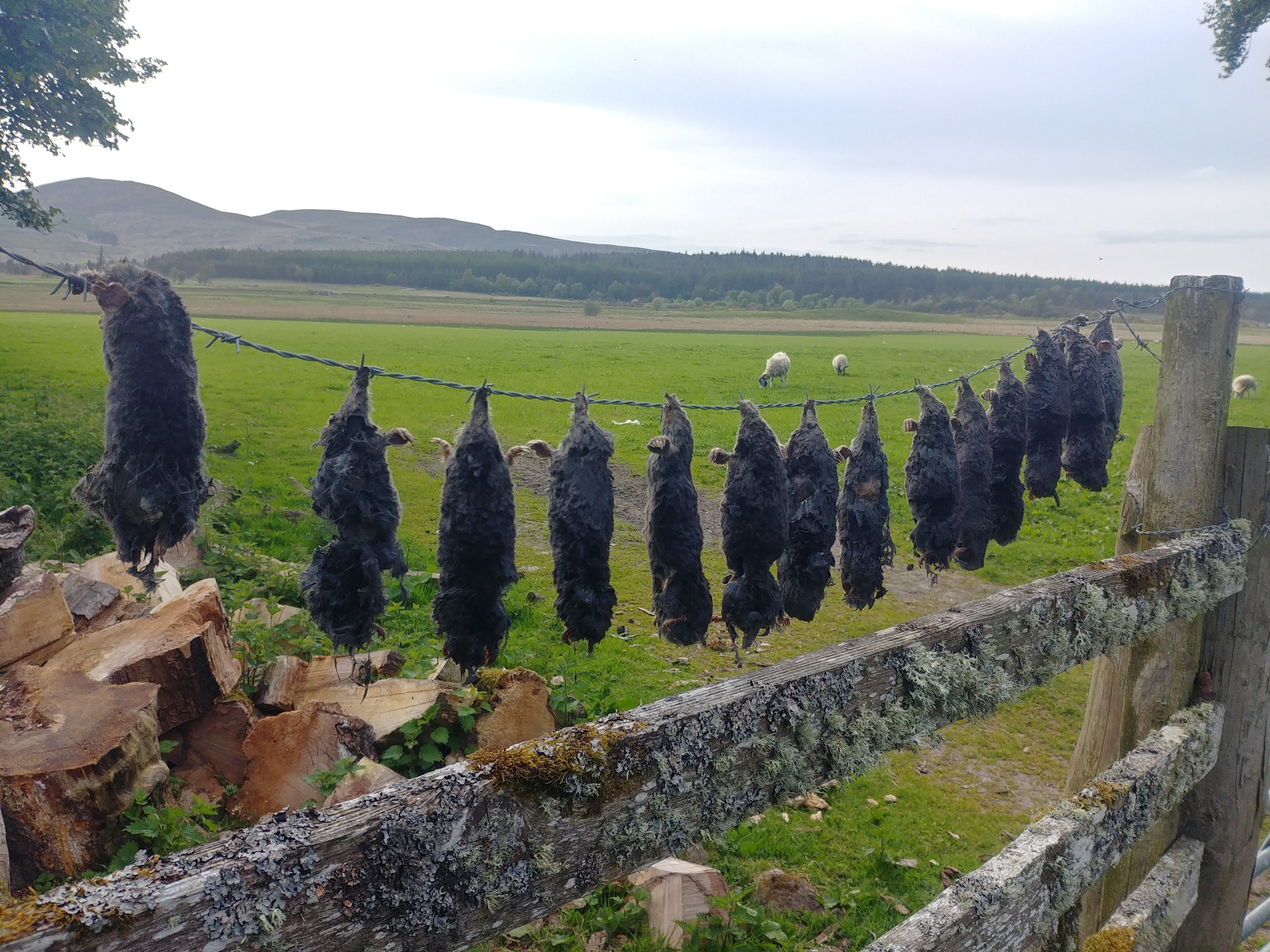
Victorian attitudes appear to persist at Moy Estate, as Andy discovered last Saturday when he found 14 dead moles hung by their snouts on a barbed wire fence:
Photo: Andy Amphlett
This disgusting activity isn’t illegal, and was once a common sight on UK shooting estates when victims would be hung on what was known as a ‘gamekeeper’s gibbet’ to demonstrate to the landowner that ‘vermin control’ was taking place.
It’s hard to believe though that anyone still thinks it’s appropriate or acceptable to brag about how much wildlife has been killed. What purpose does it serve? And why are moles still being killed anyway?
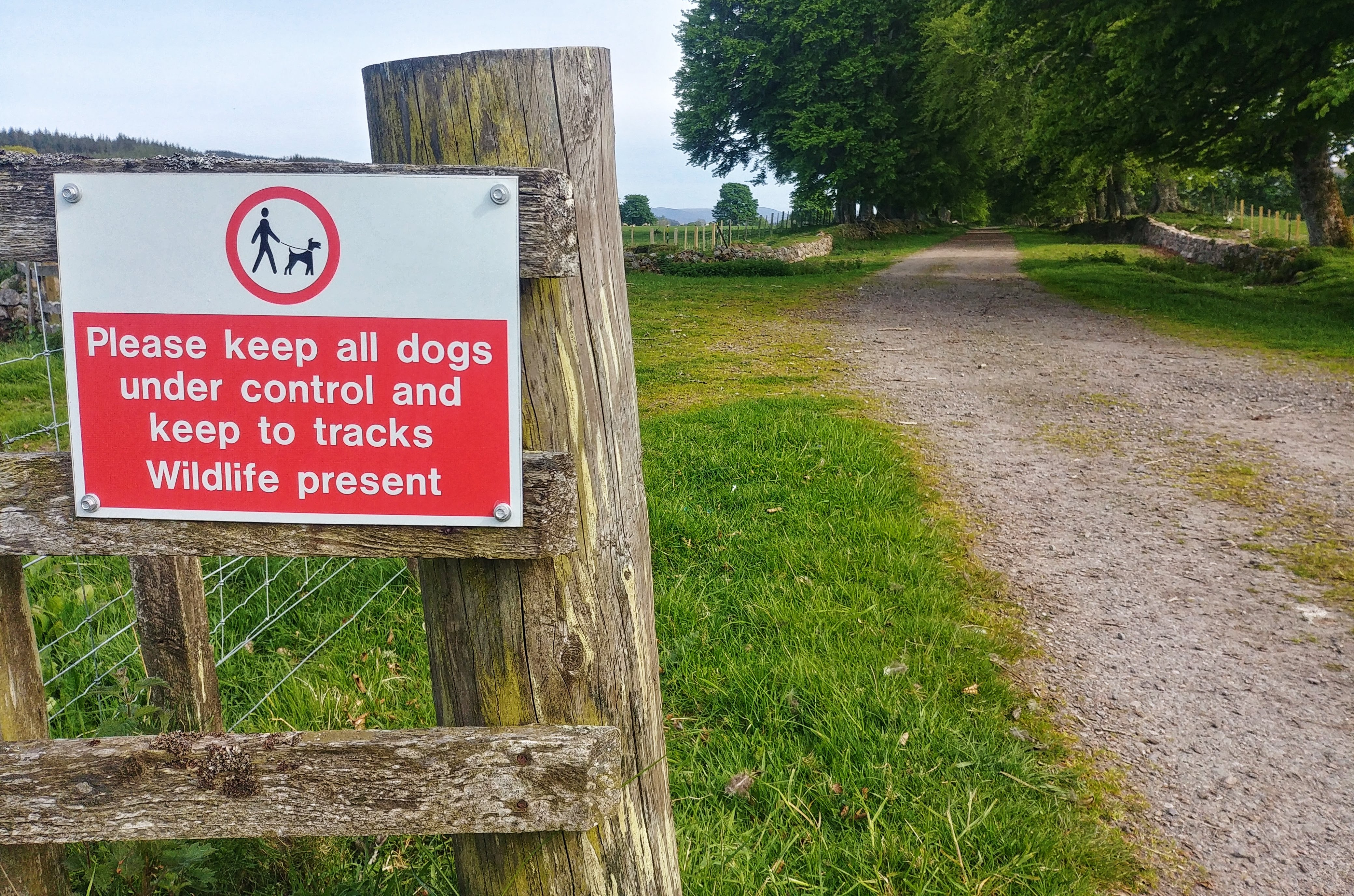
Without any sense of irony, this is the sign at the entrance to Moy Estate, just a few hundred metres away from the strung-up moles:
Photo: Andy Amphlett
Yeah, wildlife is present but a lot of it’s quite likely to have been killed.
And I’m pretty sure that this sign might be in contravention of the Scottish Outdoor Access Code, which does not insist that walkers ‘keep to tracks’ except in certain circumstances. It just makes me question what an estate might be wanting to keep from public view…
See here and here for two excellent blogs written by Nick Kempe about Scottish access signs and what is/isn’t permissible for those exercising their access rights and those controlling that access.
A report has been made to Highland Council about the Moy Estate sign.
Further to last week’s news that Scottish gamekeeper Rory Parker pleaded guilty to committing raptor persecution crime on a grouse moor on Moy Estate in September 2021 (see here), I’ve been looking to see how the game-shooting industry has responded to this conviction.
You’ll recall that this is the game-shooting industry whose organisations routinely state they have a ‘zero tolerance’ policy towards raptor persecution, in which case you’d think they’d be quick to condemn this latest crime and call on their members and the wider shooting public to distance themselves from Moy Estate, and especially as the estate is already serving a three-year General Licence restriction imposed in 2022 after Police Scotland found further evidence of wildlife crime (see here), namely a poisoned red kite and ‘incidents in relation to trapping offences’.
Four days on from Parker’s conviction, I haven’t found any statements of condemnation on the websites of the Scottish Gamekeepers Association, BASC, or the Countryside Alliance.
Their collective silence says a lot, I think. In my opinion it’s related to an ongoing, industry-wide damage limitation exercise as the Wildlife Management & Muirburn (Scotland) Bill begins its passage through the Scottish Parliament. Drawing attention to criminal activity on grouse moors at a time when MSPs are considering the extent of proposed regulation in the form of a grouse-shooting licence is not in their interests, although I’d argue that if they were as resolute about stamping out raptor persecution crimes as they claim to be, they should have been at the forefront of leading the condemnation.
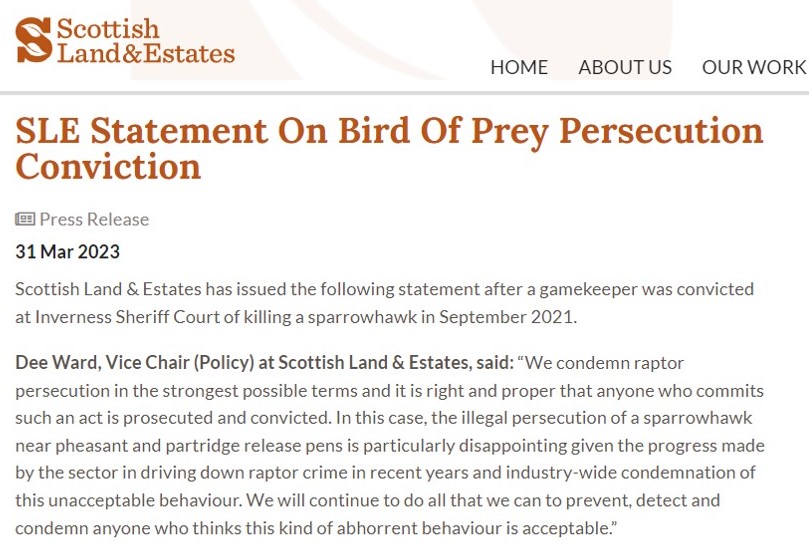
The only game-shooting organisation that has responded to the news of Parker’s conviction is landowners’ lobby group, Scottish Land & Estates (SLE).
I’ve already written about a media quote attributed to grouse moor owner Dee Ward, who’s also Vice Chair (Policy) at SLE, who seemed keen to distance Parker’s crime from grouse moor management (see here), and this was repeated in a statement that SLE published on its website on the day of Parker’s conviction.
Credit to SLE for not shying away from the news, but its manipulation of the narrative is all too obvious:
I’m not sure what the ‘progress’ is to which Dee refers. I haven’t seen any evidence of ‘the sector driving down raptor crime in recent years‘. What I have seen is an increasing number of shooting estates having General Licence restrictions imposed after Police Scotland has confirmed evidence of continued raptor persecution crimes (there are currently six GL restrictions in place – Leadhills Estate (here), Lochan Estate (here), Leadhills Estate [again] (here), Invercauld Estate (here), Moy Estate (here) and Millden Estate (here)).
The Scottish Government doesn’t appear to have seen the evidence, either, given the Environment Minister’s statement in 2020 when she announced that there could be no further delay to the introduction of a grouse moor licensing scheme because:
“…despite our many attempts to address this issue, every year birds of prey continue to be killed or disappear in suspicious circumstances on or around grouse moors“.
Time will tell if SLE sticks with Dee’s claim that, “We will continue to do all that we can to prevent, detect and condemn anyone who thinks this kind of abhorrent behaviour is acceptable“.
Will that include boycotting the Highland Game Fair, held each year on the Moy Estate? This is an event that SLE, and the other shooting organisations, routinely attend, with apparently total disregard for sanctions imposed on the estate for wildlife crime (see here).
It’s actions, not mere words, that will determine whether the industry’s ‘zero tolerance’ policy is seen as credible, and as far as I’m concerned, the industry’s actions haven’t come close.
On Friday (31st March 2023), gamekeeper Rory Parker, 24, of Drumbain Cottage, Tomatin, pleaded guilty to shooting and killing a sparrowhawk on 16th September 2021 whilst employed on Moy Estate (see here).
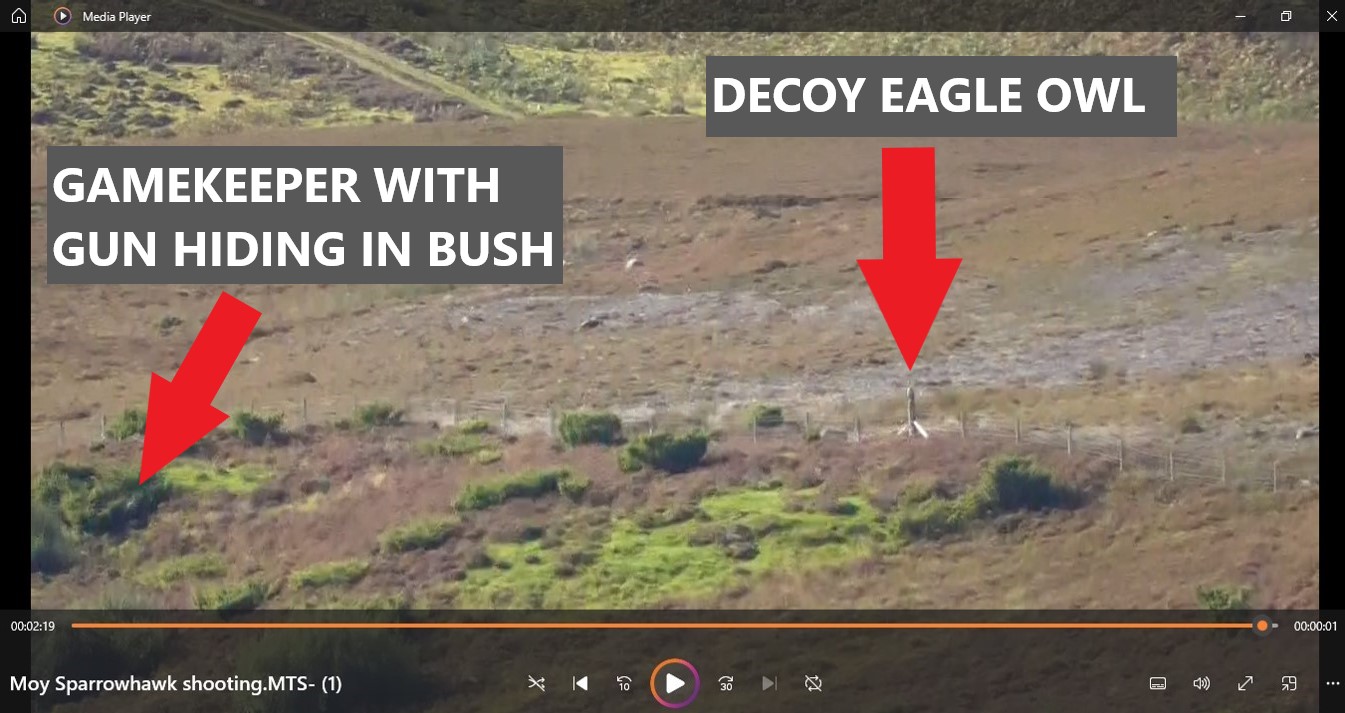
Parker was filmed by an RSPB Investigator as the (at the time 22-year-old) gamekeeper hid in a bush on the grouse moor, a few feet away from a large plastic owl that had been placed on a fencepost. It’s well-known that raptors will be drawn to an owl decoy and will try to mob / attack it. If someone sits quietly nearby with a gun they’ll have a good chance at shooting and killing the raptor whilst it’s distracted by the owl.
We’ve seen this technique deployed on grouse moors many times before, sometimes with plastic decoys, sometimes with live eagle owls (e.g. see here, here, here, here, here, here).
It looks like that’s what happened that September day in 2021. Here’s a screen grab from the RSPB’s video showing the position of Parker and the decoy owl:
If you haven’t yet seen the full video, there’s a copy of it embedded in this tweet below. I’d encourage you to watch it, and take note of Parker’s body language when he goes over to the sparrowhawk he’s just shot, as it’s flapping around, wounded, on the ground. He’s calm and proficient as he stamps his foot/knee on the bird to crush it, before casually picking it up and retuning to his hiding place in the bush. It appears to be quite routine and he does not look at all disturbed at having just committed a serious wildlife crime.
This video, provided by the RSPB, has led to a Scottish gamekeeper pleading guilty to shooting a protected bird of prey 🦅👇 pic.twitter.com/bHC8W5DYyg
In court, Parker was defended by Mark Moir KC. The KC stands for King’s Counsel and denotes an experienced, high-ranking lawyer considered to be of exceptional ability. I wonder who paid for his services? In mitigation for Parker’s offending, Mr Moir KC reportedly told Sheriff Sara Matheson that his client had been in his job since he left school.
“He is deeply shameful of what he has done. He has brought the estate into disrepute and has now resigned.
“His firearms certificate is likely to be revoked as a result of this conviction. He should have been shooting pigeons and crows that day. Feral pigeons are a problem on the estate.
“However, the sparrowhawk flew over and there was a rush of blood. He says it was a stupid thing to do.”
After watching the video, it didn’t look like ‘a rush of blood‘ to me. It looked entirely premeditated.
Apparently the RSPB video wasn’t shown in open court but I’m not sure whether Sheriff Matheson had an opportunity to see it behind closed doors. I suspect she didn’t, given the sentence she handed down to Parker – a pathetic £1,575 fine and three months in which to pay it.
This should have been a test case of the new Animals & Wildlife (Penalties, Protections & Powers) (Scotland) Act 2020; legislation that was introduced to increase the penalties available for certain wildlife crimes, including those under Section 1(1)(a) of the Wildlife & Countryside Act – ‘Intentionally, or recklessly, killing, injuring, or taking a wild bird‘. Parker committed his offence after the enactment of this new legislation.
Prior to the new legislation, the maximum penalty available for the type of offence Parker committed was up to six months imprisonment and/or a fine of up to £5,000.
The new legislation increased the maximum penalty available (on summary conviction, as in Parker’s case) to a maximum of 12 months imprisonment and/or a fine of up to £40,000.
So why was Rory Parker only given a £1,575 fine??*
The penalty increases in the new Act were introduced by the Scottish Government because the previous penalties were not considered sufficient to recognise the seriousness of wildlife crime(s) [and animal cruelty offences].
This view was supported by an independent review by Professor Poustie, published in 2015, which concluded that the then maximum penalties available to the courts may not have been serving as a sufficient deterrent to would-be offenders, nor reflecting the seriousness of the crime(s).
The Poustie Review was first commissioned in 2013 by then Environment Minister Paul Wheelhouse, and as part of a series of measures aimed at tackling the continued persecution of birds of prey (see here). It was his response to growing levels of public concern and a lack of confidence in the judiciary to deal with raptor-killing criminals. Criticisms of the system had often centred around perceived corruption, vested-interests and biased Sheriffs, and we had come to expect unduly lenient and inconsistent sentencing in most cases (e.g. see here).
The new legislation was supposed to address those concerns with a significant increase in the severity of penalties available for courts to hand down to offenders.
I don’t see any evidence of that in the sentencing of raptor-killing gamekeeper Rory Parker.
*UPDATE: Someone who was in court on Friday has just been in touch to provide further insight into sentencing. They told me:
‘When the defence KC was summing up he repeatedly suggested to the sheriff what penalty might be most appropriate, i.e. a fine and maybe a community payback order. He also told her Mr Parker had savings of £2,000. It was therefore no surprise at all she then issued a £1,800 fine (discounted to £1,500 because he wasn’t considered an adult when he committed the crime. Since when is a 22 year old not an adult?!!!) In my opinion, therefore, the Sheriff was basically spoon-fed the sentence by the KC‘.
Further to today’s news that gamekeeper Rory Parker (24) has pleaded guilty to shooting a sparrowhawk on Moy Estate in September 2021 (see here), it’s worth examining the narrative that’s being pumped out by the grouse-shooting industry representatives in a desperate attempt to distance the industry from yet another raptor persecution crime.
This conviction couldn’t have come at a worse time for the industry, as the Wildlife Management & Muirburn (Scotland) Bill begins its passage through the Scottish Parliament. Obviously, the industry won’t like the media attention of yet another raptor persecution crime being committed on a grouse-shooting estate so they’ll want to manipulate the media narrative to influence/minimise the scope of the forthcoming grouse shoot licensing scheme.
And so it begins.
It actually began this morning prior to the court hearing. I received a message from an individual within the industry (I won’t name him, he’s generally one of the good guys and I value his willingness to converse). He told me that, ‘in the spirit of accuracy and transparency’, that the shooting of this raptor hadn’t taken place on a grouse moor (as I’d previously reported) but that it was in fact in an area managed for pheasant and partridge. I told him that wasn’t my understanding but that I’d be happy to clarify this detail once the evidence had been heard in court. He told me this particular issue would be clarified during today’s hearing.
As it turns out, it wasn’t really clarified in court. But the RSPB has since published its video footage of the shooting (see link at foot of the RSPB press release, here) and it looks very much like a grouse moor to me.
Here’s a screengrab I took from the RSPB video, where incidentally I’ve highlighted the position of the gamekeeper, close to a large plastic decoy eagle owl that had been placed on a fencepost, presumably to try and draw in raptors to shoot at close quarters – we’ve seen gamekeepers using this technique many times before (e.g. see here, here, here, here, here, here).
The location of the shooting was given in court as a hill called Tom na Slaite. Here it is on an OS map – complete with a track leading up to some grouse butts:
Now, it’s quite possible that pheasants and partridge have been released on this part of the grouse-shooting estate – it’s becoming a common theme to release these birds for shooting on grouse moors (e.g. see here), either to supplement the grouse shooting days or, in some circumstances, to replace the grouse-shoot days when grouse stocks are too low to attract paying guests. It’s one of the significant faults in the proposed grouse shoot licensing Bill, in my opinion, but that’s a bigger discussion for another day.
The bottom line is that this gamekeeper, Rory Parker, shot this sparrowhawk on an upland grouse moor, not on a lowland game shoot as the industry would have us believe.
The narrative continues with a quote for the media from Moy Estate’s unnamed shooting tenant (I’ll return to the identity of the tenant/sporting agent in a future blog). His statement, quoted in the Scottish Daily Mirror, includes this line:
“As the sporting tenant on this area of land, which is used for pheasant and partridge shoots, we were shocked when made aware of the incident….blah blah”.
It appears to be casual, but that phrase “….which is used for pheasant and partridge shoots…” is carefully and deliberately placed, in my opinion.
As is the phrase quoted in the same article given by Dee Ward from landowners’ lobby group Scottish Land & Estates (SLE), whose statement includes the line:
“In this case, the illegal persecution of a sparrowhawk near pheasant and partridge release pens is particularly disappointing….”
It’s slick PR, designed to be consumed by an unassuming, uninformed audience who wouldn’t otherwise link the crime to grouse moor management.
It’s nothing new. We saw it in 2021 when a poisoned golden eagle was found dead, next to a poisoned bait, on a grouse moor on Invercauld Estate in the Cairngorms National Park. Estate Manager Angus McNicol was quoted in the press, claiming:
“The area where the bird was found is on a let farm in an area which is managed for sheep farming and is on the edge of an area of native woodland regeneration. It is not managed for driven grouse shooting” (see here).
This claim was swiftly rebutted by Ian Thomson, Head of RSPB Investigations in Scotland (who was directly involved in the investigation) who said:
“For the avoidance of doubt, the eagle was found poisoned next to a mountain hare bait, in an area of strip muirburn within 200m of a line of grouse butts and a landrover track” (see here).
The most blatant example of damage limitation by the grouse shooting industry I’ve seen was when SLE issued a statement in response to the appalling crimes committed by gamekeeper Alan Wilson on the Longformacus Estate a few years ago.
In that statement, SLE described the Longformacus Estate as being ‘managed for low ground pheasant shooting‘ (see here). It may well have been, but strangely, they forgot to mention that the crime scene (Henlaw Wood) also just happened to be at the foot of a driven grouse moor! This omission was probably just an innocent, forgetful moment, and nothing whatsoever to do with the fact that the Werritty Review on grouse moor management was imminent.
I’ll write more about today’s conviction of the Moy Estate gamekeeper in another blog, shortly.
UPDATE 1st April 2023: The sentencing of raptor-killing Moy Estate gamekeeper Rory Parker (here)
UPDATE 4th April 2023: Game-shooting industry’s response to the conviction of Moy Estate gamekeeper Rory Parker (here)
Not for the first time, a gamekeeper has been convicted for raptor persecution crime on Moy Estate, a notorious grouse- shooting estate in Scotland.
The RSPB has issued the following press statement:
GAMEKEEPER PLEADS GUILTY TO SHOOTING SPARROWHAWK ON SCOTTISH GROUSE MOOR
Gamekeeper caught by footage taken by RSPB Scotland Investigations team
Fined £1500
The conservation charity is calling for urgent implementation of the Wildlife Management and Muirburn Billwhich will bring in grouse moor licensing, aimed at stopping crimes against birds of prey
At Inverness Sheriff’s Court today (31 March 2023), Rory Parker (24), pleaded guilty to shooting a Sparrowhawk whilst employed as a gamekeeper on the Moy Estate, Inverness.
He is the 56th gamekeeper to be convicted of raptor persecution offences in Scotland since 1990.
The conviction was secured after the incident was directly filmed by RSPB Scotland Investigations staff on 16 September 2021. Footage shows the bird circling overhead, before a gun is raised by the defendant and then the bird is shot out of the sky, before finally being collected by the gamekeeper. A plastic ‘decoy’ owl can be seen close to the gamekeepers position and is most likely being used as a lure to attract live birds of prey to be shot.
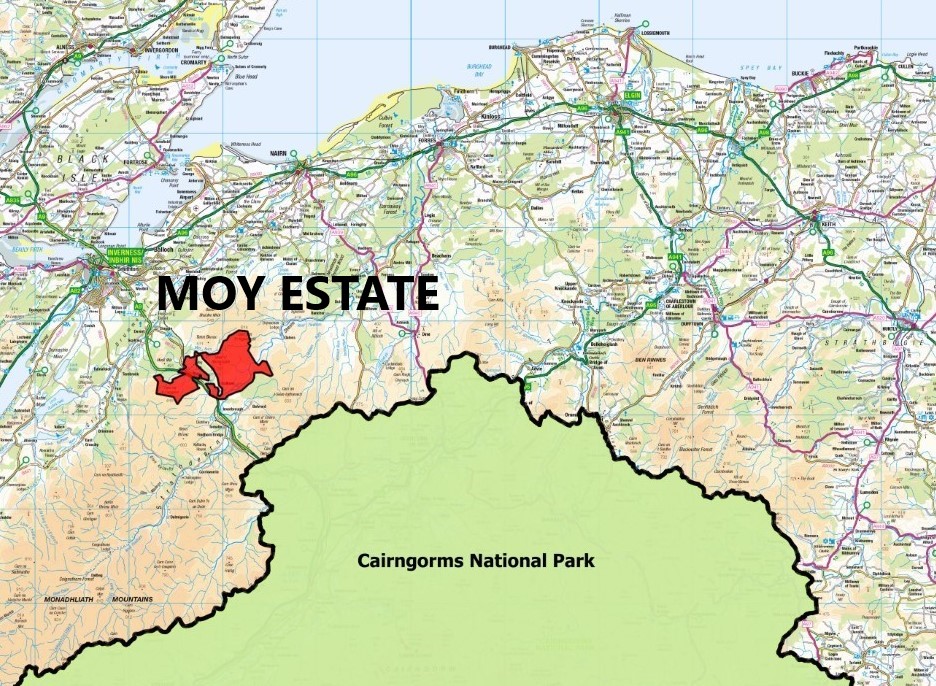
RPUK map of Moy Estate, boundaries provided by Andy Wightman’s Who Owns Scotland website
A search led by Police Scotland of the suspects address and land on the Moy Estate took place on 19 September 2021 when he was arrested and interviewed.
All birds of prey are protected under the Wildlife and Countryside Act 1981 and killing them is against the law, punishable by an unlimited fine and/or jail.
Ian Thomson, Head of Investigations for RSPB Scotland, said: “This conviction was the end result of exemplary partnership working between Police Scotland, RSPB Scotland, the Wildlife DNA Forensics team at Science and Advice for Scottish Agriculture and the Wildlife & Environmental Crime Unit of COPFS.
“It is clear, however, with the shooting of a red kite on another Highland grouse moor earlier this week [Ed: see here], and ongoing investigations into incidents on other estates, that current sanctions appear to be no deterrent to criminal activity by employees of the grouse shooting industry, with their onslaught against protected birds of prey continuing unabated”.
Ian added: “We hope that the Scottish Parliament expedites the passage of laws in the Wildlife Management and Muirburn Bill introducing proper regulation of that industry, where the right to shoot grouse is dependent on operating within the law”.
Nationally, the RSPB’s recently published Birdcrime report for 2021 found that over two-thirds of confirmed raptor persecution incidents were in relation to land managed for gamebird shooting.
ENDS
There’s a lot to say about this conviction, and this estate, and it will probably take several blogs to get through it all.
For those who don’t know, Moy Estate is already serving a three-year general licence restriction (June 2022-2025) after Police Scotland provided the licensing authority (NatureScot) with evidence of wildlife crime against birds of prey on the estate, notably the discovery of a poisoned red kite in 2020 and ‘incidents in relation to trapping offences’. I wrote a blog about it at the time (see here) which also includes details of the long and sorry history of raptor persecution uncovered on this estate over the last decade.
And they’re still at it.
More on today’s conviction shortly.
UPDATE 31st March 2023: Moy gamekeeper convicted – cue damage limitation exercise by grouse shooting industry (here)
UPDATE 1st April 2023: The sentencing of raptor-killing Moy Estate gamekeeper Rory Parker (here)
UPDATE 4th April 2023: Game-shooting industry’s response to the conviction of Moy Estate gamekeeper Rory Parker (here)
Forestry and Land Scotland (FLS) has granted a controversial licence permitting Moy Estate gamekeepers, and others from the Three Straths Fox Control Association, to hunt and kill foxes on Scotland’s national forest estate, partly for the benefit of privately-owned grouse shooting estates, including Moy Estate.
This is the same Moy Estate that has been at the centre of police investigations into alleged raptor persecution crimes for over a decade (e.g. see here) and is currently serving a three-year General Licence restriction, imposed by NatureScot, after evidence of wildlife crime (raptor persecution) was again uncovered on the estate.
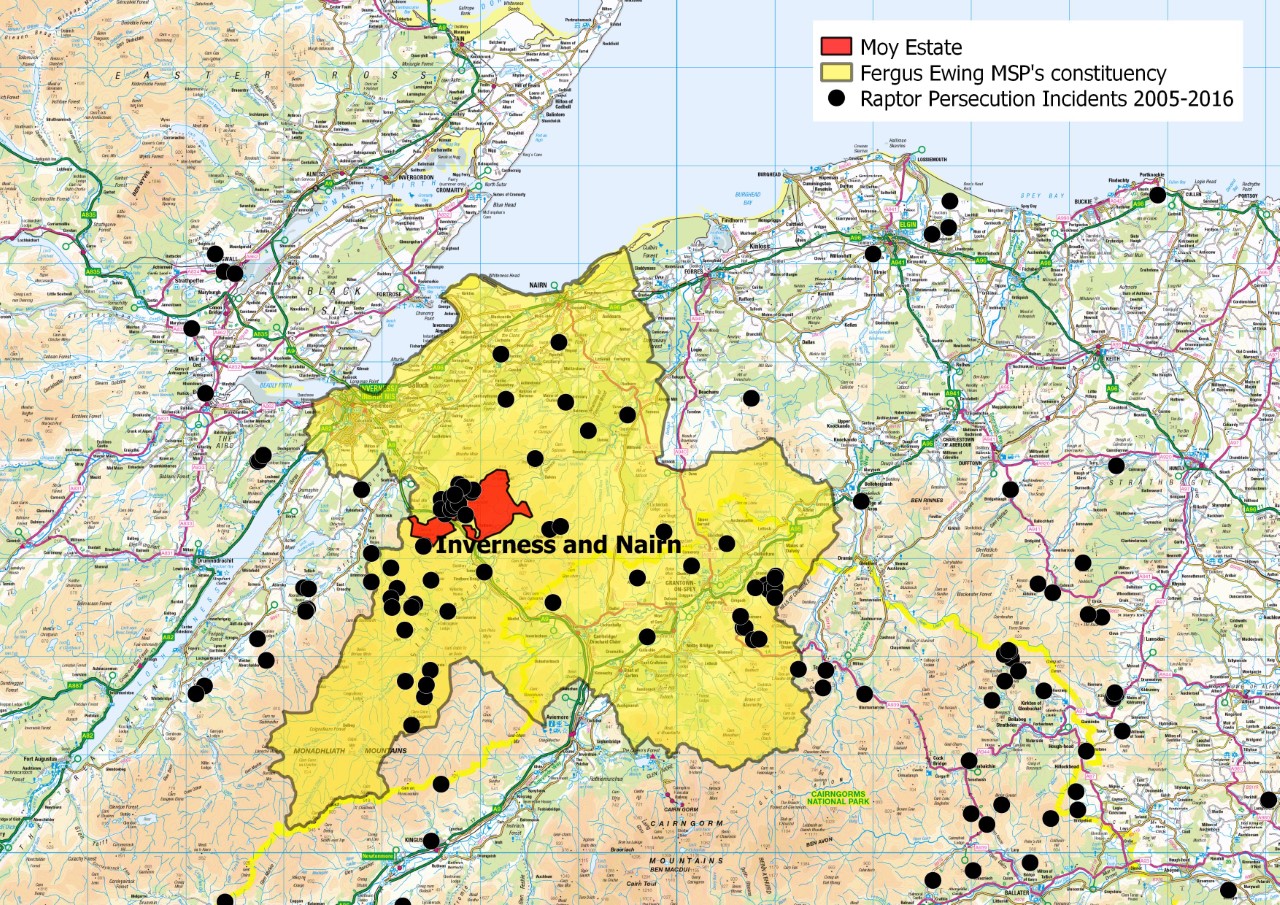
This is a map I produced a few years ago showing reported raptor persecution incidents in the region between 2005-2016. There have been many more since.
Wildlife campaigners are understandably furious about this decision, not least because FLS’s own experts strongly advised against it due to, amongst other things, the potential for illegal activity.
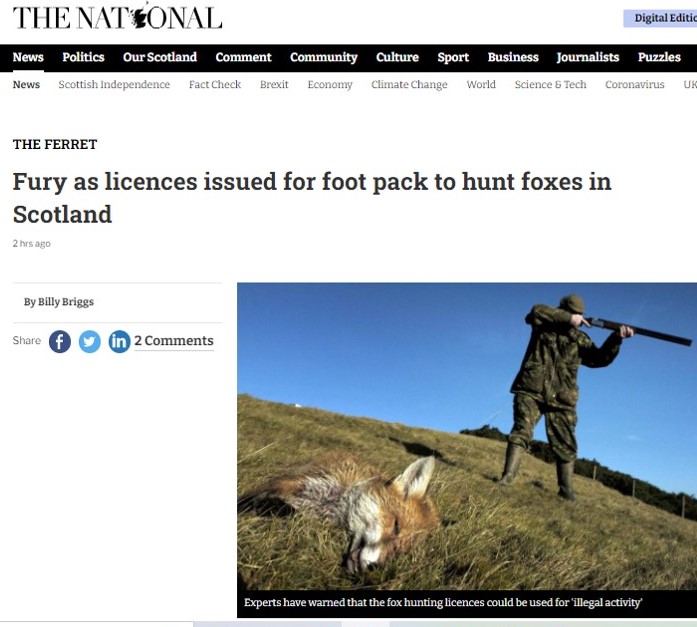
Journalist Billy Briggs has written an excellent article, based on Freedom of Information responses I received this autumn. His article is published today by The Ferret (here, behind a pay wall) and also here in The National, as follows:
LICENCES for a foot pack to kill foxes were issued by Forestry and Land Scotland despite strong objections from internal experts who feared there was potential for “illegal activity” and protected species such as badgers to be disturbed.
A foot pack – in contrast to traditional fox hunting with riders on horses – is where a huntsman, accompanied by colleagues acting as beaters, uses hounds to chase foxes out from cover to then be shot.
Critics who want hunting with packs of dogs banned in Scotland are urging Scottish Government ministers to outlaw foot packs as well as mounted hunts.
The Ferret previously revealed that foxes were being chased by hounds and shot by foot packs in forests used by the public.
Our investigation prompted angry responses from wildlife groups who have condemned Forestry and Land Scotland (FLS) once again for issuing more licences. FLS is responsible for managing and promoting Scotland’s national forest estate.
A freedom of information request was submitted to FLS by campaign group, Raptor Persecution. The reply revealed internal discussions at FLS in September and October after Three Straths Fox Control Association (Three Straths) applied for licences for fox control in the south Inverness area.
The documents, passed to The Ferret, showed that FLS experts strongly advised against the foot pack being allowed to hunt.
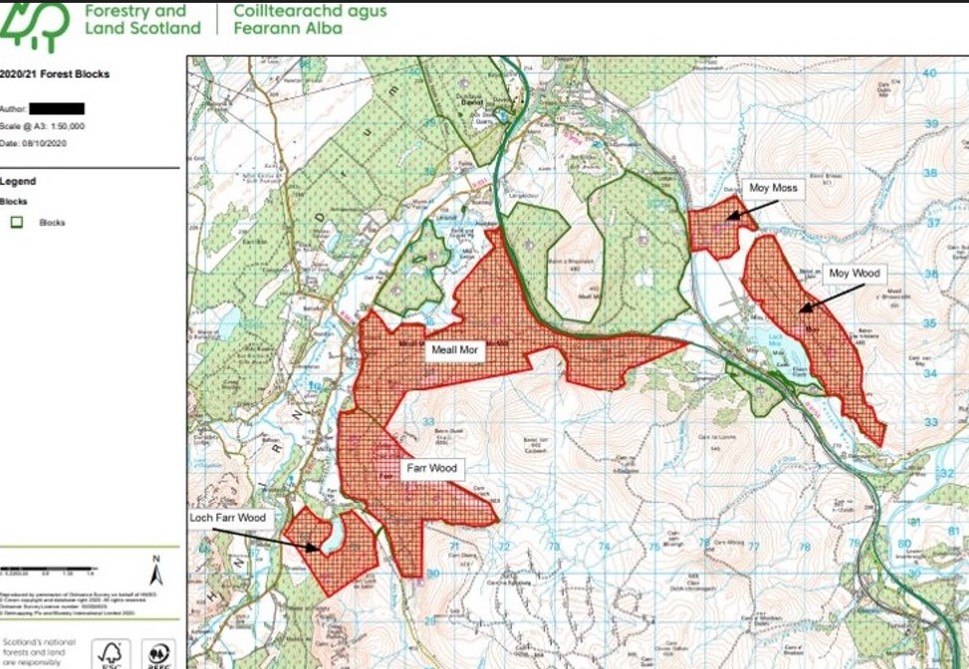
Map showing the woodland where FLS has permitted the hunting & killing of foxes during the 2022-2023 season. Released to RPUK under FoI.
The licences were issued, however, prompting condemnation by critics. They included the League Against Cruel Sports Scotland which said it was “quite staggering” FLS granted permission in the face of “vehement concerns” by its own staff.
In reply, FLS said it appreciates that fox control is a “contentious issue” but under existing legislation the activity is legal in Scotland and “closely regulated”.
Three Straths told The Ferret it always adheres to the law to “ensure public safety and to avoid non-target species”, adding that it provides a “public service at no cost to the public purse”.
The licence application said Three Straths represented a “number of sporting estates” seeking to hunt foxes on the Moy, Farr, and Dalmagarry estates. Each hunt would typically involve 30 people including local gamekeepers, 20 to 30 guns, 15 hounds and a huntsman.
The hounds are used to flush the fox from cover to a line of waiting guns where the animal is shot.
The foot packs are overseen by a wildlife team at FLS, but some staff still opposed Three Straths’ application.
Internal documents revealed one person wrote: “As a minimum we should request a protocol for how the operators (the foot pack) will deal with encounters with protected species. This was asked for at the last permission request but I have not yet seen it. As discussed before, without this I feel the activity cannot be done without potentially disturbing legally protected species and could lead to an illegal activity.”
They added: “As this is a known activity any disturbance could be classed as reckless under the law and would constitute an offence. FLS as the landowners would also be liable for allowing the activity to take place. Given the risks, lack of mitigation information and lack of rationale for why the activity is needed, I would strongly advise it is not allowed.”
Another expert — a species ecologist — also objected and wrote: “As I [sic] have pointed out several times previously, fox ‘control’ at this time of year has no impact on fox density the following spring. This is a matter of scientific fact. If the intention is to reduce (assumed) fox impacts on the shootable ‘surplus’ of grouse in 2020, it is a pointless exercise.”
They added: “Furthermore, I am not aware of any evidence that these foxes actually eat game birds on adjacent estates. To sanction this controversial activity without any evidence of an actual problem is inadvisable. For the record, and for the reasons I have listed in previous communications, I reiterate my advice that we should not give permission for this activity.”
It was also noted that internal concerns had been raised in previous years regarding requests by Three Straths to hunt, which were “not adequately addressed”.
Staff also pointed out that foxes are “part of the forest ecosystem” and “we should not be unsustainably removing any native species”. They said: “As we have no idea of the current population (no surveys have been undertaken) then effectively this could extirpate foxes on our land. We know foxes play a valuable role in keeping populations of other predators in check and in reducing rabbit and hare populations, thereby reducing damage to restock sites.”
Concerns were also raised over public safety and “verbal assurances” given by Three Straths that hounds would only chase foxes. There was a “real risk” that a bolting fox could go down the entrance to a protected species den or sett to escape the dogs, it was noted, and people firing guns on a badger sett “would be a disturbance in itself”.
Dr Ruth Tingay, of Raptor Persecution, who submitted the freedom of information request, pointed out that Moy Estate is currently serving a three-year general licence restriction, imposed by NatureScot, for wildlife crimes against birds. Moy Estate reportedly said it was extremely disappointed by the decision and would be considering an appeal. [Ed: Moy Estate has already lost its appeal against the General Licence restriction – see here].
Tingay said: “The rationale behind the restriction is that NatureScot can no longer trust Moy Estate to comply with the terms of the general licences after evidence of raptor persecution was provided by Police Scotland.
“So why on earth has FLS entrusted Moy Estate to comply with the terms of a licensed fox hunt, in a public forest, with what looks like minimal oversight and scrutiny? Don’t these licensing agencies talk to one another?”
Bob Elliot, director of the animal welfare charity, OneKind, argued that FLS fox control policy should reflect the views of the Scottish public who “overwhelmingly do not support fox hunting”.
He added: “It is incredibly disappointing to see that once again, despite several serious objections raised internally by Forestry and Land Scotland staff, FLS has granted permission to allow foot packs to kill foxes in Scotland’s public forests this winter.
“We know from our previous freedom of information requests to FLS that many of the concerns raised by FLS staff, including the non-necessity of fox hunting foot packs, the importance of foxes to the ecosystem, and the threat to other wild animals, have in fact been raised before.”
His views were echoed by Robbie Marsland, director of the League Against Cruel Sports Scotland, who said it was “quite staggering that despite vehement concerns” the licenses were issued.
He added: “The situation at FLS is yet another reason why it is imperative the new Hunting with Dogs Bill passes through parliament in the most robust form possible, ensuring hunting with dogs is really banned in Scotland once and for all.
“The existing legislation is so full of loopholes it isn’t worth the paper it’s written on and time and time again we’re seeing those who wish to hunt wild mammals with dogs for fun, simply ignoring the fact this activity is supposed to be illegal.”
A spokesperson for Forestry and Land Scotland said that in “all aspects” of its land management activities it has a duty to “follow the law and existing policies” when considering requests. “Only if there was a change in law and Scottish Government policy would we be in a position to review our procedures,” the spokesperson continued.
‘ORDINARILY FLS only controls foxes to meet specific conservation interests. However, we also appreciate that neighbouring land managers’ priorities might differ from our own and will assist where it is deemed appropriate. We continue to have our own staff monitor fox control activities.”
A spokesperson for Three Straths accused FLS experts of having a “personal bias” against predator control, adding that none of the objectors had come out with the foot pack to witness a hunt for themselves, despite being asked.
“We always have FLS staff out with us on days we are in the forest and in the 25 years I have been involved, not one of them has raised any complaint about our practices,” said the spokesperson. “On the point about controlling foxes at the time of year we do, making no difference. That is nonsense, areas where foxes are controlled all year round have a far smaller fox population and ground nesting birds breed far more successfully because of the control.
“We also used to hunt into the spring and summer on FLS land which did do a lot of good but we were stopped by the same ecologist who quotes that we are hunting at the wrong time of year now. His comment about no evidence to suggest foxes eat ground nesting birds just goes to show how far removed from reality some of these people can be.”
The spokesperson continued and said Three Straths controls foxes for the “good of all ground nesting birds”, not just game birds. “Many of these species are in dire straights [sic] at the moment and need all the help to survive they can get,” they added.
“Upland sporting estates are their last stronghold and their last chance of survival.”
A Scottish Land & Estates spokesperson said: “The predation of wild birds such as capercaillie, black grouse, curlew, golden plover, grey partridge, lapwing and oystercatcher continues to be a huge problem, with widespread declines in populations of these birds across Scotland since the 1960s.
“The control of foxes, alongside other predators such as crows and pine martens, is important in improving the breeding success of these birds. Predator control takes place when it is deemed necessary and in accordance with regulations.”
The Hunting With Dogs (Scotland) Bill – published in February and currently going through the Scottish Parliament – seeks to replace a widely criticised 2002 law which aimed to ban fox hunting in Scotland.
Both Farr Estate and Dalmagarry Estate were asked to comment. We were unable to contact Moy Estate directly so made an indirect approach through Three Straths.
ENDS
This isn’t the first time that a licence permitting fox hunting in public forests around Moy has been a source of controversy. Last year, Freedom of Information requests to FLS by campaigners from animal welfare charity OneKind revealed that FLS staff suspected that gamekeepers were visiting the forests to look for fox dens to block up, which also happened to be beside Schedule 1 raptor nests, some of which have been repeatedly attacked in previous years (see here).
And of course it’s not just FLS turning a blind eye to wildlife crimes uncovered on and around Moy Estate (e.g. see here, here, here).
Moy Estate in the Scottish Highlands has lost its appeal against a General Licence restriction that was imposed on the estate in June 2022 (see here) after Police Scotland provided the licensing authority (NatureScot) with evidence of wildlife crime against birds of prey on the estate, notably the discovery of a poisoned red kite in 2020 and ‘incidents in relation to trapping offences’.
[RPUK map showing Moy Estate boundary, based on information provided by Andy Wightman’s website, Who Owns Scotland]
Regular blog readers will know that the three-year General Licence restriction on Moy Estate took effect on 21st June 2022, prohibiting the use of General Licences 01, 02 and 03 on the estate until 21st June 2025.
However, the estate appealed the restriction (as is permitted by NatureScot’s restriction process) in July and the official ‘restriction notice’ was temporarily removed from NatureScot’s website whilst the appeal was underway.
It’s all a massive farce, of course, because the estate has already had one opportunity to appeal the decision, as part of the formal restriction process. I.E. NatureScot has to provide a written ‘notification’ to an estate when a restriction has been recommended, but before the final decision has been made. The estate then has 14 days to respond (appeal) and explain why the restriction is unwarranted. On receipt of that appeal, Naturescot makes its final decision and if it’s decided to go ahead and impose the General Licence restriction, then the estate is given ANOTHER opportunity to appeal the decision within 14 days.
I don’t have the details of Moy Estate’s appeal(s) because when I asked for similar documents relating to an appeal by Leadhills Estate against its second General Licence restriction last year, NatureScot came under pressure from the solicitor representing the estate who argued that the information was ‘of a sensitive nature and disclosure into the public domain ‘may prejudice the right to any future proceedings’. NatureScot upheld that view and refused to disclose the details of the appeal (see here). Given that the same solicitor is believed to be representing Moy Estate, I haven’t wasted my time by applying for the details, although I’d suggest, given the hilarious appeal that Leadhills Estate made against its first GL restriction (see here) that the real reason for withholding the information of any similar appeals is to avoid the embarrassment of having the laughable appeal letter torn to shreds by public scrutiny.
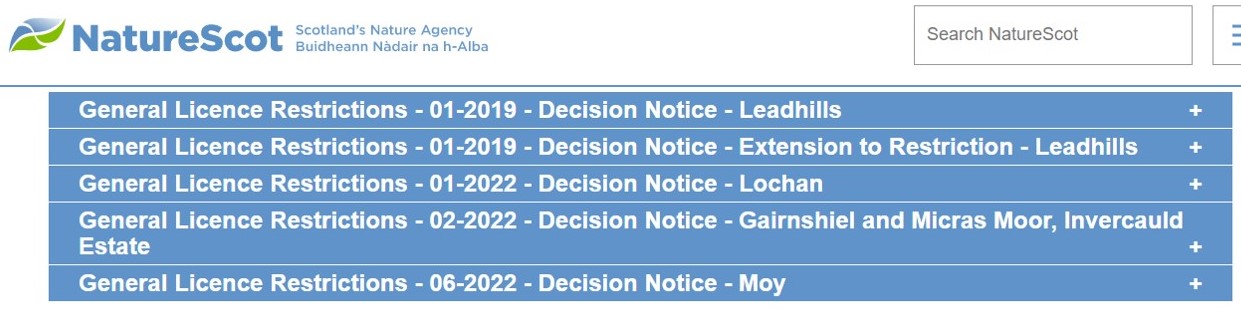
No matter really, because it’s NatureScot’s response to the appeal that’s really of interest, and in this case, Moy Estate’s appeal has failed and as of last week, the official restriction notice is back on public view on NatureScot’s website:
There’ll be more news from Moy next month when a man appears in court to face charges concerning the alleged shooting of a sparrowhawk.
Here’s another senior MSP who decided to disregard the three-year sanction imposed in June this year on Moy Estate after Police Scotland provided evidence to demonstrate wildlife crime had taken place on the estate, notably the discovery of a poisoned red kite and incidents related to alleged trapping offences, although the estate has long been recognised as a raptor persecution hotspot (e.g. see here, scroll down to below the press release).
Sir Edward Mountain, 4th Baronet, the Scottish Conservative’s Deputy Chief Whip, attended Moy Game Fair earlier this month to present prizes on behalf of BASC:
So that’s now two senior MSPs (former Cabinet Secretary Fergus Ewing MSP was the other one), the Scottish Gamekeepers Association, Scottish Land & Estates, and BASC who all seem to have a very strange approach to the notion of ‘zero tolerance’ of raptor persecution.
Some of you might remember Ed Mountain claiming, in 2017, that he’d be “the fiercest critic” of anyone killing raptors. It was a claim he made in a guest article he wrote for the Scottish Gamekeepers Association’s quarterly rag. Here’s a reminder of what he wrote:
‘I believe that challenging the ‘spectre’ [of land management reform] is vital, if the very countryside we all value and love is to be maintained. The way to do this is by standing tall and laying out a stall, for all to see the benefits positive management has to offer. The problem is that every time it looks like the right story is being delivered another case of wildlife crime comes to light. If there is any chance of moving forward we must stop these idiots, who believe illegally killing raptors is acceptable.
I therefore would urge all organisations that represent country folk to stand up and let people know all the good work that is being done for conservation. At the same time, they also need to vilify those that break the law.
Over the next 4.5 years I look forward to working with the SGA and I will do all I can to defend the values you and your members believe in. However, I must also say that I will be the fiercest critic of those that jeopardise these values by breaking the law‘.
I asked at the time whether he’d put these strong words into action, but just a few months later he seemed reticent (see here).
This year he had the perfect opportunity to stand by his stated commitment against raptor persecution and boycott the Moy Estate. His actions, and those of his shooting industry mates, speak volumes.
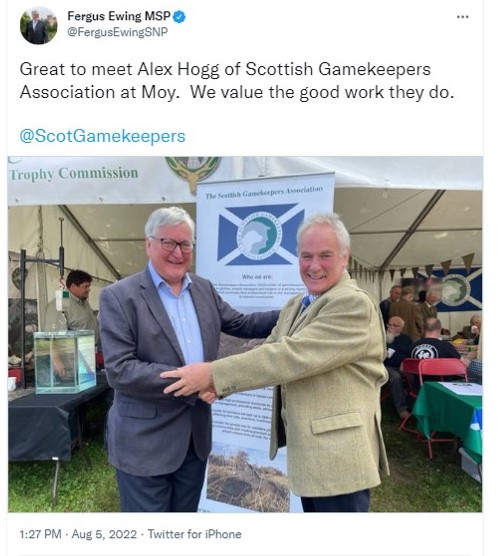
A tweet by Fergus Ewing MSP, former Cabinet Secretary for Rural Economy, posted yesterday at the Scottish Gamekeeper Association’s stand at the Moy Game Fair. I wonder who he’s referring to when he says ‘We’? Is he speaking on behalf of the Scottish Government?
The Moy Game Fair is hosted by the Moy Estate. That’ll be the disgraced Moy Estate that had a three-year General Licence restriction imposed on it in June this year (see here) after Police Scotland provided evidence to demonstrate wildlife crime had taken place on the estate, notably the discovery of a poisoned red kite and incidents related to alleged trapping offences, although the estate has long been recognised as a raptor persecution hotspot (e.g. see here, scroll down to below the press release).
An estate gamekeeper has recently been charged with the alleged shooting of a sparrowhawk and is due in court in September.
Here is a map we created way back in 2016 to highlight the extent of raptor persecution crimes in Fergus Ewing’s constituency and this shows the concentration of incidents on and close to Moy Estate. There have been further incidents since this map was created, hence the General Licence restriction imposed this year:
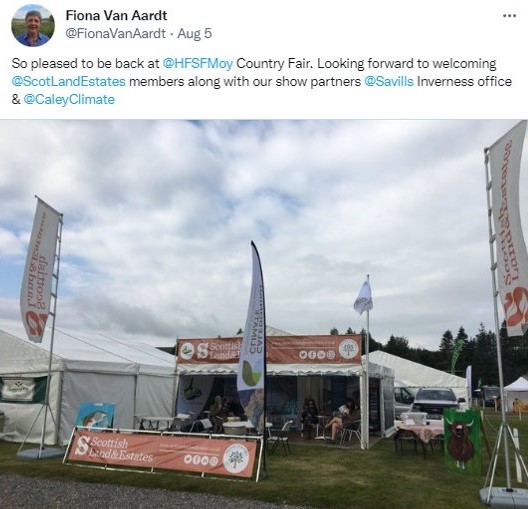
Also ignoring the sanction for wildlife crime on Moy Estate is Scottish Land & Estates (SLE), the lobby group for game-shooting estates across Scotland, as demonstrated by this tweet yesterday from SLE’s North of Scotland Regional Coordinator, Fiona Van Aardt:
So here’s a senior politician from the SNP Government, the Scottish Gamekeepers Association and Scottish Land & Estates, all effectively sticking up two fingers to the Government’s policy of sanctioning estates for raptor persecution.
When the policy of imposing General Licence restrictions as a tool for tackling rampant bird of prey persecution was first introduced in 2014, the then Environment Minister Paul Wheelhouse described the restrictions as being a ‘reputational driver‘. In other words, a sanctioned estate would not enjoy the benefits of being part of the shooting industry because the industry, with its claimed ‘zero tolerance’ approach to raptor persecution, would not wish to be associated with wildlife crime and this (hoped for) ostracization would stimulate a clamp-down on raptor-killing estates.
So much for that idea. It appears that the shooting industry, along with its political supporters, couldn’t give a monkeys. There’s been previous evidence of this on other so-called sanctioned estates (e.g. see here for examples).
Technically speaking, Mr Ewing and his shooting industry pals could argue that Moy Estate is not currently serving a General Licence restriction. How come? Well, because under the rules, if an estate appeals the GL restriction decision, the restriction is temporarily lifted whilst NatureScot considers the estate’s appeal. This is completely bonkers, of course, because a sanctioned estate has already had a chance to appeal the decision, when NatureScot first issues the notification for a restriction. But they’re then given another opportunity to appeal once the restriction has been imposed, and during that appeal process (typically four weeks) NatureScot removes the restriction so the estate can carry on as if the restriction never existed. I’m pretty sure that that’s what’s going on at Moy because the GL restriction decision notice for Moy Estate has been removed from the section of NatureScot’s website where currently-restricted estates are listed (here).
Although if Mr Ewing, the SGA and SLE were to rely upon this technicality, I don’t think that many people would view it as the shooting industry working in the spirit of wishing to stamp out raptor persecution, do you?







 Raptor Persecution UK