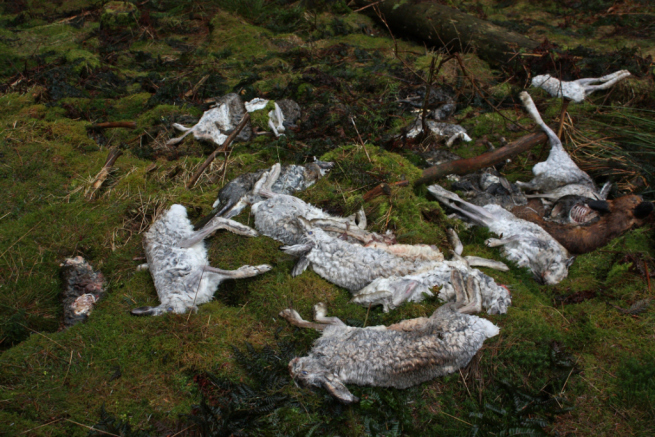
More mountain hares massacred in Cairngorms National Park

Recently we published some photographs of a load of dead mountain hares with some people lined up behind the corpses, grinning at what they’d done (see here).

These photographs caused quite a reaction, both from the general public, who were appalled at such scenes, and from the grouse-shooting industry who generally said the photographs were old and large scale hare culling no longer took place.

They were lying, of course.

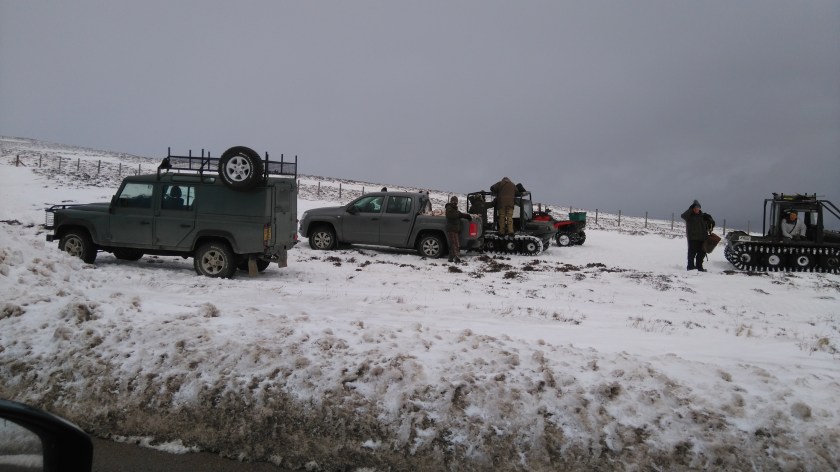
We were recently sent some photographs taken by someone who wishes to remain anonymous. The photographs were taken on 25th February 2016 in the Cairngorms National Park. On first glance, it looks like some blokes out with their vehicles in the snow:

Hares_Lecht_25Feb2016 - Copy

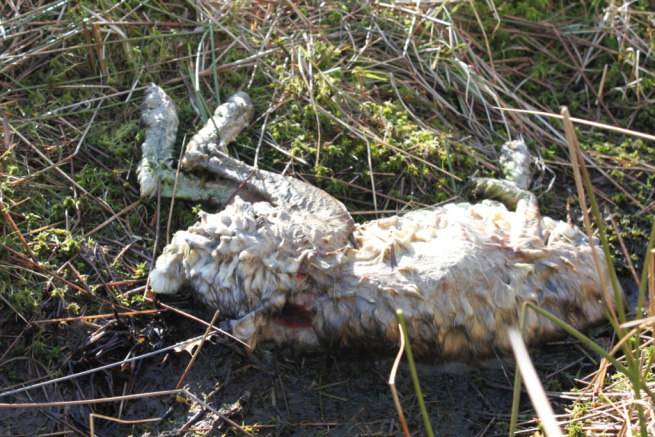
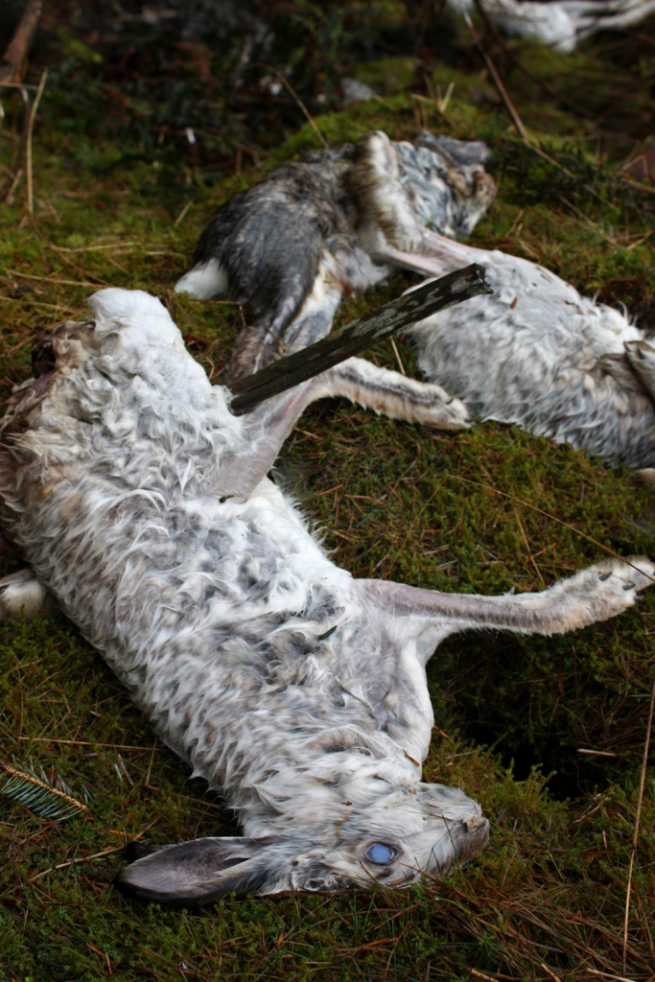
But when you zoom in, you see exactly what’s been going on:

Hares_Lecht_25Feb2016 (2) - Copy

That’s a truckload of dead mountain hares.

This photograph was taken from the Lecht road (the A939 Cockbridge to Tomintoul road). According to the grid reference we were given, these vehicles were parked on the Allargue Estate. Now that doesn’t mean that the hares had been massacred on the Allargue Estate or indeed that Allargue Estate staff were in any way involved. We’d be surprised if they were because the Allargue Estate was one of the first fully accredited members of the Wildlife Estates Scotland initiative and a gamekeeper here won the Purdey Gold Award in 2014 for Game & Conservation. According to the Purdey Awards website this estate “works tirelessly to uphold the Wildlife Estates Scotland high standards of wildlife management”.

Grouse-shooting estates have been slaughtering mountain hares for a long time. They do it because they believe mountain hares carry a disease (Louping Ill virus) which can affect their red grouse stocks (i.e. the number of red grouse available to be shot, for fun, during the grouse-shooting season). We, and others, have been writing about this for some time. Here are some previous blogs we’ve written about mountain hare massacres on grouse moors in the Angus Glens (here and here), Aberdeenshire (here) and the Lammermuirs (here).

Last year, SNH called on landowners to practice “voluntary restraint” and try to reign in their lust for slaying mountain hares (here). We said it was a pointless call (here) and clearly we were right judging by the photograph above. Last year, ten conservation organisations asked SNH to impose an immediate three-year ban on hare culling (here) to allow an assessment of how these large-scale and indiscriminate culls were affecting the conservation status of the mountain hare. Landowners reacted strongly against this proposal (read the link!) and SNH refused to impose the temporary ban because the evidence for action was lacking, apparently.

Marvellous. Welcome to Scotland and especially to the Cairngorms National Park.

Rob Edwards has covered this story today (here) as has Mark Avery (here).

UPDATE 11.30hrs: Scottish Land & Estates has issued a statement in response to Rob Edwards’ article in the Herald. You really have to read it. Bear in mind it’s not a spoof. See here.

UPDATE 14th March 2016: A few more blogs covering this atrocity –

The Ferret (by Rob Edwards) here

ParkWatchScotland here

Another one from Mark Avery (#HelpingItHappen) here

Scottish Greens here

UPDATE 14th March 16.00hrs: Cairngorms National Park Authority responds here

More mountain hares slaughtered in the Angus Glens

The photographs in this article on the iShoot website, written by Peter Carr in April 2015 about a February trip he made to the Angus Glens to participate in a weekend of driven mountain hare shooting, are something else.

We’ve blogged a lot about the indiscriminate killing of mountain hares, particularly on grouse moors in the Lammermuirs (here), Deeside (here) and the Angus Glens (here) and many others have also been campaigning about this obscene bloodbath for a number of years.

SNH has a statutory duty to maintain a healthy population of mountain hares but conservationists have argued that the routine hare culls on grouse moors have led to a severe population decline in some areas.

In December 2014, SNH called for estates to practice ‘voluntary restraint’ on large sale culls – a move we considered to be pointless.

In April 2015, ten conservation organisations called on SNH to implement an immediate three-year ban on mountain hare culling (see here) until the impact of such widespread killing can be properly assessed. The grouse-shooting industry reacted strongly against this: the Scottish Gamekeepers’ Association said it was “environmentally irresponsible” to call for a ban (eh??!) and Scottish Land & Estates said it was “ill-informed” and “heavy-handed”. You can see why SNH’s call for ‘voluntary restraint’ won’t work, can’t you!

We’re not sure if SNH has paid any attention to the ten conservation organisations calling for an immediate three-year ban. According to the SNH website, the plea for ‘voluntary restraint’ is still in place and new research is underway (due to complete in 2017) to assess the population status of the mountain hare.

Meanwhile, the slaughter continues….

Ten conservation groups call for 3-year ban on grouse moor mountain hare slaughter

Ten conservation groups in Scotland have called on SNH to implement an immediate three-year ban on the mass slaughter of mountain hares that has been taking place in Scotland.

The indiscriminate and unregulated mass killing of mountain hares has been taking place on grouse moors for many years. We’ve blogged about it a lot (see here for previous posts) and many others have also been campaigning against this obscene bloodbath.

Mountain hares are (supposedly) protected under European legislation and SNH, as the Government’s statutory conservation agency, has a legal duty to ensure the population has a favourable conservation status. The problem is, nobody really knows how many hares there are (previous surveys have only resulted in crude and pretty meaningless results). More importantly, nobody knows how this persistent mass culling is affecting the status of the overall hare population.

The latest call for an immediate ban comes hot on the heels of SNH’s recent call for grouse moor managers to exercise ‘voluntary restraint’ with their culls – a system that’ll never work because it relies entirely on the altruism of grouse moor managers (see here).

The ten groups calling for the immediate three-year ban include National Trust for Scotland, John Muir Trust, RSPB Scotland, RSZZ, Highland Foundation for Wildlife, Scottish Wildlife Trust, Scottish Raptor Study Group, The Cairngorms Campaign, the Mammal Society and the Badenoch & Strathspey Conservation Group. There are some quite hefty credentials there and SNH would be wise to take heed. You get the feeling that if they don’t, they might just find themselves facing (another) complaint to the EU.

Naturally, representatives from the grouse-shooting industry have reacted strongly against the call for a ban. According to the SGA, calling for a ban is “environmentally irresponsible” and “it will be bad for birds and bad for biodiversity”.

Tim (Kim) Baynes from Scottish Land and Estates claims the ban would be “ill-informed” and “heavy-handed”.

These are unsurprising responses and just provide further evidence that SNH’s ‘voluntary restraint’ plea will go unheeded because these grouse moor landowners and their gamekeepers don’t think there’s anything wrong with the current level of hare culling.

Calling for an immediate ban is just the first step. Several of the ten organisations calling for the ban will next call for a meeting with SNH and Scottish Government officials to discuss the issue further and, presumably, keep the pressure on SNH to stop procrastinating and actually do something meaningful to bring the carnage to a halt.

BBC News article here

RSPB Scotland press release here

Here’s what happens to mountain hares on many grouse moors in Scotland, including inside the Cairngorms National Park:

mh4 - Copy

mountain-hare-cull-angus-glens-large - Copy

Hare-brained propaganda from the grouse shooting industry

Over the last couple of years we’ve blogged a lot about the obscene massacre of mountain hares on Scottish grouse moors (see here for previous posts).

It’s quite the hot topic these days, resulting in Parliamentary questions, public petitions, and even a call from SNH/GWCT/SLE for grouse moor managers to practice “voluntary restraint”  – a pointless exercise in our opinion (see here).

It seems that SNH doesn’t have much faith that voluntary restraint will be employed – a few weeks after they issued their plea to landowners, they asked hill-walkers to report any evidence of large-scale culls (see here).

Today, the grouse-shooting industry issued their own press release about mountain hares on grouse moors. We thought it was an early April Fools’ Day stunt but apparently it isn’t. It reads as follows:

MOUNTAIN HARES ON THE MARCH AFTER GROUSE BONANZA

(Issued on behalf of a Scottish Moorland Group)

The Highlands are celebrating a special conservation bonus following two very good grouse seasons.

Scottish moorland managers are reporting large numbers of the much loved and easily recognised mountain hare, linked to last year’s ‘best in a generation’ grouse season. The Scottish population of hares is thought to be around 350,000 and in some areas they are now at historically high levels – the hares have the red grouse to thank!

Concern has been expressed recently that hare numbers may be going down; however grouse moors in the Angus Glens, Speyside and Highlands report that their numbers have increased along with grouse levels. Heather moorland managed for red grouse is an extremely good habitat for hares to thrive on.

The mountain hare is the only native species of hare or rabbit in Britain, easily distinguished by its white plumage during the winter months and brown during the summer. It is known that its population fluctuates in 7-10 year cycles, however actively managed moorlands give this iconic Scottish species a sustainable future.

Danny Lawson, head gamekeeper on Glenogil Estate in the Angus Glens, said: “I have seen more mountain hares this year than at any time since I came here. Our mountain hare population has been increasing along with grouse over the last three years because our heather management gives them good grazing and because of predator control over the estate and other neighbouring estates.

Good weather in the breeding season helps mountain hare numbers and the last two seasons, 2013 and 2014, have been very good for both grouse and mountain hares. Like grouse, mountain hare populations have to be carefully managed. Culling is legal and is necessary in some circumstances and such management should be done sustainably and be supported by a sound management plan.”

Tim Baynes, Director of the Scottish Moorland Group, says: “There are surprising gaps in our collective knowledge about this secretive animal.  This can lead to assumptions about population changes which are not correct and we support the research project commissioned by Scottish Natural Heritage to get a better handle on how to accurately count hares on the open hill.  What does seem certain from the long term observations of moorland managers on the ground is that there is a strong link to land use; hare numbers are likely to go down where moorland is unmanaged or afforested but will increase where managed for red grouse.”

-ENDS-

Anyone convinced that grouse moor managers view mountain hares as “much loved”? Anyone convinced that hare culls by grouse moor managers are “carefully managed”?

Have a look at the photographs at the foot of this blog and make up your own minds.

What’s also interesting about this press release is the decision to include a quote from the head gamekeeper of Glenogil Estate. We’ve blogged a lot about Glenogil Estate over the years (see here). Glenogil Estate is one of several grouse-shooting estates in the Angus Glens. Here’s some information about raptor persecution in the Angus Glens, mainly gleaned from the RSPB’s annual BirdCrime reports and SASA’s annual reports:

2004 May, near Edzell: long-eared owl and two short-eared owls starved to death in crow cage trap.  No prosecution.

2004 May, Invermark Estate: peregrine nest destroyed. No prosecution.

2006 March, Glenogil Estate: poisoned rabbit bait (Carbofuran). No prosecution.

2006 April, Easter Ogil: poisoned buzzard (Alphachloralose). No prosecution.

2006 April, Easter Ogil: poisoned tawny owl (Alphachloralose). No prosecution.

2006 May, Glenogil Estate: poisoned rabbit bait (Carbofuran). No prosecution.

2006 June, Glenogil Estate: poisoned woodpigeon bait (Carbofuran). No prosecution.

2006 June, Glenogil Estate: Traces of Carbofuran found in estate vehicles & on equipment during police search. No prosecution. Estate owner had £107k withdrawn from his farm subsidy payments. This was being appealed, but it is not known how this was resolved.

2006 July, Millden Estate; poisoned sheepdog (Lindane). No prosecution.

2007 November, Glenogil Estate: Disappearance of radio-tagged white-tailed eagle ‘Bird N’ coincides with tip off to police that bird been shot. No further transmissions or sightings of the bird.

2008 May, ‘Nr Noranside’: poisoned white-tailed eagle ‘White G’ (Carbofuran, Isophenfos, Bendiocarb). No prosecution.

2008 May, ‘Nr Noranside’: poisoned buzzard (Bendiocarb). No prosecution.

2008 May, ‘Nr Noranside’: poisoned mountain hare bait (Carbofuran, Isophenfos, Bendiocarb). No prosecution.

2008 May, Glenogil Estate: 32 x poisoned meat baits on fenceposts (Carbofuran, Isophenfos, Bendiocarb). No prosecution.

2008 October, ‘Glenogil Estate: poisoned meat bait on fencepost (Carbofuran). No prosecution.

2009 March, Glenogil Estate: poisoned buzzard (Carbofuran). No prosecution.

2009 March, Glenogil Estate: poisoned buzzard (Carbofuran). No prosecution.

2009 April, Millden Estate: poisoned buzzard (Alphachloralose). No prosecution.

2009 July, Millden Estate: poisoned golden eagle ‘Alma’ (Carbofuran). No prosecution.

2009 August, Glenogil Estate: poisoned white-tailed eagle “89” (Carbofuran). No prosecution.

2010 May, ‘Nr Noranside’: poisoned red kite (Carbofuran). No prosecution.

2010 September, Glenogil Estate: poisoned buzzard (Chloralose). No prosecution.

2010 October, Glenogil Estate: poisoned buzzard (Carbofuran). No prosecution.

2010 October, Glenogil Estate: poisoned pigeon bait (Carbofuran). No prosecution.

2010 October, Glenogil Estate: poisoned pigeon bait (Carbofuran). No prosecution.

2011 February, Airlie Estate: buzzard caught in illegal crow trap. (see below)

2011 March, Airlie Estate: 3 x buzzard caught in illegal crow trap. Prosecution (!) but dropped after statement from suspect given to SSPCA deemed inadmissible.

2011 April, Millden Estate: shot buzzard. No prosecution.

2012 April, ‘Nr Noranside’: Remains of buzzard found beside pheasant pen. Suspicious death.

2011 June, Rottal & Tarabuckle Estate: dead kestrel inside crow cage trap. No prosecution.

2012 February, ‘Nr Edzell’: spring-trapped buzzard. No prosecution.

2012 February, ‘Nr Bridgend’: remains of buzzard found under a rock. Suspicious death.

2012 May, Millden Estate: satellite-tagged golden eagle seemingly caught in spring trap, then apparently uplifted overnight and dumped on Deeside with two broken legs & left to die. No prosecution.

2012 May, Glen Esk: disappearance of sat-tagged red kite. No further transmissions or sightings of bird.

2013 January, Invermark Estate: white-tailed eagle nest tree felled. No prosecution.

2013 November, Glen Lethnot: poisoned golden eagle ‘Fearnan’. No prosecution.

2014 October, Nathro: shot buzzard. Prosecution? Unknown.

Can we take it then, that as this press release was issued by the Scottish Moorland Group – a sub-group of Scottish Land & Estates – that Glenogil Estate is a member of SLE? If so, surely the partner organisations of the PAW Scotland Raptor Group will be asking questions at their next ‘partner’ meeting.

A few newspapers have picked up on this press release today, including an article in the P&J entitled, ‘Mountain hare thriving thanks to grouse management‘.

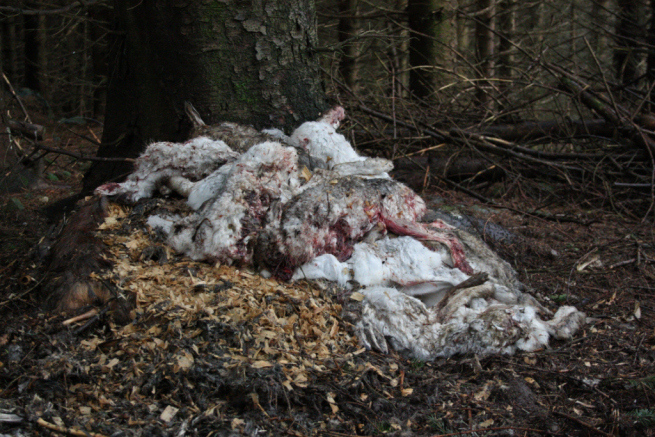
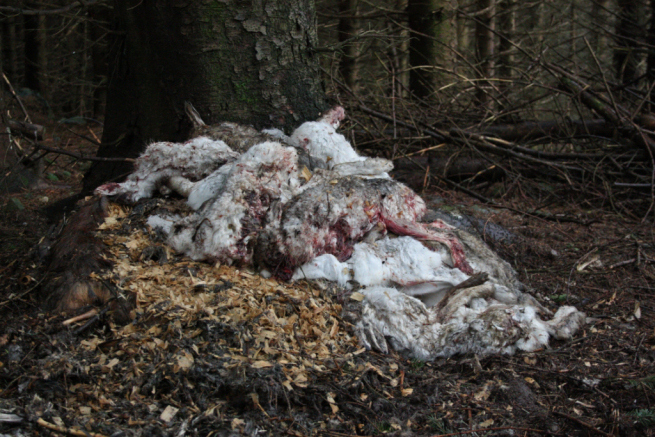
Here are some pictures of ‘much-loved’ mountain hares ‘thriving’ on Scottish grouse moors, including one photograph that was taken on, er, Glenogil Estate.
mountain-hare-cull-angus-glens-large - Copy

mh4 - Copymh2 - Copyslry30 - Copymh3 - Copy

Environment Minister visits Cairngorms National Park to discuss raptor persecution

You may remember last May, the Cairngorms National Park Authority (CNPA) wrote to the then Environment Minister, Paul Wheelhouse, to tell him that the continuing incidents of raptor persecution and ‘disappearing’ birds in the eastern part of the Cairngorms National Park “threatens to undermine the reputation of the National Park as a high quality wildlife tourism destination“. The Minister was invited to a meeting of ‘stakeholders’ to discuss ways to address the on-going problem (see here).
Eight months on, the current Environment Minister Dr Aileen McLeod attended that meeting earlier this week. Here’s what the CNPA press release said about it:

The Minister for the Environment, Climate Change and Land Reform, Dr Aileen McLeod, visited the Cairngorms National Park yesterday (19th January) to chair a meeting with landowners.

Meeting in Ballater, landowners, Scottish Natural Heritage and the Cairngorms National Park Authority (CNPA) discussed how best to collaborate to deliver landscape scale benefits for objectives including moorland management, raptor conservation, woodland expansion and peatland restoration.

Minister for Environment, Climate Change and Land Reform, Dr Aileen McLeod said “I was pleased to meet with land owners in the Cairngorms National Park yesterday. The Cairngorms National Park, one of Scotland’s best places for nature, should be at the forefront of demonstrating an integrated approach to management that tackles some of our longstanding challenges, including raptor persecution, habitat diversity and carbon management. I very much welcome the positive collaboration shown yesterday between the National Park Authority and land owners and look forward to seeing a real difference on the ground”.

Among the topics discussed was raptor persecution and conservation, with a recognition of the progress made in recent years and a shared determination to ensure no return of incidents connected to sporting management.

Grant Moir, Chief Executive of the CNPA said: “The Cairngorms is an outstanding place for nature and an internationally renowned tourism destination. We must all work to prevent the recurrence of raptor persecution, and focus on what we can do to enhance raptor conservation. This discussion helps take forward practical action on the ground, bringing together sporting management with wider priorities such as woodland expansion, peatland restoration and raptor conservation.”

Tim Baynes of Scottish Land and Estates said: “Moorland managed for sporting is the largest scale land use in the Park and we are pleased to be working with the Cairngorms National Park Authority to bring a number of estates together in a moorland management initiative. We see real opportunities through this very practical approach to show how management for sporting objectives is integrated with delivering diverse habitat and species benefits, and ways in which that can be taken further as science and national policies develop.  This builds on the Wildlife Estates Scotland accreditation scheme developed by Scottish Land & Estates which now covers 20% of the entire Park area”.

Moorland Management was one of the subjects at a recent CNPA board meeting, more information can be found at http://cairngorms.co.uk/media/news/taking-a-lead-on-moorland-collaboration-in-the-cairngorms

END

The press release doesn’t really tell us a great deal, other than these people met and talked. Unfortunately there’s scant detail about what they actually intend to do.

We did note the sentence: ‘Among the topics discussed was raptor persecution and conservation, with a recognition of the progress made in recent years and a shared determination to ensure no return of incidents connected to sporting management‘. What progress is that, then? Had there been any, presumably the CNPA wouldn’t have felt the need to ask the Minister for ‘action’ against raptor persecution within the Park.

The CNPA and its landowner ‘stakeholders’ are quite big on ‘action’. Who remembers the launch of ‘Cairngorms Nature’ in 2013? We blogged about it here. It’s an ambitious five-year ‘action plan’ which included the following ‘actions’:

ACTION: Restore the full community of raptor species.

KEY PARTNERS: SGA and SLE to trial innovative techniques to increase raptor populations.

Wonder how that’s going? What are the ‘innovative techniques’? Stop poisoning, shooting & trapping?

KEY SPECIES FOR FOCUSED ACTION: Golden eagle

KEY ACTIONS: SLE, SGA and SNH to work with moorland managers to manage mountain hare populations for the benefit of golden eagles.

Wonder how that’s going? Not terribly well by the looks of these photographs, taken in February 2014 near Glenshee, in the southern part of the National Park. Is this what Tim (Kim) Baynes means when he says “management for sporting objectives is integrated with species benefits“? We counted at least 150 dead hares, presumably killed during one session….Aren’t our National Parks great?

“The eradication of mountain hares in eastern & southern Scotland is disgraceful”

Roy Dennis with AlmaFollowing last week’s Out of Doors programme on BBC Radio Scotland, which included an unchallenged interview with Dr Adam Smith of the GWCT who was trying very hard to justify mountain hare culls on grouse moors – see here [comment #8], we were pleased to hear the subject raised again on this week’s show, this time with someone with an opposing view.
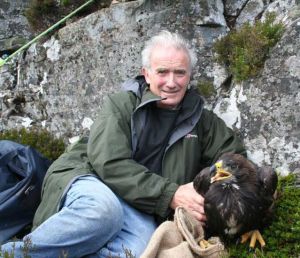
That someone was conservationist Roy Dennis, probably best known for his involvement in several raptor reintroduction and satellite-tracking projects (visit his two websites here and here).

It’s a good, well-rounded interview. Whilst he recognises that there may, in some instances, be a requirement for local culling (to protect young trees), he doesn’t buy into the argument that the widespread mass culling of hares is beneficial for controlling disease in red grouse and he describes the eradication of mountain hares in eastern and southern Scotland [on grouse moors] as “disgraceful”.

He talks about the sustainable hare population on one Highland sporting estate where he has been providing ecological advice for a number of years (proabably Coignafearn Estate – one of the few that doesn’t kill hares –  see here) and welcomes SNH’s call for land managers to exercise ‘voluntary restraint’, although he thinks SNH struggled to get that through against opposition from landowners and GWCT. Roy’s own recommendation to SNH and the Government had been for a voluntary two-year moratorium on all mountain hare culling, allowing time for an assessment of the species’ conservation status and the impact of long-term, widespread culls.

Roy doesn’t agree with the calls for a ban on the shooting of mountain hares. Others disagree and a petition has been launched, calling for exactly that. See here.

Roy’s interview can be heard here for another month. [Starts at 16:04]

The photograph shows Roy with young golden eagle ‘Alma’, hatched on the Glenfeshie Estate in 2007 and satellite-tracked by Roy. She was found dead on the Millden Estate two years later. She’d been poisoned.

New petition puts more pressure on SNH to protect mountain hares

There’s been a lot of publicity recently, and quite rightly, about the unregulated mass slaughter of mountain hares on Scottish grouse moors (e.g. see here, here, here and here).

However, this issue isn’t new.

Nine years ago (yes, nine), a complaint was made to the EU that Scotland was in breach of European law (Habitats Directive) because SNH was allowing the unrestricted killing of mountain hares on grouse moors without knowing whether those culls were affecting the species’ conservation status. The complaint was made by Neil Macdonald, a former wildlife officer with Tayside Police. His complaint was publicised by environmental journalist Rob Edwards, here.

According to Edwards’ report, SNH accepted that there could be a problem. SNH’s scientific director Colin Galbraith was quoted as follows:

The culling of mountain hares on some Highland estates is an issue that SNH is aware of and takes very seriously“.

So what happened to that EU complaint? Well, according to Dr Adam Watson (we blogged about his tirade against SNH’s failure to protect mountain hares here) this is what happened:

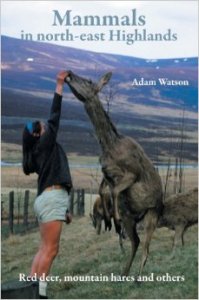
EU staff did follow this up, by requesting SNH for its views and advice. I have been told that SNH senior staff responded to the EU by asserting that they would have informed the EU if they had been aware of such severe problems. Thus the EU then ended their pursuit of Macdonald’s complaint‘ [quoted from page 132 of Watson’s book Mammals in north-east Highlands (2013)].

So here we are, nine years on, and what’s SNH doing? Calling on grouse moor managers to practice ‘voluntary restraint’ on hare culling – in our opinion, a pointless effort (see here). Oh, and conducting more ‘trials’ to work out how to count mountain hares. Seriously, we can do full face transplants, we can communicate immediately with millions of people around the globe with a single click, we can land a robot on the surface of a comet…..but we can’t figure out how to count hares on a few hill sides? Come on.

And as we predicted, SNH’s latest ‘trials’ are being used as an excuse by the Government to delay any immediate action to protect mountain hares. In December, Alison Johnstone MSP asked a Parliamentary question on what action the Scottish Government is taking to protect hares. This question was answered last week by Environment Minister Aileen McLeod (although to be fair to her, her response is probably just a regurgitation of what SNH has told her). Here’s what she said:

Question S4W-23615: Alison Johnstone, Lothian, Scottish Green Party, Date Lodged: 10/12/2014

To ask the Scottish Government, further to the answer to question S4W-18470 by Paul Wheelhouse on 4 December 2013, whether it will provide an update on the information regarding mountain hares.

Answered by Aileen McLeod (06/01/2015):

Scottish Natural Heritage (SNH), the James Hutton Institute and the Game & Wildlife Conservation Trust, acting on the advice of several mountain hare experts, have started work on field trialling a range of methods of assessing mountain hare numbers, to develop a better monitoring strategy and to improve the quality of the information used to assess population status and the sustainability of hare management measures. This programme of work is due to be completed in 2017.

Until this study is complete, and because of recent concerns about the status of mountain hares, SNH has developed a joint position statement on the subject of hare culling following consultation with key stakeholders representing moorland managers, namely Scottish Land & Estates and the Game & Wildlife Conservation Trust. The statement is evidence-based and argues that large scale culls of mountain hares to reduce tick loads, and thus to benefit grouse and other bird survival, are only effective when other tick-carrying animals are removed as well, or where they are absent. The intention is to work with estates to put in place effective but sustainable management of mountain hares. More information about the joint position statement can be found on the SNH website

http://snh.presscentre.com/News-Releases/SNH-GWCT-SL-E-position-on-large-scale-culls-of-mountain-hares-to-reduce-louping-ill-15f.aspx

In addition, a review of sustainable moorland management is currently being undertaken by a sub-group of experts from SNH’s Scientific Advisory Committee chaired by Professor Alan Werritty. This includes the management of mountain hares as one of a number of issues connected with sustainable moorland management practices. This review is due to be completed by March 2015.

Earlier in 2014, SNH was provided with additional hare count data, collected over many years in some cases. These quantitative data are potentially very useful, as previous evidence of local declines was largely based on anecdote. This information has been made available to the above SNH Scientific Advisory Committee sub-group as part of the review process.

END

If, like us, you don’t think SNH is doing anywhere near enough to protect this iconic species from the indiscriminate slaughter that continues across Scotland’s driven grouse moors, you might want to consider signing a petition which calls on SNH to confer immediate protected species status on the mountain hare and thus put an end to this barbaric, disgusting butchery. Please sign it HERE.

mountain hare cull angus glens large

Pointless call for ‘voluntary restraint’ on Scottish grouse moor mountain hare massacres

mountain hare cull Angus glensScottish Natural Heritage, in partnership with the Game & Wildlife Conservation Trust and Scottish Land & Estates, has issued a press release (here) calling for ‘voluntary restraint’ on the large scale culling of mountain hares on Scottish grouse moors. Some of you may have read about it a few days ago on Mark Avery’s blog here.
In the original press release (which was amended one day later), it was stated:

The bold step by SNH, SLE and GWCT should help ensure that future management is sustainable“.

What a steaming pile of tosh. This doesn’t come anywhere near being “a bold step”. A bold step would have been for SNH to exercise the precautionary principle and enforce an immediate and indefinite moratorium on the wide-scale, unregulated mass slaughter of mountain hares until the effect of such killing on the mountain hare population can be rigorously assessed.

The concept of calling for voluntary restraint from grouse moor managers is farcical. So many of them have refused even to adhere to 60-year-old conservation legislation (i.e. not to poison, trap or shoot protected raptors) so the chances of them volunteering restraint to not slaughter a partially-legitimate quarry species is pretty minimal.

Asking for voluntary restraint on hare-killing is also not a new approach. Last year SNH said: “We don’t support large, indiscriminate culls of mountain hares and advise moorland managers to talk to us if they are thinking of culling hares in large numbers” (see here).

And even way back in 2003, Scotland’s Moorland Forum published a document called Principles of Moorland Management. On page 27 it says the following:

We do not recommend the indiscriminate culling of hares; apart from the direct impact on the hare population, there may also be the indirect effect of a reduction of the food supply for larger raptors, including eagles. In certain circumstances, however, culling may be considered necessary……but further advice should be sought from SNH before embarking on a cull programme“.

So how many grouse moor estates, do you think, contacted SNH for advice before embarking on a cull programme?

According to allegations made by leading upland ecologist Dr Adam Watson and based on decades of scientific fieldwork, not many. In his 2013 book, Mammals in north-east Highlands, Watson writes:

I know of no grouse-moor estate within the range of the mountain hare that has not practiced or does not practice heavy killing of hares, with the exceptions of Edinglassie, Invermark, Glen Muick and Balmoral (but most of Balmoral is deer land rather than grouse moor). The only other heather-moorland areas that I know which are free from heavy killing are those owned by non-sporting agencies or by individuals primarily interested in wildlife conservation, such as the RSPB at Abernethy, SNH at Inshriach, the National Trust for Scotland at Mar Lodge, and Miss Walker of the Aberlour shortbread company, who owns Conval hills near Dufftown“.

He goes on to name various estates who, he alleges, “have been reducing the numbers of mountain hares greatly“, some dating back to the 1980s. His named estates include Altyre, Castle Grant, Lochindorb, Farr, Millden, Glenogil, Glen Dye, Dinnet, Invercauld, Tillypronie, Glen Buchat, Candacraig, Allargue, Delnadamph, Crown Estate, Fasque, Cabrach, Glenfiddich, Glenlochy, Gannochy, Fettercairn, Cawdor, Corrybrough, Moy, Glen Lyon.

Adam Watson Mammals in NE Highlands[Incidentally, this book is a goldmine of information about what goes on on the grouse moors of NE Scotland. Ignore the bizarre front cover and Watson’s somewhat erratic writing style – this book is crammed with details gleaned from decades of Watson’s scientific field work and is well worth its £9.99 price tag. There’s even an allegation that “In 2010, Millden Estate released red grouse from elsewhere, for shooting“. If that’s true it raises a number of issues, not least whether they had a licence to translocate red grouse].

Watson’s observations, and those of others, have led to a number of high-profile media reports about the mass slaughter of mountain hares on Scottish grouse moors (e.g. see here, here and here) and even Parliamentary questions (see here and here). Tellingly, MSP Alison Johnstone (Lothian, Scottish Green Party) has recently followed up on the answers provided last year and on 10th December 2014 she lodged a further question (due to be answered on 7th Jan 2015) requesting an update on how SNH intend to assess whether mountain hares are in a favourable conservation status. We already know how this question will be answered – the Environment Minister will simply recite the content of the latest SNH press release.

In addition to calling for ‘voluntary restraint’, the press release tells us that the three organisations will be ‘developing a reliable and cost-effective field method’ to form the basis of a long-term monitoring programme. Previous attempts at this have failed miserably, and some correspondence from earlier this year between Dr Watson [AW] and SNH about these ‘field methods’ is really quite illuminating: (thanks to the blog reader who sent us these)

AW letter to SNH 14 February 2014

SNH response to AW 7 March 2014

AWresponse to SNH 15 March 2014

In Dr Watson’s view (shared by many of us), these further ‘trials’ simply represent more procrastination from SNH but will be used by them (and probably by GWCT & SLE) to proclaim that “Everything’s ok, we’re sorting it”. That may fool some but the awful, bloody reality will probably not change.

A final point. We are fascinated to see that this ‘joint initiative’ is coming from not only SNH but also GWCT and SLE. The call for ‘voluntary restraint’ on the mass killing of mountain hares seems to be slightly at odds with activities carried out on Lochindorb Estate when it was owned by the GWCT’s former Scottish Committee Chairman, Alasdair Laing (e.g. see here). As for SLE, their view on the destruction of thousands of mountain hares on Scottish grouse moors can be read here.

To read our previous blogs on mountain hares, click here [and scroll down through the posts]

To view some shocking, sickening photographs of the mass killing of mountain hares on a grouse moor go here.

News round up

news 2There’s been a lot of interesting articles in the news media over the last few days. Unfortunately we’ve been too busy to blog about these in details so here’s a quick round up:

Balmoral’s nature award dismissed as a PR stunt

Balmoral, the Queen’s estate in Aberdeenshire, has won a “coveted award” (according to SLE) that recognises ‘exceptional work on game and wildlife management’. The estate has received accreditation under the Wildlife Estates Scotland’ (WES) banner – a scheme that was set up by Scottish landowners’ representative body Scottish Land & Estates in 2010, suspiciously timed to coincide with the Scottish Government’s then consideration of introducing estate licensing under the WANE Act (we blogged about it here).

However, WES has been described by environmentalists as “a mutual admiration society” and “little more than a public relations campaign that lacks credibility”. Balmoral’s award is difficult to understand given that five natural features on the estate (ancient Caledonian pine forest, bog woodland, blanket bog, dry heaths and wet heathland) have been categorised as being in ‘unfavourable condition’ by SNH.

Full story on Rob Edward’s website here.

If Prince William wants to be a conservationist then he must stop shooting

Simon Barnes has written an excellent piece in the Independent about Prince William’s recent statement on his visit to the US about zero tolerance on international wildlife crime, particularly elephant & rhino poaching. Barnes puts in to words what many of us are thinking – that if Prince William wants to be a credible ambassador for wildlife conservation (which would obviously be a good thing) then he must first address the criminality associated with driven grouse shooting in the UK (a pursuit in which he and other Royals participate). Full story in the Independent here.

Sporting estates criticised for failing wildlife in the Cairngorms

The Cairngorms National Park Authority has been reviewing moorland management practices within the Park and has highlighted many issues with which it’s unhappy. These issues are largely associated with the type of intensive management implemented by landowners to increase the number of grouse that can be shot each season. They include the illegal killing of birds of prey (an issue on which the CNPA spoke out against earlier this year, see here), the mass culling of mountain hares, bulldozing too many hill tracks, erecting fences across hillsides, and poorly managed heather burning.

The CNPA is concerned about the cumulative effects of these practices and their effect on wildlife within the Park. Grouse moor management is a dominant land use within the park, currently covering 44% of the land area. The CNPA suggests that this figure may need to be reduced in order to protect wildlife.

Full story, including a link to the CNPA’s report, on Rob Edward’s website here.

Britain would be big enough for the hen harrier and the grouse if it weren’t for politics

Charles Moore (not to be confused with Charlie Moores from Birders Against Wildlife Crime) has written a dull piece in the Telegraph which is basically just him slating the RSPB (yawn) and essentially claiming that hen harriers would be doing just fine if only the RSPB would leave the discussion re: brood management / shut up / go away. Interestingly, he cites some comments from a former RSPB employee (Alex Stoddart) to try and justify his criticism of the RSPB. He ‘forgot’ to mention that said former RSPB employee just happens to now work as the Ass Director of the Scottish Association for Country Sports (SACS) and who seems to have a bag of chips and a bottle of ketchup on his shoulder when it comes to the RSPB and other conservation charities – see here.

Unsurprisingly, it turns out that Charles Moore likes a spot of grouse shooting – another fact he ‘forgot’ to mention in his article.

For anyone interested, Martin Harper (Conservation Director RSPB) has responded to Moore’s criticisms here.

Hare coursers’ cars are crushed after being seized by a court

An article on the Cambridge News website informs us that police seized two cars that were being used by hare coursers and that the vehicles have now been crushed after being confiscated by the court. Wouldn’t it be great if this tactic was applied to the vehicles of raptor killers….there’d be a few Landrovers and quad bikes heading for the crusher…

Last night’s Landward programme: putting lipstick on a pig

Last night’s BBC 2 (Scotland) Landward programme was all about driven grouse shooting. The programme had been billed as follows:

‘Grouse shooting brings millions of pounds into the Scottish rural economy, yet it is controversial. Dougie Vipond and Sarah Mack go on a shoot to see the sport first-hand, while Euan McIlwriath investigates the impact of grouse moors on the environment’.

On that basis, we expected a well-balanced programme exploring the detail of those ‘controversies’ with input from both ‘sides’. What we got was a BBC whitewash with a quite astonishing level of presentational bias. Not what we expected from a team who are all-too-familiar with raptor persecution, especially after their programme a couple of years ago which produced the classic Alex Hogg quote lie: “Professional gamekeepers do not poison raptors“.

You only have to look at the line-up of interviewees on last night’s programme to see that something was amiss:

Robert Jamieson, owner of gunmakers James Crockhart & Son, Blairgowrie.

Andrew Farquharson, owner of Finzean Estate, Aberdeenshire.

Allan ‘Hedge’ Shand, head gamekeeper of Finzean Estate.

Charlie Thorburn, gungog trainer from Mordor Gundogs.

Robert Rattray, sporting letting agent from CKD Galbraith.

Robbie Kernahan from SNH’s licensing department.

Tim (Kim) Baynes, Moorland Group Director, Scottish Land & Estates.

How many of these individuals would you expect to provide a fully comprehensive commentary on the dirty realities of driven grouse shooting? It’s almost as if the programme had been written and directed by the SGA!

We heard about the history of driven grouse shooting, how it’s the ‘Sport of Kings’, how much a decent gun would cost, how it’s a key part of the Scottish rural economy, how good it is for supporting rural jobs and how it’s still considered a ‘prestigious field sport’. You’d expect as much from people with a vested interest in maintaining this filthy industry. But what about the other side of the story?

We did hear about habitat management on the Finzean Estate (from the estate owner and his head gamekeeper) and we were told that this is an award-winning estate because it won this year’s Golden Plover Award for Moorland Managagement. What wasn’t said was that this award was given by two industry organisations –  The Heather Trust and GWCT – two organisations who clearly don’t have a vested interest in promoting driven grouse shooting. Ahem.

But we didn’t hear anything about the environmental implications of driven grouse moor management, such as the effects of intensive heather burning, building tracks across the moorland, putting in car parks on the moors, installing grouse butts on the moors, the increased risk of flooding resulting from grouse moor management, the wholesale (legal) indiscriminate slaughter of hundreds of thousands of native creatures that could conceivably eat an egg or a grouse, including foxes, stoats, weasels, crows etc, nor the unregulated massacring of mountain hares for no good reason whatsoever (see here here and here). Why not?

And what about raptor persecution? Well, poisoning did get a brief mention, although there was no indication about the scale of illegal killing associated with driven grouse moors in Scotland (and northern England). Why not?

The head gamekeeper was asked what predators he had on the hill at Finzean, presumably in an attempt to show that this estate was predator-friendly. He mentioned foxes and hoodies, but ‘forgot’ to mention that they’re not tolerated and are routinely killed year-round, as they are on all driven grouse moors. He also mentioned a few raptor species, including merlin, ‘eagles’ and peregrine. Now that was interesting. Finzean does indeed have some raptor species, including a pair of red kites and golden eagles. But there’s having eagles and then there’s having eagles. The Finzean eagles aren’t doing very well. Their breeding attempts are routinely unsuccessful and there is a suspiciously regular turn-over of breeding birds at this site. Why is that? Golden eagles tend to be relatively sedentary once they’ve settled in a breeding territory, and only rarely do they move or change partner. The odd turn-over event is to be expected – if one of the pair dies (natural mortality) or if a nearby ‘superior’ breeding site becomes available – but these events are relatively rare and certainly couldn’t be described as a ‘regular’ behaviour, and yet territorial eagles are turning over with regularity at Finzean. Hmm.

And what about hen harriers? Why didn’t the presenter ask about those? We would have liked to have heard the head keeper’s comments on that. Finzean did used to have breeding hen harriers, but they’re not there any more and haven’t been for some time. Why not?

There was a short piece on the new restriction on General Licences that SNH may choose to use if they believe, on the balance of probabilities, that illegal raptor persecution has taken place. However, there was no mention of the ‘get-out clause‘ that would allow an estate to simply by-pass the imposed restriction and get an individual licence instead.

All in all then, a pretty god-awful, poorly-researched programme that failed to highlight the on-going environmental concerns associated with driven grouse shooting, and instead tried to portray it as something it really isn’t. You can put lipstick on a pig, but it’s still a pig.

As it’s the awards season, we might have to consider starting our own – the Lip-sticked Pig Awards for Grouse Moor Management. This programme would be a contender for best documentary of the year.

If you missed the programme, you can watch it in BBC iPlayer for the next 29 days here