Here comes 2013….the year of natural scotland

imagesHappy Hogmanay!

Tomorrow marks the start of another Scottish government themed year: The Year of Natural Scotland, in which we’re encouraged to celebrate Scotland’s stunning natural beauty and biodiversity. Good job it wasn’t this year’s theme as there might have been some red faces in the government:

  • SGA gamekeeper Whitefield sentenced for poisoning four buzzards (he already had an earlier wildlife crime conviction). His sentence this time? 100 hours community service.
  • Scottish gamekeeper McLachlan, convicted for possession of the banned poison Carbofuran. Fined £635.
  • Scottish gamekeeper Barrie lost an appeal for his sentence of £520 for illegal possession and control of a wild bird.
  • COPFS choosing not to prosecute a Scottish gamekeeper who had been filmed beating birds to death with a stick inside a crow cage trap.
  • Scottish gamekeeper Christie convicted for wildlife crimes relating to the illegal use of a crow cage trap. His sentence? An admonishment (a telling off).
  • Scottish gamekeeper Graham convicted for allowing a buzzard to starve to death inside a crow cage trap. Fined £450.
  • Scottish gamekeeper McKellar convicted for possession of banned poison. Fined £1,200.
  • Scottish gamekeeper Scobie convicted for using banned poison. Fined £270.
  • A satellite-tagged golden eagle mysteriously ‘disappeared’ in the Angus glens.
  • A satellite-tagged golden eagle mysteriously ‘disappeared’ to the North East of the Cairngorms National Park.
  • Peregrine chicks mysteriously ‘disappeared’ from a nest site in Dumfries & Galloway.
  • A golden eagle was found dead, poisoned in Lochaber.
  • A golden eagle was found dead in suspicious circumstances on the Isle of Harris. Still awaiting results.
  • A satellite-tagged golden eagle mysteriously ‘disappeared’ in the Monadhliaths.
  • A poisoned raven, crow, and three poisoned baits were found in the Borders.
  • A satellite-tagged golden eagle was found dead near a lay-by in Aberdeenshire. Its injuries and its sat tag data suggested it had been illegally trapped on an Angus grouse moor and then dumped during the night and left to die.
  • A golden eagle was found shot and critically injured on a grouse moor in Dumfries & Galloway.
  • Barry, the sat-tagged hen harrier from Langholm mysteriously ‘disappeared’.
  • Buzz, the sat-tagged buzzard mysteriously ‘disappeared’ in the Angus glens. (More on this case in the New Year).
  • Willow, a sat-tagged marsh harrier mysteriously ‘disappeared’ in Galloway.
  • A hen harrier was found shot dead on an Aberdeenshire grouse moor.

These are just a few of the ‘highlights’ from Scotland this year – there are a few more that we can’t yet report but we will in the New Year. And of course this list doesn’t include other confirmed incidents from other parts of these fair isles such as England, Wales, Northern Ireland and the Irish Republic; a list that includes shot and poisoned sea eagles, buzzards, kites, harriers, peregrines and sparrowhawks. Nor does it include the incidents that went undiscovered.

We’ll be blogging quite a lot about the Year of Natural Scotland, which hopefully won’t be just a banner-waving exercise by the government but an opportunity for them to put their money where their mouths are. You don’t think so? No, neither do we. Why should 2013 be any different from the previous three decades of ineffective action?

A hint of what’s to come is the revelation that the theme will be highlighted during several events throughout the year. Two particular locations caught our attention: the Scone Game Fair and the Moy Game Fair.

The Scone Game Fair is of course organised by the GWCT. That’s the same GWCT that has recently asked for the addition of buzzards and sparrowhawks to the General Licences (that means they want permission to kill them…we’ll be blogging about that shortly). It’s also the same Game Fair that has previously attracted sponsorship from some very, how shall we put it, ‘surprising’ sources.

The Moy Game Fair is held on the Moy Estate near Inverness. If you’re unaware of this place, try googling it.

Thanks for all your interest and support in 2012…we’ll see you soon. Sláinte!

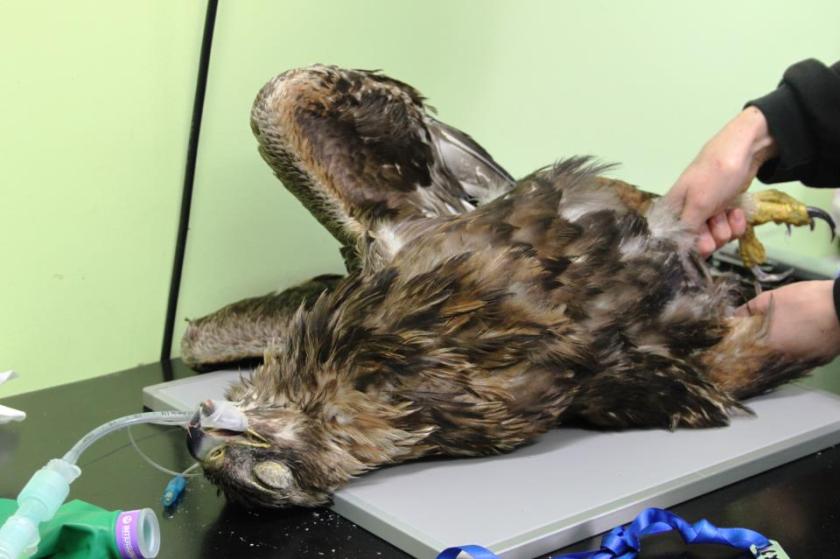
This golden eagle was found shot, critically injured &left to die on a Scottish grouse moor. Photo SSPCA
This golden eagle was found shot, critically injured and left to die on a Scottish grouse moor. Photo SSPCA

RSPB walks out of hen harrier ‘dialogue’

tec_logo_16271This isn’t especially new news, as it happened in the summer, but we were reminded of it today after reading something on Mark Avery’s blog – more on that later – and it does seem pertinent to blog about it now.

So, most readers will be aware of the Environment Council’s ‘Hen Harrier Dialogue’ – a process that started in 2006 that aimed to bring ‘stakeholders’ together to try and work out a way of resolving the hen harrier / grouse moor conflict in England (see here for website). Those stakeholders involved in these dialogue meetings included the usual suspects such as BASC, Countryside Alliance, Country Land and Business Association, GWCT, Moorland Association, National Gamekeepers’ Organisation, RSPB, Hawk & Owl Trust, Northern England Raptor Groups etc.

The ‘dialogue’ process has produced an awful lot of documents (and a lot of awful documents, see here) and meeting reports (see here), and a strong interest in pursuing a trial on a ‘quota system’ for hen harriers – a controversial idea spawned by Steve Redpath several years ago. In simplistic terms, this quota system would mean that grouse moor owners would ‘allow’ a certain number of breeding pairs (number yet to be established) and once a ‘ceiling’ had been reached, then they would be ‘allowed’ to remove harrier broods (non-lethally) to other parts of the UK away from grouse moors. This idea is still being discussed, although it brings with it obvious ethical and legal debates.

Hen harrier being removed from illegal trap on Moy EstateSome argue that conservation groups shouldn’t be sitting at the table with representatives from an industry that has been responsible for killing off England’s breeding hen harrier population. Others argue that the quota scheme may be the best way forward because at least there’d be some harriers, which is a better proposition than having none. Others have suggested that the quota system would never get off the ground anyway because the grouse moor owners would have to ‘allow’ a certain number of breeding hen harriers on their estates and they’ve shown themselves incapable of tolerating any.

Whatever your point of view, the bottom line is that six years on from the start of the dialogue process, and after all that talking over egg sandwiches and coffee, the English hen harrier breeding population has been reduced to one known pair. That’s it. Just the one pair. In a country that has suitable habitat to support over 300 breeding pairs.

This summer, the RSPB made a bold move and decided to walk away from the dialogue process. They said that as hen harriers have been systematically eradicated from English grouse moors then there was no longer any conflict and therefore no point in spending any more time talking about it. Instead, they intended to get on with their own plans for hen harrier recovery.

It’s not yet known what will happen to the Environment Council dialogue process now a major player has walked away. As far as we’re aware, there are still many questions about the lawfulness of the proposed trial quota scheme so it’s unclear whether attempts will still be made to push that through.

So what next for English hen harriers? After the recent sad story of the illegal shooting of Bowland Betty (see here), in addition to all the other horror stories we keep reading about from English and Scottish grouse moors (e.g. see here, here, here, herehere), is it time for a different approach? It’s obvious that the authorities can’t, or won’t deal with illegal persecution, and the grouse-shooting industry can’t, or won’t put a stop to it either. An alternative suggestion has been put forward by Mark Avery – unless things miraculously improve for breeding hen harriers in Northern England in 2013 then it will be time to start the campaign, on 12 August 2013, to end grouse shooting (see here for Mark’s blog).

Up until now we’d been supporters of the idea of estate-licensing schemes rather than an outright ban. Licensing seemed a fair and reasonable approach to regulate an industry so clearly incapable of expelling its criminal elements. But now?  The time for being reasonable has long since passed. Count us in, Mark.

For our anagram fans: Grouse moor – morgue or so

Hen harrier found shot dead on Yorkshire grouse moor

A young hen harrier has been found shot dead on a Yorkshire grouse moor. Regular blog readers will not be surprised to learn that it has taken over 5 months for an appeal for information to be made by North Yorks police.

The harrier was raised in a nest in Bowland, Lancashire in 2011. She was nick-named ‘Bowland Betty’ and was fitted with a satellite tag as part of Natural England’s so-called ‘Hen Harrier Recovery Project’. During her first year of life she was tracked through the uplands of Northern England and as far north as Caithness in northern Scotland. In June 2012 she was back in the Yorkshire Dales. Predictably, by late June her sat tag data suggested she was stationary and her dead body was found on 5 July on Thorny Grain Moor in Colsterdale in the Yorkshire Dales. Post-mortem results confirmed she had been shot.

This area is dominated by moorland managed for grouse shooting. We understand her body was found on Swinton Estate, although it is not known where she was actually shot as she could have flown for several miles before succumbing to her injuries.

RSPB and government data show the Yorkshire Dales as a hot spot for illegal raptor persecution, with at least 20 birds of prey illegally poisoned, trapped or shot between 2007-2011. This figure includes 10 poisoned red kites, 4 poisoned buzzards, 2 shot red kites, 2 shot buzzards, 1 shot kestrel and 1 trapped sparrowhawk. In addition there were at least 4 incidents of poisoned baits and a number of dogs were also poisoned.

Hen harriers have been tracked from Bowland since 1999. Wing tags were used to monitor hen harrier dispersal and survival between 1999-2002 (data from at least 42 birds). From 2002-2010, 118 hen harriers have been tracked either via radio transmitter or satellite tag. Astonishingly, Natural England have released very little detail about the results of this project, ten years on. They did produce a report in 2008 (see here) although this related to hen harriers over a broad geographic area and didn’t include specific detail about individual birds. What happened to all those birds? Where are their data? Why, when a satellite tag suggests that a harrier’s movements are suspicious (i.e. it’s been stationary on a grouse moor for several hours), do NE researchers have to seek the estate owner’s permission before they can go and search for the (presumably dead) bird? We’ve used an analogy before but it’s worth repeating – would you expect a police officer to call ahead to a suspected drug dealer to ask permission to go and search his house?

We all know only too well what will happen now. The death of this harrier will be added to the never-ending list of illegally-persecuted raptors found dead on UK grouse moors. Nobody will be prosecuted for shooting it. The public will express outrage for a few days but it’ll soon be forgotten, just like all the others that have been illegally killed before and all the others that undoubtedly will be killed in the future. The people who hold the positions of power that could bring this disgraceful practice to an end will continue to show wilful blindness and downplay the extent of the problem. The police will continue to form ‘partnerships’ with organisations who harbour the criminals responsible for this systematic killing. Nothing will change. Tune in next month to read about the latest victim. (Actually, tune in later this month….)

What can we do? The only thing we can do is to keep publicising these incidents. We can all play a part; don’t leave it to someone else. Tweet it, Facebook it, blog it, talk about it, email your MP about it. Do it.

Hen harrier shot in Ireland

The Kerry Birding blog in Ireland (see here) is reporting that a hen harrier has been shot at a winter roost site. There’s no further information about whether the bird survived.

The author emphasises the importance of confidentiality in relation to known raptor sites and especially hen harrier winter roosts. It’s not just at their nest sites where this species is vulnerable; winter roosts are known to be targeted by armed criminals  intent on wiping out hen harriers, and this happens in England and Scotland too, not just in Ireland.

Press release from BirdWatch Ireland here

Hen harrier found shot dead on Aberdeenshire estate

According to the Scotsman, Grampian Police are appealing for information after a protected hen harrier was found shot dead on the Fettercairn Estate, Aberdeenshire, last month.

The owner of Fettercairn Estate is quoted as saying this:

Since its inception in 2006 Fettercairn Estate has been a long term participant in the North East Scotland Raptor Watch project. As such it was particularly distressing to hear that a dead hen harrier was found on the edge of the hill land  and I join in the appeal for witnesses to come forward“.

A Grampian Police spokesman is quoted as saying this:

Investigations have established that the bird had been shot and officers are appealing to members of the public who may have been in the area and may have seen something suspicious. Gamekeeping staff at Fettercairn Estate have already provided significant assistance to police in their enquiries and continue to work closely in the hope that the offender can be identified and brought to justice“.

It must have been another one of those armed hill-walkers.

At least Grampian Police have made a public appeal in a (relatively) timely manner – that’s definitely progress so well done to them.

After hearing the news, Scottish Environment Minister Paul Wheelhouse issued another warning about his intention to crack down on the continuing illegal persecution of raptors:

We will not tolerate the illegal persecution of protected species such as the hen harrier and, as I have said recently in relation to another shooting [the golden eagle that was found shot on a grouse moor on Buccleuch Estate, see here], I am prepared to look at further measures to strengthen and assist enforcement if we continue to see this flouting of the law in respect of protected species“.

That’s great Paul, but how many more incidents are required before you consider this a ‘continuing’ problem? One? Ten? Twenty? A hundred?

Article in the Scotsman here

Langholm hen harrier ‘Blae’: starvation was likely cause of death

Regular blog readers will know we’ve been following the story of the two Langholm hen harrier chicks since the summer: the female chick, ‘Blae’ was reported dead in early September and her sibling, ‘Barry’ was reported ‘missing’ just a couple of weeks later. Since then we’ve been critical of the lack of information that’s been made available to the public (previous blog entries here, here, here, here, here, here, here, here, here, here).

Blae’s probable cause of death has now finally been reported on the Making the Most of Moorlands Project website (see here: a blog written by Cat Barlow, the education project officer at MMMP). Before we discuss the probable cause of death, it’s worth recognising that Cat Barlow deserves a good deal of credit for reporting anything at all to do with these two tagged hen harriers. We understand that some of the Langholm Moor Demonstration Project partners were not, how shall we say, enthusiastic about the prospect of tagging more harrier chicks this year. Why not? Well probably because they know very well what happens to the majority of the dispersing birds and this doesn’t exactly cover the grouse shooting industry in glory.  We believe that Cat Barlow, representing MMMP and so not directly answerable to the Langholm Moor Demonstration Project, has stuck her neck out by reporting on this year’s birds. It’s noticeable that the official Langholm Moor Demonstration Project website has made no mention of them.

So, here’s Cat’s explanation for what happened to Blae:

Back in September we posted the news that the young female Hen Harrier from this year’s nest at Langholm had died. The satellite tag data allowed the carcass to be located and recovered. A post-mortem showed no evidence of shot and no visible injuries. The bird was very thin, suggesting starvation as the most likely cause of death. As a precautionary measure the carcass was sent for further tests. We have heard today that the toxicology results were negative for the commonly-abused pesticides. The body was not found on grouse moor and there was no evidence of human persecution. It is very rare to recover a Hen Harrier carcass, the last post regarding Barry’s demise October 10th 2012, describes a more common scenario, no carcass, no tag, no evidence of his cause of death“.

This result is not at all surprising. The fact that the carcass had been recovered was an early indication that persecution was not a factor; usually, as the above statement indicates, illegally persecuted hen harriers simply ‘disappear’ (e.g. they are buried or burned in order to hide any evidence of the crime). And they don’t just ‘disappear’ on any old random bit of land – they ‘disappear’ on land that’s managed for grouse-shooting. Without direct evidence though (e.g. a carcass), it’s all too easy for the harrier-killers to deny that systematic persecution is taking place, even though endless scientific studies have shown that persecution is so widespread that it’s having population-level impacts.

The persecution-deniers will probably make a big song and dance about Blae’s post-mortem and toxicology results. They’ll probably claim that they are vindicated and the reports of widespread hen harrier persecution are simply propaganda aimed at discrediting the grouse shooting industry. However, if Blae’s premature demise is representative of the majority of young hen harrier deaths, then where are all the other corpses? If they’ve been sat-tagged, surely their carcasses would be retrievable? Sure, young hen harriers, like the young of many species, suffer high natural mortality rates in their first year. That’s what makes the illegal persecution of these birds so damaging – the population loses extra birds in addition to the natural high losses and the population cannot be sustained with these additional losses (read the Hen Harrier Conservation Framework [here] for a more detailed explanation). 

We understand that Barry’s last satellite signal came from a grouse moor in the north of England. Predictably, his body has not been recovered and the grouse moor has not been named.

Well done Cat Barlow for making Blae’s results available. Perhaps the Langholm Project partners will feel inspired and reveal information about all the other lost hen harriers, and not just the ones who’ve died of natural causes.

SNH held their Species Framework conference in Edinburgh last week and this included a presentation on the Langholm hen harriers. During the conference, @SNHMedia put out the following tweet:

Hen harriers faring alot better in Scotland than in England – 550 pairs in the latest national survey“.

What an astonishing piece of spin! Of course hen harriers are faring better in Scotland than in England – with only one breeding pair of hen harriers in England this year, it’s not that difficult! What @SNHMedia failed to mention was that the Scottish hen harrier population is also in continuing decline and the reason for that, according to the Hen Harrier Conservation Framework report that they commissioned, is illegal persecution!

In other satellite tag news….did anyone see the news yesterday where an appeal went out to the public to help find a lost basking shark tag? Guess who put out the appeal? Northern Constabulary! Not only did the appeal feature on the BBC news website (here), but also on Northern Constabulary’s own website (here). This seems a bit strange, given that the loss of the basking shark tag was not related to a criminal offence, whereas all those ‘missing’ satellite-tagged golden eagles, whose disappearance is more than likely related to a criminal offence, don’t get so much as a mention…..

The lost Langholm harriers: an update

The news is……there is still no news. Here’s a quick re-cap:

Blae, the young satellite-tagged female hen harrier was found dead on or around the 11th September 2012. Her death was made public on September 25th by a posting on the ‘Making the Most of Moorlands’ blog (see here) and we were told her carcass had been recovered and was undergoing a post-mortem.

On October 8th we were told, “No news yet on Blae’s post-mortem results“.

On October 10th, the terminology changed slightly and the word ‘post-mortem’ was replaced by the term ‘toxicology results’: “We are still awaiting toxicology results from the female Harrier Blae“.

Today it’s November 10th. Eight weeks after her body had been found and still no news about what had happened to her. Did she die of natural causes? Did she starve to death? Was she killed in an accidental road traffic collision? Did she ingest rodenticide? Did she eat from a poisoned bait? Was she shot? Or was she caught in an illegally-set spring trap and bludgeoned to death with a metal pole? Where was her carcass found? ‘South of Edinburgh’ is about as useful as saying ‘her body was found in the UK’. Has the Langholm Project received the results of the post-mortem and/or toxicology tests? If no, what’s causing the delay? If yes, why haven’t they released the results to the public?

And then there was her brother, Barry. Barry lasted for a couple of weeks longer than his sister. On October 10th we were told that Barry’s last sat tag signal was received on October 2nd, and he was now presumed dead. A search was underway for his carcass. One month later, still no news.

Where was he when the final sat tag signal was received? Has his body been recovered? If so, has it gone for post-mortem? If not recovered, is the search continuing? How long do you search for before you call it off?

We checked a few websites to see if any news updates had been provided. The first place to look was the ‘Making the Most of Moorlands’ blog – no updates since 10th October.

Next we looked at the official Langholm Demonstration Project website – no news updates since July.

Next we looked at the PAW Scotland website – apparently nothing newsworthy happened between 15th June and 31st October – not even a whisper on the two golden eagle ‘incidents’ (of which more later).

There may be some people/organisations who would prefer that this story just quietly melted away. Sorry, it ‘ain’t gonna happen. We’re going to keep asking.

Previous blog entries on this story here, here, here, here, here, here, here, here, here

Raptor Persecution: still a national disgrace

The following article has been published in the autumn edition of Wild Land News, the magazine of the Scottish Wild Lands Group (visit their website here). The magazine should be posted online in the near future and we’ll provide a link when it’s available. Congratulations to the SWLG’s magazine editor, Calum Brown, for providing a platform for this subject. UPDATE: Magazine now published online. Link here.

Raptor Persecution: Still A National Disgrace. By Bob McMillan.

Bob McMillan has had a lifelong interest in birds of prey. He retired as Assistant Chief Constable in Tayside Police in 1998 at which time he was the ‘lead officer’ on wildlife crime in Scotland on behalf of ACPOS. He represented Scottish Raptor Study Groups on PAW Scotland and the Raptor Priority Persecution Group until 2011. He now lives on Skye and runs the website www.skye-birds.com

My childhood in the 1950s had been spent in a rural village near Dunblane in south Perthshire surrounded by sporting estates. To see a Buzzard or a Kestrel was a rarity, let alone a Hen Harrier. An early interest in birds was cultivated by older friends, one of whom had found breeding Harriers on a moor on the nearby Cromlix estate. He subsequently studied and photographed the birds, much to the consternation of the local estate which eventually took out a civil action and interdicted him from the ground. Twice prosecuted for breach of interdict, the case remains unique amongst individuals who have put themselves on the line to protect birds of prey from the illegal actions of gamekeepers and sporting estates.

Eddie Blake from Dunblane died recently. Somewhat eccentric, he received little support for his actions from the ornithological establishment who shunned him. In 1952 Blake had recorded the first breeding record of Montagu’s Harrier in Scotland on Braco Moor. Though the pair returned the following year, the female was shot. There have only been five recorded breeding attempts in Scotland and the last of these was in 1955. Montagu’s Harriers might still be breeding in Scotland today were it not for persecution, but rarely merit a mention alongside formerly extinct species such as Osprey, Red Kite and White-tailed Eagle.

When I joined the police service in 1963 my final interview was by the Chief Constable at Callander Police Station. Bedecked in tweeds and with two spaniels at his heels, George Glendinning was every inch the country squire. Any discussion about Blake’s interdict was strictly off limits but I later learned that Glendinning was a regular shooting guest on Cromlix estate. The influence of landowners on local policing was profound in the 1960/70s and vestiges of it remain today. Rural police officers had access to free fishing and shooting, which invariably meant an immediate response to suspected poachers, or for that matter, to ‘suspicious trespassers’ who were simply enjoying their Scottish right to roam. Many gamekeepers were Special Constables. Rural shoots in Perthshire would have been unsustainable had it not been for the many police officers who acted as ‘beaters’ at pheasant shoots on their days off. Though trained and aware of wildlife crime, such cultural influences would make them strongly anti-poaching, and more likely than not to turn a blind eye if an occasional Sparrowhawk was accidentally ‘taken out’ during a Pheasant drive. The police response to reports of illegal trapping or poisoning of birds of prey, up until the end of the 1980s, was likely to be ambivalent. Some raptor enthusiasts would argue it remains fairly unpredictable to this day.

Despite most raptors having legal protection since 1954, persecution by gamekeepers and those with sporting interests in grouse moors and lowland estates remains a major problem. In 1998 Scottish Raptor Study Groups carried out an assessment of the extent of the illegal killing of raptors in Scotland. Published by the Scottish Office, it was launched at the Scottish Wildlife and Countryside Fair at Kinross, where the late Donald Dewar, then Secretary of State for Scotland, expounded the view that persecution of birds of prey was a national disgrace. As a retiring Assistant Chief Constable in Tayside Police, who took the lead on wildlife crime in Scotland, my last public duty was to meet Donald Dewar at the event. In the context of the persecution of raptors, this was a major political statement, and the expression “a national disgrace” was used by many others subsequently. The reality was that the expression had been conjured up by a senior civil servant and Donald Dewar posed the question as to whether he could actually say it. The fact that he decided to say it represented a major politicisation of the issue, though not necessarily a turning point.

Having found my first poisoned Golden Eagle at an eyrie in Perthshire 40 years ago these problems were not new to me, as was the case for other raptor enthusiasts. What was new, however, was that senior politicians and officials of agencies such as Scottish Natural Heritage were, for the first time, prepared to speak out against the problem. Raptor persecution was by no means rare, and the killing of adult birds and destruction of nests continued or even increased during the 1990s. Donald Dewar also said that the Government, and the soon to be Scottish Parliament, “will take all possible steps to eliminate persecution.” Fifteen years on from this statement, perhaps finally, some progress is being made.

The Partnership for Action on Wildlife Crime (PAW) brings together the Police, HM Revenue and Customs, and representatives of Government Departments and voluntary bodies with an interest in wildlife law enforcement. It provides a strategic overview of enforcement activity, considers and develops responses to strategic problems, and looks at issues of strategic concern. Its main objective is to support the networks of Police Wildlife Crime Officers (PWCO). As part of the overall UK-wide structure, PAW Scotland has existed for at least 20 years. Although it has been responsible for many preventive initiatives post-devolution, and despite Donald Dewar’s commitment, it lacked strategic support from a number of the key agencies.

Since the SNP administration came to power that has significantly changed, initially under the leadership of the then Minister for Environment Michael Russell and, since then, through subsequent ministers. A major turning point was the Borders Golden Eagle poisoning incident in 2007 which led to two parliamentary debates on Wildlife Crime and the police thematic inspection ‘Natural Justice’. This led to the publication in September 2008 of the Scottish Wildlife Crime Reduction Strategy which is being implemented through a PAW Scotland plenary and executive group, and a number of sub-groups.

The persecution of raptors had been a major factor in influencing this new strategic commitment, and although a Raptor Persecution Priority Group was established, it has been slow to make progress and is still to report. The pro-shooting lobby has been extremely influential within PAW Scotland and within this group. In terms of the protection of raptors, much of this has muddied the waters and not been particularly constructive. Whilst it is important to have a partnership approach to deal with these problems, some question whether it is appropriate that the perpetrators, in the main gamekeepers and the sporting estates which condone these crimes, should be part of it. (More details of the work of PAW Scotland can be found at http://www.scotland.gov.uk/Topics/Environment/Wildlife-Habitats/paw-scotland/).

The accurate recording of wildlife crime incidents involving raptors is a major challenge and most will be aware that the RSPB in Scotland produce an annual report. Annual maps of incidents (‘maps of shame’) can also be found on the website above. A major challenge is to make sure that all wildlife crime incidents are reported to the police, preferably to Wildlife Crime Officers who are known locally. It is equally important to make sure that RSPB Investigations staff are also aware of any incidents reported to the police. Wildlife crimes such as suspected shooting or poisoning of birds, destruction of nests or eggs, or reckless disturbance should be reported at the time and without delay. The remains of dead birds of prey, irrespective of age or condition, may be important evidence and require forensic examination. Advice on what to do if you find a suspected incident is available on the PAW Scotland website.

Recently-published research showed that illegal persecution remained particularly prevalent on grouse moors, and for raptor workers and those who visit wild land this is perhaps nothing new. The recent recovery of a poisoned Golden Eagle in Morar and a shot White-tailed Eagle on Skye confirms that birds are at risk throughout the Highlands, not just on sporting estates. Some local populations face the prospect of significant decline unless action is taken. In areas of Scotland such as the Black Isle the re-establishment of the Red Kite continues to be jeopardised by illegal persecution, and each year brings further reports of the destruction of Hen Harriers and Peregrines.

Satellite telemetry is now being used extensively on several species of birds of prey, primarily intended to trace the movements of young birds to gather information which assists their long-term conservation. An unintended outcome from this new science is that when signals indicate a bird has stopped moving, follow-ups have established that birds have been trapped, shot and poisoned. Without satellite telemetry these crimes would never be known about. The Golden Eagle ‘Alma’, poisoned in 2009, is one such example. Unfortunately a significant number of recent persecution casualties involving our large raptors have been found in this way, supporting the argument that reported incidents represent the tip of the iceberg.

The ‘Natural Justice’ thematic inspection recommended dedicated Wildlife Crime Officers in every force. The reality is there are now fewer WCOs than existed when the inspection was carried out. Strathclyde, the largest force in Scotland, have had no full-time post for some years. With a single national police force just months away there is little evidence that there is any genuine commitment on the part of the police service to meet many of the earlier recommendations. Whilst we can work in partnership, increase awareness, improve legislation and ensure landowners and employers accept vicarious responsibility, we can achieve nothing without a properly trained and professional police service which can rise to the challenge. Regrettably, the number of successful prosecutions remains extremely low, and there is a need to ensure that, in terms of enforcement and investigation, the limited resources dedicated to this field of work are properly supported so that much of the political and public relations rhetoric can be converted into tangible results.

I was part of a delegation from Scottish Raptor Study Groups which met Roseanna Cunningham when she was Minister for Environment in November 2010, and we recommended that a dedicated investigative unit be established, comprising trained WCOs and specialists from the RSPB, SSPCA and SNH, with a remit to cover the whole of Scotland, untrammelled by force boundaries. Many will argue, politicians amongst them, that only a few rogue estates and gamekeepers are involved, but any review of the so-called ‘maps of shame’ and the RSPB maps which preceded them, would find that hundreds of estates have been involved in incidents during the last ten years. Uniquely, there are also several estates with histories of persecution going back 30 years. As long as the police have responsibility to investigate such crimes, there is a need for them to develop a cutting edge and target the perpetrators. There would never be a better time to establish a specialist unit than now.

Some fifty years on from my childhood days in south Perthshire I will certainly be able to see Buzzards, Kestrels, Sparrowhawks and even Red Kites when I visit. Unfortunately Hen Harriers remain absent from the moors of Cromlix and Braco. Golden Eagles show little sign of expanding their range, and there is a real risk that fifteen years on from the branding of the problem ‘a national disgrace’, the fate of some of the iconic species which occupy our wild land remains in the balance.

Scottish estate owner accused of “blatant vandalism”

Environmental journalist Rob Edwards is reporting that a Highland estate owner is under investigation after being accused of “blatant vandalism” in a protected Caledonian pine forest in the Cairngorms National Park.

Michael Bruce, the owner of Glen Tanar Estate, is to be visited by officials from SNH today after allegations that forestry operations had damaged trees, killed plants and scarred the landscape. Read Rob’s article here.

Michael Bruce has previously been applauded for being one of the minority of Scottish estate owners with a forward-thinking, proactive approach to the conservation of hen harriers and golden eagles on his grouse moor. His activities have included diversionary feeding for breeding hen harriers (see here), supporting a hen harrier satellite-tagging project (see here) and an innovative scheme allowing photographers to film the harriers on his estate (see here).

Update on ‘missing’ or dead satellite-tracked raptors: hen harrier, Northern England

Last but not least in this mini-series of updates (well, five ‘missing’ or dead satellite-tracked raptors is plenty to be going on with) is the other Langholm hen harrier chick, ‘Barry’.

Barry managed to survive a couple of weeks longer than his sibling, Blae, but by all accounts he’s probably now dead, especially as “most of his previous movements were associated with grouse moors” (see here). His last signal was received on 2nd October and a search for him got underway. Three weeks later – no news.

So, there we have it. Five ‘missing’ or dead satellite-tracked raptors, and then let’s not forget the golden eagle recently found shot and severely injured on a grouse moor in Dumfries & Galloway (here).

Now, what was it Environment Minister Paul Wheelhouse said recently about raptor persecution? Ah yes, here it is:

“The unlawful killing of any raptors has no place in today’s Scotland and we will continue to work hard to eradicate this criminal activity. We believe that the partnership approach with the Partnership for Action Against Wildlife Crime (PAW) Scotland, is bringing the reduction in bird of prey poisoning that can be seen in the statistics in recent years. However we are not complacent and if there is evidence of a switch to other methods of persecution we will take action to bear down on those methods”.

How much more evidence do you need, Paul? What action are you going to take? And no, industrial-scale sweeping doesn’t count!