Hen Harrier spin: 2

In public relations, spin is a form of propaganda, achieved through providing a biased interpretation of an event or campaigning to persuade public opinion in favour or against some organisation of public figure. While traditional public relations may also rely on creative presentation of the facts, “spin” often implies the use of disingenuous, deceptive, and highly manipulative tactics” [Wikipedia].

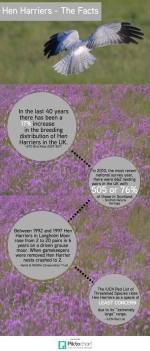
HH the facts sga - CopyYesterday (Hen Harrier Day 2015), at 10:03hrs (3 seconds after over 5.6 million thunderclap messages about missing hen harriers were beamed around the world), the SGA posted this image on their Facebook page.

Here’s the text:

Hen Harriers – The Facts

  • In the last 40 years there has been a 17% increase in the breeding distribution of Hen Harriers in the UK.
  • In 2010, the most recent national survey year, there were 662 nesting pairs in the UK with 505 or 76% of those in Scotland.
  • Between 1992 and 1997 Hen Harriers in Langholm Moor rose from 2 to 20 pairs in 6 years on a driven grouse moor. When gamekeepers were removed Hen Harrier nests crashed to 2.
  • The IUCN Red List of Threatened Species rates Hen Harriers as a species of least concern due to its extremely large range.

END

Here are some missing facts from a government report that they forgot to include:

  • The potential national hen harrier population in Scotland is estimated (conservatively) to be within the range 1467-1790 pairs.
  • The current national hen harrier population in Scotland as recorded during the most recent (2010) national survey is 505 pairs, more than a 20% decline from the numbers recorded during the 2004 national survey.
  • In Scotland, the hen harrier has a favourable conservation status in only five of 20 regions.
  • Two main constraints have been identified: illegal persecution, and in one region, prey shortages.
  • The species is particularly unsuccessful in the Central Highlands, Cairngorm Massif, Northeast Glens, Western Southern Uplands and the Border Hills. There is strong evidence in these grouse moor regions that illegal persecution is causing the failure of a majority of breeding attempts.

Now, this claim of the species being classified as ‘Least Concern’ is often trotted out by those trying to downplay the seriousness of the species’ conservation status in the UK. It is an accurate statement in as much as this is what is written on the species’ IUCN Red List entry (from where the quote is taken), with the addition of one important statement conveniently left out by the SGA – under the heading ‘Major Threats’:

Persecution is an important threat locally, notably on game preserves in Scotland (del Hoyo et al. 1994)”.

The species’ IUCN listing is fine to use if you want to stick to a species’ global conservation status and ignore its European and UK conservation status. If you look at the IUCN global status for the three wader species for which the grouse shooting industry is often claiming to be the one and only saviour, the IUCN listings also give little cause for concern:

Lapwing – listed as Least Concern. Estimated population c. 5,200,000-10,000,000 individuals. Major threats include land use intensification, pollution and hunting. [Note, no mention of raptors being a major threat].

Curlew – listed as Near Threatened. Estimated population c. 77,000-1,065,000 individuals. Major threats include afforestation, agricultural intensification and hunting. [Note, no mention of raptors being a major threat].

Golden Plover – listed as Least Concern. No population estimate given. Major threats include cultivation and afforestation, severe weather conditions and hunting. [Note, no mention of raptors being a major threat].

So, on the basis of suggesting that the hen harrier’s conservation status is of ‘least concern’ on a global scale [and therefore why all the fuss of losing an almost entire breeding population in England and between 66-72% of the Scottish breeding population?], the statement is equally as applicable to those three wader species, right? We shouldn’t be concerned about any of them because on a global scale they’re all doing just fine, right?

Wrong.

Fortunately, government and non-governmental organisations are a lot more clued in and understand the concept, and importance, of national, regional and local biodiversity. Indeed, the Westminster and Scottish Governments have a statutory responsibility for ensuring that national biodiversity targets are met and maintained (although you wouldn’t know it by their continuing failure to address illegal raptor persecution). Rather than use the broad-based IUCN Red List as guidance, they look to more detailed and relevant assessments such as the UK ‘Birds of Conservation Concern’ scientific review. In this document, the hen harrier and lapwing are red listed, and the golden plover and curlew are amber listed.

It’s quite telling, isn’t it, that those with a vested interest in driven grouse-shooting should continue to not only deny their involvement in the catastrophic loss of hen harriers across the UK, but also continue to downplay its conservation significance.

Please sign the petition to ban driven grouse shooting HERE

Hen Harrier spin: 1

In public relations, spin is a form of propaganda, achieved through providing a biased interpretation of an event or campaigning to persuade public opinion in favour or against some organisation of public figure. While traditional public relations may also rely on creative presentation of the facts, “spin” often implies the use of disingenuous, deceptive, and highly manipulative tactics” [Wikipedia].

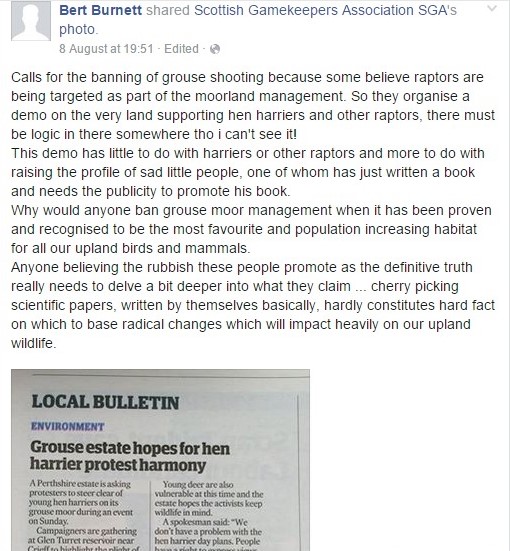
The Scottish Gamekeepers’ Association issued the following press release yesterday lunchtime. Here it is in full:

Estate hope Harriers on their moor are fine after Harrier Protest.

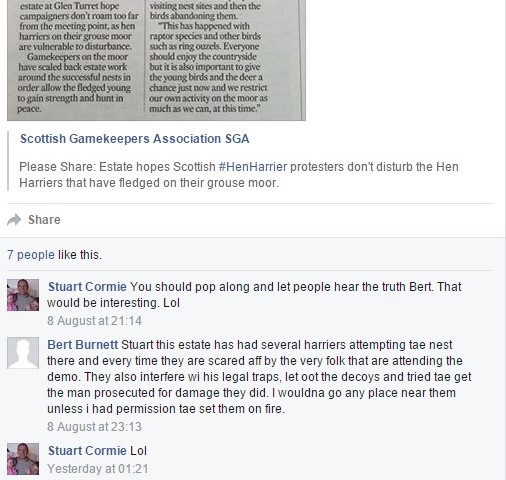
A Perthshire estate hopes a Hen Harrier protest staged next to their ground yesterday (sun) will not have bothered the Hen Harriers which have fledged on their grouse moor.

Campaign groups gathered at Glen Turret reservoir near Crieff to highlight the plight of the birds, three days before the start of the grouse shooting season.

The lobby groups believe some of the birds of prey are being killed on grouse moors because they feed on wild red grouse and their chicks.

However, the estate adjoining the site where the protest was staged has successfully fledged Hen Harrier chicks on its grouse moor this year and are hopeful the protest will not have disturbed the young birds which are just beginning to hunt independently.

An estate spokesperson said: “It was great to see people that share the same interest as ourselves in Hen Harrier conservation. The future definitely lies in co-operation between land managers who produce birds such as Hen Harriers and those who wish to see and enjoy them.

“We regularly have Harriers here on our grouse moor and we are lucky to have had successes this year, despite the weather. Naturally, our concern is for the birds because we have had nests of differing species abandoned, due to members of the public or photographers visiting the nests.

“We have restricted the activities of the estate around the nests so the birds get the best chance they can to grow and hunt in peace. Obviously, the gamekeepers will be checking the area to make sure the young birds are fine, but we are hopeful everything has gone off, well.”

The estate bordering the protest was audited recently, with RSPB counts in 2012 showing 9 raptor species on the grouse moor, 6 of which are known to have bred.

The estate is also a haven for other birds with two species of eagle recorded.

END

It’s fascinating that the SGA is attempting to infer that a group of peaceful protesters might ‘disturb’ some birds on an adjacent site by standing in the rain for a couple of hours, chatting, miles from any nests. No mention then of the start of the grouse shooting season in three days time where large groups of beaters will be marching across the moor waving flags, shouting and whistling as they scare (‘drive’) any bird in their path (but notably red grouse) towards a line of grouse butts where another load of people will be standing with guns to blast the birds to bits. Which activity do you think is likely to cause the most ‘disturbance’?

But what’s particularly interesting about this press release is the claim that there was a successful hen harrier breeding attempt on this driven grouse moor this year. Why is this interesting? Well, because the one known hen harrier breeding attempt on this site actually failed about a month ago [cause of failure unknown].

Now, of course, it’s possible that there was a second hen harrier breeding attempt on this estate, and that the raptor workers who closely monitor this site just missed it, and that the breeding attempt was successful and that there are indeed now young hen harriers “which are just beginning to hunt successfully”. If that is the case, then presumably the estate will have notified SNH’s ‘Heads up for Hen Harriers Project’ because, like all good Scottish sporting estates, this one will be keen to cooperate (we’ll be blogging more about the Heads up for Hen Harriers project in a separate ‘spin’ blog, to be posted later).

Up until a few years ago, this estate was part of the Operation Countrywatch Partnership – we blogged about it here and applauded their efforts. Funny thing is, this estate pulled out of the project shortly after it was suggested that nest cameras could be installed at hen harrier nests to better understand the causes of breeding failure regularly being recorded in this area. However, it was probably just a complete coincidence that the estate pulled out at that time and there will undoubtedly be an unrelated and perfectly reasonable explanation for their withdrawal.

Also interesting to note the final sentence of the press statement. Two species of eagle have indeed been ‘recorded’ on this estate (note the ambiguous choice of word – ‘recorded’ can mean a breeding attempt but it can also mean something was simply observed flying over/passing through). Just for the record, there aren’t any officially recorded white-tailed eagle breeding attempts on this estate, but golden eagles have certainly bred there in the past. Funny thing is, this year the golden eagle nest site was burnt out and the eagles moved to another estate for their breeding attempt. Those spontaneously combusting nests are a real problem on driven grouse moors, it seems.

The photograph shows some of the people who attended the Hen Harrier rally in Perthshire yesterday. Well done to those who organised it and also to those who turned out to support it.

HH Day Perthshire 2015

Six successful hen harrier nests in England this year: some perspective, please

hh LAURIE CAMPBELLIn response to the Telegraph’s wholly inaccurate article yesterday (see here), Natural England has issued a press statement outlining the breeding status of hen harriers in England this year.

The statement headline reads: ‘Hen harrier breeding season set to be most successful for 5 years’. On a superficial level, this sounds great, and for those who only read headlines rather than the details, they’d be forgiven for thinking that hen harriers are doing OK so what’s all the fuss about?

Perhaps this was the intended outcome by the person(s) tasked with writing the headline. It’s certainly played in to the hands of several organisations, linked with driven grouse shooting, who have been happily tweeting this ‘good news’ story.

But what’s the reality? You have to read further than the headline for that. It turns out that there were six successful hen harrier breeding attempts this year in the whole of England. Those six successful breeding attempts have produced 18 fledged chicks. Is this the most successful for five years? Technically, yes. If you look at the figures provided in the press statement (see here) then six successful nests is more than the four successful nests in 2011, one in 2012, none in 2013, and four in 2014.

But let’s just get some perspective here. We’re talking single figures. Less than ten, and certainly a lot less than the estimated 330 breeding pairs that a Government-funded report says England has suitable natural resources to support. Think about it. Six successful nests in the whole of England. In comparison, at Langholm this year there were also six successful nests, producing 17 young (see here). That’s six successful nests on a single grouse moor. And, notably, on a grouse moor that is being managed as a demonstration project, i.e. hen harriers are not being killed there. That’s pretty revealing.

That only six hen harrier nests have been successful in the whole of England this year is a bloody disgrace. It’s not a cause for celebration and it’s not ‘a positive step forward’, as suggested by Natural England. It’s a clear indication that the English hen harrier population is still being suppressed as a result of illegal persecution. No amount of superficial ‘good news’ headlines from the Government agency responsible for protecting hen harriers will change that.

The e-petition calling for a ban on driven grouse shooting (in England) is nearing 10,000 signatures, the number required to trigger a response from the Westminster Government. It would be terrific if that number could be reached before Hen Harrier Day this Sunday. If you think that six successful hen harrier nests in the whole of England this year is something to be ashamed of, as opposed to something to be celebrated, please add your voice here.

Going back to that made-up story in the Telegraph yesterday, Mark Avery has written some amusing opinion pieces that are worth a read: see here, here and here.

Henry’s tour day 79: The RSPB, slurs & lies

Mon 3 Aug Copy

Henry received a warm welcome from his friends at the RSPB HQ at The Lodge (photo by Guy Shorrock).

The RSPB has faced an increasing amount of criticism in recent months, from both ‘sides’ of the Hen Harrier ‘issue’.

Some from ‘our side’ have been critical because the RSPB has, so far, refused to sign up to the call for a ban on driven grouse shooting and instead has called for a system of grouse moor licensing. The RSPB’s CEO, Dr Mike Clarke, re-emphasised this position in a speech he made at the CLA Game Fair last Friday (see here). It’s a position that many of us find bewildering and some of us would say the criticism is thus deserved but, as public pressure grows, the RSPB may well re-evaluate its stance. Indeed, Dr Clarke said: “But the longer it takes any industry to address its problems, the stronger those calls [to ban driven grouse shooting] will become“.

Whatever your view on licensing or banning driven grouse shooting, it seems pretty counter-productive to attack an organisation that is doing a great deal of work on ‘our side’ for hen harriers (e.g. see list here), instead of aiming our ire squarely at the organisations responsible for the loss of, literally, thousands of hen harriers through shooting them, trapping them, bludgeoning them to death, poisoning them, burning out their nests and stamping on their chicks. Doesn’t it?

Other criticism of the RSPB has emerged from a group calling itself You Forgot the Birds, fronted by ex-cricketer Ian Botham and funded by the British grouse industry. We’ve blogged about them previously (here, here). In today’s Telegraph (see here), an article penned by ‘journalist’ Javier Espinoza claims that a forthcoming government report (by Natural England) will criticise the RSPB for failing to protect six hen harrier nests this year and, further, that ‘the remaining six successful nests – which were on or next to grouse moors – had no RSPB involvement and performed well’.

That’s very interesting. We’ve spoken to Natural England and have been told no such report exists, nor is one planned. In addition, we also know that the six remaining hen harrier nests in England this year were NOT all on or next to driven grouse moors – far from it!

Mr Espinoza seems to have taken a press release issued by YFTB and just published it without doing any fact checking. Not really a surprise from the Telegraph but an indication of the desperate measures being employed by the British grouse industry. They’re rattled, and so they should be. The social media Thunderclap timed to coincide with Hen Harrier Day (this Sunday) will see over five million simultaneous messages going out at 10am saying ‘We’re missing our hen harriers – and we want them back’. That message will be seen by over five million social media users – there’s still time to sign up and help increase the public reach – sign up here if you have a facebook or twitter account.

The British grouse industry is also rattled by the current e-petition to ban driven grouse shooting, which is doing well – please sign it here.

Henry’s tour day 78: One week ’til Hen Harrier Day!

Fri 31 July Copy

This year’s Hen Harrier Day takes place one week today – Sunday 9th August 2015.

Find out what’s happening at events in England and Scotland HERE

Sign up to the social media Thunderclap HERE (current social reach is 3.9 million!)

Sign the petition to ban driven grouse shooting HERE (currently at over 8,000 supporters!)

Henry’s tour day 75: Countryside Alliance HQ

Tues 28 July  Copy

Henry called by the Countryside Alliance’s HQ in London.

He’d heard that the current CEO Lieutenant General Sir Barney White-Spunner is stepping down after the AGM in September, to be replaced by the current Director of Campaigns, Tim Bonner (see here).

Previous Countryside Alliance CEOs have included Alice Barnard, whose views on hen harrier persecution weren’t very well informed – see here.

White-Spunner’s views on hen harriers weren’t well publicised, although incomer Bonner is known to be a strong supporter of brood meddling (see here) and has vigorously disputed the evidence that Bowland Betty was shot (see here). He’s recently been spending a lot of time heading a campaign to lobby the police to ‘unmask animal rights thugs’ – it’s not known if that campaign also includes a call for the unmasking of armed gamekeepers involved in criminal animal abuse (see here, here and here).

The petition to ban driven grouse shooting has passed the 6,000 mark today – add your name HERE

Hen Harrier persecution features in Private Eye

We’ve always been big fans of Private Eye. Now even more so. From the current edition (#1397):

IMG_6099 (2) - Copy

Henry’s tour day 69: Marks & Spencer

Mon 20 July Copy

Last year, Marks & Spencer decided to ban the sale of red grouse in their stores because they feared a consumer boycott  – it was a welcome move (see here).

This year, rumour has it that they might be thinking of putting red grouse back on their shelves, although this has not been confirmed.

It’d be an odd thing to do because the chances of a consumer boycott are probably higher this year as more and more people learn exactly just what is involved in the procurement of those grouse.

As an example of widening public awareness, this year’s social media thundercap already has a social reach of over 3 million people. That means that every one of those 3 million+ people will be seeing a message on their social media timelines (e.g. Facebook, Twitter) at 10am on Sunday 9th August (Hen Harrier Day) calling for an end to the illegal killing of hen harriers on driven grouse moors. That’s more than 3 million potential M&S customers who may decide to take their business elsewhere if M&S decide to put red grouse back on sale.

If you want to join in and make sure even more people get the message, please sign up HERE. It’s also worth noting which organisations have not yet signed up (see here).

Simply food? Afraid not. M&S will need to show, by their own strong food sourcing policy, that their red grouse have been sourced ethically, sustainably and responsibly and that it isn’t full of poison (lead). Good luck with that.

Henry’s tour day 68: occupy the butts

Friday 17 July Copy

Hen Harrier Day takes place three weeks today, on Sunday 9th August 2015.

There are plenty of Hen Harrier Day events popping up all over the country – please see here to find one near you.

If you’re going to the event in the Peak District, you might also want to attend the special Hen Harrier Evening event in Buxton the night before (Saturday 8th August), featuring Chris Packham, Mark Avery, Henry the Hen Harrier, Harry the Hen Harrier, Jeremy Deller, Findlay Wilde, Mark Cocker and Birders Against Wildlife Crime  – there’ll be some surprises! Tickets are selling fast so you’ll need to be quick – details here.

If you can’t attend one of the Hen Harrier Day events there are other ways you can show your support:

Send a selfie to the Hen Harrier Day website – see here

Buy a Hen Harrier Day t-shirt – see here

Join in the Hen Harrier Day ‘thunderclap’ on social media – see here

Think you can’t make a difference? You’re wrong! Get involved!

DEFRA’s plans unchanged despite loss of 5 breeding hen harriers

In June, following the news that five breeding male hen harriers had ‘disappeared’ from active nests this year, one of our blog readers submitted an FoI to DEFRA to ask about the Westminster Government’s contingency plans to protect hen harriers and to deal with the criminals who continue to persecute hen harriers and other wildlife:

Sir/ Madam

I am making a Freedom of Information request regarding hen harriers/ illegal persecution of wildlife.

1) With the recent losses of five male birds in northern England, as published in Natural England’s press release (https://www.gov.uk/government/news/five-hen-harriers-have-now-disappeared-from-northern-england), what is the Government’s contingency plan(s) to prevent the species becoming extinct in the wild in England as a direct result of illegal persecution within the next 5 years, i.e. the duration of this Parliament?  If there are no contingency plans, why are there no contingency plans?

2) In a recent court case in Spain (see http://www.venenono.org/?p=2506 with an English summary available here:https://raptorpersecutionscotland.wordpress.com/2015/06/09/now-thats-a-deterrent/, the sanction imposed on an individual found guilty of a wildlife offence was considerably more severe compared with recent similar incidents in England.  Does the UK Government have any plans to introduce similar sanctions that would act as a meaningful deterrent to wildlife criminals?  If not, why not?

3) Does the Government consider the current sanctions available to Magistrates/ Judges sufficiently severe to act as a deterrent to wildlife criminals, within the context of those imposed in the aforementioned Spanish case?

4) As in Spain, is the Government seriously considering introducing ‘sniffer dogs’ able to detect the use of poisoned bait as described in the article published by Raptor Persecution Scotland? If not, why not?

Many thanks,

XXXXX XXXXX

Here is DEFRA’s response:

Dear XXXXX XXXXX

Thank you for your request of 11 June about the illegal persecution of hen harriers. I have been asked to reply.

We share your concerns regarding the recent losses of five hen harriers but are encouraged by the news of several nests this year, following on from four nests in 2014, with 16 fledglings. In 2013, for the first time in over 50 years, there were no known fledglings.

All wild birds are protected under the Wildlife and Countryside Act 1981, which implements the EC Wild Birds Directive in Great Britain. This provides a powerful framework for the conservation of wild birds, their eggs, nests and habitats. I can assure you that we are committed to ensuring the strict protection afforded to wild birds of prey under our wildlife legislation is effectively enforced. There is a robust legal framework for protecting such birds with strong penalties for offenders, which can include imprisonment.

Despite the protection afforded to birds of prey, it is clear that they continue to be persecuted. To address this, senior Government and enforcement officers in the UK identified raptor persecution as a National Wildlife Crime Priority. Raptor persecution is subject to a prevention, intelligence and enforcement plan led by a senior police officer. The National Wildlife Crime Unit, which is part-funded by Defra, monitors and gathers intelligence on illegal activities affecting birds of prey and provides assistance to police forces when required.

It should be noted that despite instances of poisoning and killing of birds of prey, populations of many species, such as the peregrine falcon, red kite and buzzard have increased. While a small minority is prepared to kill birds of prey and where possible these people are brought to justice, this demonstrates that the policies in place to conserve these species are working.

One of our most threatened birds of prey is the hen harrier and we take the decline in hen harrier populations in England very seriously. In August 2012 Defra established the Hen Harrier Sub-Group of the Uplands Stakeholder Forum whose members include representatives from Natural England, the Moorland Association, the National Gamekeepers’ Organisation, the Game and Wildlife Conservation Trust, National Parks UK and the RSPB.

All members of the Hen Harrier Sub-Group have a common interest to protect hen harriers.  They have made concerted efforts to engage and have produced a Joint Action Plan that contains a suite of actions intended to contribute to the recovery of the hen harrier population in England. The commitment shown by the differing organisations involved in the Sub-Group to help the recovery of one of our most iconic birds demonstrates a desire to bring about behavioural change amongst gamekeepers and confidence that this can be achieved through a package of complementary actions.

The Joint Action Plan includes three measures to stamp out illegal persecution, a trial toolkit comprising two measures for land owners to safely accommodate hen harriers on grouse moors and a measure to reintroduce them to suitable habitat in other parts of England. Defra officials are currently working with Sub-Group members to finalise the Plan.

As previously stated there are already strong penalties in place for people committing offences against birds of prey. You have asked if the Government intends to introduce tougher penalties for those convicted of wildlife crimes. I should first point out that Parliament is responsible for deciding the maximum penalties for offences. There are currently no plans to increase the penalties for offences against wildlife. Within the maximum limits, it is up to the court to decide the appropriate sentence in any case, having taken into account all the facts of the case.

We are aware that sniffer dogs are used in other countries, including Italy, Spain and Greece, to detect poisoned bait but are not aware that enforcement bodies in the UK have this resource or are considering it for the future. This would be a matter for individual Police forces to decide upon.

Yours sincerely,
Charlie Coombs
Customer Contact Unit