More raptor persecution at Moy

Moy chicksPolice Scotland has issued an appeal for information following the discovery of disturbed and abandoned buzzard and goshawk nests in the Moy Forest near Tomatin in the Scottish Highlands.

During May this year, one goshawk and four buzzard nests have been abandoned in suspicious circumstances, with some evidence of illegal disturbance. These nests were being monitored by staff from Forestry Enterprise Scotland.

Further details and an appeal for information here

This area is no stranger to illegal raptor persecution. In 2010, a 20-year old gamekeeper employed by Moy Estate was convicted for possession of a dead red kite that was found in the back of his vehicle. It had two broken legs and it’s head had been smashed in.

During the police raid on the grouse moors of Moy Estate, the following was also found:

  • The remains of a further two dead red kites.
  • A red kite’s severed leg, along with wing tags that had been fitted to a sateliite-tracked red kite, hidden in holes covered with moss.
  • Six baited spring traps illegally set in the open.
  • A trapped hen harrier (still alive) caught in an illegally set spring trap.
  • A poisoned bait.
  • Four leg rings previously fitted to golden eagle chicks found in the possession of a gamekeeper.

No charges were brought against anybody for these additional crimes.

Our previous blogs on Moy can be read here.

Moy is also home of the annual Highland Game Fair, regularly attended by certain MSPs, Scottish Land & Estates and the Scottish Gamekeepers’ Association to ‘celebrate’ the activities of the game-shooting industry.

The petition to ban driven grouse shooting can be found here

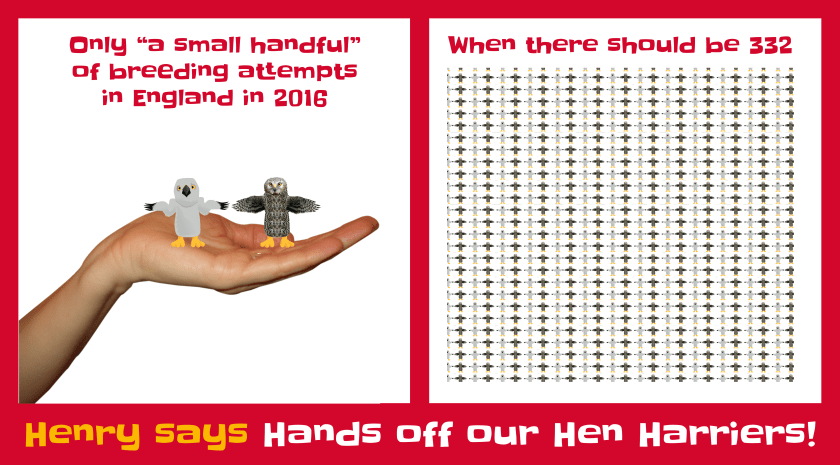
Hands off our Hen Harriers

HandOffRed2Following this morning’s news (see here and here), Henry invites you to save this date:

Saturday 25 June

For a midday picnic and rally on a Yorkshire grouse moor.

Further details available towards the end of this week.


How many hen harriers breeding in England this year?

hh LAURIE CAMPBELLMartin Harper, the RSPB’s Conservation Director, has this morning published his promised mid-season update on the status of breeding hen harriers in England this year.

To be frank, and sorry about this Martin, but it’s the biggest pile of tosh we’ve read in a while.

Back in March, when we asked whether the RSPB was planning a ‘black-out’ on hen harrier news this year, Martin responded by saying there wouldn’t be a news black out and that “transparency is absolutely key“.

Have a read of Martin’s mid-season update (here) and think about that word ‘transparency’.

Martin tells us that this year, there is “only a tiny handful of nesting attempts to date”. Not just a handful, but “a tiny handful”. What does that actually mean? Why didn’t he provide the precise number of breeding attempts (at least of which the RSPB is aware), and also provide detail of whether those attempts had resulted in eggs/chicks?

It’s all quite furtive. Why is that?

We’ve heard, from several sources, that the number of breeding pairs of hen harriers in England so far this year ranges between 0 and 1.

How accurate is that? We don’t know, because the RSPB isn’t being transparent about it. And it seems we won’t know until September when Martin says he’ll next report on how the season has gone. Terrific. So, as we predicted back in March, the grouse-shooting industry gets a PR-disaster-free ride up to the opening of the grouse-shooting season on the Inglorious 12th.

Only they won’t, because we won’t let that happen. Unlike Martin, with his soothing words about a “positive partnership approach” and how “pleased” he was to see a statement from the Moorland Association condemning the use of illegal pole traps on a grouse moor, we’re not buying it.

Does he really think that the Moorland Association was sincere in its condemnation of illegal raptor persecution? Come off it, it was nothing more than a PR sound bite because if they had really meant to condemn illegal raptor persecution they’d have booted that grouse moor owner from within their ranks.

And what about that video of the armed man sitting next to a decoy hen harrier, on a grouse moor in the Peak District National Park? Martin mentions it – he describes it as “a worrying incident”. We would describe it as clear evidence of the blatant disregard the grouse-shooting industry pays to the law.

And what about the news of hen harrier ‘Highlander’, whose satellite tag ‘suddenly and unaccountably ceased transmission’ on 16 April this year? Martin describes this as a “huge cause for concern”. We don’t disagree with him on that but unlike Martin, we’re no longer prepared to give the grouse-shooting industry the benefit of doubt.

If, like us, and like Mark Avery (here), you’ve had enough of this pathetic charade that everything’s going to be ok, there will shortly be an opportunity for you to participate in a more direct action approach. WATCH THIS SPACE!

In the meantime, please join 40,000+ people who have definitely had enough and sign the e-petition to ban driven grouse shooting HERE

Media coverage

BBC news here

Statement from Northern England Raptor Forum here

Criminal pole-trapper is gamekeeper on Mossdale Estate

pole trapThis won’t come as any surprise to anyone, but it has now been confirmed that the man given a police caution for setting illegal pole traps on a grouse moor on the Mossdale Estate in the Yorkshire Dales National Park is……wait for it….a gamekeeper from the Mossdale Estate.

How do we know? Because the Moorland Association has said so.

In a rather late public statement (probably issued after coming under considerable pressure to say something), the Moorland Association says the unnamed 23-year old is a ‘junior employee’ of the Mossdale Estate.

By the way, the name of this individual has not been publicised, and nor can it be (hence the pixelated photo from the RSPB in previous articles about this crime) because he is protected by the Rehabilitation of Offenders Act 1974 (see here for a good explanation). This Act’s basic premise is that after a period of x years post-conviction (depending on the type of crime committed – typically five years for someone convicted of a wildlife crime), the conviction can be ignored and need not be divulged (with one or two exceptions). If somebody does then publish information about the individual’s conviction, they may be subject to libel damages, but only if the primary motive for publishing the information was malicious. What’s amazing about this legislation in this particular case is that if an individual receives a police caution, that caution is considered immediately ‘spent’, which means that the individual cannot be publicly named in relation to his crime, even immediately after his admission of guilt! It gives a whole new meaning to the term police protection.

Anyway, back to that statement from the Moorland Association. Here it is:

Disgust at use of illegally set traps on posts

3rd June 2016

Chairman of the Moorland Association, Robert Benson, has today issued the following statement:

We agree with the RSPB and others expressing disgust about the use of illegally set traps on posts. This behaviour could result in indiscriminate capture of wildlife and prolonged suffering. It was rightly outlawed in 1904 and these is no place for it in 21st Century moorland management. There are perfectly good legal and targeted predator control measures available to protect ground nesting birds at this time of year, not least through the licensing system.

The owner of the estate where this gamekeeper worked is a member of the Moorland Association. He has made it clear that neither he nor his head gamekeeper knew anything of this illegal and totally unacceptable activity by a junior employee. The employee who set the traps has been suspended and, as a result of having accepted a police caution for his action, now carries a criminal record and has lost his right to own firearms.

END

The first paragraph is a commendable condemnation of illegal pole-trapping. The problem is, whether it was said with sincerity or not, many of us don’t believe it’s worth the paper it’s written on. It’s clear from this case alone that whatever the Moorland Association thinks, it has little influence over what actually happens on a grouse moor.

What would be more convincing is if the Moorland Association expelled any of its members on whose grouse moor this illegal practice had been detected. Now THAT would be a more credible display of zero tolerance for illegal raptor persecution, wouldn’t it?

But no. Instead we get a feeble explanation that the grouse moor owner and his head gamekeeper knew nothing about the illegal activity taking place on that moor. And that, it seems, is enough justification for the grouse moor owner to remain a member of the club. Does that indicate a Moorland Association policy of zero tolerance to you? It doesn’t to us.

And what action has the grouse moor owner taken against his criminal employee who has already admitted ‘illegal and totally unacceptable’ behaviour? He’s just suspended him. He hasn’t fired him, he’s JUST SUSPENDED HIM.

That tells you everything you need to know about the grouse-shooting industry.

Please sign the petition to ban driven grouse shooting HERE

We’re interested in finding out whether this criminal gamekeeper is / was a member of the National Gamekeepers’ Organisation. Let’s ask them. Emails to: info@nationalgamekeepers.org.uk

North Yorks Police try to justify police caution for criminal activity on grouse moor

Following today’s earlier blog about the man who was given a police caution after he was filmed setting illegal pole traps on the Mossdale Estate grouse moor within the Yorkshire Dales National Park (see here), North Yorkshire Police has now issued an unbelievable press statement in an attempt to justify their decision to caution instead of prosecute:

NYorksPolice statement

Before we take this statement apart, we want to make it clear that our comments are NOT aimed at the three police wildlife crime officers who attended the crime scene. It is obvious from the RSPB Investigation Team’s blog (here) and from recent accounts of police attendance at other raptor persecution crime scenes in North Yorkshire (e.g. see here) that these on-the-ground police officers are doing their utmost to respond quickly, collect evidence, issue early appeals for information, and work inclusively with the RSPB Investigation Team. We sincerely applaud their efforts and they deserve all credit for their actions.

Our comments are aimed directly at senior officers within North Yorkshire Police, i.e. the one(s) who took the decision to issue a caution rather than consider a prosecution.

So, THAT police statement. What an unbelievably stupid, self-congratulatory piece of work. It really beggars belief that this police force, which, incidentally, has just taken on the role of National Wildlife Crime Lead, views this result as a ‘successful conviction’. What interests us the most about the statement is the following sentence:

Based on the case at hand, it was decided the most appropriate course of action was to give him an adult caution“.

When the police decide on a course of action, they are supposed to refer to official guidance to help their decision-making. The official guidance document relating to whether a caution is appropriate can be read here. This is a fascinating read.

It explains that a ‘simple caution’ (once known as a formal or police caution) is a formal warning that may be given by the police to persons aged 18 years or over who admit to committing an offence. A simple caution must NOT be given if the decision-maker (i.e. senior police officer) considers that it is in the public interest for the offender to be prosecuted. Er, there’s failure #1 for North Yorks Police.

A simple caution may only be given where specified criteria are met. These criteria are listed in what’s called a Gravity Factor Matrix (see here). This matrix sets out the aggravating and mitigating factors that the decision-maker must consider for various types of offence. If you look at page 39, you’ll find the guidance the police are supposed to follow for a wildlife crime offence. Here are the listed aggravating factors, which, in this particular case, should have been considered by North Yorkshire Police:

The offence relates to a wildlife crime priority. Does this  aggravating factor apply to this case? Er, YES! Raptor persecution is a national wildlife crime priority. Failure #2 for North Yorks Police.

The conservation impact of the offence. Does this aggravating factor apply to this case? Er, YES! Hen harrier persecution is responsible for the precarious conservation status of this species in England. Failure #3 for North Yorks Police.

The offence results in or is intended to result in financial gain. Does this aggravating factor apply to this case? Er, YES! Raptor persecution on grouse moors is undertaken to maximise the number of red grouse available for paying clients to kill and the number of red grouse killed impacts on the estimated value of the estate/shoot. Failure #4 for North Yorks Police.

The offence involves cruelty. Does this aggravating factor apply to this case? Er, YES! A pole trap functions by crushing the leg(s) of any bird that lands on it and the bird can then dangle upside down from the post for many hours/days, unable to escape. Failure #5 for North Yorks Police.

The offence was planned or pre-meditated. Does this aggravating factor apply to this case? Er, YES! This offender re-set three traps knowing exactly what could result from his actions. Failure #6 for North Yorks Police.

The mitigating factors for the decision-maker to consider for this wildlife crime offence were:

The offence was committed by mistake or misunderstanding. Does this mitigating factor apply to this case? Er, NO!

The offence would result in little or no conservation impact. Does this mitigating factor apply to this case? Er, NO!

So, this offence starts off with a Gravity Score of 3. You then look at the aggravating and mitigating factors and then decide how to proceed. If you look at the guidelines (page 5), you’ll see that the appropriate police action for an offence with this gravity score is ‘Normally charge but a simple caution may be appropriate if first offence’.

We’d like to know why the senior police officer decided that this case was worthy of a simple caution instead of the ‘normally charge’ route, especially given that all five aggravating factors were met and the mitigating factors were inapplicable.

And we’re not alone in our concern. We sent a tweet to North York Police Acting Assistant Chief Constable Amanda Oliver (she with responsibility as the National Wildlife Crime Lead) asking her if she had sanctioned the above statement from North Yorkshire Police. To her credit, she responded as follows:

AmandaOliverResponse

We look forward to learning the details of her review in due course.

Attempted hen harrier persecution on grouse moor in Yorkshire Dales National Park

An unnamed man has received a police caution for setting three illegal pole traps in the middle of a grouse moor in the Yorkshire Dales National Park.

The three traps were discovered on Friday 6th May 2016 by a member of the public, who also saw a female hen harrier hunting in the vicinity. The RSPB Investigations Team moved swiftly and first made the traps safe and then installed covert cameras that night, to find out who was responsible for the traps. When they retrieved the cameras on Monday 9th May, their video footage revealed an armed man attending the traps and re-setting them (see photo below). North Yorkshire Police responded very quickly and attended the site the following day (Tuesday 10th May) to seize the traps.

Mossdale pole trap May 2016

The full details of these crimes can be read on the RSPB Investigations Team’s excellent blog here and there’s an accompanying video here.

The individual who was filmed setting the traps has received a police caution (which is presumably why he hasn’t been named). Quite why this case didn’t proceed to a prosecution is a matter of deep concern and the RSPB is writing to North Yorkshire Police to establish why the decision was made not to prosecute. We’ll come back to that in a later blog.

The location where these traps were set has been named by the RSPB as Widdale Fell on the Mossdale Estate.

Mossdale (1)

What the RSPB didn’t say was that this grouse-shooting estate is owned by the van Cutsem family. That name might be familiar to some of you. Indeed, if you google ‘van Cutsem hen harrier’ you’ll see a long list of entries relating to the alleged shooting of two hen harriers at the Queen’s Sandringham Estate in 2007. William van Cutsem was interviewed, along with his friend Prince Harry, as they were both out shooting on the estate that evening. They both denied all knowledge of the shot harriers and nobody was ever prosecuted (see here).

The van Cutsem family name is well known in grouse-shooting circles and has many royal connections. The late Hugh van Cutsem was a personal friend of Prince Charles and all four sons have featured regularly in the shooting press, mostly being recognised for their shooting prowess. The youngest van Cutsem son, William, is Prince George’s godfather, and Prince William is godfather to Grace, the daughter of the eldest van Cutsem son, Edward.

The van Cutsem’s Mossdale Estate sits within the Yorkshire Dales National Park (YDNP). This region is no stranger to hen harrier persecution. Hen harriers have not bred successfully in the YDNP since 2007. According to 2007-2014 hen harrier satellite data, published by Natural England in 2014, at least nine young sat tagged hen harriers have ‘disappeared’ within the Park boundary:

Female, tagged N England 26/6/07: last known location YDNP 5/10/07. Status: missing.

Female, tagged N England 16/7/09: last known location YDNP 27/9/09. Status: missing.

Male, tagged Bowland 29/6/09: last known location YDNP 17/8/09. Status: missing.

Female, tagged N England 29/6/10: last known location YDNP 25/11/10. Status: missing.

Female (Bowland Betty), tagged Bowland 22/6/11: last known location YDNP 5/7/12. Status: shot dead.

Female (Kristina), tagged N England 25/6/12: last known location YDNP 9/10/12. Status: missing.

Male (Thomas), tagged N England 4/9/12: last known location YDNP 4/9/12. Status: missing.

Male (Sid), tagged Langholm 21/9/14: last known location YDNP 21/9/14. Status: missing.

Female (Imogen), tagged N England 26/6/14: last known location YDNP 1/9/14. Status: missing.

The YDNP, as with other areas where land-use is dominated by driven grouse moors, is a magnet for young hen harriers, but few of them seem to survive. Why is that? What with gas guns, decoy hen harriers and illegal pole traps, all being reported from driven grouse moors in recent weeks, it’s not hard to take an educated guess. It seems there’s an ‘alternative’ Hen Harrier Action Plan at work.

We’ll be coming back to this latest crime in future blogs but for now, you might want to contact David Butterworth, Chief Executive of the Yorkshire Dales National Park Authority, and ask him why illegal pole traps are being set on grouse moors within the National Park, why hen harriers have failed to nest within the National Park since 2007, why so many young satellite-tagged hen harriers seem to ‘disappear’ within the National Park, and what action the Yorkshire Dales National Park Authority intends to take? Emails to: david.butterworth@yorkshiredales.org.uk

Petition to ban driven grouse shooting here
MEDIA COVERAGE

RSPB press release here

RSPB investigations blog here

Mark Avery’s blog here and here

ITV news here

The Moorland Association’s response to this news has been to publish a fluffy article entitled ‘Testimony to dedication of moorland men‘. No mention of raptor persecution at all. Looks like Director Amanda Anderson still suffering from wilful blindness.

Unbelievable statement from North Yorkshire Police here

Interview with senior RSPB Investigations team member Guy Shorrock on BBC Radio York (starts at 1:45:20, available for 30 days here)

BBC news here

Independent here

Daily Express here

The News Hub here

UPDATE: https://raptorpersecutionscotland.wordpress.com/2016/06/01/north-yorks-police-try-to-justify-police-caution-for-criminal-activity-on-grouse-moor/

Gas gun in use on grouse moor in Peak District National Park

As regular blog readers will know, we have an interest in the use of propane gas guns on grouse moors in the English and Scottish uplands.

For those who don’t know, propane gas guns are routinely used for scaring birds (e.g. pigeons, geese) from agricultural crops – they are set up to deliver an intermittent booming noise and the audible bangs can apparently reach volumes in excess of 150 decibels. According to the Purdue University website, 150 decibels is the equivalent noise produced by a jet taking off from 25 metres away and can result in eardrum rupture. That’s quite loud!

The grouse-shooting industry has claimed these are used for scaring ravens, but we argue they are more likely to be used (illegally) to disturb hen harrier breeding attempts. We are interested in the deployment of these bird scarers in relation to (a) their proximity to Schedule 1 (and in Scotland, Schedule 1A bird species) and thus any potential disturbance to these specially protected species and (b) their use in designated Special Protection Areas and thus any potential disturbance caused.

We, and others, have previously blogged about specific instances of gas gun use on grouse moors (e.g. see here and here) and we’ve been pressing the statutory nature conservation organisations (Natural England & Scottish Natural Heritage) to issue urgent guidelines on their use, so far without much success (see here, here, herehere and here).

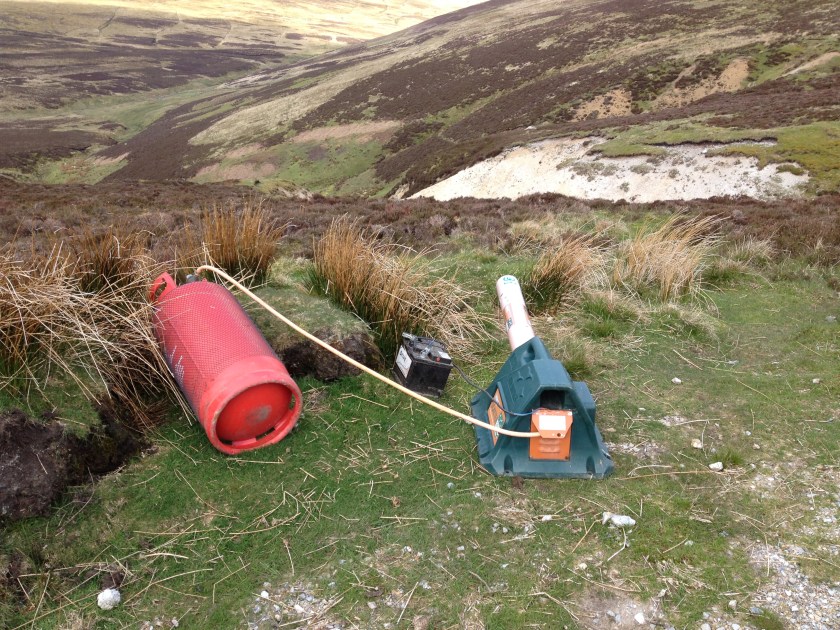
Meanwhile, grouse moor managers are still using these gas guns. The following photographs were taken on Sunday 22 May 2016 in the Peak District National Park:

Gas gun 1 Broomhead - Copy

Gas gun 2 Broomhead - Copy

Gas gun 3 Broomhead - Copy

Gas gun 4 Broomhead - Copy

This gas gun is on the Barnside Moor, which is part of the Broomhead Estate, owned by Ben Rimington Wilson, a spokesman (see here) for the grouse-shooting industry’s lobby group the Moorland Association. The grouse moors of the Broomhead Estate are part of a regional Special Area of Conservation (SAC), Site of Special Scientific Interest (SSSI) and Special Protection Area (SPA), designated as a site of importance for short-eared owl, merlin, and golden plover.

Now, what’s interesting about the placement of this particular gas gun is that it lies a few metres outside of the SPA boundary, although the gas gun is pointing towards the SPA:

SPA OS - Copy

SPA close up - google map - Copy

What’s interesting is whether this gas gun was deliberately placed outside of the SPA boundary, to avoid having to ask Natural England for deployment consent? Although we would argue that even though the gas gun isn’t placed directly within the SPA, it is placed directly adjacent to it and the noise from that gas gun will definitely resonate across the SPA boundary line, potentially disturbing ground-nesting species such as short-eared owl, merlin and golden plover, for which the site was designated. (Hen harrier is not on the site’s designation list, presumably because when the site was designated, there weren’t any hen harriers nesting there, even though this is prime hen harrier habitat!).

But even though the gun isn’t directly placed within the SPA, it does sit (just) within the SSSI boundary:

SSSI close up - google map - Copy

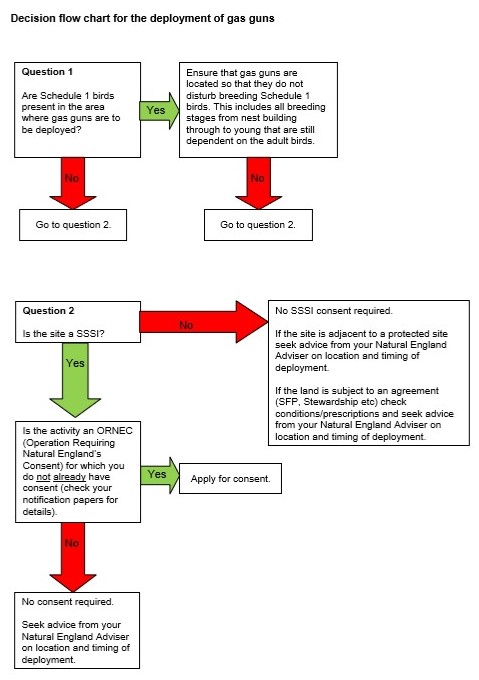
This leads us to believe that the deployment of this gas gun will require consent from Natural England as it falls under the list of ‘operations likely to damage the special interest of the site’, namely, ‘change in game management and hunting practice’.

Has Natural England given consent for the deployment of this gas gun at this site? If so, how has it justified that deployment? If Natural England hasn’t given consent, is the deployment of this gas gun contrary to section 28 of the Wildlife & Countryside Act?

We don’t know the answers to these questions because we’re still waiting for Natural England to publish its policy on gas gun use, even though this guidance document was promised before the start of the 2016 breeding season!

Natural England needs to pull its finger out, pronto, and publish clear guidelines for use. If you’d like to email Alan Law, Natural England’s Chief Strategy & Reform Officer (he’s the guy who last September told us the guidelines would be available by early 2016) and ask him where that guidance document is, here’s his email address: alan.law@naturalengland.org.uk

You may also remember that a couple of weeks ago, SNH gave their opinion of what we should do if we found a gas gun being deployed on a grouse moor (see here). It was a very confused statement, but part of their advice was that intentional or reckless disturbance of a Schedule 1 species (such as hen harrier or merlin) is an offence and any suspected incidents of this through gas gun use should be reported to the police.

In our view, this would be a big waste of time – we can’t see the police having any interest in investigating gas gun use, and even if they did, they probably wouldn’t know where to start. But, just as a test case, why don’t we report this gas gun to South Yorkshire Police as a suspected wildlife crime (potential reckless or intentional disturbance of a Schedule 1 species) and let’s see what they do with it.

Here is the information you need:

Gas gun grid reference: SK233978, Barnside Moor, Peak District National Park

Date observed in use: 22 May 2016

Please report this to Chief Superintendent David Hartley, South Yorkshire Police’s lead on wildlife crime: david.hartley@southyorks.pnn.police.uk

We’d be very interested in any responses you receive!

And if you’re in email-sending mode, you might also want to sent one to Sarah Fowler, Chief Executive of the Peak District National Park Authority and ask her whether there is a policy for the deployment of bird scaring devices on sensitive moorlands within the National Park. Email: sarah.fowler@peakdistrict.gov.uk

National Trust: bold or bottling it?

It’s been over a month since the National Trust said they were launching an investigation in to what they described as a “suspicious incident” where an armed man was filmed sitting next to a decoy hen harrier on a National Trust-owned grouse moor in the Peak District National Park.

Fake Hen Harrier (1) - Copy

How’s that investigation going? Given that the National Trust knew about this incident when it was first reported to them in February 2016, they’ve had plenty of time to ask questions of their grouse moor tenant and decide on what action, if any, they will take.

As a result of their investigation, we’re expecting them to do one of two things:

  1. Nothing.
  2. Withdraw the tenancy agreement that allows driven grouse shooting on that moor.

The National Trust has previously been bold about withdrawing shooting leases on land it owns. In 2011 it decided not to renew two of three shooting leases on its Wallington Estate in Northumberland (see here), and in 2012 it terminated the lease on a pheasant shoot on the Polesden Lacey Estate in Surrey (see here).

Will the National Trust be bold in the Peak District National Park? We think they’ve got very strong grounds for pulling the grouse-shooting lease in this instance because the grouse moor in question is part of the Peak District Bird of Prey Initiative – an initiative that has utterly failed in its objective of increasing the populations of breeding raptors in the Dark Peak area of the National Park. Presumably the National Trust’s grouse shooting lease includes a clause that demands cooperation from the tenant to reach that objective and if cooperation isn’t forthcoming, the contract can be considered to have been breached?

Let’s ask the General Manager of the National Trust in the Peak District, Jon Stewart, when we might expect to hear the findings of the National Trust’s investigation. Emails to: jon.stewart@nationaltrust.org.uk

We’re also intrigued as to why no official statement about this incident has been offered by the Peak District Bird of Prey Initiative. We’ve heard from individual member organisations such as the Peak District National Park Authority (see here) and the Moorland Association (see here), but there’s been total silence from the collective  BOP Initiative. Isn’t that strange?

The BOP Initiative is chaired by the Peak District National Park Authority and its ecologist, Rhodri Thomas, is the PDNPA’s representative on the BOP Initiative. We’d like to know how the BOP Initiative intends to respond to the video footage and how this incident will affect the progress of this so-called ‘partnership’? Let’s ask him. Emails to: rhodri.thomas@peakdistrict.gov.uk

Scottish gamekeeper charged in connection with shooting of hen harrier

Court proceedings began at Elgin Sheriff Court yesterday against gamekeeper Stanley Gordon who has been charged in connection with the shooting of a hen harrier in June 2013.

Stanley Gordon, 60, of Cabrach, Moray, did not enter a plea and the case was continued until 16th June 2016.

Statement from Cairngorms National Park Authority re: shot goshawk

mon-15-june-copyGrant Moir, Chief Executive of the Cairngorms National Park Authority, has today issued a statement about the recent shooting of a goshawk (here) on land within the National Park:

We are incredibly frustrated to again be putting out a statement condemning the shooting of a raptor in the National Park. We must ensure such crimes become a thing of the past. We will be working with the new Minister for Environment to consider what else we can do in the National Park, building on public support for our wildlife and finding ways of getting more eyes and ears on the ground. We encourage anyone with information relating to this incident to contact the police by calling 101”.

The condemnation is good and is the least we should expect. However, the bit about “We will be working with the new Minister for Environment to consider what else we can do….” shows good intent, but in reality amounts to little more than a PR soundbite.

Remember the Cairngorms Nature action plan, aimed at restoring raptor populations & managing mountain hares for the benefit of golden eagles within the Cairngorms National Park (CNP), launched with great fanfare in May 2013 (see here)?

A resounding failure, as evidenced in May 2013 by the mysterious ‘disappearance’ of a young sat-tagged golden eagle on a CNP grouse moor (here); in May 2013 by the alleged ‘coordinated hunting’ and subsequent shooting of a hen harrier on a CNP grouse moor (here); in April 2014 by the mysterious ‘disappearance’ on a CNP grouse moor of East Scotland’s first fledged white-tailed eagle in ~200 years (here); in May 2014 by this video of masked armed gunmen attacking a goshawk nest within the CNP (here); in October 2015 by the publication of a scientific study documenting the long term decline of breeding peregrines on grouse moors in the eastern portion of the CNP (see here); in February 2016 by the publication of a scientific study documenting the catastrophic decline of breeding hen harriers in the eastern portion of the CNP (here); in March 2016 by the discovery of a dead hen harrier ‘Lad’, suspected shot, found on a grouse moor within the CNP (here); in March 2016 by the news that mountain hares were being massacred on grouse moors within the CNP (here); and again in March 2016 by news that further mountain hare massacres were taking place on grouse moors within the CNP (here); and now in May 2016 by the news that a goshawk was shot on an estate within the CNP (here).

And also remember, the CNPA has already met with the (now former) Environment Minister in January 2015 to discuss the issue of raptor persecution and moorland management within the NP – we blogged about that meeting here. The Environment Minister said afterwards that she ‘welcomed the positive collaboration shown between the CNPA and landowners and looked forward to seeing a real difference on the ground‘.

What is the point of the CNPA having further discussions with another naive Environment Minister? It’s utterly pointless. The grouse moor managers within the Cairngorms National Park are running rings around the Park Authority, and have been doing so for years: Golden eagles poisoned, golden eagles ‘disappearing’, white-tailed eagles ‘disappearing’, hen harriers being shot, breeding hen harriers in catastrophic decline, goshawks being shot, goshawk nests being attacked, breeding peregrines in long-term decline, mountain hares massacred. All within the Cairngorms National Park, the so-called ‘jewel’ of Scottish wildlife. It’s scandalous.

What we need, urgently, from the CNPA is action, not more hand-wringing and platitudes. For a start, the CNPA could be looking at the Sandford Principle (see here and here). There’s an excellent blog called Parks Watch Scotland that has also suggested some courses of action the CNPA could take: see here and here.

The CNPA CEO said today he was ‘incredibly frustrated’. We all are, but the difference is the CNPA has the power to do something about it.

Actually, we do have some power, albeit more indirect than the powers of the CNPA. We have the power to blog about the rampant and persistent persecution of wildlife within the National Park and by doing so, raise awareness amongst an unsuspecting general public of just what is happening to THEIR wildlife within the boundary of THEIR National Park. We’re pretty sure that as more people get to hear about it, the vast majority will be outraged and will join the call for further action to be taken against those grouse moor estates.

Please sign the petition and join 35,000+ calling for a parliamentary debate on the banning of driven grouse shooting: HERE