Philip Merricks moves his “immoveable conditions”

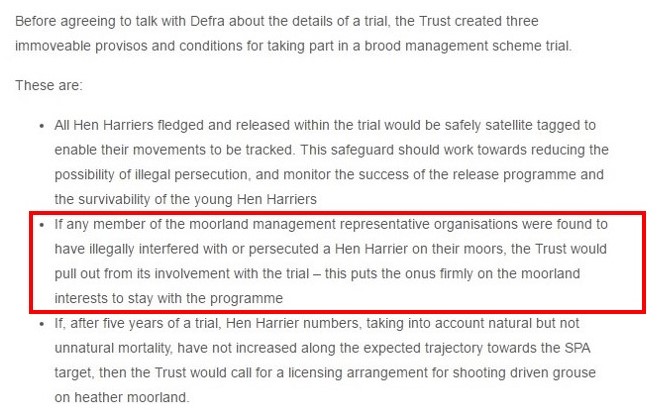
Back in June, we blogged about the Hawk & Owl Trust’s supposed “immoveable provisos and conditions” that had been set, by them, as part of their agreement for taking part in DEFRA’s brood meddling plan (see here).

Here they are, as a reminder:

HOT2

We were interested to hear whether the setting of three illegal pole traps on the Mossdale Estate grouse moor would cause the Hawk & Owl Trust to pull out of the brood meddling scheme because it seemed that one of their “immoveable provisos and conditions” had been broken. The Hawk & Owl Trust didn’t respond.

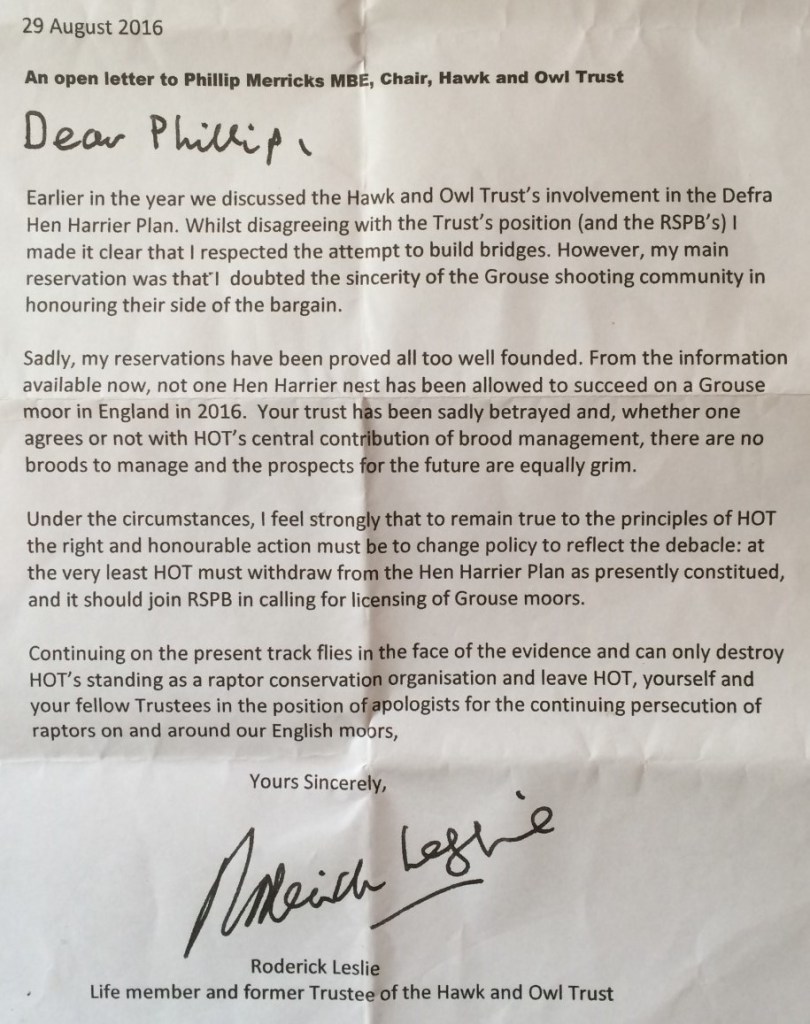
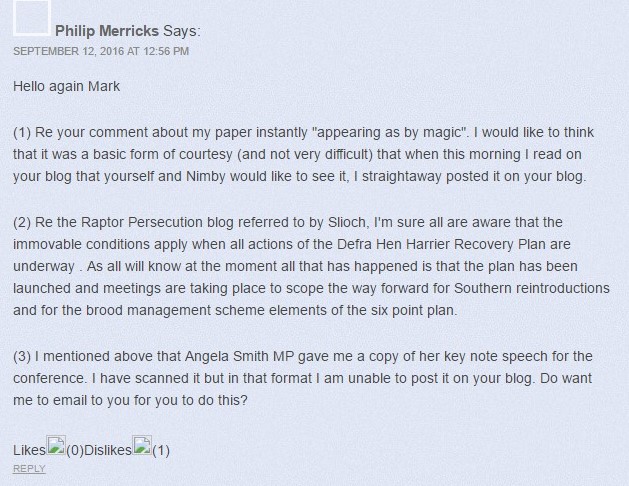
But now they have, in a comment written by Philip Merricks (Hawk & Owl Trust Chair) on Mark Avery’s blog today (see here), and the response is astonishing.

merricks-response

According to Philip, those “immovable conditions” only apply “when all actions of the DEFRA Hen Harrier Recovery Plan are underway“. As two elements of the Plan have yet to begin (brood meddling and the southern reintroduction), apparently the “immovable conditions” are not yet applicable.

But that’s not what the Hawk & Owl Trust said in their original statement about those “immoveable conditions“. Have another look at the Hawk & Owl Trust’s original statement (top image above). The first line reads:

‘Before agreeing to talk with DEFRA about the details of a trial, the Trust created three immoveable provisos and conditions for taking part in a brood management scheme trial’.

What a total bloody cop out! Philip has demonstrated that the Hawk & Owl Trust’s intentions are just as disingenuous as those claimed by the grouse-shooting industry at the beginning of the year when they professed tolerance to a limited number of hen harriers on their moors. Philip knows and accepts that since the DEFRA plan was launched in January 2016 (here), illegal hen harrier persecution has taken place – he acknowledged this throughout his presentation in Sheffield at the weekend (see here), and yet here he is, suggesting that this year’s persecution incidents ‘don’t count’ because the full plan has yet to be launched.

This isn’t conflict resolution, this is the Hawk & Owl Trust acting as apologists for an industry which relies upon the illegal killing of birds of prey. It’s shameful.

What Philip Merricks said at the Sheffield conference

There was a conference in Sheffield last Friday and Saturday: ‘Raptors, Uplands & Peatlands – Conservation, Land Management & Issues’. Mark Avery has written a blog giving an overview of his impressions (here).

Raptor conference poster

We will be publishing a selection of transcripts from this conference and here is the first of those. Note, this is NOT a parody. You’ll probably need to remind yourself of that if you manage to reach the end.

Philip Merricks, Chair of the Hawk & Owl Trust:The Hawk & Owl Trust’s involvement in the Hen Harrier Recovery Action Plan‘.

It’s very good to be at Sheffield. Our daughter spent four happy years here at uni and she very much enjoyed it and got to know and love the moors, and when I took her to meet her brother at another university, ultimately, you know, she was always thought to be brighter than him, after a day of going around his college she said, walking back to the parking, she said: ‘Dad, why do I want to have to come here and do two essays a week when I can go to Sheffield and have a real life?’. But to be serious she got to know the moors and love the moors and now she and her husband are managing a nature reserve in Kent, a long way from the moors, below sea level in Kent, but you know, she has many, many happy, well many happy years out on the moors.

Now I completely agree with everything that Angela Smith said. I don’t know her, but I thought that as local MP everything she said made a huge, huge amount of sense. And it’s a real, real disgrace, I mean a real disgrace that she and other people, Sheffield people, can’t see hen harriers, peregrines and everything else on those moors, it really is an utter, utter disgrace. She made a very good point that to resolve this issue we should remember that politics is the art of the possible, and that it’s always preferable to act on the basis of consensus and partnership, and that’s driven me all of my life and hopefully it drives the Hawk & Owl Trust. Just remember that she said that politics is the art of the possible.

Quick introduction about myself. I manage two National Nature Reserves, Elmley and Swale, and two former RSPB reserves, all below sea level, all in Kent, and the two National Nature Reserves on the Sheppey marshes, they now hold the largest concentration of breeding raptors, breeding birds of prey, in south east England, something we’re really, really pleased about, and also really large numbers of marsh harriers, which I’m sure you will all know are rarer than hen harriers. And as Ian [Ed: Professor Ian Rotherham, Sheffield Hallam University] said were incredibly rare when he was as a student or when he was a young lecturer many years ago. And then 40 miles south in Kent we manage the Romney Marsh reserve, which similarly holds, I’m told, the largest number of birds of prey on the south coast, or south east coast.

I come from a land management background, as you can understand, I’m passionately interested in management for nature conservation and I’m passionately interested in getting an understanding of land management and getting managers to understand, I mean are there any land managers, grouse moor managers in the audience? Does anybody have responsibility for managing grouse? Yeah brilliant, so there’s one guy, who, well I, I’m very keen on talking to land managers to get them to manage their land, you know, for conservation. Whether it’s, and of course I’m a long way away from the moors, but quite clearly, at the end of the, pragmatic point, at the end of the day the overwhelming majority of countryside is managed by farmers and landowners, and that’s a crucial point.

And another introduction point, I should say, I don’t shoot and I never have shot, for those that like to write about me, I’ll just repeat that, I don’t shoot and I never have shot. Ok. But I Chair the Hawk & Owl Trust, I served as a trustee over 20 years ago, a couple of terms which was six years and then the Chairman died, I was no more than an ordinary member then and I was asked to see if I would come back and Chair, which I did, and quite clearly the Hawk & Owl Trust is a pragmatic organisation and it works, its strap line is ‘Working for wild birds of prey and their habitats’. And as you might imagine, the overwhelming majority of wild birds of prey are on land managed by, well by farmers and landowners and of course on the moors and by gamekeepers. So that’s pretty important point, you know, if we’re going to work with those who manage the habitats throughout most of the UK we have to manage, we have to work with farmers and landowners and up here on the moors we have to work with the gamekeepers again.

And this is where we come to the crux of the problem for this whole conference. The Hawk & Owl Trust is more than happy to be working with those who manage the habitats, farmers and landowners, we do that every day, sometimes I do it all day, but it’s not so easy to do it with gamekeepers when it’s pretty bloody clear that a number of them are continuing to break the law, and persecuting these birds, especially hen harriers. So I’ll just repeat that, it really is a despicable crime and something that’s been going on for far too long, and, which we’ve heard today, is continuing. On that line, it’s going on, I recently called in to see a great guy, a former RSPB Chairman, former RSPB Gold medallist, one of the great guys, and he gave me, he showed me, this invitation to a press release, and it just shows that this is something, I think then he was the incoming Chairman of the Council, became Chairman of the RSPB, and it just shows, 1971, you can possibly see that closer I think, 1971 the RSPB were, basically this is staff and council members, were giving a press conference on the persecution of birds of prey. And I mean clearly they were raising awareness of it then and they’re raising awareness of it now, so I’m just showing this is nothing new. What I do like about that, the way the RSPB operated, they stopped at 12.15 for cocktails. Can you see that at the bottom there? I’m sure things go on like that exactly the same way at The Lodge today.

Right. But I said, and I’ll put this up, the position is no damn different or better today. And one of the dreadful examples we’ve seen and you’ve all heard about is the setting of a pole trap on the Mossdale grouse moor. And that is appalling. As soon as I heard about that or was told about it, I went up to Mossdale because I’m always someone who likes to see things at first hand. I’ve got to the age now where actually, I actually want to see things and talk to people about it first hand. Has anybody been to Mossdale by the way? Brilliant, some of you have.I’ve talked to the head gamekeeper, I’ve talked to the owner, has anybody done that? A couple anyway. And I, you know, it was quite appalling, you know, it’s easier in some ways for me to give them a piece of my mind because I can almost speak landowner to landowner, although, you know, they might well be up in, you know, up on the moors and I’m down below sea level but I mean the principle is just the same. It is quite a disgusting incident, despicable act. And you know, I’m sure you’re all aware of it, this is a thing on a post, it holds birds by the legs until they die. I mean, and it was done by an untrained, unsupervised twenty-something year old, 22 year old, and it was a real, real dereliction of management, of supervision, and of training, absolutely appalling. And you know, that is lack of those, supervision and management and training by the head keeper and ultimately by the landowner. And, you know, I, it’s relatively easy for me, landowner to landowner, to say, ‘Look you bloody fool, you, you are, well, not just breaking the law but you’re letting all of us down whether we’re in below sea level in Kent or whether you’re up here’. And I, I, think, you know, perhaps things like that are easier.

So, how do we bring this to an end? We all want the same thing, everyone in this room wants the same thing. I think that’s the one thing that unites us, and the only thing that we may differ about is how we do it and that’s why I think we can all agree with that. Mark, [Avery] down on the front row, will say that banning grouse shooting is the best bet, and the RSPB will say that licensing is the best bet, but as Angela Smith said this morning, politics is the art of the possible, and I did clock that pretty strongly. And, you know, on that government has made it abundantly clear that they won’t go down the route of banning it and they won’t go down the route of licensing it and it seems now that this government is stabilised, with, with, Theresa whats-her-name, Theresa May, but, you know, stabilised for another three years and probably another term after that, so for a long time, you know, this government is in power and they’re not going to change their minds. So, on the art of the possible, if the first two routes are off the table that only leaves the government’s preferred option of the DEFRA six point plan which we heard about in detail from Adrian [Adrian Jowitt, Natural England] today. And of course, there are many people who for whatever reason don’t like that, but I bring you back to this point, this Angela Smith point, about, you know, politics being the art of the possible.

But another guy I went to see, you know, and who’s a good friend of mine who I’ve known for 20 years and is one of the great, great conservationists, well he’s a guru to me more than a friend. I like, I’m proud to call him a friend, he’s a guru to me, probably for 30 years, he’s guided all my steps in conservation, possibly for 35 years, and he’s one of the great, I mean he is of probably of all conservation biologists of all time, he’s probably done more for birds of prey than anyone else. You know, we heard from Ian [Rotherham] about the effect of persistent organochlorides [sic], DDT, on raptors, and this is the guy who started and appointed the team, and that team that included great people like Derek Ratcliffe, he, he set up that team at the research and then eventually cracked the problem of the birds of prey and of course, you know, I guess many of you will know who that is, Norman Moore. He really was one of the greats and I’m proud, well, we all need our gurus don’t we. He was, he was one for me. And it was such a privilege, I had the honour of speaking at his memorial service at the cathedral earlier this year and it was a huge, huge privilege to do that, and you know, he was immensely effective and was one of the greats.

So we get to the next one [next image on screen], and this is what he said. Can everybody at the back read that? Well, you don’t need me to tell you about it, you don’t need me to read it, but I’ll just leave you with it. You. Are you comfortable now, having read it? Well the point being, now who was it made that point this morning? Was it, was it Ian? Made that point, or somebody who made it, it’s just not science. And a couple of issues, people with different points of reference, well, we know that grouse moor managers have got different points of reference so things have to be explained, but, I’m pretty certain it was Ian who made that point this morning. But what for me, we just have to, if we want to get things across we have to get them across to people who are culturally completely different.

Right, my, the subject of my talk which I hope I haven’t wandered from, you know, I’m talking about the Hawk & Owl Trust’s involvement in the DEFRA plan and we heard from Adrian this morning and he went through it, so the first one, prevention, intelligence, led by senior police officers […inaudible…]. Well done to all involved and more power to your elbow.

Second one is monitoring of hen harrier breeding sites and winter roost sites. Well I do know a bit about this because winter roost sites on, in fact all four of our, well three of the, our four reserves are winter roost sites for raptors and marsh harriers and that’s when we see these hen harriers, down with us in the south east, that’s when we see them, and it’s absolutely crucial they’re monitored everywhere and protected everywhere, so well done to the guys who do that and usually on a voluntary basis.

So, and then of course number three, the sat tagging and the satellite tracking. Well, I mean nobody knows more about that than the other Steve [Stephen Murphy, Natural England] and he’s told me all about it, and I’m really pleased to see, to say that a number of tags have been fitted this year, tags funded by the Trust and fitted by, by Steve, and, and, and Trust staff and volunteers I think were with him when, when, it was, I mean they were fitted. And I think you’ll soon, as soon as they, well Steve will be able to tell you more of the detail, but soon you’ll be able to see the, their movements on the website. I mean it’s something I’m not very good on IT but I mean it’ll be really, really interesting that, and I, and I think it’s crucial, the more sat tags that are fitted, by everyone, the RSPB have obviously fitted them in the EU LIFE campaign means they can fit a lot, the less likely it will be, criminal gamekeepers to shoot them in other areas, you know, the risk will become increasingly greater because, you know, and I think this, this really does prevent it.

And then number four, diversionary feeding. I’ve been to Langholm a couple of times, well actually three, but once in early days and I’ve seen how effective this is and we’ll hear about this tomorrow from the speaker tomorrow, Sonja [Sonja Ludwig, GWCT], the speaker tomorrow, and of course this obviously is something that’s strongly supported and it should be carried out more widely and it is of course I’m told that people do it and where they, yeah, and it’s so damn obvious.

Number five, southern reintroductions, that was explained by Adrian and that’s something that obviously hasn’t started yet but of course it’s important and that’s where it’s crucial to get some confidence of landowners, farmers and others in the areas where they’re going to be reintroduced or where it’s proposed that they’re going to be reintroduced. It’s all about getting the confidence of the guys who manage the land, and there are several places been suggested, and, and that should be very interesting.

And then number six, which is what we hear so much about, we’ve already heard today, the trialling, and I do say trialling, people seem to think it’s an action, it is a trial. It’s the trial removal of eggs and young chicks where a certain threshold’s been reached. The incubating of them, the rearing of them, and you know, and don’t forget the Hawk & Owl Trust has got world class facilities to do this, owned and managed by a Trustee, and these really are world class facilities. And then of course, as Steve was telling us, released back on to the moors. And the other thing that we’ve done, the Trust, is make a really, really determined effort to get to know moorland owners and moorland managers and we’ve got quite a, quite a list of moorland managers and moorland owners who would be keen, no, more than keen, they would be proud, I’ll say that again, they would be proud to have hen, a pair of hen harriers on their moors. Of course they know that there’s, they’re semi-colonial nesters and everything but they’re proud to act as receptor moors for those translocated birds.

And I think the key issue about the DEFRA recovery, hen harrier recovery plan, is that while that hen harriers benefit hugely from and are largely dependent on the habitats created by good moorland management, large number of hen harriers and once again as I’ve said, don’t forget they are semi-colonial nesters can make grouse shooting unviable and we’ve heard about that hence, you know, that the management has that choice. As Langholm has shown, or, I mean, you’ll dispute what it’s shown, but I’m no expert on Langholm, but that, but that, oh I’m sorry I’m just losing my place, but, well you all know what Langholm does and you’ve all made up your own mind what Langholm did but it’ll get written up over the years and then we’ll all know more about it.

But I guess that, I guess the issue is, on the moors, that gamekeepers fear for their jobs, and their income and their houses, and they do continue with this appalling persecution, or some of them continue with this appalling persecution of these lovely birds and this is quite appalling. But, I mean and Mark said, in his book, it’s an understandable crime and there’s a reason for it, and I’m going to put Mark’s book up on the thing which is a really good read, it’s an interview with many bird watchers, and Mark’ll probably tell us about it. Right, good, now I’m almost at the end which I’m sure several of you will be relieved about. Right. Behind the Binoculars, and interesting one, on we go to the next one, this is where he interviewed, that’s right, Ian Newton, Ian obviously an eminent guy, eminent guy, Hawk & Owl Trust Vice President and he Chairs the Hawk & Owl Trust scientific advisory panel, so on to what he said. Mark, the first paragraph is Mark and I’ll just read the bits that I think, clearly he had the viewpoint that it [hen harrier persecution] was understandable, so what are we going to do about it? And Ian then on the second paragraph goes through and says well there are three possibilities as we heard about this afternoon and then on to the next one and then he says, this is Ian Newton again, really I think you’re left having to accept a third proposal: that harrier densities could be limited on grouse moors, to levels that allow some hen harriers to survive but allow grouse shooting, driven grouse shooting, to survive also. Ok, the idea then was the difficulty was in finding landowners. Well the good thing is that we’ve done that work, you know, because we’ve found landowners, we’ve got as I said, quite a respectable list. Then he says that would be a potential solution, and I bring you back to this word ‘potential’. Everybody thinks well we don’t know if it’ll work but it’s a potential solution.

So, where do we go to now? And I’m being hurried up, which is good, right. So, it goes on to say that we have, and it is a trial, I’m rattling through that, and I’ll just bring you back to something that Professor Redpath said. There’s a lot of evilness out there, and I like that word, it’s been used lots of times, Chris Packham, I picked up, it is because there is a lot of evilness out there but this trial will find out whether this evilness ceases or not, it’ll discover whether removing the reason for the crime reduces the crime, which’ll be the key. Whether it’ll work, I don’t know but grouse moor owners, or some of them, say that it will and I sincerely hope it will but it’s up to the guys out on the moors. We’ll find out whether this attempt at conflict resolution, and I’m a great believer in conflict resolution, we’ll find out whether it works or not. And for the sake of our hen harriers I hope it does.

END

Trial for gamekeeper re: alleged shooting of a hen harrier

Criminal proceedings continued at Elgin Sheriff Court on Thursday against Scottish gamekeeper Stanley Gordon.

Mr Gordon, 60, of Cabrach, Moray, is facing a charge in connection with the alleged shooting of a hen harrier in June 2013.

Mr Gordon entered a not guilty plea at Thursday’s hearing and so this case will now move to trial. An intermediate diet has been set for 18 November 2016 (this is an administrative hearing to establish whether both the defence and prosecution are ready for trial) and the trial date itself has been set for 19 December 2016.

Previous blogs on this case hereherehere and here

PAW Scotland rejects gamekeeper’s claims as ridiculous

Further to the claims of Scottish gamekeeper Donald McBeath that ‘bird activists’ are killing golden eagles and hen harriers as part of a smear campaign against grouse shooting (see here and here), the Partnership for Action against Wildlife Crime (PAW Scotland) has dismissed his claims as ridiculous.

PAW Scotland statement:

The Partnership for Action Against Wildlife Crime (PAW) Scotland is calling for a cool-headed discussion about the disappearance of birds of prey in the Scottish highlands.

The call comes following unsubstantiated claims by a gamekeeper who believes ‘bird activists’ might be to blame. Louise Batchelor, a spokesperson for PAW Scotland, says that there appeared to be no evidence to back the claims. There were reports that the gamekeeper said: “I certainly would imagine that there would be a few activists who would take a chance of doing something and I wouldn’t put it past them.’’

Reports also said that some pressure groups had called for grouse shooting to be outlawed and they reported the gamekeeper as saying that call ‘might give activists a motive for sacrificing a few birds of prey’. Louise Batchelor said: “The idea that ‘bird activists’ were responsible for the disappearance of golden eagles and hen harriers as part of some conspiracy theory, to smear gamekeepers, is ridiculous. This kind of claim, made without foundation, cannot go unchallenged and PAW Scotland will continue to take the lead in any serious debate about what is happening to Scotland’s birds of prey. ”

It’s understood that the gamekeeper behind the claims does not belong to the Scottish Gamekeepers Association, who are members of PAW Scotland. A spokesman for the SGA said: “As has always been the case since these reports have emerged, our sole focus is the investigation.  The SGA will do anything we can to assist Police Scotland and the Scottish Government in their investigations and we do not comment on the opinion of private individuals.”

END

Well done, PAW Scotland!

Gamekeeper accusing ‘bird activists’ of killing raptors was on TV last night

Following yesterday’s blog about that Scottish gamekeeper who was interviewed on BBC Scotland radio, accusing “bird activists” of killing satellite-tagged golden eagles and hen harriers (see here), he was also on the telly last night.

The TV piece was a shortened version of the radio interview. Here’s the transcript they left out:

I now have very strong reason to believe that we’ve got some bird activists in the area. I now have strong suspicions it’s a bird activist. They’re so close to winning this case against the grouse moors. I don’t know if any of the gamekeeper lads over this side of the hill would like to be responsible for going down in history for getting the grouse shooting banned but I certainly would imagine there’d be a few activists who’d take a chance of doing something and I wouldn’t put it past them“.

The TV version focuses on him denying any gamekeeper involvement because there’s ‘no evidence’. Unfortunately, the presenter didn’t do a very good job as he failed to challenge Mr McBeath’s views. He could have discussed the 30+ years worth of overwhelming evidence that all points to the grouse shooting industry, but he didn’t. Or if he did it was edited out.

Ah well, the video is still very funny. Here’s the clip from BBC Reporting Scotland (evening news, 30 Aug 2016).

Enjoy!

“Bird activists” killing satellite-tagged raptors, says gamekeeper

It’s ok everybody, the mystery of the vanishing satellite-tagged raptors has finally been solved. It wasn’t the (non-existent) wind farms (see here). And it wasn’t the unreliable satellite tags with a dodgy salt water switch attached to Olive Ridley Turtles off the coast of India (see here).

No, the real reason, according to a Scottish gamekeeper, is that “bird activists” have been killing off the raptors as part of a smear campaign against those who manage grouse moors.

Phew. Glad that’s all been cleared up.

Have a listen to gamekeeper Donald McBeath, interviewed on Good Morning Scotland earlier today (here – starts at 02:51:37, available for 29 days).

gamekeepers prosecuted - Copy

UPDATE 31 Aug 2016: The name of this gamekeeper is Donald McBeath, not Donald Macbeth.

UPDATE 31 Aug 2016: Mr McBeath was on the telly last night. Watch the video here

UPDATE 1 September 2016: PAW Scotland dismisses gamekeeper’s claims as ridiculous here

Review of Scottish raptor satellite-tag data widened to three species

A couple of weeks ago we blogged about the Cabinet Secretary for the Environment’s call for a review of golden eagle satellite tag data (see here). This was in response to the news that eight young satellite-tagged golden eagles had ‘disappeared’ on grouse moors in the Monadhliaths over a five year period, with three of them vanishing this year alone (see here). Cabinet Secretary Roseanna Cunningham called for the review “to discover if there is a pattern of suspicious activity“.

Shortly afterwards, the news broke that a young satellite-tagged hen harrier (‘Elwood’) had also ‘disappeared’ on a grouse moor in the Monadhliaths (see here). We wondered how Roseanna Cunningham would react to this news and hoped her response would be more substantial than the usual Ministerial expression of “disappointment“.

It seems she has taken note. Here is her response:

The news that a juvenile hen harrier has disappeared in the Monadhliaths, complete with its satellite tag, only weeks after it fledged, strengthens my determination to get to the truth about how, where and why raptors with functioning satellite tags seem to be regularly disappearing. I have asked for a review of all the evidence and I intend to ensure that data from hen harriers and red kites, as well as data from golden eagles will be considered as part of this. We are continuing to collect evidence in relation to raptors in Scotland, which will be a significant factor in deciding the next steps for tackling wildlife crime.”

So, the review has been widened from just looking at golden eagle satellite tag data to now including hen harrier and red kite satellite tag data. We are pleased about this (with certain caveats, see below), although we still maintain that the review is superfluous to understanding and acknowledging what’s happening to these species on driven grouse moors. The scientific evidence is already clear, and has been available to the decision makers for many, many years. Let’s not pretend we don’t know what’s going on. Looking for, and finding, ‘patterns of suspicious activity‘ has been done to death and the findings have been conclusive, over and over again.

Elwood 2 - Adam Fraser

The reason we welcome the widening of this review is because we can already predict the results for each of the three species, and we predict they will all point to the same problem: the majority of young, satellite-tagged golden eagles, hen harriers and red kites that ‘disappear’ do so on driven grouse moors. Seeing the evidence from one species (golden eagles) would be pretty powerful, but having virtually identical results from two further species should be devastatingly compelling.

The caveat to welcoming this widened review is that the Scottish Government MUST push on with this review without delay and then MUST respond to the findings in a timely manner. This Government (and notably its statutory conservation advisory agency, SNH) has a long track record of prevarication when it comes to publishing results and then acting on the evidence provided. Here are some examples:

The Golden Eagle Conservation Framework (an holistic approach to assessing raptor conservation, trying to find out what’s going on regionally and nationally and trying to look at what’s limiting numbers and influencing productivity). This impressive and substantial review was submitted in 2003. It wasn’t published until 2008. The report identified illegal persecution as a significant constraint on the population.

The Hen Harrier Conservation Framework. Another impressive and substantial review that was submitted in 2008. It wasn’t published until 2011. The report identified illegal persecution as a significant constraint on the population.

The Hen Harrier Conservation Framework Update. This update was required after land managers criticised the 2011 report because it excluded results from the 2010 National Hen Harrier Survey. The update report was submitted in 2013. It has still not been published (and is likely to be further criticised because it won’t include results from the 2016 National Hen Harrier Survey!). We know (because we’ve attended several presentations given by one of the authors) that this report identifies illegal persecution as a significant on-going constraint on the population.

The Peregrine Conservation Framework. This review began in 2003 (or thereabouts – we’re not certain of the exact start date). An interm progress report was published in 2007 but nothing further since then.

The consultation on increased investigatory powers for the SSPCA. This consultation was first suggested in 2011. The consultation was finally launched in March 2014. The consultation closed on 1 September 2014. In May 2016, Cabinet Secretary Roseanna Cunningham said a decision “would be announced in due course“. This coming Thursday will mark two years since the consultation period ended.

Population modelling of red kites in northern Scotland. This review aimed to update the findings of a paper published in 2010 which showed illegal persecution was responsible for the slow population growth in this region. The review was submitted in 2015. It has yet to be published. We know (through informal discussions with colleagues) that this report identifies illegal persecution as a significant on-going constraint on this population.

Wildlife Crime Penalties Review. This review was commissioned in July 2013 and it finally reported in November 2015. In February 2016 the then Environment Minister Dr Aileen McLeod accepted the report’s recommendations. We have yet to hear how the Scottish Government intends to progress those recommendations.

Review of gamebird licensing and legislation in other countries. This report was commissioned in January 2016 and the final report was submitted in late spring 2016. The report has yet to be published. Claudia Beamish MSP has lodged a parliamentary question (dated 18 August 2016) to find out when the Government intends to publish.

Decision on the fate of the Tay beavers. In March 2012 the then Environment Minister Stewart Stevenson delayed a decision on the fate of the Tay beavers for three years, until the end of 2015. In May 2016, the current Cabinet Secretary Roseanna Cunningham announced a further delay ‘until later in 2016’. That decision is still pending.

These examples do not inspire great confidence in the Scottish Government’s willingness to act quickly on issues of wildlife conservation, and particularly those issues relating to the illegal persecution of raptors. These long delays only inspire frustration and increasing anger. Let’s hope that with this latest review of raptor satellite tag data, Roseanna Cunningham encourages a fast review process, doesn’t delay the publication of the findings, and acts quickly and robustly to implement measures against those who continue to flout the law.

Photograph shows young hen harrier ‘Elwood’ with his satellite tag, just a few weeks before he ‘disappeared’ on a grouse moor in the Monadhliaths. Photo by Adam Fraser.

Flawed Natural England policies assume gamekeepers don’t illegally kill raptors

We’ve been blogging for over a year about the use of propane gas guns on grouse moors and about our concerns that these booming bird scaring devices are being used to discourage raptors (and particularly hen harriers) from settling to breed (e.g. see here, here, here, here).

In June this year, Natural England finally produced what they called ‘guidance’ for those wishing to deploy gas guns and published a decision flow chart. It looked like this:

Gas gun guidance NE - Copy

A spokesperson for Natural England said he hoped the guidance was helpful (it wasn’t, see here) and welcomed further questions if clarification was needed.

One of our blog readers did want further clarification and he asked Natural England to explain how ‘ensuring that gas guns are located so that they do not disturb breeding Schedule 1 birds’ would work in practice?

Here’s Natural England’s response:

In response to your query the onus is on the land manager or their representative not to cause disturbance as that would be unlawful. The use of gas guns aims to dissuade species such as corvids from causing damage to ground nesting birds or livestock. On large expanses of open moorland they should be able to be deployed away from Schedule 1 species. Most managers should know where these species are present but it would be best practice for Natural England and other interested groups, for example raptor study group members, to pass on information over the location of Schedule 1 species to the land manager so they are in a more informed position and then able to ensure that gas guns are deployed appropriately“.

Ah, of course. Because telling the grouse moor manager/gamekeeper where you’ve seen hen harriers will undoubtedly lead to those birds being protected and left undisturbed, right? Have you got that, raptor study group workers?

And here’s another ingenious policy strategy from Natural England. In response to the news that Natural England had issued a licence to a gamekeeper allowing him to kill up to ten buzzards in order to ‘protect his pheasants’ (see here), another blog reader (@exPWCO) asked Natural England how they would check that just ten buzzards had been killed? Here’s Natural England’s response:

NEbuzzLicence

Ah, of course. Because asking a gamekeeper to fill in a form stating how many buzzards he’d killed under licence is bound to result in a truthful response, right?

Both of these policy statements just beggar belief. They are both based on the assumption that gamekeepers don’t illegally kill raptors, which, as we all know (and so should Natural England), is a flawed assumption.

gamekeepers prosecuted - Copy

Young satellite-tagged hen harrier ‘Elwood’ disappears on Monadhliath grouse moor just weeks after fledging

ElwoodWith depressing predictability, news has emerged that one of this year’s young satellite-tagged hen harriers (a male called ‘Elwood’) has ‘disappeared’ on a grouse moor in the Monadhliath mountains just a few weeks after he fledged from his nest in Banffshire.

RSPB press release:

Another satellite-tagged bird of prey disappears in the Monadhliath Mountains

RSPB Scotland has today announced that a young male hen harrier, fitted with a satellite transmitter as part of the charity’s part EU funded Hen Harrier LIFE+ Project, has gone missing on a grouse moor in the Monadhliath Mountains, south-east of Inverness.

The bird, named Elwood, was the only chick to fledge from a nest in Banffshire, which was being monitored under the Partnership for Action against Wildlife Crime Scotland (PAW Scotland) ‘Heads-up for Harriers scheme’.

The transmitter’s data, being monitored by RSPB Scotland staff, indicated that the young bird fledged from its nest in the first week of July, but stayed close to the site in the hills above the River Spey until the 20th, when he began to travel more widely. By the 27th, he had moved 20 miles to the south west, and had settled in the hills around Tomatin.

The bird remained in this area, with the transmitter providing detailed information about his daily travels until suddenly, transmissions ceased abruptly on August 3rd. The bird’s last recorded position was on an area of managed moorland a few miles from the Slochd summit on the A9.

Last week, news emerged that eight satellite-tagged golden eagles had also disappeared in the northern Monadhliaths in the last five years, with three of these birds, whose transmitters were also functioning normally, going ‘off the radar’ this spring [see here].

Ian Thomson, RSPB Scotland’s Head of Investigations, said: “This latest disappearance of a satellite-tagged bird is deeply concerning, and joins the long list of protected birds of prey that have been confirmed to have been illegally killed or disappeared suddenly in this area. The transmitters being fitted to these birds are exceedingly reliable, and illegal persecution is therefore the most likely explanation of the disappearance of these birds of prey. The absence of typical breeding raptor species from areas of suitable habitat, or at traditional nesting sites, in large parts of the Monadhliaths is further supporting evidence of a major problem with wildlife crime in this general area.

This case is all the more depressing as the nest from which Elwood successfully fledged was monitored as part of a partnership project between PAW Scotland and the local landowner. It proves, yet again, that despite there being a good number of enlightened estates who are happy to host and protect nesting birds of prey – as soon as they move away from these areas they are being illegally killed.

The denials and obfuscation from representatives of the land management sector, and their consistent failure to acknowledge and address this problem, is one of the main reasons why our bird of prey populations are struggling in the central and eastern Highlands. We repeat our call to the Scottish Government to introduce a robust system of licensing of game bird hunting, where the right to shoot is dependent on legal and sustainable management of the land, in line with approaches adopted in most other European countries.”

END

So what now, Roseanna Cunningham, Cabinet Secretary for the Environment? How are you going to react to this one? Are you going to tell us how ‘disappointed’ you are? Are you going to tell us that more research needs to be done to understand why driven grouse moors in Scotland are almost devoid of breeding hen harriers (and golden eagles and peregrines)? Are you going to tell us that the Partnership for Action against Wildlife Crime is effectively addressing this problem? Are you going to believe the lies of the organisations within the grouse-shooting industry that there is ‘no evidence’ that raptors are routinely and systematically killed on driven grouse moors? Are you going to tell us you’re still looking for ‘a pattern of suspicious activity’? Are you going to tell us that you will ‘not hesitate to take further action if deemed necessary’? Are you going to tell us we need to wait to see whether previous anti-persecution measures are working?

How about you tell us that you’ve had enough, that you believe that further action IS necessary and that you’ll be using your powers as Cabinet Secretary for the Environment to put an end to this shameful slaughter?

You could support the call for an introduction of licensing for all gamebird hunting in Scotland, so that these grouse-shooting estates can finally be held to account for their criminal acts. Well, assuming any licensing system is actually properly enforced, but that’s another matter.

And you really should pay attention to the strength of feeling against driven grouse shooting that has emerged south of the border (with considerable support from Scottish voters, too), which will now result in a parliamentary debate in Westminster later this autumn on the subject of banning driven grouse shooting.

Whatever you do, plenty of people here, and around the world, are watching.

Coordinated hunt & shooting of a hen harrier in 2013 – location revealed

A couple of years ago (20 June 2014) we blogged about the alleged coordinated hunt and shooting of a male hen harrier on a grouse moor in Scotland (see here).

This alleged crime had actually taken place in May 2013 – it was reported to Police Scotland by the two members of the public who had witnessed the event, Police Scotland investigated but no further evidence was available to take the case forward.

For some reason, Police Scotland failed to publicise this incident or appeal for information, despite hen harrier persecution being a UK National Wildlife Crime Priority. Instead, it was left to the RSPB to issue a press release over a year later (see here) as part of a wider call for more sporting estates to take action to protect hen harriers.

At the time, the location of this incident was pretty sketchy. The RSPB press release said it took place ‘on a moor in the eastern Cairngorms, within the boundary of the Cairngorms National Park’.

But then roll on to late 2015 and the publication of RSPB Scotland’s 20-year review of raptor persecution crimes. If you have a look at Table 3 in this report, which details confirmed incidents of persecution or attempted persecution (excluding poisoning) of birds of prey in Scotland 2013, the following information appears:

HH shot Glen Gairn

According to this table, a hen harrier was shot at ‘Glen Gairn’ in Aberdeenshire in May 2013. We presume, given the date and location, this is the same incident as referred to in that 2014 RSPB press release.

So, Glen Gairn. Where’s that then?

Well, would you believe, part of Glen Gairn appears to lie at the eastern boundary of Invercauld Estate, not a million miles from where those illegally-set spring traps were recently discovered at Gellaig Hill. (Map detail created from information provided on Andy Wightman’s Who Owns Scotland website).

Glen Gairn final - Copy

Now, we should urge caution here before anyone jumps to conclusions. This map is slightly misleading because it suggests that Glen Gairn lies entirely within the boundary of Invercauld Estate. It doesn’t. Glen Gairn extends east across the river, beyond the Invercauld Estate boundary, and on to the grouse moors of neighbouring Dinnet Estate.

We don’t know exactly where in Glen Gairn those two members of the public watched the alleged coordinated hunt and then shooting of that male hen harrier in 2013. It could have been on the Dinnet side of the Glen, or it could have been on the Invercauld side of the Glen, or it could have extended across both sides of the Glen. We don’t know, but presumably Police Scotland will know if those two members of the public were able to give accurate grid references.

As so often happens, there was insufficient evidence to proceed with a prosecution so we have no idea who was responsible. It must have been the handiwork of those pesky moorland fairies. They do seem to be quite active in this part of the Cairngorms National Park, don’t they?