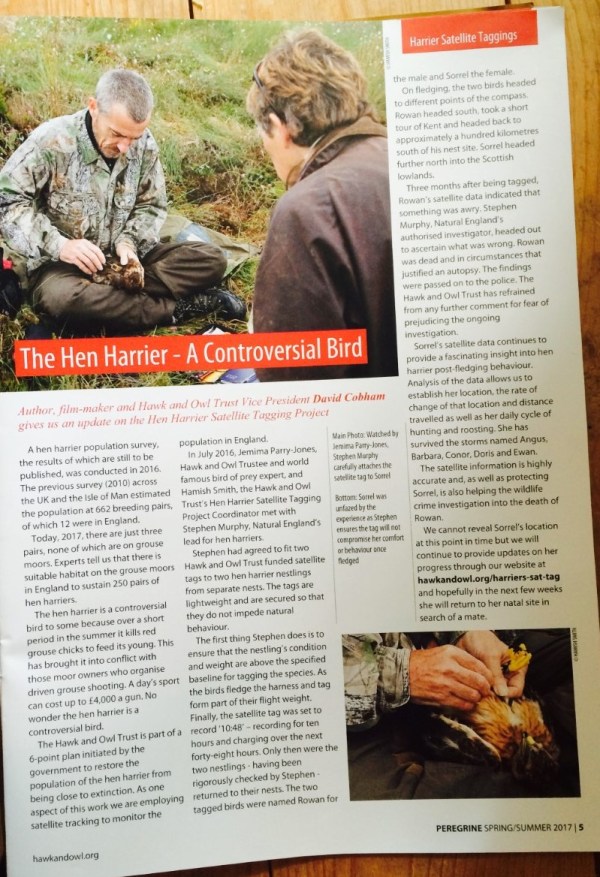
Species Champion Mairi Gougeon MSP speaks up for hen harriers

‘Species Champions’ are members of the Scottish Parliament who have agreed to provide political support and awareness for Scotland’s threatened wildlife, under a scheme organised by Scottish Environment LINK.

Mairi Gougeon (nee Evans) MSP is the Species Champion for the hen harrier, and it was fantastic to see her attend Hen Harrier Day at Loch Leven a couple of weeks ago. She wasn’t the only MSP present – also in attendance was Alexander Stewart MSP (Scottish Conservatives) and Andy Wightman MSP (Scottish Greens) – Andy had cycled from Edinburgh and broke his pedal 5 miles away but still managed to make it on time – impressive!

It was gratifying to see all three of these politicians giving up their Saturday to come along. And they didn’t just turn up for the photo call and then clear off; they spent a considerable amount of time talking with the public, asking pertinent questions (and listening to the responses!) and they all stayed to hear the presentations throughout the afternoon. Mairi even gave a short but very encouraging presentation – you can watch it here (it’s only 4 mins long – well worth a listen, thanks to Guy Shorrock for recording it):

Perhaps of all three politicians in attendance, Mairi had the most cause to be there. Not just as the Hen Harrier Species Champion, but also because her SNP constituency is Angus North & Mearns, which includes the Angus Glens grouse moors, a notorious raptor persecution hotspot.

The history of illegal raptor persecution in this area is well known (see here for a long list of incidents), and it’s also known for its lack of breeding hen harriers – not a single recorded breeding attempt on these grouse moors for 11 years, although there was one breeding attempt in the area this year, but it wasn’t on a driven grouse moor. It’s clear from Mairi’s speech that she is well informed about the situation there.

Here’s a map we’ve created for Mairi to study. It’s a map of her constituency and includes data from the recent expert review of golden eagle satellite tag data and also from the RSPB’s recent map showing the locations of ‘disappeared’ or illegally killed satellite-tagged hen harriers and red kites. It’s quite clear that it’s the grouse moor areas of the Angus Glens that are bringing her constituency in to such disrepute.

Thanks to all three MSPs for their genuine interest in protecting the hen harrier and particular thanks and good luck to Mairi – we hope blog readers will support her endeavours to draw political attention to this species’ plight.

Natural England Board making up justification for Hen Harrier southern reintroduction?

Last month we blogged about the minutes of a Natural England Board meeting (held 22 March 2017) in relation to the proposed reintroduction of hen harriers to southern England. The published minutes stated:

The NE Board has considered the overall objective of the southern reintroduction [of hen harriers] and agreed this was to help relic upland populations in respect of the genetic diversity and the overall favourable conservation status of the species”. 

We were curious about the scientific evidence used by Natural England’s Board to assess the genetic diversity of the UK hen harrier population and determine that its genetic diversity is in need of “help”. We were also curious about whether potential donor hen harrier populations had been screened to assess their genetic suitability.

The reason we were so curious is because we were unaware of any genetic assessment ever having been undertaken for the UK hen harrier population, but, considering the scientific credentials of many NE Board members, we assumed they would have insisted on seeing such evidence before making such a claim. So we submitted an FoI to Natural England to ask for these details.

Natural England has responded as follows:

So basically, Natural England is unable to point to any scientific evidence to indicate that the genetic diversity of the UK hen harrier population is in need of ‘help’, and yet the NE Board has claimed that ‘helping’ the species’ genetic diversity is suitable justification for the southern reintroduction project to go ahead.

As Mark Avery said on his blog this morning, ‘Is NE fit for purpose? Quite honestly I don’t think it is. I no longer trust NE to do the right things for nature, and I no longer trust NE to tell the truth about what it is doing‘. We’re in full agreement with that, and based on this latest FoI response, we’d extend that to the NE Board.

More illegal raptor persecution hotspots revealed in new map

Ian Thomson, Head of RSPB Investigations Scotland has written an interesting blog examining the ‘disappearance’ and/or illegal killing of satellite tagged red kites and hen harriers – see here.

It’s well worth a read. And take a close look at this map, illustrating the locations of suspicious disappearances as well as where the corpses have been found:

Here’s a direct quote from Ian:

It is clear from this map that, like golden eagles, the distribution of illegally killed or suspiciously disappeared satellite-tagged red kites and hen harriers is far from random, and shows clear clusters in some upland areas. As with the “hotspots” for eagles, these clusters are almost entirely coincident with land dominated by driven grouse shooting management, again including areas like the northern Monadhliaths and the Angus Glens. But, harriers and kites have clearly being targeted in other regions – notably, but not exclusively, upper Strathspey, Strathnairn and the Lowther Hills of S Lanarkshire‘.

Following the recent news that the RSPB, in partnership with LUSH, has satellite-tagged a record number of hen harriers this year, we can expect many more dots to appear on this map, most of them will be added before Xmas.

We’ll be undertaking some finer analyses of this map, probably next week, and we’ll be asking blog readers to get involved. More on that soon.

There’s one other point in Ian’s blog that is worth highlighting here, in response to the unsubstantiated yet repeated claims by some that raptors do better on driven grouse moors than they do on RSPB reserves:

More pairs of hen harriers bred successfully on one RSPB reserve on Islay in 2017, than on the grouse moors of Aberdeenshire, Kincardineshire, Angus and the Scottish Borders put together. In fact, RSPB nature reserves hold 10% of Scotland’s breeding population of hen harriers, with 46 pairs in 2016‘.

How many hen harriers do you think bred successfully on Scottish grouse moors in 2016 (where driven shooting took place – not on moors which are currently not being shot)?

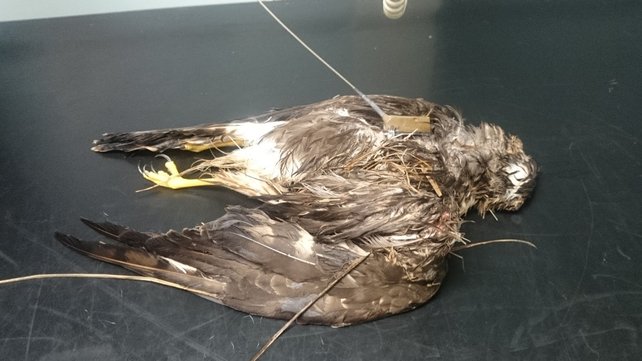
Photo of hen harrier Annie, who was found shot on a grouse moor in South Lanarkshire in 2015. (Image: RSPB Scotland).

Record number of hen harriers fitted with satellite tags


RSPB press release:

The RSPB has fitted a record number of hen harrier chicks with satellite tags in the UK this year, more than doubling the number from any other year.

More than 24 birds have been fitted with transmitters so far, the majority of them in Scotland, as part of the conservation organisation’s EU-funded Hen Harrier LIFE Project. Harriers were also tagged in Wales and the Isle of Man.

By tracking the movements of these threatened birds of prey, the RSPB will be able to build up an even clearer picture of where hen harriers go and where they are most at risk, for example from illegal persecution.

This is the third consecutive year that hen harriers have been tagged as part of the project [6 tagged in 2015; 12 tagged in 2016]. The increase in the number of tags deployed in 2017 was made possible by cosmetic company LUSH, which raised funds through the sales of a specially created “Skydancer” bath bomb.

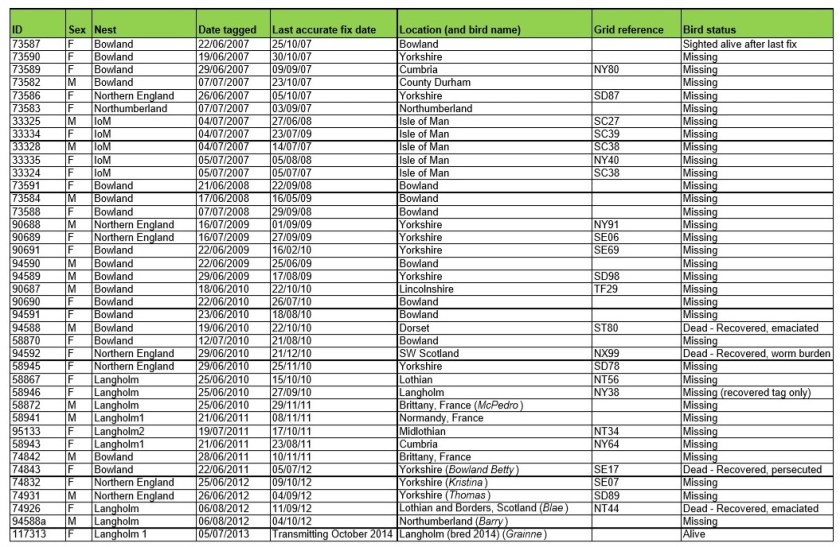
Conservationists hope the ‘Hen Harrier Class of 2017’ will fare better than last year’s cohort. Out of the 12 young harriers fitted with tags by the RSPB in 2016, only five are still alive. [See here for fates of RSPB and Natural England tagged 2016 hen harriers].

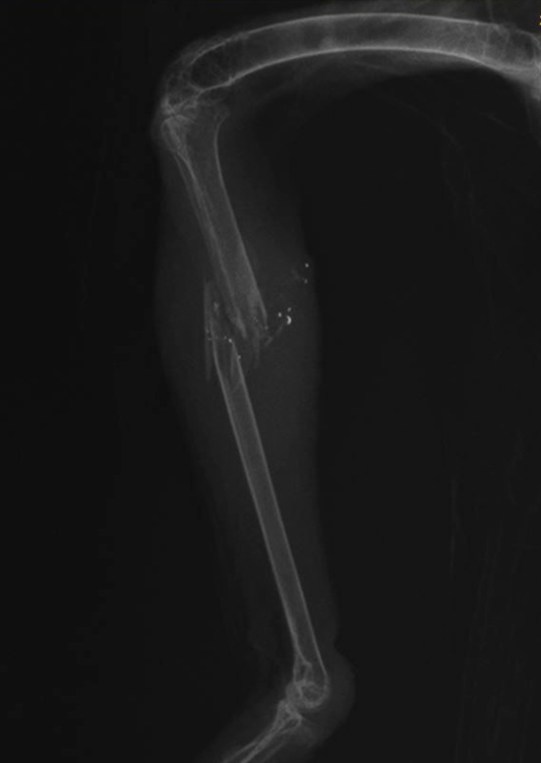
One of the birds, Carroll, was found dead having suffered from an infectious disease. Disturbingly, a post mortem later revealed lead pellets, indicating she had survived being shot at some earlier point in her life. Two of the other birds disappeared in suspicious circumstances when their tags suddenly stopped transmitting, while a further three were lost to unknown causes. All are presumed to have died, as it is very rare for tags to fail for technical reasons.

It is not only RSPB-tagged hen harriers that have met with untimely demises over the past 12 months. In May this year a police investigation was launched after a hen harrier was allegedly shot on Leadhills Estate in South Lanarkshire, while in October Rowan, a bird tagged by Natural England, was discovered shot dead in Cumbria.

The RSPB sincerely hopes that Natural England will publish the publicly funded satellite tracking data which the statutory agency has collected over the past decade, as this will add significantly to the weight of evidence being gathered through the RSPB’s work. [We have an FoI back from NE about this and will blog shortly].

The need for this sort of data has never been greater. Hen harriers are in serious trouble across the UK. The results of the recently published National Hen Harrier Survey revealed that in the last 12 years, the number of breeding pairs has declined by more than a quarter (27%) in Scotland and by over a third (39%) in the UK as a whole.

While the final numbers are still being collated, anecdotal reports suggest the situation in Scotland does not appear to have improved this breeding season with hen harriers notably absent or in very low numbers in areas of suitable habitat, particularly in the south and east. In England, the final figures for 2017 show only three successful nests across habitat suitable for over 300.

The main reason hen harriers are continuing to decline is illegal killing and disturbance associated with the increasingly intensive management of driven grouse moors. The Scottish Government recently set up an independent enquiry into gamebird shoot licensing after an independent scientific review of golden eagle satellite tracking data revealed that approximately a third of them are being illegally killed.

Blánaid Denman, Project Manager for the RSPB’s Hen Harrier LIFE+ Project, said: By satellite tracking more hen harriers than ever before, we’ll gain a clearer picture of where these birds are spending their time and what exactly is happening to them. We’ve already discovered previously unknown nesting and winter roosting sites, as well as been able to pinpoint where natural deaths and illegal killings have occurred.

“It’s both infuriating and utterly heartbreaking to see these beautiful birds, year after year, disappear off the radar. Something needs to change. A system of grouse moor licensing would not only protect hen harriers but also tackle wider damaging grouse moor management practices, such as heather burning on deep peat and inappropriate drainage. For now though, I’ll be watching our newly fledged hen harriers, praying for their safety, and waiting to see what incredible journeys are about to unfold.”

Paul Morton from LUSH said: “We’re thrilled to hear that the money raised by our customers has allowed the RSPB to sat tag more hen harrier chicks than ever before. Monitoring as many youngsters as possible as they take their first flights across the length and breadth of the country is vital for their long-term protection. The message is loud and clear; a nation is watching and will have the welfare of each of these birds close to our hearts. The illegal persecution of hen harriers or any bird of prey will not be tolerated“.

From September, it will be possible to follow the travels of a selection of this year’s tagged hen harriers, together with last year’s surviving birds at: www.rspb.org.uk/henharrierlife.

ENDS

A fantastic partnership effort (real, actual partnership-working rather than the charade of pretence we’re so used to seeing from the PAW Raptor Group). Well done to all involved at RSPB and LUSH, and well done to everyone who purchased a Skydancer bathbomb because you helped this project happen.

Three successful hen harrier nests in England (none on driven grouse moors)

The RSPB has just announced the results of the 2017 hen harrier breeding season in England. There was a pathetic total of three successful nests (England has the capacity for ~330 pairs).

The three successful nests (with ten fledglings) were on land managed by the Forestry Commission in Northumberland.

Read the full, sorry details on the RSPB’s Skydancer blog here.

Well done to the Northumberland Hen Harrier Protection Partnership (Northumberland National Park Authority, Forestry Commission, RSPB, Natural England, Northumberland Wildlife Trust, Ministry of Defence, Northumbria Police, and the Northern England Raptor Forum).

There’s an interesting quote from Andrew Miller of the National Park who says, “We will continue to monitor our birds throughout the year….” This implies that the young birds have been satellite tagged, but according to our sources, only one fledgling was fitted with a tag because Natural England left it too late this year. This seems hard to believe, given NE’s experience of sat tagging hen harriers, but no doubt we’ll hear more about this in due course.

The real story, and what should be our focus of attention, is that for a second year in a row, there wasn’t a single successful breeding attempt on any driven grouse moor in England. This is despite the grouse shooting industry supposedly being signed up to DEFRA’s Hen Harrier InAction Plan.

[Drawing by Gerard Hobley]

If this year’s shameful breeding results don’t inspire you to attend a Hen Harrier Day event this coming weekend, nothing will.

Well done to the RSPB for publishing the details of this year’s breeding season in good time (presumably Natural England is still fiddling with its super computer, trying to count up to three and ‘analysing’ the data).

RSPB statement on hen harrier reintroduction to southern England

Last week we wrote a series of blogs updating what we know about the proposed controversial ‘reintroduction’ of hen harriers to southern England.

In one of those blogs (here) we included an email from Jeff Knott (RSPB) to Simon Lees (Hen Harrier Southern Reintroduction Project Manager, Natural England) that included the following muddled sentence:

While we [RSPB] have said we don’t actively support the reintroduction project, nor are we opposed to it and of course we would want to see it be a success“.

We, and many others, didn’t have a clue what that meant. The RSPB has now published a clarification statement, posted on an RSPB community blog by Tony Whitehead, RSPB Public Affairs Manager, SW England region:

A consortium led by Natural England is currently looking at the feasibility of re-introducing hen harrier to southern England. The species is red listed, and has declined markedly over the past few decades with it’s continuing rarity due to ongoing illegal persecution on and around intensively managed grouse moors in northern England.

The current NE feasibility project aims to assess the opportunity of re-establishing a viable population away from the moors, and thus improve the bird’s prospects. Areas being looked at include Dartmoor, Exmoor and Wessex.

The RSPB has serious reservations about this approach to hen harrier conservation in England, and therefore is NOT supporting the project.

Firstly, the RSPB only advocates reintroduction in situations where natural re-colonisation is not possible through other measures. At present, we believe that this could be achieved if persecution in the uplands was stopped.

Secondly, the RSPB is concerned that if hen harriers were to be re-introduced to southern England, birds that disperse from their natal areas would be threatened by ongoing illegal persecution in the uplands. Therefore, again, persecution would need to stop entirely before any re-introduction would be viable.

However, the re-introduction project is still at the feasibility stage, and we have yet to see detailed proposals. Although we have serious doubts, to be fair, if the project can address these concerns, which we believe it would need to do in order to comply with IUCN re-introduction guidelines, then the RSPB would wish it every success.

Currently we don’t see how it can do this.

ENDS

This statement provides us with a much better understanding of the RSPB’s position (it DOESN’T support the project) but it’s not as unequivocal as it could/should be. The RSPB is suggesting that it is only ‘fair’ to wait and see a detailed proposal. Why? What possible detail could alleviate the legitimate concerns about ongoing illegal persecution? Why pretend that the grouse-shooting industry and Natural England might pull something out of the bag to change all our minds?

There’s a time for diplomacy, sure, but on the subject of the illegal killing of hen harriers, that time has long since passed. Drop the final paragraph, stop pandering to the criminals and stand up with the rest of us.

Mark Osborne on hen harriers, Mark Avery and Chris Packham

Some of you will be very familiar with the name of sporting agent Mark Osborne. He is feted within the grouse-shooting industry for his ability to turn a ‘poorly performing’ grouse moor in to “something beyond the moor owner’s wildest dreams” (e.g. see here).

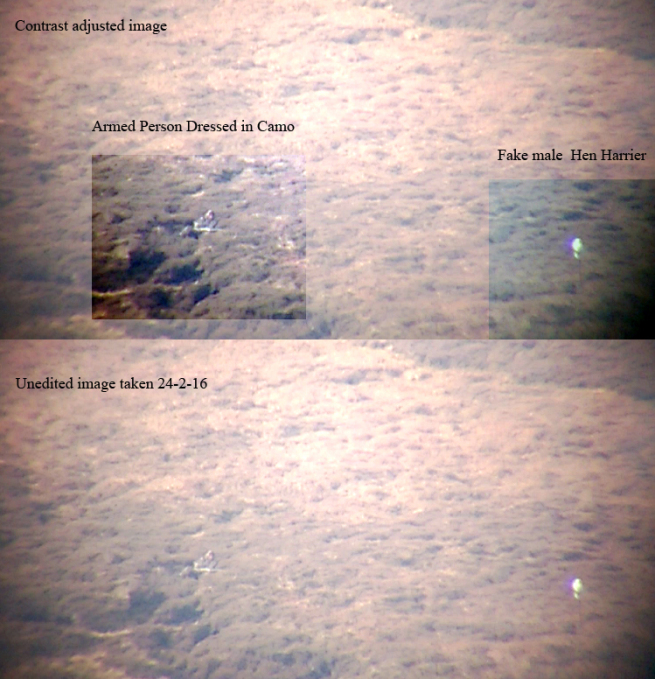
Some of you may be more familiar with the names of some of the grouse-shooting estates where Mr Osborne was a shooting tenant (e.g. Leadhills [Hopetoun] Estate in South Lanarkshire), or whose management has been under the control of one of Mr Osborne’s sporting agencies, JM Osborne & Co and William Powell Sporting Ltd, (e.g. Glenogil Estate in the Angus Glens, Raeshaw Estate in the Scottish Borders, Snilesworth Estate in the North York Moors National Park, Park Hall & Hope Woodland in the Peak District National Park [the one where the National Trust pulled the shooting tenant’s lease after an armed man was filmed next to a decoy hen harrier]).

We always enjoy hearing raptor-loving Mark Osborne’s thoughts, especially about hen harriers. Here’s an excerpt from his July newsletter:

The big news in the Grouse world was the Parliamentary debate before Christmas following from Dr Mark Avery’s petition. This has woken many of us up and we now realise that we have got to get our act together if we are to see off the likes of Avery and Chris Packham who seem hell bent on curtailing or indeed banning driven Grouse shooting. I have absolutely no doubt that if they were at all successful in this, they would then turn their attentions to pheasant and partridge shooting. Guns who think otherwise are deluding themselves. We must all get behind this fight even if only a few of us are lucky enough to shoot Grouse. This leads onto the subject on Hen Harriers and it is good news indeed to see major efforts made in the Uplands to increase the number of breeding Hen Harriers on driven Grouse Moors. The Moorland Association who are leading this (alongside Natural England) are to be congratulated on this initiative and I am sure that over the next few years, there will be an increase in numbers, but I doubt that this will do much to satisfy the likes and Avery and Packham whose vitriolic hatred of Grouse Moors and Grouse shooting would seem to have much more to do with class, envy and little the real concern for the Hen Harriers themselves‘.

How perceptive is he, eh? How stupid of us to think that the award-winning careers of Mark Avery & Chris Packham, spanning approx 40 years, have been all about ‘class envy’ and absolutely nothing to do with wildlife conservation.

That argument is about as convincing as the grouse-shooting industry’s commitment to hen harrier conservation.

Mark Osborne can toast the Moorland Association and the other Action Plan stakeholders as much as he likes; for most of us, the reality looks a lot different (thanks to Gerard Hobley for the image):

National Trust to receive petition calling for cessation of grouse shooting

Today (Tuesday 25 July 2017) the National Trust will receive a petition calling for the cessation of grouse shooting on one of their moors in the Peak District National Park.

The petition was launched last year by a newly-formed group called Moorland Vision (see website here). It was triggered by a video we posted on this blog in April 2016 showing an armed man sitting close to a decoy hen harrier on a National Trust-owned moor within the National Park (see here). The National Trust had leased the moor to a tenant for grouse shooting and the moor was supposedly one of several within the Peak District Bird of Prey Initiative – an ambitious partnership plan to restore raptor populations in the region, which unsurprisingly has so far failed to meet its targets.

That video, filmed by two birdwatchers who had the presence of mind to record their observations, led to a police investigation but unfortunately there was insufficient evidence for a prosecution. Many readers of this blog (and others) were infuriated by the content of that video and were frustrated by the lack of criminal proceedings. As a result, the National Trust was inundated with emails calling for the Trust to take action.

A few months later, in June 2016, the National Trust surprised us all by announcing it was to terminate the grouse shooting lease four years early (see here). The tenant was given 22 months notice and is due to leave in April 2018. We viewed this as a significant and welcome move by the National Trust, especially as the decision wasn’t based on the outcome of a criminal prosecution, but rather that the Trust had lost faith in the shooting tenant’s commitment to the National Trust’s upland vision, including the restoration of raptor populations. It was a fantastic example of how public opinion and pressure can effect change.

However, other campaigners didn’t think the National Trust had gone far enough. They wanted to see the removal of the shooting tenancy altogether, rather than the Trust’s idea that a new, more enlightened shooting tenant would be installed in 2018.  This is when the campaign group, Moorland Vision, was formed.

For the last year, members of Moorland Vision have run a local campaign to secure petition signatures calling on the National Trust to remove the grouse shooting tenancy from this moor. They’ve collected nearly 5,000 signatures and have the support of fifteen local organisations:

Derbyshire Ornithological Society, Dark Peak Fell Runners, Darley & Nutwood LNR Management Group, Pleasley Pit Nature Study Group, Sutton-in-Ashfield and District Rambling Club, Ogston Bird Club, Derbyshire Mammal Group, Carsington Bird Club, Wessington Green LNR Management Group, Bakewell Bird Study Group, Buxton Ramblers, Derbyshire Amphibian & Reptile Group, Derbyshire Bat Conservation Group, Stanfree Valley Preservation Group, Derby Natural History Society.

Nick Moyes, the founder of Moorland Vision said: “The National Trust is a major conservation organisation and normally does brilliant work in protecting and enhancing our environment. But with clear evidence that moorland management for grouse shooting leads to the killing of birds of prey and almost every other predator – and especially here on its doorstep – you would think the National Trust would have decided immediately that enough is enough. The fact that it did not immediately recognise the opportunity this provides us with to re-wild and restore these moorlands without the well-documented problems associated with grouse moor management is really disappointing. Hence our petition“.

Bob Berzins from the Dark Peak Fell Runners said: “I and my club members see so much harm done by mis-management on the Peak District moorlands. The worst excesses are definitely on privately-owned shooting estates, where intensive burning, track building, predator snaring and shooting is particularly rife. But this is a one off opportunity for the National Trust to say ‘no more’ to management purely for one hobby and to show its true conservation credentials by establishing a proper rewilding project over 8,000 hectares of iconic moorland which would be far better for biodiversity and would create more natural landscapes – just as the Trust is helping to do on the Eastern Moors where the Peak Park banned shooting many decades ago“.

Congratulations to Moorland Vision for all their hard work over the last year. This is a fantastic grass-roots effort and has done much to increase awareness in the local community and beyond. It’ll be interesting to see how the National Trust responds.

Photo of some of the local campaigners (by Moorland Vision)

Hen harrier ‘reintroduction’ to southern England: Project team visits France

Continuing on from recent blogs (herehere and here) about a series of updates on the proposed ‘reintroduction’ of hen harriers to southern England, here’s some more news gleaned from the latest FoI response from Natural England.

We know from previous FoI responses from Natural England that the Southern England Reintroduction Team has been scouting around looking for a donor population of hen harriers (see here). They’re not allowed to use any hen harrier eggs or chicks that might be ‘brood-meddled’ in northern England so they’ve been looking elsewhere in Europe. The Netherlands, Spain and Poland all said ‘no’ but France seemed to be a distinct possibility, which was a surprise given that the French hen harrier population is showing a long-term declining trend.

Earlier this year Adrian Jowitt (Natural England) wrote to researchers in France about a potential visit. This was to learn more about the captive rearing and release scheme (hen harrier & Montagu’s harrier) that the French have been undertaking for genuine conservation purposes, as the birds are threatened by industrial harvesting machinery before the young are able to fledge the nests in agricultural fields. The French team collects the birds, keeps them in captivity until the harvesting period is over, and then releases them back to the wild once the threat has ended.

Incidentally, the UK grouse-shooting industry often argues that this French conservation project is ‘proof’ that hen harrier brood meddling is a tried and tested conservation tool and they use it as justification for the UK brood meddling scheme. What they don’t seem to understand is that the two situations are incomparable. In France, the threat to the harriers is temporary (just during the crop harvest) and so the birds can be safely released back to the wild whereas in the UK, the threat to hen harriers is year-round, on the grouse moors and, increasingly, at winter roosts. There is no ‘safe’ time to release brood-meddled hen harriers in the UK.

Anyway, back to the France visit. Here’s a copy of Adrian’s email to the French researchers: Planning visit to France_May2017

It makes for quite an amusing read, as Adrian’s choice of words tries to minimise the scale of the problems the proposed project is facing in the UK – he mentions “small pockets of resistance” from some landowners (actually strong enough resistance that the Project Team is now suddenly keen to explore Dartmoor National Park as an alternative release site) but emphasises the ‘positives’ such as the Chair of Natural England declaring that he wants to see more hen harriers in England within the next three years. Yep, that’s what the grouse shooting industry claims too – talk is cheap.

In June this year some members of the Project Team did visit the French project and here’s Project Manager Simon Lee’s thank you email to the French researchers:

Simon says “Let’s not talk of the British politics again“. He probably didn’t mean this in a literal sense, rather it was likely just an acknowledgement that they’d spent a good deal of time talking about it during the visit. But talk of it he, and the rest of us, must, because whether the project is technically feasible or not isn’t the issue here; the ‘politics’ (i.e. legislation & ethics) is still the main issue to be addressed.

We’re not convinced that a reintroduction is legal. The IUCN guidelines are clear: ‘There should generally be strong evidence that the threat(s) that caused any previous extinction have been correctly identified and removed or sufficiently reduced‘. This criterion cannot possibly be met when the current hen harrier population is on its knees, showing no signs of recovery (see results from 2016 national survey), and the main cause of the decline (illegal persecution) has not been dealt with. We used the same argument against the planned re-stocking of golden eagles in southern Scotland, although in that scenario there is a counter argument that golden eagles in the Highlands (the proposed source birds) are just as likely to be killed in the north as they are in the south, whereas hen harriers in France would have much better survival prospects if they remained in France as opposed to being sent to persecution-rife England. (So, sorry, Simon, but your notion that this reintroduction could possibly “benefit European harrier conservation” is just ludicrous).

As for the ethics of reintroducing hen harriers to southern England, well we’ve talked about that over and over and over again. The proposed reintroduction is clearly a plan to move the focus away from the real problem (illegal persecution on grouse moors) – shove a load of hen harriers in the south, hope they survive, and then shout about how the species’ conservation status has improved, whilst ignoring the on-going illegal slaughter in the north. Job done.

And talking of ethics, here’s a rather confusing message from Jeff Knott (RSPB) to the new Southern Reintroduction Project Manager Simon Lees:

While we have said we don’t actively support the reintroduction project, nor are we opposed to it and of course we would want to see it be a success“. Eh?

Photo of hen harrier nestlings by Andrew Sandeman.

Hen harrier ‘reintroduction’ to southern England: revised costs

Continuing on from recent blogs (here, here) about a series of updates on the proposed ‘reintroduction’ of hen harriers to southern England, here’s some more news gleaned from the latest FoI response from Natural England.

The estimated cost of a ‘reintroduction’ of hen harriers to southern England has previously been estimated at £515k (see DEFRA’s Hen Harrier InAction Plan).

Since DEFRA’s Inaction Plan was published in January 2016, we haven’t seen any other paperwork relating to these costs, or an explanation of how they were calculated. There was some comment last year from Natural England’s external funding bid, who were asked to provide advice to the Southern Reintroduction Project Team about a potential funding application to the Heritage Lottery Fund, that the final cost was more likely to be in excess of £2 million (see here).

However, in Natural England’s most recent FoI response, the details of a 2013 cost estimate (at the lower end of the scale) has now been released: HH southern reintro estimated project costs 2013

This estimate was described by the author (Ian Carter, who has since left NE) as “back of the proverbial fag packet stuff“. That’s fair enough. With so many project unknowns, it would have been difficult to provide anything more robust at that stage.

Fast forward four years and Natural England is now working to a revised cost estimate. It appears to have jumped from half a million quid to 1.15 million quid, and the only rationale, that we can see, is that this is how much the South Scotland Golden Eagle Project has just secured from the Heritage Lottery Fund: