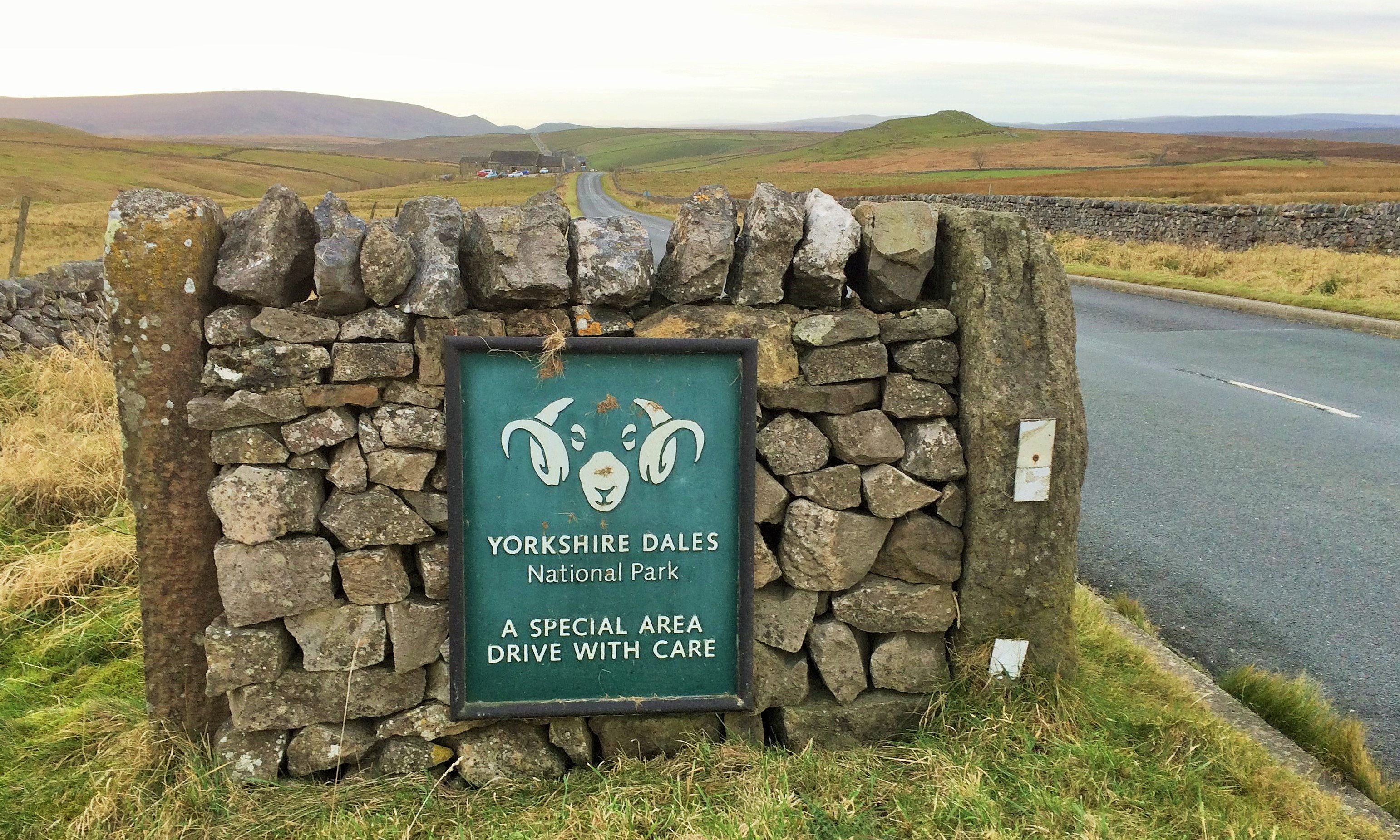
In April this year, a blog reader (who wishes to remain anonymous) was watching a pair of hen harriers showing great interest in a moorland hillside in the Yorkshire Dales National Park. The harriers’ behaviour, as well as the time of year, was indicative that this pair was nest prospecting. Our harrier-watcher also noted that someone else was watching the hillside from inside a white pick-up truck.
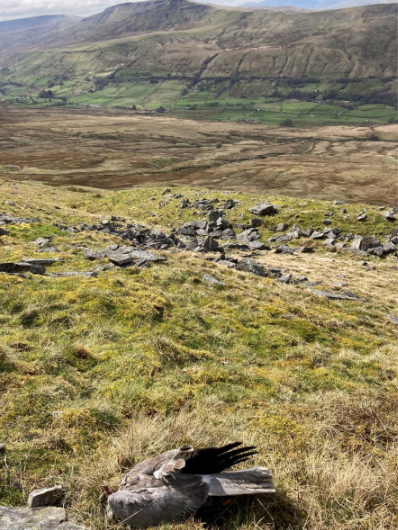
The blog reader returned to the moorland a few days ago to check on the status of the harriers and found that ‘somebody’ has installed a mannequin on the same hillside:
It’s not even subtle.
Stand by for claims from the grouse shooting industry that this is a welcoming committee, rather than yet another tactic for deliberately disturbing hen harriers and preventing them from breeding, in a so-called National Park.
Meanwhile, Natural England has extended the insane hen harrier brood meddling trial while it pretends it doesn’t have sufficient evidence to ‘test attitudes’ towards hen harriers amongst members of the grouse shooting industry that aren’t yet participating in the trial (i.e. most of them).
Earlier this month, Natural England announced its decision (here) to extend the insane hen harrier brood meddling trial beyond the five years (2018-2022 inclusive) it was originally intended to run.
For new blog readers, hen harrier brood meddling is a conservation sham sanctioned by DEFRA as part of its ludicrous ‘Hen Harrier Action Plan‘ and carried out by Natural England, in cahoots with the very industry responsible for the species’ catastrophic decline in England. In general terms, the plan involves the removal of hen harrier chicks and eggs from grouse moors, rear them in captivity, then release them back into the uplands just in time for the start of the grouse-shooting season where they’ll be illegally killed. It’s plainly bonkers. For more background see here.
An un-meddled hen harrier being reared in the wild. Photo: Laurie Campbell
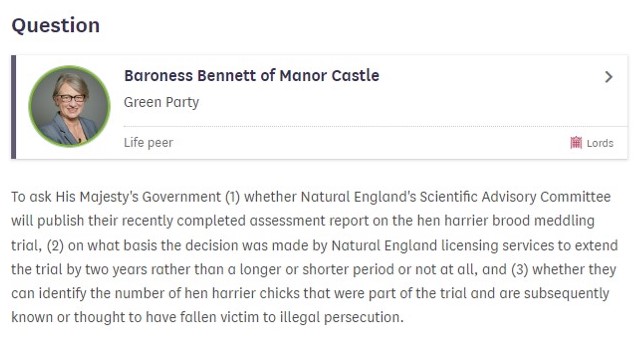
Following Natural England’s decision to extend the brood meddling trial, Natalie Bennett (Life peer, Green party) raised a number of pertinent questions in the House of Lords, as follows:
DEFRA Minister and grouse moor owner Lord Benyon responded last week with these answers:
The ‘overview’ of Natural England’s Scientific and Advisory Committee’s (NESAC) decision that Benyon points to is this blog, posted by Natural England on 16th March 2023. This ‘overview’ was already out of date when it was published because NE conveniently decided not to include the 2022 cohort of brood meddled hen harrier chicks – several of which were already confirmed as ‘missing’ by December 2022 (see here). Had they been included, NE’s graphs in that ‘overview’ blog wouldn’t look quite as favourable. Funny that.
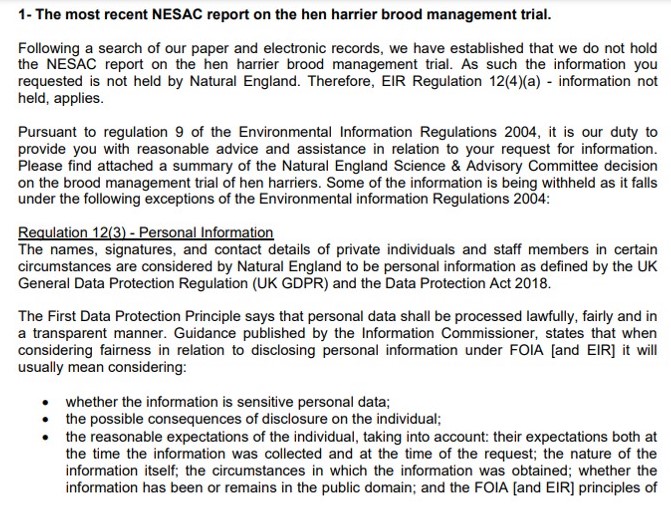
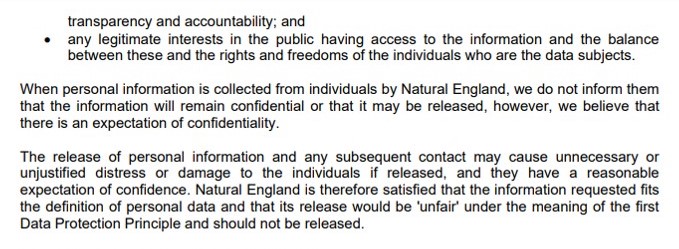
You’ll note that what NE published was just an ‘overview’, and regular blog readers will know that in February 2023 I submitted an FoI request asking for a copy of the full NESAC report, only to be told by NE that there apparently wasn’t one (see here).
I’ve since submitted a further FoI request to determine if anybody at NE has produced a report, and if so, where is it? Surely someone has produced an assessment report, otherwise how on earth has NE assessed the application to extend the trial?! NE’s FoI response is due on 7th June 2023, although judging by NE’s continued obfuscation and lack of transparency (on which, more soon), I fully expect them to respond by telling me my information request is ‘complex’ and therefore they require a further 20 working days to complete the task. Let’s see.
I was pleased to see Benyon’s remark that ‘… all hen harriers are part of the trial…’. Good – that means that whoever is assessing the trial (assuming somebody is) will have to take in to account all of the 94 hen harriers (so far) that are confirmed ‘missing’ or illegally killed, most of them on or close to grouse moors, since the brood meddling trial began in 2018.
It was also interesting to note that Benyon admitted that of the 32 hen harrier chicks that have been brood meddled since the trial began, at least 16 of them are confirmed as ‘missing’. That’s half of them.
The brood meddling sham doesn’t sound quite as ‘successful’ now, does it?
And given the recent spate of vanishing hen harriers (see here, here and here), in addition to the publication of yet another scientific paper that confirms the ongoing and widespread illegal persecution of this species on many driven grouse moors (see here), I’d say Natural England looks to be in some trouble with its justification to extend the brood meddling trial.
Further to the news from the RSPB earlier this month that 20 hen harriers had ‘disappeared’ on English grouse moors between April 2022 and April 2023 (see here), leading to my updated tally of illegally killed/missing hen harriers since 2018 (n = 92), I’ve since realised that I forgot to add one of the brood-meddled hen harriers that ‘disappeared’ in Dec 2022 (a female, #R2-F2-20, who vanished in Cumbria). She has now been added to the list, below.
And further to the news yesterday that another satellite-tagged hen harrier has ‘disappeared’ on a grouse moor in the Bowland AONB (see here), I also need to add this harrier to the list.
So now the running tally is 94 illegally killed / ‘missing’ hen harriers since 2018.
Here’s the blog I always write after every reported killing or suspicious disappearance…
For anyone who still wants to pretend that the grouse shooting industry isn’t responsible for the systematic extermination of hen harriers on grouse moors across the UK, here’s the latest catalogue of crime that suggests otherwise.
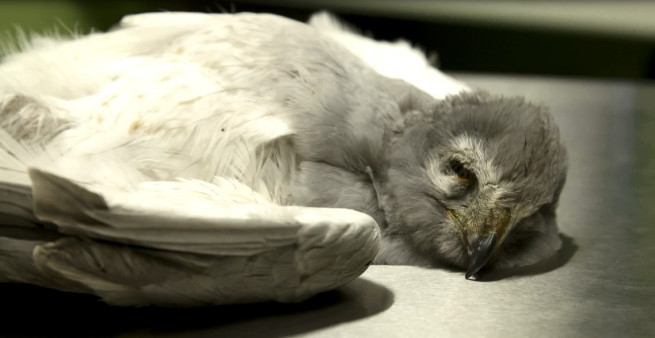
This male hen harrier died in 2019 after his leg was almost severed in an illegally set trap that had been placed next to his nest on a Scottish grouse moor (see here). Photo by Ruth Tingay
“They disappear in the same way political dissidents in authoritarian dictatorships have disappeared” (Stephen Barlow, 22 January 2021).
I’ve been compiling this list only since 2018 because that is the year that the grouse shooting industry ‘leaders’ would have us believe that the criminal persecution of hen harriers had stopped and that these birds were being welcomed back on to the UK’s grouse moors (see here).
This assertion was made shortly before the publication of a devastating new scientific paper that demonstrated that 72% of satellite-tagged hen harriers were confirmed or considered likely to have been illegally killed, and this was ten times more likely to occur over areas of land managed for grouse shooting relative to other land uses (see here). Incidentally, a further scientific paper published in 2023 by scientists at the RSPB, utilising even more recent data, echoed these results – see here).
2018 was also the year that Natural England issued a licence to begin a hen harrier brood meddling trial on grouse moors in northern England. For new blog readers, hen harrier brood meddling is a conservation sham sanctioned by DEFRA as part of its ludicrous ‘Hen Harrier Action Plan‘ and carried out by Natural England (NE), in cahoots with the very industry responsible for the species’ catastrophic decline in England. For more background see here.
Brood meddling has been described as a sort of ‘gentleman’s agreement’ by commentator Stephen Welch:
“I don’t get it, I thought the idea of that scheme was some kind of trade off – a gentleman’s agreement that the birds would be left in peace if they were moved from grouse moors at a certain density. It seems that one party is not keeping their side of the bargain“.
With at least 94 hen harriers gone since 2018, there is no question that the grouse shooting industry is simply taking the piss. Meanwhile, Natural England pretends that ‘partnership working’ is the way to go and DEFRA Ministers remain silent.
‘Partnership working’ according to Natural England appears to include authorising the removal of hen harrier chicks from a grouse moor already under investigation by the police for suspected raptor persecution (here) and accepting a £75k ‘donation’ from representatives of the grouse shooting industry that prevents Natural England from criticising them or the sham brood meddling trial (see here). This is in addition to a £10k ‘donation’ that Natural England accepted, under the same terms, in 2021 (here).
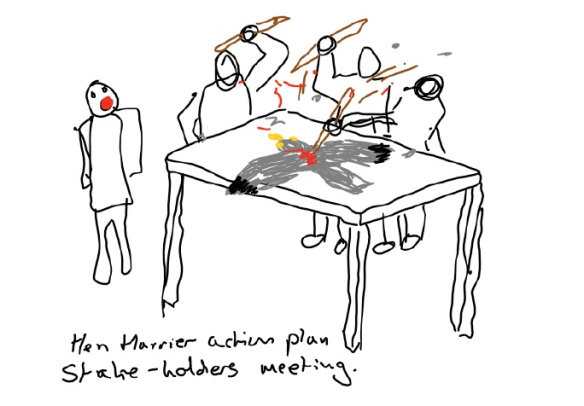
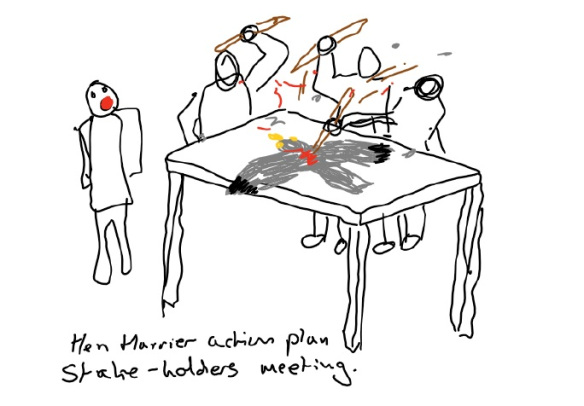
Cartoon by Gerard Hobley
So here’s the latest gruesome list. Note that the majority of these birds (but not all) were fitted with satellite tags. How many more [untagged] harriers have been killed?
February 2018: Hen harrier Saorsa ‘disappeared’ in the Angus Glens in Scotland (here). The Scottish Gamekeepers Association later published wholly inaccurate information claiming the bird had been re-sighted. The RSPB dismissed this as “completely false” (here).
5 February 2018: Hen harrier Marc ‘disappeared’ on a grouse moor in Durham (here).
9 February 2018: Hen harrier Aalin ‘disappeared’ on a grouse moor in Wales (here).
March 2018: Hen harrier Blue ‘disappeared’ in the Lake District National Park (here).
March 2018: Hen harrier Finn ‘disappeared’ near Moffat in Scotland (here).
18 April 2018: Hen harrier Lia ‘disappeared’ in Wales and her corpse was retrieved in a field in May 2018. Cause of death was unconfirmed but police treating death as suspicious (here).
8 August 2018: Hen harrier Hilma ‘disappeared’ on a grouse moor in Northumberland (here).
16 August 2018: Hen harrier Athena ‘disappeared’ on a grouse moor in Scotland (here).
26 August 2018: Hen Harrier Octavia ‘disappeared’ on a grouse moor in the Peak District National Park (here).
29 August 2018: Hen harrier Margot ‘disappeared’ on a grouse moor in Scotland (here).
29 August 2018: Hen Harrier Heulwen ‘disappeared’ on a grouse moor in Wales (here).
3 September 2018: Hen harrier Stelmaria ‘disappeared’ on a grouse moor in Scotland (here).
24 September 2018: Hen harrier Heather ‘disappeared’ on a grouse moor in Scotland (here).
2 October 2018: Hen harrier Mabel ‘disappeared’ on a grouse moor on the edge of the Yorkshire Dales National Park (here).
3 October 2018: Hen Harrier Thor ‘disappeared’ next to a grouse moor in Bowland, Lanacashire (here).
23 October 2018: Hen harrier Tom ‘disappeared’ in South Wales (here).
26 October 2018: Hen harrier Arthur ‘disappeared’ on a grouse moor in the North York Moors National Park (here).
1 November 2018: Hen harrier Barney ‘disappeared’ on Bodmin Moor (here).
10 November 2018: Hen harrier Rannoch ‘disappeared’ on a grouse moor in Scotland (here). Her corpse was found nearby in May 2019 – she’d been killed in an illegally-set spring trap (here).
14 November 2018: Hen harrier River ‘disappeared’ on a grouse moor in the Nidderdale AONB (here). Her corpse was found nearby in April 2019 – she’d been illegally shot (here).
16 January 2019: Hen harrier Vulcan ‘disappeared’ in Wiltshire close to Natural England’s proposed reintroduction site (here).
7 February 2019: Hen harrier Skylar ‘disappeared’ next to a grouse moor in South Lanarkshire (here).
22 April 2019: Hen harrier Marci ‘disappeared’ on a grouse moor in the Cairngorms National Park (here).
26 April 2019: Hen harrier Rain ‘disappeared’ on a grouse moor in Nairnshire (here).
11 May 2019: An untagged male hen harrier was caught in an illegally-set trap next to his nest on a grouse moor in South Lanarkshire. He didn’t survive (here).
7 June 2019: An untagged hen harrier was found dead on a grouse moor in Scotland. A post mortem stated the bird had died as a result of ‘penetrating trauma’ injuries and that this bird had previously been shot (here).
5 September 2019: Wildland Hen Harrier 1 ‘disappeared’ on a grouse moor nr Dalnaspidal on the edge of the Cairngorms National Park (here).
11 September 2019: Hen harrier Romario ‘disappeared’ on a grouse moor in the Cairngorms National Park (here).
14 September 2019: Hen harrier (Brood meddled in 2019, #183704) ‘disappeared’ in the North Pennines (here).
23 September 2019: Hen harrier (Brood meddled in 2019, #55149) ‘disappeared’ in North Pennines (here).
24 September 2019: Wildland Hen Harrier 2 ‘disappeared’ on a grouse moor at Invercauld in the Cairngorms National Park (here).
24 September 2019: Hen harrier Bronwyn ‘disappeared’ near a grouse moor in North Wales (here).
10 October 2019: Hen harrier Ada ‘disappeared’ on a grouse moor in the North Pennines AONB (here).
12 October 2019: Hen harrier Thistle ‘disappeared’ on a grouse moor in Sutherland (here).
18 October 2019: Member of the public reports the witnessed shooting of an untagged male hen harrier on White Syke Hill in North Yorkshire (here).
November 2019: Hen harrier Mary found illegally poisoned on a pheasant shoot in Ireland (here).
14 December 2019: Hen harrier Oscar ‘disappeared’ in Eskdalemuir, south Scotland (here).
January 2020: Members of the public report the witnessed shooting of a male hen harrier on Threshfield Moor in the Yorkshire Dales National Park (here).
23 March 2020: Hen harrier Rosie ‘disappeared’ at an undisclosed roost site in Northumberland (here).
1 April 2020: Hen harrier (Brood meddled in 2019, #183703) ‘disappeared’ in unnamed location, tag intermittent (here).
5 April 2020: Hen harrier Hoolie ‘disappeared’ on a grouse moor in the Cairngorms National Park (here)
8 April 2020: Hen harrier Marlin ‘disappeared’ on a grouse moor in the Cairngorms National Park (here).
19 May 2020: Hen harrier Fingal ‘disappeared’ on a grouse moor in the Lowther Hills, Scotland (here).
21 May 2020: Hen harrier (Brood meddled in 2019, #183701) ‘disappeared’ on a grouse moor in Cumbria shortly after returning from wintering in France (here).
27 May 2020: Hen harrier Silver ‘disappeared’ on a grouse moor on Leadhills Estate, Scotland (here).
2020: day/month unknown: Unnamed male hen harrier breeding on RSPB Geltsdale Reserve, Cumbria ‘disappeared’ while away hunting (here).
9 July 2020: Unnamed female hen harrier (#201118) ‘disappeared’ from an undisclosed site in Northumberland (here).
25 July 2020: Hen harrier Harriet ‘disappeared’ on a grouse moor in the Yorkshire Dales National Park (here).
14 August 2020: Hen harrier Solo ‘disappeared’ in confidential nest area in Lancashire (here).
7 September 2020: Hen harrier Dryad ‘disappeared’ on a grouse moor in the Yorkshire Dales National Park (here).
16 September 2020: Hen harrier Fortune ‘disappeared’ from an undisclosed roost site in Northumberland (here).
19 September 2020: Hen harrier Harold ‘disappeared’ on a grouse moor in the Yorkshire Dales National Park (here).
20 September 2020: Hen harrier (Brood meddled in 2020, #55152) ‘disappeared’ next to a grouse moor in North Yorkshire (here).
24 February 2021: Hen harrier Tarras ‘disappeared’ next to a grouse moor in Northumberland (here)
12th April 2021: Hen harrier Yarrow ‘disappeared’ near Stockton, County Durham (here).
18 May 2021: Adult male hen harrier ‘disappeared’ from its breeding attempt on RSPB Geltsdale Reserve, Cumbria whilst away hunting (here).
18 May 2021: Another adult male hen harrier ‘disappeared’ from its breeding attempt on RSPB Geltsdale Reserve, Cumbria whilst away hunting (here).
24 July 2021: Hen harrier Asta ‘disappeared’ at a ‘confidential site’ in the North Pennines (here). We learned 18 months later that her wings had been ripped off so her tag could be fitted to a crow in an attempt to cover up her death (here).
14th August 2021: Hen harrier Josephine ‘disappeared’ at a ‘confidential site’ in Northumberland (here).
17 September 2021: Hen harrier Reiver ‘disappeared’ in a grouse moor dominated region of Northumberland (here)
24 September 2021: Hen harrier (Brood meddled in 2021, R2-F-1-21) ‘disappeared’ in Northumberland (here).
15 November 2021: Hen harrier (brood meddled in 2020, #R2-F1-20) ‘disappeared’ at the edge of a grouse moor on Arkengarthdale Estate in the Yorkshire Dales National Park (here).
19 November 2021: Hen harrier Val ‘disappeared’ in the Lake District National Park in Cumbria (here).
19 November 2021: Hen harrier Percy ‘disappeared’ in Lothian, Scotland (here).
12 December 2021: Hen harrier Jasmine ‘disappeared’ on a grouse moor (High Rigg Moor on the Middlesmoor Estate) in the Nidderdale AONB in North Yorkshire (here).
9 January 2022: Hen harrier Ethel ‘disappeared’ in Northumberland (here).
26 January 2022: Hen harrier Amelia ‘disappeared’ in Bowland (here).
10 February 2022: An unnamed satellite-tagged hen harrier ‘disappeared’ in a grouse moor dominated area of the Peak District National Park (here). One year later it was revealed that the satellite tag/harness of this young male called ‘Anu’ had been deliberately cut off (see here).
12 April 2022: Hen harrier ‘Free’ (Tag ID 201121) ‘disappeared’ at a ‘confidential site’ in Cumbria (here). It later emerged he hadn’t disappeared, but his mutilated corpse was found on moorland in the Yorkshire Dales National Park. A post mortem revealed the cause of death was having his head twisted and pulled off. One leg had also been torn off whilst he was still alive (here).
April 2022: Hen harrier ‘Pegasus’ (tagged by the RSPB) ‘disappeared’ on a grouse moor at Birkdale in the Yorkshire Dales National Park (here).
May 2022: A male breeding hen harrier ‘disappeared’ from a National Trust-owned grouse moor in the Peak District National Park (here).
May 2022: Another breeding male hen harrier ‘disappeared’ from a National Trust-owned grouse moor in the Peak District National Park (here).
14 May 2022: Hen harrier ‘Harvey’ (Tag ID 213844) ‘disappeared’ from a ‘confidential site’ in the North Pennines (here).
20 June 2022: Hen harrier chick #1 stamped to death in nest on a grouse moor in the Yorkshire Dales National Park (here).
20 June 2022: Hen harrier chick #2 stamped to death in nest on a grouse moor in the Yorkshire Dales National Park (here).
20 June 2022: Hen harrier chick #3 stamped to death in nest on a grouse moor in the Yorkshire Dales National Park (here).
20 June 2022: Hen harrier chick #4 stamped to death in nest on a grouse moor in the Yorkshire Dales National Park (here).
17 August 2022: Hen harrier (brood meddled in 2022, #R1-M1-22) ‘disappeared’ on moorland in the Yorkshire Dales National Park (here).
September 2022: Hen harrier ‘Sullis’ (tagged by the RSPB) ‘disappeared’ on a grouse moor in Cumbria (here).
5 October 2022: Hen harrier (brood meddled in 2022, #R3-M2-22) ‘disappeared’ on moorland in the Yorkshire Dales National Park (here).
10 October 2022: Hen harrier ‘Sia’ ‘disappeared’ near Hamsterley Forest in the North Pennines (here).
October 2022: Hen harrier (brood meddled in 2021, #R1-F1-21) ‘disappeared’ in the North Sea off the North York Moors National Park (here).
December 2022: Hen harrier female (brood meddled in 2020, #R2-F2-20) ‘disappeared’ on moorland in Cumbria (here).
1 December 2022: Hen harrier male (brood meddled in 2021, #R1-M1-21) ‘disappeared’ on moorland in the Yorkshire Dales National Park (here).
14 December 2022: Hen harrier female (brood meddled in 2022, #R3-F1-22) ‘disappeared’ on moorland in the North Pennines AONB (here).
15 December 2022: Hen harrier female (brood meddled in 2022, #R2-F1-22) ‘disappeared’ on moorland in the Yorkshire Dales National Park (here).
March 2023: Unnamed male hen harrier (tagged by Natural England – details not yet released) ‘disappeared’ in North Yorkshire (here).
April 2023: Unnamed female hen harrier (tagged by Natural England – details not yet released) ‘disappeared’ in North Yorkshire (here).
April 2023: Hen harrier ‘Lagertha’ (tagged by RSPB) ‘disappeared’ in North Yorkshire (here).
April 2023: Hen harrier ‘Nicola’ (Tag ID 234078) ”disappeared’ in North Yorkshire (here).
April 2023: Untagged male hen harrier ‘disappeared’ from an active nest on RSPB Geltsdale Reserve in Cumbria (here).
April 2023: Another untagged male hen harrier ‘disappeared’ from an active nest on RSPB Geltsdale Reserve in Cumbria (here).
April 2023: Untagged male hen harrier ‘disappeared’ from an active nest in Durham (see here).
4/5 May 2023: Satellite-tagged hen harrier (ID not yet released) ‘disappeared’ from grouse moor in Bowland AONB in Lancashire (here).
To be continued…….
Not one of these 94 incidents has resulted in an arrest, let alone a prosecution. I had thought that when we reached 30 dead/missing hen harriers then the authorities might pretend to be interested and at least say a few words about this national scandal. We’ve now reached NINETY FOUR hen harriers, and still Govt ministers remain silent. They appear not to give a monkey’s. And yes, there are other things going on in the world, as always. That is not reason enough to ignore this blatant, brazen and systematic destruction of a supposedly protected species, being undertaken to satisfy the greed and bloodlust of a minority of society.
ILLEGAL KILLING IS MAJOR CAUSE OF DEATH IN HEN HARRIERS
New study published in an important scientific journal shows yearly survival rates of Hen Harriers are ‘unusually low’ with birds typically living just four months after fledging the nest.
Illegal killing is the main cause of death for older birds, accounting for up 75% of yearly deaths in birds between one and two years old and is also a major cause of death in birds under one year.
Mortality due to illegal killing was highest in areas managed for Red Grouse shooting, highlighting the significant role that persecution on some grouse moors plays in limiting Hen Harrier populations in the UK.
Illegal killing is the main cause of death in Hen Harriers over one year of age and a major cause of deaths in birds under one year according to a new paper, published in the journal Biological Conservation, and led by the RSPB. Using data from the largest GPS tracking programme for Hen Harriers globally, the authors discovered that individuals tracked by the project were typically living just 121 days after fledging. The risk of dying as a result of illegal killing increased significantly as Hen Harriers spent more time on areas managed for grouse shooting.
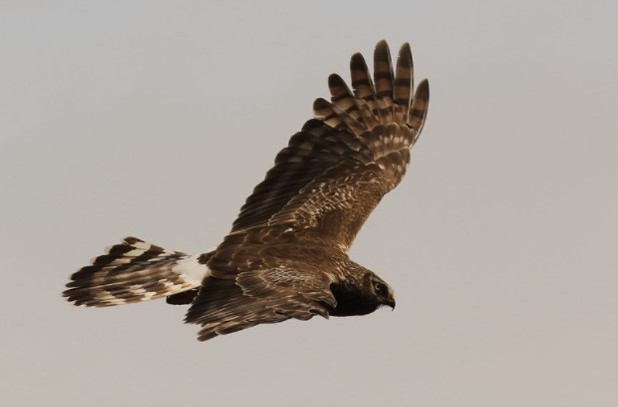
Hen harrier. Photo: Ian Poxton
Hen Harriers are on the Red List of Birds of Conservation Concern in the UK, meaning they are one of the most at-risk species here. Despite all birds of prey being protected by law since the 1950s and more recently under the Wildlife and Countryside Act 1981, illegal persecution is still known to be a serious issue.
In 2011 the UK Government published the authoritative Conservation Framework for Hen Harriers which identified illegal killing of this species as the primary cause stopping population recovery. A 2019 UK Government study using tracking data from Hen Harriers in northern England and southern Scotland also found illegal killing to be the main factor limiting the recovery of the UK Hen Harrier population.
Scotland is the species’ UK stronghold with about 70-80% of the UK breeding population of Hen Harriers here, mostly found in Orkney and the Hebrides. However, the estimated 460 breeding pairs by the 2016 national survey is just a third of the estimated population size of 1500 breeding pairs that habitat in Scotland could support, according to the 2011 UK Government report.
For the new study researchers used satellite tracking devices to look into the survival and movements of Hen Harriers. Whilst these tags provide critical insights into the ecology of the species and aid in conservation, they can also be used to recover dead Hen Harriers, thus allowing the cause of death to be identified.
Between 2014 and 2020, the RSPB and partners fitted satellite transmitters to juvenile Hen Harriers at nests across Scotland, England, Wales, and the Isle of Man. Tags were deployed on 148 individuals, of which 86 were in Scotland, funded by the Hen Harrier LIFE project. The scientists analysed the data and looked at survival rates, causes of death whether natural or through illegal killing, and associations between mortality and land managed for grouse shooting.
Annual survival was low, especially among birds under one year (males: 14%; females: 30%), with illegal killing accounting for the deaths of 27-41% of birds under one year, and 75% of mortality in birds aged between one and two years. Not enough birds survived over two years to estimate mortality due to illegal killing of adults.
The authors found multiple strands of compelling evidence that illegal killing is associated with land management for grouse shooting. A 10% increase in grouse moor use by the birds was associated with a 43% increase in the rate of mortality. There was also a strong overlap between the extent of mortality in 20km squares and the area of grouse moor, with hotspots of illegal killing identified in the central and eastern highlands of Scotland and northern England. In contrast, there were no clear associations between use of grouse moors and death due to natural causes.
Hen harrier. Photo: Ruth Tingay
Steven Ewing, RSPB Senior Conservation Scientist and lead author of the study said: “Hen Harriers have been legally protected for almost 70 years, but this study adds to the already overwhelming evidence base that illegal killing on grouse moors remains a key cause of this species’ low population size and its ongoing absence from large areas of the uplands, particularly grouse moors.”
Duncan Orr-Ewing, Head of Species and Land Management. RSPB Scotland, said: “This study reinforces the devastating impact that illegal killing is having on our Hen Harrier population, how strongly it is associated with grouse moors, and why urgent changes are needed to bring this to an end. There should be three times as many breeding pairs of Hen Harriers in Scotland than we currently have.”
“Thankfully the Scottish Government has undertaken an independent review of the evidence and is now taking action. It is proposing to licence grouse shooting with sanctions including the removal of the right to shoot grouse where wildlife crimes are confirmed, and to provide a meaningful deterrent to wildlife crime. We hope to give evidence to the Rural Affairs and Islands Committee of the Scottish Parliament when it considers the draft Wildlife Management and Muirburn Bill shortly and to present the details of this study. The illegal killing of Hen Harriers, and other birds of prey, has no place in the nature and climate emergency and must end.
“One example of many incidents recorded as part of this study is Rannoch, a young female Hen Harrier, who fledged from a Perthshire nest in July 2017. Her remains were recovered in May 2019 on a Perthshire grouse moor – she had been caught in an illegally set spring trap, and died an agonising death. We cannot have more of our precious Hen Harriers being killed in such a way. This study is a crucial piece of evidence in helping to secure them a better future”.
ENDS
Channel 4 ran a piece on this last night – watch the 4 minute video here.
Since 2018, at least 92 hen harriers have been confirmed ‘missing’ or illegally killed in UK, mostly on or next to driven grouse moors (see here).
The new scientific paper can be read/downloaded here:
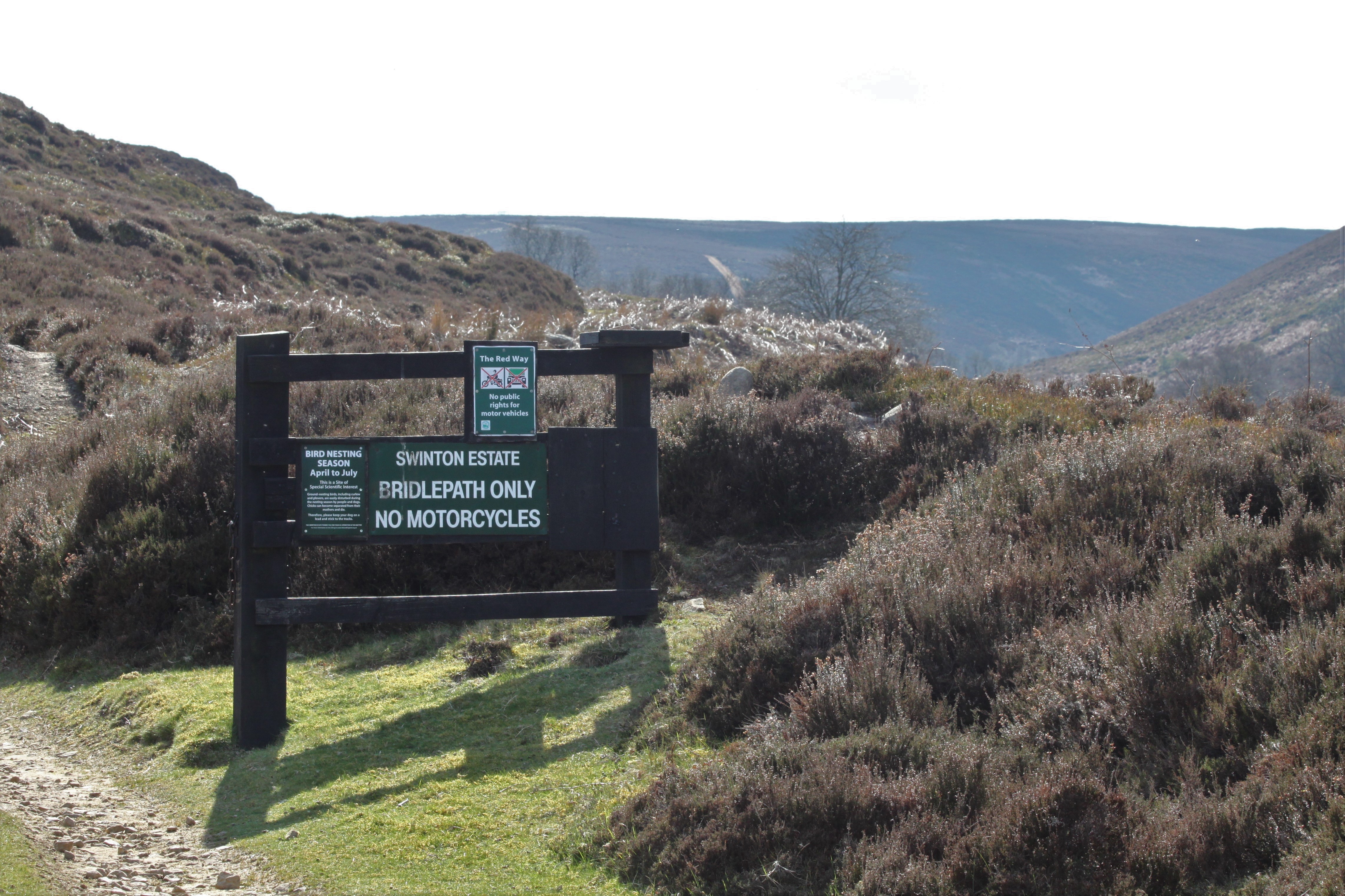
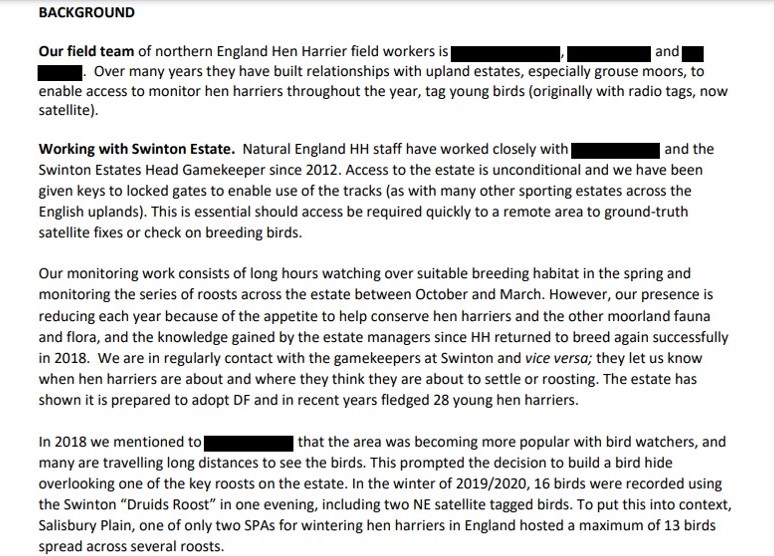
Several months ago I blogged about Natural England’s senior management team having a lovely day out on the notorious Swinton Estate in North Yorkshire on 14th February 2023, as indicated by Tweets from Natural England’s Chief Exec Marian Spain and Chair, Tony Juniper (see here).
When I say Swinton Estate is ‘notorious’, I’m referring to the numerous police investigations into alleged raptor persecution on this grouse-shooting estate (e.g. here, here, here, here) as well as the most recent discovery of a poisoned red kite in 2021 which, inexplicably and outrageously, did not result in a police investigation (see here).
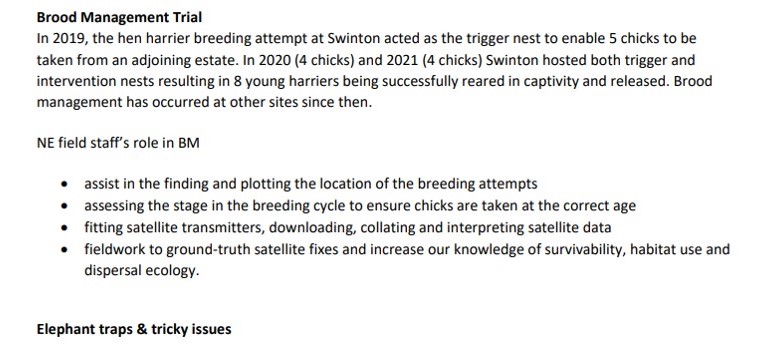
Since the start of DEFRA’s insane hen harrier brood meddling trial in 2018, Swinton Estate, owned by Mark, Cunliffe-Lister, the current Chair of the Moorland Association, has become somewhat of a poster-child for the brood meddling trial due to the estate’s enthusiastic participation in hosting breeding hen harriers which have been subsequently ‘meddled’ (i.e. chicks removed, reared in captivity and released elsewhere).
Swinton Estate grouse moor. Photo: Ruth Tingay
I was curious about what Natural England’s senior staff might have been doing at Swinton Estate in February so I submitted an FoI to Natural England asking for the following:
An itinerary of the visit, including date and time of arrival/departure, and activities undertaken during the visit.
Details of any/all hospitality provided to any member of NE’s senior management team, to other NE staff who were present, and to any NE Board members who were present. This should include information about transport, food and accommodation.
Copies of all correspondence between NE and Swinton Estate and the Moorland Association relating to this visit.
Regular blog readers won’t be surprised to learn that it took Natural England two months to provide the information requested, doing its usual predictable trick of claiming my request was so ‘complex’ it needed 40 working days to respond instead of the standard 20. Being obstructive and lacking transparency has become this statutory agency’s trademark.
Natural England’s response to my ‘complex’ (hardly!) request finally arrived in mid-April. I’m going to split the information into several blogs because there’s a lot to discuss.
First up, in this blog, I’ll just set the scene:
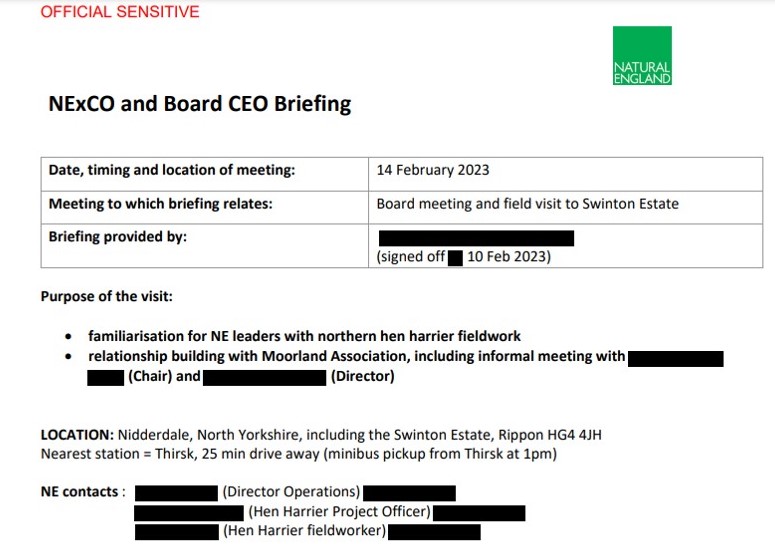
As part of the visit, the Natural England Board was provided with a series of briefing notes (from NE staff) in preparation for the site visit to Swinton Estate and also in preparation for any “tricky issues” that might arise in conversation at the evening dinner with grouse-shooting industry reps. Those briefing documents are fascinating, and very useful, but I’ll come back to those in a separate blog.
Here are the non-controversial bits first:
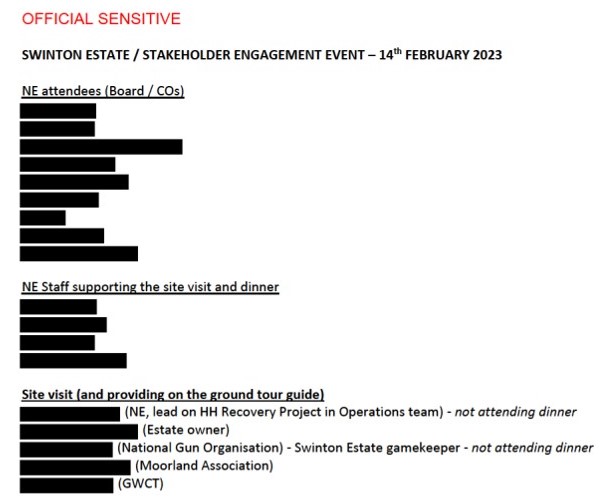
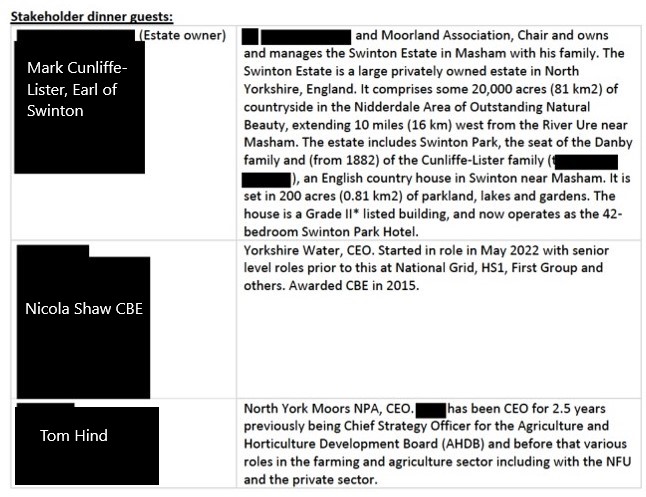
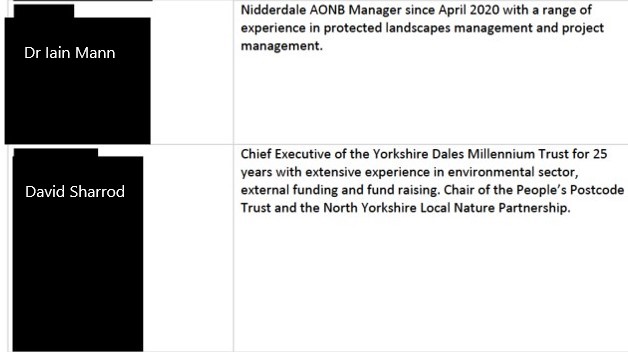
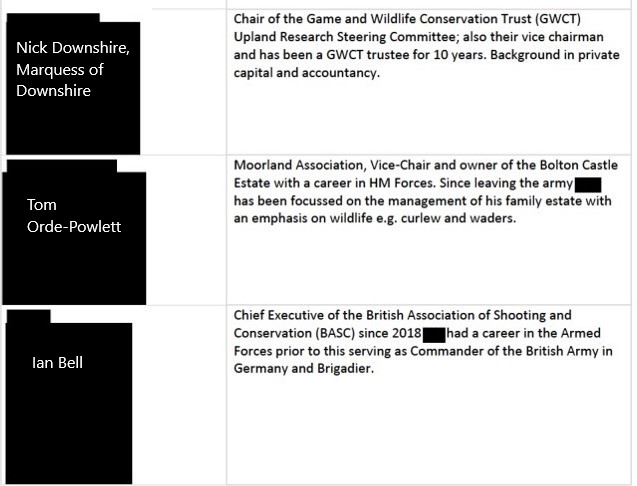
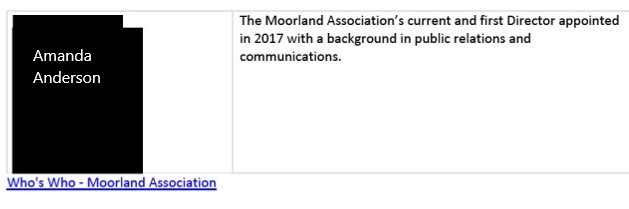
Natural England also provided me with a redacted list of the dinner guests, although bizarrely the dinner guests’ names were redacted but not their accompanying biographies (!) so I’ve added in the names in the left-hand column:
Part two of this blog will appear later this week…(this isn’t being done for effect, I’ve just got too much else on right now).
UPDATE 16 August 2024 (sorry, took longer than I’d anticipated!): Has the hen harrier brood meddling sham finally collapsed? (here)
As many of you will know, DEFRA’s highly controversial (I would argue insane) hen harrier brood meddling scheme was initially approved to run for five years between 2018-2022, facilitated by Natural England.
For new blog readers, hen harrier brood meddling is a conservation sham sanctioned by DEFRA as part of its ludicrous ‘Hen Harrier Action Plan‘ and carried out by Natural England, in cahoots with the very industry responsible for the species’ catastrophic decline in England. In general terms, the plan involves the removal of hen harrier chicks and eggs from grouse moors, rear them in captivity, then release them back into the uplands just in time for the start of the grouse-shooting season where they’ll be illegally killed. It’s plainly bonkers. For more background see here.
An un-meddled hen harrier being reared in the wild. Photo: Laurie Campbell
The brood meddling sham has been hailed by those involved (e.g. Natural England and the Moorland Association) as delivering ‘real’ and ‘great’ progress because the number of breeding hen harriers has risen since the trial began.
However, the number of breeding hen harriers isn’t really the issue – its the ongoing illegal killing of hen harriers that’s the issue. It’s pointless pumping out more hen harrier chicks if they’re just going to get shot/trapped/have their wings ripped off/have their heads twisted and torn off by criminals within the grouse shooting industry once the young birds have been released.
The participants in the trial have been congratulating each other on the trial’s so-called ‘success’, whilst conveniently ignoring the fact that illegal persecution remains rampant – e.g. we know that at least 92 hen harriers are likely to have been killed since this ridiculous pantomime began in 2018 (see here).
One of the grouse-shooting estates involved in the brood meddling trial was even under police investigation for suspected raptor persecution during the trial (see here) and another grouse-shooting estate should have been under police investigation during the brood meddling trial following the discovery of a poisoned red kite on the estate but, shockingly, North Yorkshire Police refused to investigate (see here).
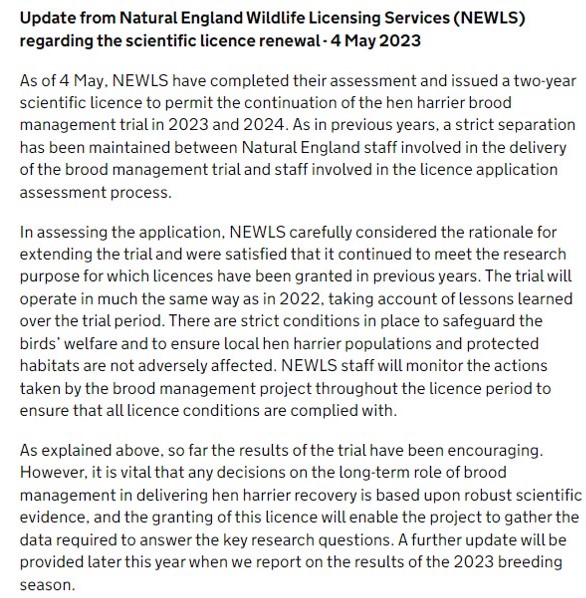
But instead of bringing this sham to an end last year, at the end of the initial five-year trial period, Natural England has announced that a new brood meddling licence has just been issued to extend the sham for at least a further two years (2023 and 2024 breeding seasons).
The announcement was made by Natural England here on 4th May 2023 and I’ve reproduced it below in case it disappears from the Govt website:
I find this decision to extend the brood meddling trial utterly beyond comprehension and earlier this year, when I knew an extension to the licence was being considered, I submitted an FoI to Natural England to try and understand the logic/rationale for continuing with an expensive trial that simply hasn’t delivered in terms of getting the grouse shooting industry to stop illegally killing hen harriers.
I asked three simple things:
For a copy of the most recent assessment report on the hen harrier brood meddling trial from Natural England’s Scientific Advisory Committee (NESAC);
For confirmation of the end date of the brood meddling trial;
For confirmation of when a final assessment report about the trial would be submitted to the NE Board.
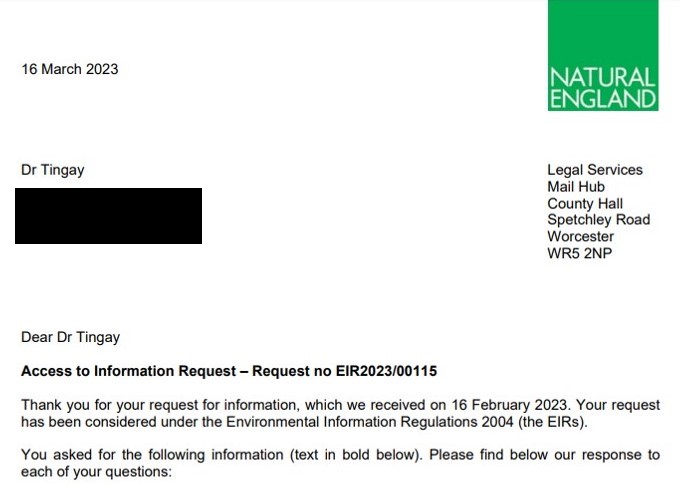
Here’s the response from Natural England on 16th March 2023:
In relation to Q1, I was somewhat surprised to learn that NE ‘does not hold the NESAC report on the hen harrier brood management trial‘.
Eh? Does that mean the NESAC hasn’t produced an assessment/evaluation report? If it hasn’t, who has? I’ve since submitted a further FoI request to determine if anybody at NE has produced a report, and if so, where is it? Surely someone has produced an assessment report, otherwise how on earth has NE assessed the application to extend the trial?!
In lieu of not having an NESAC assessment report, NE did provide ‘a summary of the Natural England Scientific Advisory Committee decision on the brood management trial of hen harriers‘. That summary document, dated 18th January 2023, is provided here:
According to this document, the NESAC has advised the Natural England Board that a five-year extension to the hen harrier brood meddling trial ‘would be appropriate‘. Notably, the ‘full note’ mentioned at the beginning of the document (called Annex 1) was not released as part of NE’s response to my FoI.
In addition to asking NE for a copy of any assessment report on the hen harrier brood meddling trial, I have also submitted FoIs requesting a copy of the licence application for the 2023/24 licence extension and a copy of the actual licence.
Further information about the brood meddling trial has emerged through a separate FoI request I made about NE’s senior management team’s day trip to Swinton Estate (one of the brood meddling estates) in February this year (see here). I’ll be writing about those revelations shortly.
Further to the news on Friday that a previously unreported 20 hen harriers had ‘disappeared’ on English grouse moors between April 2022 and April 2023, in addition to another one whose mutilated corpse was found on a grouse moor (see here and here), I’ve now had the time to go through the latest list of reported victims and work out which ones had not previously been included on my running tally of dead/missing hen harriers since 2018.
You may recall (although admittedly, it is hard to keep up), just two weeks ago I reported that the running tally was 82 dead/missing hen harriers since 2018. I can now report the current total is 92.
Here’s the blog I always write after every reported killing or suspicious disappearance…
For anyone who still wants to pretend that the grouse shooting industry isn’t responsible for the systematic extermination of hen harriers on grouse moors across the UK, here’s the latest catalogue of crime that suggests otherwise.
This male hen harrier died in 2019 after his leg was almost severed in an illegally set trap that had been placed next to his nest on a Scottish grouse moor (see here). Photo by Ruth Tingay
“They disappear in the same way political dissidents in authoritarian dictatorships have disappeared” (Stephen Barlow, 22 January 2021).
Today the list has been updated to include the most recently reported victims, 10 young hen harriers (0f 20) that ‘disappeared’ in suspicious circumstances between April 2022 – April 2023, almost all of them on or close to grouse moors in northern England (see here).
I’ve been compiling this list only since 2018 because that is the year that the grouse shooting industry ‘leaders’ would have us believe that the criminal persecution of hen harriers had stopped and that these birds were being welcomed back on to the UK’s grouse moors (see here).
This assertion was made shortly before the publication of a devastating new scientific paper that demonstrated that 72% of satellite-tagged hen harriers were confirmed or considered likely to have been illegally killed, and this was ten times more likely to occur over areas of land managed for grouse shooting relative to other land uses (see here).
2018 was also the year that Natural England issued a licence to begin a hen harrier brood meddling trial on grouse moors in northern England. For new blog readers, hen harrier brood meddling is a conservation sham sanctioned by DEFRA as part of its ludicrous ‘Hen Harrier Action Plan‘ and carried out by Natural England (NE), in cahoots with the very industry responsible for the species’ catastrophic decline in England. For more background see here.
Brood meddling has been described as a sort of ‘gentleman’s agreement’ by commentator Stephen Welch:
“I don’t get it, I thought the idea of that scheme was some kind of trade off – a gentleman’s agreement that the birds would be left in peace if they were moved from grouse moors at a certain density. It seems that one party is not keeping their side of the bargain“.
With at least 92 hen harriers gone since 2018, there is no question that the grouse shooting industry is simply taking the piss. Meanwhile, Natural England pretends that ‘partnership working’ is the way to go and DEFRA Ministers remain silent.
‘Partnership working’ according to Natural England appears to include authorising the removal of hen harrier chicks from a grouse moor already under investigation by the police for suspected raptor persecution (here) and accepting a £75k ‘donation’ from representatives of the grouse shooting industry that prevents Natural England from criticising them or the sham brood meddling trial (see here). This is in addition to a £10k ‘donation’ that Natural England accepted, under the same terms, in 2021 (here).
Cartoon by Gerard Hobley
So here’s the latest gruesome list. Note that the majority of these birds (but not all) were fitted with satellite tags. How many more [untagged] harriers have been killed?
February 2018: Hen harrier Saorsa ‘disappeared’ in the Angus Glens in Scotland (here). The Scottish Gamekeepers Association later published wholly inaccurate information claiming the bird had been re-sighted. The RSPB dismissed this as “completely false” (here).
5 February 2018: Hen harrier Marc ‘disappeared’ on a grouse moor in Durham (here).
9 February 2018: Hen harrier Aalin ‘disappeared’ on a grouse moor in Wales (here).
March 2018: Hen harrier Blue ‘disappeared’ in the Lake District National Park (here).
March 2018: Hen harrier Finn ‘disappeared’ near Moffat in Scotland (here).
18 April 2018: Hen harrier Lia ‘disappeared’ in Wales and her corpse was retrieved in a field in May 2018. Cause of death was unconfirmed but police treating death as suspicious (here).
8 August 2018: Hen harrier Hilma ‘disappeared’ on a grouse moor in Northumberland (here).
16 August 2018: Hen harrier Athena ‘disappeared’ on a grouse moor in Scotland (here).
26 August 2018: Hen Harrier Octavia ‘disappeared’ on a grouse moor in the Peak District National Park (here).
29 August 2018: Hen harrier Margot ‘disappeared’ on a grouse moor in Scotland (here).
29 August 2018: Hen Harrier Heulwen ‘disappeared’ on a grouse moor in Wales (here).
3 September 2018: Hen harrier Stelmaria ‘disappeared’ on a grouse moor in Scotland (here).
24 September 2018: Hen harrier Heather ‘disappeared’ on a grouse moor in Scotland (here).
2 October 2018: Hen harrier Mabel ‘disappeared’ on a grouse moor on the edge of the Yorkshire Dales National Park (here).
3 October 2018: Hen Harrier Thor ‘disappeared’ next to a grouse moor in Bowland, Lanacashire (here).
23 October 2018: Hen harrier Tom ‘disappeared’ in South Wales (here).
26 October 2018: Hen harrier Arthur ‘disappeared’ on a grouse moor in the North York Moors National Park (here).
1 November 2018: Hen harrier Barney ‘disappeared’ on Bodmin Moor (here).
10 November 2018: Hen harrier Rannoch ‘disappeared’ on a grouse moor in Scotland (here). Her corpse was found nearby in May 2019 – she’d been killed in an illegally-set spring trap (here).
14 November 2018: Hen harrier River ‘disappeared’ on a grouse moor in the Nidderdale AONB (here). Her corpse was found nearby in April 2019 – she’d been illegally shot (here).
16 January 2019: Hen harrier Vulcan ‘disappeared’ in Wiltshire close to Natural England’s proposed reintroduction site (here).
7 February 2019: Hen harrier Skylar ‘disappeared’ next to a grouse moor in South Lanarkshire (here).
22 April 2019: Hen harrier Marci ‘disappeared’ on a grouse moor in the Cairngorms National Park (here).
26 April 2019: Hen harrier Rain ‘disappeared’ on a grouse moor in Nairnshire (here).
11 May 2019: An untagged male hen harrier was caught in an illegally-set trap next to his nest on a grouse moor in South Lanarkshire. He didn’t survive (here).
7 June 2019: An untagged hen harrier was found dead on a grouse moor in Scotland. A post mortem stated the bird had died as a result of ‘penetrating trauma’ injuries and that this bird had previously been shot (here).
5 September 2019: Wildland Hen Harrier 1 ‘disappeared’ on a grouse moor nr Dalnaspidal on the edge of the Cairngorms National Park (here).
11 September 2019: Hen harrier Romario ‘disappeared’ on a grouse moor in the Cairngorms National Park (here).
14 September 2019: Hen harrier (Brood meddled in 2019, #183704) ‘disappeared’ in the North Pennines (here).
23 September 2019: Hen harrier (Brood meddled in 2019, #55149) ‘disappeared’ in North Pennines (here).
24 September 2019: Wildland Hen Harrier 2 ‘disappeared’ on a grouse moor at Invercauld in the Cairngorms National Park (here).
24 September 2019: Hen harrier Bronwyn ‘disappeared’ near a grouse moor in North Wales (here).
10 October 2019: Hen harrier Ada ‘disappeared’ on a grouse moor in the North Pennines AONB (here).
12 October 2019: Hen harrier Thistle ‘disappeared’ on a grouse moor in Sutherland (here).
18 October 2019: Member of the public reports the witnessed shooting of an untagged male hen harrier on White Syke Hill in North Yorkshire (here).
November 2019: Hen harrier Mary found illegally poisoned on a pheasant shoot in Ireland (here).
14 December 2019: Hen harrier Oscar ‘disappeared’ in Eskdalemuir, south Scotland (here).
January 2020: Members of the public report the witnessed shooting of a male hen harrier on Threshfield Moor in the Yorkshire Dales National Park (here).
23 March 2020: Hen harrier Rosie ‘disappeared’ at an undisclosed roost site in Northumberland (here).
1 April 2020: Hen harrier (Brood meddled in 2019, #183703) ‘disappeared’ in unnamed location, tag intermittent (here).
5 April 2020: Hen harrier Hoolie ‘disappeared’ on a grouse moor in the Cairngorms National Park (here)
8 April 2020: Hen harrier Marlin ‘disappeared’ on a grouse moor in the Cairngorms National Park (here).
19 May 2020: Hen harrier Fingal ‘disappeared’ on a grouse moor in the Lowther Hills, Scotland (here).
21 May 2020: Hen harrier (Brood meddled in 2019, #183701) ‘disappeared’ on a grouse moor in Cumbria shortly after returning from wintering in France (here).
27 May 2020: Hen harrier Silver ‘disappeared’ on a grouse moor on Leadhills Estate, Scotland (here).
2020: day/month unknown: Unnamed male hen harrier breeding on RSPB Geltsdale Reserve, Cumbria ‘disappeared’ while away hunting (here).
9 July 2020: Unnamed female hen harrier (#201118) ‘disappeared’ from an undisclosed site in Northumberland (here).
25 July 2020: Hen harrier Harriet ‘disappeared’ on a grouse moor in the Yorkshire Dales National Park (here).
14 August 2020: Hen harrier Solo ‘disappeared’ in confidential nest area in Lancashire (here).
7 September 2020: Hen harrier Dryad ‘disappeared’ on a grouse moor in the Yorkshire Dales National Park (here).
16 September 2020: Hen harrier Fortune ‘disappeared’ from an undisclosed roost site in Northumberland (here).
19 September 2020: Hen harrier Harold ‘disappeared’ on a grouse moor in the Yorkshire Dales National Park (here).
20 September 2020: Hen harrier (Brood meddled in 2020, #55152) ‘disappeared’ next to a grouse moor in North Yorkshire (here).
24 February 2021: Hen harrier Tarras ‘disappeared’ next to a grouse moor in Northumberland (here)
12th April 2021: Hen harrier Yarrow ‘disappeared’ near Stockton, County Durham (here).
18 May 2021: Adult male hen harrier ‘disappeared’ from its breeding attempt on RSPB Geltsdale Reserve, Cumbria whilst away hunting (here).
18 May 2021: Another adult male hen harrier ‘disappeared’ from its breeding attempt on RSPB Geltsdale Reserve, Cumbria whilst away hunting (here).
24 July 2021: Hen harrier Asta ‘disappeared’ at a ‘confidential site’ in the North Pennines (here). We learned 18 months later that her wings had been ripped off so her tag could be fitted to a crow in an attempt to cover up her death (here).
14th August 2021: Hen harrier Josephine ‘disappeared’ at a ‘confidential site’ in Northumberland (here).
17 September 2021: Hen harrier Reiver ‘disappeared’ in a grouse moor dominated region of Northumberland (here)
24 September 2021: Hen harrier (Brood meddled in 2021, R2-F-1-21) ‘disappeared’ in Northumberland (here).
15 November 2021: Hen harrier (brood meddled in 2020, #R2-F1-20) ‘disappeared’ at the edge of a grouse moor on Arkengarthdale Estate in the Yorkshire Dales National Park (here).
19 November 2021: Hen harrier Val ‘disappeared’ in the Lake District National Park in Cumbria (here).
19 November 2021: Hen harrier Percy ‘disappeared’ in Lothian, Scotland (here).
12 December 2021: Hen harrier Jasmine ‘disappeared’ on a grouse moor (High Rigg Moor on the Middlesmoor Estate) in the Nidderdale AONB in North Yorkshire (here).
9 January 2022: Hen harrier Ethel ‘disappeared’ in Northumberland (here).
26 January 2022: Hen harrier Amelia ‘disappeared’ in Bowland (here).
10 February 2022: An unnamed satellite-tagged hen harrier ‘disappeared’ in a grouse moor dominated area of the Peak District National Park (here). One year later it was revealed that the satellite tag/harness of this young male called ‘Anu’ had been deliberately cut off (see here).
12 April 2022: Hen harrier ‘Free’ (Tag ID 201121) ‘disappeared’ at a ‘confidential site’ in Cumbria (here). It later emerged he hadn’t disappeared, but his mutilated corpse was found on moorland in the Yorkshire Dales National Park. A post mortem revealed the cause of death was having his head twisted and pulled off. One leg had also been torn off whilst he was still alive (here).
April 2022: Hen harrier ‘Pegasus’ (tagged by the RSPB) ‘disappeared’ on a grouse moor at Birkdale in the Yorkshire Dales National Park (here).
May 2022: A male breeding hen harrier ‘disappeared’ from a National Trust-owned grouse moor in the Peak District National Park (here).
May 2022: Another breeding male hen harrier ‘disappeared’ from a National Trust-owned grouse moor in the Peak District National Park (here).
14 May 2022: Hen harrier ‘Harvey’ (Tag ID 213844) ‘disappeared’ from a ‘confidential site’ in the North Pennines (here).
20 June 2022: Hen harrier chick #1 stamped to death in nest on a grouse moor in the Yorkshire Dales National Park (here).
20 June 2022: Hen harrier chick #2 stamped to death in nest on a grouse moor in the Yorkshire Dales National Park (here).
20 June 2022: Hen harrier chick #3 stamped to death in nest on a grouse moor in the Yorkshire Dales National Park (here).
20 June 2022: Hen harrier chick #4 stamped to death in nest on a grouse moor in the Yorkshire Dales National Park (here).
17 August 2022: Hen harrier (brood meddled in 2022, #R1-M1-22) ‘disappeared’ on moorland in the Yorkshire Dales National Park (here).
September 2022: Hen harrier ‘Sullis’ (tagged by the RSPB) ‘disappeared’ on a grouse moor in Cumbria (here).
5 October 2022: Hen harrier (brood meddled in 2022, #R3-M2-22) ‘disappeared’ on moorland in the Yorkshire Dales National Park (here).
10 October 2022: Hen harrier ‘Sia’ ‘disappeared’ near Hamsterley Forest in the North Pennines (here).
October 2022: Hen harrier (brood meddled in 2021, #R1-F1-21) ‘disappeared’ in the North Sea off the North York Moors National Park (here).
1 December 2022: Hen harrier male (brood meddled in 2021, #R1-M1-21) ‘disappeared’ on moorland in the Yorkshire Dales National Park (here).
14 December 2022: Hen harrier female (brood meddled in 2022, #R3-F1-22) ‘disappeared’ on moorland in the North Pennines AONB (here).
15 December 2022: Hen harrier female (brood meddled in 2022, #R2-F1-22) ‘disappeared’ on moorland in the Yorkshire Dales National Park (here).
March 2023: Unnamed male hen harrier (tagged by Natural England – details not yet released) ‘disappeared’ in North Yorkshire (here).
April 2023: Unnamed female hen harrier (tagged by Natural England – details not yet released) ‘disappeared’ in North Yorkshire (here).
April 2023: Hen harrier ‘Lagertha’ (tagged by RSPB) ‘disappeared’ in North Yorkshire (here).
April 2023: Hen harrier ‘Nicola’ (Tag ID 234078) ”disappeared’ in North Yorkshire (here).
April 2023: Untagged male hen harrier ‘disappeared’ from an active nest on RSPB Geltsdale Reserve in Cumbria (here).
April 2023: Another untagged male hen harrier ‘disappeared’ from an active nest on RSPB Geltsdale Reserve in Cumbria (here).
April 2023: Untagged male hen harrier ‘disappeared’ from an active nest in Durham (see here).
To be continued……..
Not one of these 92 incidents has resulted in an arrest, let alone a prosecution. I had thought that when we reached 30 dead/missing hen harriers then the authorities might pretend to be interested and at least say a few words about this national scandal. We’ve now reached NINETY TWO hen harriers, and still Govt ministers remain silent. They appear not to give a monkey’s. And yes, there are other things going on in the world, as always. That is not reason enough to ignore this blatant, brazen and systematic destruction of a supposedly protected species, being undertaken to satisfy the greed and bloodlust of a minority of society
Further to the news that 20 hen harriers have gone ‘missing’ in the last year (many of them on grouse moors in the Yorkshire Dales National Park), as well as the discovery of a mutilated hen harrier corpse, whose head and leg was ripped off whilst the harrier was still alive, also in the National Park (see here and here), the Yorkshire Dales National Park Authority has published a statement:
Photo: Ruth Tingay
RESPONSE TO THE DEATH OF ‘FREE’, A NATURAL ENGLAND TAGGED HARRIER
Friday, 5th May 2023
David Butterworth, Chief Executive of the Yorkshire Dales National Park Authority, said:
“It’s astonishing that 21 Hen Harriers have disappeared across Northern England in 12-months, and sickening to hear that ‘Free’, a Natural England tagged hen harrier has been found dead, headless and missing a leg in an area of moorland in the National Park.
“After so many years of illegal bird of prey persecution in the area you might think we would become more immune to this pathetic criminality. We never should.
“Locally, we have seen some tentatively encouraging results in recent years in terms of successful breeding of hen harriers, with the strong support of some land owners. However, that progress will be rendered utterly worthless if these attacks are allowed to continue.
“It is shameful that we still have individuals among our local communities who take part in these atrocities. I would strongly urge anyone with any information on this incident to come forward. This has to stop”.
Killing birds of prey is illegal. Anyone with concerns about a possible wildlife crime should call 101, and anyone witnessing a suspected wildlife crime should call 999 and ask for the Police.
Yesterday, the RSPB announced the shocking news that 20 hen harriers had gone ‘missing’ on grouse moors in northern England between April 2022 – April 2023, and that the mutilated corpse of a further hen harrier, named ‘Free’, had been found dead on moorland in the Yorkshire Dales National Park (see here).
Hen harrier ‘Free’ was a satellite-tagged bird that was being tracked by Natural England. Natural England has published a blog about the grisly circumstances of Free’s death. I’m reproducing it here, in case the original blog vanishes at some future point.
THE DEATH OF FREE, A NATURAL ENGLAND TAGGED HEN HARRIER
By Stephanie Bird-Halton, Director, National Delivery, Natural England (May 5th 2023).
Hen harriers are currently extremely rare in England due to illegal persecution and nest disturbance, primarily in areas associated with grouse shooting. Natural England satellite-tracks hen harriers in order to investigate patterns of dispersal and survival, and the causes of any deaths. This blog is about Free, one of our tagged hen harriers, that died due to human persecution.
Free was hatched in 2020 from a nest in Cumbria, and in April 2022 he was two years old. At around this time, he had apparently settled in an area of moorland around Birkdale, near the border of Yorkshire and Cumbria. Our staff raised concerns when Free’s tag transmitted a signal late at night on 11 April 2022, indicating he was away from his normal roosting area.
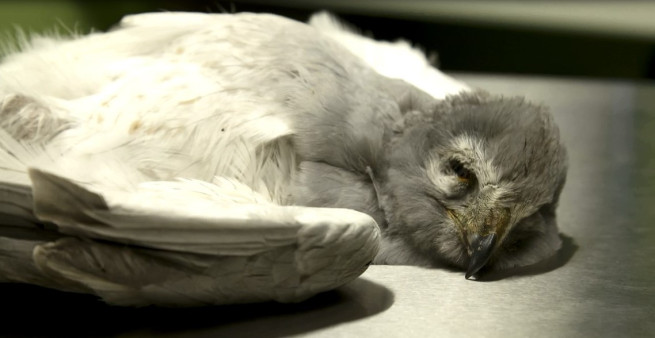
As always, the police were immediately informed. It is not always possible to accurately identify the location of a satellite tag, as they do not transmit constantly, but in this case the tag was swiftly tracked down to a rocky slope above Outhgill. Free was found dead, headless and missing a leg, but showing no other sign of being eaten or scavenged by an animal predator, and still fitted with his satellite tag.
Hen harrier ‘Free’ as found. Photo: Natural England
Hen Harrier ‘Free’ as found. Photo: Natural England
Free’s body was recovered and sent for post-mortem examination to diagnose signs of death. Shockingly and upsettingly, the post-mortem examination concluded that Free’s leg had been torn off while he was alive, and that the cause of death was the head being twisted and pulled off while the body was held tightly. These injuries would be consistent with Free being killed by human hands. There were no other signs of damage from any animal, and Free had not been shot.
Hen harrier ‘Free’ under post-mortem examination showing the signs of bleeding where the leg had been removed. Photo: ZSL
The police and National Wildlife Crime Unit were kept informed, and no information has been shared publicly while enforcement action has been ongoing. Unfortunately, the police investigation did not gather sufficient information to identify a suspect. We are appalled and upset by this horrible death of a beautiful bird, but without further evidence the police and Natural England have no basis for further action. Any requests for more details about this case, or new evidence, should be directed to Cumbria police.
What next?
We are sickened by this evidence of persecution, which remains a serious issue and needs more focus and action from the police, businesses, landowners, and game management interests. We will continue our work tracking hen harriers and will make every effort to track down tags that stop transmitting, and to support the police in their role of bringing the perpetrators of these crimes to justice.
Natural England remains committed to working with our partners on hen harrier recovery. We are encouraged by the possibilities demonstrated by the recent increase in nesting hen harrier numbers overall, and will continue to work to turn the tide on the illegal persecution of these at-risk birds.
We regularly share the status of all our satellite-tracked Hen Harriers (every few months) on this page.
ENDS
I applaud Natural England for publishing this detailed account, but that’s as far as my applause goes.
Why has it taken 13 months, from the discovery of Free’s mutilated corpse in April 2022, for this information to be published? This isn’t the first case where this has happened either (e.g. see here).
The police have said absolutely nothing about this investigation. No statements, no public appeals for information, nothing. I don’t accept that issuing a statement or appeal, no matter how generalised, would have compromised the investigation.
Natural England’s standard response is that it won’t say anything whilst a police investigation is ongoing. I understand that position, and it’s a fair position to take during the early stages of an investigation when evidence-gathering may still be taking place. But to wait for 13 months? That’s ridiculous, and in my view is just NE hiding behind the police as a convenient excuse. And I suspect the news has only emerged now because NE knew that if it didn’t say something, someone else would.
Natural England is using public funds to pay for these satellite tags and staff time to monitor the data. It could easily have made a statement about this case, which is very much in the public interest, without compromising the police investigation.
As long as NE remained silent, it provided an opportunity for both NE and the grouse-shooting industry to flood the media last year, and this year, with propaganda designed to demonstrate that ‘real‘ and ‘great‘ progress was being made by the ludicrous hen harrier brood meddling scheme.
As for the sadistic bastard(s) who tore Free’s leg off whilst he was still alive and then held Free’s body tightly and twisted and pulled his head off (reported in the post mortem as the official cause of death), leaving his body (and sat tag) in place knowing that he’d be found by researchers, if that isn’t an intentional act of defiance and sticking up two fingers to the law then I don’t know what is.
Natural England may well be ‘sickened’ by the evidence – anybody in their right mind would be – but Natural England isn’t just ‘anybody’. It’s the statutory regulator and has a duty to protect this species. When will it accept that decades of so-called ‘partnership-working’ with the grouse shooting industry hasn’t worked, and won’t ever work as long as the criminals are allowed to keep getting away with it?
A couple of weeks ago I blogged about the ‘disappearance’ of five more satellite-tagged hen harriers that had all vanished, in suspicious circumstances, on moorland in northern England between August and December 2022 (see here).
A week later I blogged about how Natural England and the Moorland Association had remained silent about those latest disappearances (see here).
Hen harrier. Photo: Ian Poxton
This morning, the RSPB has issued a press statement about a further 21 hen harriers, as follows:
RARE BIRD OF PREY FOUND MUTLILATED AS 20 OTHER INDIVIDUALS GO MISSING
One of the UK’s rarest birds of prey, a Hen Harrier, has been found dead and its body mutilated. Twenty other harriers, including 15 birds that were part of satellite-tagged tracking projects, have also disappeared across Northern England in the past year.
Hen Harriers are on the red list of birds of conservation concern in the UK, with the last national survey in 2016 recording 545 pairs in the UK – a decline of 13% since 2010. In England there were 34 successful nests in 2022, despite enough habitat and food to support over 300 pairs. In 2019, the Government’s own study found illegal killing to be the main factor limiting the recovery of the UK Hen Harrier population.
The story began in April 2022 when an RSPB satellite-tagged Hen Harrier named Pegasus vanished whilst on Birkdale – an area of driven grouse moor in the Yorkshire Dales National Park on the North Yorkshire/Cumbria border. This was followed shortly after by the discovery of a dead Hen Harrier in the same area – a Natural England tagged bird called Free. The bird was missing its head and leg, which had held a metal ring for identification. Expert veterinary assessment concluded the bird has been killed through traumatic removal of its head and leg, whilst alive – consistent with persecution. A month later, another hen harrier, NE tagged bird Harvey, vanished in this area. The police carried out a search warrant in connection with the incidents, but the ensuing investigation has failed to lead to charges.
However, since the investigation ended a further four satellite-tagged Hen Harriers (one from a RSPB project and three from a Natural England one) have disappeared in this same area, managed for driven grouse shooting.
During autumn 2022, two additional RSPB tagged birds vanished in Cumbria and Durham, both also on grouse moors.
These nine birds are separate to another seven Natural England satellite-tagged Hen Harriers recorded as missing, fate unknown, over the past year.
Finally, also in the past year, five (un-tagged) breeding male Hen Harriers have vanished, including two in the Peak District National Park in 2022 and, in April this year, one in Durham and two from the RSPB’s Geltsdale Nature Reserve in Cumbria: both these birds had active nests which have now been abandoned, one containing three cold eggs. Male harriers are known to hunt away from their nest sites, and this is not the first time that adult male harriers with active nests have vanished from Geltsdale in recent years.
All 21 birds were reported at the time by the RSPB and Natural England to the Police and the National Wildlife Crime Unit.
Commenting on the situation, the RSPB’s conservation director Katie-Jo Luxton said,“These 21 birds represent a significant proportion of the existing English Hen Harrier population. The Government’s own study found illegal killing to be the main reason preventing the recovery of this species, and these recent events indicate that the situation has yet to improve for this rare and beautiful bird.”
Natural England Strategy Director John Holmes said: “We are sickened by this evidence of persecution, which remains a serious issue and needs more focus and action from the police, businesses, landowners, and game management interests. Natural England will continue to work with partners on Hen Harrier recovery, and direct our resources towards science, monitoring, enforcement, and conservation management. We will continue all efforts to track down tags that stop transmitting, as our dedicated staff did in the case of Free, and to support the police in their role of bringing the perpetrators of these crimes to justice“
ENDS
There’s quite a lot to digest in this press release and I’m short on time today, but what is immediately obvious is the clear escalation in persecution incidents, and that they are all linked to driven grouse moors. North Yorkshire, and particularly the Yorkshire Dales National Park, is once again at the centre of the criminality.
The unspeakable barbarity inflicted on Hen Harrier ‘Free’, whose head and leg was ripped off while the bird was still alive, is shocking, but not at all surprising, especially given what we know happened to hen harrier ‘Asta’ (see here). I’ll write more about ‘Free’ shortly.
The RSPB has helpfully provided the following table showing the hen harriers confirmed as persecuted or missing between April 2022-April 2023:
I will need to go through this table and work out which of these harriers are already included in the 82 that we know have been confirmed as illegally killed or missing in suspicious circumstances since 2018 – see here. There will definitely be more to add to that shameful running total.
With this blatant, ongoing, and widespread criminal persecution, Natural England’s recent decision to extend its ‘partnership’ with the grouse shooting industry as part of the ludicrous hen harrier brood meddling scheme, warrants further scrutiny. I’ll come back to that.
UPDATE 6th May 2023: Post mortem reveals hen harrier’s cause of death was ‘head being twisted and pulled off while the body was held tightly’ (here)











 Raptor Persecution UK