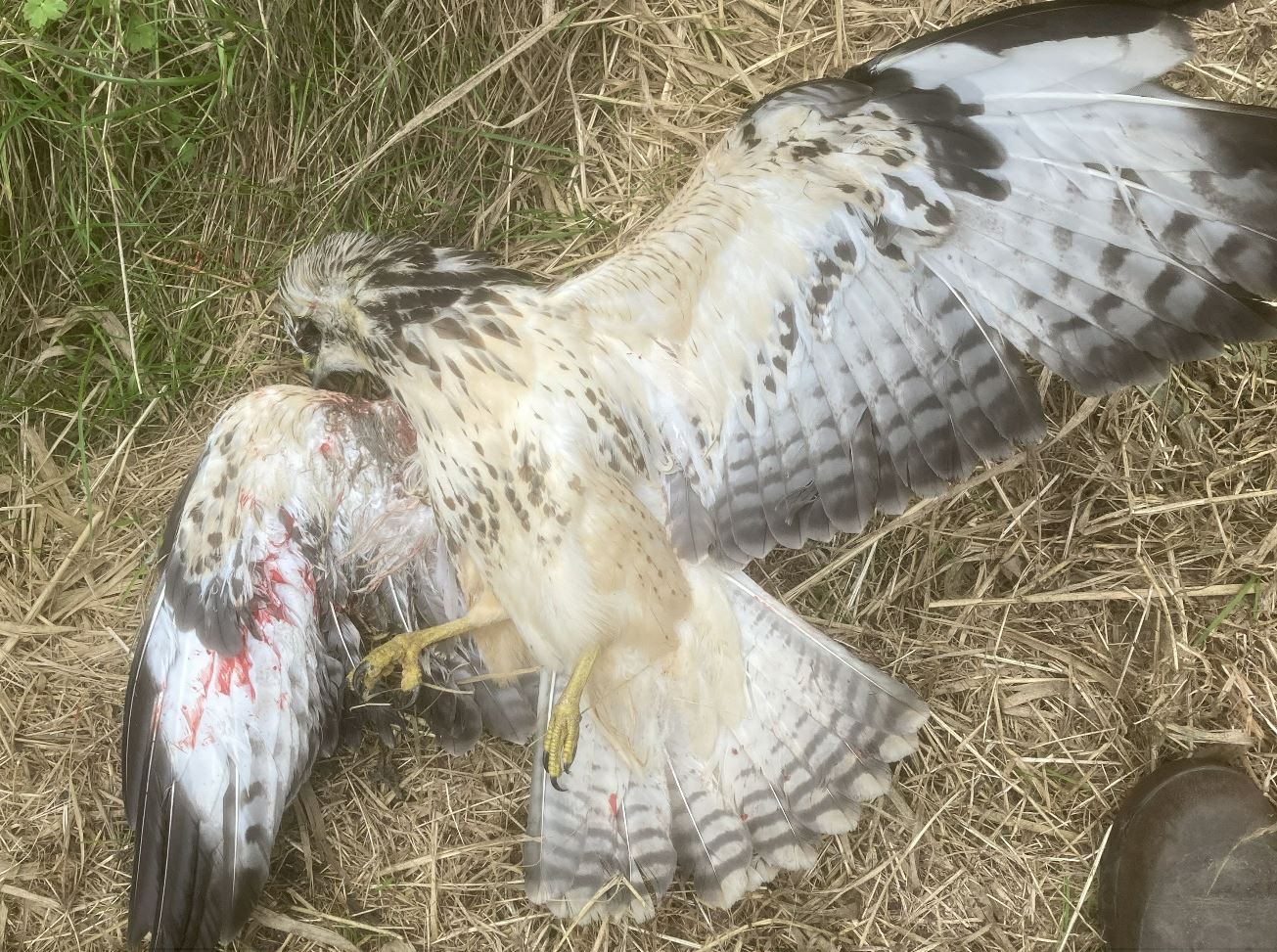
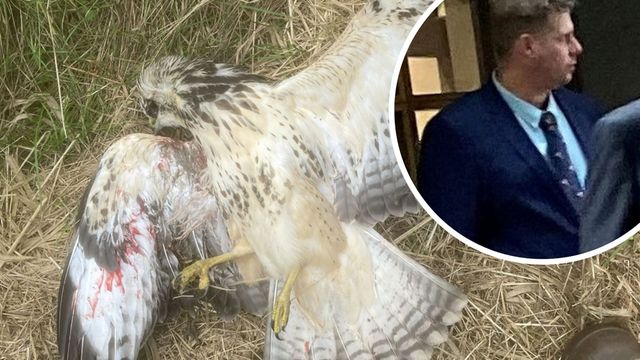
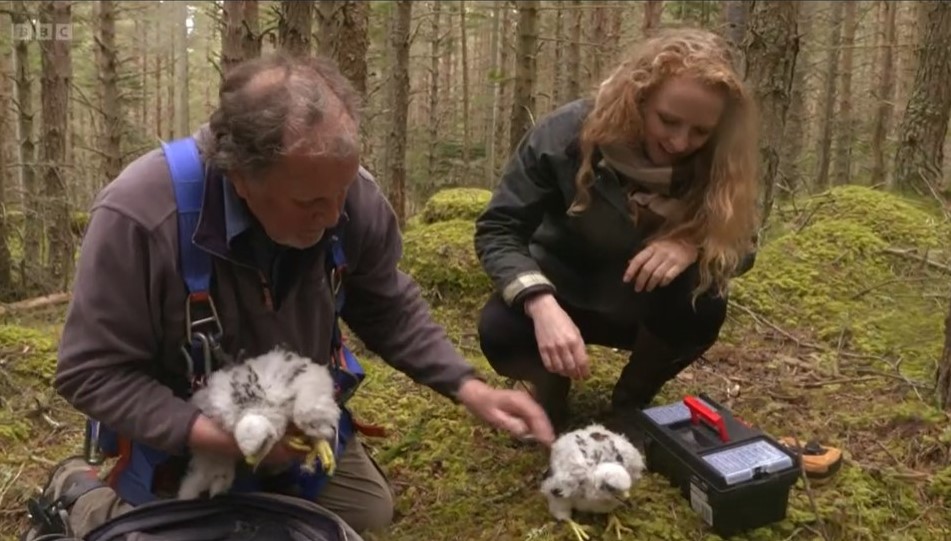
Goshawk nest attacked in Peak District National Park – Derbyshire Police appeal for information

An appeal for information by Derbyshire Police’s Rural Crime Team (21st August 2022):

‘Back in June this year a larch tree at Westend in the Upper Derwent Valley which was home to a pair of goshawks was found to have been interfered with. Sadly, the birds abandoned the site and it was discovered that the tree had drilled holes and bolts all the way up it which we believe to be evidence of how the nest had been accessed. A local ornithologist had confirmed the presence of eggs in the nest prior to all this but had then found the be no longer there.

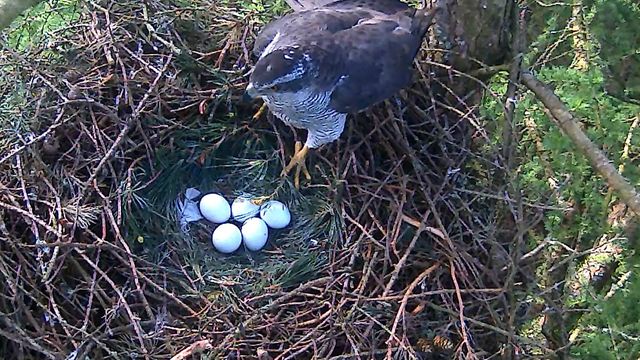
[A goshawk nest, photo by Archant]

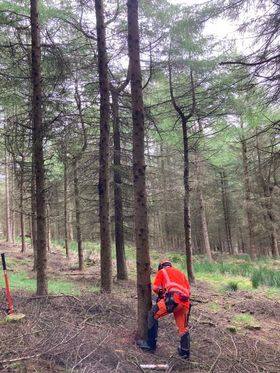
With help from Forestry England staff a forensic examination was carried out on the tree and items were submitted to the lab.

We are appealing to anyone who may be able to provide information to help with this enquiry.

Thank you‘.

ENDS

[Photo of the forensic examination of the goshawk’s nest tree. Photo by Derbyshire Police]

Goshawks in the Dark Peak area of the Peak District National Park have been the target of relentless illegal persecution for decades, along with a number of other raptor species including peregrine and hen harrier (the most recent incident reported earlier this summer – here).

The majority of these crimes have been linked to driven grouse shooting. For new blog readers, the following reports and scientific papers provide good background evidence:

GWCT disregards police investigation into alleged wildlife crime on Van Cutsem’s Norfolk estate

Last week I wrote about how former Cabinet Secretary Fergus Ewing MSP, the Scottish Gamekeepers Association, and landowners’ lobby group Scottish Land & Estates had shown complete disregard for the sanction imposed on Moy Estate after raptor persecution crimes had been recorded there (see here).

This week it’s the turn of the Game & Wildlife Conservation Trust (GWCT) to seemingly turn a blind eye.

Have a look at this event currently being promoted on GWCT’s website:

Regular readers will know that Hilborough House is the home of William van Cutsem. In May this year, police raided the estate after video footage emerged of alleged raptor persecution.

The footage, captured on a secret camera installed by the Hunt Investigation Team, appeared to show a crow cage trap in woodland alleged to be on the Hilborough Estate. The trap had been baited with live pigeons (this is an offence) and a young goshawk was attracted to the bait, entered the trap and then couldn’t escape. A masked man is then recorded entering the trap, pinning the goshawk to the side netting with a stick so he could grab the bird, and then removing it from the trap and walking away with it (also an offence). The goshawk’s fate is not shown.

As far as I’m aware, the police investigation is ongoing.

Mr Van Cutsem hasn’t commented publicly about this investigation although in a classic attempt at diversion, the Mail on Sunday ran a piece quoting ‘an unnamed source close to Mr van Cutsem’ who questioned the relationship between the Hunt Investigation Team and the RSPB:

What also is interesting is how close HIT works with the RSPB. It would be good to understand how a mainstream charity is working with a shady group’. 

Oh the irony!

General Licence restriction imposed on Moy, a grouse-shooting estate, after discovery of poisoned red kite

Press release from NatureScot, 21st June 2022:

General Licence restricted on Highland estate

NatureScot has restricted the use of General Licences on Moy Estate for three years

The decision was made on the basis of evidence provided by Police Scotland of wildlife crime against birds.

This evidence included a poisoned red kite found on the estate in 2020, and incidents in relation to trapping offences.

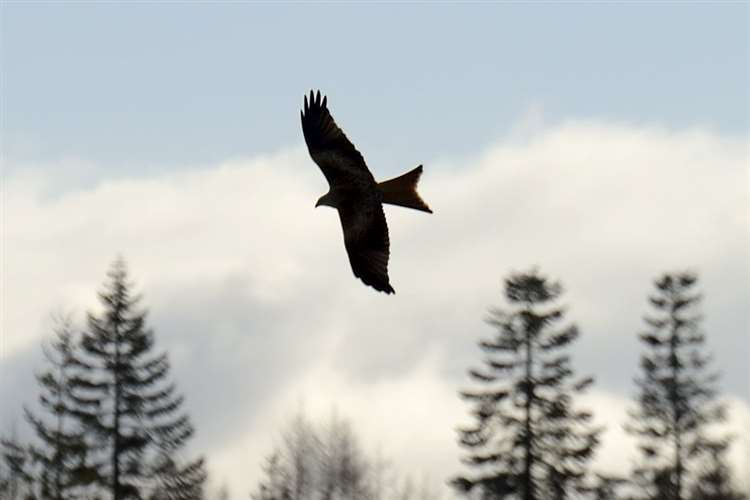
[Red kite. Photographer unknown]

Donald Fraser, NatureScot’s Head of Wildlife Management, said: “We consider the information from Police Scotland provides robust evidence that wild birds have been killed or taken or there has been intention to do so illegally on this land.

“Because of this, and the risk of more wildlife crimes taking place, we have suspended the use of general licences on this property for three years until June 2025. They may still apply for individual licences, but these will be closely monitored.

“NatureScot is committed to using all the tools we have available to tackle wildlife crime. This measure will help to protect wild birds in the area, while still allowing necessary land management activities to take place, although under tighter supervision.

“We believe this is a proportionate response to protect wild birds in the area and prevent further wildlife crime. We will continue to work closely with Police Scotland and consider information they provide on cases which may warrant restricting general licences.”

General licences allow landowners or land managers to carry out control of common species of wild birds, such as crows and magpies, to protect crops or livestock, without the need to apply for an individual licence.

In addition to this restriction, there are currently three other restrictions in place on Invercauld Estate in the Cairngorms National Park, Lochan Estate in Perthshire and Leadhills Estate in South Lanarkshire.

ENDS

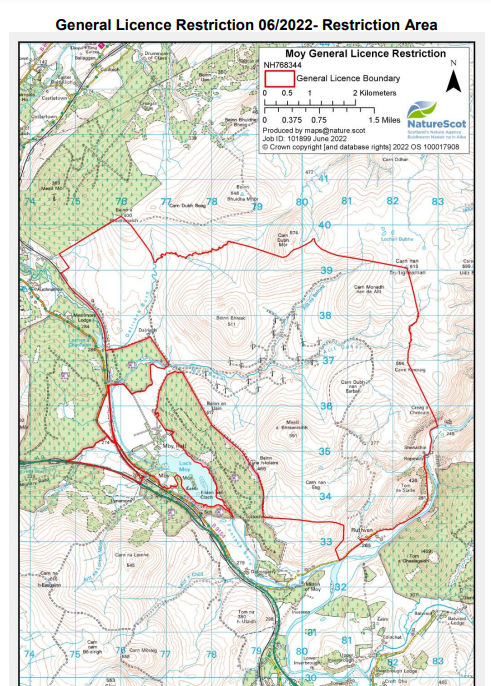
The restriction notice reads as follows:

In line with NatureScot’s published General Licence restrictions: Framework for Implementing Restrictions we hereby give notice that a restriction has been applied to the land outlined in red overleaf. This restriction prohibits the use of General Licences 01, 02 and 03 on that land between 21st June 2022 and 21st June 2025.

Please note that this restriction does not imply responsibility for the commission of crimes on any individuals.

This one has been a long time coming. Moy is one of those estates where if its name comes up in conversation amongst raptor conservationists in Scotland, eyes tend to roll and knowing looks are exchanged. It has been identified as a raptor persecution hotspot for many, many years.

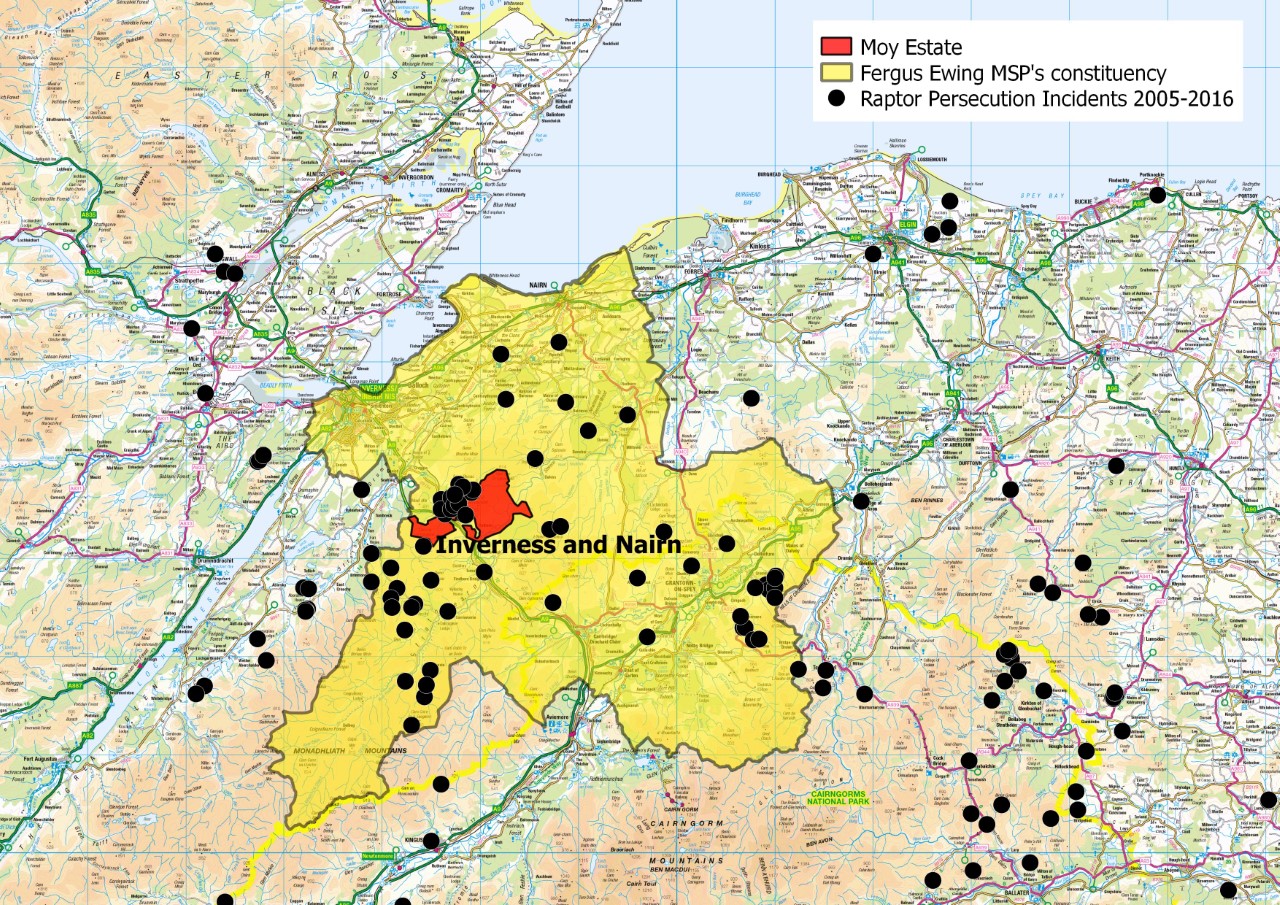
Here is a map we created way back in 2016 to highlight the extent of raptor persecution crimes in former Cabinet Secretary Fergus Ewing’s constituency (given his strong support of the Scottish Gamekeepers Association) and this shows the concentration of incidents on and close to Moy Estate:

Here is a selection of examples, but this is by no means an exhaustive list:

Moy Estate was raided by police in 2010 after the discovery of poisoned bait and dead raptors and illegally set traps. A gamekeeper was later convicted of possession of a red kite after its bloodied corpse was found in the back of his vehicle. It had two broken legs, consistent with being caught in spring traps, and a head injury. A bloodied shinty stick was also found in the back of the vehicle. Notably, the gamekeeper wasn’t convicted for killing the kite, just for having possession of it. Nobody was charged with killing this kite.

These baited traps were discovered on the moor (the illegally-set spring traps were originally disguised under moss, removed here for evidential purposes). No charges were brought.

The remains of two further red kites were discovered on the moor, including a severed red kite leg and some wing tags that had previously been fitted to a kite, all found buried in holes under some moss. No charges were brought.

A jar in one of the gamekeeper’s houses contained the leg rings of four young golden eagles – nobody could account for how they had ended up inside that jar. Perhaps he’d found them whilst ‘metal detecting at his uncle’s farm’ like gamekeeper Archie Watson, who recently gave this implausible explanation to the court for how he’d come to possess BTO leg rings from a buzzard and a red kite attached to his keyring.

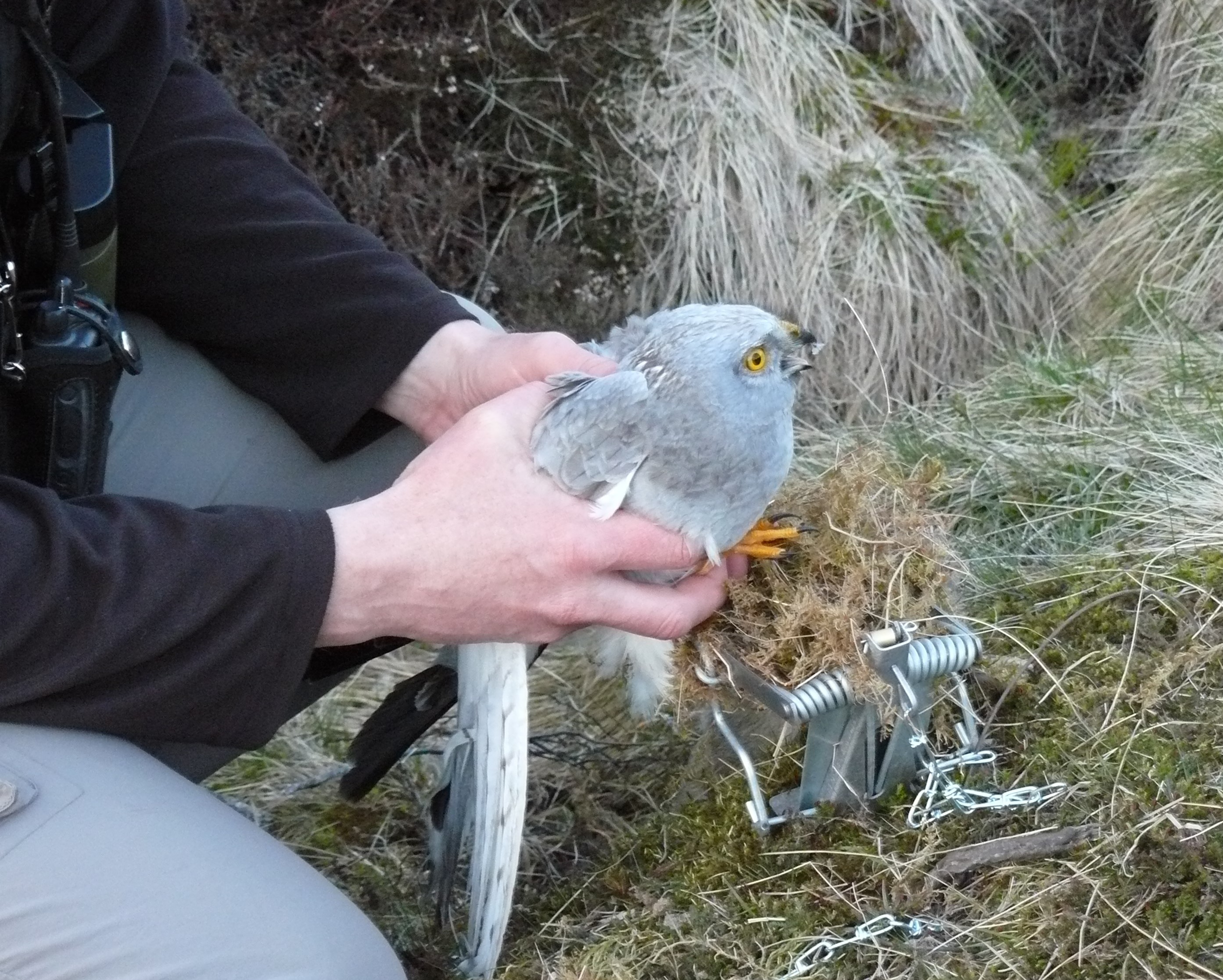
This male hen harrier was found caught by its leg in an illegally-set spring trap on Moy Estate in 2010. No charges were brought. It survived after being rescued by raptor workers from the Scottish Raptor Study Group.

In May 2011 a satellite-tracked red kite ‘disappeared’ on Moy, and another one ‘disappeared’ in August 2011.

In 2016 Police Scotland issued an appeal for information following the discovery of disturbed and abandoned buzzard and goshawk nests in the Moy Forest. One goshawk and four buzzard nests were abandoned in suspicious circumstances, with some evidence of illegal disturbance. These nests were being monitored by staff from Forestry Enterprise Scotland (see here). No charges were brought.

In 2017 masked gunmen were caught on camera at a goshawk nest in Moy Forest. A few days later the nest and a clutch of four eggs was found abandoned (see here). No charges were brought.

In 2018 Police Scotland issued an appeal for information after a buzzard was found caught in an illegal pole trap in the Moy area (see here). No charges were brought.

In 2020 a poisoned red kite was found dead, containing traces of a banned pesticide, leading to a police appeal for information (here).

In 2021 an individual was charged with the alleged killing of a bird of prey in this area. This case is believed to be progressing through the courts so I can’t comment further at this stage.

Of course, a General Licence restriction doesn’t amount to much of a sanction in real terms, as I’ve discussed on this blog endless times before (e.g. see here). However, it’s currently the only tool available to the authorities until we finally see the introduction of the promised grouse moor licensing scheme by the Scottish Government. Had that scheme been in place already, we’d hopefully have seen the removal of Moy Estate’s licence to shoot for a number of years, if not permanently.

Meanwhile, what will be really interesting to see is whether the Moy Game Fair goes ahead this year, given that the shooting organisations have all claimed to have a ‘zero tolerance’ approach to raptor persecution. I don’t think the likes of Scottish Land & Estates, Fergus Ewing MSP and the Scottish Gamekeepers Association can expect anything other than high-level criticism if they attend this event on an estate that has now been sanctioned for wildlife crimes by the statutory nature conservation advisor, based on evidence provided by Police Scotland. Mind you, the conviction of a gamekeeper on Moy Estate in 2011 didn’t stop them attending (see here and here).

UPDATE 14th July 2022: Scottish Gamekeepers Association plans award ceremony at disgraced Moy Estate (here)

UPDATE 6th August 2022: Fergus Ewing MSP & his shooting industry pals disregard sanctions imposed on Moy Estate for wildlife crime (here)

UPDATE 22nd August 2022: Moy Estate loses appeal against General Licence restriction imposed for wildlife crime (here)

Gloucestershire Police appeal for info after goshawk found shot in Forest of Dean

Press release from Gloucestershire Constabulary (13th June 2022)

Appeal for information after birds of prey are found dead in the Forest of Dean

Officers are appealing for information after two birds of prey were found dead in the Forest of Dean.

A Goshawk and Sparrowhawk were found next to a bus stop just south of Aylburton near Lydney on the A48 by a member of the public on Monday 25 April.

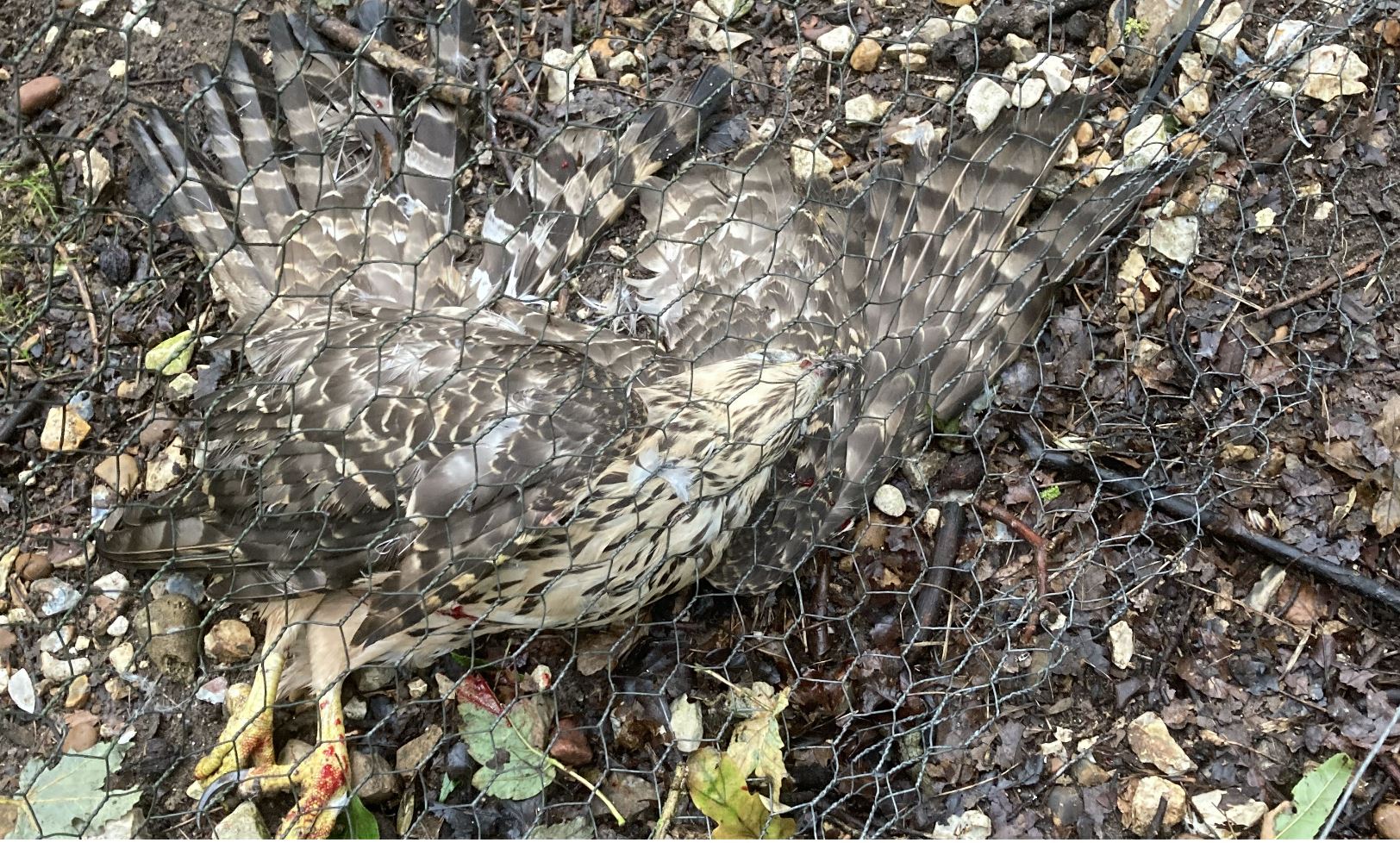
The male Goshawk was just under 17-years-old and X-rays show that the bird had been shot with a shotgun.

The cause of death has not yet been established for the male Sparrowhawk however post mortems will take place for both birds. 

[The shot goshawk. Photos via Gloucestershire Constabulary]

PC Cath McDay said: “This is an awful crime under the Countryside and Wildlife Act 1981, to truly special birds

The Goshawk had managed to live to an exceptional age only for his life to be ended like this.”

Enquiries are ongoing and investigating officers are asking anyone with information on the incident to please get in contact.

Information can be submitted by completing the following form online and quoting incident number 130 of 25 April: https://www.gloucestershire.police.uk/tua/tell-us-about/cor/tell-us-about-existing-case-report/    

Alternatively, you can call 101 and quote the same incident number or speak to Crimestoppers anonymously on 0800 555 111.

ENDS

Mail on Sunday blames ‘vigilantes’ for police investigation into alleged wildlife crime on Van Cutsem’s estate

The police investigation of alleged raptor persecution and associated wildlife crime at William van Cutsem’s Hilborough Estate in Norfolk is being kept in the public eye thanks to the Mail on Sunday (MOS).

However, instead of claiming that [Police] ‘Officers found no evidence of wrong-doing‘ [on van Cutsem’s estate] which is what the MOS published the previous weekend (here), this time they’re focusing on the ‘animal rights vigilantes’ who had secretly filmed the alleged offences on the estate and then passed on their footage to the police.

The full article can be read here.

It’s classic tabloid nonsense, designed to take the focus off the alleged offences and undermine the credibility of the people who discovered those alleged offences.

The article quotes ‘a source close to Mr van Cutsem‘ throughout, but conveniently doesn’t name that source. Quotes from this unidentified source include:

A source close to Mr van Cutsem condemned HIT as a vigilante group which had set up cameras on private land without his permission, saying there were questions about its relationship with police and the Royal Society for the Protection of Birds‘.

and

William is baffled the police didn’t say anything or give him any information and he had to read about it [on their Twitter page],’ said the source.

and

‘What also is interesting is how close HIT works with the RSPB. It would be good to understand how a mainstream charity is working with a shady group. Police said nothing.’

and

The source added: ‘William doesn’t want to say anything else at this stage, but needless to say it’s bonkers that the first he finds out about details was not from the police but from the HIT story’. 

The same weekend this happened, a neighbouring estate had four traps vandalised and a buzzard was found in another one, which was then released by the estate owner. 

These were all reported to the police. I’m also surprised the RSPB, who attended the raid, seem to be getting information from a group with a long history of shady entrapments.

Interesting then that ‘the source’ didn’t apparently raise any concerns about what had been filmed, just who had filmed it and whether they had permission to do so.

This sort of commentary is a tried and tested routine, and one we’ve seen over and over again from the likes of You Forgot the Birds and C4PMC, even down to the slagging off of the RSPB. This is not quality journalism, it’s just laughable bollocks, designed to deflect attention from the alleged crimes filmed on this estate.

I particularly enjoyed the MOS’s sub-heading in this article:

They [that’ll be the so-called vigilantes] released a video purporting to show a Goshawk stuck in a trap on the estate‘.

Er, I think it was a bit more than showing ‘a goshawk stuck in a trap’! What the video actually showed was a masked man removing a goshawk from an illegally-set trap (baited with live pigeons) purportedly filmed on van Cutsem’s estate. The man was then filmed carrying the goshawk away, which is also an offence under the Wildlife & Countryside Act (the goshawk should have been immediately released).

Thanks for the laugh, MOS, and especially for the crap reporting which will just draw this police investigation to the attention of an even larger audience.

I look forward to reading an update from Norfolk Police in due course.

Covert video footage published showing masked man with trapped goshawk on van Cutsem’s Hilborough Estate

Yet more evidence has emerged about the police investigation into alleged raptor persecution on William van Cutsem’s Hilborough Estate in Norfolk (see here, here, here for previous blogs).

Last night, the Hunt Investigation Team (HIT), a group describing itself as ‘anti-bloodsports’, published covert video footage it claims was filmed on van Cutsem’s estate. The footage shows a crow cage trap in woodland, the trap had been baited with live pigeons (this is an offence) and a young goshawk was attracted to the bait, entered the trap and then couldn’t escape. A masked man is then recorded entering the trap, pinning the goshawk to the side netting with a stick so he could grab the bird, and then removing it from the trap and walking away with it (also an offence). The goshawk’s fate is not shown.

[Screen grab from the HIT covert footage]

The video can be watched on YouTube here.

There are concerns amongst some conservationists, including me, that releasing this footage at this stage could jeopardise any potential prosecution. This is (was?) an active police investigation, the estate had been searched, police had seized various items and a number of employees are (were?) due to be questioned this week. Norfolk Police were doing a good job by all accounts and there wasn’t any reason to question their commitment to the investigation.

I doubt very much whether Norfolk Police gave their blessing to release this footage at this stage of the investigation.

The HIT team have already published potentially libellous commentary on Twitter (which I won’t repeat here, for obvious reasons) and they said this about releasing the footage at this stage of the investigation:

We do not believe in sitting on evidence for months and years on end, hoping for an unlikely prosecution whilst wildlife is relentlessly killed. People need to know what goes on within shooting estates and to be empowered to act‘.

I do sympathise with this view, and I guess it’s a reflection of the many police failures to investigate allegations of illegal fox-hunting (which is an area in which the HIT team are very experienced) and failures of some police forces to investigate raptor persecution. People get frustrated when the authorities repeatedly refuse to investigate what looks like clear criminal activity, and so they decide to do what they think is right. But from my point of view, with this particular investigation, Norfolk Police had responded well and were actively pursuing enquiries so the premature release of this footage by the HIT team is hard to comprehend. I wish they’d waited a few more days.

It’s out there now though. And the camera is well-positioned and the footage is very clear.

I hope the release hasn’t jeopardised this police investigation by compromising the planned employee interviews. Even if the case does reach court, a top QC (because let’s face it, that’s who would be representing the defendants) would make light work of drawing attention to this footage and the associated commentary and could argue the defendants wouldn’t get a fair trial.

Let’s see what happens.

UPDATE 16th May 2022: Mail on Sunday blames ‘vigilantes’ for police investigation into alleged wildlife crime on van Cutsem’s estate (here)

Goshawk nest camera streaming live from RSPB’s Abernethy Forest

Press release from RSPB Scotland:

Live camera at RSPB Scotland’s Loch Garten Nature Centre provides viewers with 24/7 goshawk footage

Visitors to RSPB Scotland’s Loch Garten Nature Centre have been enjoying live footage of an active goshawk nest within their Abernethy nature reserve.

A camera has been installed in a tree adjacent to the nest and the feed is also being streamed online to the RSPB’s YouTube channel. Infrared technology in the camera means that viewers from around the world can see what the birds are doing day and night.

[The adult female goshawk on the nest. Video grab by RSPB Scotland]

Jess Tomes, Abernethy Site Manager for People at RSPB Scotland, said, “Visitors to the Nature Centre are thoroughly enjoying such an intimate look at the goshawks. We’re also thrilled that we can share this amazing footage with people from all over the world through our YouTube channel. It’s been fascinating watching the pair setting up their rather bulky nest and noting the differences between them – while we’ve yet to see both birds together we’ve been telling them apart by their different coloured eyes.”

Goshawks have a wingspan of approximately 1.5m and larger females can weigh up to 2kg. Despite their bulk, they are known for being graceful fliers, even in dense woodland, where they weave between trees at high speed and capture prey in flight. Because of this, they are often referred to as ‘phantoms of the forest’. They were driven to extinction in the UK in the late nineteenth century before escaped falconry birds re-established a population from the 1960s onwards.

The goshawk camera has been set up in addition to Loch Garten’s long-established osprey camera and another which was recently installed near a white-tailed eagle nest in the Cairngorms Connect partnership landscape. Visitors to the Nature Centre can now view live footage of three of Scotland’s most iconic birds of prey in one place.

Fraser Cormack, Warden for RSPB Scotland’s Abernethy nature reserve said, “Goshawks are exactly the type of bird we’d expect to see in a healthy pine forest, so we’re delighted to have them at Abernethy. While the camera doesn’t allow us to see the nest cup, the behaviour of the female indicates that she may indeed be on eggs, so it would be wonderful if we could welcome some chicks in the coming weeks. We’ve a longstanding tradition of being a home for ospreys at Loch Garten, so hopefully the goshawks will see the same level of success.”

Goshawks often lay three or four eggs which take approximately 5-6 weeks to hatch. Young birds remain in the nest for a further 6-7 weeks beyond this, relying on their parents for food.

The camera was installed by Wildlife Windows with technical support from External Reality. Funding was provided by the European Regional Development Fund through NatureScot.

ENDS

The goshawk nest camera can be watched live here:

Dyfed-Powys Police appeal for information after ‘unexplained’ death of two goshawks in separate incidents

Dyfed-Powys Police are appealing for information from the public after two goshawks were found dead in ‘unexplained’ circumstances in two separate incidents over the last few weeks.

The first dead goshawk was found on Saturday 26th March 2022 in the ‘Llanidloes area’ of Wales. There are no further details about the location.

PCSO Gary Gwilt said: “After receiving the report, a Rural Crime Team officer attended the location and recovered the bird. We cannot speculate on the cause of death at this time (as it may well be natural causes) however the bird has been submitted to the Wildlife Incident Investigation Scheme (WIIS) for an autopsy to be carried out, in an attempt to confirm a cause of death.”

Anyone who has information that could help with the police investigation can contact the Rural Crime Team by phoning 101 and quoting incident reference number 205 of 26/03/22

The second dead goshawk was found in the ‘Brecon area’ on Sunday 10th April 2022. There are no further details about the location. The goshawk has also been collected by the Rural Crime Team and its death is currently being described as ‘unexplained’. Presumably it, too, has been submitted for a post mortem/toxicology analysis.

Anyone who has information that could help with the police investigation can contact the Rural Crime Team by phoning 101 and quoting incident reference number 288 of 10/04/22.

Raptor persecution ignored in North York Moors National Park draft management plan

The North York Moors National Park Authority (NYMNPA) is currently consulting on its draft management plan, which aims to set out a series of priority actions to help the Park tackle issues which include ‘recovery from the COVID pandemic, escalating climate and nature emergencies, increasing mental and physical health problems among the general population, and the need to change the way we look after our landscapes‘.

You can download the draft plan here:

I had a quick read through this document at the weekend and was surprised to see how little substance it contained and how vague its stated 22 priority objectives were. For example, whilst there was general commentary around ‘active restoration’ of degraded blanket bog and peat habitats, the only reference I found that might possibly allude to the massive environmental problems caused by intensive driven grouse shooting, which dominates the landscape of this National Park, was this:

Objective 8 – Work with our moorland community to support the sustainable management of moorland to ensure it retains a natural remoteness which supports a greater variety of species and habitats.

I didn’t find one single reference to tackling wildlife crime, and especially raptor persecution, which has long been recognised as an ongoing characteristic of this National Park. For example, just in the last few years alone we’ve seen a shot buzzard (here), a poisoned buzzard (here), deliberate disturbance of a goshawk breeding attempt (here), a satellite-tagged hen harrier vanish in suspicious circumstances (here), another shot buzzard (here), and another shot buzzard (here), a goshawk trapped, reportedly killed and taken away in sack (here), another poisoned buzzard (here), an illegally-set trap (here), and five shot buzzards found stuffed under a rock (here).

Nor did I find any reference to targeting the mass release of non-native gamebirds (pheasants and red-legged partridge) or assessing the damage they cause inside the National Park. It seems the North York Moor National Park Authority could do with taking a look at the Cairngorms National Park Authority’s management plan, which has recently included this issue as one of its priorities (see here).

The North York Moors National Park draft management plan is important, because it aims to set out its vision for how the National Park will be in 20 years time.

According to the NYMNPA website, ‘the draft plan is the result of a series of conversations with stakeholders and partners over the last year. The proposals it contains are not set in stone. Neither we nor our partners possess a monopoly of wisdom. This document invites discussion, input and feedback so that the final plan can properly reflect as wide a range of views as possible. It is an opportunity for everyone to collaborate with us to create a shared plan that will shape the future of the North York Moors National Park‘.

The Park Authority wants your views, whether you live in the Park or you are a visitor. Particularly, it wants to know whether it has ‘missed something that is important to you’:

If you share my concerns about ongoing raptor persecution in this National Park, and the unregulated mass release of non-native species for shooting, I’d encourage you to contact the NYMNPA and ask them to prioritise tackling these issues in the management plan. Contact details are shown in the image above.

Please note, the consultation closes this Friday (21st January 2022).

Thank you.

Convicted gamekeeper to escape 3-year General Licence restriction for killing birds of prey?

On 30th November last year, gamekeeper Peter Givens from the Cathpair Estate in the Scottish Borders was convicted at Selkirk Sheriff Court of recklessly killing a barn owl and a goshawk in September 2020.

The two supposedly protected species had become caught inside a cage trap operated by Givens but they starved to death because Givens had failed to release them as he was required to do by law.

Givens was fined a pathetic £300 and a £20 victim surcharge (see here).

[Photograph of the unlawfully operated trap on Cathpair Estate. Photo by Stuart Spray]

Givens’ sentence was derisory, there’s no doubt about that, especially when you consider raptor persecution is supposedly a National Wildlife Crime Priority.

But the £300 fine from the court wasn’t Givens’ only sanction. On conviction, Givens was automatically banned from using the General Licences, including those which permit the killing of some birds (especially corvids) but also GL14, the licence that permits a person to use certain traps to kill stoats in Scotland for the conservation of wild birds or the prevention of serious damage to livestock.

This automatic ban on using the General Licences came in to force the day gamekeeper Givens was convicted, because General Licences ‘cannot be used by those convicted of a wildlife crime on or after 1 January 2017 unless, in respect of that offence, they are a rehabilitated person (for the purposes of the Rehabilitation of Offenders Act 1974 and that conviction is spent), or a court discharged them absolutely‘, according to the terms of the General Licences.

If Givens is the only gamekeeper on Cathpair Estate (and I have no information about that) then being prevented from killing crows and stoats would probably have a negative impact on the estate’s ability to host a gamebird shoot, unless the estate employs other gamekeepers to conduct those duties. Although, as ridiculously as ever, a convicted gamekeeper may still apply to use an Individual Licence to carry on operating traps and guns to kill corvids and stoats as if he’d never committed his crimes at all.

When gamekeeper Givens’ sentence was announced, I was interested in how this automatic ban on using the General Licences would apply, and I especially wondered whether it would extend for three years, as per the usual General Licence restriction imposed on estates where evidence of wildlife crime is apparent but insufficient to result in a prosecution.

However, when I looked up how long it would be before Givens’ conviction could be considered spent, I found it was only 12 months (according to the Rehabilitation of Offenders Act 1974 as amended by the Management of Offenders (Scotland) Act 2019). So this means Givens would not be allowed to use the General Licences to kill corvids and stoats for a period of only 12 months (unless he applied for an Individual Licence) but after those 12 months had expired (30th November 2022) he’d be able to return to killing wildlife under the conditions of the General Licences.

Eh? That seems a bit counter-intuitive, doesn’t it? On the one hand, regulator NatureScot can impose a three-year General Licence restriction on an estate where the police have evidence of criminal activity but insufficient evidence to pin it on any named individual. But when the authorities secure an actual conviction for wildlife crime on an estate, then the General Licence sanction only applies for one year, instead of three, if the criminal has been convicted and handed a ludicrously tiny fine that is likely to have been paid by his employer anyway!

That didn’t make sense to me so I contacted NatureScot and asked them about it. They agreed that it was counter-intuitive and that this scenario hadn’t really been considered before, probably due to the incredibly low prosecution/conviction rates for raptor persecution, especially in recent years. However, now that this ridiculous situation had been brought to their attention, NatureScot advised that they would be looking at tightening up the terms of the General Licences to better reflect the lack of trust that a conviction for a wildlife offence implies.

This will probably come too late to be applied to gamekeeper Givens, and to be fair to NatureScot they can only work with the existing terms and conditions that apply at any one time, but I was encouraged to hear that part of the planned review will also be to consider how Fiscal Fines and Fixed Penalty Notices for wildlife offences impact the ability of an individual to operate under General Licences.

Meanwhile, if anyone is out and about for a walk on the Cathpair Estate in the next ten months it may well be worthwhile having a look to see whether any traps are being operated to kill corvids and stoats. If they are and you’re suspicious of their legality, take photographs and a grid reference/What3Words and report them to Police Scotland on 101. Please share your report with the RSPB’s Investigations team so they can follow up with the police.

[The Cathpair Estate boundary (in blue), from Andy Wightman’s Who Owns Scotland website]