Goshawk suffers shotgun injuries to head

The following images appeared on social media a couple of days ago.

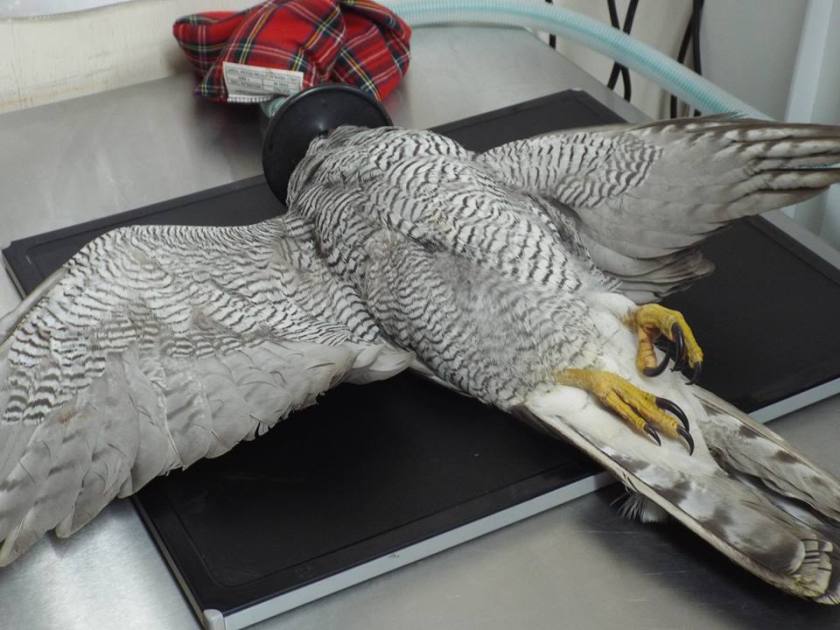
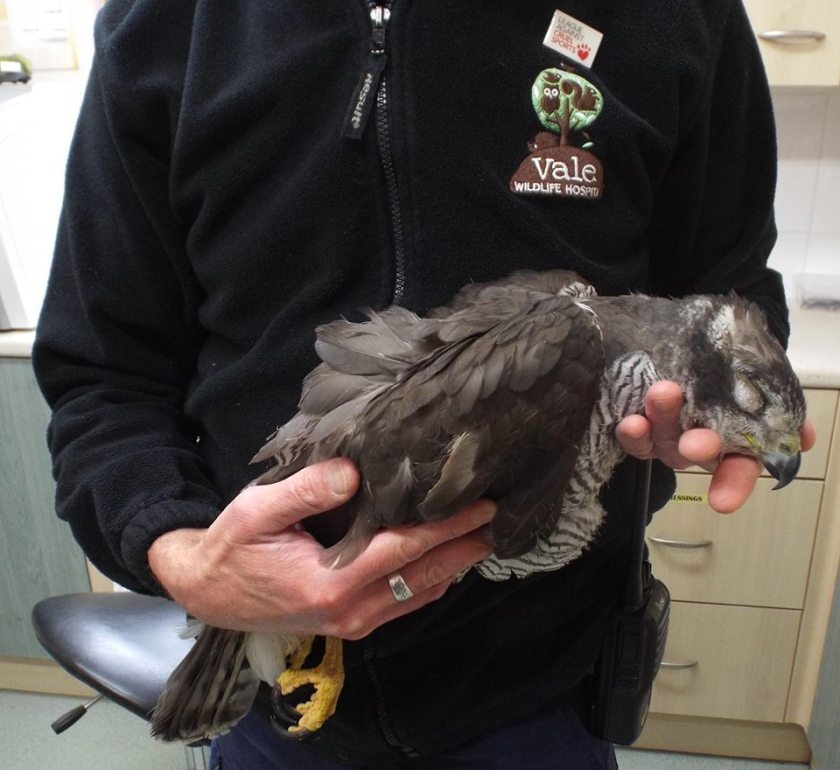
This is a goshawk that was found critically injured in Brockweir, Gloucestershire in April 2016 and was taken to Vale Wildlife Hospital. It had been shot in the head.

Unfortunately its injuries were so severe the decision was taken to euthanise the bird.

No further information available.

UPDATE Tues 26th April: Glos Police has today issued an appeal for info here

Photographs by Vale Wildlife Hospital

Goshawk shot Chepstow April 2016

goshawk shot Chepstow April 2016b

Goshawk shot Chepstow April 2016c

Increase in raptor persecution crimes in 2015

The Partnership for Action against Wildlife Crime (PAW Scotland) has just published the ‘official’ 2015 raptor persecution data, including their annual persecution hotspot maps.

The PAW Scotland press release can be read here and the hotspot maps can be accessed here.

20 crimes against birds of prey were recorded in 2015, which is an increase on the 18 recorded in 2014. The 2015 crimes included six poisoning incidents, five shootings, five disturbance incidents, three trapping or attempted trapping offences and one case of chick theft. The victims included red kite, peregrine, buzzard, goshawk, osprey and hen harrier. Surprisingly, golden eagle isn’t included in the list. We’ll discuss that below.

Having read the press release and looked at the hotspot maps, four things jumped out at us.

First is the increase in recorded raptor persecution incidents in 2015. It’s only a slight increase, from 18 to 20 recorded crimes, but nevertheless it is still an increase. This is important to note, especially in light of a recent statement made by Tim (Kim) Baynes of the Scottish Moorland Group (funded by the landowners’ lobby group Scottish Land & Estates). In December 2015, in response to the publication of the RSPB’s 20-year raptor persecution review, Kim said this:

Bird of prey deaths……have fallen dramatically over the last five years in particular“.

At the time, Kim didn’t back up this claim with any evidence and as the 2015 data have now been published, it’s clear why he didn’t. Basically, the evidence wasn’t there. As Head of RSPB Scotland’s Investigation team Ian Thomson says in the latest PAW Scotland press release:

These latest figures make it readily apparent that claims of a decline in the illegal killing of raptors are wholly without foundation“.

This time, Kim isn’t claiming that there has been a decline but he still tries to diminish the problem by saying “annual variations [in the number of reported persecution crimes] are now very small“. Another way of putting it, Kim, would be to say that no progress has been made!

The second thing to jump out at us is perhaps the most concerning of all, and that’s the withholding of data relating to a quarter of the recorded 2015 crimes. If you read the PAW Scotland press release, you’ll notice the following caveat written in the ‘Notes to Editors’ section:

Further details of 5 of the 20 bird of prey crimes recorded in 2015 are currently withheld for police operational reasons. It has therefore not been possible to include the locations of these incidents on the hotspot maps‘.

So here’s one of the maps purporting to show all types of raptor persecution crimes recorded over a three-year period in Scotland (2013-2015). Only it doesn’t show them all, as 25% are missing. Not only are 25% missing, but also missing are details of poisoned baits (no victims present) that were recorded during this period – for some reason they’ve been placed on a separate map. So when you look at this map, ignore the misleading title. It isn’t a map of ‘All Recorded Bird of Prey Crimes Scotland – 2013-2015’, it’s a map of SOME Recorded Bird of Prey Crimes 2013-2015, just the ones we’re allowed to know about.

ALL Raptor crimes 2013 to 2015

The purpose of publishing these annual hotspot maps and their associated data is, according to the PAW Scotland website, ‘to allow all the partner organisations to enter into meaningful discussions and work together to eradicate bad or illegal practices in Scotland‘. Presumably, because the maps and data are also placed in the public domain, the purpose is also to increase transparency and thus public confidence. What is the point of publishing a proportion of the data and withholding the rest? It just makes a mockery of the whole process. Why bother publishing at all?

The caveat in the ‘Notes to Editors’ section goes on to say:

The [withheld] incidents are, however, included in the figures provided in the summary tables accompanying the maps. The maps and background data will be updated, where possible, in future publications‘.

Sounds promising, but when you actually look at the summary tables you find large sections still marked as ‘withheld’:

Confirmed poisonings 2015

ALL raptor crimes 2015

These ‘withheld’ incidents, shrouded in secrecy, make it virtually impossible to cross reference known reported persecution crimes with those being touted as the ‘officially recorded’ crimes, which closes off any opportunity to scrutinise these ‘official’ data to ensure that incidents have not been ‘missed’ or ‘forgotten’ (we’re being kind). In other words, we are expected to accept and trust the ‘official’ data from Police Scotland as being accurate. Sorry, but having seen Police Scotland’s shambolic handling of some wildlife crime incidents we have limited confidence in their ability, either intentionally or unintentionally, to get this right.

This leads us nicely on to the third thing to jump out at us. As mentioned above, we were surprised not to see golden eagle listed as one of the 2015 victims. According to our sources, a traditional golden eagle eyrie was burnt out in 2015 – we blogged about it here. Why wasn’t this incident included in the 2015 PAW data? Or was it included and it was categorised in the ‘withheld’ category? Who knows. Do you see what we mean about the difficulty of cross-referencing known incidents?

The fourth thing to jump out was an entry in Table 5c (see above). The second line down tells us that a red kite was poisoned in Tayside in January 2015. That’s news to us. Does anybody remember seeing anything in the media about this crime? Any appeal for information? Any warning to the public that deadly poison was being used in the area? No, thought not.

The reticence of the police to publicise some of these crimes is deeply concerning, and especially when that suppression extends to details of crimes in ‘official’ reports that are supposed to demonstrate openness and transparency. Ask yourselves, in whose interest is it to keep these crimes under wraps?

New report reveals hundreds of raptors illegally killed on game-shooting estates in Scotland

RSPB persecution review 1994 2014Yesterday the RSPB published its latest figures on illegal raptor persecution in Scotland.

Rather than their usual annual review, this time they’ve produced a 20-year review covering the period 1994-2014. This is a really useful exercise as it puts the scale of (known) persecution in to perspective. It’s a sobering read.

A total of 779 birds of prey were confirmed to have been illegally killed during this period, either by poisoning, shooting or trapping. The known victims included 104 red kites, 37 golden eagles, 30 hen harriers, 16 goshawks, 10 white-tailed eagles and 458 buzzards.

In addition to these confirmed victims, a further 171 incidents are documented where poisoned baits and/or non-birds of prey victims were found, including 14 pet cats and 14 pet dogs, and then a further 134 incidents where no victim had been found but clear attempts to target raptors had been uncovered (e.g. illegally-set traps).

The report includes a map showing the landholdings of all known persecution incidents during this period. As ever, it’s pretty revealing, with a handful on the west coast but the vast majority in the uplands of central, eastern and southern Scotland – areas dominated by driven grouse shooting.

RSPB persecution review 1994 2014 map

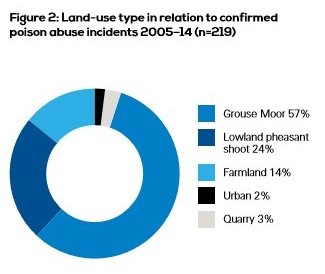
Drilling down in to the detail, there’s a useful analysis of land-use type of confirmed poisoning incidents between 2005-2014 (219 incidents). A shocking (or not) 81% of confirmed poisoning incidents during this nine-year period were on land used for game-shooting: 57% on grouse moors and 24% on land managed for lowland pheasant shoots. This tells us a great deal about who is responsible for the vast majority of illegal raptor poisoning. Despite their continued denials and protestations, and their increasingly-desperate attempts to minimise the scale of these crimes (“it’s just a few rogues”, “it’s just a small minority”), this graphic exposes the criminality at the heart of the game-shooting industry:
RSPB persecution review 1994 2014 land use

Further damning evidence, which isn’t needed by most of us but for the benefit of those who are still in denial of the bleedin’ obvious, is this graph showing the occupations of those convicted of raptor persecution between 1994-2014. Surprise, surprise, 86% of them were gamekeepers:

RSPB persecution review 1994 2014 occupation

RSPB Scotland is to be commended for publishing this exceptionally detailed and meticulously-researched report. There are a number of things in it that are of particular interest to us and we’ll come back to those in due course. For now though, particular recognition should go to the Investigations team – they may be small in number but their contribution to exposing the disgraceful continuation of illegal raptor persecution in Scotland is enormous. They, and their colleagues south of the border, are worthy of high acclaim. If anybody reading this is in a position to recognise excellence in the field of raptor conservation, e.g. a nomination for an award, this team should be at the top of your list.

So, how has the Environment Minister, Dr Aileen McLeod, responded to such an embarrassing report? She said: “There is no doubt that the figures in this report make for uncomfortable reading, but we have made progress in recent years with the new vicarious liability provisions, the publication of the report from the Wildlife Crime Penalties Review Group, new measures implementing restrictions on the use of General Licences and earlier this year the Scottish Government funded pesticide disposal scheme that removed over 700kg of illegally held poisons in Scotland“.

We have made progress…” Hmm. Let’s have a look:

Vicarious liability – introduced almost 4 years ago and only two successful convictions to date. A slow (but good) start, but we need to see many more convictions.

Wildlife Crime Penalties Review – Commissioned over two years ago, published last month. An excellent report calling for tougher sanctions but we’re waiting to hear whether the Environment Minister will act on the recommendations. Can only be defined as ‘progress’ if she agrees to act.

General Licence restrictions – available to be used against landholdings where raptor crimes committed/suspected from 1st January 2014. So far, only two restrictions have been implemented and those only lasted for six days each before they were suspended as legal arguments continue. A slow start, and the legal challenges were to be expected, but can’t be defined as ‘progress’ unless the restrictions are fully implemented. There should also be a lot more of them.

Pesticide disposal scheme –  implemented this year and resulted in the removal of some illegally-held poisons. That is progress, although it is tinged with frustration that the game-shooting industry was given yet another chance to avoid justice as this scheme (the second of its kind) comes 14 years after the pesticides were originally banned. It’s also interesting to note in the RSPB’s report (page 18) that evidence suggests a number of individuals have retained their illegal stocks. This is supported by more poisoning incidents that have taken place this year, after the disposal scheme ended.

So some progress has been made (and almost entirely due to the efforts of Dr McLeod’s predecessor, Paul Wheelhouse) but it is glacially slow and, so far, has not stemmed the occurrence of illegal persecution, as the damning figures in this report show all too clearly. Much, much more can and needs to be done before we’ll be convinced that Dr McLeod is having any sort of impact. She has, though, announced that tenders have just been invited for a review of game licensing practices in other countries (to inform a possible decision of introducing licensing to game-shooting estates in Scotland), and that’s a good thing, but again, the research needs to be done and then a decision made, which probably won’t happen for a number of years if past performance is anything to go by. She’d find herself with a lot more support if she got on with announcing increased investigatory powers for the SSPCA – the public consultation closed 1 year and 3 months ago – and still we await her decision as the criminals continue their rampage. It’s not impressive at all.

And what of the response of the game-shooting industry itself? Some didn’t bother to publish a statement (Scottish Gamekeepers’ Association), which ironically tells us quite a lot, although they are quoted in an article by STV (see media coverage below) where they revert to type and simply deny the evidence and slag off the RSPB instead. And remember, the SGA is a fully-paid up member of the Partnership for Action Against Wildlife Crime (cough).

Scottish Land and Estates (SLE), another PAW partner, did manage to issue a statement, via their Scottish Moorland Group (see media coverage below). Again, it’s the usual lamentable denial, characterised beautifully by this statement from Director Tim (Kim) Baynes:

Bird of prey deaths……have fallen dramatically over the last five years in particular“.

Er, here are some persecution figures that Kim might want to re-punch in to his calculator:

2012 – 18 confirmed deaths

2013 – 28 confirmed deaths

2014 – 37 confirmed deaths

There’s also this statement:

Our condemnation of wildlife crime is unquivocal...” All very touching but how is that “condemnation” manifested in the real world? It’s been brought to our attention that the current head gamekeeper on a Scottish grouse shooting estate has a (spent) conviction for shooting dead a raptor when he worked on another Scottish grouse moor. How does a criminal with a conviction like that (spent or not) remain employed in the game-shooting industry, let alone get a senior position on another Scottish grouse moor? Was he one of the posse of moorland gamekeepers recently invited to Holyrood to mingle with, and be applauded by, a number of MSPs, as part of the Gift of Grouse propaganda campaign? Surely not…

Download the RSPB report here

Media coverage

RSPB press release here

Statement from Environment Minister Dr Aileen McLeod here

Scottish Moorland Group statement here

BBC news here

STV article here

BBC Radio Scotland (Newsdrive) interview with Ian Thomson, Head of Investigations RSPB Scotland here (starts at 21.50, available for 29 days)

Guardian article here (a mis-leading headline but nevertheless good to see coverage in this paper)

Educating the 21st Century gamekeeper – with 19th Century ignorance

We often hear (from the shooting industry) about how well qualified young gamekeepers are these days and how these young men & women are so much better informed than their predecessors. Two years ago there was a parliamentary motion put forward to recognise the need for ‘well-trained young gamekeepers’ and the value of responsible gamekeeping to Scotland’s economy and biodiversity (see here), and this year, the SGA’s Young Gamekeeper of the Year Award was presented by none other than the Environment Minister (see here).

SGA Chairman Alex Hogg has hailed the Scottish colleges involved (see here), and apparently all graduates must pass key tests in various areas and have an understanding of conservation.

Sounds good, right?

One of the colleges offering qualifications in gamekeeping is Borders College. They have a webpage headed: ‘Educating the 21st Century Gamekeeper’ (see here).

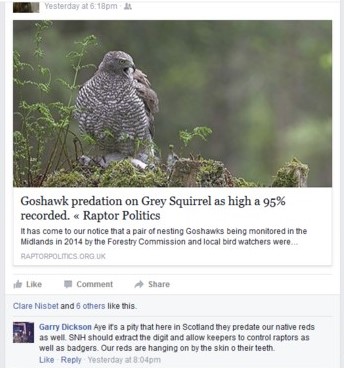
Imagine our surprise, then, when we were sent the following image, captured from Facebook two days ago:

Garry Dickson

In case you can’t read it, here is the comment written by Garry Dickson about protected native goshawks:

Aye, it’s a pity that here in Scotland they predate our native reds as well. SNH should extract the digit and allow keepers to control raptors as well as badgers. Our reds are hanging on by the skin of their teeth“.

Who’s Garry Dickson? He’s a lecturer on the gamekeeping course at Borders College.

Is this the sort of ill-informed, unsubstantiated nonsense he’s teaching to young gamekeeping students at Borders College? Mind you, if they don’t hear it from their lecturer they’ll probably hear it from the SGA – Alex Hogg shared his ignorance on goshawks a couple of years ago – see here.

It’s no surprise that the goshawk is listed as a wildlife crime priority species (because of the extent of persecution against it) if armies of young gamekeeping graduates are being let loose in the countryside after being taught such moronic 19th Century prejudice.

Bird of prey ‘initiative’ in Peak District National Park fails to deliver

IMG_5764 (2)In 2011, a five-year ‘Bird of Prey Initiative’ was launched which aimed to restore declining populations of some raptor species in the Dark Peak region of the Peak District National Park.
This ‘initiative’ was deemed necessary following years of evidence of wide scale raptor persecution within the region (e.g. see RSPB summary reports here and here).

The members of the ‘Bird of Prey Initiative’ comprised five organisations: The Moorland Association, The National Trust, Natural England, Peak District National Park Authority and the RSPB. Two local raptor study groups (the Peak District Raptor Monitoring Group and the South Peak Raptor Study Group) were also involved.

Targets were set to increase the breeding populations of three key raptor species for which the area had been given Special Protection Area status, i.e. it was considered a nationally important site for these raptors.

The targets were set as follows:

Merlin: increase from 22 breeding pairs to 32 breeding pairs by 2015

Short-eared owl: maintain the average breeding population of 25 pairs to 2015.

Peregrine: increase from 13 breeding pairs to 15 breeding pairs by 2015.

These targets were not unreasonable – they reflected the number of breeding pairs that the SPA should have been able to support.

goshawk-legsInterestingly, the group failed to set any targets to improve the breeding populations of local goshawks and hen harriers; there was just an ‘expectation’ that these species would be encouraged to breed. Sure, neither are an SPA-qualifying species in this area but nevertheless the area used to hold historically important populations which have since been reduced, through illegal persecution, to an occasional successful pair, so why exclude them?

Anyway, the ‘initiative’ has now ended and surprise surprise, the targets set for merlin, short-eared owl and peregrine have not been met. And goshawks and hen harriers are still largely absent with just a couple of exceptions. You can download the project report here for details: PDNP-Birds-of-Prey-Report-2012-15

In response to the report’s findings, Rhodri Thomas, an ecologist with the Peak District National Park Authority, is quoted in this BBC article (here) as saying the report’s findings are “concerning and disappointing“. Mark Avery has described the findings as “entirely predictable and totally unacceptable” (see here).

Rhodri Thomas goes on to say that the decline in peregrine numbers (now at only four pairs) was the hardest to explain as numbers in other parts of the Park were increasing and there was no obvious reason why they were staying away from the Dark Peak. He said he was determined to “bottom-out” what was causing the decline.

Here’s an easy starting point for him – try reading the provisional results of the most recent National Peregrine Survey (see here) as well as the recent paper documenting peregrine declines in another region dominated by driven grouse shooting (see here).

Sorry, Rhodri, but it’s not that difficult to understand.

In a press release from the Peak District National Park (see here), there’s talk of ‘renewed commitment’ from the project partners as well as ‘new rigour and energy’ to restore the breeding success of raptors in the Dark Peak. This is, of course, utter bollocks.

Mark Avery has picked up on this in his blog from this morning (see here), and as he says, it’s just an opportunity for the National Park authorities to hide behind a failing project for a few more years and avoid taking any real action, like, for example, banning driven grouse shooting within the National Park.

We’re so tired of all this ‘talking’ and so-called ‘cooperation’. It hasn’t worked and nor will it work. How do you move on from a conversation that goes something like this:

Conservationists to the grouse shooting industry: “Stop illegally killing raptors”.

Grouse shooting industry to conservationists: “We’re not killing them”.

Meanwhile, the killing continues and The Untouchables remain untouchable. The time for talking is over.

Sign the petition to ban driven grouse shooting here

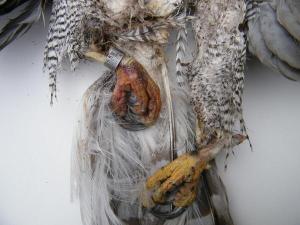
This dead goshawk (photo above) was found in the Peak District National Park in 2014 – both legs were broken and its injuries were consistent with being caught in an illegally set spring trap.

Police Scotland explain failure of vicarious liability in Kildrummy case

waneLast month we blogged about the failure of the Crown Office to initiate a vicarious liability prosecution in the Kildrummy case (see here).

A quick re-cap: in December 2014, Kildrummy Estate gamekeeper George Mutch was convicted of a series of wildlife crime offences that took place on Kildrummy Estate in 2012, including the trapping of a goshawk which he then beat to death with a stick (see here). In January 2015, Mutch was sentenced to four months in prison – the first gamekeeper in the UK to receive a custodial sentence for raptor persecution crimes (see here).

In September 2015, the possibility for a vicarious liability prosecution against Mutch’s employer became impossible as the case had become legally time-barred (i.e. three years had elapsed since the commission of his crimes). We wanted to find out why a vicarious liability prosecution had not been brought in this case so we asked the Crown Office for an explanation. They responded by saying that as nobody had been reported to them for consideration, they couldn’t take forward a prosecution. We speculated (here) about the reasons why nobody had been reported, and thought that it probably had something to do with the fact that Kildrummy Estate is registered as an off-shore company (in Jersey) and thus identification of the actual owner was well hidden; this situation had been expertly uncovered by Andy Wightman’s research earlier this year – see here. However, to find out if this really was the reason why nobody had been reported to the Crown Office, we really needed to hear from Police Scotland, so last month we asked them why they hadn’t reported anyone from Kildrummy Estate to the Crown Office for consideration of a vicarious liability prosecution.

Police Scotland has now responded with a cryptic masterpiece, but if you look closely at their carefully-worded reply it is actually quite revealing:

Police Scotland is committed to tackling wildlife crime whilst recognising that these investigations can often be challenging and prolonged. In 2013, a report about George Mutch was submitted to the Wildlife and Environmental Crime Unit (WECU) at the Crown Office and Procurator Fiscal Service (COPFS) alleging the unlawful taking and killing of birds of prey at Kildrummy Estate, Aberdeenshire in 2012. Following a criminal prosecution Mr Mutch was convicted and sentenced to 4 months imprisonment in January 2015.

In parallel with the investigation surrounding the activities of George Mutch, enquiries were made to establish whether any further charges could be brought in terms of Vicarious Liability legislation (Section 18A of the Wildlife & Countryside Act 1981). However, this legislation does require an offence to have been committed and therefore charges can only be formally libelled once a conviction has been confirmed. Significant international investigations were undertaken by Police Scotland but after consultation with COPFS it was established that due to insufficient evidence the additional charge of Vicarious Liability could not be libelled.

The experience of this case has, however, identified opportunities for refining future Vicarious Liability investigations, a matter currently being explored with COPFS. Please be assured that Police Scotland will continue to ensure that robust and modern investigative tactics are utilised to bring those committing wildlife crime to justice. Police Scotland’s wildlife crime commitment is additionally reflected in our membership of PAW (Partnership for Action Against Wildlife Crime) Scotland.

I hope the above information addresses the issue raised by you in your correspondence.

Yours sincerely,
Sean Scott, Detective Chief Superintendent”.
END
For the purposes of our interest, the first paragraph can be ignored. Where things start to get interesting is in paragraph two. Pay close attention to the wording:
Significant international investigations were undertaken……..it was established that due to insufficient evidence the additional charge of Vicarious Liability could not be libelled“.
International investigations” can only relate to an enquiry about either the land owner, or Mutch’s employer, or who owned the shooting rights; in other words, the individual who could be liable for a potential vicarious liability prosecution. “Insufficient evidence” implies that Police Scotland knew who was responsible for managing Mutch, but just couldn’t prove it. Why? Because the details are hidden in an off-shore holding.
It is apparent then, in the Kildrummy case, that justice has been defeated because the details of land ownership (or at least the hierarchical management structure from Mutch upwards) are concealed. This has big implications for any future vicarious liability prosecutions on estates where the land is registered as an off-shore company (a convenient ploy to escape a potential criminal prosecution) and we’re pretty sure Andy Wightman will have something to say about this in terms of his work on the Land Reform Bill currently being considered by the Scottish Parliament. (Update: Andy Wightman has blogged abut this latest development – see here).
The first line of paragraph three, (“The experience of this case has, however, identified opportunities for refining future Vicarious Liability investigations….“) is interesting and we’ll watch to see what this ‘refinement’ might entail.
As an aside, we were interested to read that Police Scotland thinks that vicarious liability charges “can only be formally libelled once a conviction has been confirmed“. That’s not actually what the legislation says. The legislation allows that the person who committed the primary offence need not be prosecuted in order for a prosecution to be brought against the person in management or control (see here). We’re a bit bemused by Police Scotland’s interpretation of this in their above statement, but, as we say, it’s a bit of a side issue in this case because even if Mutch hadn’t been convicted but an attempt was still made to undertake a vicarious liability prosecution, presumably Police Scotland would still have faced the same issue of being unable to identify the person in management or control because these details are squirreled away in an office in Jersey, apparently beyond the reach of Police Scotland.
So, even though vicarious liability has failed in the Kildrummy case, we feel it’s important to acknowledge that in this case, as far as we currently understand what went on, the failure is through no fault of Police Scotland or the Crown Office. This failure is, though, an indication that Vicarious Liability is not the panacea the Scottish Government would like us to believe it is for putting an end to raptor persecution crimes. Since vicarious liability was introduced as an option on 1st January 2012, there has still only been one single successful prosecution. In almost four years, that’s not a good return rate by anyone’s standards.

Kildrummy Estate: vicarious liability prosecution?

On 11th December 2014, Scottish gamekeeper (and SGA member) George Mutch was convicted of four wildlife crime offences that he’d committed on the Kildrummy Estate, Aberdeenshire in 2012 (see here).

On 12th January 2015, Mutch was given a four month custodial sentence for his crimes; the first gamekeeper to be jailed in the UK for killing raptors (see here).

Both his conviction and sentence were widely welcomed across the conservation community, not least because video evidence had been deemed admissible in this case and because the agencies involved in the investigation and prosecution had worked exceptionally hard to achieve these results.

Hopes were high that a subsequent vicarious liability prosecution would follow, especially when a journalist friend told us that Fiscal Tom Dysart had made a point of asking Mutch in court whether he’d received any training for the use of his traps, to which Mutch had replied, “No”. That response would indicate that a defence of ‘due diligence‘ wouldn’t stand up to scrutiny for anyone charged with being vicariously liable for Mutch’s crimes. All good so far, although Andy Wightman cast doubt over the feasibility of charging someone from Kildrummy Estate given the difficulty of establishing ownership there (read his blog here).

So seven months on, what’s happening now?

Well, it all gets a bit interesting around about now.  As we understand it, for offences committed under the Wildlife & Countryside Act, criminal proceedings MUST begin within three years from the date of the commission of the offence (two years in England & Wales). After three years, the case becomes ‘time-barred’ and it is no longer possible to prosecute.

Mutch was convicted of four offences, and the dates those offences were commissioned are as follows (info from COPFS press release, January 2015) –

  1. On 14 August 2012 & 15 August 2012, Mutch did intentionally or recklessly kill or take a wild bird, namely a goshawk.
  2. On 23 August 2012 and 24 August 2012, Mutch did intentionally or recklessly take a wild bird, namely a buzzard.
  3. On 28 August 2012, Mutch did intentionally or recklessly kill, injure or take a wild bird, namely a goshawk.
  4. Between 6 August 2012 – 13 September 2012, Mutch did use a trap to catch two goshawks and a buzzard.

Pay close attention to those dates. The first three offences are now time-barred (unless someone has already been charged) because it is over three years since they took place. The final offence is not quite time-barred, but will be by this Sunday (13 Sept 2015).

So, two big questions:

  1.  Has somebody from Kildrummy Estate been charged for a vicarious liability prosecution for the first three offences, and if not, why not?
  2. Is the Crown Office intending to charge someone (before Sunday) from Kildrummy Estate for a vicarious liability prosecution for the fourth offence, and if not, why not?

This case is of huge public interest and we don’t think it unreasonable to be asking questions, especially when successive Environment Ministers keep telling us that the effectiveness of Government policy against the raptor killers will be measured by the success of approaches such as vicarious liability.

If, like us, you’re curious about what’s happening with this case, you can email the Crown Office and ask them. The usual response when we ask about criminal cases is ‘As this case is on-going it would be inappropriate to comment’. It’s a handy ‘get out’ option when the authorities want to keep the public in the dark. The Crown Office could legitimately respond like this in this case, if they’ve already charged somebody. However, if they haven’t charged anybody, then the case is now time-barred and therefore cannot be said to be ‘on-going’.

Let’s see how transparent and accountable they wish to be. Emails to Helen Nisbet, Head of Wildlife & Environmental Crime Unit, Crown Office & Procurators Fiscal Office: Helen.Nisbet@copfs.gsi.gov.uk

Henry’s Tour: Day 20

Monday 27 April  Copy

Henry’s arrived in Yorkshire in his quest to find a mate. This should be interesting.

North Yorkshire (includes North York Moors National Park & Yorkshire Dales NP) is the worst county in England for recorded incidents of bird of prey persecution.

Between 2004-2013 there were 70 confirmed raptor persecution incidents. (2014 data not yet published).

These 70 incidents included:

  • At least 26 confirmed incidents involving the illegal use of pesticides – these include the illegal poisoning of 14 red kites, six buzzards, one goshawk, one peregrine plus the finding of a number of poisoned baits; several domestic pets were also poisoned.
  • The confirmed shooting of 25 birds of prey – consisting of 10 buzzards, three red kites, three kestrels, two goshawks, two peregrines plus singles of hen harrier, sparrowhawk, short-eared owl and eagle owl.
  • The illegal trapping of seven birds of prey plus another 11 illegally set traps for raptors.

In connection with these incidents six individuals, all gamekeepers, were prosecuted.

Hen harrier last bred successfully in North Yorkshire in 2007, despite huge areas of suitable habitat.

A Natural England study between 2002 and 2008 showed that of 11 HH breeding attempts recorded in North Yorkshire, only five sites reared any young and most of the sites that failed were believed to be due to human persecution.

#HaveYouSeenHenry

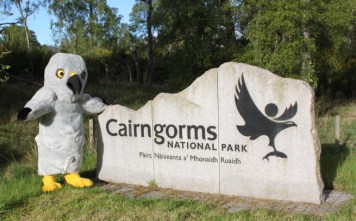
Masked gunmen caught on camera attacking goshawk nest in Cairngorms National Park

Police Scotland and the RSPB have released video footage showing a gang of masked gunmen attacking a goshawk nest in the Cairngorms National Park.

The gunmen, wearing balaclavas, were filmed on a secret camera set up to monitor the nest site on Forestry Commission Scotland land at Glen Nochty, Strathdon. They made at least four visits to the nest tree – 14th May 2014 at 10.26hrs and again at 20.08hrs, and 15th May 2014 at 09.11hrs and again at 20.01hrs.

The video has been released in an appeal for information – nine months after the crimes were committed.

You can watch it here. [Update: this video appears to have been removed from YouTube. You can still see it on BBC News website here]

Interestingly, this FCS forest is very close to the boundaries of three grouse moor estates. Now, it’s not apparent from the video whether the criminals are gamekeepers (hard to tell when they wear balaclavas) but we’ll take an educated guess that it isn’t a gang of District Nurses having a bit of recreational downtime in between home visits, out for a little spot of armed trespass, dressed up in camouflage and firing bullets at the nest of a protected species. A species that just happens to be hated by those involved with game-bird shooting.

Media coverage:

BBC news (with a quote from Environment Minister Aileen McLeod) here

RSPB Scotland press statement here

There’s actually been a great deal of media coverage, which is excellent, including P&J, Daily Record, STV News, and the video was broadcast on Reporting Scotland. Strangely, no publicity from the SGA….

Amusingly, this shocking video footage coincides with a campaign currently being run by the Countryside Alliance who are lobbying for police to ‘unmask’ hunt sabs. In the longer term, they also want the next Government to review the law around wearing balaclavas. You can read their campaign notes here – and they really are worth a few minutes of your time. The Countryside Alliance should be careful what they wish for – there’ll be a lot of gamekeepers who won’t be happy if they’re banned from covering their faces while committing their crimes (see recent convictions of balaclava-wearing criminal gamekeepers such as George Mutch and Glenn Brown).

Countryside Alliance masked thugs - Copy

Jailing raptor-killing gamekeepers ‘not the answer’, says Robertson

Alastair Robertson Scotsman 24 Jan 2015The fall-out from the shock custodial sentence for raptor-killing gamekeeper George Mutch continues….

The following appeared in yesterday’s Scotsman weekend magazine (24th January 2015). It’s the regular country sports column written by Alastair Robertson, the pro-game shooting journalist who also contributes to Daily Mail, Mail on Sunday, Telegraph, The Sun, Country Life & The Field.

“I only met George Mutch a few times. We were both in the beating line on a local shoot early in the season. Later, when I was shooting myself as a guest of a friend on Donside, I spotted him with his dogs picking up behind the guns. “Changed days from beating”, we laughed. Like most keepers he was helping out on the next door shoot for a few quid and a dram. At the time Mutch’s name didn’t mean anything until I spotted his face on Raptor Persecution Scotland, a website dedicated to the iniquities of gamekeepers and the game shooting world and a site which I highly recommend to anyone who likes shooting.

Which is why Mutch’s photo had appeared. He was captured on a hidden RSPB “research” camera killing goshawks caught in a vermin trap on Kildrummy where he ran the pheasant shoot.

His jailing for four months is being hailed as a breakthrough by the anti-shooting lobby which for years has complained that the government, police and courts have underrated the seriousness of wildlife crime. Perhaps, in their unofficial minds, police put the discomfort of birds rather further down their list of priorities than domestic violence, paedophilia, rape and drink-driving. But now the worm has turned. Mutch is the first keeper to be jailed for killing a raptor. The sad thing is that there is little understanding really on either side of the raptor argument.

The comments on Raptor Persecution following Mutch’s jailing were largely of the “Yippee, serves him right” sort. On the other side there are clipped official statements deploring wildlife crime, while among keepers and shooters a sullen silent resentment pervades that the RSPB, generally loathed for its interfering ways, has somehow “won”.

The only sensible comment I have seen, on the Raptor Persecution site as it happens, is that instead of jailing Mutch at great expense he should have been sent, possibly as a community service order, to work on an RSPB reserve. This may have been a joke and I missed it. But at least the reserve wouldn’t have any vermin problems.

The Mutch affair will inevitably increase demand to ban all legitimate live traps which keepers use to keep down vermin. It might, however, be better to turn the whole bird of prey argument on its head. Instead of trying to catch keepers at it, pay them a bounty for all raptors caught, logged and/or released. Poachers turned gamekeepers as it were. If, as the anti-shooting/raptor lobby insist, raptor persecution is widespread, then what is the point of conducting a war of low level attrition in the countryside which no-one is winning? Banging up Mutch pour encourager les autres isn’t the answer”.

END

So, no real surprises. Gamekeepers and shooters apparently ‘loathe’ the RSPB for ‘interfering’ (= catching raptor-killing gamekeepers and reporting them to the police). Oh, and killing raptors doesn’t really merit a custodial sentence because it doesn’t rank as a priority crime, even though the Government and Police Scotland have both stated that tackling wildlife crime IS a priority, and even though the penalty available for EACH offence could be a £5,000 fine and/or a six month custodial sentence. Some would say Mutch got off lightly with just a four-month jail sentence.

Instead of trying to catch gamekeepers at it, Robertson’s theory is that gamekeepers should be paid a bounty for each raptor they manage not to kill. A bit like giving a bank robber a bounty for each bank he manages to walk past without robbing it. ‘Ah, well done lad, you’ve managed to go a whole day without committing a crime – here, have some tax-payer’s money in recognition of your self-control’.

Talking of Mutch, we were interested to receive a photo taken on a grouse moor in September 2014.  This was on Edinglassie Estate in Aberdeenshire. Edinglassie is an award-winning estate, receiving the GWCT’s Golden Plover Award in 2013 for their progressive & sustainable moorland management, and becoming WES-accredited (SLE’s Wildlife Estates Scotland thing). Is that George Mutch, clearing the butts after a drive? Who would employ Mutch to help out on a game shoot? (There’s no more helping out for a few quid and a dram – new rules mean that, unless in exceptional circumstances, HMRC views beaters etc as ’employees’ for tax purposes). Interesting. Although to be fair, in September he was still denying his guilt and hadn’t yet been convicted (that came in Dec). Can’t imagine an esteemed estate like Edinglassie would employ him now he’s been convicted of raptor persecution…..