Shot goshawk found dead in Angus

In yesterday’s blog (here) we discussed how the raptor-killing criminals have changed tactics to avoid detection and are going to greater lengths to remove/hide the evidence of their crimes.

This latest case is a good example of how this may be happening and how this can lead to raptor persecution crimes remaining undetected.

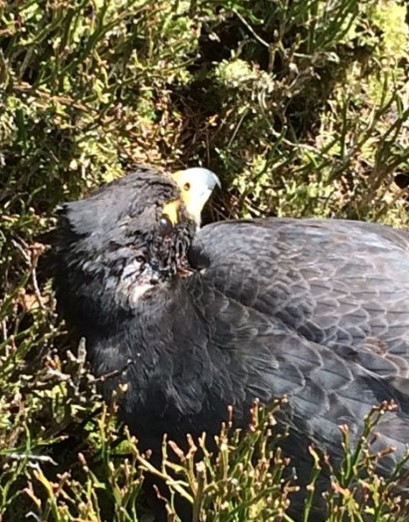
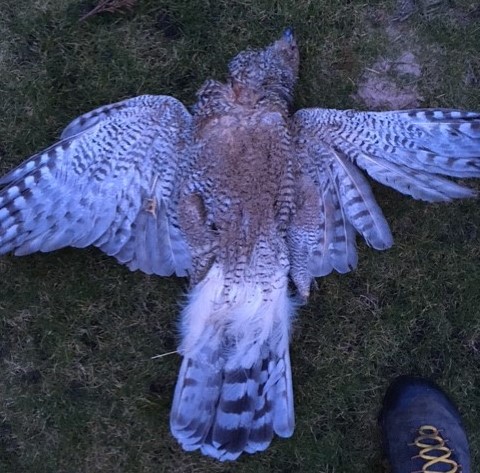
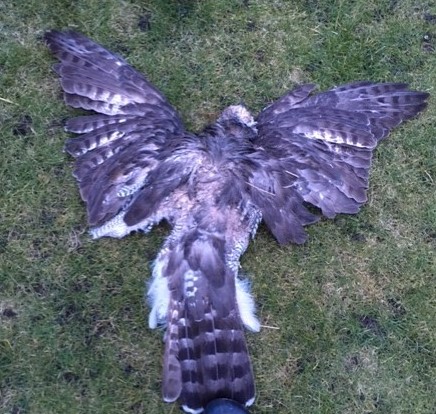
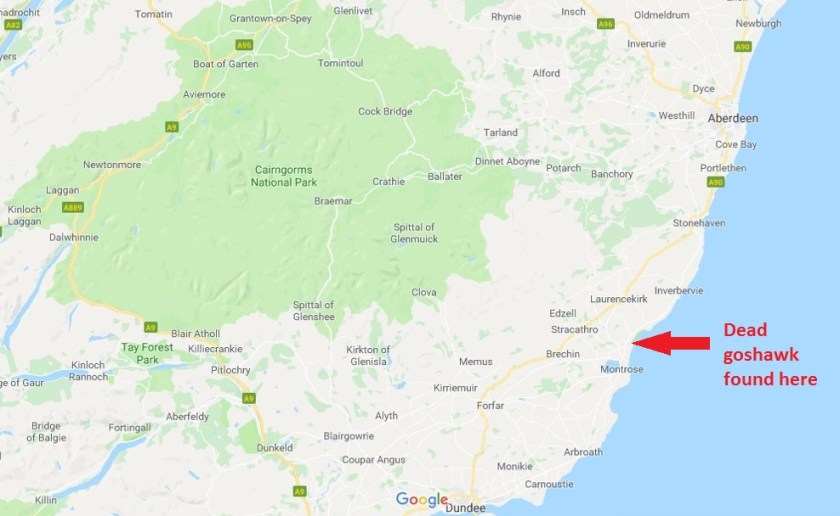
In March 2018 a member of the public found a dead goshawk washed up at the mouth of the River North Esk near St Cyrus in Aberdeenshire. The bird had an identifying leg ring and the finder reported this ring number to the British Trust for Ornithology (BTO). The BTO quickly notified the ringer, Dr Chris McGuigan, and provided him with the grid reference of where the bird had been found. Chris contacted a colleague in the area (Simon Ritchie) who was able to attend the scene and collect the fresh corpse.

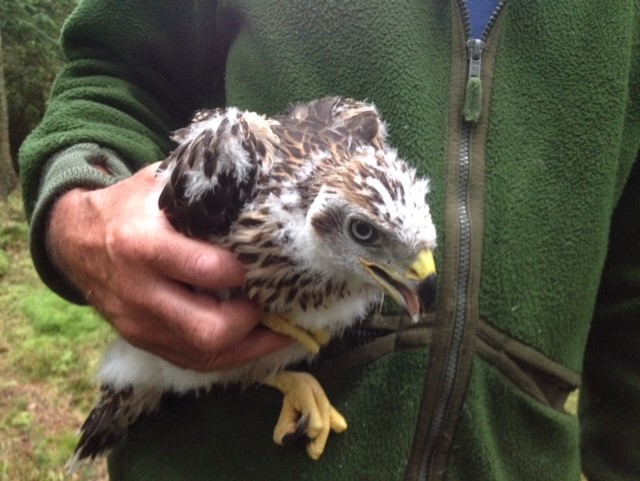
[Photos of the dead goshawk by Simon Ritchie]

Chris was able to identify the bird as one of three females that were ringed as chicks in Angus in 2014:

Having experience of finding dead raptors in Angus which upon closer examination turned out to have been illegally shot, and given the location of where the corpse had been found (not prime goshawk habitat), in addition to the known level of hatred directed towards goshawks by many in the game-shooting industry, Chris took the decision to submit the dead goshawk for testing. It was a very good decision.

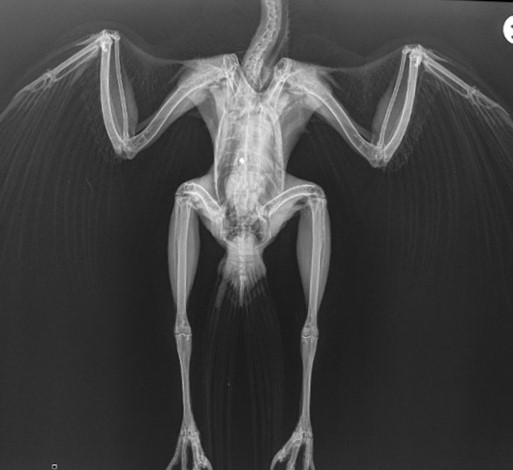
The goshawk was sent to the Royal School of Veterinary Studies at Edinburgh University where an x-ray revealed the goshawk’s body was peppered with lead shot, suggesting it had been shot at close range.

So how did the dead goshawk end up washed up on the shoreline at the mouth of the River North Esk? Given the large amount of lead shot in its body it would have died immediately, so it’s possible it was killed on the shoreline and left to rot, although this seems unlikely given the habitat and the stupidity of leaving an illegally-killed raptor in full view of any passing members of the public.

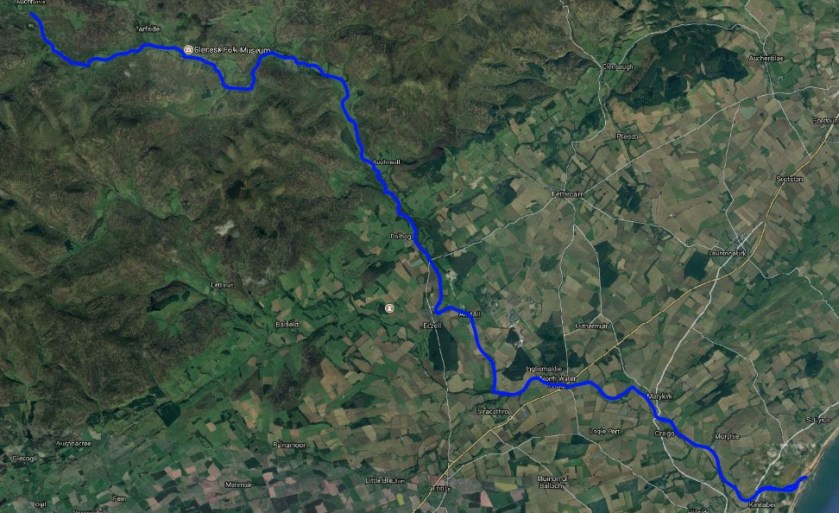
Another explanation is that the goshawk had been shot and killed further inland and then tossed in the river for the water to carry away the corpse (and thus the evidence of the crime).

[Map showing the River North Esk running down through the Angus Glens grouse moors and out along the plain to the North Sea]

Undoubtedly there will be some who consider this explanation far-fetched, but throwing dead goshawks in to rivers isn’t unheard of in Scotland – we’ll shortly be reporting on another case that includes some amazing supportive evidence……we’re just waiting for a bit more detail on that one.

Meanwhile, back to the investigation in to the illegal shooting of this goshawk in Angus….

When Chris submitted the goshawk carcass to the Edi Vet School he hadn’t notified the police as there was nothing to report at that stage – just the discovery of a dead goshawk. However, when the x-ray revealed the lead shot in the goshawk’s body, he asked the staff member to report the incident to Police Scotland.

We understand that the staff member sent the corpse to Scotland’s Rural College (SRUC) for a post-mortem (standard practice) and that the SRUC would then notify the police.

However, when we contacted Police Scotland last week to ask about the status of the investigation and why they hadn’t made a public appeal for information (this goshawk was found in March, remember, that’s seven months ago!), we were told that the police had only been informed about the incident ‘in the last couple of weeks’ and so the investigation was ‘at the very early stages’.

We asked Police Scotland for a crime reference number that we could include in this blog but we were told that a crime number ‘had not yet been issued’.

Hmm.

There are several lessons to learn from this case, not least the importance of submitting carcasses for further examination to help detect criminal activity – if Chris & Simon hadn’t acted, this crime would not be recorded in the official statistics.

But this case also highlights the importance of sending reports of suspected raptor crime to RSPB Scotland at the earliest possible time, so if there is a subsequent breakdown in communication between the authorities, which appears to have happened in this case, the RSPB can follow-up and make sure that at least these crimes are properly recorded and investigated, even though the chances of catching the culprit are precisely zero.

UPDATE 20 Oct 2018: This blog has been picked up by an article in The Express (here)

UPDATE 20 Oct 2018: This blog has also been picked up by an article in The Press & Journal (here)

Moorland Association giving false hope for an end to raptor persecution in Peak District National Park

The Moorland Association’s long-term ability to deny and undermine the proven link between illegal raptor persecution and driven grouse moor management is legendary (see here for just one of many examples).

Never far from the headlines, they’ve been churning out the propaganda again, this time during an interview on BBC Radio 4’s Today programme, broadcast 2 May 2018, in response to the recently published scientific paper linking illegal raptor persecution in the Dark Peak area of Derbyshire’s Peak District National Park with driven grouse moor management.

The interview is available on iPlayer for the next 21 days here (starts at 53:15 mins).

Here’s the transcript:

John Humpries: There’s new research seems to show a clear link between grouse shooting and the decline in the number of birds of prey, specifically the goshawk and the magnificent peregrine falcon, the fastest bird in the world. Mark Thomas of the RSPB has done the work, Amanda Anderson is the Director of the Moorland Association. They are both on the line.

Mr Thomas, haven’t we heard this before?

Mark Thomas: We have, John, lots of times. The difference here is you’ve got a National Park, a place where the public can go, 10m visitors a year.

John Humphries: The National Park being ?

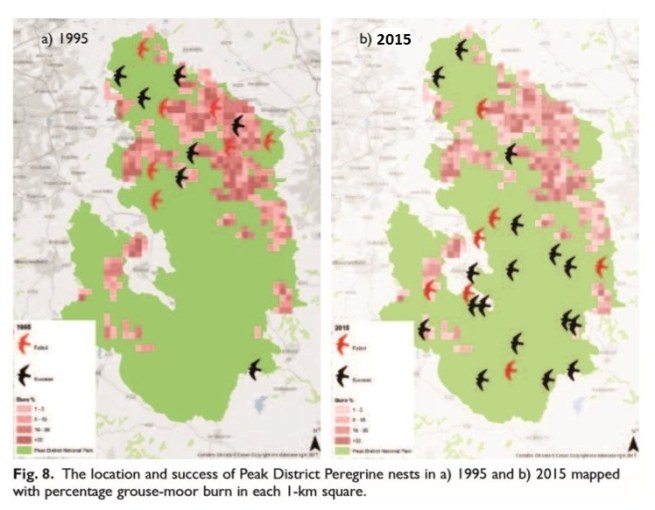
Mark Thomas: The Peak District National Park. It is highly protected yet half of the park, the northern bit with the grouse moors, are a no go zone for the very birds that you’ve just discussed.

John Humphries: Because?

Mark Thomas: Because we’ve done some research and what we’ve done is we’ve looked at all the crimes against birds of prey. So this is shot peregrines, poisoned buzzards, shot buzzards, pole trapped ospreys, it goes on and on, and all those crimes, we’ve matched them statistically with the area used for driven grouse shooting in the Dark Peak, the northern area.

John Humphries: But I’m not quite sure how you link the crimes, as you put it, to legitimate grouse shooting.

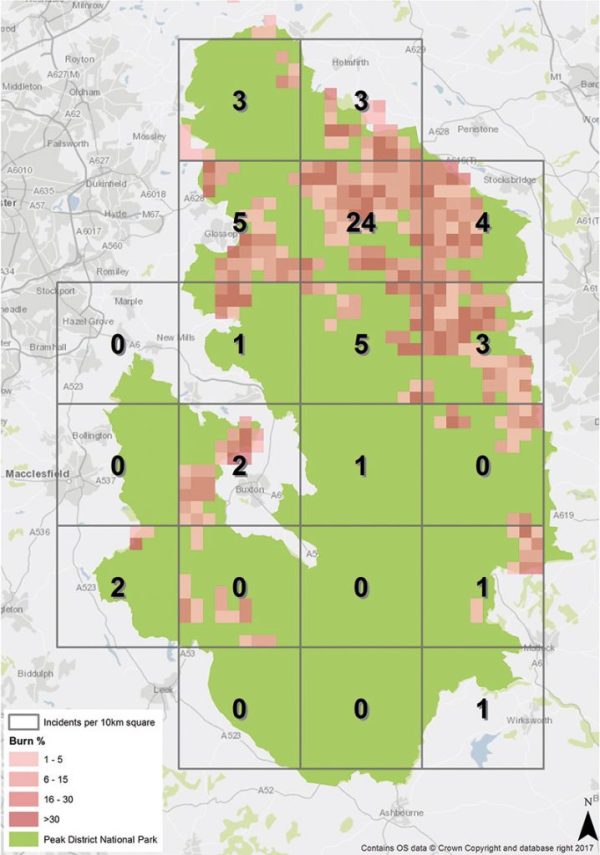
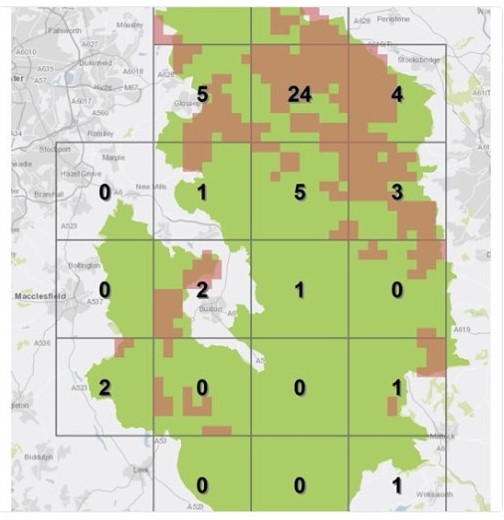
Mark Thomas: Because what we’ve basically done is we’ve matched the places where the crimes occur and then we’ve put a layer on showing where the grouse moors are and statistically that is significant. It overlays each other and we’ve proven a correlation between the two. If you are a bird of prey, you do not want to be in the Dark Peak.

[RSPB map from the new scientific paper showing the number of confirmed raptor persecution incidents in the Peak District National Park 2000-2016 overlaid with areas managed for grouse shooting]:
John Humphries: Amanda Anderson, do you accept that?

Amanda Anderson: Good morning John, good morning Mark. I have to refute that Mark thinks the northern area is a no go zone for birds of prey. The National Park is a massive area, the size of London, and in the north of the park this year we have 8 pairs of peregrines and 7 or 8 pairs of goshawk. Now it’s early in the season, it’s a very cold late spring, I’m sure you’ll agree, so we can’t guarantee that these pairs will turn into nests and eggs turn into chicks.

John Humphries: But it’s this correlation between the crime and the areas where grouse shooting happen.

Amanda Anderson: One incident of a bird of prey being persecuted is too many but we must look at the instances of this, the amount of crimes reported. I don’t know the definition of a confirmed crime but it is over a 16-year period so there are 3-4 incidents per year and there have been 2 prosecutions in the area that Mark refers to and bird of prey numbers are now increasing.

John Humphries: That presents a slightly different picture, Mark.

Mark Thomas: That’s not exactly right. When you look nationally, 69% of all people convicted for killing birds of prey, gamekeepers, let’s get to it, they are the people killing birds of prey in this park. And, as I’ve said, we have a whole catalogue of incidents. The confirmed ones is when we’ve got a body, we’ve physically got a body where nobody can refute that that bird has not been poisoned, hasn’t been trapped. In terms of the birds that are there at the moment, we’ve had this situation year on year. At the beginning of the season it looks good. Ask Amanda. Last year not one single peregrine falcon was successful in the northern Dark Peak where the grouse moors are.

Amanda Anderson: That’s absolutely true. Last year peregrine were very disappointing. As I say, this year it’s looking very exciting with about 8 pairs on the go at the moment.

John Humphries: So there we are, that’s it, it does fluctuate, doesn’t it Mark?

Mark Thomas: It does but what our data is looking at is over a long period of time. Amanda’s reflecting on one year. We must acknowledge Amanda has tried very hard with her moorland managers to self regulate but that is not working.

John Humphries: So what would you do? Would you ban grouse shooting?

Mark Thomas: No, the RSPB is not saying that and we are not going as far as that. We are saying we want licencing. If a shoot has committed a crime then the licence to shoot on that moor is removed for a period of time. That would focus and we think that would solve this problem.

John Humphries: And would you accept that, Amanda?

Amanda Anderson: If a shoot has committed a crime then somebody should be in court and prosecuted and that is a fair system and is working. The conclusion the RSPB draw to legislate to help birds of prey is flawed when the population is increasing.

ENDS

Wow. Amanda’s final comment deserves a whole blog to itself but that’s for another time.

For now, we want to concentrate on Amanda’s claim that this year is “looking very exciting with about 8 pairs [of peregrines] on the go at the moment” and “7 or 8 pairs of goshawk“.

That sounds promising, doesn’t it? But just how accurate are these figures?

Not very, according to local raptor group fieldworker Mike Price from the Peak District Raptor Monitoring Group.

We asked Mike to comment and here’s his response:

“Thank you for your email. Whilst we are not able to publicly share the figures of breeding, highly threatened raptor species at this point in the season, we can tell you that the activity of Peregrine Falcons has followed the pattern of previous years, with several sites occupied earlier in the season. Approximately 50% of these sites are no longer occupied. 

We know that there has been an incident near to one site that led to an injured bird being photographed by a member of the public. It was described as immobile, on the ground and covered in blood. Unfortunately, despite extensive searching the bird has not been recovered and we do not know what caused the bird’s injuries.

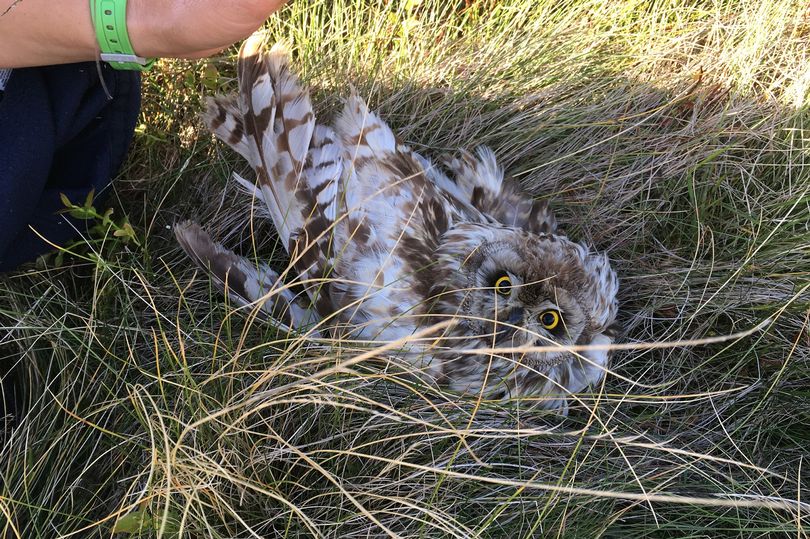
[Photos of the injured peregrine, found 14 April 2018, published on Twitter by @RSPBBirders]

Occupied Goshawk sites appear to be lower than in 2017, although known breeding pairs remain in line with 2016 and 2017. Several sightings of pairs exhibiting breeding behaviour at historic breeding sites appear to have fizzled out and at a number of sites this appears to be happening annually and without any reasonable explanation.

With all of that in mind the figures quoted by Amanda Anderson for the north of the Peak District National Park, are in our opinion, inaccurate. We would welcome a recovery for both Peregrine and Goshawk in the area mentioned but after seven years of failed collaborative working we are understandably cautious”.

Hmm, this report paints quite a different picture to the one Amanda was suggesting, doesn’t it?

To be fair though, Amanda did say it was still early in the season and it’d been a cold, late spring so there was a chance that not all the peregrine and goshawk breeding attempts would be successful. That’s true, and the weather may well have played a role in some of these early failures (we’ll find out when the 2018 report is published). But take a look again at that bloodied, injured peregrine laying in the heather. Was that a victim of the cold, late spring?

It’s a critical time for breeding birds, and especially for breeding raptors in the Peak District National Park. According to a statement made by the Peak District National Park Authority in January this year, it is “looking for an increase in birds in the breeding season before committing to working with the other organisations in the Peak District Bird of Prey Initiative beyond 2018″.

It’s no wonder the Moorland Association is keen to pretend things are on the up.

New paper links raptor persecution to driven grouse moors in Peak District National Park

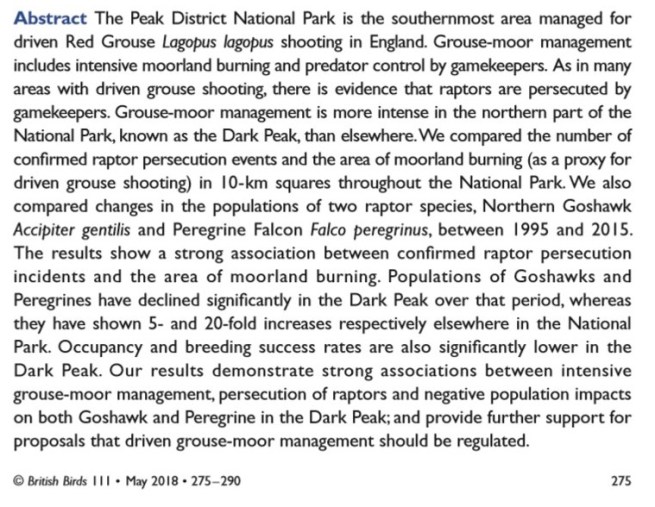
A new scientific, peer-reviewed paper, published in the journal British Birds, links the illegal killing of birds of prey with driven grouse moor management in the Dark Peak area of the Peak District National Park.

Full citation: Melling, T., Thomas, M., Price, M. and Roos, S. (2018). Raptor persecution in the Peak District National Park. British Birds 111 (May): 275-290.

Unfortunately we’re not permitted to publish the full paper [UPDATE: paper now available at the foot of this blog] but here is the abstract and a number of the figures:

The RSPB has published a blog about this research which is well worth a read – here.

At the end of the RSPB blog, RSPB Investigator Mark Thomas writes: “It’s going to be interesting to see the response to our paper“.

The response will be the same one we’ve seen to every other scientific paper linking illegal raptor persecution to driven grouse moor management (and there have been many):

  1. Conservationists will be appalled (but not surprised);
  2. The grouse shooting industry will either (a) ignore it or (b) try to undermine the credibility of the authors and the science;
  3. The statutory authorities will either (a) ignore it or (b) they’ll acknowledge it and say raptor persecution ‘won’t be tolerated’ and then do nothing.

We still need to work on increasing public awareness about the illegal persecution of raptors on driven grouse moors and encourage more voters to apply pressure to their political representatives. Good progress has been made in the last few years but there is much, much more to do.

Scientific papers such as this latest one all help build the evidence, although if they sit behind a journal paywall they have limited value. Please help spread the word about this paper, especially on social media, and if you’re a resident of the Peak District National Park or if you live nearby and your MP’s constituency extends in to the Park, please send a copy of the paper’s abstract to them and ask that they contact Wildlife Minister Therese Coffey at DEFRA to demand she takes action.

In fact, even if you’re not a Peak District resident, this is a National Park that is there for all of us to enjoy, so please send a copy of this paper’s abstract to your local MP, wherever you live, and ask him/her to demand action from Minister Therese Coffey on your behalf.

The illegal killing of raptors on grouse moors in this National Park (and many others) has been going on for decades. It’s all documented. It will continue to go on unless we demand change. Please act.

UPDATE: Here is the paper in full:

Illegal activity uncovered at goshawk nest in North York Moors National Park

RSPB press release (26/3/18)

ILLEGAL ACTIVITY UNCOVERED AT GOSHAWK NEST IN NORTH YORK MOORS

North Yorkshire Police and the RSPB are appealing for information after several instances of illegal disturbance were recorded at a goshawk nest in North Yorkshire.

In spring 2017, a covert camera was trained on a nest with poor breeding success near Helmsley to better understand what was causing the nest to fail. In April 2017, the footage showed two men visiting the nest and one of the men then repeatedly hitting the nest tree with a large stick. This appeared to be a clear attempt to flush the incubating bird off the nest.

Then, on two occasions the following month, a man is seen and the sound of gunshots is heard, along with the repeated alarm calls of the parent birds on one of the occasions. The nesting attempt subsequently failed and the four cold eggs were later recovered from the nest after a visit by the police. Analysis showed one of the eggs had a fully formed chick inside.

Goshawks are secretive, forest-dwelling hunters, around the size of a buzzard. There are very few nesting pairs in North Yorkshire, despite plenty of available habitat. Goshawks are legally protected under the Wildlife and Countryside Act 1981 and listed on Schedule 1 of the Act. It is an offence to intentionally or recklessly disturb the birds at the nest site during the breeding season unless operating under the authority of a government licence.

Investigations are ongoing and police are appealing for information.

Watch video footage from the RSPB’s covert camera:

Howard Jones, RSPB Investigations Officer, said: “We are very concerned that this was an attempt to shoot the goshawks or disturb the adults to make them desert the nest site. Goshawks are magnificent birds and should be widespread throughout North Yorkshire. The idea that people are deliberately trying to destroy nests and prevent them from raising chicks is beyond belief.

Birds of prey in the North York Moors National Park are at a huge risk of persecution, and this county consistently proves the worst in the country for the illegal killing of birds of prey. This latest evidence shows the pressures they continue face. We are grateful for the enquiries being made by North Yorkshire Police in relation to the events recorded. We hope that further information emerges to help identify these individuals.”

Acting Inspector Kevin Kelly, of North Yorkshire Police, added: “The ongoing problem of raptor persecution in our county prompted a public awareness campaign in February between ourselves, the RSPB, RSPCA, North York Moors National Park and Yorkshire Dales National Park. The initiative – know as Operation Owl – was designed to educate local people and send a clear message that raptor crime will not be tolerated.

If you have any information that may help our enquiries regarding these incidents, please speak out. Ahead of the spring breeding season, look out for individuals acting suspiciously and please report any concerns immediately.”

If you have any information relating to this incident, call North Yorkshire Police on 101. Or to speak with somebody in complete confidence, call the RSPB’s Raptor Crime Hotline 0300 999101.

If you find a wild bird which you suspect has been illegally killed, contact RSPB investigations on 01767 680551, email crime@rspb.org.uk or fill in the online form.

ENDS

RSPB Investigations Officer Howard Jones has also written a blog here

Masked gunmen at goshawk nest in Moy Forest

The following article was published today in the Press & Journal:

For regular blog readers, this is a story we ran in November 2017 (here) when we’d found out through an FoI that a masked gunman and an associate had been caught on camera near a raptor nest at an undisclosed public forest in Scotland.

We were pretty shocked that Police Scotland had kept silent about this incident and, given public safety concerns, we encouraged blog readers to write to their local MSPs to ask questions about the (mis)handling of this case (here).

We also asked Justice Secretary Michael Matheson and the Minister for Community Safety & Legal Affairs, Annabelle Ewing, about this issue but neither bothered to respond.

Police Scotland did respond to some of our blog readers requests for information (see here) but refused to discuss the details or reveal the location. However, several local MSPs did commit to taking this up with the Police on behalf of their constituents.

At least one of those MSPs was as good as his word and we’ve recently received copies of correspondence between him and his constituents, which we’ll blog about early in the New Year.

For now, it is apparent that this political intervention has resulted in Police Scotland issuing an appeal for information (only 8 months too late) and revealing the location as Moy Forest, a site well known for being targeted by raptor killers.

Nobody will be surprised to learn that the land around Moy Forest is managed for intensive driven grouse shooting.

Well done to those blog readers who chased up this story, well done to those MSPs who followed up with the Police, and well done to Kieran Beattie at the P&J for taking it to press. But it’s pretty pathetic that we all had to go to such lengths to get Police Scotland to react. Not good enough.

There’s a lot more to talk about in relation to this incident and we’ll be returning to it in the New Year….

SNH refuses to disclose details of individual General Licence restriction

In September 2017 we learned that SNH had imposed a General Licence restriction on an individual for alleged criminal activity in relation to raptor persecution (see here).

This was a highly unusual restriction because it applied to an individual rather than to an estate.

At the time the restriction was announced, SNH provided virtually no information other than to say a General Licence restriction had been imposed and that it would apply for three years.

However, RSPB Scotland released a press statement in relation to this restriction order which included the following quote from RSPB Scotland’s Head of Investigations, Ian Thomson:

The restriction was imposed after RSPB investigations staff passed video footage to police of a gamekeeper allegedly setting illegal traps, baited with a dead woodpigeon, very close to a goshawk nest in NE Scotland”.

Here’s a clip from that video evidence:

From this, we were able to deduce that this alleged wildlife crime took place in March 2014 ‘nr Tarland, Aberdeenshire’, although the specific location was not given.

This alleged offence was reported by Police Scotland to the Crown Office in April 2014 (see here). It is clear, now, that the Crown Office did not prosecute the gamekeeper, probably on the grounds that the video evidence was deemed ‘inadmissible’. That’s the sixth alleged wildlife crime case, that we know about, that the Crown Office has dropped in recent months.

So at this stage we know that an alleged wildlife crime had taken place, we know that a criminal prosecution is not going to happen (because the case is now time-barred), and we know that SNH has imposed an individual General Licence restriction on a gamekeeper as a supposed sanction. The identity of the alleged offender remains a secret, as does the name of the estate where the alleged offence was committed. This lack of transparency is, frankly, appalling, especially when former Environment Minister Paul Wheelhouse had stated when he first introduced General Licence restrictions in 2014 that he expected them to function as “a reputational driver”. Not much chance of that happening when the details of a case are kept secret.

In early October 2017 we submitted an FoI to SNH to try and find out more details about this case. We asked for:

  1. The name of the person who had been given a General Licence restriction (we didn’t expect to be told but thought we’d ask anyway – you never know)
  2. The occupation of that person (we already knew from the RSPB press statement that he was a gamekeeper but we wanted SNH to confirm this)
  3. The name of the county in which this individual resides (we already knew from the RSPB press statement that the alleged offence had taken place in Aberdeenshire but we wanted SNH to confirm this)
  4. The name of the estate from where the Police evidence of alleged raptor persecution had been collected
  5. An explanation about why an individual and not an estate was the recipient of the General Licence restriction
  6. An explanation about how SNH intends to monitor the activities of the individual for potential breaches of his General Licence restriction.

SNH has now responded and it’s astonishing:

It looks like SNH has been taking lessons from Natural England in the withholding of information that should be in the public domain. It’s understandable that SNH can’t disclose the alleged offender’s identity, but withholding details of his occupation and the county in which he resides because “this would allow them to be identified” is obviously nonsense, and we already know this information from the RSPB press release!

We would argue that it is in the public interest to know the name of the estate on which this alleged offence took place (and we do know from various local sources it was on a game-shooting estate and that this gamekeeper was employed by that estate). Why should that information be kept secret? Who is SNH shielding, and why?

And does anyone actually believe that Police Scotland, no matter how well-intentioned, has the resources to track this gamekeeper’s activities for the next three years to ensure he’s not breaching the terms of his General Licence restriction?!

Whilst this response doesn’t get us any further forward in knowing the specifics of this case, what it does demonstrate, quite clearly, is that the General Licence restriction, introduced as a way of publicly embarassing estates where there is evidence of wildlife crime but, due to perceieved evidential difficulties, the cases don’t ever reach the courts, is simply not working.

Tomorrow’s blog, on another General Licence restriction case, will emphasise this point again but on a whole bigger scale.

More on the mystery gamekeeper with the General Licence restriction

Further to this morning’s blog about the mystery gamekeeper from north east Scotland who was filmed allegedly setting an illegal trap near a goshawk nest and who has subsequently been slapped with a General Licence restriction order by SNH, but whose name and employment details have been withheld.

Who could he possibly be and where, exactly, did this take place? There are some clues….

Have another look again at the short video clip of this gamekeeper in action, released by RSPB Scotland:

The video is date stamped: 21 March 2014.

Now have a look at RSPB Scotland’s 2014 persecution report, and note the confirmed incident of raptor persecution recorded in March 2014 relating to the setting of spring traps (with pigeon bait) on a plucking post close to a goshawk nest:

The location is given as ‘nr Tarland, Aberdeenshire’.

Where’s Tarland? Here it is, just to the east of the Cairngorms National Park boundary:

If we accept that the gamekeeper caught on video was allegedly trying to target a goshawk with an illegal trap, the motive for doing so would most likely be to protect game birds from predation. This is illegal, of course – goshawks have been legally protected since 1954, but as we know only too well, this doesn’t stop some gamekeepers from trying to kill them.

So we thought we’d look at how many game shooting estates are located ‘nr Tarland’. It’s a pretty vague location but consulting Andy Wightman’s brilliant Who Owns Scotland website, it turns out there are three big game-shooting estates in the area that could, reasonably, be defined as being ‘nr Tarland’: the MacRobert Trust Estate, the Tillypronie, Deskrie and Towie Estate, and the Dinnet Estate. There is also an area of ‘dead ground’ whose ownership is not included on Andy’s website, although we do know that GWCT’s new demonstration farm, Auchnerran, sits in this ‘dead ground’.

This map is useful, but it doesn’t really help draw many conclusions. What we can say is that all three estate owners would be both horrified, and embarrassingly compromised, if it turns out that this gamekeeper was employed by, or associated with, any of the estates.

The MacRobert Trust Estate is, as the name suggests, administered by a well-respected charity and the estate website suggests ‘an exemplary approach to estate management‘. There is a pheasant shoot here, which was advertised as a three-year ‘prestigious sporting lease’ in 2010.

The Tillypronie Estate was owned, at the time of the video recording, by Philip Astor. The estate, described as ‘One of Scotland’s most famous sporting estates’, went on the market last year valued at a cool £10.5 million and is now believed to have been sold to a ‘mystery buyer’. Gosh, there’s a lot of mystery in this part of the world, isn’t there? There is pheasant and grouse shooting here. Phil is a Vice Chairman of the GWCT.

The Dinnet Estate has long been owned by the Humphrey family and there is a designated National Nature Reserve on the estate, managed by SNH. A Dinnet Estate gamekeeper was convicted in 2006 of trespassing on a neighbouring estate with a firearm back in 2002 but that was a long time ago. A Dinnet Estate grouse moor was mentioned on this blog last month as being a potential location of satellite-tagged hen harrier Calluna’s last tag transmission but there’s been no further news on that. Dinnet Estate is a direct neighbour of the GWCT’s demonstration farm, Auchnerran, and the Dinnet Estate grouse moor is summer-grazed by some of GWCT’s sheep.

Given the GWCT’s indirect links and direct interests in the area ‘nr Tarland’, they must be concerned about the General Licence restriction being applied to a local, unnamed gamekeeper. If we ran an upland farm in the area, and were setting out to demonstrate good conservation benefits for both agriculture and wildlife, we too would be concerned. What if we employed him without knowing any of his history?

Shall we ask the GWCT for a comment? Perhaps, given their local contacts, they know something we don’t? Emails to: info@gwct.org.uk

May be all will become clear when we submit an FoI to SNH asking for further details about this particular General Licence restriction, although we’re not holding our breath!

Another avenue for information-seeking might be Police Scotland. We know from the RSPB’s press release that the police were investigating this alleged crime, so presumably the police know the name of the gamekeeper and where, exactly, this allegedly illegal trap had been filmed. Given that the case is now time-barred, meaning that the Crown Office couldn’t prosecute even if they wanted to (highly doubtful), there is no reason why Police Scotland can’t release relevant details as there’s no chance of it interfering with a live case. Let’s ask them. Emails to National Wildlife Crime Coordinator for Police Scotland, Andy Mavin: andrew.mavin@scotland.pnn.police.uk

SNH imposes General Licence restriction on ‘mystery’ gamekeeper

So, SNH has today announced it has imposed two General Licence restriction orders, based on evidence provided by Police Scotland of alleged raptor persecution crimes.

We know that one of those restriction orders has been placed on Edradynate Estate, Perthshire, because SNH has been quite upfront about it and has named the estate (see here).

But what about the other General Licence restriction? Well, according to the SNH press release, this has been imposed on “an individual” rather than on an estate.

This in itself is interesting. We know from the SNH framework for imposing these restrictions that this action can be taken against an individual, as well as on certain areas of land, but the framework document suggests that imposing it on land would be preferable to imposing it on an individual:

While the wording provides for the exclusion of individuals, it is the intention that where SNH has robust evidence that wild birds have been killed or taken or where there is intention to do so other than in accordance with a licence, SNH will exclude the area of land on which such evidence is found from General Licences 1, 2 and/or 3“.

Hmm. So who is this individual and why did SNH impose the restriction on him/her, rather than on an estate?

The SNH press release points the reader to the SNH webpage on General Licences for “full licence restriction details“. However, when you look at the SNH webpage, all you find is this:

Is SNH having a laugh? The “full licence restriction details” of this particular GL restriction order amounts to one sentence:

In addition [to the restriction imposed on Edradynate Estate] SNH has imposed a restriction prohibiting the use of General Licences by an individual for 3 years from 15th September 2017“.

That’s it? No name? No information on the area, let alone the name of the land where the evidence of raptor persecution took place? Not even the region?

What’s with the secrecy? Who is SNH shielding, and why?

This could be absolutely anyone! Is it Nicola Sturgeon? Is it Alex Salmond? Is it JK Rowling? Highly unlikely, it has to be said, but you get the point we’re trying to make.

And what happened to the transparency that was promised when former Environment Minister Paul Wheelhouse first announced this new measure to tackle ongoing raptor persecution? He said he expected details of General Licence restrictions to be published on the SNH website to act as “a reputational driver“. That’s not going to happen if SNH withholds the details, is it?

This is a very dangerous precedent to set. SNH has previously withheld details of estates that were being considered for a GL restriction but in that case, the justificiation for being all secret squirrel was reasonable: the GL restrictions hadn’t yet been imposed, but rather the estates had been notified of an intent to impose, and SNH argued that the estates needed time to respond/appeal (see here). That was fair enough.

But in this case, SNH has already imposed the GL restriction, and we’re struggling to understand the justification SNH might have for keeping the details secret.

What is it with statutory agencies and their reluctance to release information that’s clearly in the public interest?

We’ll be submitting an FoI to SNH to ask for further details, and, based on the response, we’ll consider appealing the decision to the Scottish information Commissioner.

In the meantime, have a look at today’s press statement from RSPB Scotland about these latest GL restrictions. This gives us more of a clue about the recipient of the restriction order. The statement includes the following quote from Head of Investigations, Ian Thomson:

The other restriction was imposed after RSPB investigations staff passed video footage to police of a gamekeeper allegedly setting illegal traps, baited with a dead woodpigeon, very close to a goshawk nest in NE Scotland.”

Ok, now we’re getting somewhere. The recipient of the GL restriction is a gamekeeper, working in NE Scotland, who was filmed allegedly setting illegal traps close to a goshawk nest. And the RSPB has even provided a video clip of the alleged offence, with the individual’s face pixellated (presumably done on legal advice).

Well, quelle surprise! Another gamekeeper trying, allegedly, to persecute a goshawk in north east Scotland. This is becoming quite a habit in this part of the country. First we had gamekeeper George Mutch, caught on video trapping and battering to death a goshawk on the Kildrummy Estate in 2012, crimes for which he went to prison (see here), then we had a gang of masked armed men caught on video shooting at a goshawk nest on Forestry Commission land at Glen Nochty in 2014 (see here), and now this latest case.

But who is this latest gamekeeper and on whose land was he working when he allegedly set this trap?

More on this in the next blog…..

UPDATES:

More on the mystery gamekeeper with the general licence restriction (here).

Head of National Wildlife Crime Unit still talking about ‘rogue’ gamekeepers

We’ve been sent some fascinating correspondence from one of our blog readers.

Following the news in February 2017 of the ‘non suspicious’ death of a tagged goshawk on the royal Sandringham Estate in Norfolk (see here), a blog reader wrote to Norfolk Constabulary as follows:

I write in reference to the Mail on Sunday’s coverage (online, Sunday 12 Feb 2017) of the radio-tagged goshawk reported to have been found (first said to be found dead, then said to have been found alive) at Sandringham. Given the confusion that surrounds this case, will the Police be making any further statements to clarify what they believe happened to the bird, to help ascertain what may have caused its decline and then death (important to know as part of the study being carried out on the species) and why its body was incinerated when it had only just died, and was obviously part of a tagging project? A lot of people obviously think there are grounds for suspicion here, and would be interested to know why the Police are said to have taken a different view. I am sure the estate would also welcome the matter to be cleared up. Many thanks for your help in this and for any reassurance you can give the public that the matter is being looked into thoroughly“.

The reply came in the form of a jointly-signed letter from Chief Inspector Martin Sims (Head of National Wildlife Crime Unit) and Inspector Jon Papworth (Wildlife Crime Coordinator, Norfolk Constabulary).

It beggars belief that the Head of the NWCU, the ‘coordinating intelligence body for wildlife crime’ is still talking in terms of ‘rogue’ gamekeepers being responsible for raptor persecution.

How does he explain the virtual extirpation of breeding hen harriers in the grouse moor areas of northern England?

How does he explain the continuing decline of breeding peregrines on the grouse moors of northern England?

How does he explain the repeated reports of shot and poisoned red kites in the grouse moor areas of North Yorkshire?

How does he explain the continued suppression of the golden eagle breeding population in the grouse moor areas of central, eastern and southern Scotland?

How does he explain the continued suppression of the red kite breeding population in the grouse moor areas of northern Scotland?

How does he explain the almost continuous reports of satellite-tagged raptors that ‘disappear’ disproportionately on land managed for driven grouse shooting in England and Scotland?

This isn’t the work of a few ‘rogue’ gamekeepers; this is the result of systematic persecution, affecting entire regional (and sometimes national) raptor populations, at the hands of the game shooting industry. It is industrial scale criminality and the sooner Chief Inspector Sims gets his head around this, the sooner we might see an improvement in enforcement action.

He says that media commentary on these crimes ‘appears to have polarised two sections of society’. Which two sections of society are they, then? The criminals and the law-abiding public? He seems to think we should all stop talking about this criminality and instead place our trust in the game-shooting sector. Yeah, great idea. Let’s not talk about the crimes that criminals commit, whether they be gamekeepers, drug dealers, burglars, rapists, murderers or thieves. Instead, let’s hold support groups, sit around with tambourines and all sing Kumbaya. That’ll sort it.

He talks about trying ‘a different approach’ and refers to the Raptor Persecution Priority Delivery Group (RPPDG) as an example of this. And what has the RPPDG delivered since its inception in 2010? Bugger all. We’ve recently seen some minutes from these RPPDG meetings, obtained via FOI, and all the meetings seem to achieve is to provide an opportunity for the gameshooting industry ‘partners’ to consistently challenge the confirmed persecution data recorded by the RSPB. Presumably that’s why we haven’t seen any national persecution incident maps from the RPPDG since 2011. It’s pathetic.

He talks about the law-abiding gamekeepers within the industry. There must be some, but where are they? How are we expected to tell the difference between the criminals and the law-abiders? How much intelligence on raptor persecution is supplied by gamekeepers to the police? How often do you see gamekeepers and their representative organisations highlighting raptor crimes or calling for tighter regulation?

With views like those of Chief Inspector Sims, it’s no wonder the NWCU hasn’t made even the tiniest dent in addressing illegal raptor persecution. It definitely is time for a different approach.

Here’s a pie chart for CI Sims to contemplate while he’s dreaming up ways of supporting the game shooting industry. It shows the occupations/interests of 176 individuals convicted of bird of prey related offences 1990-2016 (from the RSPB’s 2015 Birdcrime report).


Goshawk dies in ‘mysterious circumstances’ on Queen’s Sandringham Estate

Not for the first time, the Queen’s Sandringham Estate in Norfolk has been at the centre of a police investigation in relation to a raptor incident.

According to an article in today’s Mail on Sunday (here) a police investigation was launched after Sandringham Estate staff mailed a young goshawk’s tracking tag back to the BTO on 11 August last year, but without the corpse. When the BTO contacted Sandringham Estate to ask what had happened to the bird, they were told the bird had been ‘disposed of’ because ‘it had been dead for a long time’ and was ‘decomposing’. However, the GPS tag data revealed the bird had still been alive on the evening of 8th August, in some trees close to Sandringham House.

During the Police investigation, Sandringham Estate staff changed their story and said the goshawk had been found alive by a gardener beside a perimeter fence but that ‘it was in a poor condition and quickly died’. They told Police the bird had been incinerated.

Hmm.

Estate staff justified these contrasting stories about what had happened by saying there had been ‘a breakdown in communication’ amongst Estate staff.

Hmm.

Norfolk Police issued a statement: “A thorough investigation was carried out and no wrong doing was identified“.

Norfolk Police also told the BTO: ‘There were no suspicious circumstances surrounding the bird’s death‘.

Hmm. Perhaps they’d turned up with a white stick and a dog.

Without having this goshawk’s corpse available for post-mortem it is impossible to determine how it died, so it’s no surprise that Norfolk Police said ‘no wrong doing was identified’. Of course no wrong doing was identified because any potential evidence had been conveniently incinerated!

Sandringham Estate was at the centre of a police investigation in 2005 when a tawny owl was caught in an illegally-set trap. A Sandringham Estate gamekeeper was convicted and fined, but wasn’t sacked (see here, pages 3-4).

In 2007 Sandringham Estate was at the centre of another police investigation after the alleged shooting of two hen harriers. Prince Harry, his friend William van Cutsem (whose family own the now infamous Mossdale Estate), and an unnamed gamekeeper were questioned but denied all knowledge of the incident. The hen harrier corpses were never found.

In 2014, a satellite-tagged Montagu’s harrier called Mo ‘disappeared’ on land next door to Sandringham Estate and police launched an investigation. Mo’s corpse has never been found.

Photo of a young Norfolk goshawk with its GPS tag, part of the Heritage Lottery funded BTO goshawk tracking study (photographer unknown).