Bird boycott

Here is a letter that was published in today’s edition of The Scotsman:

I recently had another holiday in Scotland – my third visit this year – principally to do bird and wildlife watching.

Like many others I have always wanted to go bird watching in Malta and Cyprus, but have boycotted these islands on principal because of their hunting and persecution of birds.

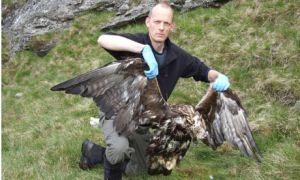
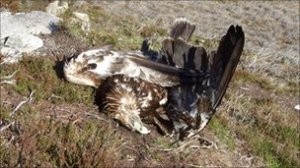
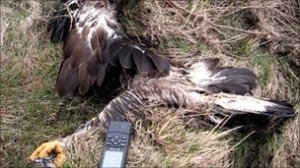
On each visit to Scotland I learn of more illegal poisoning and persecution of raptors – including a major tourist attraction, the iconic golden eagle.

I am beginning to think that my patronage of your tourist industry is somewhat hypocritical in view of my stance on the European countries I mentioned.

It appears that wildlife crime detection is grossly underfunded and that penalties are woefully inadequate.

What good is a fine of a few thousand pounds to a gamekeeper whose multi-millionaire lord and master will pay the fine anyway?

I think a universal boycott by wildlide enthusiasts would be damaging to the economies of Scotland, and I implore the Scottish Government to make a concerted effort to stamp out these crimes.”

P. Bateson, Halifax.

The Scotsman letter here

“Professional gamekeepers do not poison raptors” says Alex Hogg

Episode 11 of the BBC 2 Scotland ‘Landward’ programme went out on Friday 27 May and included a segment on the new vicarious liability regulation in the Wildlife and Natural Environment (Scotland) Act 2011. The programme is available here for a limited period.

The segment opened with Duncan Orr-Ewing, Head of Species at RSPB Scotland, who told the interviewer, “Bird of prey poisoning is particularly associated with driven grouse moors in the upland of Scotland, in the central and eastern highlands, parts of Perthshire and also down in the southern uplands”.

The interviewer, Dougie Vipond, asked: “So who is doing this? Who is killing the birds?”

Orr-Ewing: “Well, it is estate employees, gamekeepers who are usually involved, but they are only employees, they are acting under the direct instructions so ultimately it is the landowners that are responsible for this”.

A short section followed with a brief interview with Liz Plath, listed as a rural law specialist and a partner at Thorntons Law LLP. Basically she explained in simple terms how vicarious liability brings the landowner or the employer into the frame in cases of raptor poisoning.

Next up was Alex Hogg, chairman of the SGA, whose opening line was: “Professional gamekeepers do not poison raptors”. Funny that, because if you bother to look back at the statistics on raptor poisoning for the ten-year period that Hogg has been in post, you’ll see that raptor poisoning incidents have been recorded on many estates, and yes, ‘professional’ gamekeepers have been convicted.

He then contradicted himself (and not for the first time) by saying: “It’s only a small minority that are still at it. A rogue few if you like”.  Lest we forget, here is the official government map showing confirmed raptor poisoning incidents between 2006-2010. Widespread, I’m sure you’ll agree, and the trend is pointing upwards.

He continued: “And we’ve tried our hardest over the past, I’ve now been in this job for ten years, to impress on everybody that it’s absolutely illegal to poison raptors”. Peer pressure from Hogg and co., while welcome, has been ineffective. It can’t help the situation when he and others from his industry continue to claim that raptors are having a significantly negative effect on game birds, songbirds, waders and lambs. Is there any scientific evidence for this? No, not a shred.

Next up came David Hendry, listed as the proprietor of Cardney Estate, near Dunkeld in Perthshire. Now this was an interesting interview. The piece opened with an introduction to Hendry, and video footage of a diving osprey on his estate. We were told that this estate ‘is home to many endangered birds of prey’. Unfortunately, Hendry was not asked how many and what species of raptors made their home there. The osprey was implied, but of course the osprey only eats fish, not exotic red-legged partridge (also known as French partridge) or pheasant, which are reared and released in large numbers for sport shooting on this estate, according to this shooting directory.

Vipond talked about the belief that the only way to stop poisoning is to introduce a licensing system which would allow landowners to control [kill] raptors. Hendry agreed, and suggested “it should become the gamekeeper’s job for instance to look after the rare raptors like harriers, your merlins, bring on your red kites, but they should also be allowed to reduce buzzards and sparrowhawks to numbers that are sustainable, because what we have today is not sustainable”.

Ok, so this is the first time we’ve officially heard that sparrowhawks are also the landowners’ intended target for licensed killing. Until now, the list has ‘just’ included buzzards and ravens. So what happens if they get the go ahead to kill these species? Will we see goshawks added to the next list? They’re just an over-sized sparrowhawk after all, so why not? And golden eagles? They’re just over-sized buzzards, so why not? Where will it stop?

It’s also very interesting that he thinks the current number of buzzards and sparrowhawks is ‘unsustainable’. According to this shooting website, Cardney Estate offers shooting days where between 200-400 exotic birds (partridge/pheasant) can be shot. That’s 200-400 birds per shooting day, depending on the time in the season. In September 2010, a record 677 birds were shot on one day according to one participant! Sounds to me like this sporting estate is doing very nicely thank you, without the need to kill off any indigenous protected raptors, whatever species they may be.

We then went back to Orr-Ewing, who was asked for his opinion about the need to ‘manage’ [kill] protected raptors. “These birds of prey are rightly protected because they’re vulnerable. We have a history of killing birds of prey in Scotland, many species are just recovering from that situation, there’s no other country in Europe that [legally] kills birds of prey”.

His first three points are accurate, but his last statement is not. In 2008 the provincial government of Lower Austria issued a decree allowing hunters to shoot 1,000 buzzards and 250 goshawks over the following five years. It previously allowed the killing of Montagu’s harriers until the EC stepped in to halt it. The decree allowing the legal persecution of buzzards and goshawks resulted in an international public outcry – the same can be expected if the licensed killing of raptors for the benefit of the game bird-shooting industry is permitted in Scotland.

And of course, it’s not just poison that is used to illegally kill raptors. Unfortunately our government does not produce annual statistics on the other incidences of raptor persecution that take place every single year. Thankfully, the RSPB does. Their annual reports (one covering bird persecution in the UK as a whole, and the other covering incidents in Scotland) are a welcome insight into the extent of the problem. Their 2010 annual reports are due for publication in the very near future. Their efforts to compile and publish these reports are worthy of the public’s gratitude because without them, we would only have Alex Hogg and co’s word about the extent of illegal raptor killing on Scotland’s sporting estates.

Skibo Estate results

Dean Barr, a gamekeeper (and reported elsewhere as being the sporting manager) on the Skibo Castle Estate, has been convicted of having enough illegal poison “to wipe out the entire Scottish golden eagle and red kite populations several times over”. Barr, 44, of East Lodge, Clashmore, Dornoch, admitted possessing 10kg of the banned pesticide Carbofuran. He admitted carrying the poison from his previous job as head gamekeeper on the Raeshaw Estate to Skibo Castle Estate in 2008, because he had ‘not known how to safely dispose of it’.

The Carbofuran haul was discovered in a locked store on the Skibo Castle Estate, for which Barr had the keys. According to the Northern Times and Northern Constabulary, the poison was discovered within premises operated and solely accessed by Barr on Skibo Estate land.

Today he was fined £3,300 “to mark the court’s disapproval”. This was apparently reduced from a £5,000 fine for his early plea.

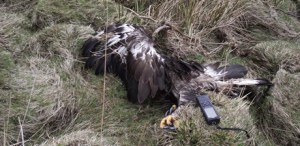
Despite this conviction, the Crown accepted he had ‘no part’ in the deaths of two poisoned golden eagles and a sparrowhawk (killed with Carbofuran) found on the estate in May 2010 (along with a dead buzzard and a third poisoned golden eagle killed by Aldicarb).

Barr’s defence lawyer said Barr was well regarded personally and professionally by his current and previous employers. “If it was thought that he was involved in the use of this material, they would not be so supportive”.

This is not the last we will write on this case.

The Scotsman news story

BBC news story

STV news story

Case against Skibo Castle gamekeeper opens at Inverness Sheriff Court

Following blog post 12 May 2010…

A year on from the discovery of THREE poisoned golden eagles, 1 buzzard and 1 sparrowhawk in or close to the grounds of Skibo Castle Estate, the case against one of the gamekeepers opened today at Inverness Sheriff Court.

The case against Dean Barr, originally from Northern Ireland, is to be continued on 26 May 2011. The charges against him are not yet being reported as he has not yet entered a plea. Last year, Mr Barr made a public statement in The Daily Record suggesting that the dead birds had been ‘planted’ by the RSPB – see blog post 22 June 2010 here: https://raptorpersecutionscotland.wordpress.com/2010/06/22/skibo-gamekeeper-blames-rspb-for-stuff-turning-up/

Golden eagle found poisoned on North Glenbuchat Estate, Aberdeenshire

An investigation is underway after the discovery of a dead golden eagle found poisoned on the North Glenbuchat Estate in Aberdeenshire. The young eagle, being tracked by satellite, was found dead on 29 March. Tests have confirmed the eagle had been poisoned by Carbofuran. Grampian Police raided the estate yesterday and items have been removed for forensic testing but nobody has been charged as yet. Well done to Grampian Police for publicising this incident.

 BBC news story here: http://www.bbc.co.uk/news/uk-scotland-north-east-orkney-shetland-13292307

This is not the first time that North Glenbuchat Estate has been at the centre of a wildlife crime investigation. In July 2006, the head gamekeeper at North Glenbuchat was convicted of three offences: killing a wild bird, possession of birds’ eggs, and possession of a proscribed pesticide under the Wildlife & Countryside Act 1981. The head keeper, who had been employed at the estate for 30 years, was fined £850 (see here).

So, here we go again. Another year, another golden eagle found poisoned on a Scottish sporting estate, despite the rhetoric of the SRPBA and the SGA that this is a ‘rare’ event and they’re doing their best to put a stop to it. These continuing persecution incidents are nothing short of bloody outrageous.

Tetra Pak heiress accuses lairds of killing golden eagles

Today’s Daily Telegraph newspaper (Sat 12/03/2011) carries the story of wealthy heiress Sigrid Rausing, the owner of Coignafearn Estate in the Monadhliath mountains, who accuses lairds and their gamekeepers of killing golden eagles in Scotland because they believe it is a “victimless crime”.

In an intelligent and well informed attack on Victorian attitudes to land ownership and management,  Dr Rausing told The Daily Telegraph that many owners of sporting estates took the view that “they own the land, and no one has the right to interfere”. She went on to say, ” On the other hand most landowners are in receipt of quite substantial grants.  There is no reason why the public should pay grants to landowners whose philosophy of land management is hostile to the whole idea that the public has a right to intervene.”

Sigrid Rausing, a philanthropist and publisher who is the daughter of Hans Rausing, the Swedish billionaire whose father built the Tetra Pak packaging empire, is a breath of fresh air in Scottish highland estate ownership. When she took over the estate one of her first actions was to ban the estate keepers from killing raptors and introduce policies at Coignafearn to incorporate a “traditional model of a sporting estate within a conservation model” to prove it is possible to “transcend the hostility between the two ways of viewing land ownership.”

Dr Rausing certainly has not let the grass grow under her feet since she has taken over at Coignafearn as far as encouraging eagles is concerned. Four artificial golden eagle eyries have been built in locations where the birds used to breed and two have been “built up” by immature eagles, but so far no breeding pair has returned.  Dr Rausing has stated the most likely reason is that “individuals have flown over the estate boundary and been killed on other estates”. She added: “The food supply and habitat on Coignafearn is excellent for eagles, with plenty of red grouse, blue hares and red deer grallochs. We also protect blue hares on the estate. At any one time, probably up to ten to 12 juvenile, immature and sub-adult golden eagles might be present on the estate.”

Sigrid Rausing, we applaud your enlightened attitude and congratulate you on your actions to encourage a truly balanced habitat on your estate .

Telegraph article here – http://www.telegraph.co.uk/news/uknews/scotland/8376111/Tetra-Pak-heiress-accuses-lairds-of-killing-golden-eagles.html

Update on pending court cases

Nicholas Parker, head gamekeeper on the Holkham Estate, Norfolk, was due to appear before King’s Lynn Magistrates on Wednesday 9 February 2011 to answer the following charges:

  • Killing a Schedule One bird
  • Taking game out of season
  • Possessing ammunition for a firearm without a certificate
  • Possessing a shotgun or rifle for committing an ‘either way’ offence
  • Possessing a shotgun without a certificate
  • Contravening the Wildlife & Countryside Act.

Parker’s case has been postponed and is now due to be heard on 2 March 2011. (See blog post 25 January 2011 for original story).

A convicted gamekeeper in Scotland (name removed for legal reasons) was due back in court on 2nd December 2010 to face charges of using poison to kill multiple buzzards on a sporting estate. This case was postponed due to bad weather and was re-scheduled for 23 December 2010. The second trial was postponed after the defendant lodged an appeal on a legal technicality. This appeal is still pending. We will post an update in due course. (See blog posts Dec 1 & 21 for original story).

HOT OFF THE PRESS – there will be a forthcoming trial in March/April concerning alleged raptor persecution incidents in Derbyshire. Watch this space!

Hen harriers and gamekeepers – ‘damning evidence’ soon to be published

Following the blog posts of December 18th and 24th 2010 about the delayed publication of the long-awaited Hen Harrier Conservation Framework report, one of our readers emailed the Environment Minister, Roseanna Cunningham. Thank you Mike Price for sending us the government’s response:

Thank you for your email of December 24th, to Roseanna Cunningham MSP, Minister for Environment and Climate Change, regarding the Conservation Framework for Hen Harriers. I have been asked to respond on behalf of the Scottish Government.

We are aware of the report and of the delays that it has experienced on its way to publication. Although my understanding is that SNH have arranged meetings with stakeholders to go through their scientific concerns, I appreciate that this is frustrating for those who have an interest in raptors in Scotland and are waiting for the report’s conclusions to be made public.

We have been assured by SNH that the report will be published before the Parliament has completed consideration of the Wildlife and Natural Environment (Scotland) Bill and will be made available to the Rural Affairs and Environment Committee. While I can’t comment on the content of a report that is yet to be published, I assure you that the Minister and her officials look forward to reading its conclusions with great interest.

Kind regards

Catherine Murdoch

Natural Resources Division

Rural and Environment Directorate

The Scottish Government

Phone: 0131-244 7140

Mail: 1-D North, Victoria Quay, Edinburgh EH6 6QQ

For information on wildlife crime and PAW Scotland, please visit http://www.PAW.Scotland.gov.uk

Meanwhile back in Gamekeeper World, the SGA has announced it is conducting a national wildlife survey on sporting estates, focusing on birds. SGA Chairman Alex Hogg says on his blog: “We know from extensive scientific studies that land which is managed by gamekeepers has some of the most prolific wildlife in the country“. Hmm, we also know from extensive scientific studies that land which is managed by gamekeepers is where raptors are persistently and illegally persecuted. The forthcoming Hen Harrier Framework report provides very clear evidence that the land where hen harriers are absent (despite it being apparently suitable breeding habitat) also just happens to be land that is managed as grouse moors. What an amazing coincidence! In fact, isn’t that also what the Golden Eagle Conservation Framework reported in 2008? Yes, I think it is. A cynic may conclude that the SGA’s national wildlife survey is simply their latest public relations offensive in an attempt to bury the devastating evidence of hen harrier persecution on Scottish sporting estates that will shortly be published for all to read. And yes, we have read the report – and it most certainly does contain damning evidence. We’ve considered posting it on this site but we will wait and hope that SNH keeps its promise and publishes the report sometime this month.

Alex goes on to encourage SGA members to participate in the forthcoming bird survey, and tells them that the survey form will only take “a short time” to fill in. Is that because most of the native birds have been illegally poisoned, or shot, or clubbed to death after being caught in a trap….?

Alex Hogg Blog here: http://www.scottishgamekeepers.co.uk/content/gamekeepers-conduct-national-wildlife-survey

Alex Hogg blames conservationists for depleting golden eagle population

Alex Hogg, Chairman of the Scottish Gamekeepers’ Association (SGA), has today spouted yet another ill-informed attack on the Irish Golden Eagle Project  http://www.scottishgamekeepers.co.uk/content/another-scottish-eagle-killed-ireland claiming that it makes “absolutely no sense” for Scotland to continue providing golden eagle chicks to augment the growing Irish golden eagle population.

He fails to comprehend that eagle chicks are only collected in Scotland from nests with twins (where more often than not, only one chick will naturally survive), and that chicks are only collected in areas of Scotland where scientists believe the species has a favourable conservation status (this means that chicks are collected from very few areas).

Yes, persecution in Ireland is a problem, as we have seen in recent months, but it is nowhere near the problem levels here in Scotland. I think that Alex makes such ridiculous claims against the Irish Project because he’s either very stupid, or because he’s trying to deflect attention away from the Scottish poisoning events. Or both. I wish he would make such a fuss about the eagle poisoning incidents in Scotland – six confirmed poisoned this year alone, and a further four from this year currently under investigation. Have we heard an outcry from Alex and his SGA chums about these, plus all the other confirmed raptor poisonings in Scotland this year and in previous years? What we have heard from him is his continual bleatings about how gamekeepers need to be given licences to kill protected raptors.

Perhaps he should read this report into the Irish Golden Eagle Project – it provides all the information he’ll need so that his next commentary on golden eagle conservation can be based on facts, not fiction. Irish Golden Eagle Project Review 2009

Scottish golden eagle poisoned in Ireland

A young golden eagle, just a few months old, has been poisoned and killed by the illegal pesticide Carbofuran in Ireland. The young bird was born in the Outer Hebrides earlier this summer, and was donated to the Irish golden eagle reintroduction project, where it was released in August 2010. It was found dead on 1st November 2010, aged 5 months old. Tests revealed it was killed by Carbofuran. Police are investigating.

This brings the total known eagle deaths resulting from illegal poisoning in the British Isles this year to TEN (4 golden eagles & 1 sea eagle in Scotland, and 3 sea eagles & 2 golden eagle in Ireland). Take note, John Scott MSP – is this what you call imaginary?

WHEN IS THIS GOING TO STOP?

Full news story here: http://www.bbc.co.uk/news/uk-northern-ireland-11937623