New report reveals hundreds of raptors illegally killed on game-shooting estates in Scotland

RSPB persecution review 1994 2014Yesterday the RSPB published its latest figures on illegal raptor persecution in Scotland.

Rather than their usual annual review, this time they’ve produced a 20-year review covering the period 1994-2014. This is a really useful exercise as it puts the scale of (known) persecution in to perspective. It’s a sobering read.

A total of 779 birds of prey were confirmed to have been illegally killed during this period, either by poisoning, shooting or trapping. The known victims included 104 red kites, 37 golden eagles, 30 hen harriers, 16 goshawks, 10 white-tailed eagles and 458 buzzards.

In addition to these confirmed victims, a further 171 incidents are documented where poisoned baits and/or non-birds of prey victims were found, including 14 pet cats and 14 pet dogs, and then a further 134 incidents where no victim had been found but clear attempts to target raptors had been uncovered (e.g. illegally-set traps).

The report includes a map showing the landholdings of all known persecution incidents during this period. As ever, it’s pretty revealing, with a handful on the west coast but the vast majority in the uplands of central, eastern and southern Scotland – areas dominated by driven grouse shooting.

RSPB persecution review 1994 2014 map

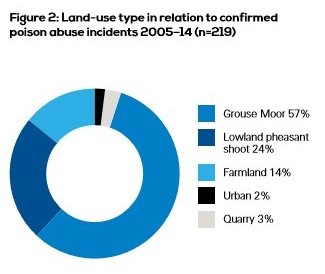
Drilling down in to the detail, there’s a useful analysis of land-use type of confirmed poisoning incidents between 2005-2014 (219 incidents). A shocking (or not) 81% of confirmed poisoning incidents during this nine-year period were on land used for game-shooting: 57% on grouse moors and 24% on land managed for lowland pheasant shoots. This tells us a great deal about who is responsible for the vast majority of illegal raptor poisoning. Despite their continued denials and protestations, and their increasingly-desperate attempts to minimise the scale of these crimes (“it’s just a few rogues”, “it’s just a small minority”), this graphic exposes the criminality at the heart of the game-shooting industry:

RSPB persecution review 1994 2014 land use

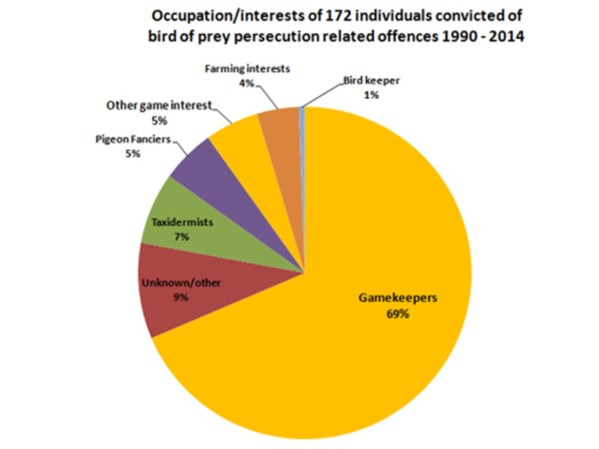
Further damning evidence, which isn’t needed by most of us but for the benefit of those who are still in denial of the bleedin’ obvious, is this graph showing the occupations of those convicted of raptor persecution between 1994-2014. Surprise, surprise, 86% of them were gamekeepers:

RSPB persecution review 1994 2014 occupation

RSPB Scotland is to be commended for publishing this exceptionally detailed and meticulously-researched report. There are a number of things in it that are of particular interest to us and we’ll come back to those in due course. For now though, particular recognition should go to the Investigations team – they may be small in number but their contribution to exposing the disgraceful continuation of illegal raptor persecution in Scotland is enormous. They, and their colleagues south of the border, are worthy of high acclaim. If anybody reading this is in a position to recognise excellence in the field of raptor conservation, e.g. a nomination for an award, this team should be at the top of your list.

So, how has the Environment Minister, Dr Aileen McLeod, responded to such an embarrassing report? She said: “There is no doubt that the figures in this report make for uncomfortable reading, but we have made progress in recent years with the new vicarious liability provisions, the publication of the report from the Wildlife Crime Penalties Review Group, new measures implementing restrictions on the use of General Licences and earlier this year the Scottish Government funded pesticide disposal scheme that removed over 700kg of illegally held poisons in Scotland“.

We have made progress…” Hmm. Let’s have a look:

Vicarious liability – introduced almost 4 years ago and only two successful convictions to date. A slow (but good) start, but we need to see many more convictions.

Wildlife Crime Penalties Review – Commissioned over two years ago, published last month. An excellent report calling for tougher sanctions but we’re waiting to hear whether the Environment Minister will act on the recommendations. Can only be defined as ‘progress’ if she agrees to act.

General Licence restrictions – available to be used against landholdings where raptor crimes committed/suspected from 1st January 2014. So far, only two restrictions have been implemented and those only lasted for six days each before they were suspended as legal arguments continue. A slow start, and the legal challenges were to be expected, but can’t be defined as ‘progress’ unless the restrictions are fully implemented. There should also be a lot more of them.

Pesticide disposal scheme –  implemented this year and resulted in the removal of some illegally-held poisons. That is progress, although it is tinged with frustration that the game-shooting industry was given yet another chance to avoid justice as this scheme (the second of its kind) comes 14 years after the pesticides were originally banned. It’s also interesting to note in the RSPB’s report (page 18) that evidence suggests a number of individuals have retained their illegal stocks. This is supported by more poisoning incidents that have taken place this year, after the disposal scheme ended.

So some progress has been made (and almost entirely due to the efforts of Dr McLeod’s predecessor, Paul Wheelhouse) but it is glacially slow and, so far, has not stemmed the occurrence of illegal persecution, as the damning figures in this report show all too clearly. Much, much more can and needs to be done before we’ll be convinced that Dr McLeod is having any sort of impact. She has, though, announced that tenders have just been invited for a review of game licensing practices in other countries (to inform a possible decision of introducing licensing to game-shooting estates in Scotland), and that’s a good thing, but again, the research needs to be done and then a decision made, which probably won’t happen for a number of years if past performance is anything to go by. She’d find herself with a lot more support if she got on with announcing increased investigatory powers for the SSPCA – the public consultation closed 1 year and 3 months ago – and still we await her decision as the criminals continue their rampage. It’s not impressive at all.

And what of the response of the game-shooting industry itself? Some didn’t bother to publish a statement (Scottish Gamekeepers’ Association), which ironically tells us quite a lot, although they are quoted in an article by STV (see media coverage below) where they revert to type and simply deny the evidence and slag off the RSPB instead. And remember, the SGA is a fully-paid up member of the Partnership for Action Against Wildlife Crime (cough).

Scottish Land and Estates (SLE), another PAW partner, did manage to issue a statement, via their Scottish Moorland Group (see media coverage below). Again, it’s the usual lamentable denial, characterised beautifully by this statement from Director Tim (Kim) Baynes:

Bird of prey deaths……have fallen dramatically over the last five years in particular“.

Er, here are some persecution figures that Kim might want to re-punch in to his calculator:

2012 – 18 confirmed deaths

2013 – 28 confirmed deaths

2014 – 37 confirmed deaths

There’s also this statement:

Our condemnation of wildlife crime is unquivocal...” All very touching but how is that “condemnation” manifested in the real world? It’s been brought to our attention that the current head gamekeeper on a Scottish grouse shooting estate has a (spent) conviction for shooting dead a raptor when he worked on another Scottish grouse moor. How does a criminal with a conviction like that (spent or not) remain employed in the game-shooting industry, let alone get a senior position on another Scottish grouse moor? Was he one of the posse of moorland gamekeepers recently invited to Holyrood to mingle with, and be applauded by, a number of MSPs, as part of the Gift of Grouse propaganda campaign? Surely not…

Download the RSPB report here

Media coverage

RSPB press release here

Statement from Environment Minister Dr Aileen McLeod here

Scottish Moorland Group statement here

BBC news here

STV article here

BBC Radio Scotland (Newsdrive) interview with Ian Thomson, Head of Investigations RSPB Scotland here (starts at 21.50, available for 29 days)

Guardian article here (a mis-leading headline but nevertheless good to see coverage in this paper)

Golden eagles, the SGA, and porky pies

Fearnan Angus Glens Dec 2013The season of mince pies may be upon us but the SGA is feasting on a hefty pile of pork pies.

An article has appeared on the BBC news website today (see here) based on a claim by the SGA that grouse moors are good for golden eagles, and they justify this by saying their ‘survey’ (whatever that entailed) had found golden eagles nesting in 58 areas managed for grouse shooting.

This may sound familiar to some of you. They made a similar claim back in 2013 (see here), although that time they’d found 55 nesting pairs; a claim we took apart here and here. Rather than having to go over the same old ground, again, please read these previous two blogs on this.

To say that the SGA’s latest claim is disingenuous is putting it mildly. They’ve chosen some of their words wisely, by saying “areas managed for grouse shooting”. This, of course, includes both driven and walked up grouse moors. Had their ‘survey’ included only intensively managed driven grouse moors, their results would look quite different.

As we’ve said before, golden eagles do nest successfully on some driven grouse moors, but these tend to be the exception rather than the rule. The number of vacant, unoccupied breeding territories on driven grouse moors is a bit of a giveaway to the overall picture.

What’s also misleading about their latest figures is that they haven’t included any data about the age of those pairs attempting to breed in areas managed for grouse shooting. Perhaps this was a deliberate exclusion, or perhaps they didn’t collect those data. Why is the age of the birds important? Well, if one or both of the breeding pair just happens to be a juvenile, that’s also a strong indicator that all is not well with the local golden eagle population. We’ve explained this before (see here) but this bit is worth repeating:

‘According to several scientific studies, the occurrence of breeding subadult eagles should actually be used as an early-warning of potential population decline. The reason these Scottish golden eagles are attempting to breed at three years of age is because there is little or no competition for that vacant territory. Why is there little or no competition? Because one or both of the territorial adults have been killed and there are very few non-breeding adults (known as ‘floaters’) around to challenge for the territory. If the population was healthy, it would be these breeding-age floaters that would move in to the territory, not an immature three-year old bird.

An excellent study (Whitfield et al. 2004 – see below) has also demonstrated that subadult and mixed-age breeding golden eagle pairs in Scotland have lower breeding success than adult pairs – a result of inexperience and persecution, seeing as most golden eagle territories in Scotland with subadult breeders are in areas associated with illegal persecution’.

According to a presentation at this year’s recent SOC conference, there is evidence from a number of golden eagle territories on driven grouse moors in Perthshire that show either one or both of the pair attempting to breed is a juvenile. These closely-monitored sites (subject to long-term monitoring by experts from the Scottish Raptor Study Group) are showing an unusually high turnover rate of adult golden eagles. This situation is easily masked by superficial SGA claims that golden eagles are breeding there. To the unsuspecting reader, it will sound like all is rosy but to get to the actual truth you need to look a bit more closely.

Also included in today’s BBC article are the following statements:

“The SGA said numbers of golden eagles were recovering from declines in the 1960s caused by pesticides”

and

“It [the SGA] said the management of grouse moors had helped to increase Scotland’s population of the large raptors”.

This is contrary to decades of peer-reviewed science that shows unequivocally that golden eagle recovery is severely limited in areas managed for driven grouse shooting. It’s outrageous that the BBC website has published these statements without providing an opportunity for any organisation to contest their validity. These statements amount to lies and the BBC should not have published them.

If you’d like to complain to the BBC, and ask them to retract these statements, please contact them here (click on ‘make a complaint’) – http://www.bbc.co.uk/complaints/complain-online/

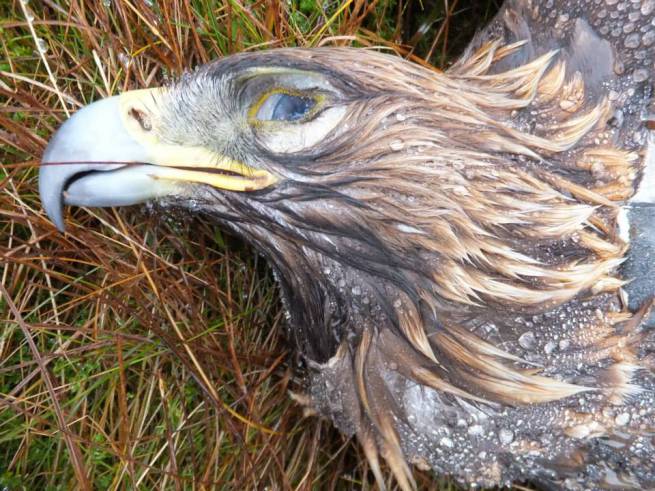
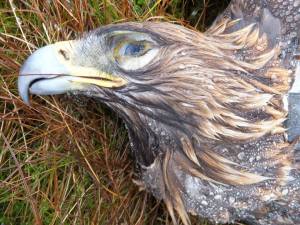
The photograph shows a dead golden eagle called ‘Fearnan’ who was found poisoned on a grouse moor in the Angus Glens in 2013.

UPDATE 5PM: The BBC article has now been updated with a quote from RSPB Scotland, who also dispute the SGA’s findings.

Duncan Orr-Ewing said: “We are not sure where the SGA have got their information, however, if correct their survey highlights only 53% occupancy  of known traditional golden eagle territories in the central and eastern Highlands, far below the natural carrying capacity and continues to indicate that the species is in unfavourable conservation status in this area“.

To read what else he had to say see updated BBC article here

What grisly fate awaits these two satellite-tagged hen harriers?

Bowland HH Jude LaneAs part of the RSPB’s Hen Harrier Life+ Project, the movements of two satellite-tagged hen harriers can now be followed online – see here.

The two birds are called ‘Holly’ and ‘Chance’.

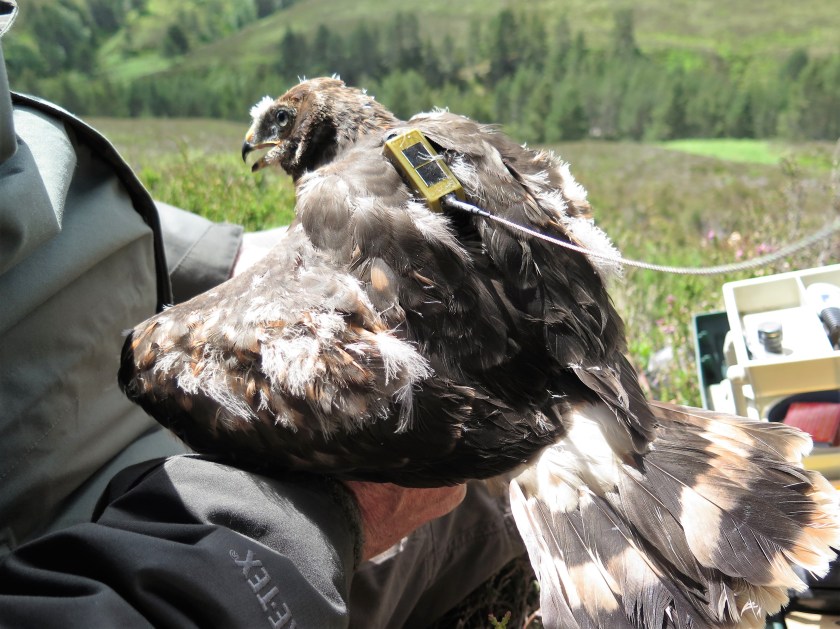
Holly had her satellite tag fitted in June this year by members of the Scottish Raptor Study Group, assisted by the MOD Police and was one of three chicks from a nest located on high security MOD land at Coulport. She was named after a member of the production crew from BBC Scotland’s Landward programme after appearing in a special feature about hen harriers and the threats these birds face from illegal killing (see here). Holly fledged in August and has since left her natal area, moving in to the uplands of central Scotland.

Chance had her sat tag fitted in June last year by members of the Scottish Raptor Study Group and was named by RSPB Scotland staff. She travelled south from her nest in SW Scotland to the RSPB Wallasea Reserve in Essex at the end of October (2014), before crossing the Channel to spend the winter months in western France. Chance came back to the UK in spring this year but has since returned to France via Wales.

The RSPB’s explanation for sat tagging these two hen harriers (and others) is: ‘To better understand the threats they face and identify the places they are most at risk‘.

To be frank, there is already a very good understanding of the threats they face and of the places they are most at risk; it’s been known for at least 20 years that these birds are illegally killed by gamekeepers on driven grouse moors. It’s no mystery and it’s no secret.

However, that’s not to say that continued satellite-tagging is without purpose. There’s a very important reason for continuing to do it, and that is to raise public awareness by getting people ‘involved’ with these individual birds (hence, giving them names) and showing people the birds’ movements (via online maps) so that when they are eventually shot, trapped, poisoned, or they simply ‘disappear’ in grouse moor areas (it’s inevitable), the public outcry will be considerable and the subsequent pressure on the authorities to actually do something about it will be greater. That is, assuming the police decide to publish the information, but it’ll be harder for them to keep quiet if we all know the birds have stopped moving.

There are already plenty of examples of satellite-tagged hen harriers either ‘disappearing’ or being found shot, so nobody should expect anything different for Holly and Chance. Here are some of the well-known individuals from the last few years:

Hen Harrier Annie – found shot dead on a Scottish grouse moor in April 2015 (here).

Hen Harrier Heather – found shot dead at a winter roost site in Ireland in January 2015 (here).

Hen Harrier Sky – ‘disappeared’ on a grouse moor in Lancashire in September 2014 (here).

Hen Harrier Hope – ‘disappeared’ on a grouse moor in Lancashire in September 2014 (here).

Hen Harrier Sid – ‘disappeared’ on a grouse moor in North Yorkshire in September 2014 (here).

Hen Harrier Blue – ‘disappeared’ somewhere (location not revealed) in October 2013 (here).

Hen Harrier Bowland Betty – found shot on a grouse moor in North Yorkshire in July 2012 (here).

Hen Harrier Tanar – ‘disappeared’ on a grouse moor in Aberdeenshire in June 2011 (here).

Hen Harrier (unnamed) – ‘disappeared’ on a grouse moor in southern Scotland in October 2011 (here).

And then there were the 47 hen harriers that Natural England sat-tagged between 2007-2014. Last year we were told that four were still known to be alive, six had been found dead, and a staggering 37 birds (78.7%) were ‘missing’ ‘somewhere’ (see here). Natural England has been persistently coy about telling us us where those 37 birds went missing, even though the satellite tagging project has been funded by us taxpayers.

Bowland Betty

And of course it’s not just hen harriers that we’ve watched meet a premature death. Other species have also been sat-tagged in recent years including Montagu’s harrier ‘Mo’, who ‘disappeared’ on the Queen’s Sandringham Estate in Norfolk last year (here) as well as at least eleven golden and white-tailed eagles (listed here), including some very high profile cases such as golden eagle Fearnan (found poisoned on a Scottish grouse moor here), golden eagle Alma (found poisoned on a Scottish grouse moor here) an unnamed golden eagle that had been illegally trapped on a Scottish grouse moor before being dumped in a lay by (here) and the first fledged white-tailed eagle in East Scotland for over 200 years who ‘disappeared’ on a Scottish grouse moor (here).

So, contrary to the belief of the Hawk & Owl Trust who earlier this year told us that fitting satellite tags to hen harriers “would prevent any gamekeepers from shooting them in the sky” (see here), gamekeepers don’t give a toss whether the bird in their gun sight is carrying a transmitter or not because they know full well that they are highly unlikely to get caught, let alone prosecuted. Not one of the above cases has resulted in a prosecution. So, no, the purpose of tagging isn’t to directly save the bird, but indirectly it just might, if enough of us follow the online movements of Holly and Chance and all the other tagged harriers that will be part of the RSPB’s Hen Harrier Life+ Project and then shout from the rooftops when each bird is illegally killed. It’s going to happen, and we are going to shout.

Top photo: Bowland Betty alive (photo Jude Lane).

Bottom photo: Bowland Betty dead (photo RSPB).

The intellectual capacity of a cabbage

There was an article in Country Life magazine recently (26th Aug edition) on the proposed plan (see here) to bolster the golden eagle population in southern Scotland. (Thanks to the contributor who sent us a copy).

The short piece included commentary from Dr Cat Barlow (the new project officer) and also a bit from everybody’s favourite ecological expert, Alex Hogg of the SGA:

Alex Hogg, Chairman of the Scottish Gamekeepers’ Association, believes that the large raptors [golden eagles] could threaten not only grouse, but, ironically, the endangered hen harrier. “Grouse cover a huge area and can stand the pressure of hunting, but hen harriers nest en masse and are thus particularly vulnerable. And white hares, one of the eagle’s favourite prey, only breed well in areas where foxes are controlled”, he points out. He adds: “I’m delighted about the idea of the golden-eagle release, but I’m worried there won’t be enough food supply. My overriding feeling is that if the golden eagle had wanted to settle in southern Scotland, it would have done so“‘.

My ‘overriding feeling’ is that Alex Hogg has the intellectual capacity of a cabbage.

How many “en masse nesting” hen harriers are there in southern Scotland? According to the most recent data available from the Scottish Raptor Monitoring Scheme, in 2013 one hundred hen harrier home ranges were checked across southern Scotland for occupancy. Of those 100, there were only 23 breeding attempts and of those, only 18 nests produced fledglings. Here are the data:

Dumfries & Galloway: 24 home ranges checked, 10 breeding attempts, 8 nests producing fledglings.

Lothian & Borders: 5 home ranges checked, 3 breeding attempts, 2 nests producing fledglings.

South Strathclyde: 71 home ranges checked, 10 breeding attempts, 8 nests producing fledglings.

As for a shortage of food, perhaps if the grouse moor gamekeepers in southern Scotland (and elsewhere) weren’t slaughtering mountain hares in their thousands (e.g. see here), in addition to the mass killing of other eagle prey items such as crows, stoats, weasels, fox cubs etc, Alex’s touching concern could be put to rest.

High risk plan to boost golden eagle population in southern Scotland

Peebles August 2007There’s an article on the BBC News website today about a proposal to take golden eagle chicks from the Highlands and release them in southern Scotland in an attempt to boost the tiny, depleted population currently clinging on by its talons (BBC report here).

The timing of this news is suspicious, especially when you learn that the project hasn’t yet been formally approved and thus may or may not happen. The cynical amongst us might view it as yet another piece of spin aimed at portraying the grouse-shooting industry in a favourable light so close to the start of the Inglorious 12th, especially when you see who is involved with the project – more on that later.

There’s no doubt that the southern Scotland golden eagle population is in serious trouble, and has been for many years. We’ve blogged about this previously (here, here). On the face of it then, any attempt to increase the population to its former status should be welcome news. But…..

A basic tenet of any restocking / translocation / restoration / reinforcement / reintroduction (whatever they choose to call this project) is that there should be strong evidence that the threat(s) that caused any previous decline has been identified and removed or sufficiently reduced. This is a standard guideline issued by the IUCN and is part of the criteria used to assess whether such projects can proceed.

One of the biggest constraints on golden eagle population recovery in southern Scotland is persecution. Raptor persecution in southern Scotland has definitely not been removed, nor sufficiently reduced. In the last ten years alone there have been more than 150 confirmed persecution incidents (that figure doesn’t include the ‘probable’ or ‘possible’ cases, nor those that went undiscovered). Just three days ago we were given a sharp reminder of just how current this problem still is when it was announced that a young hen harrier had been found shot dead on a grouse moor in South Lanarkshire (see here). The 2014 SNH-commissioned report on the status of golden eagles in southern Scotland also identified several areas where persecution is an ongoing concern, including the Lowther Hills, the Lammermuirs and the Moorfoots (all driven grouse moor areas – what a surprise), and stated that persecution needed to be brought under control in those regions if golden eagles were to thrive in southern Scotland once again (see SNH report here).

Environment Minister Dr Aileen McLeod acknowledges the persecution issue and in an earlier version of the BBC article this morning she said she will “work hard” to ensure the project is a success. In the latest version of the article, this has been updated with her saying that the persecution of raptors would “not be tolerated under any circumstances“. We’re sure she has good intentions but to be frank, this is just more rhetoric. She (and her predecessors) has been unable to bring persecution under control in other parts of the golden eagle’s range (notably the driven grouse moor regions of central and eastern Scotland – see report here from 2011 and report here from 2014) so why should we think she’ll be able to bring it under control in southern Scotland without bringing in new sanctions?

Having said all that, other high risk projects of a similar nature have been very successful on the whole (think reintroduction of red kites and white-tailed eagles). It’s also abundantly clear that if we wait for the southern Scotland golden eagle population to rebound of its own accord (by natural recruitment of individuals from the more northerly populations) then we’re likely to see the demise of the southern Scotland golden eagle population within a few years. It’s a definite trade off situation.

The one big thing in the project’s favour is that, if it does go ahead, it is likely to be a high profile project. There will be plenty of public interest and, assuming the released birds will be satellite-tracked (and their movements made publicly available and not kept secret), the unlawful killing or ‘mysterious disappearance’ of any of those birds will cause public uproar. This will put a lot of pressure on landowners and their gamekeepers to behave themselves and leave those eagles alone. If they don’t, it may well be the final nail in the coffin for their industry. There have been two very high profile killings of golden eagles in southern Scotland in recent years: an adult female was poisoned in 2007 (see here) and an adult male was shot in 2012 (see here). Ironically, that shot golden eagle was found on Buccleuch Estate, one of the listed project supporters. This is also where hen harrier Annie’s corpse was found.

As well as Buccleuch Estates, another project supporter is Scottish Land and Estates. Their CEO Doug McAdam is quoted as follows in the BBC article:

Landowners value golden eagles, they are one of our most iconic birds and I think people will work hard with us to make this project a success. Often landowners are portrayed as the villain here and against golden eagles and nothing could be further from the truth“.

It’s actually very close to the truth. Yes, there are a handful of landowners who cherish having breeding golden eagles on their land (not least the landowner who provides a home for the one remaining pair in the Borders) but that handful is greatly outnumbered by the vast majority of driven grouse moor owners who employ a zero tolerance policy for golden eagles (and many other raptor species) on their ground. Why else does McAdam think there is a need for conservation intervention to rescue the southern Scotland golden eagle population? How else does McAdam explain the large number of vacant golden eagle territories on grouse moors in central and eastern Scotland? How else can McAdam explain the disproportionate number of satellite-tagged eagles that ‘vanish’ on driven grouse moors? How else does McAdam explain the disproportionate number of poisoned, shot and trapped golden eagles that are found on driven grouse moors?

Let’s hope this restoration project does go ahead and we see an increasingly viable golden eagle population in southern Scotland. We’ll be watching with interest and McAdam and his industry mates can rest assured that if any of those young eagles are illegally killed, we and others will go to town on exposing it to the public.

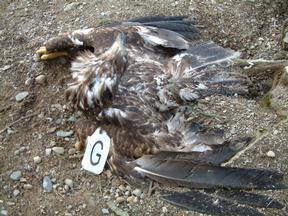
The image above is of the poisoned golden eagle found underneath her nest tree in the Borders in 2007. Nobody has ever been prosecuted for this.

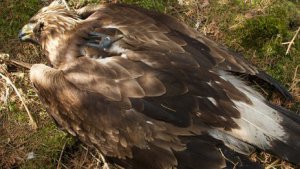
The image below is of the shot golden eagle found on Buccleuch Estate in 2012. He didn’t survive. Nobody has ever been prosecuted for this.

 Wanlock Head GE Oct 2012

Hen Harrier spin: 1

In public relations, spin is a form of propaganda, achieved through providing a biased interpretation of an event or campaigning to persuade public opinion in favour or against some organisation of public figure. While traditional public relations may also rely on creative presentation of the facts, “spin” often implies the use of disingenuous, deceptive, and highly manipulative tactics” [Wikipedia].

The Scottish Gamekeepers’ Association issued the following press release yesterday lunchtime. Here it is in full:

Estate hope Harriers on their moor are fine after Harrier Protest.

A Perthshire estate hopes a Hen Harrier protest staged next to their ground yesterday (sun) will not have bothered the Hen Harriers which have fledged on their grouse moor.

Campaign groups gathered at Glen Turret reservoir near Crieff to highlight the plight of the birds, three days before the start of the grouse shooting season.

The lobby groups believe some of the birds of prey are being killed on grouse moors because they feed on wild red grouse and their chicks.

However, the estate adjoining the site where the protest was staged has successfully fledged Hen Harrier chicks on its grouse moor this year and are hopeful the protest will not have disturbed the young birds which are just beginning to hunt independently.

An estate spokesperson said: “It was great to see people that share the same interest as ourselves in Hen Harrier conservation. The future definitely lies in co-operation between land managers who produce birds such as Hen Harriers and those who wish to see and enjoy them.

“We regularly have Harriers here on our grouse moor and we are lucky to have had successes this year, despite the weather. Naturally, our concern is for the birds because we have had nests of differing species abandoned, due to members of the public or photographers visiting the nests.

“We have restricted the activities of the estate around the nests so the birds get the best chance they can to grow and hunt in peace. Obviously, the gamekeepers will be checking the area to make sure the young birds are fine, but we are hopeful everything has gone off, well.”

The estate bordering the protest was audited recently, with RSPB counts in 2012 showing 9 raptor species on the grouse moor, 6 of which are known to have bred.

The estate is also a haven for other birds with two species of eagle recorded.

END

It’s fascinating that the SGA is attempting to infer that a group of peaceful protesters might ‘disturb’ some birds on an adjacent site by standing in the rain for a couple of hours, chatting, miles from any nests. No mention then of the start of the grouse shooting season in three days time where large groups of beaters will be marching across the moor waving flags, shouting and whistling as they scare (‘drive’) any bird in their path (but notably red grouse) towards a line of grouse butts where another load of people will be standing with guns to blast the birds to bits. Which activity do you think is likely to cause the most ‘disturbance’?

But what’s particularly interesting about this press release is the claim that there was a successful hen harrier breeding attempt on this driven grouse moor this year. Why is this interesting? Well, because the one known hen harrier breeding attempt on this site actually failed about a month ago [cause of failure unknown].

Now, of course, it’s possible that there was a second hen harrier breeding attempt on this estate, and that the raptor workers who closely monitor this site just missed it, and that the breeding attempt was successful and that there are indeed now young hen harriers “which are just beginning to hunt successfully”. If that is the case, then presumably the estate will have notified SNH’s ‘Heads up for Hen Harriers Project’ because, like all good Scottish sporting estates, this one will be keen to cooperate (we’ll be blogging more about the Heads up for Hen Harriers project in a separate ‘spin’ blog, to be posted later).

Up until a few years ago, this estate was part of the Operation Countrywatch Partnership – we blogged about it here and applauded their efforts. Funny thing is, this estate pulled out of the project shortly after it was suggested that nest cameras could be installed at hen harrier nests to better understand the causes of breeding failure regularly being recorded in this area. However, it was probably just a complete coincidence that the estate pulled out at that time and there will undoubtedly be an unrelated and perfectly reasonable explanation for their withdrawal.

Also interesting to note the final sentence of the press statement. Two species of eagle have indeed been ‘recorded’ on this estate (note the ambiguous choice of word – ‘recorded’ can mean a breeding attempt but it can also mean something was simply observed flying over/passing through). Just for the record, there aren’t any officially recorded white-tailed eagle breeding attempts on this estate, but golden eagles have certainly bred there in the past. Funny thing is, this year the golden eagle nest site was burnt out and the eagles moved to another estate for their breeding attempt. Those spontaneously combusting nests are a real problem on driven grouse moors, it seems.

The photograph shows some of the people who attended the Hen Harrier rally in Perthshire yesterday. Well done to those who organised it and also to those who turned out to support it.

HH Day Perthshire 2015

Satellite-tagging golden eagles in Scotland

ge GUARDIAN pics 2015

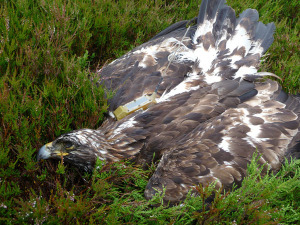
There is a series of absolutely stunning photographs in the Guardian (photographer Dan Kitwood/Getty Images) of golden eagles being satellite-tagged in the Scottish Highlands – see here.

They feature the work of some of the top class fieldworkers from the Scottish Raptor Study Group, notably Justin Grant and Dr Ewan Weston. These two, along with a handful of others, are among the best in the world – they have spent years monitoring, ringing and sat-tagging white-tailed and golden eagles (as well as many other species!), all under licence, and it’s thanks to their expertise and dedication that not only have we learned a lot about the dispersal movements of these iconic species, but we’re also now able to see where many of them are being poisoned, trapped, shot, or simply ‘disappearing’ – see here.

Henry’s tour day 45: Dinnet

Tues 16 June  Copy

Henry called in at Dinnet (Deeside) but would only visit in daylight hours – here’s why.

It’s actually not all that safe in the daytime either – here’s why.

Welcome to the Cairngorms National Park.

Henry’s Tour day 42: Leadhills

Thurs 11th June Copy

Henry went with an armed escort to visit Leadhills in South Lanarkshire.

He looks a bit distressed. Perhaps he was being deafened by the booming gas guns that have recently been deployed on the grouse moors of the Leadhills (Hopetoun) Estate.

Or perhaps he’d just been told about the long list of wildlife crimes that have been discovered in this corner of South Lanarkshire; 46 confirmed since 2003, but only two resulting in successful convictions (2004 – Leadhills Estate gamekeeper convicted of shooting a short-eared owl; 2009 – Leadhills Estate gamekeeper convicted of placing out a poisoned rabbit bait).

Here’s the list, all from Leadhills unless otherwise stated:

2003 April: hen harrier shot [prosecution failed – inadmissible evidence]

2003 April: hen harrier eggs destroyed [prosecution failed – inadmissible evidence]

2004 May: buzzard shot [no prosecution]

2004 May: short-eared owl shot [gamekeeper convicted]

2004 June: buzzard poisoned (Carbofuran) [no prosecution]

2004 June: 4 x poisoned rabbit baits (Carbofuran) [no prosecution]

2004 June: crow poisoned (Carbofuran) [no prosecution]

2004 July: poisoned rabbit bait (Carbofuran) [no prosecution]

2004 July: poisoned rabbit bait (Carbofuran) [no prosecution]

2005 February: poisoned rabbit bait (Carbofuran) [no prosecution]

2005 April: poisoned buzzard (Carbofuran) [no prosecution]

2005 June: poisoned rabbit bait (Carbofuran) [no prosecution]

2005 June: poisoned rabbit bait (Carbofuran) [no prosecution]

2006 February: poisoned buzzard (Carbofuran) [no prosecution]

2006 March: poisoned buzzard (Carbofuran) [no prosecution]

2006 March: poisoned pigeon bait (Carbofuran) [no prosecution]

2006 April: dead buzzard (persecution method unknown) [no prosecution]

2006 May: poisoned rabbit bait (Carbofuran) [no prosecution]

2006 May: poisoned rabbit bait (Carbofuran) [no prosecution]

2006 May: poisoned egg baits (Carbofuran) [no prosecution]

2006 June: poisoned buzzard (Carbofuran) [no prosecution]

2006 June: poisoned raven (Carbofuran) [no prosecution]

2006 June: 6 x poisoned rabbit baits (Carbofuran) [no prosecution]

2006 June: poisoned egg bait (Carbofuran) [no prosecution]

2006 September: 5 x poisoned buzzards (Carbofuran) [no prosecution]

2006 September: poisoned rabbit bait (Carbofuran) [no prosecution]

2006 September: poisoned rabbit bait (Carbofuran) [no prosecution]

2007 March: poisoned buzzard (Carbofuran) [no prosecution]

2007 April: poisoned red kite (Carbofuran) [no prosecution]

2007 May: poisoned buzzard (Carbofuran) [no prosecution]

2008 October: poisoned buzzard (Carbofuran) [listed as ‘Nr Leadhills’] [no prosecution]

2008 October: poisoned rabbit bait (Carbofuran) [listed as ‘Nr Leadhills’] [no prosecution]

2008 November: 3 x poisoned ravens (Carbofuran) [listed as ‘Nr Leadhills’] [no prosecution]

2009 March: poisoned rabbit bait (Carbofuran) [no prosecution]

2009 March: poisoned raven (Carbofuran) [no prosecution]

2009 April: poisoned rabbit bait (Carbofuran) [gamekeeper convicted]

2009 April: poisoned magpie (Carbofuran) [no prosecution]

2009 April: poisoned raven (Carbofuran) [no prosecution]

2010 October: short-eared owl shot [no prosecution]

2011 March: illegally-set clam trap [no prosecution]

2011 December: buzzard shot [no prosecution]

2012 October: golden eagle shot (just over boundary with Buccleuch Estate) [no prosecution]

2013 May: shot otter found on estate [no prosecution]

2013 June: significant cache of pre-prepared poisoned baits found on estate [no prosecution]

2013 August: red kite found shot and critically-injured in Leadhills village [no prosecution]

2014 February: poisoned peregrine (Carbofuran) [‘Nr Leadhills’] [no prosecution]

Word has it from a local informant that a suspected shot raven was found on Leadhills Estate in May 2015. Post-mortem results are awaited.

Just a few weeks ago, we were sent footage of a young man dressed in camouflage who was lying on the moor holding a firearm, looking over at a plastic decoy peregrine which had been placed on top of a small mound. When he realised he’d been spotted, he removed the decoy and took off back down the hill on a quad bike. Can’t imagine who that was or what his intentions might have been.

Henry’s tour day 39: Moy Estate

Mon 8 June 2015 - Copy

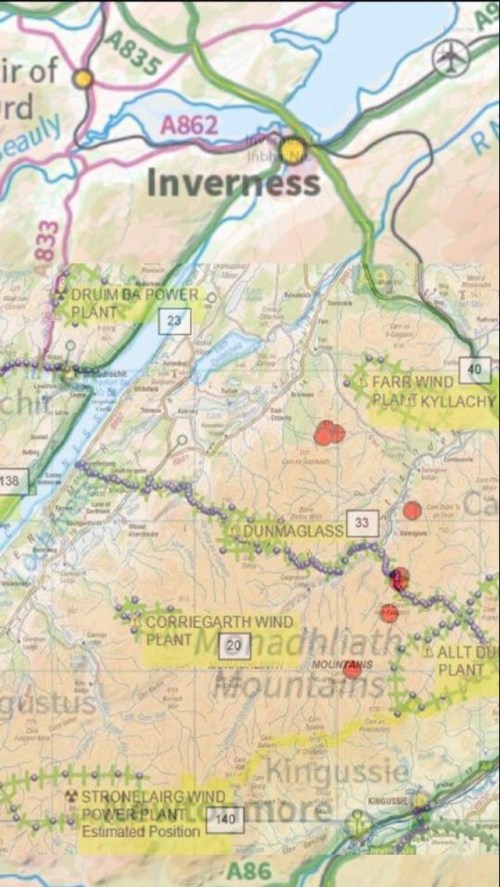
Henry paid a visit to Moy Estate in the Monadliaths.

Regular blog readers will probably remember what was found on Moy Estate in 2010:

  • A dead red kite in the back of a gamekeeper’s vehicle. It had two broken legs and had died as a result of a blow to the head.
  • The remains of a further two dead red kites.
  • A red kite’s severed leg, along with wing tags that had been fitted to a sateliite-tracked red kite, hidden in holes covered with moss.
  • Six illegal baited spring traps set in the open.
  • A trapped hen harrier (still alive) caught in an illegally set spring trap.
  • A poisoned bait.
  • Four leg rings previously fitted to golden eagle chicks found in the possession of a gamekeeper.

A 20-year-old gamekeeper (James Rolfe – straight out of game-keeping college) was charged with possession of the dead red kite and was fined £1,500. No charges were ever brought against anyone for any of the other offences.

Previous blogs on Moy: see here, herehere and here. It’s particularly worth having a look at this, especially in light of recent hen harrier ‘disappearances’ in England. They weren’t necessarily shot (as the grouse-shooting industry keeps telling us) – they could just as easily have been trapped like this (as the grouse-shooting industry keeps forgetting to mention).

The gamekeeper on Moy was convicted four years ago in 2011. Since then, several more satellite-tracked red kites have ‘disappeared’ since their last signals emitted from Moy, and several buzzard and goshawk nests seem to fail each year. It’s quite windy at Moy. It was probably the wind that blew off those rings from the young golden eagles’ legs and blew them straight in to a jar inside the gamekeeper’s house. It was probably the wind that severed the leg of the red kite and then blew it in to a hole on the moor and then blew moss over the hole to cover it. It was probably the wind that blew away the more recent ‘missing’ red kites. It was probably the same wind that blew holes in those buzzard and goshawk nests, too. Still no breeding hen harriers on this estate – yep, must have been blown away.

Word has it that the game management on Moy Estate is being taken over by a sporting agent with whom we’re very familiar. Cue hundreds of thousands of pounds worth of night vision equipment to carry out his particular style of grouse moor management.

Henry left the estate before darkness fell. He lives another day, although he’s still single.