Disappearance of golden eagle Tom prompts Parliamentary motion

Earlier this week we blogged about the suspicious disappearance of Tom, a golden eagle we’d been satellite-tracking since last year with Chris Packham and who vanished in to thin air, along with his fully-functioning satellite tag, with his last known location being on a driven grouse moor in Strathbraan, a well-known raptor persecution hotspot (see here).

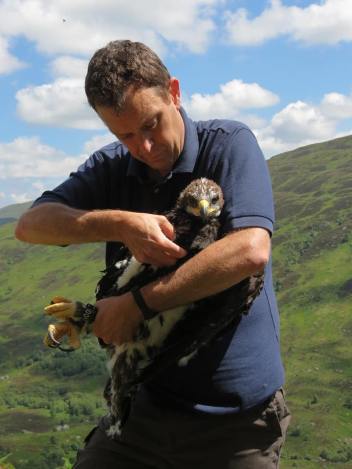
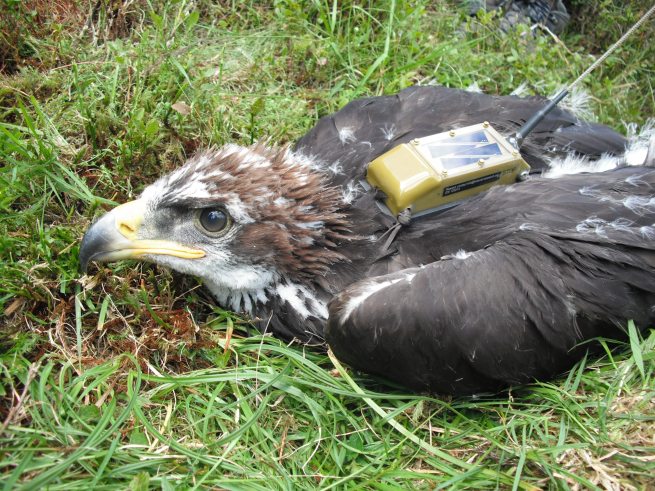
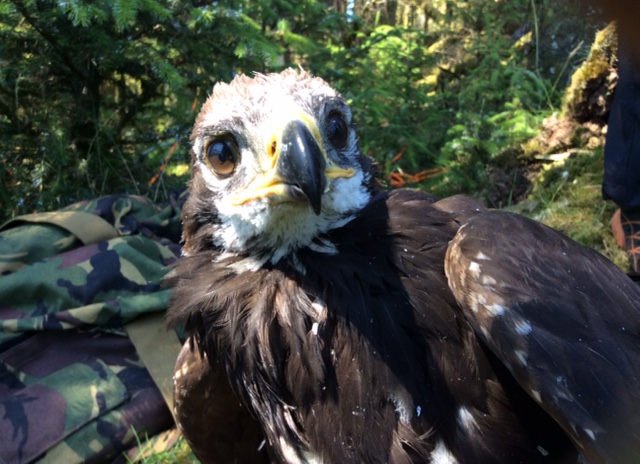
[Golden eagle Tom at approx 8 weeks old having his satellite tag fitted in 2019 under expert licence. Photo Raptor Persecution UK]

We produced a video about Tom’s suspicious disappearance and this, along with the RPUK blog on his disappearance, received good media coverage both online and in the printed media throughout the week, even though a journalist at The Times simply cut and pasted the text from the RPUK blog, regurgitated it in an article and attributed this to ‘a spokesman from RPUK‘. Ha!

Here’s the video for those who may have missed it:

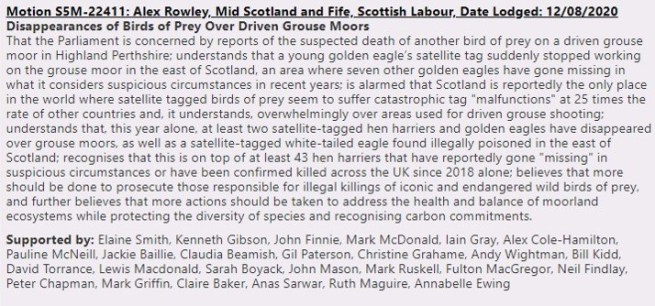
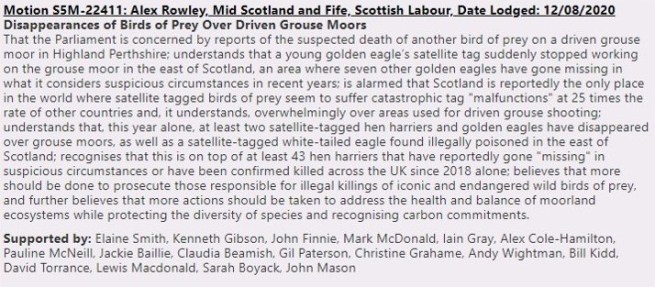
And now Tom’s disappearance has prompted a Parliamentary motion, lodged by Labour MSP Alex Rowley as follows:

It’s not just Tom’s disappearance that has led to this. As you can see, Alex also mentions the suspicious disappearance of seven other satellite-tagged golden eagles in the same area, the disappearance of another satellite-tagged hen harrier on another Scottish driven grouse moor (here), the illegal poisoning of a satellite-tagged white-tailed eagle found dead on another Scottish grouse moor (here), and the 43 hen harriers that have either gone missing or have been killed in the UK in the last two years (here).

He’s done his homework.

For a Parliamentary Motion to be considered for debate, at least 30 MSPs from at least two different political parties need to support it. So far, Alex’s motion has attracted the support of 17 MSPs, representing Labour, SNP, Greens, Liberal Democrats and one independent.

If your MSP’s name isn’t on the list as a supporter, please email them and prompt them to sign up. If they refuse, ask them why. Put them on the spot and most importantly of all, let them know that this issue matters to you.

If you don’t know who your MSP is you can find out here

If you want to do more, and if you’re sick to the back teeth of illegal raptor persecution on driven grouse moors, please consider participating in this quick and easy e-action to send a letter to your local Parliamentary representative (MSP/MP/MS) urging action. Launched last Saturday by Wild Justice, RSPB and Hen Harrier Action, over 41,000 people have signed up so far.

This means that over 41,000 pre-written letters complaining about illegal raptor persecution and the environmental damage caused by intensive grouse moor management, are winging their way to politicians of all parties across the UK. If you want your local politician to receive one, Please join in HERE

Thank you

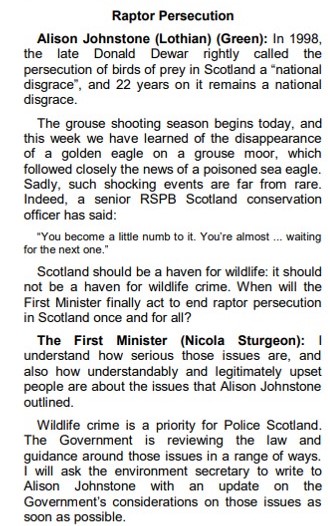
First Minister Nicola Sturgeon put on spot about ongoing illegal raptor persecution on grouse moors

The Scottish Greens are doing a fantastic amount to hold the Scottish Government to account on wildlife conservation issues.

Yesterday, Alison Johnstone MSP put Nicola Sturgeon on the spot during First Minister’s Questions. Click on this link to hear Alison ask Nicola Sturgeon “When she will finally act to end raptor persecution in Scotland?

https://twitter.com/AlisonJohnstone/status/1293601009659510788

The First Minister’s response went as follows (as published in the Official Report of the Scottish Parliament, 12th August 2020):

Remember, this is the first response anyone has heard from the First Minister, despite an avalanche of angry emails following the recent discovery of the poisoned white-tailed eagle on a grouse moor in the Cairngorms National Park (see here), and the news earlier this week about the suspicious disappearance of yet another golden eagle (Tom) on a grouse moor in Strathbraan, a well-known raptor persecution hotspot in Perthshire (see here).

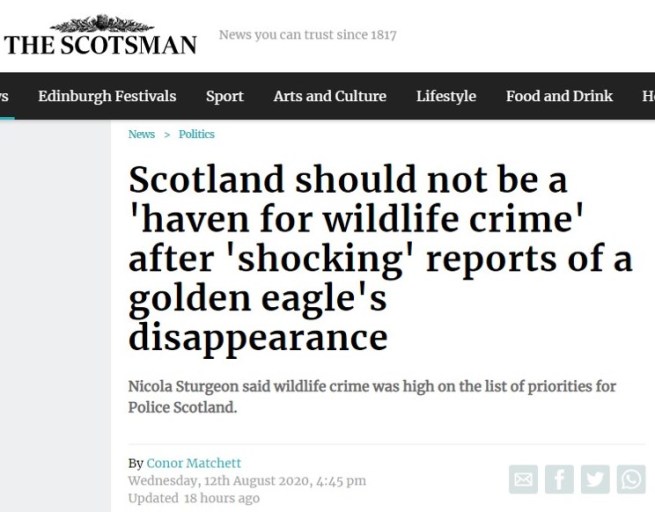
The Scotsman has run a piece today about Alison’s question to the First Minister (see here) and includes commentary about the poisoned sea eagle and the missing golden eagle.

The Scotsman article includes further comment from Alison Johnstone:

The First Minister described wildlife crime as a priority for the police, but it’s clear that greater action is required by her government if we are to bring an end raptor persecution in Scotland once and for all“.

Roseanna Cunningham, Cabinet Secretary for the Environment has just issued a statement about what the Scottish Government intends to do. More on that shortly….

TAKE ACTION

Meanwhile, if you’re sick to the back teeth of illegal raptor persecution on driven grouse moors, please consider participating in this quick and easy e-action to send a letter to your local Parliamentary representative (MSP/MP/MS) urging action. Launched on Saturday by Wild Justice, RSPB and Hen Harrier Action, over 36,000 people have signed up so far.

This means that over 36,000 pre-written letters complaining about illegal raptor persecution and the environmental damage caused by intensive grouse moor management, are winging their way to politicians of all parties across the country. If you want your local politician to receive one, Please join in HERE

Thank you

Golden eagle Tom disappears in suspicious circumstances on Scottish grouse moor

In 2017, Raptor Persecution UK teamed with Chris Packham to start a project fitting satellite tags to young golden eagles in Scotland, as part of a wider conservation research initiative in to golden eagle ecology, which began back in 2004 (see here for more info).

Since then, each year our team of licensed experts has been fitting tags to young eagles and we’ve been able to monitor these eagles’ movements as they try and make their way in the world. Our tag data are shared collaboratively within a specialised Golden Eagle Research Group and are contributing to some ground-breaking studies on golden eagle dispersal and movement ecology (see here for more info).

Unfortunately, our study is being undertaken in a country where the illegal persecution of raptors is rife, and that includes the illegal killing of golden eagles.

A Government-commissioned report published in 2017 showed how almost one-third of all satellite-tagged golden eagles in Scotland (41 of 131 eagles) had ‘disappeared’ in suspicious circumstances between 2004-2016, many of them vanishing in particular clusters on or close to driven grouse moors.

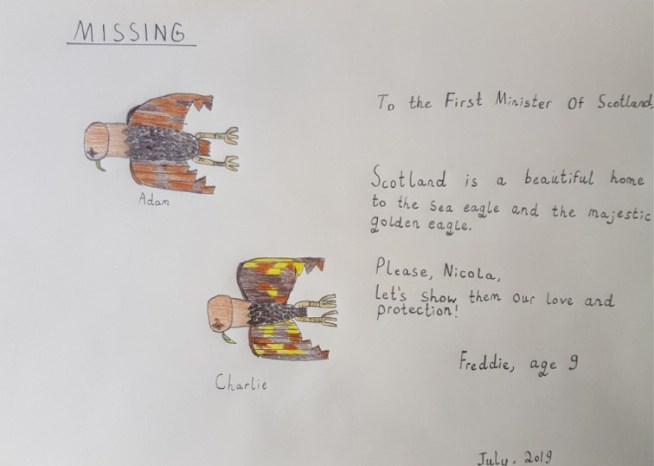
So far, three of ‘our’ tagged eagles have vanished in suspicious circumstances on or next to driven grouse moors – there was Fred in 2018 who disappeared from the Pentlands and whose tag last transmitted 10 miles offshore in the North Sea where we believe the tag, and perhaps Fred, had been dumped (here), and then there was Adam and Charlie who both disappeared within hours of one another on the same grouse moor in Strathbraan in 2019 (here).

Now another one has gone.

His name was Tom, and he hatched in Argyll in May 2019.

[Golden eagle Tom having his satellite tag fitted at approx 8 weeks old. Photo RPUK]

Tom survived for a year, travelling to explore the west, out as far as the Isle of Mull, before making a fateful journey east towards the grouse moors in the spring of this year.

Here is an overview of his movements; the yellow disc is the last known location from his tag, on 18th May 2020.

Tom vanished in the early hours of the morning on a grouse moor in the Strathbraan area of Perthshire, a well-known raptor persecution hotspot, just a few miles north of the area where Adam and Charlie vanished last year.

We notified Police Scotland of the sudden loss of tag transmission and they examined the tag data and agreed that the circumstances were indeed suspicious. They undertook a search of the grouse moor but of course didn’t find any evidence – no tag, no carcass, nothing.

In late July the police gave us permission to publicise this incident and we’ve made a video to document Tom’s short life:

Needless to say we are upset and angry that another golden eagle has gone in virtually identical circumstances to so many others – vanishing without trace on a driven grouse moor in Scotland.

What angers us the most is the Scottish Government’s apparent indifference to the ongoing killing of birds of prey. We’re not alone in our anger – we believe thousands of people have written to the First Minister just a couple of weeks ago after the poisoned corpse of a white-tailed eagle was found dead on a grouse moor inside the Cairngorms National Park (here).

The Scottish Government has been aware of what’s been going on for decades. They know where it goes on, why it goes on and which sector of society is responsible. And yet still we’re having to wait for effective action.

Why is that?

If you share our anger, you can channel it in to something worthwhile. Please consider participating in this quick and easy e-action to send a letter to your local Parliamentary representative (MSP/MP/MS) urging action on illegal raptor persecution on grouse moors. Launched on Saturday by Wild Justice, RSPB and Hen Harrier Action, over 21,000 people have signed up so far. Please join in HERE

Thank you.

MEDIA COVERAGE

This article was picked up by

The Times (here)

The Oban Times (here)

BBC News website (here)

The Scotsman (here)

Evening Standard (here)

The Courier (here)

Perthshire Advertiser (here)

UPDATE 14th August 2020: Disappearance of golden eagle Tom prompts Parliamentary motion (here)

Poisoned sea eagle: Chris Packham’s letter to Scottish Ministers

Public anger over the news that yet another bird of prey has been found illegally killed on a Scottish grouse moor – this time a white-tailed eagle found poisoned in the Cairngorms National Park – is showing no sign of subsiding (see here and click on the links to read some of the letters that have been sent to Scottish Ministers urging immediate action).

Chris Packham has now added his voice and has written to the First Minister Nicola Sturgeon and Environment Cabinet Secretary Roseanna Cunningham, as follows:

It’s not the first time Chris has spoken with Ministers about the ongoing persecution of eagles and other birds of prey on Scottish grouse moors.

In 2018 he had a long conversation with Roseanna Cunningham following the suspicious disappearance of one of our satellite-tagged golden eagles, ‘Fred’, who vanished just seven miles from the Scottish Parliament building in Edinburgh. You can watch the extended version of that conversation here:

Here we are, two years later, and what’s changed?

Absolutely nothing.

Except public anger has surged.

Thank you to everyone who has written to the First Minister and Environment Cabinet Secretary expressing your disgust and urging immediate action following this latest poisoning incident. The public’s reaction has been phenomenal.

Here are their email addresses for those who would still like to comment:

To email Nicola Sturgeon, please use this address: firstminister@gov.scot

To email Roseanna Cunningham, please use this address: CabSecECCLR@gov.scot

Thank you.

New paper documents history of eagles in Wales

An important new scientific paper has just emerged documenting the history of golden and white-tailed eagles in Wales.

Published in the journal Conservation Science & Practice, this new paper builds on the earlier, painstaking work of the much missed Richard Evans who, along with colleagues (see here), mapped the historical distribution of eagles across Britain and Ireland.

This latest paper, authored by Cardiff University PhD student Sophie-lee Williams et al, thoroughly evaluates the evidence for both species in Wales and maps their likely core distributions. The authors conclude there is strong evidence that both species were widespread across Wales but fell victim to persecution and haven’t bred there for over 150 years.

This paper is open access which means it is freely available to everyone.

Download it here: Williams et al 2020_Past distribution eagles Wales

The significance of this paper relates to a proposed reintroduction of golden and/or white-tailed eagles to Wales. Many blog readers will recall that this prospect has been on the table for a while and whilst there is still a lot more work to complete before licence applications are submitted, understanding the species’ past historical ranges is important.

Some blog readers may recognise some of the names involved in this latest research. They are part of the Eagle Reintroduction Wales Project (ERWP) (website here) who we blogged about last year when news emerged that a different team was also contemplating an eagle reintroduction in Wales, but apparently without the careful research assessment being undertaken by the Cardiff University team (see here). Fortunately, so far, that alternative approach hasn’t advanced very far (see here and here).

Hopefully it won’t be too long before we see more research results from the ERWP that’ll take us another step closer to restoring these eagles back to Wales.

Concern for safety of birds of prey on grouse moors during lockdown

Conservationists are deeply concerned about the safety of birds of prey, particularly on grouse moors, during the Coronavirus lockdown as many nest sites will be unmonitored for the first time in almost two decades.

In an article on The Ferret website yesterday Scottish Raptor Study Group (SRSG) communications secretary Logan Steele is quoted:

SRSG is very concerned about the probable increase in incidents of raptor persecution during the lockdown. In particular on driven grouse moors, gamekeepers will be under less scrutiny from raptor workers and recreational visitors and so will effectively have a free hand.

The two species most at risk are hen harriers and golden eagles which are perceived to pose the greatest risk to grouse stocks and are routinely shot, trapped or poisoned“.

The RSPB is also concerned. Head of Species and Land, Duncan Orr-Ewing said:

Raptor persecution has continued unabated with numerous well-publicised cases of shootings, illegal trap use and other crimes both north and south of the border despite the driven grouse shooting industry being under intense scrutiny – particularly in Scotland where the government has just published the findings of a three year review of grouse moor management.

We don’t believe that under the current circumstances of significantly reduced public access to our uplands, anyone is naive enough to think that wildlife criminals won’t be making the most of this opportunity to kill any species they perceive to be a threat, with a minimal chance of their crimes being witnessed or detected“.

The full article can be read here: http://theferret.scot/birds-of-prey-monitoring-coronavirus/ 

‘Key moment’ as Scottish Government considers grouse moor licensing

It’s been three months since the Government-commissioned Werritty Review on grouse moor management was published (see here) and we’ve been waiting for the Scottish Government’s official response, which is due this spring.

We did hear from Nicola Sturgeon at First Ministers Questions in December that shortening the timescale for which grouse moor licensing may be introduced was ‘a serious consideration’ (here) which was very welcome news, although not to all.  Grouse moor trustee Magnus Linklater argued in a Times opinion piece that licensing threatened gamekeepers jobs (here), although he didn’t manage to explain how being law-abiding and not killing protected birds of prey would cost a gamekeeper his employment.

[An illegally-poisoned golden eagle in the Cairngorms National Park. Photo by Dave Dick]

As a follow up to the First Minister’s comments in December, Andy Wightman MSP (Scottish Greens) recently lodged this Parliamentary question:

S5W-27631: To ask the Scottish Government, further to the comments by the First Minister on 19 December 2019 (Official Report, c. 21), what its timescale is for reconsideration of the introduction of a licensing scheme for grouse shooting.

Environment Minister Mairi Gougeon has now responded:

We are giving very careful consideration to the recommendations in the report by the Grouse Moor Management Group (the ‘Werritty Review’).

We will set out our response to the report in due course, which will cover the recommendation on introducing licensing of grouse moor businesses.

Earlier this week Duncan Orr Ewing, RSPB Scotland’s Head of Species and Land Management wrote a very good blog (here) discussing the Werritty Review’s primary recommendation that grouse moor licensing be introduced but that the review had suggested a five-year delay. He goes on to explain what options are available to the Scottish Government as they consider the Werritty Review recommendations. Well worth a read.

Duncan describes this as a ‘key moment which could help safeguard some of Scotland’s most spectacular wildlife’ if the Scottish Government chooses to finally do what it’s been threatening for years and years and introduce a grouse moor licensing scheme.

He urges members of the public to contact their MSPs and ask them to encourage the Scottish Government to make grouse shooting both legal and more sustainable through a licencing system for grouse moors.

You can find contact details for your MSPs by entering your postcode on the “Find Your MSP” tool on the Scottish Parliament website here.

For those who don’t live in Scotland please contact Scottish Ministers at scottish.ministers@gov.scot.

Top ten most read RPUK blogs in 2019

Thanks for all your continued interest and support in 2019….it’s been another very busy year.

Here are the top ten most read RPUK blogs over the last 12 months:

  1. Young golden eagle flying around Cairngorms National Park with an illegal trap clamped to its leg (here)
  2. Two more golden eagles go ‘missing’, on the same morning, on the same Scottish grouse moor (here)
  3. Chris Packham targeted (here)
  4. Hen harrier suffers savage brutality of an illegally-set trap on a Scottish grouse moor (here)
  5. Convicted Scottish gamekeeper Alan Wilson and his litany of wildlife crimes (here)
  6. More detail emerges about SSPCA/Police Scotland raid at Millden Estate (here)
  7. Disgusting display of savagery on Yorkshire grouse moor (here)
  8. Monumentally inadequate sentence for convicted Scottish gamekeeper Alan Wilson (here)
  9. Hen harrier reintroduction to southern England: Natural England suggests persecution not an issue (here)
  10. At least 72% satellite tagged hen harriers presumed illegally killed on grouse moors (here)

The blog will reach its ten year milestone in March 2020.

Happy New Year!

Werritty Review: encouraging response from Environment Cabinet Secretary Roseanna Cunningham

Further to the publication of the Werritty Review on grouse moor management this morning (here), Environment Cabinet Secretary Roseanna Cunningham has made an encouraging statement in a Scot Gov press release, as follows:

GROUSE MOOR MANAGEMENT: LICENSING OPTION UNDER CONSIDERATION

A review into grouse moor management has recommended the introduction of a shooting licensing scheme if breeding populations of raptors show no marked improvement.

The review, which was chaired by Professor Alan Werritty, Professor Emeritus of Physical Geography at University of Dundee, was asked to examine how we can ensure that grouse moor management continues to contribute to the rural economy while being environmentally sustainable.

As well as the recommendation that a licensing scheme is introduced for the shooting of grouse if there is no marked improvement in the ecological sustainability of grouse moor management, the report also makes a number of other recommendations relating to common grouse moor practices, such as the use of medicated grit and muirburn.

Environment Secretary Roseanna Cunningham said:

I would like to thank Professor Werritty and the other members of the Grouse Moor Management Group for undertaking this important review and for their extensive work over the last two years.

As well as the issue of raptor persecution, the review was asked to look at grouse moor management practices including muirburn, the use of medicated grit and mountain hare culls and also to examine regulatory options including possible licensing of grouse shooting businesses.

It is important that we give careful consideration to the recommendations, alongside other evidence, before issuing a response. An important part of this will involve meeting key stakeholders to discuss the findings of the review, and we will publish a full response to the report in due course. At this early stage, however. I believe the option of a licensing scheme will need to be considered and – if required – implemented earlier than the five-year timeframe suggested by the review group.”

[Photo insert by RPUK – in 2018 after the suspicious disappearance of golden eagle Fred in the Pentland Hills Roseanna Cunningham told Chris Packham in an interview that grouse shoot licensing had been talked about by the Scottish Government since 2009. It’s ten years on – time for action now, not in another five years. Photo by Ruth Peacey].

Professor Werritty said:

When I accepted the invitation from the Scottish Government to lead an expert review on grouse shooting, I had not fully appreciated the complexity of the issues involved, the passion with which contrasting views were held, or the length of time the review would require.

Our remit invited us to make recommendations to reduce the illegal killing of raptors but at the same time to give due regard to the socio-economic contribution that grouse shooting makes to Scotland’s rural economy. Both topics have proved complex and problematic.

In order to have a unanimous recommendation on this key issue with the authority that implies, the Group proposes a five year probationary period for specified raptors on or near grouse shooting estates to recover to a favourable conservation status. Should this target fail to be achieved, licensing should be introduced immediately. We all agree that it is the only way forward in that situation“.

Background

The Grouse Moor Management Group was established in November 2017. It was commissioned by the Scottish Government in response to a report from Scottish Natural Heritage (SNH) which showed that around one third of tagged golden eagles had disappeared on or around driven grouse moors.

The group’s report can be found on the Scottish Government website.

ENDS


Special Constables pilot scheme in Cairngorms National Park a waste of time & money

Two and a half years ago, Environment Cabinet Secretary Roseanna Cunningham announced a pilot scheme whereby Police Special Constables would be deployed in the Cairngorms National Park to tackle wildlife crime.

This initiative was one of a number of measures announced in May 2017 in response to the findings of the golden eagle satellite tag review which showed clear evidence of deliberate and sustained illegal raptor persecution, particularly on some driven grouse moors in and around the Cairngorms National Park (CNP).

This RPUK map shows the last known location of satellite-tagged golden eagles that were either found illegally killed or had disappeared in suspicious circumstances in and around the CNP (data from the golden eagle satellite tag review):

Golden eagles are not the only victims of wildlife crime in and around the CNP. This RPUK map below, based mostly on RSPB data, shows raptor persecution incidents between 2005-2016. Only one of these (just outside the CNP boundary on Kildrummy Estate) has resulted in a successful prosecution. With such clear evidence of wildlife crime it’s easy to see why the CNP was chosen as the first location for this pilot scheme.

This pilot scheme was the Government’s alternative to extending the powers of the SSPCA to allow it to investigate a wider suite of wildlife crime (including raptor persecution) – a decision made after six years of Governmental deliberation under five different Environment Ministers.

It also emerged in 2018 that this pilot scheme was an alternative to the Government’s 2016 manifesto pledge to establish a Wildlife Crime Investigation Unit as part of Police Scotland – a pledge on which it has now reneged (see here).

The idea was that the police special constable scheme could be rolled out across Scotland “if judged to be successful” in the CNP, but we weren’t told the criteria that would be used to judge this ‘success’.

The scheme was formally launched in March 2018 (see here) and nothing more was heard of it.

Just over a year later in April 2019 we asked the Cairngorms National Park Authority the following questions about the scheme:

Here’s the response:

So basically after a year of operation, one of the main project partners couldn’t tell us anything about the scheme.

Fast forward six months to November 2019 and Scottish Greens MSP Mark Ruskell thought it was time more questions were asked. Here are his two Parliamentary questions and Roseanna Cunningham’s answers:

S5W-26349 Mark Ruskell (Mid Scotland and Fife) (Scottish Green Party): To ask the Scottish Government how much funding (a) it and (b) the Cairngorms National Park Authority allocated each year to the Wildlife Special Constables pilot project.

Roseanna Cunningham: The Scottish Government agreed to contribute £18,000 and the Cairngorms National Park Authority agreed to provide £10,000 for the Wildlife Special Constables pilot project.

S5W-26346 Mark Ruskell (Mid Scotland and Fife) (Scottish Green Party): To ask the Scottish Government what the outcome was of the Wildlife Special Constables pilot project; how many constables participated each month in this, and how many suspected crimes they reported, also broken down by how many led to subsequent (a) arrests, (b) charges, (c) prosecutions and (d) convictions.

Roseanna Cunningham: a)The Scottish Government is currently undertaking an evaluation of the Special Constable Pilot Project in conjunction with Police Scotland and the Cairngorms National Park Authority. We will announce a decision on the future direction of the project in due course.

b) There were five special constables in the project, employed on a part-time basis.

c) and d) From the information gathered in the review conducted by Police Scotland, there were no recorded crimes reported by the Special Constables during their patrols in the 12 month trial period. However, Special Constables were involved in meeting stakeholders and partners operating within the Cairngorms National Park to build relationships and understand the needs and demands of National Park users which will aid future intelligence gathering.

Gosh, it’s easy to see why the Scottish Government’s evaluation of the pilot scheme is taking so long, what with having to count ZERO reported wildlife crimes.

Meanwhile satellite tagged raptors continue to disappear in suspicious circumstances in the Cairngorms National Park (white-tailed eagle here; hen harrier here; hen harrier here and hen harrier here); birds are still being illegally poisoned in the Cairngorms National Park (here) and birds of prey are still being caught by illegally-set traps in the Cairngorms National Park (golden eagle here).

But it’s ok, nothing to worry about because £28K has just been spent on ‘building relationships and understanding the needs and demands of National Park users’.

FFS.