Proposed golden eagle reintroduction in Wales: another public meeting & more controversy

Regular blog readers will know there are currently two ‘competing’ organisations working on a potential reintroduction of golden eagles to Wales.

One of the groups, called the Eagle Reintroduction Wales Project and affiliated with Cardiff University, is taking a well-considered and thoroughly-evidenced approach to evaluate the feasibility of reintroducing golden and white-tailed eagles to Wales. They have an active crowdfunder at the moment to help support their ongoing research (see here)

The other organisation is called Wilder Britain and its sole director, Dr Paul O’Donoghue, appears to be quite good at media soundbites but has been less forthcoming, so far, about the actual details of his grand plan.

Previous blogs that might be informative can be found here, here, here, here, here, and here.

Earlier this month Wilder Britain held the first of several planned public consultation events hosted by Paul O’Donoghue (see here).

The second such event is due to take place this evening:
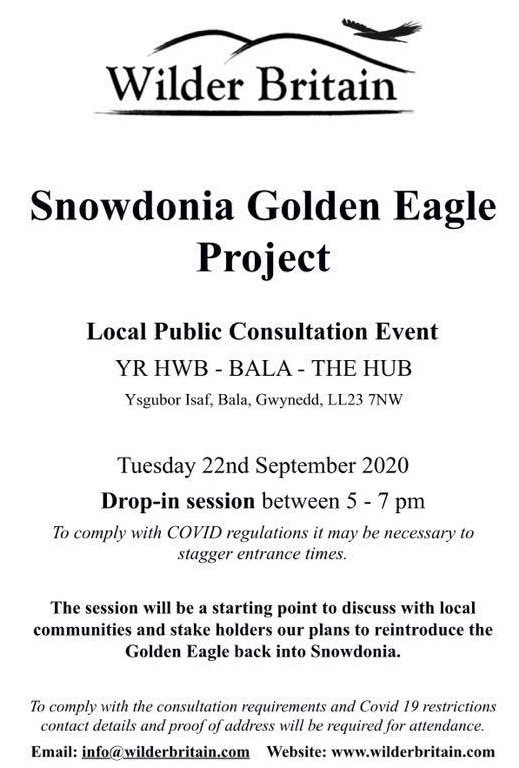
This evening’s event comes after some unfavourable commentary about the proposed reintroduction in the media and inside the Senedd, the Welsh Parliament.

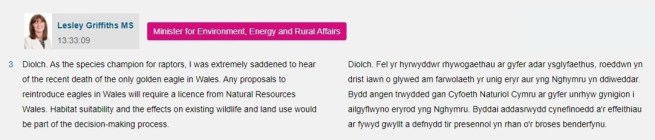
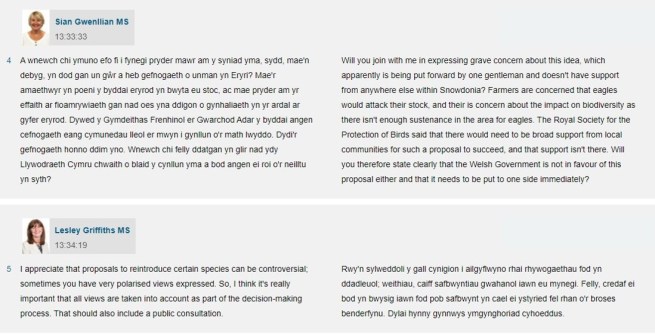
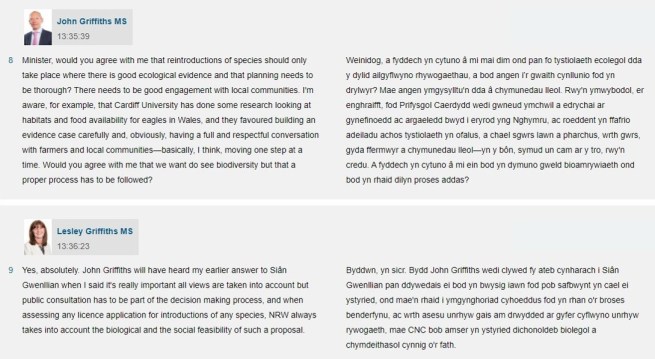
Last week, Welsh politician Sian Gwenllian raised the issue with Lesley Griffiths, the Minister for Environment, Energy and Rural Affairs (and also the Species Champion for Raptors in Wales).

Their conversation went as follows:

This was then followed up by unfavourable press coverage in The Bangor Aye, which read as follows:
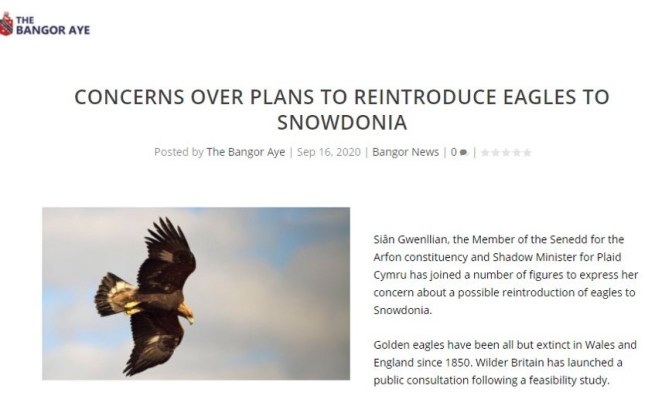
Siân Gwenllian, the Member of the Senedd for the Arfon constituency and Shadow Minister for Plaid Cymru has joined a number of figures to express her concern about a possible reintroduction of eagles to Snowdonia.

Golden eagles have been all but extinct in Wales and England since 1850. Wilder Britain has launched a public consultation following a feasibility study.

In 2019, Cardiff University researchers said Wales was home to “large expanses of potentially suitable eagle habitat” but reintroduction was not likely to happen “for some time”.

Siân Gwenllian MS has said: “There are many reasons to oppose this plan, but the interests of local farmers are undoubtedly a priority.

“I have been in discussions with local farmers, and with the local branch of the FUW, and I share their concerns that these plans could pose an additional danger to local agriculture, an industry which is already facing countless challenges.

“The likely reason that the species disappeared from the area in the first place is insufficient subsistence in the Snowdonia area. This could mean that if reintroduced, local farmers’ lambs would be easy prey for them. That is very worrying. ”

Wilder Britain, the organisation calling for the reintroduction of eagles to Wales, held a public meeting to discuss the plans in Betws-y-Coed in early September.

There is concern that Wilder Britain is interfering with the rigorous research project carried out by the Eagle Reintroduction Wales (ERW) project, led by Cardiff University. That project undertakes careful and detailed research into the environmental and ecological impact of eagle reintroduction.

Siân Gwenllian MS added: “Dr Paul O’Donoghue, director of Wilder Britain, claims that eagles in Snowdonia were culled, but there is ground to believe that their disappearance was due to lack of subsistence for the species.

“This could be a major threat to the area’s wildlife and agricultural stock. We know that eagles can carry the weight of other animals, putting Snowdonia’s biodiversity at risk. ”

Siân Gwenllian raised the issue in a plenary session of the Senedd today with Lesley Griffiths MS, Minister for the Environment, Energy and Rural Affairs. Ms Gwenllian asked the minister to ‘state clearly that the Welsh Government will not support these recommendations, and that they need to be put aside as soon as possible.’

Lesley Griffiths MS responded by saying that she appreciated that such proposals were ‘controversial’ and that there were polarised views’, and she noted that all points of view on the issue needed to be considered.

Siân Gwenllian MS said: “It is important that we listen to the voices of farmers who are expressing great concern about this scheme.

“I appreciate RSPB Cymru’s statement that any proposed reintroduction of the species would have to come following thorough research, local consultation, and widespread support from local communities.

“According to my conversations with the FUW, there is reason to believe that that local support does not exist.”

ENDS

It seems that Sian Gwenllian is not a big fan of any proposed eagle reintroduction as she seems to think that golden eagles ‘would put Snowdonia’s biodiversity at risk‘. It’s probably fair to say, based on that statement alone, that Ms Gwenllian’s comprehension of what biodiversity actually is is quite limited, but that’s not necessarily an unsurmountable problem that couldn’t be addressed by some gentle education.

However, it appears that Ms Gwenllian is using the approach of Wilder Britain as reason enough to dismiss any thought of a reintroduction. That was always the danger of having two conflicting groups taking different approaches, and is what we feared might happen as a result.

Thankfully, Environment Minister Lesley Griffiths seems a lot better informed and has a sensible approach to how a proposed reintroduction will be assessed by the Government. In that sense, the Cardiff University-based Eagle Reintroduction Wales Project looks set to tick all the right boxes in terms of its background research, ecological feasibility studies, partnership development and planned public consultations.

Incidentally, in mid-August an FoI was submitted to the Welsh Government’s statutory nature conservation agency, Natural Resources Wales, to find out what correspondence had been received from Wilder Britain about a proposed eagle reintroduction. NRW’s response is now overdue.

Proposed golden eagle reintroduction to Wales: genuine intent or just a publicity stunt?

Back in February 2019 we blogged about two different organisations who were taking two very different approaches to a possible reintroduction of the golden eagle to Wales (see here and here).

The most serious effort, in our view, to examine whether this might be feasible and appropriate was/still is being undertaken by a team of researchers at Cardiff University under the auspices of the Eagle Reintroduction Wales (ERW) Project (view their website here). The ERW’s approach has involved several years of carefully conducting a scoping exercise, to properly consider all the factors that need to be addressed before a reintroduction licence would be granted, e.g. biological and environmental considerations, social and political considerations, and comprehensive risk assessments and an exit strategy. The group has also been building partnerships with local stakeholders.

The other organisation is called Wilder Britain (website here), whose sole director is Dr Paul O’Donoghue, who according to Companies House is also a Director of six other companies, some of whom blog readers may already be familiar (Lynx UK Trust Community Interest Company (CIC), Wildcat Haven Enterprises CIC, Wildcat Haven CIC, Paul O’Donoghue Consultancy Ltd, Specialist Wildlife Services Ltd, and We Rescue Animals CIC). Some of you may know Dr O’Donoghue’s name as being behind the failed 2018 application to reintroduce Lynx to Kielder Forest (see here) and earlier this year he lost an outrageous defamation claim against Andy Wightman MSP (see here).

In a blaze of publicity and fanfare in February 2019, it was claimed that Wilder Britain’s plans to reintroduce ten golden eagles to Wales were ‘well underway’ and that a licence application would be submitted to Natural Resources Wales (NRW) by July 2019.

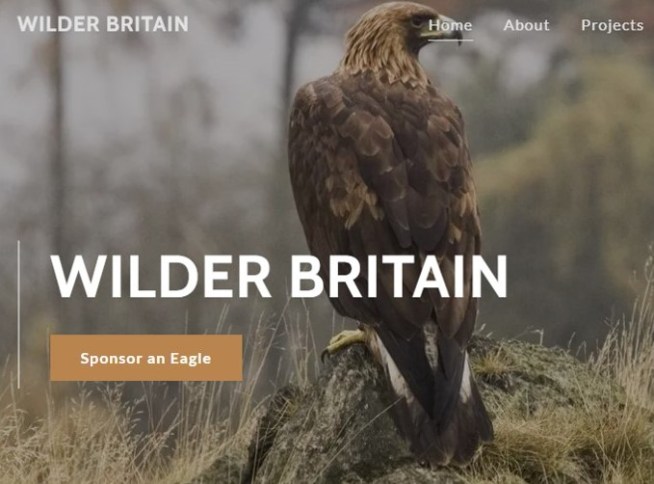
However, at that time there was very little detail available about any research that may or may not have been completed to support such an application. We were also interested in any modelling work that would be needed to understand how many young eagles would have to be released to establish a self-sustaining breeding population. Many previous studies on raptor reintroductions have demonstrated that long term success is largely dependent on releasing a sufficient number of birds, which is calculated by considering a wide variety of demographic factors. And that’s assuming that the habitat and prey has been deemed sufficient to support any reintroduction and that illegal persecution isn’t a threat. One thing’s for sure, any viable project is going to need to release significantly more than ten birds, which according to Dr O’Donoghue are being sourced from ‘Europe’ and will all be satellite tracked. We’re talking serious funding requirements here, that are unlikely to be met by Wilder Britain’s requests to ‘sponsor an eagle’ on its website.

Curious to find some answers, in November 2019 we asked NRW, via a freedom of information request, for copies of all correspondence it had had with Dr O’Donoghue/Wilder Britain, including any licence applications. NRW responded by stating it had received no correspondence from Dr O’Donoghue/Wilder Britain relating to a proposed golden eagle reintroduction (see here). Hmm.

Fast forward to August 2020 and amidst another blaze of publicity, which just happened to coincide with the news that a golden eagle that had been living in the wild in Wales for several years had been found dead (here), and up pops Dr O’Donoghue again, this time announcing (here) a public survey and consultation to support a proposal to ‘release five pairs of golden eagles’ in Wales in 2021.

This afternoon, Dr O’Donoghue is hosting the first of several public meetings in Wales to answer questions about the proposal. Should be interesting.

UPDATE 16.25hrs:

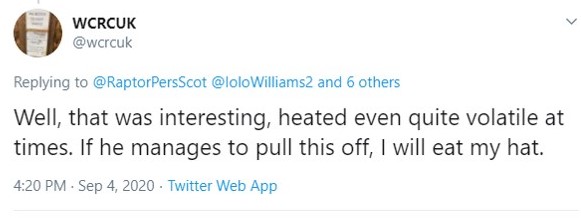
Here is a tweet from @WCRCUK who attended this meeting:


Update on parliamentary motion on ‘disappearances of birds of prey over driven grouse moors’

Three weeks ago we reported that Alex Rowley MSP (Scottish Labour) had lodged a parliamentary motion relating to the ‘disappearances of birds of prey over driven grouse moors’ (see here).

This motion was triggered not only by the suspicious disappearance of satellite-tagged golden eagle Tom, who vanished in to thin air during lockdown in May this year, along with his fully-functioning satellite tag, with his last known location being on a driven grouse moor in Strathbraan, a well-known raptor persecution hotspot (see here), but also the suspicious disappearance of seven other satellite-tagged golden eagles in the same area, the disappearance of another satellite-tagged hen harrier on another Scottish driven grouse moor (here), the illegal poisoning of a satellite-tagged white-tailed eagle found dead on another Scottish grouse moor (here), and the 43 hen harriers that have either gone missing or have been killed in the UK in the last two years, mostly on or close to driven grouse moors (here).

A quick check today on the progress of this parliamentary motion has revealed it has full cross-party support, with MSPs from all parties signing up:

There are 26 supporters to date, from Scottish Labour, SNP, the Greens, the Lib Dems, an independent, and, surprisingly, the Conservatives. Well done Peter Chapman MSP (Scottish Conservatives, NE Scotland) for being the sole supporter (so far) from this party.

The motion needs four more supporters before it reaches the threshold of 30 MSPs from at least two different political parties to qualify for a Parliamentary debate.

Parliamentary motions are ‘live’ for six weeks before they’re culled (if they haven’t attracted sufficient support) so this one still has about three weeks to run.

If your MSP is not listed, please consider dropping them an email and encourage them to support this motion. If they refuse, it’d be interesting to hear their explanations. NB: Ministers and Cabinet Secretaries are not eligible to support these motions.

If you’re unsure about who your elected representatives are, you can find them here.

Thank you

10 year old boy tells First Minister he’s worried about golden eagles ‘going missing’

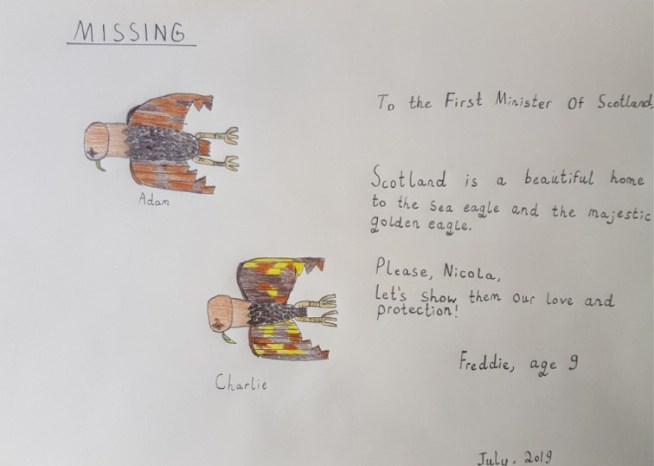
Last year, a nine-year-old boy called Freddie Blackman was so upset about the suspicious disappearance of two satellite-tagged golden eagles (Adam & Charlie) that vanished on a grouse moor in Strathbraan (see here) that he, and many others, wrote to First Minister Nicola Sturgeon urging her and her Government to do more to protect Scotland’s eagles (see here, here, here, here).

Here’s the letter Freddie wrote to Nicola Sturgeon last year:

The First Minister eventually responded to Freddie and wrote him a letter (here) telling him, ‘I believe that the Scottish Government must do everything it can to look after our eagles’ and then going on to fob him off telling him she was waiting for the Werritty review to be delivered.

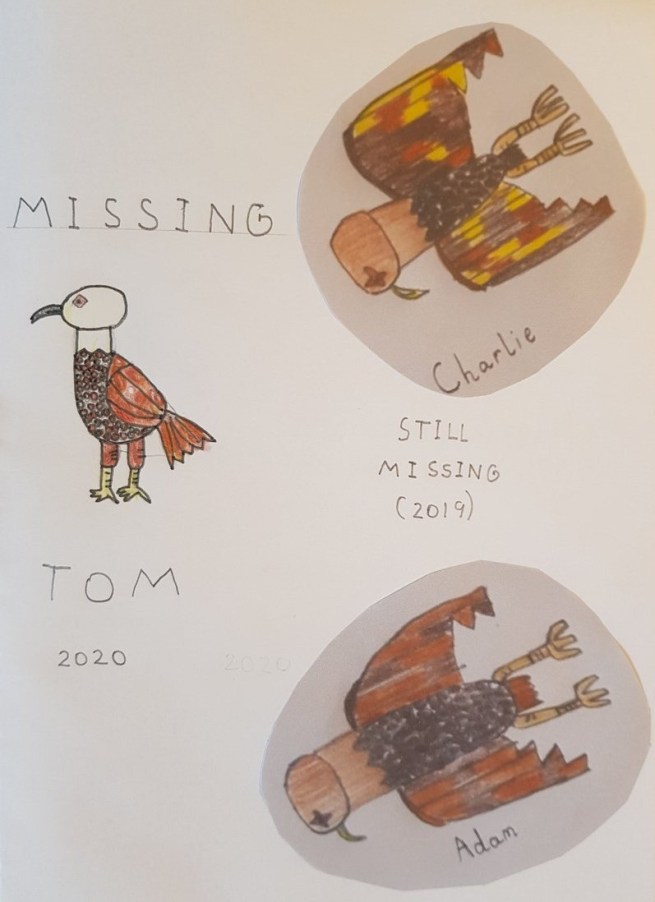
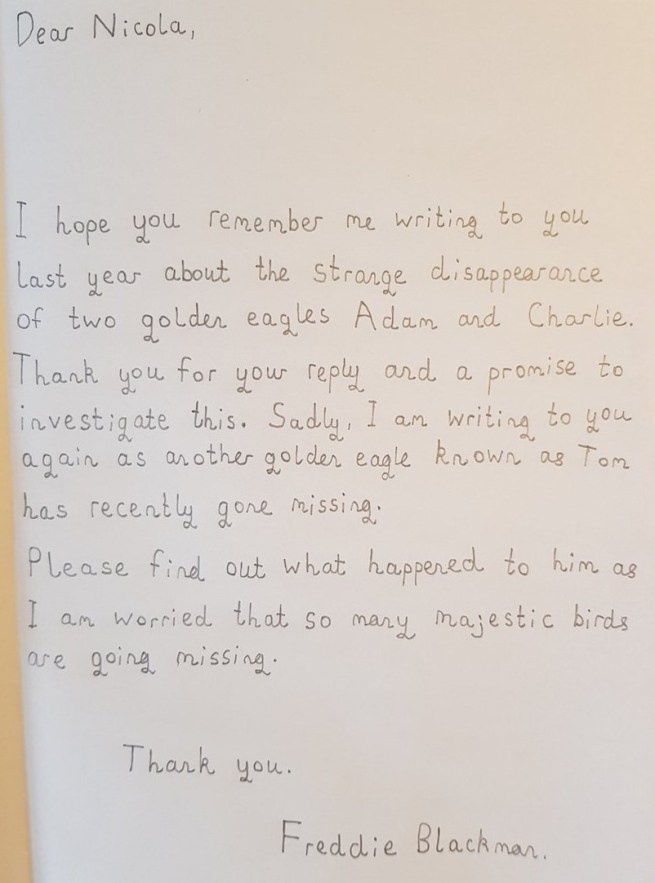
Fast forward 12 months and Freddie is now a year older, another satellite-tagged golden eagle (Tom – see here) has gone ‘missing’ in suspicious circumstances on a Scottish grouse moor, in the same raptor persecution hotspot as where Adam and Charlie disappeared, and we’re still waiting for the Scottish Government to respond to the Werritty review, which cost taxpayers £86,000 and which has been sitting on Ministers’ desks since November 2019 (nine months ago).

Ten-year-old Freddie has just sent another card to the First Minister:

How will the First Minister respond this time?

How embarrassing must it be to have a nine and now ten-year-old calling you out on your failure to protect one of your country’s most iconic species?

How many more letters will Freddie have to write and how old will he be when the Scottish Government finally takes effective action against those who continue to kill these eagles?

YOU CAN TAKE ACTION

If you’re sick to the back teeth of illegal raptor persecution on driven grouse moors, please consider participating in this quick and easy e-action to send a letter to your local Parliamentary representative (MSP/MP/MS) urging action. Launched just nine days ago by Wild Justice, RSPB and Hen Harrier Action, over 53,000 people have signed up so far.

This means that over 53,000 pre-written letters complaining about illegal raptor persecution and the environmental damage caused by intensive grouse moor management, are winging their way to politicians of all parties across the UK. If you want your local politician to receive one, Please join in HERE

Thank you


Disappearance of golden eagle Tom prompts Parliamentary motion

Earlier this week we blogged about the suspicious disappearance of Tom, a golden eagle we’d been satellite-tracking since last year with Chris Packham and who vanished in to thin air, along with his fully-functioning satellite tag, with his last known location being on a driven grouse moor in Strathbraan, a well-known raptor persecution hotspot (see here).

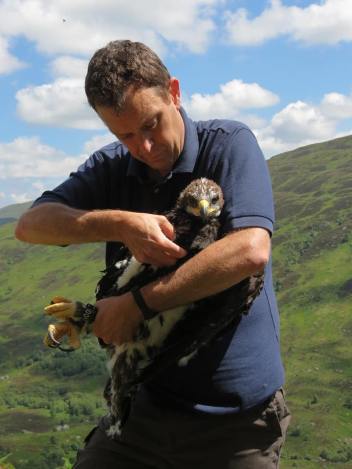
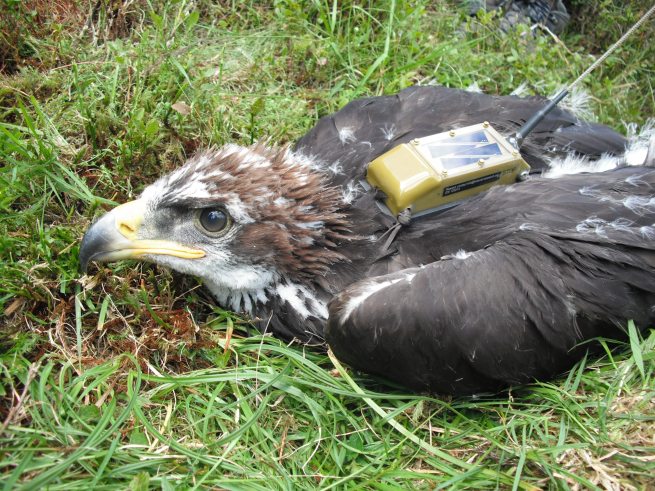
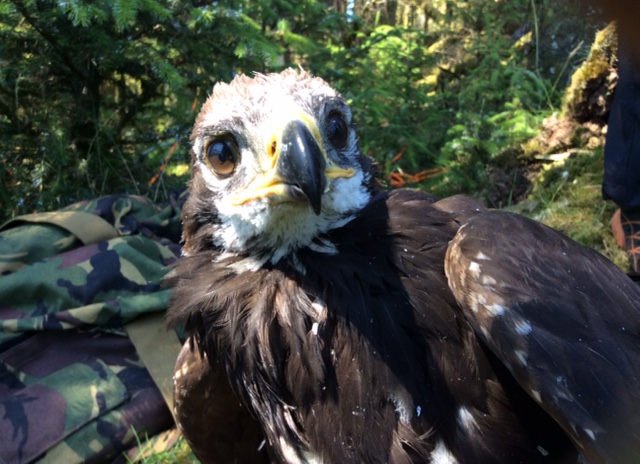
[Golden eagle Tom at approx 8 weeks old having his satellite tag fitted in 2019 under expert licence. Photo Raptor Persecution UK]

We produced a video about Tom’s suspicious disappearance and this, along with the RPUK blog on his disappearance, received good media coverage both online and in the printed media throughout the week, even though a journalist at The Times simply cut and pasted the text from the RPUK blog, regurgitated it in an article and attributed this to ‘a spokesman from RPUK‘. Ha!

Here’s the video for those who may have missed it:

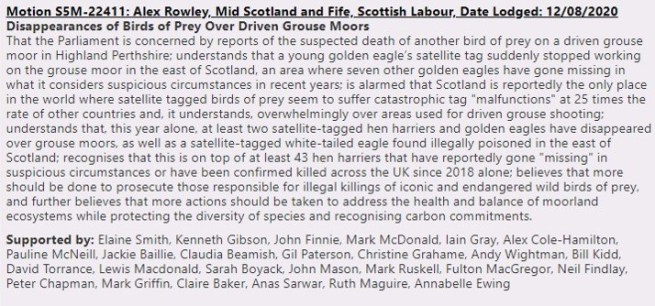
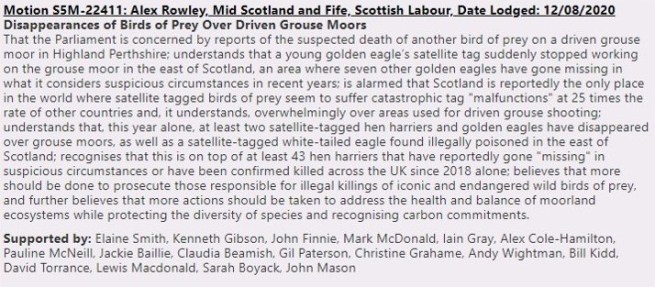
And now Tom’s disappearance has prompted a Parliamentary motion, lodged by Labour MSP Alex Rowley as follows:

It’s not just Tom’s disappearance that has led to this. As you can see, Alex also mentions the suspicious disappearance of seven other satellite-tagged golden eagles in the same area, the disappearance of another satellite-tagged hen harrier on another Scottish driven grouse moor (here), the illegal poisoning of a satellite-tagged white-tailed eagle found dead on another Scottish grouse moor (here), and the 43 hen harriers that have either gone missing or have been killed in the UK in the last two years (here).

He’s done his homework.

For a Parliamentary Motion to be considered for debate, at least 30 MSPs from at least two different political parties need to support it. So far, Alex’s motion has attracted the support of 17 MSPs, representing Labour, SNP, Greens, Liberal Democrats and one independent.

If your MSP’s name isn’t on the list as a supporter, please email them and prompt them to sign up. If they refuse, ask them why. Put them on the spot and most importantly of all, let them know that this issue matters to you.

If you don’t know who your MSP is you can find out here

If you want to do more, and if you’re sick to the back teeth of illegal raptor persecution on driven grouse moors, please consider participating in this quick and easy e-action to send a letter to your local Parliamentary representative (MSP/MP/MS) urging action. Launched last Saturday by Wild Justice, RSPB and Hen Harrier Action, over 41,000 people have signed up so far.

This means that over 41,000 pre-written letters complaining about illegal raptor persecution and the environmental damage caused by intensive grouse moor management, are winging their way to politicians of all parties across the UK. If you want your local politician to receive one, Please join in HERE

Thank you

First Minister Nicola Sturgeon put on spot about ongoing illegal raptor persecution on grouse moors

The Scottish Greens are doing a fantastic amount to hold the Scottish Government to account on wildlife conservation issues.

Yesterday, Alison Johnstone MSP put Nicola Sturgeon on the spot during First Minister’s Questions. Click on this link to hear Alison ask Nicola Sturgeon “When she will finally act to end raptor persecution in Scotland?

https://twitter.com/AlisonJohnstone/status/1293601009659510788

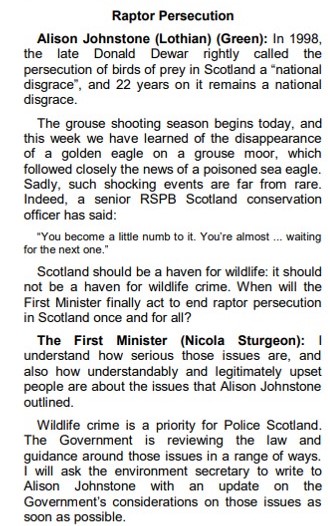
The First Minister’s response went as follows (as published in the Official Report of the Scottish Parliament, 12th August 2020):

Remember, this is the first response anyone has heard from the First Minister, despite an avalanche of angry emails following the recent discovery of the poisoned white-tailed eagle on a grouse moor in the Cairngorms National Park (see here), and the news earlier this week about the suspicious disappearance of yet another golden eagle (Tom) on a grouse moor in Strathbraan, a well-known raptor persecution hotspot in Perthshire (see here).

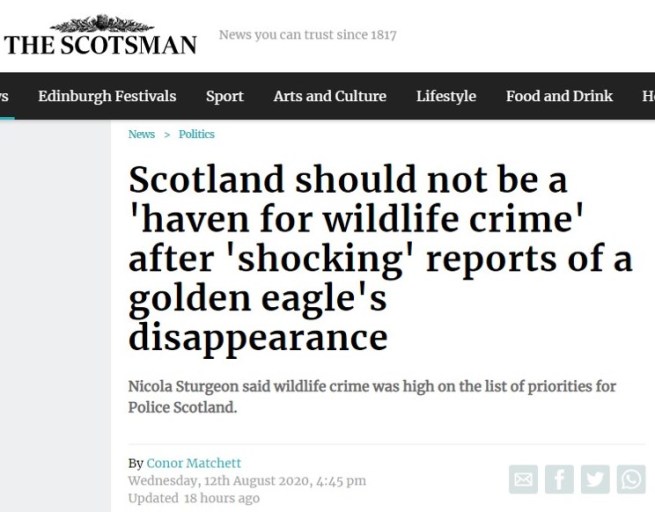
The Scotsman has run a piece today about Alison’s question to the First Minister (see here) and includes commentary about the poisoned sea eagle and the missing golden eagle.

The Scotsman article includes further comment from Alison Johnstone:

The First Minister described wildlife crime as a priority for the police, but it’s clear that greater action is required by her government if we are to bring an end raptor persecution in Scotland once and for all“.

Roseanna Cunningham, Cabinet Secretary for the Environment has just issued a statement about what the Scottish Government intends to do. More on that shortly….

TAKE ACTION

Meanwhile, if you’re sick to the back teeth of illegal raptor persecution on driven grouse moors, please consider participating in this quick and easy e-action to send a letter to your local Parliamentary representative (MSP/MP/MS) urging action. Launched on Saturday by Wild Justice, RSPB and Hen Harrier Action, over 36,000 people have signed up so far.

This means that over 36,000 pre-written letters complaining about illegal raptor persecution and the environmental damage caused by intensive grouse moor management, are winging their way to politicians of all parties across the country. If you want your local politician to receive one, Please join in HERE

Thank you

Golden eagle Tom disappears in suspicious circumstances on Scottish grouse moor

In 2017, Raptor Persecution UK teamed with Chris Packham to start a project fitting satellite tags to young golden eagles in Scotland, as part of a wider conservation research initiative in to golden eagle ecology, which began back in 2004 (see here for more info).

Since then, each year our team of licensed experts has been fitting tags to young eagles and we’ve been able to monitor these eagles’ movements as they try and make their way in the world. Our tag data are shared collaboratively within a specialised Golden Eagle Research Group and are contributing to some ground-breaking studies on golden eagle dispersal and movement ecology (see here for more info).

Unfortunately, our study is being undertaken in a country where the illegal persecution of raptors is rife, and that includes the illegal killing of golden eagles.

A Government-commissioned report published in 2017 showed how almost one-third of all satellite-tagged golden eagles in Scotland (41 of 131 eagles) had ‘disappeared’ in suspicious circumstances between 2004-2016, many of them vanishing in particular clusters on or close to driven grouse moors.

So far, three of ‘our’ tagged eagles have vanished in suspicious circumstances on or next to driven grouse moors – there was Fred in 2018 who disappeared from the Pentlands and whose tag last transmitted 10 miles offshore in the North Sea where we believe the tag, and perhaps Fred, had been dumped (here), and then there was Adam and Charlie who both disappeared within hours of one another on the same grouse moor in Strathbraan in 2019 (here).

Now another one has gone.

His name was Tom, and he hatched in Argyll in May 2019.

[Golden eagle Tom having his satellite tag fitted at approx 8 weeks old. Photo RPUK]

Tom survived for a year, travelling to explore the west, out as far as the Isle of Mull, before making a fateful journey east towards the grouse moors in the spring of this year.

Here is an overview of his movements; the yellow disc is the last known location from his tag, on 18th May 2020.

Tom vanished in the early hours of the morning on a grouse moor in the Strathbraan area of Perthshire, a well-known raptor persecution hotspot, just a few miles north of the area where Adam and Charlie vanished last year.

We notified Police Scotland of the sudden loss of tag transmission and they examined the tag data and agreed that the circumstances were indeed suspicious. They undertook a search of the grouse moor but of course didn’t find any evidence – no tag, no carcass, nothing.

In late July the police gave us permission to publicise this incident and we’ve made a video to document Tom’s short life:

Needless to say we are upset and angry that another golden eagle has gone in virtually identical circumstances to so many others – vanishing without trace on a driven grouse moor in Scotland.

What angers us the most is the Scottish Government’s apparent indifference to the ongoing killing of birds of prey. We’re not alone in our anger – we believe thousands of people have written to the First Minister just a couple of weeks ago after the poisoned corpse of a white-tailed eagle was found dead on a grouse moor inside the Cairngorms National Park (here).

The Scottish Government has been aware of what’s been going on for decades. They know where it goes on, why it goes on and which sector of society is responsible. And yet still we’re having to wait for effective action.

Why is that?

If you share our anger, you can channel it in to something worthwhile. Please consider participating in this quick and easy e-action to send a letter to your local Parliamentary representative (MSP/MP/MS) urging action on illegal raptor persecution on grouse moors. Launched on Saturday by Wild Justice, RSPB and Hen Harrier Action, over 21,000 people have signed up so far. Please join in HERE

Thank you.

MEDIA COVERAGE

This article was picked up by

The Times (here)

The Oban Times (here)

BBC News website (here)

The Scotsman (here)

Evening Standard (here)

The Courier (here)

Perthshire Advertiser (here)

UPDATE 14th August 2020: Disappearance of golden eagle Tom prompts Parliamentary motion (here)

Poisoned sea eagle: Chris Packham’s letter to Scottish Ministers

Public anger over the news that yet another bird of prey has been found illegally killed on a Scottish grouse moor – this time a white-tailed eagle found poisoned in the Cairngorms National Park – is showing no sign of subsiding (see here and click on the links to read some of the letters that have been sent to Scottish Ministers urging immediate action).

Chris Packham has now added his voice and has written to the First Minister Nicola Sturgeon and Environment Cabinet Secretary Roseanna Cunningham, as follows:

It’s not the first time Chris has spoken with Ministers about the ongoing persecution of eagles and other birds of prey on Scottish grouse moors.

In 2018 he had a long conversation with Roseanna Cunningham following the suspicious disappearance of one of our satellite-tagged golden eagles, ‘Fred’, who vanished just seven miles from the Scottish Parliament building in Edinburgh. You can watch the extended version of that conversation here:

Here we are, two years later, and what’s changed?

Absolutely nothing.

Except public anger has surged.

Thank you to everyone who has written to the First Minister and Environment Cabinet Secretary expressing your disgust and urging immediate action following this latest poisoning incident. The public’s reaction has been phenomenal.

Here are their email addresses for those who would still like to comment:

To email Nicola Sturgeon, please use this address: firstminister@gov.scot

To email Roseanna Cunningham, please use this address: CabSecECCLR@gov.scot

Thank you.

New paper documents history of eagles in Wales

An important new scientific paper has just emerged documenting the history of golden and white-tailed eagles in Wales.

Published in the journal Conservation Science & Practice, this new paper builds on the earlier, painstaking work of the much missed Richard Evans who, along with colleagues (see here), mapped the historical distribution of eagles across Britain and Ireland.

This latest paper, authored by Cardiff University PhD student Sophie-lee Williams et al, thoroughly evaluates the evidence for both species in Wales and maps their likely core distributions. The authors conclude there is strong evidence that both species were widespread across Wales but fell victim to persecution and haven’t bred there for over 150 years.

This paper is open access which means it is freely available to everyone.

Download it here: Williams et al 2020_Past distribution eagles Wales

The significance of this paper relates to a proposed reintroduction of golden and/or white-tailed eagles to Wales. Many blog readers will recall that this prospect has been on the table for a while and whilst there is still a lot more work to complete before licence applications are submitted, understanding the species’ past historical ranges is important.

Some blog readers may recognise some of the names involved in this latest research. They are part of the Eagle Reintroduction Wales Project (ERWP) (website here) who we blogged about last year when news emerged that a different team was also contemplating an eagle reintroduction in Wales, but apparently without the careful research assessment being undertaken by the Cardiff University team (see here). Fortunately, so far, that alternative approach hasn’t advanced very far (see here and here).

Hopefully it won’t be too long before we see more research results from the ERWP that’ll take us another step closer to restoring these eagles back to Wales.

Concern for safety of birds of prey on grouse moors during lockdown

Conservationists are deeply concerned about the safety of birds of prey, particularly on grouse moors, during the Coronavirus lockdown as many nest sites will be unmonitored for the first time in almost two decades.

In an article on The Ferret website yesterday Scottish Raptor Study Group (SRSG) communications secretary Logan Steele is quoted:

SRSG is very concerned about the probable increase in incidents of raptor persecution during the lockdown. In particular on driven grouse moors, gamekeepers will be under less scrutiny from raptor workers and recreational visitors and so will effectively have a free hand.

The two species most at risk are hen harriers and golden eagles which are perceived to pose the greatest risk to grouse stocks and are routinely shot, trapped or poisoned“.

The RSPB is also concerned. Head of Species and Land, Duncan Orr-Ewing said:

Raptor persecution has continued unabated with numerous well-publicised cases of shootings, illegal trap use and other crimes both north and south of the border despite the driven grouse shooting industry being under intense scrutiny – particularly in Scotland where the government has just published the findings of a three year review of grouse moor management.

We don’t believe that under the current circumstances of significantly reduced public access to our uplands, anyone is naive enough to think that wildlife criminals won’t be making the most of this opportunity to kill any species they perceive to be a threat, with a minimal chance of their crimes being witnessed or detected“.

The full article can be read here: http://theferret.scot/birds-of-prey-monitoring-coronavirus/