Natural England has just published its latest update on the fates of the satellite-tracked hen harriers it has tagged and subsequently been tracking. This latest update (dated Dec 2024) shows that since its last update (Aug 2024 but actually published in Sept 2024), three more hen harriers have gone ‘missing’ and two more have been found dead and are awaiting post-mortem.
Once again, I haven’t seen any press releases or appeals for information about any of these incidents, either from Natural England or the police.
Here are the details of the latest hen harriers listed as ‘missing’:
Female hen harrier named ‘Dreich’, Tag ID: 254842, last known transmission date 1 October 2024 in Lanarkshire. Listed by NE as ‘Missing Fate Unknown, site confidential – ongoing investigation‘.
Male hen harrier named ‘Baldur’, Tag ID: 240291, last known transmission date 15 October 2024 in Northumberland. Listed by NE as ‘Missing Fate Unknown, site confidential – ongoing investigation‘.
Female hen harrier named ‘Margaret’, Tag ID: 254844, last known transmission date 19 October 2024 in Northumberland. Listed by NE as ‘Missing Fate Unknown, site confidential – ongoing investigation‘.
I’ll be adding these three birds to my long-running tally of hen harriers that are known to have been illegally killed and/or have ‘disappeared’ in suspicious circumstances since 2018.
Here are the details of the latest hen harriers listed by NE as found dead and awaiting post mortem:
Male hen harrier named ‘Chance’, Tag ID: 254840, last known transmission date 8 August 2024 in Cumbria. Listed by NE as ‘Recovered awaiting PM‘.
Female hen harrier named ‘Sofia’, Tag ID: 34346, last known transmission date 3 October 2024 in Northumberland. Listed by NE as ‘Recovered awaiting PM‘.
I won’t add these two birds to my tally of missing/illegally killed hen harriers just yet because the circumstances of their deaths have not yet been published. They join the other four dead hen harriers whose corpses were found earlier in 2024 (see here) but whose causes of death have not yet been published. They are:
Female hen harrier named ‘Susie’, Tag ID: 201122. Last known transmission 12 February 2024, Northumberland. Found dead. Site confidential. In NE’s April 2024 update, Susie was listed as, ‘recovered, awaiting post mortem‘. Now her listing says, ‘Ongoing police investigation, final transmission location temporarily withheld at police request‘. You might remember ‘Susie’ – she’s the hen harrier whose chicks were brutally stamped on and crushed to death in their nest on a grouse moor in Whernside in the Yorkshire Dales National Park, in June 2022 (here).
Female hen harrier named ‘Edna’, Tag ID: 161143a. Last known transmission 7 June 2024, Northumberland. Listed by NE as ‘Recovered, awaiting post mortem‘.
Female hen harrier, Tag ID: 254843. Last known transmission 29 July 2024, Northumberland. Listed by NE as ‘Recovered, awaiting post mortem‘.
Male hen harrier, Tag ID: 254839. Last known transmission 5 August 2024, Northumberland. Listed by NE as ‘Recovered, awaiting post mortem‘.
I won’t be holding my breath waiting for NE to publish the post mortem results and inform us whether any of these additional six hen harriers died of natural causes or were the victims of illegal persecution. As we saw in December 2024 (here), it took NE 18 and 20 months respectively to reveal that two brood meddled hen harriers that had been previously listed as ‘Missing Fate Unknown’ had actually been found dead, their corpses containing two and three shotgun pellets respectively.
I’ll be writing more about hen harrier brood meddling shortly, but first it’s time to update the death list, which now stands at 133 hen harriers confirmed ‘missing’ or illegally killed in the UK since 2018, mostly on or close to grouse moors. If the six dead hen harriers currently still awaiting post mortems turn out to have been illegally killed, the death list will stand at 139 hen harriers.
If you’re sick to the back teeth of watching the death list expand, and the grouse moor owners and gamekeepers continue to escape prosecution for their crimes, please sign Wild Justice’s latest petition calling for a ban on driven grouse shooting. The petition runs until 22 May 2024 and currently stands at 53,000 signatures. If it reaches 100,000 signatures it will be considered for a debate in Westminster Hall. Please sign the petition HERE and then share it! Thank you.
Further to this afternoon’s blog about the conviction today of Scottish gamekeeper Thomas Ebner for a snaring offence in April 2023 (here), the Scottish SPCA has issued the following press release:
GAMEKEEPER PLEADS GUILTY TO SNARING FOX
A man has been fined £1,250 and ordered to pay a £75 surcharge for cruelly snaring a fox.
Thomas Ebner, 74, from Reston in the Scottish Borders, pled guilty to setting a snare that could cause unnecessary suffering to any animal that came into contact with it. The snare was located on land belonging to Old Castles Farm in Chirnside.
The snared fox at the centre of this case. Photo SSPCA
The fox was caught by the neck and partially suspended on a broken fence line.
Ebner was sentenced at Selkirk Sheriff Court on Monday, January 20 2025.
Sheriff Paterson remarked, “This is a breach of the act. You knew what you were doing, and the fox suffered. But, I must consider that you have no previous convictions and pleaded guilty.”
The sheriff then fined Ebner £1,250, plus a £75 surcharge.
A Scottish SPCA Inspector from the Special Investigations Unit (SIU) said, “The fox was found caught in a snare along a broken fence line by members of the public. It was seen jumping through the fence in considerable distress and foaming at the mouth. The snare was wrapped around a fence post and was blood-stained. The public was able to free the fox from the snare.
“This snare was set in a way that caused suffering to the fox. There was a significant risk of it becoming entangled in the fence, which could have led to strangulation. It was clear that the fox was experiencing both mental and physical distress. The animal was at further risk of injury from surrounding barbed wire and broken wood.
“The snare was set by an individual who had attended an official snare training course, where they were taught the correct way to set snares.
“This is yet another example of the cruel impact snares can have on animal welfare and the unnecessary suffering they cause. We welcome the ban on snares implemented by the Scottish Government.”
A ban on the use of snares came into effect in March 2024 as part of the Wildlife Management and Muirburn (Scotland) Act.
“We have also been given additional investigative powers to tackle wildlife crime. These powers allow our inspectors, who are already investigating animal welfare offences, to search, examine, and seize evidence.
“The Bill includes various measures to protect wildlife, such as a ban on all forms of snares and glue traps.
“We have long called for an outright ban on snares due to the suffering they inflict on animals, whether used legally or illegally. Animals caught in snares can endure unimaginable physical and mental anguish. Snares are non-selective and can harm both domestic animals and non-target wildlife.”
A Scottish gamekeeper has pleaded guilty to a snaring offence and has been fined £1,250.
Thomas Ebner, 74, of Lakeside, Reston, Berwickshire, had previously pleaded not guilty to four charges relating to an incident that took place on land believed to be used by a small shooting syndicate at Old Castles Farm, Chirnside, in the Scottish Borders on April 25th 2023, which resulted in a fox being suspended by its neck in a snare on a broken fence line where it was found foaming at the mouth and thrashing around trying to escape (see here for previous blog on this case).
At the time of the offence, snares were still lawful in Scotland but were not permitted to be set in a position where a trapped animal could be suspended, and users had to first attend a snare training course and then apply for an identification tag that would identify the snare operator and the target species.
A snared fox on a fence line. NB: File photo, not associated with this case. Photo by SSPCA
Ebner’s previous not guilty plea had led to a trial date being set for 4th February 2025. However, in a pre-trial hearing this morning at Selkirk Sheriff Court, Ebner changed his plea to guilty of one charge and the other three charges were dropped.
I’d argue that Ebner got off lightly. A fine of £1,250 + £75 surcharge is well below the maximum sentence available, which is a custodial sentence of six months and/or a fine of £5,000. So much for those so-called ‘tougher penalties‘ for wildlife crime.
Thankfully, the use of snares in Scotland has now been banned (since 25th November 2024) under the new Wildlife Management & Muirburn (Scotland) Act, thanks to a long-running campaign by animal welfare campaigners who spent decades putting forward evidence that these devices, recently and cynically named ‘humane cable restraints’ by the game-shooting industry, are actually cruel, indiscriminate and inhumane and have no place in modern society.
UPDATE 16.30hrs: Gamekeeper pleads guilty to snaring fox – press release from SSPCA (here)
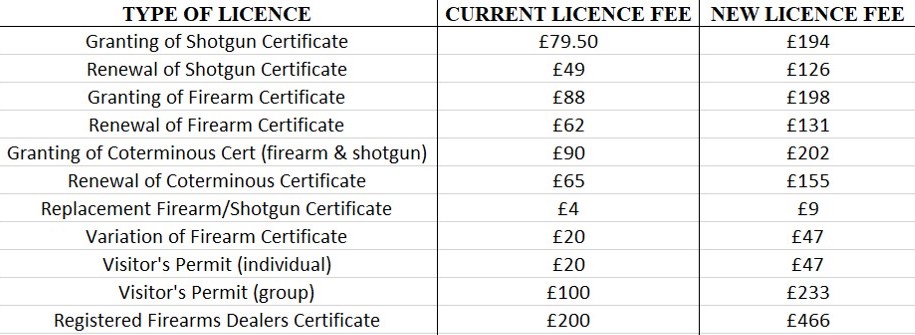
The UK Government has announced that licence fees for firearms and shotguns are set to increase next month to allow for ‘full-cost recovery’, which means that taxpayers will no longer be subsidising the use of these weapons.
Photo by Ruth Tingay
Those wishing to possess, buy or acquire a firearm or shotgun and ammunition in the UK are required to have a certificate, issued by the user’s local police force who act as the licensing authority. These certificates are valid for five years, unless revoked.
Before a certificate is granted, the police undertake a vetting procedure which includes medical checks and a range of suitability checks including referee interviews and a home visit to ensure the applicant has a secure facility to store a weapon and ammunition. All of this costs money from the force’s budget and until now, this cost has been significantly subsidised by the tax payer, costing the national police budget an estimated £17 – £20 million pounds a year.
Last week the Home Office announced an increase in licensing fees, the first since 2015, that will, for the first time, achieve full-cost recovery for police forces.
Here are the current licence fees and the new fees that begin on 5th February 2025:
This has been a long time coming. It was in Labour’s election manifesto and I’m pleased to see the speed with which it’s being rolled out.
Some game-shooting organisations, such as BASC, are dramatically claiming that the fee increase ‘poses a threat to rural livelihoods‘. Having to pay the equivalent of £25.20 per year for a shotgun certificate renewal isn’t exactly going to ruin the rural economy, is it?
Let’s hope the £17-£20 million pounds saved from the annual police budget can be put to good use to chase down all those certificate-holding gamekeepers who continue to use their firearms and shotguns to illegally kill birds of prey.
A few weeks ago just before Xmas, Natural England published an update on the fates of three brood meddled satellite-tracked hen harriers: one that had been found dead in north Devon on 5th March 2024 (it died of natural causes) and two that had both vanished within a week of each other from a winter roost site in the North Pennines in December 2022 and whose gunshot-riddled corpses were later found in April and June 2023 (see here).
An illegally killed hen harrier. Photo by Ruth Tingay
Both of these shot hen harriers were found in the North Pennines National Landscape (previously known as an AONB, Area of Outstanding Natural Beauty) and the North Pennines NL was quick to highlight these ongoing crimes by posting a statement on its website the following day.
The Director of the North Pennines NL, Chris Woodley-Stewart, has long been proactively involved in raising awareness about raptor persecution in the area (e.g. see here) and he’s quoted in the North Pennines NL statement as follows:
“It has taken some time to come to light and given that the bodies were on the ground for months before being found, the precise cause of death is uncertain. However, the two birds were found with lead shot in them, near to a North Pennines roost site.
“Whatever the conclusion about the explicit cause of death, the shotgun pellets tell an unequivocal story of illegality. Someone shot these birds with the intent of ending their lives; why else do it? This, regardless of the ultimate cause of death, is evidence of ongoing illegal raptor persecution in the North Pennines.
“This has to stop. We will continue to work with others to raise awareness and support practical action where we can. We’re asking, as always, for anyone with information about any incidents of raptor persecution, to come forward using the confidential hotline“.
The confidential hotline Chris mentioned is the RSPB’s Raptor Crime Hotline, Tel: 0300 999 0101, for sensitive information specifically relating to the illegal targeting of birds of prey.
Meanwhile, we’re still waiting for Natural England to provide updates / post mortem results on four other satellite-tagged hen harriers that were found dead during the first eight months of 2024, and all four of them in Northumberland:
Hen harrier ‘Susie’, female, Tag ID 201122. Last known transmission 12 February 2024, Northumberland. Found dead. Site confidential. In NE’s April 2024 update, Susie was listed as, ‘recovered, awaiting post mortem‘. In NE’s August 2024 update her listing says, ‘Ongoing police investigation, final transmission location temporarily withheld at police request‘. You might remember ‘Susie’ – she’s the hen harrier whose chicks were brutally stamped on and crushed to death in their nest on a grouse moor in Whernside in the Yorkshire Dales National Park, in June 2022 (here).
Hen harrier ‘Edna’, female, Tag ID 161143a. Last known transmission 7 June 2024, Northumberland. ‘Recovered, awaiting post mortem‘.
Hen harrier, female, Tag ID 254843. Last known transmission 29 July 2024, Northumberland. ‘Recovered, awaiting post mortem‘.
Hen harrier, male, Tag ID 254839. Last known transmission 5 August 2024, Northumberland. ‘Recovered, awaiting post mortem‘.
Natural England last updated its online database of satellite-tagged hen harriers in August 2024. That was five months ago, so who knows how many more may have ‘disappeared’ or been found illegally killed since then?
We know of at least one more killed, as revealed exclusively by Channel 4 News in October 2024 when it published covert footage filmed by the RSPB of three gamekeepers on an undisclosed grouse moor in northern England discussing the shooting of an untagged hen harrier and casually chatting to one another about other protected species they’d shot that same afternoon (see here). The police haven’t released any information about a subsequent investigation.
My current running tally of hen harriers that have either been illegally killed or have ‘disappeared’ in suspicious circumstances, most of them on or close to grouse moors, since 2018 stands at 130 birds and this list doesn’t include any of the four Natural England-tagged hen harriers listed above because their causes of death have not yet been revealed.
The National newspaper published a special report on Monday 16 December 2024 entitled, ‘Why are birds of prey still being killed in Scotland despite new legislation?’, with a particular focus on the Cairngorms National Park.
It’s reproduced below.
SCOTLAND passed the Wildlife Management and Muirburn (Scotland) Bill earlier this year, introducing a licensing scheme for the grouse shooting industry in a bid to end the illegal killing of birds of prey.
The first licenses were issued this past summer, and while considered a blueprint for tougher legislation across the UK – people are still killing birds of prey on grouse moors, which is not an easy thing to do.
Guilty parties must have access to a vehicle, equipment such as a firearm, opportunity and motive.
“This isn’t people traveling from towns and cities going up onto our hills and randomly killing birds of prey. These are targeted offences,” Ian Thomson, investigations manager for the RSPB, told The National.
But why? And who would do this?
Why are grouse moor shootings still taking place?
A Hen Harrier disappeared in February. A buzzard was shot in Perthshire in mid-May. An osprey was shot in the Glen Doll area in August. A dead golden eagle was found in a plastic bag near Loch Rusky in November.
In the last 15 years, more than 1500 birds of prey have been killed, with 57 convictions. However, the majority of these sentences are suspended, and only one person has been jailed.
Most of the evidence gathered by investigators is from satellite tags, fitted to allow conservationists to monitor the movements around the country.
The technology is estimated to be about 97% reliable, and “very rarely suffers some sort of technical function”, according to Thomson.
“Often we believe that there is strong evidence that supports the fact that these birds are being shot often at night, the tags destroyed, and the carcass is disposed of,” Thomson said.
The RSPB investigations team assists Police Scotland by speaking to local land managers and liaising with the community if a tag stops working. When asked why anyone would target the birds, even with the new legislation in place, Thomson said: “The killings are being undertaken by people who are working on the land.
“That’s the reality, and the vast majority of raptor persecution offenses occurring in Scotland are linked to management for kind of game bird shooting and particularly grouse shooting.
“There are many layers of evidence that support that.
“First of all, the location of the incidents that are found. Whether its birds shot, birds poisoned, or nests destroyed, these are all subject to police investigations.
“A significant proportion of people convicted for raptor persecution offenses have been gamekeepers,” Thomson shared.
RSPB data shows that at least 54% of all confirmed incidents in the last 10 years (2014-2023) have been linked to land managed for pheasant, partridge and grouse shooting.
The association of these crimes with the gamebird industry is also evidenced by criminal court records. Of all individuals convicted of bird of prey persecution related offences from 2009 to 2023, 75% were connected to the gamebird shooting industry and 68% were gamekeepers.
The Angus Glens crime hotspot
Angus Glens in the Cairngorms is a hotspot for the number of raptor persecution in Scotland, with the Highlands having 69 since 2009.
There have been multiple confirmed incidents occurring on several estates in the area. This includes many poisoning incidents using chemicals whose possession was long banned, repeated illegal misusing abuse of crow traps and pole traps, shootings and destruction of nests.
Earlier this year, NatureScot placed restrictions on an estate on the edge of the Cairngorms National Park for three years following evidence of bird poisoning on the property.
Thomson said there had been 10 suspicious disappearances of satellite tags on birds of prey in the Angus Glen in the last 15 years.
There has been a peregrine, and an osprey shot since the start of the shooting season in Angus Glens this year, which Thomson described as “worrying”.
The law as it has stood since 2012 has been serious liability, which means landowners are responsible for the actions of their employees and the land.
So are landowners aware of the circumstances surrounding raptor persecutions on their land?
A wall of silence
The first licenses under the new bill were approved this past July, but Thomson noted there would have been no need for it had the industry “taken possession of this problem decades ago”.
He added: “I think had the industry rooted out criminals, then we wouldn’t have needed this sort of legislation moved on.
“We are in a situation where some Victorian management practices towards birds of prey persist. It really is time that the shooting industry got into the 21st century.”
Thomson said it was rare for estates to report raptor persecutions.
When asked whether estates may be protecting or turning a blind eye to those who target birds of prey, Thomson said he could not confirm but he and his team frequently hear of peer pressure within estates to keep reporting low, adding that crimes are rarely reported by the industry.
“The problem is the game keeping industry is used to operating a bit like a closed shop,” Thomson said.
“It’s very difficult. There is no whistleblowing culture, and it would be fantastic if organizations representing gamekeepers set up a scheme where people could report incidents taking place and those are passed on to the police.
“But that just never seems to happen. Exceedingly rare truths are told.”
Thomson revealed that gamekeepers come to the team sharing their worries and are “terrified” to come forward.
“They say to us this information can’t come from me because I may lose my job and I may lose my friends and I may lose my hobby. People are under considerable pressure to keep their mouths shut,” he said.
“Either people won’t see anything or there is just a culture of denial.”
Thomson described “efforts to deny or downplay” incidents, and said that when satellite tags start to disappear, people blame “imaginary wind farms” or factors, dismissing science and evidence of crimes.
“It’s a mix of cultural misinformation, a wall of silence and complete denial”, Thomson added.
ENDS
For those who are sick to the back teeth of birds of prey being illegally killed on grouse moors, you might want to sign this new petition from Wild Justice calling for a ban on driven grouse shooting – HERE.
Natural England has today posted a blog updating the status of three brood meddled satellite-tagged hen harriers, which had previously been reported as ‘dead, awaiting post mortem’ (x 1) and ‘Missing, Fate Unknown’ (x 2).
A post mortem on the dead hen harrier has concluded it died from natural causes. The two ‘missing’ hen harriers have been found dead, and both corpses contained shotgun pellets.
I’ll reproduce Natural England’s blog, below, then I’ll comment on the content of Natural England’s blog, then on the extraordinary (or not) response from the Moorland Association.
An illegally killed hen harrier. Photo by Ruth Tingay
UPDATE ON THE DEATHS OF THREE TAGGED HEN HARRIERS
Natural England blog, 18 December 2024.
Hen harriers remain rare in England, with a welcome increase in their population over the last few years stalling in 2024. Poor weather and food availability may cause their numbers to fluctuate, but ongoing illegal killing remains a serious threat to the species’ survival in England.
Natural England (NE) has recently received confirmation that police investigations into the deaths of two tagged hen harriers have concluded, and we can now be confident that releasing information relating to these cases will not jeopardise the course of justice. We have also recently received final post-mortem information for a third tagged bird. This blog serves to document their fate.
R2-M1-23, #213927
Juvenile male harrier R2-M1-23 was tagged in July 2023, at a release site in Cumbria as part of the Brood Management Trial, before heading to spend the winter in North Devon (a link to our monitoring spreadsheet for all NE tagged hen harriers can be found here). On 29 February 2024, R2-M1-23’s tag recorded a very low body temperature, indicating death. As is standard procedure, NE’s Enforcement and Appeals Team (NE E&A) informed the police of the discrepancies in the tracking data. On 5 March under direction from police, specialist NE E&A staff were deployed to search for the missing hen harrier. R2-M1-23 was found in a small clearing between agricultural fields, his tag clearly visible, and his body showing some signs of predation.
The carcass of R2-M1-23 was photographed and collected, then sent to the Institute of Zoology at Zoological Society of London (ZSL) for a post-mortem examination. Poor body condition, masses growing in the crop, and other internal signs, indicate that he carried a number of common diseases. The role of these in his death cannot be fully quantified, but R2-M1-23 is considered to have died of natural causes.
R2-F2-20 #55144 + R3-F1-22 #213921a
Two female hen harriers R2-F2-20 and R3-F1-22 were tagged in 2020 and 2022 at release sites in northern England as part of the Brood Management Trial. During the winter of 2022 both settled into the same roost site in the North Pennines, monitored by NE Hen Harrier Team field staff under the brood management trial partnership agreement.
On 7 December 2022, R2-F2-20’s tag stopped transmitting. One week later, on 14 December, R3-F1-22’s tag also went offline. Leading up to this both birds had been behaving naturally. With the full cooperation of local land managers, numerous searches were made by police and NE E&A staff around the last transmission site, nearby roost, and in areas used by each bird, but unfortunately neither was found in the weeks that followed.
Further intermittent transmissions were received from both tags between January and April 2023, but further ground searches were unsuccessful until 10 April, when R3-F1-22 was recovered by NE field staff with the assistance of the local gamekeeper and estate manager. Her remains were collected by a Wildlife Crime (police) Officer and sent to ZSL for a post-mortem examination. On 25 June 2023, R2-F2-20 finally transmitted again; she was located 4 days later by a quickly mustered multi-agency search team, and also sent to ZSL for a post-mortem.
After months laying dead, both bodies were highly degraded, but three suspected lead shotgun pellets were found within the body of R2-F2-20, and two in the body of R3-F1-22. The level of decomposition of the bodies led ZSL to conclude that it was not possible to explicitly link the death of either bird to the pellets. NWCU could take the case no further, but the presence of pellets suggests ongoing illegal persecution of hen harriers in northern England.
Detective Inspector Mark Harrison from the National Wildlife Crime Unit (NWCU) said:
“The work that Natural England, and other organisations do to satellite tag these birds has given the police an opportunity to assess what is going on and where the greatest threats are. We have developed new procedures to assess each incident referred to us so that we can try to establish what has happened and to give the police the best chance of recovering evidence when a crime has occurred. It also means that we can be proactive and target repeat crime locations. It is working and there has been a significant decrease in crimes involving tagged birds this year. Obviously, birds do die naturally, but 2 out of 3 of these rare birds was a victim of crime. That is unacceptable and we will do everything we can to prevent further crimes and prosecute offenders.”
Natural England’s Hen Harrier Team monitor, tag and track these rare and threatened birds to support their recovery as set out in the Hen Harrier Action Plan. We are grateful to partner organisations and land managers who support our work, and will continue to work closely with the National Wildlife Crime Unit in their efforts to investigate bird of prey crime. In the interests of transparency, we publish the status of all tagged hen harriers on our tracking update page, and aim to share details of how birds died when possible. News of deliberate killing of tagged hen harriers is always hard for our team to hear, but it does not discourage us from our continued work on hen harrier recovery.
ENDS
The news of brood meddled hen harrier (R2-M1-23, #213927) found dead in North Devon on 5 March 2024 that NE has now confirmed died of natural causes, first came to light in NE’s August 2024 tracking data update that I blogged about on 10 September 2024 (see here). Quite why it’s taken nine months for its cause of death to be publicised is beyond me.
This harrier was one of five that had been found dead during 2024 and for which we were awaiting post mortem results. I note that NE has still not publicised the post mortem results of the other four dead harriers.
This harrier was not included in my running tally of persecuted/’missing’ hen harriers (currently numbering 130 dead/’missing’ birds since 2018) because the circumstances of its death weren’t known. Now we know it died of natural causes, it definitely won’t be added to the list. I await the post mortem results of the other four birds with interest.
The two brood meddled hen harriers (R2-F2-20 #55144 and R3-F1-22 #213921a) were previously listed as ‘Missing, Fate Unknown’ and were included on my list of dead/’missing’ hen harriers.
They both ‘disappeared’ two years ago, in December 2022, within days of each other, from the same winter roost site in the North Pennines. This is the first time that NE has announced their corpses were later found (one in April 2023 and the other in June 2023). Why on earth has it taken NE 18 months and 20 months respectively to reveal that (a) both birds had been found dead, and (b) both corpses contained shotgun pellets (3 and 2 pellets respectively)?
The post mortem results of these two harriers are smothered in caution: “The level of decomposition of the bodies led ZSL to conclude that it was not possible to explicitly link the death of either bird to the pellets“. The key word here is ‘explicitly’. The fact the two corpses contained shotgun pellets shows that they were both definitely the victims of wildlife crime, as stated clearly by Detective Inspector Mark Harrison from the NWCU’s Hen Harrier Taskforce. The fact that both birds had vanished from the same winter roost on a grouse moor in the North Pennines, within a week of one another, points to a pretty obvious set of circumstances to anyone looking at this objectively.
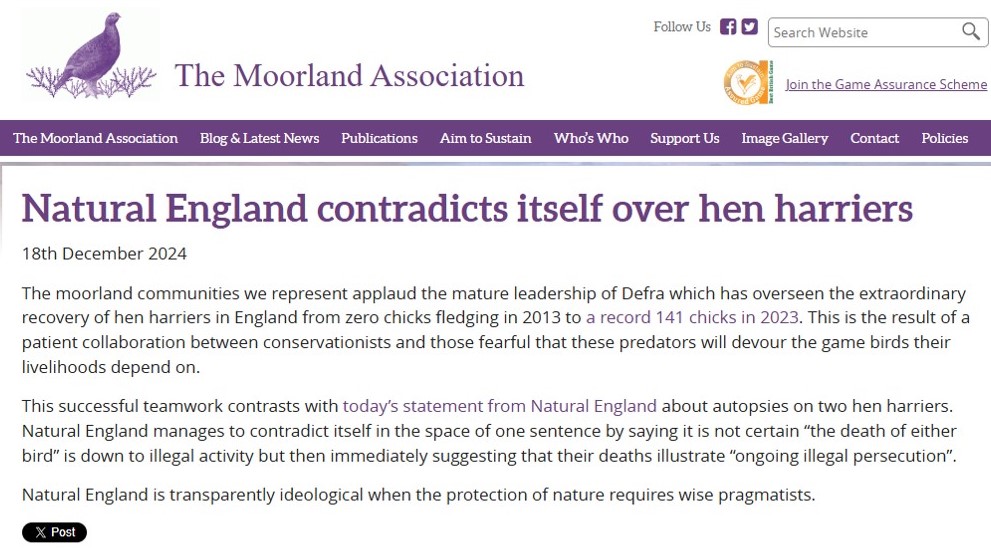
The Moorland Association (the grouse owners’ lobby group) has responded to Natural England’s blog with yet another blatant and shameful attempt at misrepresentation:
In the Moorland Association’s second paragraph, where it purports to quote from the Natural England blog, the Moorland Association blog author has not only removed the context of the post mortem reports, but has also removed several of Natural England’s words, resulting in an entirely distorted (and thus false) ‘quote’.
Natural England wrote:
“The level of decomposition of the bodies led ZSL to conclude that it was not possible to explicitly link the death of either bird to the [shotgun] pellets”.
The Moorland Association wrote:
“This successful teamwork contrasts with today’s infantile press statement from Natural England which manages to contradict itself by saying “it is not possible to link the death of either bird” with illegal activity while also saying that their deaths “serve of evidence of ongoing killing”“.
The Moorland Association has removed the word “explicitly”, removed any reference to shotgun pellets, and then completely fabricated another ‘quote’ from Natural England (“serve of evidence of ongoing killing”).
The Moorland Association blog author is not identified but this level of distortion and misrepresentation has all the hallmarks of Andrew Gilruth, the Moorland Association’s current CEO, who has somewhat of a track record for this kind of shoddy behaviour.
Interestingly, the Moorland Association published its response prior to the Natural England blog being published, presumably after having sight of what Natural England was about to publish.
The Moorland Association has since revised its statement, once Natural England’s blog went live. Here’s how it currently looks:
Even if Andrew Gilruth didn’t write this snidey guff, you’d think as CEO he’d be responsbible for overseeing/approving whatever appears on the Moorland Association’s website.
For how much longer will he remain in post, I wonder? The Moorland Association’s reputation is already in tatters after Gilruth was expelled from the Raptor Persecution Priority Delivery Group (RPPDG) earlier this year after the police accused him of “wasting time and distracting from the real work” of the Hen Harrier Taskforce (see here).
Natural England is currently undertaking a formal review of its ludicrous hen harrier brood meddling sham, with its findings due by the end of this month. Those findings will influence DEFRA’s decision on whether the sham is allowed to continue.
The Moorland Association has already stated it wants brood meddling licences to be issued as a routine part of grouse moor management.
With at least 130 killed/’missing’ hen harriers since the brood meddling sham trial began in 2018, and the Moorland Association’s continual denial and misrepresentation of the bleedin’ obvious, we’ll all be very interested in Natural England’s findings.
Meanwhile, for those who can no longer stomach what’s happening to hen harriers on grouse moors across the country, Wild Justice has another petition calling for a ban on driven grouse shooting. Please sign it HERE.
UPDATE 5th March 2025: Natural England quietly releases intriguing grouse moor location where two shot brood meddled hen harriers found dead (here)
Over the last 17 years or so, satellite-tracking technology has revolutionised our understanding of not only hen harrier ecology, but also the persistent, illegal killing of these birds on driven grouse moors across the UK.
Two organisations have been at the forefront of hen harrier satellite tracking – Natural England and the RSPB (with significant help from raptor study groups and others).
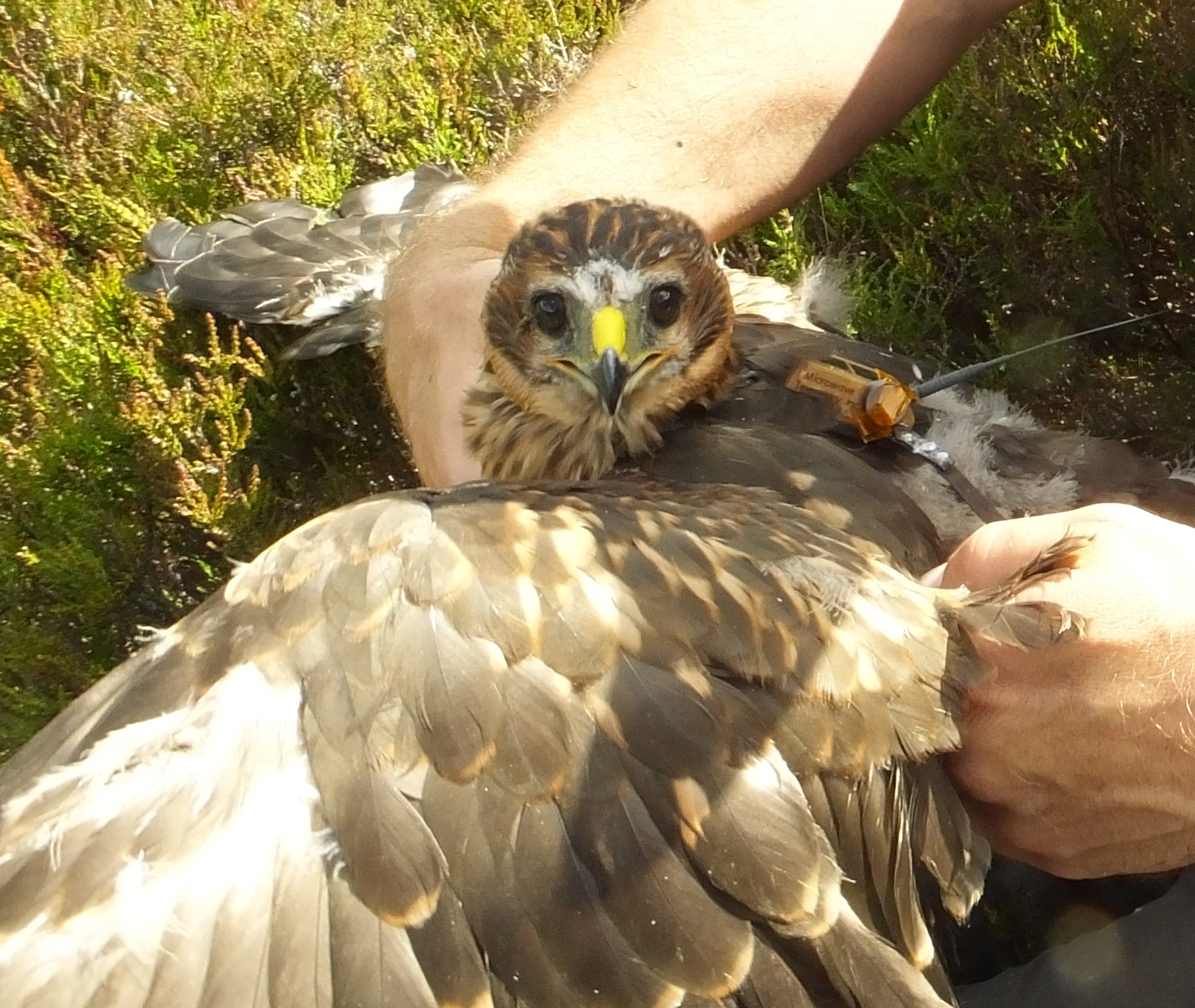
Satellite-tagged hen harrier. Photo by RSPB
For several years now, Natural England has been intermittently publishing the fates of the hen harriers it’s team has tagged (see here), but only with vague explanations about its definition of the category, ‘Missing, Fate Unknown’ (e.g. see here).
Of course, since then, a significant academic paper published in 2019 demonstrated what we all already knew – that patterns of satellite-tagged hen harrier disappearances suggested widespread illegal killing on British grouse moors (see here).
A further paper, published in 2023 and this time analysing the fates of hen harriers tagged by the RSPB, reached the same conclusion (see here).
Since 2018, I have been publishing details about the confirmed/suspected deaths of satellite-tagged (and a few untagged) hen harriers using data from both Natural England and the RSPB (this list currently stands at 130 illegally killed/’missing’ hen harriers although there are still more to add; those data are currently being withheld from the public – see here).
Now, for the first time, the RSPB has launched an interactive map hub showing the fates of hen harriers its team has satellite-tagged since 2014 (currently up to October 2024).
The RSPB’s interactive database includes the fates of 178 of the 226 hen harriers satellite-tagged so far. Some dead hen harriers are not included as they are subject to ongoing police investigations. The hen harriers that are still alive and are currently being tracked are also not included, for what should be obvious reasons.
Screen grab of the RSPB’s new interactive HH map hub
The interactive map hub allows users to filter the ‘fates’ of the RSPB’s tagged hen harriers into five different categories:
Confirmed Illegal persecution
Stop no malfunction (where the bird has disappeared in suspicious circumstances)
Natural
Unknown
Tag failure/expired
Detailed explanations of each of these categories are provided on the hub.
Users are also able to zoom in to the map to show the general area where a harrier died and you can manipulate the map to show terrain etc.
This facility is a useful and welcome addition to the public record on the fates of individual satellite-tracked hen harriers in the UK. I’m not sure it provides us with any wider, big-picture information that we don’t already know but that’s probably not the intention behind this interactive hub anyway. What it does do is provide the public with a level of detail to help them understand the scale of satellite-tagging efforts on the UK’s hen harriers and thus the veracity of the extent of the ongoing illegal killing of this species on many driven grouse moors.
Last month conservation campaign group Wild Justice published a detailed report on the impact of the mis-use and abuse of second generation rodenticides (SGARs) on red kites and buzzards in England and the failure of the Government’s Rodenticide Stewardship Scheme, which had been set up in 2016 to reduce the amount of rodenticides in wildlife (see here for press release and a copy of the Wild Justice report, ‘Collateral Damage‘).
Brodifacoum bait station illegally set on the edge of a grouse moor in the Yorkshire Dales National Park. Photo by Ruth Tingay
Brodifacoum. Photo by Ruth Tingay
On the back of the publication of Wild Justice’s report, Scottish Greens MSP Ariane Burgess lodged the following parliamentary question on 19th November 2024:
Question reference S6W-31459
To ask the Scottish Government, in light of the latest report, Collateral Damage, by the UK campaign group, Wild Justice, which states that the Rodenticide Stewardship Scheme in England “is a failed scheme”, and other reports that have indicated increased exposure to anticoagulant rodenticides in common buzzards in Scotland, whether it has assessed the effectiveness of the rodenticide scheme in Scotland.
The question was answered by Agricultural Minister Jim Fairlie on 3rd December 2024:
The Scottish Government continues to contribute to UK-wide monitoring of rodenticide use and exposure in wildlife. There is evidence that many users of rodenticides are complying with the Campaign for Responsible Rodenticide Use’s (CRRU) Rodenticide Stewardship Scheme (RSS), and that in Scotland rodenticide use in agriculture has substantially declined since the introduction of the scheme. But, despite this, recent environmental data for Scotland indicate that it has not yet achieved the aim of significantly reducing wildlife exposure.
Both the UK Government Oversight Group, which includes Scottish Government representation, and CRRU have acknowledged that rodenticide residues in UK wildlife have not declined as hoped. The RSS is being updated firstly to ban the use of second generation anticoagulant rodenticides (SGARs) bromadiolone and difenacoum for open area use from the end of this year. This means no SGARs will be available for open area use; this is also intended to reduce accidental or deliberate misuse of other products in open areas. Secondly, training requirements for the farming sector are also being brought in line with other sectors from end 2025 to ensure a consistent level of professional training across all sectors and reduce the risk of poor practice.
Whilst it’s true that legal authorisation is being rescinded for the use of the SGARs Bromadiolone and Difenacoum in open areas (see press release on this from June 2023, here), it is very clear from the Wild Justice report that the total increase of SGAR exposure in red kites and buzzards in England is being driven by a dramatic increase in the use/mis-use of Brodifacoum, not by Bromadiolone or Difenacoum.
Fig 3 from Wild Justice’s Collateral Damage report (p8) showing the percentage of buzzards and red kites analysed by the WIIS that contained different concentrations of Brodifacoum, Bromadiolone and Difenacoum.
Brodifacoum is the dominant SGAR being found in birds of prey and is more toxic than Bromadiolone and Difenacoum. It used to be restricted to internal use only, until the Government decided to relax that regulation and permit its use ‘in and around buildings’ – a regulation that is obviously being breached routinely given the high levels of exposure in birds of prey (e.g. here).
From January 2025, Bromadiolone and Difenacoum will also be permitted for use ‘in and around buildings’, but there are no proposed tighter rules on the use of Brodifacoum.
Minister Fairlie suggests that a restriction against any use in open areas of any SGAR is intended to reduce accidental or deliberate mis-use of other products in open areas and that new training requirements for all users (not just professional pest controllers) will ‘reduce the risk of poor practice’.
I suppose he’s thinking that this standardisation will remove any supposed ‘confusion’ between the use of different products. However, given that Brodifacoum is already supposedly restricted to use only ‘in and around buildings’, yet has been used with increasing frequency by gamekeepers for targeting birds of prey, Wild Justice argues that the new legal restrictions are unlikely to improve things significantly.
The Wild Justice report suggests that a better option is to return Brodifacoum to its pre-April 2016 approval status, so that it can be used in strict ‘internal areas’ within buildings, and to limit its use to professional pest control companies.
For those who might have missed it, Wild Justice’s Collateral Damage report can be read/downloaded here:
At the recent REVIVE conference in Perthshire I met a couple of people from a relatively new Scottish-based charity called the KITH Trust, who, along with the University of Edinburgh, had earlier this year bought the Glen Turret Estate in Strathbraan, Perthshire.
Approximate location of Glen Turret Estate in Perthshire
Regular blog readers will know that Strathbraan is dominated by a number of estates with driven grouse moors and the area has been identified in a Government-commissioned report as being a hotspot for raptor persecution. It’s also the area where NatureScot (formerly SNH) licensed a controversial raven cull in 2018 (see here) but then came under fire from its own scientific advisory committee who stated the scientific rigour of the licence was “completely inadequate“.
Glen Turret Estate has been at the centre of police investigations into alleged wildlife crime over a period of many years (no prosecutions or General Licence restrictions, natch) so the news that it is under new management and no longer operating as a driven grouse moor is very welcome indeed.
This should mean an end to the use of things like crow-cage traps, commonly deployed [legally!] on grouse moors in all seasons, where non-target species like this Long-eared owl can no longer be caught and held for over 24 hrs in appalling weather conditions (photo by RSPB).
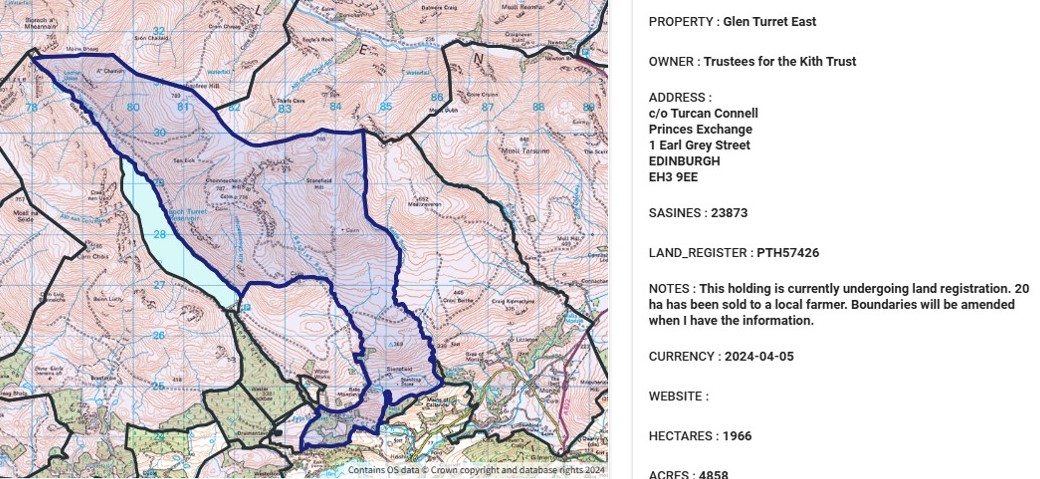
This screengrab shows the new ownership details, from Andy Wightman’s brilliant website, Who Owns Scotland:
This map shows the boundary of the area under Kith Trust management, in addition to the Barvick Burn Wood, now under the management of the University of Edinburgh:
The Kith Trust has kindly provided some information about its plans, for publication on this blog:
The KITH Trust (SC049902), a small Scottish family run charity, took on stewardship of Glenturret Estate in January 2024 in partnership with the Department for Social Responsibility and Sustainability at The University of Edinburgh to facilitate their similar goals of ecological restoration.
KITH Trust is dedicated to restoring and protecting natural ecosystems and supporting biodiversity as well as supporting local community activities and enterprise.
The University intends to fence off part of the estate for a mixed tree planting scheme. They have carried out a community engagement project, archaeological surveys and ecological surveys to ensure any activities are undertaken to work with the natural environment and local communities.
KITH Trust has stewardship of the remainder, mainly hill ground. This land has historically been dedicated to the preservation of red grouse. This practice is no longer a primary aim of Glenturret Estate and it no longer operates as a driven grouse moor. There is a farming enterprise on Glenturret that has been in operation for many years. One of the aims of KITH is to reduce, over time, grazing pressure through farming practices that look after both agriculture and the environment. Another is to restore peatland areas. As a result natural regeneration is supported. Active deer management will be undertaken in collaboration with other members of the South Perthshire Deer Management Group and in conjunction with Nature Scot.
ENDS
The University of Edinburgh has a useful website outlining its plans for the restoration of Barvick Burn Wood here.
No doubt certain organisations from the grouse shooting sector will be very unhappy at the loss of another driven grouse moor and over the coming months/years will be misrepresenting the ecological restoration work, just as they have done with other rewilding efforts (e.g. here).
Some of us don’t want to wait for the buy-out of individual driven grouse moors, we’d like to see a widespread ban on driven grouse shooting sooner rather than later. If you share that view, please sign the new petition from Wild Justice calling for a ban – HERE.








 Raptor Persecution UK