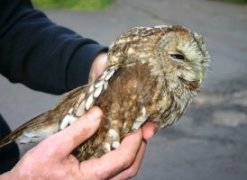
Gamekeeper convicted after trapped buzzard starved to death

Following the post we wrote on 31 May 2012 (see here), another Scottish gamekeeper has been convicted of a wildlife crime offence, this time for allowing a buzzard to starve to death inside a crow cage trap.

Jonathan Smith Graham (30), a gamekeeper on Glen Lyon Estate in Perthshire (see here), pleaded guilty to using a crow cage trap in which a buzzard was trapped and then starved to death. He has been fined £450 which is pretty pathetic when you consider the scope of available penalties (up to £5,000 &/or 6 months in prison), but perhaps more importantly he has now been banned from operating a crow cage trap for five years. Sheriff McCreadie’s comments about Graham’s actions (and in-actions) were also greatly encouraging and are welcomed. Credit to Tayside Police for undertaking the investigation on their own initiative and to wildlife fiscal Shona McJannett for a successful prosecution.

For the details of this case see here, here and here.

Some questions:

1. Will Jonathan Smith Graham be sacked from his gamekeeper job at Glen Lyon Estate now he has a wildlife crime conviction? Ask them directly: sally@glenlyonestate.co.uk

2. Was he/is he a member of the Scottish Gamekeepers’ Association? (His defence lawyer was David McKie – the SGA’s solicitor – just coincidence?). If he is a member, will he be expelled now he has a wildlife crime conviction? Ask them directly: info@scottishgamekeepers.co.uk and while you’re there, ask them if they’re ready to say yet whether convicted gamekeeper Robert Christie (Lindertis Estate) is/was a member (see here).

3. Why hasn’t the SGA issued a public statement condemning the actions of this gamekeeper? Ask them directly: info@scottishgamekeepers.co.uk

4. Is Glen Lyon Estate a member of Scottish Land and Estates? Ask them directly: info@scottishlandandestates@co.uk

Would jubilee’ve it: hen harriers finished in England?

We’ve been hearing rumours that the last remaining pair of hen harriers attempting to breed in England have now failed. We don’t yet have confirmation but several (usually reliable) sources are telling us the same thing.

In a recent BBC news article (here), a spokesman from the National Gamekeepers’ Organisation said:

We are unaware of any instance of human interference with hen harriers in England in recent years“.

Yeah, of course you are. Just like Bashar al-Assad is unaware of any instance of government troops massacring the Syrian people?

So, while the country celebrates ’60 glorious years’, take a moment to reflect on the effects of 60 years of raptor persecution.

Inadmissable evidence: double standards for wildlife crime offences?

In February we blogged about the Crown Office & Procurator Fiscal Service (COPFS) decision not to accept the video evidence showing a head gamekeeper apparently bludgeoning crows to death with a stick inside a crow cage trap on a Scottish sporting estate (see here). The video had been filmed by a field officer from the charity OneKind who, by chance, happened to be in the right place at the right time (or the wrong place at the wrong time, depending on your view).
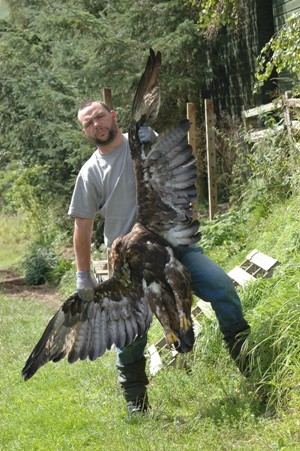
OneKind appealed against the COPFS decision not to initiate court proceedings against the gamekeeper but the Lord Advocate ruled that the COPFS decision would stand. In response, OneKind submitted a petition to the Scottish Government, signed by over 2,000 members of the public who were disgusted by what they’d seen in the video. OneKind asked the Scottish Environment Minister, Stewart Stevenson, for greater clarity on what is / isn’t considered admissable evidence in wildlife crime cases.

Here’s his reply:

“….the Scottish Government believes it is vital to all our efforts in tackling wildlife crime, for members of the public who come across anything suspicious to report what they have seen to the police.

I would however note that there is a difference between cases where members of the public come across evidence that seems to point to a wildlife crime, and those cases where a person who is employed as, or is acting in some capacity as, a wildlife crime investigator, reports such evidence. It is for the Crown Office to decide on how a court would deal with evidence in either of those cases, and their decision on whether to prosecute a case is final”.

See here for the full update on the crow-killing incident provided by OneKind.

So, what have we learned? If you’re a member of the public who doesn’t really know what you’re looking at, or how to record evidence that might be crucial in a subsequent prosecution, then your ‘evidence’ will probably be admissable. However, if you’re someone who knows exactly what you’re looking at and has been trained in the best techniques of evidence collection and preservation, then your evidence will probably be inadmissable.

And the logic in that is….what, exactly? Are there any other areas of criminal law where these double standards apply? (This is a genuine question – we don’t know the answer but would like to hear from anyone who can enlighten us and help us to understand these rules).

Is it any wonder our wildlife crime conviction rates (and especially for raptor persecution incidents) are so pathetically low? How many more legal obstacles are going to be placed in the way of bringing these criminals to justice?

Yet another golden eagle mysteriously ‘disappears’

Last month we blogged about the ‘disappearance’ of a satellite-tagged golden eagle (see here). Now 22 days later we’re blogging about another one. Isn’t it strange how many UK satellite-tagged raptors go ‘missing’; not just golden eagles, but white-tailed eagles, hen harriers and red kites too. Wonder how these figures compare with tagged raptors in other parts of the world?
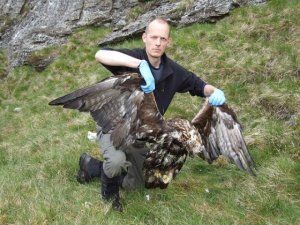
The last signal from the latest young golden eagle (#32857) to go ‘missing’ was received on May 11, just to the north-east of the Cairngorms National Park (see here).

Was it just a satellite tag failure and the eagle is still alive and well? Possibly.  Did it die of natural causes? Possibly. Was it poisoned? Possibly. Was it shot? Possibly. Was it caught inside a crow cage trap and bludgeoned to death? Possibly. Will we ever find out? Possibly. If it is found to have been killed illegally, will the perpetrator be brought to justice? Probably not (see here for the ever-growing list of dead and/or missing eagles in recent years for which nobody has ever been prosecuted).

Somebody asked a question the other day and we’ve still not been able to provide an answer:

What does it take to secure a conviction for killing an eagle in the UK?”.

We’ve heard all the excuses in the book, some valid, some not:

(i) The discovery of a poisoned eagle on a sporting estate isn’t enough to secure a conviction because either it could have been poisoned elsewhere and then flown to die at that location, or, it could have been ‘planted’ on the estate by the anti-game-shooting lobby (according to claims made by various gamekeepers over the years although without any actual evidence).

(ii) The discovery of a poisoned eagle lying next to a poisoned bait on a sporting estate isn’t enough to secure a conviction because it’s virtually impossible to identify which individual gamekeeper laid the bait, especially when they all deny it.

(iii) The discovery of a poisoned eagle and a stash of the same poison found on premises on the same sporting estate, and an admission from an individual gamekeeper that he had sole access to the poison isn’t enough to secure a conviction because….well, we don’t know the answer to that one, you’d have to ask COPFS.

(iv) The discovery of a poisoned eagle and a stash of the same poison found in vehicles and traces of it on knives and gamebags on the same estate isn’t enough to secure a conviction because….we don’t know the answer to that one either – ask COPFS.

(v) What if somebody was filmed laying out a poisoned bait and was then later filmed returning to remove the eagle poisoned by that bait? The film evidence would probably be ruled inadmissable because the cameraman was operating ‘covertly’ (i.e. without the landowner’s permission!).

(vi) What if a gamekeeper was found with a dead eagle in the back of his vehicle, and the eagle had injuries consistent with being caught in an illegal spring trap (e.g. broken legs) and having had its head caved in with a blunt object (e.g. smashed skull)? This wouldn’t be enough to secure a conviction because the keeper would probably claim he had just found the dead bird and was taking it home to report it to the authorities. At best he’d be charged with ‘possession’.

The shocking truth is, there has never been a successful prosecution for the illegal killing of an eagle in the UK, in spite of the sometimes overwhelmingly compelling evidence in some cases. So, just what does it take for someone to be convicted of killing an eagle in the UK?

Scottish gamekeepers in court: latest

Two cases against two Scottish gamekeepers have been heard recently at Perth Sheriff Court:

David Campbell, head gamekeeper at Edradynate Estate, Perthshire, is charged with various offences relating to firearms and explosives (see here). His case has been continued for an intermediate diet on 26 July 2012. At that hearing it will be decided whether the case proceeds to trial on 20 August 2012. This is an interesting one for several reasons which will become clear in due course.

Jonathan Graham, apparently a gamekeeper at Glenlyon Estate, Perthshire, is charged with three offences under the Wildlife & Countryside Act (Section 5 (1) (b) relating to the prohibition of certain methods of killing or taking wild birds. The hearing was continued today until 27 June 2012. Those of you interested in the topical subject of crow cage traps (see here) might want to follow this case.

Crow traps: what you should know part 1

Without even the tiniest weeniest hint of irony, the Scottish Gamekeepers Association is complaining about ‘criminal activity in the countryside’ in reference to the recent alleged release of crows from a trap on a Scottish sporting estate.

Oh and it gets better…. according to the SGA, in response to this criminal activity Northern Constabulary has “issued an appeal for information”. Although we should point out that we’ve been unable to find any public record of this ‘appeal for information’ so we only have the SGA’s word to rely upon. But let’s assume the SGA is telling the truth…

Is this the same Northern Constabulary who apparently failed to fully investigate the suspected decapitation and shooting of a white-tailed eagle on Skye (see here) and the discovery of a poisoned red kite on the boundary of Skibo Estate (see here)?

That’s not the end of the irony either – the SGA goes on to suggest that cameras could be installed at crow traps, presumably to film any member of the public who may be inclined to interefere with the trap (which may amount to a criminal offence). Wouldn’t it be interesting to see whether that film footage would be considered as acceptable evidence in any subsequent prosecution, especially after recent film footage showing the activities of a Scottish gamekeeper using a stick to beat crows to death inside a crow trap on a Speyside sporting estate (see here), was deemed inadmissable evidence?

One rule for one but not the other? Surely not!

In light of the SGA’s recent one-sided promotion of crow traps and their encouragement to SGA members to report suspected trap interference (see here for their article) as well as the landowners’ representative body, Scottish Land and Estates, encouraging their members to do likewise (see here), we thought it only fair that we provide an alternative view on the use (and more importantly the mis-use) of crow traps on Scottish sporting estates and give the public the neccessary information about how to recognise the difference between a legal and an illegal trap, and what to do if you find an illegal one.

Watch this space…

Outrage at (more) Peak District bird of prey persecution

The RSPB and Severn Trent Water have today expressed their outrage at the ‘wanton destruction’ over the last few days of the nest of one of Britain’s most persecuted raptors. Goshawk eggs, only days from hatching, were found smashed underneath a nest in the Upper Derwent Valley on land managed by Severn Trent Water.

It is the latest in a long line of raptor persecution incidents in the Peak District (see here for a 2006 RSPB report aptly named Peak Malpractice, and here for a 2007 updated report). The last reported incident was the case of gamekeeper Glenn Brown, who was convicted last year after RSPB investigators filmed him using a caged pigeon to lure raptors into a trap on National Trust-owned Howden Moor (see here). This latest incident demonstrates just how ineffective Brown’s sentence was (100 hours community service ‘ain’t gonna deter anybody – sure, he also had to pay costs but do you really think he’ll be paying those from his own pocket?). That this latest attack has happened at all should come as no surprise to anybody.

The RSPB says this now leaves only one known active goshawk nest in the entire Derwent Valley, which previously had held six pairs. The RSPB is offering a £1,000 reward for information leading to a conviction.

RSPB press release here

Big, big day in court (part 5): Glen Orchy golden eagle

Here we go….

Tom McKellar, previously reported as being a gamekeeper (see link below for his earlier conviction for possession of illegal guns) but currently reported as being a farmer, has today pleaded guilty at Oban Sheriff Court to being in possession of the illegal pesticide Carbofuran.

This poison stash was discovered during a multi-agency raid on McKellar’s house in June 2009, where investigators found three separate containers of Carbofuran as well as traces of it in a syringe.

McKellar reportedly admitted during a police interview that he had, “in the past”, placed the poison out on laced meat to kill foxes.

Sentencing was deferred until 29 May 2012 for background reports.

McKellar had previously been charged for the illegal possession of two handguns, kept in his attic, that came to the attention of the police during the raid. On conviction, instead of receiving the mandatory five year jail sentence, he was given just 300 hours of community service (see here).

What has not been mentioned in the press (so far), is that McKellar’s house was raided after the discovery of a poisoned golden eagle, reportedly found with the body of a fox and a sheep carcass at Glen Orchy in June 2009 (see here and here). Toxicology tests reportedly detected Carbofuran on all three animals, although interestingly, only the golden eagle results appear in the official SASA results table; the sheep and the fox results are only mentioned in the RSPB’s 2009 report.

Does today’s reporting mean that McKellar, or anyone else, has not been charged with poisoning the golden eagle?

Rest assured, this is not the last we will be writing about this case…

COPFS press release here

STV article here

Is this convicted gamekeeper a member of the SGA?

Last Tuesday (3 April 2012), Scottish gamekeeper Robert Christie of the Lindertis Estate was convicted at Forfar Sheriff Court of wildlife crimes (see here).

Nine days later, we are still waiting for the Scottish Gamekeepers Association (SGA) to issue a public statement condemning the criminal activities that led to the conviction and also clarifying Christie’s SGA membership status. Was he an SGA member at the time he committed the offences (2010)? If so, is he still a member now he has a criminal conviction?

It’s unusual for the SGA to be so coy about the membership status of a convicted gamekeeper. To their credit, in each of the cases that have been heard so far this year (and even in one case that didn’t even make it to court – the crow trap video case), the SGA has been quick to publicise whether the accused/convicted gamekeeper was an SGA member.

So why so coy this time? Perhaps we should give them the benefit of the doubt and assume that they just got caught up in the Easter holidays and haven’t got around to making a statement yet. Although they have managed to find the time to add various other news items to their website, including an announcement about a forthcoming snaring training course at a choice of venue that certainly raised our eyebrows (see here).

If anyone has tried to contact the SGA about Christie’s membership status we would be very interested to hear about it. For anyone who wants to ask them now, here are the SGA’s contact details:

Email: info@scottishgamekeepers.co.uk

Tel (Perth Office): 01738 587515

Why convicted gamekeeper Robert Christie only got a telling off

Two days ago we blogged about Scottish gamekeeper Robert Christie (Lindertis Estate) who was convicted at Forfar Sheriff Court after pleading guilty to wildlife crimes (see here).

Since then there has been a fair bit of press coverage but the media hasn’t really picked up on the fact that Christie’s ‘punishment’ was just an admonishment (effectively a telling off), even though the available penalties included a fine of up to £5,000 and/or a six month prison sentence.

However, an article published in yesterday’s Courier did include commentary about the penalty:

“…Sheriff Kevin Veal at Forfar decided not to impose a penalty on gamekeeper Robert Christie after hearing the ‘immediate and draconian consequences’ connected with breaching a trapping licence could render the 57-year-old unemployable for the rest of his working life”.

Christie’s solicitor, David McKie (who also happens to be the SGA’s solicitor – see here), reportedly commented:

There are implications under the general licence – if the court imposes anything more than an admonition the licence is automatically withdrawn for five years“.

Was what Christie did the crime of the century? No of course it wasn’t, but what it was, without a doubt, was a criminal offence under the wildlife legislation. It seems astonishing that the Sheriff would decide not to impose any penalty, especially given the current high priority that the Scottish Government has placed on tackling wildlife crime.

What we are seeing yet again is an inconsistency in sentencing (compare Christie’s penalty with that of Aswanley Estate gamekeeper Craig Barrie who was recently fined £520 for illegal use of a trap, see here) and the sense that wildlife crime is still not being taken seriously by some Scottish courts. Do you think this defence would be acceptable for other offences, such as a drink driving taxi driver? ‘Oh, sorry m’Lord, yes I was drunk when I drove my car and I really should have known the consequences of doing this as driving is my profession but the immediate and draconian measure of losing my licence will also mean I lose my job’.

Talking of taking wildlife crime seriously, the Scottish Gamekeepers’ Association has not yet issued any public statement of condemnation for Christie’s actions, nor have they said whether he is/was an SGA member. To find out about Christie’s SGA membership status, send an email to: info@scottishgamekeepers.co.uk

Article in the Courier here