Case against gamekeeper George Mutch: part 4

Criminal proceedings against Scottish gamekeeper George Mutch continued today at Aberdeen Sheriff Court. His case was continued without plea for the 4th time.

His 5th court hearing will be on 16th December.

Mutch, of Kildrummy Estate in Aberdeenshire is understood to be facing six charges of alleged wildlife crime under Sections 1 & 5 of the Wildlife & Countryside Act. These sections relate to the protection of wild birds and prohibited methods of killing and taking wild birds.

For previous posts about this case see here, here and here.

So long, Sheriff Drummond

One of the most influential figures in the world of Scottish wildlife crime enforcement, and particularly in relation to raptor persecution, has finally retired. There are some who will be delighted with this news, others not so much.

Sheriff Kevin Drummond QC left office this week after 13 years in the Sheriff courts of the Scottish Borders. In addition, he’d played a significant role on various PAW Scotland committees, including Chair of the Legislation, Regulation and Guidance Sub Group (see here), and was a member of the high-level PAW Scotland Executive Group (see here). He was also heavily involved in the provision of ‘mock trials’ as part of a training programme for police wildlife crime officers and procurators fiscal to help prepare them for dealing with wildlife crime trials. Prior to being appointed Sheriff, he had worked as a leading defence QC whose clients included gamekeepers accused of wildlife crimes. His own reported hobbies include shooting and fishing (see here).

An article in the Selkirk Advertiser reporting his retirement (see here) describes the Sheriff as ‘well-respected’, ‘fair and consistent’ and ‘kind and approachable’. We’d agree with ‘consistent’ at least. In a number of cases over which Sheriff Drummond presided around 2006-2007 there was opportunity to sentence the convicted gamekeepers in his court to jail time – a provision that had at the time been recently introduced in an attempt to crack down on raptor persecution. Disappointingly, Sheriff Drummond decided that community service orders were adequate punishments for these convicted poisoners, including one case that had been described by one RSPB investigator as ‘the worst he had seen in 20 years’. This reluctance to send convicted poisoners to jail is still very much in evidence in Sheriff courts right across Scotland – there still hasn’t been a single one.

Sheriff Drummond held strong views against the introduction of vicarious liability – his visibly agitated performance in front of the WANE bill committee in 2010 was quite a display – and he also strongly opposed the concept of increasing the investigatory powers of SSPCA inspectors to allow them to take on raptor persecution cases (e.g. see here).

There were calls for the Sheriff’s dismissal from the PAW Scotland group following another of his outbursts at the Police Wildlife Crime Conference in 2010 when a wildlife investigator asked whether there should be tougher sentences for wildlife criminals. Sheriff Drummond’s reported response, “Get a life“, was met with ‘shock and bewilderment’ by conference delegates but was later defended by then Environment Minister Roseanna Cunningham (see here).

Many years earlier RSPB Investigator Dave Dick also found himself on the receiving end of one of the Sheriff’s seemingly characteristic tantrums. Here’s an excerpt from Dave’s 2012 book, Wildlife Crime: The Making of an Investigations Officer:

Thursday 20 June 1991. Jedburgh Sheriff Court and Jimmy [a gamekeeper] has got himself a QC – or more correctly, Jimmy’s boss, a wealthy Austrian banker, has got Jimmy a QC. Kevin Drummond, QC, who walks into the Fiscal’s office just before the trial is due to start, where I am having a last-minute conference as was the normal, efficient practice by 1991. Kevin announces that he is going to win this case because Section 19 of the 1981 Act does not permit a constable to enter land and search for evidence. The Fiscal may have been used to this robust, even arrogant approach but I wasn’t and in my naivety, combined with experience of Section 19 in court, I blurted out, “Do you really think that’s what Parliament thought, when they drew this up?” The resulting angry out-burst (‘You may be very good at what you do out there, Mr Dick, but in here, I’m in charge!’) was my first sight of an apparent lack of control which I have since witnessed many times“.

It is without question that Sheriff Drummond has had considerable influence on the approach taken to tackling wildlife crime in Scotland, at both a strategic governmental level as well as on the front-line level in court. That influence has been welcomed by some, while exasperating others.

Today is his 70th birthday and we wish him a long and enjoyable retirement – here’s hoping he doesn’t ‘do a Dysart‘ – we’re all hoping for the start of a new era.

Case against gamekeeper George Mutch: part 3

Criminal proceedings against Scottish gamekeeper George Mutch continued today at Aberdeen Sheriff Court. His case was continued without plea for the 3rd time.

The case against Mutch, of Kildrummy Estate in Aberdeenshire was first called for a pleading diet on 11th September 2013. On that date the case was continued without plea until 2nd October 2013 (see here). On 2nd October, the case was again continued without plea until 30th October 2013 (see here). At today’s hearing, the case was once more continued without plea until 27th November 2013.

We understand that Mutch has been charged with up to six alleged offences under Sections 1 and 5 of the Wildlife & Countryside Act; these sections relate to the protection of wild birds and prohibited methods of killing and taking wild birds.

Watching this one with great interest….


More on that vicarious liability prosecution

wane1Regular blog readers will know that we’ve been chasing information about the first potential prosecution under the new vicarious liability legislation for some time.

The case in point relates to the conviction of gamekeeper Peter Bell, who was guilty of poisoning offences on the Glasserton and Physgill Estates in December 2012 (see here).

In July 2013 we asked the Environment Minister for an update on the VL prosecution (see here). He replied in August and said it would be inappropriate to comment as police enquiries had not yet concluded (see here). Fair enough.

By early October we expected the police enquiries to have been completed, ten months after the original offence was committed, so we asked the Environment Minister for an update (see here).

One of our blog readers wrote the following comment a couple of days ago:

I duly sent an e-mail to Mr Wheelhouse about the update on whether or not there would be a prosecution under the vicarious liability following Mr Bells conviction. I’m apparently not allowed to post the reply anywhere but was told Mr Wheelhouse is unable to enter into discussion about such matters and I was pointed in the direction of The Crown Office and Procurator Fiscal Service for any information I might want“.

Interesting. So the first excuse given was that ‘police enquiries had not yet concluded’, and that has now changed to ‘Wheelhouse is unable to enter into discussion’ (and apparently members of the public are not permitted to publish the Minister’s replies to their queries).

Anyone getting the impression that these answers are designed to subdue any further reporting on this case?

Wheelhouse has apparently suggested contacting the Crown Office and Procurator Fiscal Service for the information. Let’s do that, taking note of the word ‘service’ – they are supposedly serving us, the general public.

The thing is, we’re not too sure who within COPFS to contact for this information. Rumour has it that the head of the Wildlife and Environmental Crime Unit (WECU) at COPFS, Craig Harris, has since moved on. Rumour also has it that a new head of unit has been installed although it’s not clear who that person is, although six-figure-Dysart’s name has been mentioned. Hmm.

We could ask the Lord Advocate, Frank Mulholland QC, who is the ministerial head of COPFS, although we’ve been unable to find a direct email address for him.

Let’s try our luck with the COPFS’s general email address and ask the following questions:

Dear COPFS,

Please can you tell us the name of the new head of the Wildlife and Environmental Crime Unit at COPFS? And please could you tell us whether there will be a prosecution under the vicarious liability legislation relating to the poisoning offences carried out at the Glasserton and Physgill Estates in December 2012? Thanks.

Emails to: enquirypoint@copfs.gsi.gov.uk

UPDATE: The email address to use is apparently this: _WildlifeSpecialists@copfs.gsi.gov.uk  Please note the underscore at the beginning of the address. Thanks to the contributors who have provided this new address.

Benyon given the boot

Some good news! Richard Benyon MP, the DEFRA minister, has been booted out in today’s Government reshuffle. He now returns to the back benches, presumably with more time to pursue his ‘sporting’ interests on his grouse moor in Scotland and his pheasant shoot estate in Berkshire.

Benyon had been in post at DEFRA for just over three years, with special responsibility for biodiversity and the natural environment, amongst other things (see here).

He is best known to us for being in office when a buzzard ‘management’ trial was sanctioned in 2012 (see here) which DEFRA almost got away with until public opinion forced a speedy government u-turn (see here).

Benyon also refused to criminalise the possession of the banned poison Carbofuran in England (see here) and didn’t see the need to introduce vicarious liability in England, but instead applauded gamekeepers “for the wonderful work they do in providing excellent biodiversity across our countryside” (see here).

Good riddance.

Vicarious liability prosecution?

wane1On July 1st this year, Environment Minister Paul Wheelhouse set out his proposed ‘further measures’ to tackle the continuing problem of illegal raptor persecution (see here).

In response to his announcement, on July 2nd we asked him (see here) for clarification on some of these ‘further measures’ and also for updates on some previously promised measures, including prosecutions under the new vicarious liability legislation.

On August 4th we blogged about the Minister’s responses to our questions (see here).

One of the questions we’d asked him was this:

Question 3:

Please can you advise whether there will be a prosecution under the new vicarious liability legislation following the recent conviction of gamekeeper Peter Bell, found guilty of poisoning offences on the Glasserton and Physgill Estates? If you don’t know the answer (which would be surprising, given that you said in March 2013 that you would be “keeping an eye on this particular area [i.e. vicarious liability] with interest”, please can you provide the contact details of someone who can answer the question?

The Minister’s response was this:

It would be inappropriate to comment further on this case as police enquiries have not yet concluded.

At the time we said we weren’t too impressed with this response, seeing as though 8 months had already elapsed since the original crimes were committed (in December 2012). However, as this was the first time a potential prosecution had been considered under the new legislation, we didn’t have a benchmark for how long these cases might take. We also said we would ask, periodically, for updates on this case so that it couldn’t be quietly swept under the carpet.

It’s now October, ten months after the original crimes were committed, and there’s still no official word. We thought it was time to ask the Minister for another update.

Dear Paul Wheelhouse,

Please could you provide an update on whether there will be a prosecution under the new vicarious liability legislation following the recent conviction of gamekeeper Peter Bell, found guilty of poisoning offences on the Glasserton and Physgill Estates?

Thanks.

Emails to: ministerforenvironment@scotland.gsi.gov.uk

Case against gamekeeper George Mutch: part 2

Criminal proceedings against Scottish gamekeeper George Mutch continued today at Aberdeen Sheriff Court.

Mutch, from Kildrummy Estate in Aberdeenshire, is understood to have been charged with six alleged offences under Sections 1 and 5 of the Wildlife & Countryside Act.

Section 1 of the Act is concerned with the protection of wild birds, their nests and eggs.

Section 5 of the Act is concerned with the prohibition of certain methods of killing and taking wild birds.

This case opened last month (see here) for a pleading diet, but was continued without plea until today’s hearing. The case was adjourned again today, still without plea, until 30th October.

As we wrote last time, this case is of particular interest on several levels and is expected to attract a great deal of interest. Watch this space…

Why we don’t trust the National Gamekeepers’ Organisation

A few days ago, Charles Nodder, Political Advisor to the National Gamekeepers’ Organisation (NGO), wrote on this blog:

You should regard us [the NGO] as a key part of the solution [to stamping out illegal raptor persecution], not part of the problem. An organisation to be supported, not attacked”.

The thing is, in order to support an organisation there first needs to be a level of trust. It’s very hard for us to trust the NGO, and here’s why…

Until recently, we were under the impression (mistakenly, as it turns out) that the NGO wouldn’t tolerate any illegal gamekeeping activity and if any of their members were convicted of such an offence, they would be expelled from the organisation. This is what the NGO wants us all to believe, as outlined in their own Disciplinary Code, as published on their website.

However, it would now appear that the NGO does, in our opinion, tolerate some illegal gamekeeping activity. This has only come to light because we discovered that the NGO member who has been applying for licences to kill buzzards (and now sparrowhawks too) was recently convicted for being in possession of several banned poisons, including Carbofuran, the most common poison used to illegally kill birds of prey. We have now discovered that the NGO member, who we have called Mr Buzzard Licence Applicant, was not booted out of the NGO following his conviction for a wildlife crime that is closely linked with the illegal poisoning of birds of prey. Not only was he not booted out, but the NGO then actively supported this member by helping him to apply for his buzzard and sparrowhawk-killing licences.

When challenged about this, Mr Nodder provided some fascinating responses on this blog (see here). Before we take a closer look at those responses, we would first like to acknowledge Mr Nodder’s willingness to engage in conversation on this blog. That’s to his credit; there are many others within the game-shooting industry who have repeatedly refused to engage with us, citing excuses such as, “We don’t communicate with anonymous individuals” but who then go on to complain that we publish articles without giving them the right to reply!! Quite an astonishing response given today’s world of multi-media and social networking communications. A missed opportunity for them, but not really that surprising when you consider that many of them are still hanging on to other 19th Century ideals.

Anyway, back to that NGO policy of supposedly not tolerating any illegal gamekeeping activity.

To begin with, Mr Nodder tried to claim that “The possession of a banned substance [and remember we’re talking here about banned poisons that are routinely used to illegally poison wildlife] is quite clearly a possession offence and not an offence against wildlife”. We were astounded by this comment. There are many, many examples of ‘possession’ offences that are inextricably linked to wildlife crime. Here are just a few examples:

  • Possession of a dead red kite (see James Rolfe case).
  • Possession of 10.5kg of the banned poison Carbofuran (see Dean Barr case).
  • Possession of the banned poison Carbofuran (see Cyril McLachlan case).
  • Possession of wild birds eggs (see Matthew Gonshaw cases).
  • Possession of an illegal pole trap (see Ivan Crane case).
  • Possession of a wild bird (see Craig Barrie case).
  • Possession of live & dead birds for trade/taxidermy (see Gary McPhail case).
  • Possession of the banned poison Alphachloralose (see David Whitefield case).
  • Possession of the banned poison Carbofuran (see Tom McKellar case).
  • Possession of wild birds (see Cogoo Sherman Bowen case).
  • Possession of the banned poisons Carbofuran, Strychnine and Alphachloralose (see Peter Bell case).
  • Possession of wild birds eggs (see Keith Liddell case).
  • Possession of the banned poison Sodium Cyanide (see William Scobie case).
  • Possession of dead wild birds (see Luke Byrne case).
  • Possession of the banned poisons Carbofuran and Alphachloralose (see Graham Kerr case).

In many of these example cases, poisoned and/or other illegally killed raptors were also discovered. Indeed, in many cases it is the discovery of these poisoned animals that then leads on to a police investigation and search that then leads to the discovery of a stash of banned poisons. Quite often, as we all know, the subsequent charges that are brought do not often include charges for actually poisoning the wildlife, but instead the charges relate to the ‘lesser’ (in legal terms) offence of ‘possession’, either due to plea bargaining or due to lack of evidence needed to secure a conviction for the actual poisoning of a wild animal. It stands to reason that the actual poisoning of wildlife is inextricably linked to the possession of banned poisons; in order to poison wildlife, the criminal obviously first has to be in possession of the poison to carry out the act of poisoning.

The National Wildlife Crime Unit defines the possession of a banned poison as a wildlife crime – the Unit often publicises convictions for the possession of banned poisons in its reports. The Scottish Government also defines convictions for possession of banned poisons as wildlife crime – indeed, this is one of the offences that can trigger a prosecution under the new vicarious liability legislation, brought in specifically to address the continuing illegal persecution of raptors. The Crown Office considers possession of banned poisons as a wildlife crime because its specialist wildlife prosecutors take on these cases. The Partnership for Action against Wildlife Crime (PAW, of which the NGO boasts membership) also considers possession of banned poisons a wildlife crime – they, too, publicise ‘possession’ convictions in their newsletters.

So why is it that the National Gamekeepers’ Organisation doesn’t accept possession of banned poisons as a wildlife crime? And if they don’t, why the hell are they allowed to participate in the Raptor Persecution Wildlife Crime Priority Group? Surely that group has been established to find ways of stamping out illegal raptor persecution, but how can it achieve that if one organisational member refuses to expel members who have been convicted of a serious wildlife crime? It makes a mockery of the whole group and does absolutely nothing to instill public confidence in the sincerity of the process.

Mr Nodder’s next explanation for why Mr Buzzard Licence Applicant wasn’t booted out of the NGO was to suggest that possession of a banned poison was not a ‘gamekeeping activity’. On the contrary, if Mr Nodder took the time to look at the conviction statistics (publicly available to those who want to look) he would notice that the significant majority of those convicted for possession of banned poisons are gamekeepers, and that trend has continued for many years. In the case of Mr Buzzard Licence Applicant, his stashes of banned poisons were found in his work vehicle and inside one of his pheasant pens. There’s simply no denying it, unless of course you happen to be the NGO, trying to justify why you haven’t stuck to your stated Disciplinary Code and expelled a member for his criminal conviction.

And what sort of message does this policy send to other NGO members? ‘Don’t worry if you get caught in possession of banned poisons, we won’t kick you out of the club’. It makes you wonder what the law-abiding members of the NGO feel about this policy. If you were a law-abiding member (and there must be some, surely), would you want to be a member of a group that welcomed those with a criminal conviction related to banned poisons? If the NGO doesn’t distinguish between criminal and law-abiding members, why should we?

The third argument Mr Nodder used to try and get us to drop what must be quite embarrassing questions was to pull out the old ‘It’s a spent conviction so we can’t discuss it’ routine. Nice try, but in this case, wholly inapplicable. The legislation that prevents publication of so-called ‘spent convictions’ is the Rehabilitation of Offenders Act 1974 (see here for a good explanation). Its basic premise is that after a period of x years of rehabilitation (depending on the type of crime committed – in this case, five years), the conviction can be ignored and need not be divulged (with one or two exceptions). If somebody does then publish information about the conviction, they may be subject to libel damages, but only if the primary motive of publishing the information was malicious. In this case, seeing as though we haven’t named Mr Buzzard Licence Applicant, even though we’ve had lots of opportunity to do so (and indeed our own received legal advice was that we could name him), it would be extremely difficult, if not impossible, to demonstrate that we are acting in malice (against him as an individual) by discussing his spent conviction because he hasn’t been identified as a named individual. Our primary motive for discussing this case has been to (a) examine the Natural England/DEFRA policy that allows convicted wildlife criminals to apply for licences to kill protected species (see earlier blogs on this), and (b) to examine the sincerity of the NGO’s claims that they won’t tolerate any illegal gamekeeping activity and will expel any member with such a conviction.

And while we’re on the subject of the Rehab of Offenders Act, we’ve made a very interesting observation. Certain professions are exempt from the Act, so that individuals are not allowed to withhold details of previous convictions in relation to job applications. These professions include teachers, social workers, doctors, dentists, vets, accountants etc. But interestingly, also included are “Employees of the RSPCA or SSPCA whose duties extend to the humane killing of animals”. Now then, it is beyond question that the duties of gamekeepers ‘extend to the humane killing of animals’. They probably kill (legitimately) more animals on a daily basis than all the RSPCA and SSPCA employees put together. So why are gamekeepers not included in this list of exemptions? Why should a gamekeeper be able to hide past wildlife crime convictions but an RSPCA/SSPCA employee cannot? That’s a question for the policy makers…

In summary then, in our opinion the NGO’s stated claim that they don’t tolerate any illegal gamekeeping activity is not convincing. They don’t view the possession of a banned poison as a wildlife crime and a conviction for possession of a banned poison is not enough to warrant expulsion from the NGO, even when that poison just happens to be the most commonly used substance to illegally kill birds of prey. It doesn’t matter to us how many wildlife crime groups the NGO has joined – in our view this is just a convenient shield for hiding true intentions – we don’t trust them and will continue to view them with suspicion until they start to back up their stated claims with convincing actions.

SGA Chairman’s ignorance could fuel goshawk persecution

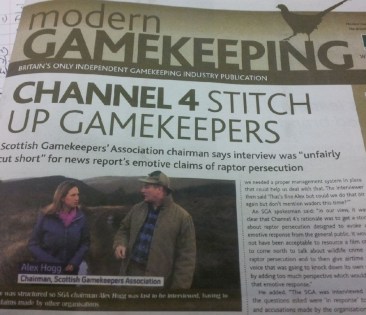
The Scottish Gamekeepers’ Association has recently published its autumn magazine. It’s full of quite remarkable material, as you might expect. We’ll be blogging about some of the articles in due course but thought we’d start with the ‘Chairman’s Column’, written by Alex Hogg.

He writes about a few issues but of particular concern to us is what he wrote about goshawks. Here’s an excerpt:

My local newspaper has just published an article on ringing chicks at a goshawk nest on forestry commission ground. In the article, gamekeepers are criticised for persecuting goshawks, without any attempts at providing proof, journalistic balance or an attempt to look at the history of the goshawk in Scotland. For the past 35 years I have lived with goshawks on my doorstep. I strongly believe the goshawk never was indigenous to the United Kingdom and there is absolutely no hard evidence to suggest otherwise. Those that illegally released this species into the British Isles could legitimately be charged, therefore, with a wildlife crime. These nests in the article are in commercial forestry where there is nothing whatsoever for the poor chicks to eat. What happens then? The young make their way out onto keepered ground, managed at significant cost and time to create a richness in biodiversity. Our local red squirrel population is now under severe threat and much of this can be put down to predation by the goshawk. Most raptors will eat what they kill. The goshawk will kill over and over again. The largest number of pheasant poults I lost on a stubble in one strike was 35. God knows what this could mean for our poor Curlews and Lapwings, teetering on the brink. Balance must surely be considered before we lose more precious species“.

Hogg’s display of ignorance about this species is quite staggering. The history of the goshawk in the British Isles, including its indigenous status, has been very well documented in many scientific papers and books, as have the effects of the relentless persecution it has suffered and continues to suffer, as well as its varied diet which changes according to latitude and habitat (he should try reading this and the references listed as a basic introduction).

Such is the concern about ongoing goshawk persecution that the species is listed by the National Wildlife Crime Unit as one of the ‘priority species’ to focus on, along with golden eagle, hen harrier, peregrine, red kite and white-tailed eagle. Every single one of these species is suffering population-level effects thanks to the illegal persecution carried out by those with game-shooting interests. As a participating member of PAW Scotland and PAW Scotland’s Raptor Persecution Group, Hogg should be very well aware of the pressures already facing this species.

For somebody in his position to be writing such unsubstantiated nonsense about an already significantly-threatened raptor is completely unacceptable. There will be some readers of the SGA magazine who will assume that Hogg’s information is reliable and credible and could use it as justification to persecute the goshawk.

Hogg should be hauled over the coals by the PAW Scotland group for such ignorance and irresponsibility.

We’ll be returning to the issue of goshawk persecution by gamekeepers in the very near future…..watch this space.

Gos1


Gamekeeper convicted for theft & massive illegal stash of ammunition & pesticides

Knights ammoGamekeeper Andrew Knights, 47, of Sandy Lane, Dereham, in Norfolk has been convicted for stealing over 7,500 rounds of ammunition and cartridges from his former employer, and for possessing 5,200 rounds illegally, and for illegally storing 36 canisters of the pesticide Talunex in his bedroom.

The offences were so serious (read the details in the news links below) that his case was heard at Norwich Crown Court as opposed to a Magistrates Court. On Monday he was given a 15-month prison sentence, suspended for 18 months, and a £1,000 fine. One report suggests he also received a 200-hour community service order. Essentially then, as long as he doesn’t commit any offences for the next 18 months, all he got for these offences was a £1,000 fine, and possibly a few weeks of unpaid work. Quite incredible, considering the scale of his criminal activities and the very high risk of danger to his family, neighbours and visitors to his home.

Excellent work by Norfolk Constabulary, Natural England, and the Health & Safety Executive who worked together to bring this case to court. As usual, the sentencing was a major disappointment; it was just a fraction of what could have been imposed.

Wonder if Mr Knights was/is a member of the National Gamekeepers’ Organisation? So far there’s been no comment about it on their website (here). Let’s ask them! Emails to: info@nationalgamekeepers.org.uk

Norfolk Constabulary press release here

BBC news here