First vicarious liability prosecution: part 3

Criminal proceedings continued today against Ninian Robert Hathorn Johnston Stewart in the first known vicarious liability prosecution under the WANE Act 2011.

Mr Johnston Stewart, the landowner of Glasserton & Physgill Estates, is charged with being vicariously liable for the criminal actions of Glasserton gamekeeper Peter Bell, who was convicted in 2013 of laying poisoned bait which killed a buzzard (Carbofuran) and possession of three banned pesticides (Carbofuran, Strychnine and Alphacloralose) (see here).

Today’s hearing was continued for an intermediate diet on 8th December 2014.

Previous blogs on this case here and here

Case against Scottish gamekeeper William Dick: part 4

Criminal proceedings continued today against Scottish gamekeeper William Dick.

Dick, 24, of Whitehill Cottages, Kirkmahoe, Dumfries is accused of bludgeoning and then repeatedly stamping on a buzzard. The offences are alleged to have taken place in Sunnybrae, Dumfries in April 2014. Dick has denied the charges.

Today’s hearing was a notional diet and the next hearing will be an intermediate diet on 24 February 2015. A provisional trial date has been set for 23 March 2015, pending the outcome of the intermediate diet in February.

Previous blogs on this case here, here, here

Ross-shire Massacre: Police Scotland, see what you’ve done?

Last Friday, Police Scotland put out an idiotic press release stating that they could now CONFIRM that the 22 raptors illegally poisoned in the Ross-shire Massacre seven months ago “were most likely not deliberately targeted“. It was an astonishing statement, not least because they had ruled out criminal intent before they’d even got a suspect, and despite the fact that those birds are known to have been killed with a banned poison. We blogged about it here and we’ll be blogging further on this shortly, following the grilling that senior police officers received during yesterday’s Scot Gov RACCE Committee hearing (see here).

Following that Police Scotland press statement, Tim (Kim) Baynes of Scottish Land & Estates wrote a letter to the Herald complaining about media speculation and stating (falsely) that raptor persecution crimes had declined (see here).

In response to that letter, yesterday Duncan Orr-Ewing of RSPB Scotland set out the facts about the increase in raptor persecution crimes (see here).

Today, another letter has appeared in the Herald, in response to Duncan Orr-Ewing’s letter. This letter was tweeted by the SGA this morning, with the following statement: “Herald letter from Ayrshire reader on the legal concept of innocent until proven guilty”.

Here’s the letter:

Thursday 30 October 2014

RSPB has its own agenda

DUNCAN Orr-Ewing, Head of Species and Land Management for RSPB Scotland, does not let the facts get in the way of his argument (Letters, October 29).

I would remind Mr Orr-Ewing that he stated in this very journal that a crime had been committed with the poisoning of raptors on the Black Isle and he then proceeded to promote his agenda against gamekeepers and shooting estates. Police Scotland has stated that no crime was committed, but that has not stopped RSPB advocating regulation which would allow it to attempt to criminalise legal businesses.

Rather than being a positive, the involvement of RSPB in police investigations creates a massive question about impartiality. This underlines the danger of allowing bodies with their own agendas to be involved in criminal investigations. They appear willing to ignore the fact that in this country we are all innocent until proven guilty.

David Stubley,

22 Templeton Crescent, Prestwick.

So Mr Stubley thinks that the Ross-shire Massacre was not a crime. This is precisely why Police Scotland should never have issued their press statement. Although their press statement did say: “The criminal investigation into their deaths is still ongoing”, those seeking to diminish this crime as something ‘accidental’ have been given the perfect fodder to perpetuate their ignorant claims which many average members of the public will likely believe.

As for the SGA re-tweeting this letter, with no mention that the Ross-shire Massacre was indeed a crime, well that speaks volumes, doesn’t it?

Mr Stubley is no stranger to muddying the water about the Ross-shire Massacre. In May he wrote another letter to the Herald about this crime:

Wednesday 21 May 2014

Falling prey to an accident?

I NOTE that immediately after the discovery of several dead raptors on the Black Isle many people jumped to the conclusion that they had been poisoned by a gamekeeper, even though there was not a shred of evidence to back up this assumption.

Several weeks later and despite a large reward being offered no-one has been charged. I have a suggestion for a possible cause of the poisoning.

Those responsible for the reintro­duction of red kites and other birds set up feeding sites where the birds know they will be fed and therefore congregate in large numbers. The birds are fed on agricultural beasts which have been killed, roadkill or, during the shooting season, gamebirds which cannot be sold. Could one of those food sources have been exposed to poison by accident? This would surely explain the concentration of dead birds and the lack of anyone to blame.

David Stubley,

22 Templeton Crescent, Prestwick.

We wonder if Mr Stubley is a member of the SGA? Just sayin’……

Police Scotland’s media strategy about this high profile crime has been appalling. They complained yesterday during the RACCE Committee hearing that media speculation hadn’t been helpful. They could easily have alleviated that speculation by publishing clear, timely and precise information about this crime, without jeopardising their criminal investigation.

More on this shortly.

Killing with impunity: Birdcrime 2013 published

Birdcrime 2013The RSPB has published its latest annual report on crimes against birds in the UK in 2013.
Their press release here.

The killing goes on, with impunity.

76 individual birds & other animals were confirmed illegally poisoned in 2013. This is more than double the figure from 2012 (29 confirmed victims).

Poisoning victims in 2013 included 30 buzzards, 20 red kites, 1 golden eagle and 1 white-tailed eagle.

68 confirmed incidents involved the shooting or destruction of birds of prey. Victims included two hen harriers, two marsh harriers and 5 peregrines.

These are just the confirmed incidents. A total of 338 incidents were reported to the RSPB in 2013, with North Yorkshire once again being the worst location. There’s also a worrying number of incidents from Powys in South Wales, seemingly relating to poisoned baits.

Birdcrime 2013 is a thoroughly depressing read. The RSPB calls on the shooting industry, again, to clean up its act. Judging by the contents of this report, that’s a seemingly futile request.

Well done and thanks to the RSPB for not only compiling these thorough statistics but importantly, for sharing them in the public domain.

Download Birdcrime 2013: Birdcrime 2013

Hen harrier Bowland Betty, found shot dead on a grouse moor in North Yorkshire. (Photo by Natural England).

Bowland Betty

Interesting bedfellows

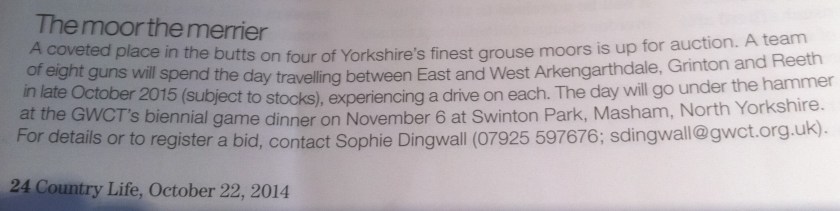
From Country Life Magazine, October 22nd 2014, page 24:

A coveted place in the butts on four of Yorkshire’s finest grouse moors is up for auction. A team of eight guns will spend the day travelling between East and West Arkengarthdale, Grinton and Reeth in late October 2015 (subject to stocks), experiencing a drive on each. The day will go under the hammer at the GWCT’s biennial game dinner on Nov 6 at Swinton Park, Masham, North Yorkshire“.

Fascinating stuff.

Swinton Park is linked with the Swinton Estate. Swinton Estate was where the shot corpse of hen harrier Bowland Betty was discovered in 2012 (see here), although that was likely just an unfortunate coincidence as there was no evidence to link her death to anybody, let alone anyone associated with the estate. According to the Countryside Alliance, she wasn’t shot at all (see here).

A different incident confirmed criminal activity by a Swinton Estate employee. Earlier this year, gamekeeper Ryan Waite was convicted of illegally setting a spring (pole) trap on Swinton Estate (see here).

What an interesting choice of venue for the GWCT to select for their prestigious event, eh?

Case against gamekeeper George Mutch: part 12

Well, well well. Today was the first day in the much-anticipated trial of Scottish gamekeeper George Mutch.

Mutch, 48, of Kildrummy Estate, Aberdeenshire, has been accused of various wildlife crimes relating to the alleged capture and subsequent killing or injuring of two goshawks and a buzzard in 2012. He has denied the charges and we’ve seen this case drag on and on and on…..

The dragging on looks set to continue….

The trial was halted today after the Sheriff (Annella Cowan) decided to stand down. Why did she decide to stand down? According to the BBC (here) it was because the defence counsel argued that as Sheriff Cowan was a member of the RSPB, she shouldn’t hear the case because the RSPB had been involved in the criminal investigation in to Mutch’s alleged activities.

Yes, seriously!

We thought a Sheriff was supposed to be considered as being ‘above bias’? The defence counsel, Mr Moir, apparently said that he wasn’t suggesting that Sheriff Cowan would be biased – so why then did he say she shouldn’t hear the case?! What a joke.

What’s an even bigger joke is that another (now retired) Sheriff, one Kevin Drummond, was never considered to be ‘unsuitable’ to hear cases against gamekeepers accused of wildlife crime, even though his hobbies apparently included shooting, and prior to becoming a Sheriff he had worked as a defence QC for……er, gamekeepers! (see here).

Fascinating, eh? You couldn’t make this stuff up.

Anyway, back to Mutch’s trial. It’s no big problem that Sheriff Cowan has decided to stand down – the case will be decided on the merit of the evidence presented against Mutch – and THAT is where our interest lies. Whether it’s Sheriff Cowan or another Sheriff who hears the case is largely irrelevant; it’s just irritating that yet another delay has been introduced to this case. Still, we can wait.

We understand the trial will re-start in December.

Case against Scottish gamekeeper William Dick: part 3

Criminal proceedings continued yesterday in the case against Scottish gamekeeper William Dick.

Mr Dick, 24, is accused of bludgeoning and repeatedly stamping on a buzzard. The alleged offences are reported to have taken place in Sunnybrae, Dumfries in April 2014. Mr Dick has denied the allegations.

Yesterday a notional diet was heard at Dumfries Sheriff Court. The case was continued for another notional diet, scheduled for 4th November 2014.

Previous blogs on this case here and here.

Case against gamekeeper George Mutch: part 11

The day has finally come. Today is the opening day of the trial of Scottish gamekeeper George Mutch, of Kildrummy Estate, Aberdeenshire.

Mutch is accused of a variety of offences relating to the illegal trapping, and then killing and/or taking away of birds of prey, alleged to have taken place over two years ago in August 2012. Mutch has denied the charges, hence the trial.

There have been 12 previous court hearings in this case, including yet another intermediate diet yesterday. It’s good to finally have the trial underway.

Watching with great interest…..

CEH scientist claims gamekeepers “protect” hen harriers & mountain hares

BBC radio 4 logoThere was a fascinating discussion on the BBC’s Shared Planet programme this morning. It was all about conflict resolution, with a particular focus on the hen harrier ‘problem’.

We were told that to achieve conflict resolution, trust was needed on all sides. That’s a complete non-starter then, when those with a vested interest in killing harriers (and other protected raptor species such as golden eagles, white-tailed eagles, red kites, buzzards, goshawks, peregrines etc) consistently deny the extent of illegal killing and claim not to know who’s doing it. It’s quite hard to trust a liar.

Interviewees included Dr Juliette Young (CEH Edinburgh), who spoke about how the media often portrays ‘actors’ (stakeholders) in a negative light. She said:

Gamekeepers do sometimes feel like they’re the bad guys in all this when actually, it’s often thanks to their management of moorlands that we do have these absolutely fantastic species on moorlands, like hen harriers, like mountain hares; these species that are iconic, and that their [gamekeepers] management helps to protect“.

Wow, did she actually just say that? Perhaps she should read this, this, this, this, this, this, this, this, this, this, this, this as taster articles on how well gamekeepers are “protecting” hen harriers, and  this, this and this as taster articles on how well gamekeepers are “protecting” mountain hares.

Also interviewed was Simon Lester, Head Gamekeeper at Langholm. When asked how he would like to see the hen harrier ‘problem’ resolved, he said:

The real key to solving this problem is to endorse the quota brood management system. I wouldn’t like to see a countryside devoid of raptors but I think there has to be a level of when is enough enough?

So, with only four pairs of nesting hen harriers in England this year (when there should be 300+), and a 20% decline in the Scottish hen harrier population, with an almost complete absence of breeding harriers on Scottish grouse moors, Mr Lester thinks that ‘removing’ hen harriers (from grouse moors) is the solution. How about gamekeepers stop illegally killing them? Why not use diversionary feeding, which has proven successful at Langholm? Why is that not the solution?

Lester also went on to trot out his old blind prejudice about buzzards. He said, when asked about how to get a conflict resolution:

The first big thing is to put in mechanisms where you can use different management tools to get there. So diversionary feeding would be one, quota system for harriers, but possibly with buzzards a lethal option“.

Interesting that his Victorian attitude towards buzzards hasn’t changed over the years, despite the results of a recent three-year study, at Langholm, that suggested buzzards aren’t really that fussed about taking grouse (see here).

You can listen to the programme here.

First vicarious liability prosecution: part 2

wane1Last week we blogged about what we believe to be the first prosecution under the 2011 vicarious liability legislation (see here), relating to poisoning offences that took place on the Glasserton & Physgill Estates in December 2012. Gamekeeper Peter Bell was convicted in June 2013 for those crimes, including the laying out of a poisoned bait that subsequently killed a buzzard, and the possession of three banned poisons (Carbofuran, Strychnine and Alphachloralose) which were found in his tool shed and in his home (see here).

The vicarious liability prosecution was adjourned yesterday and the next hearing is due in November.

Definitely one to watch.