Case against gamekeeper William Curr, Glenogil Estate: part 2

Glenogil sign RPSCopyCriminal proceedings have continued against Scottish gamekeeper William Curr.

Curr, 22, is accused of several wildlife crimes alleged to have taken place on the Glenogil Estate in August and September 2014. His case was adjourned at Forfar Sheriff Court on 10th September 2015 and will continue on 8th October.

Previous blog about this case here.

Kildrummy Estate: vicarious liability prosecution?

On 11th December 2014, Scottish gamekeeper (and SGA member) George Mutch was convicted of four wildlife crime offences that he’d committed on the Kildrummy Estate, Aberdeenshire in 2012 (see here).

On 12th January 2015, Mutch was given a four month custodial sentence for his crimes; the first gamekeeper to be jailed in the UK for killing raptors (see here).

Both his conviction and sentence were widely welcomed across the conservation community, not least because video evidence had been deemed admissible in this case and because the agencies involved in the investigation and prosecution had worked exceptionally hard to achieve these results.

Hopes were high that a subsequent vicarious liability prosecution would follow, especially when a journalist friend told us that Fiscal Tom Dysart had made a point of asking Mutch in court whether he’d received any training for the use of his traps, to which Mutch had replied, “No”. That response would indicate that a defence of ‘due diligence‘ wouldn’t stand up to scrutiny for anyone charged with being vicariously liable for Mutch’s crimes. All good so far, although Andy Wightman cast doubt over the feasibility of charging someone from Kildrummy Estate given the difficulty of establishing ownership there (read his blog here).

So seven months on, what’s happening now?

Well, it all gets a bit interesting around about now.  As we understand it, for offences committed under the Wildlife & Countryside Act, criminal proceedings MUST begin within three years from the date of the commission of the offence (two years in England & Wales). After three years, the case becomes ‘time-barred’ and it is no longer possible to prosecute.

Mutch was convicted of four offences, and the dates those offences were commissioned are as follows (info from COPFS press release, January 2015) –

  1. On 14 August 2012 & 15 August 2012, Mutch did intentionally or recklessly kill or take a wild bird, namely a goshawk.
  2. On 23 August 2012 and 24 August 2012, Mutch did intentionally or recklessly take a wild bird, namely a buzzard.
  3. On 28 August 2012, Mutch did intentionally or recklessly kill, injure or take a wild bird, namely a goshawk.
  4. Between 6 August 2012 – 13 September 2012, Mutch did use a trap to catch two goshawks and a buzzard.

Pay close attention to those dates. The first three offences are now time-barred (unless someone has already been charged) because it is over three years since they took place. The final offence is not quite time-barred, but will be by this Sunday (13 Sept 2015).

So, two big questions:

  1.  Has somebody from Kildrummy Estate been charged for a vicarious liability prosecution for the first three offences, and if not, why not?
  2. Is the Crown Office intending to charge someone (before Sunday) from Kildrummy Estate for a vicarious liability prosecution for the fourth offence, and if not, why not?

This case is of huge public interest and we don’t think it unreasonable to be asking questions, especially when successive Environment Ministers keep telling us that the effectiveness of Government policy against the raptor killers will be measured by the success of approaches such as vicarious liability.

If, like us, you’re curious about what’s happening with this case, you can email the Crown Office and ask them. The usual response when we ask about criminal cases is ‘As this case is on-going it would be inappropriate to comment’. It’s a handy ‘get out’ option when the authorities want to keep the public in the dark. The Crown Office could legitimately respond like this in this case, if they’ve already charged somebody. However, if they haven’t charged anybody, then the case is now time-barred and therefore cannot be said to be ‘on-going’.

Let’s see how transparent and accountable they wish to be. Emails to Helen Nisbet, Head of Wildlife & Environmental Crime Unit, Crown Office & Procurators Fiscal Office: Helen.Nisbet@copfs.gsi.gov.uk

Newlands Estate, where buzzard bludgeoned & stamped to death, is member of SLE & WES

2nd June 2015 CopyWell, well, well.

Following the sentencing today of Newlands Estate gamekeeper William (Billy) Dick for bludgeoning a buzzard with rocks and then repeatedly stamping on it (see here), we wondered whether the Newlands Estate was a member of Scottish Land & Estates (SLE).

Actually, we wondered this back in early August when Dick was convicted (see here), but SLE refused to answer at that time. It’s now clear why.

It turns out that the Newlands Estate is indeed a member of SLE. And not only that, it’s also an accredited member of SLE’s ‘Wildlife Estates Scotland’ (WES) initiative. You know the one, the much-lauded (by the game-shooting lobby) initiative ‘that aims to promote the best game and wildlife management practices, build recognition and raise standards through the introduction of an objective accreditation system’ (see here).

Oops.

SLE has issued a short statement this evening, as follows:

A spokesman for Scottish Land and Estates said: “Scottish Land & Estates has a clear and long -established policy of condemning all forms of wildlife crime. Those who engage in such activity should feel the full force of the law. Newlands Estate is a member of Scottish Land & Estates but that membership has been suspended voluntarily pending further inquiries and ongoing legal proceedings“.

It’s interesting that the estate’s membership has been suspended ‘voluntarily’ and only after the Estate’s gamekeeper had been sentenced. Why was the suspension ‘voluntary’? And why wasn’t suspension invoked in June 2014 when gamekeeper Dick made his first court appearance to answer the charges? And if not then, why wasn’t it invoked last month when Dick was convicted? Why wait until now? Nothing to do with pressure from blogs like this, surely?

WILDLIFE ESTATES SCOTLAND LOGOIt’s also interesting that SLE don’t mention the Newlands Estate’s membership of the Wildlife Estates Scotland initiative in their press statement. Not a word. That news has been gleaned from ITV (see here) and reads as follows:

Conditions of membership of Wildlife Estates Scotland include the requirements to maintain best practice standards of animal welfare and comply with all legal requirements and relevant Scottish codes of practice.

Wildlife Estates Scotland’s position is that it will suspend membership if it is notified of a prosecution or of a breach of relevant legislation.

The case of William Dick has been discussed with Newlands Estate, whose membership and accreditation under WES has been voluntarily suspended and will remain so until after further enquiries and any other legal proceedings have concluded.”

– WILDLIFE ESTATES SCOTLAND SPOKESPERSON

Vicarious liability prosecution: Andrew Walter Bryce Duncan

A prosecution is underway against Andrew Walter Bryce Duncan, who is alleged to be vicariously liable for the criminal actions of gamekeeper William (Billy) Dick, who was recently convicted of killing a buzzard in April 2014 (see here).

Duncan, 71, of Kirkton, Dumfriesshire, is understood to manage the pheasant shoot on the Newlands Estate where Dick committed his crimes. Dick is due to be sentenced in September.

At a hearing in Dumfries Sheriff Court on Tuesday 18th August 2015, a trial date was set for Duncan (23rd November 2015) with an intermediate diet due to be heard on 20th October 2015.

Great to see the Crown Office pursuing this prosecution. We’ll follow proceedings with interest.

Vicarious liability in relation to the persecution of raptors in Scotland (where one person may potentially be legally responsible for the criminal actions of another person) came in to force on 1st January 2012. To date there has only been one conviction – landowner Ninian Robert Hathorn Johnston Stewart was convicted in December 2014 of being vicariously liable for the criminal actions of Glasserton & Physgill Estates gamekeeper Peter Bell (see here).

SGA Committee Member wouldn’t mind setting Hen Harrier Day protesters on fire

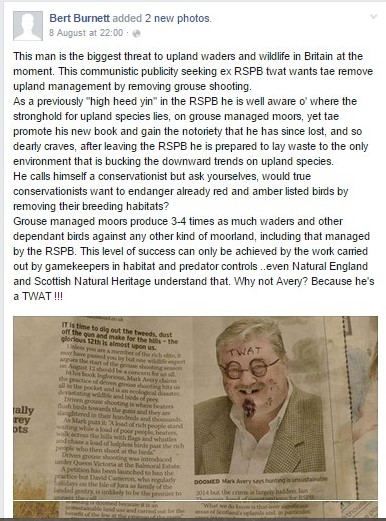
There was an article in the Daily Record on Saturday about the forthcoming grouse shooting season (the Inglorious 12th) which outlined many of the reasons that have triggered a call to ban the ‘sport’. The piece included extensive quotes from Mark Avery (see here).

SGA Committee Member Bert Burnett has obviously thought long and hard about the arguments against driven grouse shooting and he presented them on his Facebook page on Saturday night. Watch out for a new SGA fund-raising drive to purchase some new crayons for Bert.

Bert Burnett Facebook Avery twat - Copy

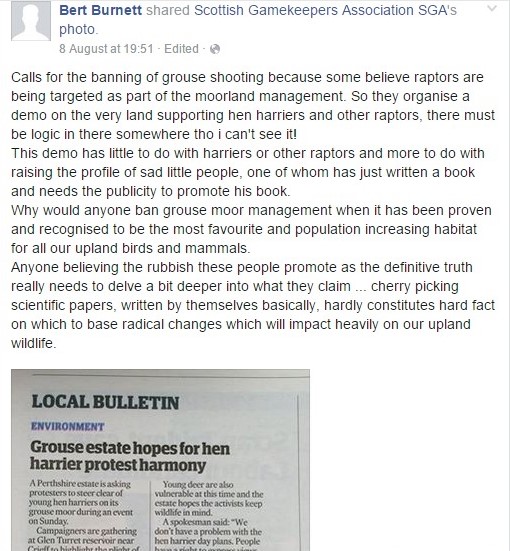
On a related issue, he also shared his considered views on the Hen Harrier Day protesters who were due to gather in Perthshire the following day:

Bert Burnett Facebook HH Day Perthshire 1 - Copy

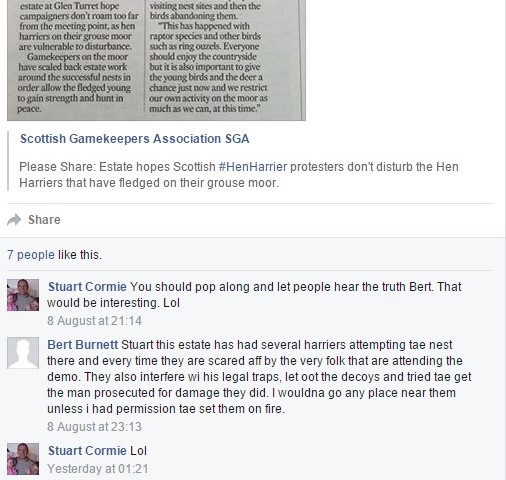
On a more serious and sinister note, when one of his Facebook acquaintances suggests that Bert should attend the protest demo, he said this:

Bert Burnett Facebook HH Day Perthshire 2 - Copy

It’s a perfectly illustrated example of why so-called ‘partnership working’ is nothing but a sham. It would also be interesting to know how Police Scotland view his comments when they assess his suitability to hold firearms and shotgun certificates. Threat to public safety springs to mind.

Gamekeeper accused of making death threats with firearms

Gamekeeper Ralph Sturgess is on trial for allegedly making death threats to his girlfriend after putting her in a headlock and pressing a loaded pistol to her forehead.

Hull Crown Court heard yesterday that after an evening at the pub, Sturgess, a former gamekeeper on Lord Hotham’s Dalton Estate in East Yorkshire, took pot shots at a noisy owl before attacking his girlfriend.

He has denied the charges. The trial continues.

Further details here

Scottish gamekeeper convicted of killing buzzard

The long-running case against Scottish gamekeeper William (Billy) Dick concluded today with a conviction for illegally killing a buzzard.

Dick, 25, of Whitehill Cottages, Kirkmahoe, Dumfries, had been observed by two witnesses on the Newlands Estate striking a buzzard with rocks and then repeatedly stamping on it, in April last year. The observers were alerted to the scene by the sound of a gun shot. Dick had denied the charges (in addition to two alleged firearms offences, which were subsequently dropped) but was convicted today at Dumfries Sheriff Court.

He will be sentenced in early September.

Well done to the SSPCA and Police Scotland for their investigation and to the Crown Office for a successful prosecution.

We understand that a vicarious liability prosecution will get underway at Dumfries Sheriff Court later this month.

The Newlands Estate offers driven partridge and driven pheasant shooting. This estate has previously donated to the GWCT’s Scottish Auction (see here – page 23).

While we wait for the sentencing hearing, here are some questions you might like to ask:

1. Is/was Dick a member of the Scottish Gamekeepers’ Association? Emails to: info@scottishgamekeepers.co.uk

2. Is Dick still employed on the Newlands Estate? Emails to: awbd@newlandsestate.co.uk

3. Is the Newlands Estate a member of Scottish Land & Estates? They get a mention in the SLE’s 2013 newsletter (here – page 10). Emails to: info@scottishlandandestates.co.uk

The photograph of Billy Dick was sourced from his Facebook page.

Previous blogs on this case here, here, here, here, here, here, here, here, here

Gamekeeper accused of wildlife crimes on Glenogil Estate, Angus Glens

Glenogil sign RPSCopyA Scottish gamekeeper is facing charges of wildlife crimes alleged to have taken place in the Angus Glens last year.

William Curr faces charges that he set or failed to check the snare that trapped a deer for more than 24 hours on the Glenogil Estate last year, and that he failed to remove it. It is understood the animal died.

The 22 year old, of Game Keeper’s House, Glen Trusta, will appear at Forfar Sheriff Court on 20th August where he will also face charges that he failed to keep a record of finding a deer in the snare at Glen Trusta between 26th – 29th August 2014.

It is also alleged that Curr failed to check another snare for more than 24 hours, during which time a fox became trapped and died of dehydration between September 24th-26th 2014.

Curr did not appear or make a plea to the charges when the case called at the court on Thursday.

Depute fiscal Jim Eodonable intimated the matter would continue without plea for three weeks, after a letter from solicitors Levy & McRae asked for more time to take instruction.

We’ll be following this one with interest.

Photograph by Raptor Persecution Scotland.

Stody Estate subsidy penalties: an update

IMG_4752 (2) - CopyOn 1st October 2014, gamekeeper Allen Lambert from the Stody Estate in Norfolk was found guilty of poisoning 10 buzzards and one sparrowhawk, which had been found dead on the estate in April 2013. He was also convicted of storing banned pesticides & other items capable of preparing poisoned baits (a ‘poisoner’s kit’), and a firearms offence (see here and here).

On 6th November 2014, Lambert was sentenced. Even though the magistrate acknowledged that Lambert’s crimes passed the custody threshold, he only received a 10 week suspended sentence for poisoning 11 raptors (suspended for one year), a six week suspended sentence for possession of firearms and nine poisoned buzzards (suspended for one year), and was ordered to pay £930 prosecution costs and an £80 victim surcharge.

On 5th October 2014, we blogged about the millions of pounds worth of subsidies that had been awarded to Stody Estate in recent years (see here) and we encouraged blog readers to contact the Rural Payments Agency (RPA) to ask whether Stody Estate would receive a financial penalty in the form of subsidy withdrawal for being in breach of the terms & conditions of their subsidy-fest.

On 10th October 2014, the RPA responded by saying they would consider what action could be taken against Stody Estate (see here).

Then it all went quiet.

In December 2014, one of our blog readers submitted an FoI to the RPA to ask what was happening. In January 2015, the RPA responded by saying they ‘weren’t able to provide a meaningful response’ but said they would take action if it was found to be appropriate to do so (see here).

Six months on, we thought it was time for an update so an FoI was sent to the RPA to ask whether they had implemented a subsidy penalty. This is their response:

Dear XXXXX XXXXX

Thank you for your email dated 5 July 2015 regarding Stody Estate.

Cross Compliance rules only apply to recipients of Single Payment Scheme or certain Rural Development scheme payment in the year in which a cross compliance breach is found.

The person prosecuted for the offences mentioned in your e-mail is not a recipient of either of these types of payment.  Therefore before RPA can take further action, it will be necessary to determine whether there [sic] a link between this person and a subsidy recipient and, if there is, whether that recipient can be considered liable for the actions of the person who committed the breaches.

Identifying whether the person prosecuted is linked to a subsidy recipient will form a key part of our investigations.

Should you have any further queries please contact us again quoting reference number XXXXX

Regards

Helen Hunter

Customer Service Centre, Operations

END

This is all very interesting. The mass illegal poisoning of birds of prey took place on Stody Estate and a Stody Estate employee, gamekeeper Allen Lambert, was convicted of these crimes and several others. But the Rural Payments Agency is still trying to determine whether there is a link between Lambert and the Stody Estate. Eh?

It’s not very convincing is it?

Perhaps the RPA should have a read of the judge’s comments about the relationship between Lambert and his (now former) employer – see here.

Gamekeeper’s trial collapses after District Judge rules RSPB covert video “disproportionate”

A Shropshire gamekeeper has been cleared of charges relating to the alleged illegal use of a trap after the District Judge pronounced the RSPB’s use of covert surveillance “disproportionate”.

Neil Wainwright had been accused of using a Larsen trap, illegally baited with two live quails, to trap birds of prey. The trap, set near to a pheasant pen, had been seen by an RSPB investigator (whilst walking on a public right of way), who had returned the following day to install covert video (on private land) to determine the identity of the trap user.

Footage from the camera had identified Wainwright, who was also reportedly seen carrying a dead buzzard. The RSPB then alerted the police who began an investigation, resulting in the Crown Prosecution Service taking the case to court.

This case featured several court hearings, and during one of these Wainwright had admitted using the trap baited with live quail but had claimed he was targeting mink, not birds of prey. So his use of the trap wasn’t in question (because he hadn’t denied using it); just his purpose for using it (which was the basis for some of the charges against him).

It’s very strange then, that the District Judge, Kevin Grego, should then exclude the video evidence and claim its use to be “disproportionate” because the RSPB didn’t have the landowner’s permission to film there. This implies that the RSPB should have sought the landowner’s permission, which would have been a complete non-starter because for all they knew, the landowner and/or the agent may have been complicit with any alleged offences so asking for permission to film would have defeated the objective of filming. It may also imply that the judge thought that the RSPB should have approached the police before setting the camera. However, for the police to have been involved they would have needed to seek authority to film under the Regulation of Investigatory Powers Act 2000. The chances of them getting that authority for what may be considered a minor offence (in terms of the scale used to categorize the seriousness of all crimes, not just wildlife crimes) on private land would be pretty slim.

In which case, any trap user intent on illegal activity to trap and kill birds of prey on private land can be assured that the chance of being prosecuted is virtually non-existent. In other words, they’re untouchable.

This is the second time this year that RSPB video footage in relation to the alleged mis-use of a trap by a gamekeeper has been ruled inadmissible in England – see here for earlier case. These are interesting developments because covert video footage has long been accepted as admissible in the English courts, as opposed to the difficulty of having it accepted by the Scottish courts. And although neither of these two recent cases set a legal precedent, you can bet your house that defence lawyers in future English cases will be pointing to these findings as they try to justify having similar evidence dismissed.

These examples serve to demonstrate, once again, just how high the odds are stacked against securing a conviction for wildlife crimes that take place in relatively remote areas where direct witnesses are few and far between.

Wainwright’s case wasn’t a complete failure though. He was convicted of three other offences which wouldn’t have come to light without this investigation in to the alleged mis-use of the trap: failure to properly store ammunition (two offences, for which he was fined a total of £300) and failure to store a dangerous chemical securely (Phostoxin, a highly toxic fumigant used to gas moles, rabbits etc) which was found in his vehicle (one offence, for which he was fined £200). He was also ordered to pay £85 costs and a £30 surcharge.

Previous blogs on this case here, here and here.

BBC news article on Wainwright’s trial here