Vicarious liability prosecution: Andrew Duncan (Newlands Estate) part 5

Criminal proceedings continued yesterday  against landowner Andrew Walter Bryce Duncan, who is alleged to be vicariously liable for the crimes committed by gamekeeper William (Billy) Dick in April 2014.

Gamekeeper Dick was convicted in August 2015 of killing a buzzard on the Newlands Estate, Dumfriesshire by striking it with rocks and repeatedly stamping on it (see here). Dick was sentenced in September 2015 and was given a £2000 fine (see here), although he is appealing his conviction.

Here’s a quick review of the proceedings against Andrew Duncan so far:

Hearing #1 (18th August 2015): Trial date set for 23rd Nov 2015, with an intermediate diet scheduled for 20th Oct 2015.

Hearing #2 (20th October 2015): Case adjourned. Nov trial date dumped. Notional diet hearing (where a trial date may be set) scheduled for 18th January 2016.

Hearing #3 (18th January 2016): Case adjourned. Another notional diet & debate scheduled for 11th March 2016.

Hearing #4 (11th March 2016): Case adjourned, pending the result of gamekeeper Billy Dick’s appeal. Another notional diet scheduled for 4th April 2016.

Hearing #5 (4th April 2016): Case adjourned, pending the result of gamekeeper Billy Dick’s appeal. Another notional diet scheduled for 3rd June 2016.

Vicarious liability in relation to the persecution of raptors in Scotland (where one person may potentially be legally responsible for the criminal actions of another person working under their supervision) came in to force four years ago on 1st January 2012. To date there have been two successful convictions: one in December 2014 (see here) and one in December 2015 (see here).  One further case did not reach the prosecution stage due, we believe, to the difficulties associated with identifying the management structure on the estate where the crimes were committed (see here).

Crown Office drops prosecution against Glenogil Estate gamekeeper

Snared fox dead alt, Glenogil Estate, Credit OneKindRegular blog readers will know we’ve been following the case of Scottish gamekeeper William Curr, who had been charged last year with alleged snaring offences on Glenogil Estate in the Angus Glens, said to have occurred in September 2014 (see here, here, here and here).

The charges related to allegations that several snares had not been checked (as they are required to be) within a 24-hour period of being set, after a field officer from the charity OneKind had discovered a dead snared deer, a dead snared fox and another snared fox that was still alive but had to be euthanised at the scene due to the extent of its horrific injuries (see OneKind photo).

For a harrowing description of what was found on Glenogil Estate, including a confrontation with the Head Gamekeeper, read this blog on the OneKind website.

Curr’s trial was due to start on 9th May but last week (10 March) the Crown Office informed the court that it was not going to proceed. OneKind has not yet been able to ascertain the reason for this decision, and in fact may never find out because the Crown Office is under no obligation to explain.

Accountability and transparency, anybody?

To quote from the OneKind blog:

OneKind is mystified by the dropping of this case, given the eye witness evidence, the horrific video footage and the detailed follow-up investigation carried out by the Scottish SPCA. This was a shocking incident where at least six people, including gamekeepers, witnessed the terror and pain of a live fox as the wire noose of a snare sliced into its abdomen. Had our research officer not been on the estate on that particular day, who knows how much longer the fox would have continued to suffer?

To put this dreadful story in the wider context: snares are still legal in Scotland and the rest of the UK. It is simply intolerable that the suffering this fox endured should be considered legally acceptable. The video footage is utterly harrowing and illustrates an animal which is clearly distressed, both physically and mentally. OneKind has long called for an outright ban on all snares and sadly we feel these calls have been justified by this case.

OneKind will seek an explanation for the failure of the Scottish justice system to bring this animal welfare case to court“.

The reason we’ve been so interested in this case is because the alleged offences occurred on the Glenogil Estate, one of several grouse shooting estates in the Angus Glens where wildlife crime incidents keep cropping up but have never resulted in a successful prosecution. For example, here are some incidents reported from in and around Glenogil over the last ten years:

2006 March: poisoned rabbit bait (Carbofuran). Listed as ‘Glenogil’ in RSPB annual report. No prosecution.

2006 April: poisoned buzzard (Alphachloralose). Listed as ‘Glenogil’ in RSPB annual report. No prosecution.

2006 April: poisoned tawny owl (Alphachloralose). Listed as ‘Glenogil’ in RSPB annual report. No prosecution.

2006 May: poisoned rabbit bait (Carbofuran). Listed as ‘Glenogil’ in RSPB annual report. No prosecution.

2006 June: poisoned woodpigeon bait (Carbofuran). Listed as ‘Glenogil’ in RSPB annual report. No prosecution.

2006 June: Traces of Carbofuran found in estate vehicles & on equipment during police search. Not listed in 2006 RSPB annual report but reported here. (Now former) estate owner John Dodd had £107k withdrawn from his farm subsidy payments as a result. This was being appealed but it is not known how this was resolved. Also a write up in RSPB 2007 annual report. No prosecution.

2007 November, Glenogil Estate: Disappearance of radio-tagged white-tailed eagle ‘Bird N’ coincides with tip off to police that bird been shot. No further transmissions or sightings of the bird. Not listed in RSPB annual report but reported here. No prosecution.

2008 May: poisoned white-tailed eagle ‘White G’ (Carbofuran, Isophenfos, Bendiocarb). Listed as ‘Nr Noranside’ in RSPB annual report. No prosecution.

2008 May: poisoned buzzard (Bendiocarb). Listed as ‘Nr Noranside’ in RSPB annual report. No prosecution.

2008 May: poisoned mountain hare bait (Carbofuran, Isophenfos, Bendiocarb). Listed as ‘Nr Noranside’ in RSPB annual report. No prosecution.

2008 May: 32 x poisoned meat baits on fenceposts (Carbofuran, Isophenfos, Bendiocarb). Listed as ‘Nr Noranside’ in RSPB annual report. No prosecution.

2008 October: poisoned meat bait on fencepost (Carbofuran). Listed as ‘Nr Noranside’ in RSPB annual report. No prosecution.

2009 March: poisoned buzzard (Carbofuran). Listed as ‘Glenogil’ in RSPB annual report. No prosecution.

2009 March: poisoned buzzard (Carbofuran). Listed as ‘Glenogil’ in RSPB annual report. No prosecution.

2009 August: poisoned white-tailed eagle “89” (Carbofuran). Listed as ‘Glenogil’ in RSPB annual report. No prosecution.

2010 May: poisoned red kite (Carbofuran). Listed as ‘Nr Noranside’ in RSPB annual report. No prosecution.

2010 September: poisoned buzzard (Chloralose). Listed as ‘Glenogil’ in RSPB annual report. No prosecution.

2010 October: poisoned buzzard (Carbofuran). Listed as ‘Glenogil’ in RSPB annual report. No prosecution.

2010 October: poisoned pigeon bait (Carbofuran). Listed as ‘Glenogil’ in RSPB annual report. No prosecution.

2010 October: poisoned pigeon bait (Carbofuran). Listed as ‘Glenogil’ in RSPB annual report. No prosecution.

2012 April: Remains of buzzard found beside pheasant pen. Listed as ‘Nr Noranside’ in RSPB annual report. No prosecution.

2014 June: shot buzzard. Listed as ‘Glenogil’ in RSPB annual report. No prosecution.

Vicarious liability prosecution: Andrew Duncan (Newlands Estate) part 4

Criminal proceedings continued last week against Andrew Walter Bryce Duncan, who is alleged to be vicariously liable for the crimes committed by gamekeeper William (Billy) Dick in April 2014.

Gamekeeper Dick was convicted in August 2015 of killing a buzzard on the Newlands Estate, Dumfriesshire by striking it with rocks and repeatedly stamping on it (see here). Dick was sentenced in September 2015 and was given a £2000 fine (see here), although he is appealing his conviction.

Proceedings against Andrew Duncan, 71, who is believed to be responsible for the pheasant shoot on Newlands Estate, began in August 2015 and a provisional trial date was set for 23rd November 2015 (see here). However, at an intermediate diet hearing in October, the November trial date was dumped and a notional diet hearing (where a trial date may be set) was set for 18th January 2016 (see here). At the January hearing, proceedings were adjourned again for another notional diet and a debate to take place on 11th March 2016.

At last week’s hearing the case was continued again, pending the result of William (Billy) Dick’s appeal.

The next installment of Andrew Duncan’s case will be heard on 4th April 2016.

Vicarious liability in relation to the persecution of raptors in Scotland (where one person may potentially be legally responsible for the criminal actions of another person working under their supervision) came in to force four years ago on 1st January 2012. To date there have been two successful convictions: one in December 2014 (see here) and one in December 2015 (see here).  One further case did not reach the prosecution stage due, we believe, to the difficulties associated with identifying the management structure on the estate where the crimes were committed (see here).

Previous blogs on the Andrew Duncan case here, here and here.

More shameless spin-doctoring from the Gift of Grouse

Gift of GrouseTim (Kim) Baynes, Director of the grouse-shooting industry’s propaganda campaign, The Gift of Grouse, is shameless. He must be to have penned his latest bout of spin-doctoring, this time pointing the finger at raptor workers.

Before we begin, here’s a definition of a spin doctor:

A person whose job involves trying to control the way something is described to the public in order to influence what people think about it“.

Ladies and gentlemen, the spin doctor is IN.

The following article, authored by Tim (Kim) Baynes, appears in today’s Courier and is entitled: ‘Trust needs to develop quickly between raptor groups and land management‘.

Despite the grouse season ending more than a month ago, our moorland continues to fire passions on all sides.

Since Jim Crumley’s last column, The Courier letters’ pages have been alive with debate. Yet, much of the criticism levelled at estates does not reflect what I see on our moors.

The Gift of Grouse campaign demonstrates the benefits of moorland, including species conservation.

Since then, a number of reports have been publicised. One looked at species present on Invermark, the estate cited by Jim Crumley. It found that 81 different bird species were breeding or feeding there, including a range of ‘red-listed’ most at risk birds. Amongst those present were 10 species of raptor including peregrine, golden eagle and hen-harrier.

Similar is happening on many Scottish estates. Yet disappointingly, the politics of the past – pitting raptor enthusiast versus gamekeeper – are still being played. The RSPB’s report uses incidents from two decades ago to influence present-day policymaking.  But, official figures from the past five years demonstrate raptor incidents are now in the teens per annum, with only some linked to land management. There is always work to be done but the law is tough on anyone convicted of wildlife crime, and even higher sentences are likely soon.

At the heart of this is continuing mistrust between some raptor enthusiasts and land managers. There are also internal rivalries within the raptor groups on who monitors which area, and this leads to secrecy. This is a serious issue as land managers need to know which birds are on their land in order to better manage them, but the survey results are often not shared with them, even when funded by bodies such as Scottish Natural Heritage.

To break down mistrust, we must develop ways of maximising both raptors and prey species alongside grouse.  It should not be an either/or scenario. The persecution of raptors is becoming a thing of the past, but there is also a duty on raptor lobby to engage and share information. Trust is developing in some places but it needs to spread – and rapidly.

ENDS

Oh god, where to begin?

For context, perhaps we should begin by pointing out to those who don’t already know, Tim (Kim) Baynes is employed by the lairds’ lobby group Scottish Land & Estates as Director of the Scottish Moorland Group. The Scottish Moorland Group is chaired by the one and only Lord Hopetoun – he of the Leadhills (Hopetoun) Estate – an estate with one of the worst records of illegal raptor persecution in the country.

Tim (Kim) is right in his assertion that there is distrust between some raptor workers and some landowners. Of course there is, and with bloody good reason!

Scottish Land & Estates (SLE) portrays itself as a wildlife-crime-fighting organisation and frequently points to its membership of the Partnership for Action Against Wildlife Crime (PAW Scotland) as evidence of this. SLE has consistently stated that it is working hard to eradicate wildlife crime, and particularly illegal raptor persecution. The thing is, many raptor workers simply don’t believe them. Why not? Well probably because SLE has not sought to expel several member estates that have been implicated, over many years, in raptor persecution crimes. It would be an easy thing for them to do, but they haven’t done it. Until they do, raptor workers (and the general public) are justified to view SLE and their land-owning members with deep suspicion.

Another good reason for distrusting SLE is their continued denial of the extent of illegal raptor persecution, and their denial that the grouse-shooting industry (some of whom are members of SLE) is in any way implicated with these crimes (e.g. see here and here for just two recent examples). Where clear evidence has been provided, (e.g. 81% of all reported poisoning incidents in Scotland between 2005-2014 were on land used for game-shooting – see here), SLE has simply dismissed the figures and slagged off the RSPB for providing them (here).

RSPB persecution review 1994 2014 land use

In his article for the Courier, Tim (Kim) tries to claim that grouse moors are ‘good’ for species conservation and refers to a recent ‘study’ of breeding birds on Invermark Estate to back up this claim. The problem is, the full details of that ‘study’ (and a couple of others) have not been made available for public scrutiny, despite several requests to see it, and therefore has naff all credibility, especially when the ‘study’ of breeding birds was conducted, er, outside of the breeding season (see here).

But what interested us the most about Tim’s (Kim’s) article in the Courier was his (false) accusations (he’s good at those) about the raptor study groups. He said:

There are also internal rivalries within the raptor groups on who monitors which area, and this leads to secrecy. This is a serious issue as land managers need to know which birds are on their land in order to better manage them, but the survey results are often not shared with them, even when funded by bodies such as Scottish Natural Heritage”.

This is absolute rubbish. The Scottish Raptor Study Group comprises 12 regional branches. These branches organise raptor monitoring within clearly-defined geographic regions, to avoid over-lapping and thus avoid ‘double-counting’ as well as ‘double disturbance’ of sensitive species. All the raptor workers who monitor Schedule 1 species are licensed (by SNH) to do so. These Schedule 1 disturbance licences are issued for specific areas; so if you have a licence to monitor, say, golden eagles in one area, you can’t use the same licence to monitor them in another area unless your licence specifically includes another area. Again, this is to regulate the amount of disturbance to sensitive species. There is no “internal rivalry” – raptor workers simply get on with monitoring in their own patch.

Raptor workers DO share their data – they provide their results to the Scottish Raptor Monitoring Scheme (SRMS) and have been doing so since 2002! Tim (Kim) is obviously annoyed that landowners aren’t given access to those data “in order to better manage” those species. We all know what he means by “better manage” and that is precisely why raptor workers would be reluctant to share location data about highly persecuted species with dodgy landowners. Duh!

Tim (Kim) tries to imply that raptor workers are funded by SNH and as such, the data they collect should be made publicly available. Again, he either misunderstands the system or he’s trying to spin it so that raptor workers look like the bad guys. The truth is, raptor workers are not ‘funded’ by SNH, or by anyone else. SNH does provide SOME funding to the SRSG, but this amounts to a small contribution towards raptor workers’ fuel costs. It certainly doesn’t cover the full fuel costs (the funding is actually well below the commercial mileage rate claimed by consultants) and it does not cover the thousands and thousands of hours of time that raptor workers put in to their monitoring efforts. As such, the data collected by raptor workers belong to the individual raptor worker; not to SNH, not to the SRSG, and not to anybody else. These raptor workers are volunteers – nobody pays for their time, experience and expertise. They can do what they like with their data. That they contribute those data to the SRMS is to their credit, and they do so because they know their data will be useful to conservation and scientific organisations who want to keep tabs on species’ populations. Tim (Kim) Bayne’s inference that raptor workers are the problem is disgraceful.

Trust him and the grouse-shooting industry? Not a bloody chance. Not until we see SLE expelling the estates where persistent raptor persecution continues. Not until we see SLE supporting the work of RSPB Scotland’s investigations team. Not until we see SLE acknowledging the extent of illegal raptor persecution. Not until we see healthy, sustainable breeding populations of raptors such as golden eagles, hen harriers, peregrines, over  a period of years, on driven grouse moors in central, eastern and southern Scotland.

By the way, Kim, you still haven’t provided an explanation for why hen harriers have been absent as a breeding species in the Angus Glens since 2006 (here). Try and spin-doctor your way out of that.

Case against gamekeeper William Curr, Glenogil Estate: part 4

Criminal proceedings have continued against Glenogil Estate gamekeeper William Curr, who is accused of various snaring offences alleged to have taken place in the Angus Glens in August and September 2014.

An intermediate diet was called at Forfar Sheriff Court on 19th January 2016 and the provisional trial date of 9th February was dumped. There will now be a further intermediate diet on 12th April and a new provisional trial date has been set for 9th May 2016.

Previous blogs on this case here, here and here.

Vicarious liability prosecution: Andrew Duncan (Newlands Estate) part 3

Criminal proceedings continued yesterday against Andrew Walter Bryce Duncan, who is alleged to be vicariously liable for the crimes committed by gamekeeper William (Billy) Dick in April 2014.

Gamekeeper Dick was convicted in August 2015 of killing a buzzard on the Newlands Estate, Dumfriesshire by striking it with rocks and repeatedly stamping on it (see here). Dick was sentenced in September 2015 and was given a £2000 fine (see here), although we understand he may be appealing his conviction.

Proceedings against Andrew Duncan, 71, who is believed to be responsible for the pheasant shoot on Newlands Estate, began in August 2015 and a provisional trial date was set for 23rd November 2015 (see here). However, at an intermediate diet hearing in October, the November trial date was dumped and a notional diet hearing was set for 18th January 2016 (see here).

A notional diet hearing is where an actual trial date may be set.

However, at yesterday’s hearing proceedings were adjourned again for another notional diet and a debate, to take place on 11th March 2016.

Vicarious liability in relation to the persecution of raptors in Scotland (where one person may potentially be legally responsible for the criminal actions of another person working under their supervision) came in to force four years ago, on 1st January 2012. To date there have been two successful convictions: one in December 2014 (see here) and one in December 2015 (see here).  One further case did not reach the prosecution stage due, we believe, to the difficulties associated with identifying the management structure on the estate where the crimes were committed (see here).

New report reveals hundreds of raptors illegally killed on game-shooting estates in Scotland

RSPB persecution review 1994 2014Yesterday the RSPB published its latest figures on illegal raptor persecution in Scotland.

Rather than their usual annual review, this time they’ve produced a 20-year review covering the period 1994-2014. This is a really useful exercise as it puts the scale of (known) persecution in to perspective. It’s a sobering read.

A total of 779 birds of prey were confirmed to have been illegally killed during this period, either by poisoning, shooting or trapping. The known victims included 104 red kites, 37 golden eagles, 30 hen harriers, 16 goshawks, 10 white-tailed eagles and 458 buzzards.

In addition to these confirmed victims, a further 171 incidents are documented where poisoned baits and/or non-birds of prey victims were found, including 14 pet cats and 14 pet dogs, and then a further 134 incidents where no victim had been found but clear attempts to target raptors had been uncovered (e.g. illegally-set traps).

The report includes a map showing the landholdings of all known persecution incidents during this period. As ever, it’s pretty revealing, with a handful on the west coast but the vast majority in the uplands of central, eastern and southern Scotland – areas dominated by driven grouse shooting.

RSPB persecution review 1994 2014 map

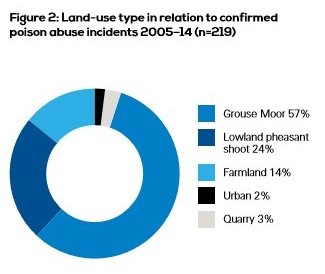
Drilling down in to the detail, there’s a useful analysis of land-use type of confirmed poisoning incidents between 2005-2014 (219 incidents). A shocking (or not) 81% of confirmed poisoning incidents during this nine-year period were on land used for game-shooting: 57% on grouse moors and 24% on land managed for lowland pheasant shoots. This tells us a great deal about who is responsible for the vast majority of illegal raptor poisoning. Despite their continued denials and protestations, and their increasingly-desperate attempts to minimise the scale of these crimes (“it’s just a few rogues”, “it’s just a small minority”), this graphic exposes the criminality at the heart of the game-shooting industry:
RSPB persecution review 1994 2014 land use

Further damning evidence, which isn’t needed by most of us but for the benefit of those who are still in denial of the bleedin’ obvious, is this graph showing the occupations of those convicted of raptor persecution between 1994-2014. Surprise, surprise, 86% of them were gamekeepers:

RSPB persecution review 1994 2014 occupation

RSPB Scotland is to be commended for publishing this exceptionally detailed and meticulously-researched report. There are a number of things in it that are of particular interest to us and we’ll come back to those in due course. For now though, particular recognition should go to the Investigations team – they may be small in number but their contribution to exposing the disgraceful continuation of illegal raptor persecution in Scotland is enormous. They, and their colleagues south of the border, are worthy of high acclaim. If anybody reading this is in a position to recognise excellence in the field of raptor conservation, e.g. a nomination for an award, this team should be at the top of your list.

So, how has the Environment Minister, Dr Aileen McLeod, responded to such an embarrassing report? She said: “There is no doubt that the figures in this report make for uncomfortable reading, but we have made progress in recent years with the new vicarious liability provisions, the publication of the report from the Wildlife Crime Penalties Review Group, new measures implementing restrictions on the use of General Licences and earlier this year the Scottish Government funded pesticide disposal scheme that removed over 700kg of illegally held poisons in Scotland“.

We have made progress…” Hmm. Let’s have a look:

Vicarious liability – introduced almost 4 years ago and only two successful convictions to date. A slow (but good) start, but we need to see many more convictions.

Wildlife Crime Penalties Review – Commissioned over two years ago, published last month. An excellent report calling for tougher sanctions but we’re waiting to hear whether the Environment Minister will act on the recommendations. Can only be defined as ‘progress’ if she agrees to act.

General Licence restrictions – available to be used against landholdings where raptor crimes committed/suspected from 1st January 2014. So far, only two restrictions have been implemented and those only lasted for six days each before they were suspended as legal arguments continue. A slow start, and the legal challenges were to be expected, but can’t be defined as ‘progress’ unless the restrictions are fully implemented. There should also be a lot more of them.

Pesticide disposal scheme –  implemented this year and resulted in the removal of some illegally-held poisons. That is progress, although it is tinged with frustration that the game-shooting industry was given yet another chance to avoid justice as this scheme (the second of its kind) comes 14 years after the pesticides were originally banned. It’s also interesting to note in the RSPB’s report (page 18) that evidence suggests a number of individuals have retained their illegal stocks. This is supported by more poisoning incidents that have taken place this year, after the disposal scheme ended.

So some progress has been made (and almost entirely due to the efforts of Dr McLeod’s predecessor, Paul Wheelhouse) but it is glacially slow and, so far, has not stemmed the occurrence of illegal persecution, as the damning figures in this report show all too clearly. Much, much more can and needs to be done before we’ll be convinced that Dr McLeod is having any sort of impact. She has, though, announced that tenders have just been invited for a review of game licensing practices in other countries (to inform a possible decision of introducing licensing to game-shooting estates in Scotland), and that’s a good thing, but again, the research needs to be done and then a decision made, which probably won’t happen for a number of years if past performance is anything to go by. She’d find herself with a lot more support if she got on with announcing increased investigatory powers for the SSPCA – the public consultation closed 1 year and 3 months ago – and still we await her decision as the criminals continue their rampage. It’s not impressive at all.

And what of the response of the game-shooting industry itself? Some didn’t bother to publish a statement (Scottish Gamekeepers’ Association), which ironically tells us quite a lot, although they are quoted in an article by STV (see media coverage below) where they revert to type and simply deny the evidence and slag off the RSPB instead. And remember, the SGA is a fully-paid up member of the Partnership for Action Against Wildlife Crime (cough).

Scottish Land and Estates (SLE), another PAW partner, did manage to issue a statement, via their Scottish Moorland Group (see media coverage below). Again, it’s the usual lamentable denial, characterised beautifully by this statement from Director Tim (Kim) Baynes:

Bird of prey deaths……have fallen dramatically over the last five years in particular“.

Er, here are some persecution figures that Kim might want to re-punch in to his calculator:

2012 – 18 confirmed deaths

2013 – 28 confirmed deaths

2014 – 37 confirmed deaths

There’s also this statement:

Our condemnation of wildlife crime is unquivocal...” All very touching but how is that “condemnation” manifested in the real world? It’s been brought to our attention that the current head gamekeeper on a Scottish grouse shooting estate has a (spent) conviction for shooting dead a raptor when he worked on another Scottish grouse moor. How does a criminal with a conviction like that (spent or not) remain employed in the game-shooting industry, let alone get a senior position on another Scottish grouse moor? Was he one of the posse of moorland gamekeepers recently invited to Holyrood to mingle with, and be applauded by, a number of MSPs, as part of the Gift of Grouse propaganda campaign? Surely not…

Download the RSPB report here

Media coverage

RSPB press release here

Statement from Environment Minister Dr Aileen McLeod here

Scottish Moorland Group statement here

BBC news here

STV article here

BBC Radio Scotland (Newsdrive) interview with Ian Thomson, Head of Investigations RSPB Scotland here (starts at 21.50, available for 29 days)

Guardian article here (a mis-leading headline but nevertheless good to see coverage in this paper)

Educating the 21st Century gamekeeper – with 19th Century ignorance

We often hear (from the shooting industry) about how well qualified young gamekeepers are these days and how these young men & women are so much better informed than their predecessors. Two years ago there was a parliamentary motion put forward to recognise the need for ‘well-trained young gamekeepers’ and the value of responsible gamekeeping to Scotland’s economy and biodiversity (see here), and this year, the SGA’s Young Gamekeeper of the Year Award was presented by none other than the Environment Minister (see here).

SGA Chairman Alex Hogg has hailed the Scottish colleges involved (see here), and apparently all graduates must pass key tests in various areas and have an understanding of conservation.

Sounds good, right?

One of the colleges offering qualifications in gamekeeping is Borders College. They have a webpage headed: ‘Educating the 21st Century Gamekeeper’ (see here).

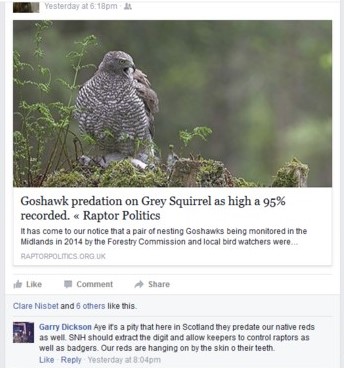
Imagine our surprise, then, when we were sent the following image, captured from Facebook two days ago:

Garry Dickson

In case you can’t read it, here is the comment written by Garry Dickson about protected native goshawks:

Aye, it’s a pity that here in Scotland they predate our native reds as well. SNH should extract the digit and allow keepers to control raptors as well as badgers. Our reds are hanging on by the skin of their teeth“.

Who’s Garry Dickson? He’s a lecturer on the gamekeeping course at Borders College.

Is this the sort of ill-informed, unsubstantiated nonsense he’s teaching to young gamekeeping students at Borders College? Mind you, if they don’t hear it from their lecturer they’ll probably hear it from the SGA – Alex Hogg shared his ignorance on goshawks a couple of years ago – see here.

It’s no surprise that the goshawk is listed as a wildlife crime priority species (because of the extent of persecution against it) if armies of young gamekeeping graduates are being let loose in the countryside after being taught such moronic 19th Century prejudice.

Sporting agent on Cardross Estate convicted in latest vicarious liability case

Press release from the Crown Office:

A self-employed game farmer has pled guilty to wildlife offences, leading to the second conviction in Scotland by vicarious liability for wildlife crime against wild birds.

At Stirling Sheriff Court, Graham Christie was fined a total of £3,200 after admitting his liability for the crimes committed by James O’Reilly, a gamekeeper employed by him.

O’Reilly was previously sentenced to a community payback order after pleading guilty to intentionally trapping and injuring a buzzard, using an illegal gin trap, contrary to the Wildlife and Countryside Act 1981. Despite veterinary treatment for the severe injury caused to its leg, the buzzard required to be euthanised as it would never be suitable for release back to the wild. The buzzard had been in good condition otherwise.

Graham Christie leased part of the Cardross Estate in Stirlingshire to use for his business, Dunmhor Shooting. He had employed O’Reilly as head game-keeper with responsibility for pest control on this part of the estate.

The offences were committed more than a year after the introduction of the vicarious liability legislation.

The law placed responsibility on Christie unless he could show that he took all reasonable steps and exercised all due diligence to prevent O’Reilly from committing the offences.

When asked by police how he was able to see what was going on ensure everything was done properly and professionally, Christie stated;

“Well I can only tell that by the amount of pheasants that were shown on a shoot day and that he was very good to be fair”.

Helen Nisbet, Head of the Wildlife and Environmental Crime Unit said:

“These offences were committed well after the vicarious liability offence was introduced and the accused had ample time in which to take advice and put appropriate measures in place.

“He failed in his responsibilities and as a result stands convicted of the killing of a wild bird using an illegal gin trap.

“Anyone who seeks to injure or kill wild birds and anyone who employs or engages the services of such persons without taking appropriate precautions to prevent these offences being committed can fully expect to be brought to account before the courts.”

Notes To Editors

1. Section 18A of the Wildlife and Countryside Act 1981, the vicarious liability provisions, came into force on the 1st January 2012. They were created in an attempt to tackle raptor persecution by encouraging landowners, employers, and those with responsibility in connection with shooting to be diligent and proactive in countering wildlife crime.

2. James O’Reilly previously pled guilty to:

Intentionally injuring and taking a wild bird (a buzzard) by setting a gin trap (otherwise known as a leg hold trap) on open ground baited by a deer carcase contrary to section 1(1)(a); and,

Setting in position a trap, namely a gin trap (otherwise known as a leg hold trap) being of such a nature and so placed as to be likely to cause bodily injury to any wild birds contrary to section 5(1)(a) of the Wildlife and Countryside Act 1981.

3. Section 18A(2) makes the accused guilty of the original offence and is liable to be punished accordingly.

4. Wildlife and environmental crime is a priority for COPFS. The development of specialist prosecutors and the creation of the COPFS Wildlife and Environment Crime Unit (WECU) have been significant steps forward in tackling wildlife crime. Our close working relationship with police wildlife crime officers and other specialist reporting agencies has permitted a collaborative building of expertise which has already shown impressive results. In serious cases, prosecutors work with wildlife investigators at an early stage to ensure that cases are prepared and presented to the highest standard.

WECU began operating from 15 August 2011.

END

Dunmhor Sporting LogoThis is good news, after the disappointment of the recent failure to prosecute another vicarious liability case on the Kildrummy Estate (see here). The penalty in this latest case (£3,200) is a considerable improvement on the pathetic £675 penalty given in the first successful vicarious liability case (see here), although it still falls far below what it could be and the fine itself is unlikely to act as any sort of deterrent to other would-be raptor killers. When you also consider the penalty handed to Christie’s gamekeeper for the original horrific offence (240 hours unpaid work – see here) it’s hard to get away from the sense that, although technically justice has prevailed in this case, the penalties do not reflect the seriousness of the crime. Whether the reputation of Christie’s sporting agency, Dunmhor Sporting, will suffer as a consequence of his criminal conviction remains to be seen although that would be hard to measure. Let’s hope Environment Minister Dr Aileen McLeod gets on with accepting the recommendations of the recent Willdife Crime Penalties Review group (see here), which include raising the penalty for this type of offence to fines of up to £40,000 and a 12 month custodial sentence. It’ll also be interesting to see whether SNH  decides to slap a General Licence Restriction Order on the Cardross Estate.

In the meantime, huge congratulations to Fiscal Kate Fleming for a successful prosecution and to all those involved with the initial investigation, especially the SSPCA.

Photo of Graham Christie from Press & Journal.

Media coverage

BBC news here

STV news here

Press & Journal here

RSPB Scotland here

Stody Estate subsidy penalty confirmed

Following on from our blog five days ago about the subsidy penalty imposed against the Stody Estate as a result of their gamekeeper’s criminal poisoning activities (see here), the Rural Payments Agency has now clarified the actual size of the penalty:

RPA Stody Estate subsidy penalty - Copy

There’s something odd about this. Converting the penalty from Euros to Sterling using a currency converter app, the subsidy penalty amounts to £184, 745.08 (although the app used by Mark Avery has calculated the conversion to be £192, 160.63). Whatevs! Whichever calculation is accurate, it’s still a huge penalty and that’s good. And it still represents the highest known subsidy penalty imposed in the UK for cross-compliance breaches related to raptor persecution offences.

However, both of these amounts are considerably less than the amount we had calculated in our earlier blog five days ago.

We had previously calculated the penalty to be £221,946.75, which was 75% of the SPS subsidy that Stody Estate had received in 2014. We got the information about the amount of subsidy the Stody Estate had received in 2014 by doing a search on CAP Payments.

When you compare our first calculation of what the penalty was (£221, 946.75), with the amount the Rural Payments Agency now say the penalty is (£184, 745.08 OR £192, 160.63), it becomes clear that around £37,000 worth of potential subsidy penalty has apparently gone missing.

So either the data on the CAP Payments website are inaccurate, or the Rural Payments Agency has miscalculated and imposed a smaller penalty than they should.

Not sure we have the appetite for going back to the RPA to ask for clarification – it’s too much like hard work for a Friday afternoon. We’re quite content just to know that the penalty has finally been imposed and that the Stody Estate has had to suffer serious financial consequences as a result of the criminal actions of their gamekeeper. Good stuff.