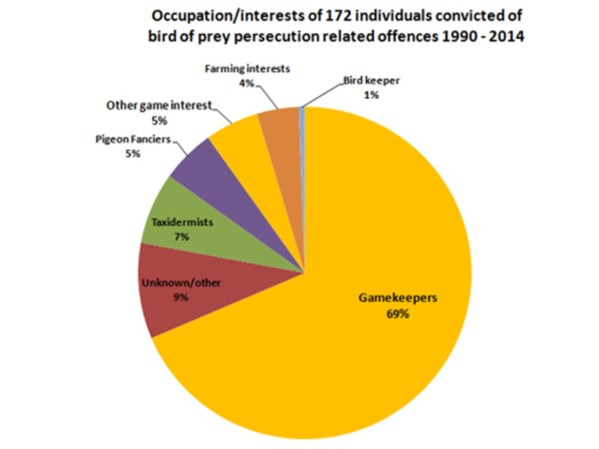
“Bird activists” killing satellite-tagged raptors, says gamekeeper

It’s ok everybody, the mystery of the vanishing satellite-tagged raptors has finally been solved. It wasn’t the (non-existent) wind farms (see here). And it wasn’t the unreliable satellite tags with a dodgy salt water switch attached to Olive Ridley Turtles off the coast of India (see here).

No, the real reason, according to a Scottish gamekeeper, is that “bird activists” have been killing off the raptors as part of a smear campaign against those who manage grouse moors.

Phew. Glad that’s all been cleared up.

Have a listen to gamekeeper Donald McBeath, interviewed on Good Morning Scotland earlier today (here – starts at 02:51:37, available for 29 days).

gamekeepers prosecuted - Copy

UPDATE 31 Aug 2016: The name of this gamekeeper is Donald McBeath, not Donald Macbeth.

UPDATE 31 Aug 2016: Mr McBeath was on the telly last night. Watch the video here

UPDATE 1 September 2016: PAW Scotland dismisses gamekeeper’s claims as ridiculous here

Flawed Natural England policies assume gamekeepers don’t illegally kill raptors

We’ve been blogging for over a year about the use of propane gas guns on grouse moors and about our concerns that these booming bird scaring devices are being used to discourage raptors (and particularly hen harriers) from settling to breed (e.g. see here, here, here, here).

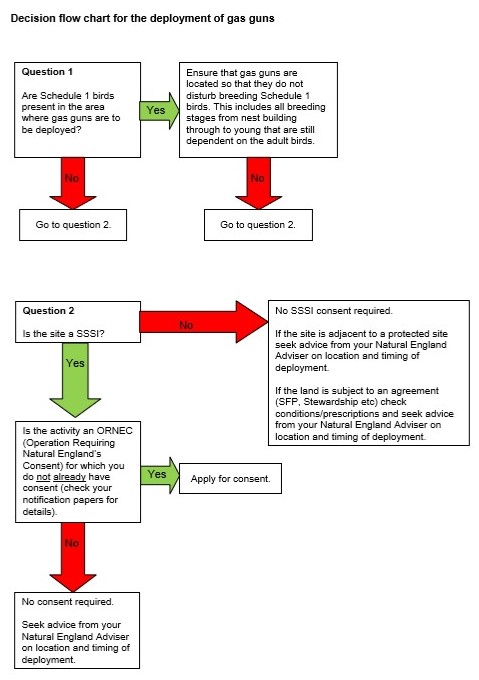
In June this year, Natural England finally produced what they called ‘guidance’ for those wishing to deploy gas guns and published a decision flow chart. It looked like this:

Gas gun guidance NE - Copy

A spokesperson for Natural England said he hoped the guidance was helpful (it wasn’t, see here) and welcomed further questions if clarification was needed.

One of our blog readers did want further clarification and he asked Natural England to explain how ‘ensuring that gas guns are located so that they do not disturb breeding Schedule 1 birds’ would work in practice?

Here’s Natural England’s response:

In response to your query the onus is on the land manager or their representative not to cause disturbance as that would be unlawful. The use of gas guns aims to dissuade species such as corvids from causing damage to ground nesting birds or livestock. On large expanses of open moorland they should be able to be deployed away from Schedule 1 species. Most managers should know where these species are present but it would be best practice for Natural England and other interested groups, for example raptor study group members, to pass on information over the location of Schedule 1 species to the land manager so they are in a more informed position and then able to ensure that gas guns are deployed appropriately“.

Ah, of course. Because telling the grouse moor manager/gamekeeper where you’ve seen hen harriers will undoubtedly lead to those birds being protected and left undisturbed, right? Have you got that, raptor study group workers?

And here’s another ingenious policy strategy from Natural England. In response to the news that Natural England had issued a licence to a gamekeeper allowing him to kill up to ten buzzards in order to ‘protect his pheasants’ (see here), another blog reader (@exPWCO) asked Natural England how they would check that just ten buzzards had been killed? Here’s Natural England’s response:

NEbuzzLicence

Ah, of course. Because asking a gamekeeper to fill in a form stating how many buzzards he’d killed under licence is bound to result in a truthful response, right?

Both of these policy statements just beggar belief. They are both based on the assumption that gamekeepers don’t illegally kill raptors, which, as we all know (and so should Natural England), is a flawed assumption.

gamekeepers prosecuted - Copy

Case against gamekeeper Stanley Gordon re: shot hen harrier, part 4

Criminal proceedings continued at Elgin Sheriff Court yesterday against Scottish gamekeeper Stanley Gordon.

Mr Gordon, 60, of Cabrach, Moray, is facing charges in connection with the alleged shooting of a hen harrier in June 2013.

The case continued without plea and the next hearing will be 1st September 2016.

Previous blogs on this case herehere and here


Vicarious liability prosecution: Andrew Duncan (Newlands Estate) part 9

Criminal proceedings continued on 2 August 2016 against landowner Andrew Walter Bryce Duncan, who is alleged to be vicariously liable for the crimes committed by gamekeeper William (Billy) Dick in April 2014.

Gamekeeper Dick was convicted in August 2015 of killing a buzzard on the Newlands Estate, Dumfriesshire by striking it with rocks and repeatedly stamping on it (see here). Mr Dick was sentenced in September 2015 and was given a £2000 fine (see here). Mr Dick attempted to appeal his conviction but this was refused on 15 July 2016 (see here).

Here’s a quick review of the proceedings against Andrew Duncan so far:

Hearing #1 (18th August 2015): Trial date set for 23rd Nov 2015, with an intermediate diet scheduled for 20th Oct 2015.

Hearing #2 (20th October 2015): Case adjourned. November trial date dumped. Notional diet hearing (where a trial date may be set) scheduled for 18th January 2016.

Hearing #3 (18th January 2016): Case adjourned. Another notional diet & debate scheduled for 11th March 2016.

Hearing #4 (11th March 2016): Case adjourned, pending the result of gamekeeper Billy Dick’s appeal. Another notional diet scheduled for 4th April 2016.

Hearing #5 (4th April 2016): Case adjourned, pending the result of gamekeeper Billy Dick’s appeal. Another notional diet scheduled for 3rd June 2016.

Hearing #6 (3rd June 2016): Case adjourned, pending the result of gamekeeper Billy Dick’s appeal. Another notional diet scheduled for 17th June 2016.

Hearing #7 (17th June 2016): Case adjourned, pending the result of gamekeeper Billy Dick’s appeal. Another notional diet scheduled for 15th July 2016.

Hearing #8 (15 July 2016): Case adjourned. Another notional diet scheduled for 2 August 2016.

At hearing #9 yesterday (2 August), the proceedings moved to trial. An intermediate diet is scheduled for 15 November 2016 (this is a short hearing where the court determines that both the prosecution and defence are prepared for trial). If the intermediate diet goes smoothly, the actual trial has been set for 7th & 8th December 2016.

Vicarious liability in relation to the persecution of raptors in Scotland (where one person may potentially be legally responsible for the criminal actions of another person working under their supervision) came in to force over four and a half years ago on 1st January 2012. To date there have been two successful convictions: one in December 2014 (see here) and one in December 2015 (see here).  One further case did not reach the prosecution stage due, we believe, to the difficulties associated with identifying the management structure on the estate where the crimes were committed (see here).

Following gamekeeper Mr Dick’s failed appeal in July 2016 (see here), we posed a number of questions. These are still to be answered:

  1. Is/was criminal gamekeeper William (Billy) Dick a member of the Scottish Gamekeepers’ Association? The SGA refused to comment on Mr Dick’s membership status at the time, saying they ‘wanted to wait until the legal process had concluded’. Well, now Mr Dick’s criminal conviction for wildlife offences has been upheld, how about answering the question? Emails to: info@scottishgamekeepers.co.uk
  2. Will Scottish Land & Estates now expel the Newlands Estate from the ranks of SLE membership? SLE said at the time that Newlands Estate’s membership of SLE had been ‘voluntarily suspended’ pending on-going legal proceedings. Well, now the gamekeeper’s criminal conviction for wildlife offences has been upheld, how about answering the question? Emails to: info@scottishlandandestates.co.uk
  3. Will the Newlands Estate’s accredited membership of Wildlife Estates Scotland (WES) now be revoked? The conditions of membership of this scheme include: “the requirements to maintain best practice standards of animal welfare and comply with all legal requirements and relevant Scottish codes of practice”. At the time of Mr Dick’s conviction, a spokesperson for WES said the Newlands Estate’s membership and accreditation of WES had been ‘voluntary suspended’ pending the outcome of legal proceedings. Well, now the gamekeeper’s criminal conviction for wildlife offences has been upheld, how about answering the question? Emails to: info@scottishlandandestates.co.uk

We’ll also be watching closely to see whether the Newlands Estate will now be subject to a General Licence Restriction from SNH. If you recall, this restriction may be imposed by SNH where evidence of raptor crime is apparent and it has been available as a sanction for offences committed since 1 January 2014. Mr Dick killed the buzzard on Newlands Estate in April 2014. Although, even if the GL restriction is put in place, the estate can easily side-step it by applying for an ‘individual’ licence instead (e.g. see here).

Had there been a gamebird licensing scheme in place, the Newlands Estate could now have been facing a temporary ban on pheasant shooting for a number of months/years. At the moment, no such licensing scheme exists, but a petition has recently been launched by the Scottish Raptor Study Group, asking the Scottish Government to introduce such a licensing scheme. You can sign the petition HERE

Vicarious liability prosecution: Andrew Duncan (Newlands Estate) part 8

Criminal proceedings continued on 15 July 2016 against landowner Andrew Walter Bryce Duncan, who is alleged to be vicariously liable for the crimes committed by gamekeeper William (Billy) Dick in April 2014.

Gamekeeper Dick was convicted in August 2015 of killing a buzzard on the Newlands Estate, Dumfriesshire by striking it with rocks and repeatedly stamping on it (see here). Mr Dick was sentenced in September 2015 and was given a £2000 fine (see here). Mr Dick attempted to appeal his conviction but this was refused on 15 July 2016 (see here).

Here’s a quick review of the proceedings against Andrew Duncan so far:

Hearing #1 (18th August 2015): Trial date set for 23rd Nov 2015, with an intermediate diet scheduled for 20th Oct 2015.

Hearing #2 (20th October 2015): Case adjourned. November trial date dumped. Notional diet hearing (where a trial date may be set) scheduled for 18th January 2016.

Hearing #3 (18th January 2016): Case adjourned. Another notional diet & debate scheduled for 11th March 2016.

Hearing #4 (11th March 2016): Case adjourned, pending the result of gamekeeper Billy Dick’s appeal. Another notional diet scheduled for 4th April 2016.

Hearing #5 (4th April 2016): Case adjourned, pending the result of gamekeeper Billy Dick’s appeal. Another notional diet scheduled for 3rd June 2016.

Hearing #6 (3rd June 2016): Case adjourned, pending the result of gamekeeper Billy Dick’s appeal. Another notional diet scheduled for 17th June 2016.

Hearing #7 (17th June 2016): Case adjourned, pending the result of gamekeeper Billy Dick’s appeal. Another notional diet scheduled for 15th July 2016.

Hearing #8 (15 July 2016): Case adjourned. Another notional diet scheduled for 2 August 2016.

Vicarious liability in relation to the persecution of raptors in Scotland (where one person may potentially be legally responsible for the criminal actions of another person working under their supervision) came in to force four and a half years ago on 1st January 2012. To date there have been two successful convictions: one in December 2014 (see here) and one in December 2015 (see here).  One further case did not reach the prosecution stage due, we believe, to the difficulties associated with identifying the management structure on the estate where the crimes were committed (see here).

Conviction upheld for buzzard-killing gamekeeper from Newlands Estate

In April 2016 we blogged about a Scottish gamekeeper who was appealing his conviction for killing a buzzard (here).

In August 2015, gamekeeper William (Billy) Dick, now 26, was found guilty of killing a buzzard on the Newlands Estate, Dumfriesshire, in April 2014. Two witnesses had observed him striking the buzzard with rocks and then repeatedly stamping on it (see here). In September 2015 he was sentenced: £1,500 fine for killing the buzzard and £500 for possession of the dead buzzard (see here).

Mr Dick had maintained his innocence throughout the trial and had claimed he was elsewhere when the offence took place (see here).

Mr Dick’s appeal was heard in May (here) and we’ve been waiting for the written judgement from that hearing. Yesterday, that written judgement was published and Mr Dick’s appeal was thrown out.

The judgement itself is well worth a read (see here) as it explains not only the evidence used to convict Mr Dick, but also the grounds for his appeal, which basically centred on what time Mr Dick and his line manager (Head Gamekeeper) had left a BASC training course in Dunkeld. Mr Dick has always argued he couldn’t have been the person observed killing the buzzard because he was still travelling back to Newlands Estate from Dunkeld at the time the observation was made. The Sheriff in the original trial had preferred the testimony of the two witnesses (tenants on Newlands Estate who knew gamekeeper Mr Dick) to the testimony of Mr Dick and his Head Gamekeeper.

You might think that 21st Century technology could easily have resolved this issue. For example, did the vehicle in which Mr Dick and his Head Gamekeeeper were travelling not pass any Automated Number Plate Recognition (ANPR) cameras enroute from Dunkeld to Newlands Estate? Surely that would have provided conclusive evidence about the timing of their journey? Apparently not.

Mr Dick’s appeal was heard by three senior judges: Lord Carloway (Lord Justice General), Lord Menzies, and Lord Bracadale. In the written judgement, each of these three judges state their individual opinion about the case and explain the reasoning behind their decisions. Two of the judges (Carloway and Bracadale) considered that the appeal should be refused. The other judge, Menzies, considered that there were sufficient grounds for appeal. [Interesting to note, according to Wikipedia, Lord Menzies’ interests include shooting]. The appeal was rejected 2:1 against.

This is a rare success and the SSPCA, Police Scotland, and Crown Office deserve credit for their efforts. Special credit to the two witnesses who risked a lot to bring this criminal to justice.

As Mr Dick’s criminal conviction has now been upheld, presumably this will now allow the prosecution to proceed against Andrew Duncan, the Newlands Estate landowner, for alleged vicarious liability of Mr Dick’s crimes. The case against Mr Duncan has been repeatedly delayed (see here) while Mr Dick’s appeal was underway.

Mr Dick’s failed appeal also leads us back to several questions we asked at the time of his conviction in August 2015. These were:

  1. Is/was criminal gamekeeper William (Billy) Dick a member of the Scottish Gamekeepers’ Association? The SGA refused to comment on Mr Dick’s membership status at the time, saying they ‘wanted to wait until the legal process had concluded’. Well, now Mr Dick’s criminal conviction for wildlife offences has been upheld, how about answering the question? Emails to: info@scottishgamekeepers.co.uk
  2. Will Scottish Land & Estates now expel the Newlands Estate from the ranks of SLE membership? SLE said at the time that Newlands Estate’s membership of SLE had been ‘voluntarily suspended’ pending on-going legal proceedings. Well, now the gamekeeper’s criminal conviction for wildlife offences has been upheld, how about answering the question? Emails to: info@scottishlandandestates.co.uk
  3. Will the Newlands Estate’s accredited membership of Wildlife Estates Scotland (WES) now be revoked? The conditions of membership of this scheme include: “the requirements to maintain best practice standards of animal welfare and comply with all legal requirements and relevant Scottish codes of practice”. At the time of Mr Dick’s conviction, a spokesperson for WES said the Newlands Estate’s membership and accreditation of WES had been ‘voluntary suspended’ pending the outcome of legal proceedings. Well, now the gamekeeper’s criminal conviction for wildlife offences has been upheld, how about answering the question? Emails to: info@scottishlandandestates.co.uk

We’ll also be watching closely to see whether the Newlands Estate will now be subject to a General Licence Restriction from SNH. If you recall, this restriction may be imposed by SNH where evidence of raptor crime is apparent and it has been available as a sanction for offences committed since 1 January 2014. Mr Dick killed the buzzard on Newlands Estate in April 2014. Although, even if the GL restriction is put in place, the estate can easily side-step it by applying for an ‘individual’ licence instead (e.g. see here).

Had there been a gamebird licensing scheme in place, the Newlands Estate could now have been facing a temporary ban on pheasant shooting for a number of months/years. At the moment, no such licensing scheme exists, but a petition has recently been launched by the Scottish Raptor Study Group, asking the Scottish Government to introduce such a licensing scheme. You can sign the petition HERE

Case against gamekeeper Stanley Gordon re: shot hen harrier, part 3

Criminal proceedings continued at Elgin Sheriff Court yesterday against Scottish gamekeeper Stanley Gordon.

Mr Gordon, 60, of Cabrach, Moray, is facing charges in connection with the alleged shooting of a hen harrier in June 2013.

The case continued without plea and the next hearing will be 11 August 2016.

Previous blogs on this case here and here


North Yorkshire Police admit they should have charged pole-trapping gamekeeper

On 1 June 2016 we blogged about the Mossdale Estate gamekeeper who had been caught on film setting illegal pole traps on a grouse moor in the Yorkshire Dales National Park (here).
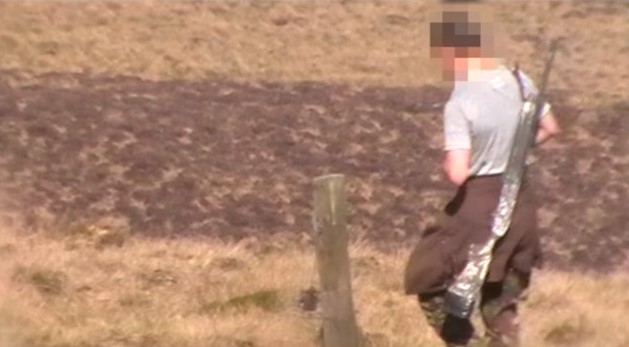
Mossdale pole trap May 2016

Also on 1 June 2016, we blogged about North Yorkshire Police’s decision to issue this criminal with a caution rather than refer him to the Crown Prosecution Service to begin a formal prosecution. We argued that, according to the official Police ‘cautions’ guidelines, the decision to caution in this case was apparently flawed. The offences, to which the gamekeeper had already admitted guilt, backed up by excellent video evidence obtained by the RSPB’s Investigations Team, were of such gravity and included all five aggravating factors (and no mitigating factors) as listed in the Police guidelines, that this was a clear case for proceeding to charges and a prosecution. Following a bombardment of complaints from blog readers (thank you all), Amanda Oliver, Acting Chief Constable of North Yorkshire Police, promised a review of the decision not to charge this criminal gamekeeper (see here).

Today, Amanda Oliver has published the findings of that review:

You wrote to us recently to complain about our decision to caution a man, after he admitted an offence contrary to section 5(1) of the Wildlife and Countryside Act 1981.

North Yorkshire Police has now completed a review of this investigation. This involved looking again at the evidence and the decision, using the Ministry of Justice Guidelines on Adult Cautions, the Adult Gravity Factor Matrix, and the latest Director of Public Prosecutions Guidance on Charging. Specialist advice was also sought from the Crown Prosecution Service.

Our review found that we had not used the correct cautioning guidelines when dealing with this case. Police officers have a level of discretion in deciding how to deal with a case, based on the specific circumstances of the incident. However, the review concluded that if the correct guidelines had been used, it is likely that the man would have been charged, rather than cautioned.

It is important to remember that a police caution is not a “let off”. A person who has been cautioned has a criminal record, and there can be very serious consequences as a result.  Depending on the circumstances, they may lose their job and income, and there may also be implications for the person’s future employment. A decision was also made to revoke this man’s firearms licence as a result of his involvement in this offence.

As a result of the review, we asked the Crown Prosecution Service to consider whether further action should be taken on this case, and provided them with other details of our activity related to the man involved. After consideration, the Crown Prosecution Service decided that, taking all matters into account, including that a decision had already been made, no further action should be taken. 

I would like to reassure you that the mistake we made on the use of guidelines was isolated to this particular case. Nonetheless, we have taken the matter very seriously, and we have ensured we have done everything we can to avoid mistakes happening in the future. We have amended our policy on how wildlife crimes are dealt with by investigators and decision-makers, and advice from specially-trained officers is now sought in every case. We are also using our position as the National Police Chiefs’ Council lead on rural and wildlife crime, to share what we have learned with other police services across the UK.

Thank you for raising this matter with us. On behalf of North Yorkshire Police I would like to apologise for the distress that this matter has caused you, and assure you that we will do our very best to protect our local wildlife, and deliver the police national wildlife action plan here in North Yorkshire and more widely.

Yours sincerely

Amanda Oliver

Acting Assistant Chief Constable

END

We very much appreciate Amanda Oliver’s decision to conduct this review and publicise the findings. This level of accountability, honesty and transparency is, in our experience, extremely rare but it is vital if the public is to have any confidence in the way the Police handle wildlife crimes. We applaud North Yorkshire Police for not trying to cover up their mistakes.

On to the actual review itself, Amanda says the usage of incorrect charging guidelines was isolated to this particular case. We’re not so sure about that. In 2015, we blogged about the discovery of five illegally set pole traps at a gamebird-breeding facility in North Yorkshire. The police charged the owner of that facility and he was found guilty of permitting the use of one pole trap, although this conviction was later quashed. But the Police failed to charge two employees with setting those five illegal traps and instead they were both given a caution (see here). Did North Yorkshire Police use the incorrect guidelines when they decided to caution those two employees? We’ll never know.

Amanda suggests that in the case of the Mossdale Estate gamekeeper, a police caution is “not a let off”. Sorry, but that’s nonsense, and we share Mark Avery’s views (here) on why it absolutely is a let off. It’s particularly frustrating in this case because, as you all know, raptor persecution on grouse moors is prolific and yet there are relatively few convictions. Why? Because it takes an extraordinary set of circumstances to have first-rate evidence AND an admission of guilt from the gamekeeper. This particular case was handed to the Police on a plate, thanks to the superb efforts of the RSPB’s Investigations Team. It should have been an easy ‘win’ that ended in a successful prosecution. That opportunity was missed in this case, and that’s unfortunate. However, we do applaud the Police’s decision to revoke this gamekeeper’s firearms certificate and we hope other Police forces take note of that decision.

It’s also unfortunate that the CPS has taken the decision not to take any further action against this criminal gamekeeper but without knowing the full details of the case it’s difficult to assess the validity of that decision.

We’re pleased and encouraged to hear that North Yorkshire Police has now amended its policy on how it tackles wildlife crimes. Given this region’s well-deserved reputation for being a raptor persecution hell hole, it probably won’t be long before we get to see just how well this new policy is working. The next case won’t be far away.

NYorks Police decision to caution pole-trapping gamekeeper: where’s that review?

On 1st June 2016, we blogged about the Mossdale Estate gamekeeper who had been caught on film setting illegal pole traps on a grouse moor in the Yorkshire Dales National Park (see here).

Later that day we also blogged about North Yorkshire Police’s decision to issue this criminal with a caution rather than refer him to the Crown Prosecution Service to begin a formal prosecution. We argued that, according to the official Police ‘cautions’ guidelines, the decision to caution in this case was apparently flawed. The offences, to which the gamekeeper had already admitted guilt, backed up by excellent video evidence obtained by the RSPB’s Investigations Team, were of such gravity and included all five aggravating factors (and no mitigating factors) as listed in the Police guidelines, that this was a clear case for proceeding to charges and a prosecution (see here).

The Police’s decision to issue a caution, and their justification for that decision, resulted in widespread public anger, particularly on social media.

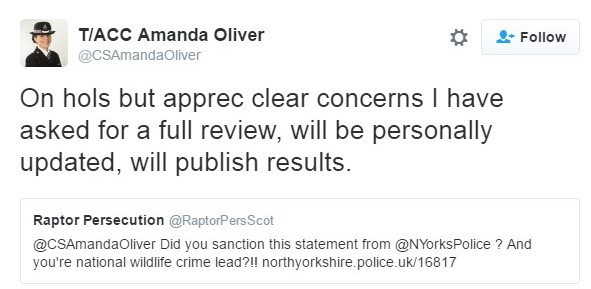
To her credit, Amanda Oliver, North Yorkshire Police Acting Chief Constable (also the newly-appointed Police National Wildlife Crime lead) responded by tweeting the following:

AmandaOliverResponse

Around the same time, one of our readers sent an FoI to North Yorkshire Police about this case, asking for details about the procedures that were followed to reach the decision to caution this gamekeeper. The response doesn’t tell us anything we didn’t already know. That blog reader has kindly given us permission to post the Police’s FoI response here: NYP_FOI_June2016_pole trap decision

So, it’s now 30th June 2016 and a month has passed since we were promised a police review of the decision to caution. Where is it? How long does it take to conduct a review of this nature? It can’t take very long, surely? The evidence against the gamekeeper was as good as it gets (unequivocal video footage and a subsequent admission of guilt from the gamekeeper) so the question to be addressed by the review is pretty simple:

Why did the police officer issue a simple caution when the official police guidelines state that a simple caution was inappropriate for these offences?

Let’s ask Acting Chief Constable Amanda Oliver when we might expect to see the results of the review. Emails to: amanda.oliver@northyorkshire.pnn.police.uk 

Vicarious liability prosecution: Andrew Duncan (Newlands Estate) part 7

Criminal proceedings continued on 17th June against landowner Andrew Walter Bryce Duncan, who is alleged to be vicariously liable for the crimes committed by gamekeeper William (Billy) Dick in April 2014.

Gamekeeper Dick was convicted in August 2015 of killing a buzzard on the Newlands Estate, Dumfriesshire by striking it with rocks and repeatedly stamping on it (see here). Dick was sentenced in September 2015 and was given a £2000 fine (see here), although he is appealing his conviction.

Here’s a quick review of the proceedings against Andrew Duncan so far:

Hearing #1 (18th August 2015): Trial date set for 23rd Nov 2015, with an intermediate diet scheduled for 20th Oct 2015.

Hearing #2 (20th October 2015): Case adjourned. November trial date dumped. Notional diet hearing (where a trial date may be set) scheduled for 18th January 2016.

Hearing #3 (18th January 2016): Case adjourned. Another notional diet & debate scheduled for 11th March 2016.

Hearing #4 (11th March 2016): Case adjourned, pending the result of gamekeeper Billy Dick’s appeal. Another notional diet scheduled for 4th April 2016.

Hearing #5 (4th April 2016): Case adjourned, pending the result of gamekeeper Billy Dick’s appeal. Another notional diet scheduled for 3rd June 2016.

Hearing #6 (3rd June 2016): Case adjourned, pending the result of gamekeeper Billy Dick’s appeal. Another notional diet scheduled for 17th June 2016.

Hearing #7 (17th June 2016): Case adjourned, pending the result of gamekeeper Billy Dick’s appeal. Another notional diet scheduled for 15th July 2016.

For those interested in gamekeeper Billy Dick’s appeal, we blogged about it here.

Vicarious liability in relation to the persecution of raptors in Scotland (where one person may potentially be legally responsible for the criminal actions of another person working under their supervision) came in to force four and a half years ago on 1st January 2012. To date there have been two successful convictions: one in December 2014 (see here) and one in December 2015 (see here).  One further case did not reach the prosecution stage due, we believe, to the difficulties associated with identifying the management structure on the estate where the crimes were committed (see here).