Case against gamekeeper Stanley Gordon re: shot hen harrier, part 9

As many of you will be aware, criminal proceedings are underway against Scottish gamekeeper Stanley Gordon.

Mr Gordon, 60, of Cabrach, Moray, is facing a charge in connection with the alleged shooting of a hen harrier in June 2013. He has denied the charge.

We need to amend some information about this case, written in an earlier post on 10 Feb 2017 (here).

We had previously been told that the new trial date was 21 March 2017. This was incorrect. There will be another hearing on 21 March 2017 but it will be an intermediate diet. The new trial date has been set for 15 May 2017.

Here is the revised timeline of this case:

Hearing #1 (19 May 2016): Case continued without plea until 16 June 2016.

Hearing #2 (16 June 2016): Case continued without plea until 14 July 2016.

Hearing #3 (14 July 2016): Case continued without plea until 11 August 2016.

Hearing #4 (11 August 2016): Case continued without plea until 1 September 2016.

Hearing #5 (1 September 2016): Mr Gordon enters a not guilty plea. A provisional trial date is set for 19 December 2016, with an intermediate diet set for 18 November 2016.

Hearing #6 (18 November 2016): Case adjourned for another intermediate diet on 2 December 2016.

Hearing #7 (2 December 2016). Provisional trial date of 19 December is dumped. Case adjourned for another intermediate diet on 10 February 2017.

Hearing #8 (10 February 2017). Case adjourned for another intermediate diet on 21 March 2017. New provisional trial date set for 15 May 2017.

Environment Secretary’s message to Scottish gamekeepers re: raptor persecution

roseanna-cunninghamLast week, Environment Cabinet Secretary Roseanna Cunningham gave a speech at the Scottish Raptor Study Group’s annual conference, where she described, with feeling, her ‘contempt‘ for the continued illegal persecution of birds of prey (see here).

Her speech was warmly welcomed by those in the audience and many were hoping she would deliver the same message when she spoke at the Scottish Gamekeepers’ Association AGM, six days later on 3 March.

It seems as though she did. According to this article in the Courier, her speech to the SGA was similarly-worded and hopefully it was delivered with the same strength of feeling she gave at the SRSG conference.

Here are some quotes from her SGA speech:

Not only are you valuable eyes and ears in the Scottish countryside, but you are stakeholders in the Partnership for Action Against Wildlife Crime, with a vital role to play.”

We also need to continue to work together to change attitudes and every person in this room can help“.

The successful reintroductions of red kite and white-tailed eagle, and the recent 15% increase – which is in real terms a recovery – in golden eagle numbers, from the results of the last national survey – is welcome progress“.

For many people seeing these magnificent birds is a rare event. Many of you here today are in the fortunate position of seeing them regularly and I envy you that“.

Unhappily however the illegal killing of raptors is still with us“.

I have no patience at all with old fashioned attitudes towards these birds that linger on in this day and age. We all have to abide by the law, and must do so every day“.

I have no truck with any excuse that raptors damage driven grouse shooting interests – such damage is a business risk that grouse moor owners have to live with, and manage for – and this has to be done within the law“.

I note and welcome your chairman Alex Hogg’s reiteration of the pledge to ensure SGA members only consider legal routes to conflict resolution and he has made it clear that those committing wildlife crime will be removed from the SGA.

Although it looks like she didn’t go as far as directly pointing the finger at the SGA, it is to be hoped that the sub-text was clear enough to have some people squirming in their seats.

As several commentators have mentioned on this blog, although the Environment Secretary’s words were welcome, we have heard them all before, not only from her but also from three previous Environment Ministers, and yet raptor persecution continues. For now though, we’re cautiously giving Roseanna Cunningham the benefit of the doubt.

Yes, her words to the SGA are a big improvement on the words her predecessor gave to the SGA (see here) and yes, she’s bought herself and the Scottish Government a bit more time with these two speeches, but society’s patience is not limitless. We expect to see further measures enacted, and soon. There will be a lot of attention placed on the Cabinet Secretary’s response to the recently-published game bird licensing review, the forthcoming review of satellite tagged raptors, and the decision on whether to give increased investigatory powers to the SSPCA.

There’ll also be a great deal of attention paid this year to whether SNH grants licences to gamekeepers allowing them to kill protected raptors and if so, on what grounds? Roseanna has been clear that any perceived damage by raptors to grouse moor management should be a ‘business risk’ that has to be ‘managed within the law’. The SGA will no doubt argue that applying for licences to kill raptors would be ‘managing the business risk within the law’ and technically, they’d be correct, in as much as the provision is there to apply for such licences but whether protecting artificially high numbers of game birds is justification for legally killing protected raptors, especially when illegal raptor persecution continues, is an argument that will dominate MSPs’ inboxes if licences are given this year.

Interesting times ahead.

Scottish Gamekeepers chairman attacks Raptor Study Group

hogg-shiteAlex Hogg, Chairman of the Scottish Gamekeepers’ Association, has a long track record of talking out of his backside.

Previous missives directly attributable to the SGA’s esteemed leader have included lines such as, “Professional gamekeepers do not poison raptors” (here), “It is unfair to accuse gamekeepers of wildlife crime” (here), “In the last ten years we have stamped out poisoning” (here), “We kill animals because probably we’re the doctors and nurses of the countryside” (here) and, when asked whether gamekeepers are involved in the poisoning, shooting and trapping of raptors: “No they aren’t. We would dispute that” (here).

In the latest edition of the Shooting Times, he accuses the Scottish Raptor Study Group of ‘driving [gamekeepers’] wives, children and grandchildren from their homes‘. Here’s part of the article to provide the context to his claim:

One of the reasons the SGA was set up was to stop the police raiding our houses without proper evidence of wrongdoing. Wives and children were being subjected to dawn raids, houses were being pulled to pieces; in some cases children’s cough mixture was confiscated in case poison was being hidden in the bottle.

Hopefully these bad old days are gone. The SGA has worked extremely hard with our members to drive the poisoning incidents almost off the map. We have been very successful and last year it looks as if we had only two incidents of poisoning that involved a raptor. If the police had these results in any other form of crime it would be in all the news media for months.

Still, all we hear from the RSPB is that this can only be the tip of the iceberg. The Scottish Raptor Study Group, along with the RSPB, has launched a petition calling for the licensing of Scottish shooting estates. This group has been publicly funded since inception and has taken access on estates for years without even having to inform the keeper or landowner. In this regard it is unaccountable as it can log whatever it wishes, with little or no checks or balances on the process or the effects of its monitoring.

It seems strange that a group lacking in accountability is calling for shoots to be licensed. We will not stand by and allow double standards to drive wives, children and grandchildren from their homes. Everybody who works and lives in the countryside must now be wary that compliance with such organisations, sadly, is compliance with people who are attacking our jobs and way of life. It should never have got to this stage.

If the SGA had not been formed 20 years ago, what we live for would have been swallowed up by different government bodies. Some people hate the truth, but we will always tell it. It is that honesty which has gained us the respect that we have’.

ENDS

It seems that Alex hasn’t read the Scottish Moorland Group’s recently proposed ‘four point plan‘ for eradicating illegal raptor persecution, as presented to the Scottish Parliament’s Environment Committee last December. Point four was, “We would very much like to see greater cooperation between ourselves, the Raptor Study Groups and the RSPB“. Oops.

A few other points for Alex to consider:

  1. The police are not allowed to raid houses on a whim. They first have to apply for a search warrant from a Sheriff (via the Crown Office) and this will only be granted if there are reasonable grounds to assume that evidence of criminal activity may be uncovered during a search.
  2. It’s no surprise if children’s cough mixture has been confiscated during a raid. It has not been uncommon to find illegal poison stored in everyday household containers (particularly coffee jars!) and on at least one search a banned, highly toxic poison was found in a container on a shelf within a child’s reach.
  3. Raptor persecution has not stopped. Poisoning reports may have dropped, but other methods (particularly shooting and trapping) have not. Stop pretending otherwise.
  4. Members of the Scottish Raptor Study Group, just like every other member of the public, are entitled to access land without having to inform the keeper or landowner. Get over it.
  5. Members of the Scottish Raptor Study Group are individually licensed to visit the nests of Schedule 1 birds. They are accountable for their actions as they have to submit data returns to the Government’s licensing authority on an annual basis as a condition of the licence. If you want to discuss unaccountability, contrast this licensing regime with that of gamekeepers, who are not individually licensed and do not have to submit annual returns detailing any of their activities, which mostly involves killing wildlife.
  6. It’s not clear to us how launching a petition calling for a licensing scheme for gamebird shooting is going to ‘drive wives, children and grandchildren from their homes’. What will drive them from their homes is if gamekeepers get caught illegally killing raptors and lose their jobs (and tied house) as a result of a conviction.
  7. The SGA is supposedly a partner organisation in the Partnership Against Wildlife Crime (PAW), and notably, the PAW Raptor Group. Quite how publicly slagging off and warning SGA members to be wary of cooperating with another PAW partner (the Scottish Raptor Study Group) is evidence of good partnership working is beyond us. Perhaps the SGA will be asked to explain this at the next PAW Raptor Group meeting.

Alex’s article also touched on some other issues, including how the SGA is this year going to push for the Scottish Government to issue licences to ‘control’ (kill) protected species such as badgers, buzzards and ravens. He mentions that Environment Cabinet Secretary Roseanna Cunningham will be a guest speaker at the SGA’s annual conference in March and how staff members from SNH’s licensing team will also be in attendance to answer questions about this issue.

Interestingly, this subject was raised during Roseanna Cunningham’s address to the Scottish Raptor Study Group’s annual conference last Saturday. If she tells the SGA conference what she told the SRSG conference, there’ll be tears at bedtime for Alex and his wildlife-killing colleagues. (We’ll be blogging about the Cabinet Secretary’s speech to SRSG members in the next day or so, highlighting several points she made about raptor persecution and her full endorsement and gratitude for the “dedicated high quality fieldwork” of the SRSG).

Here is a copy of the Shooting Times article in full: alex-hogg-article_shooting-times_23feb2017

Gamekeeper chat

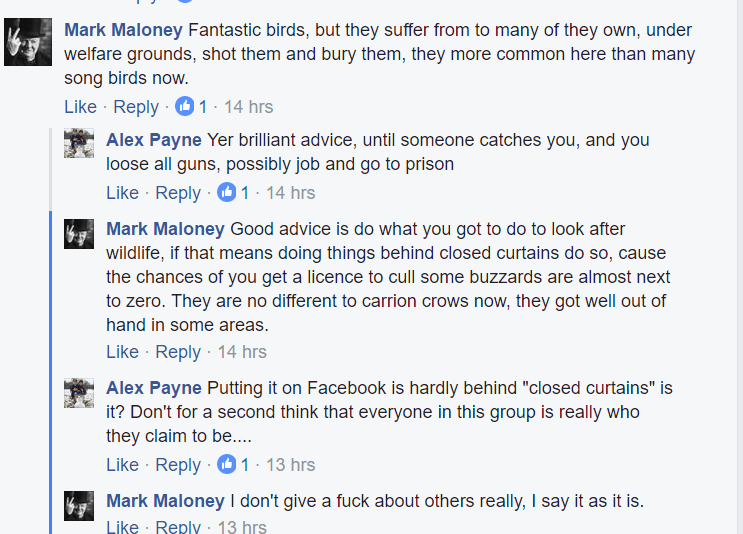
The following conversation took place on a Facebook page called ‘Gamekeeper chat’ on 12 February 2017. They were discussing buzzards:

Not very bright, is he?

Shall we just remind ourselves what Dr Colin Sheddon (BASC) said in his recent evidence to the Scottish Parliament’s Environment Committee? He told MSPs that a licensing scheme to regulate gamebird hunting in Scotland wasn’t necessary as all those who shoot game are already regulated via their shotgun certificates and that “shotgun certificate holders are among the most law-abiding sector of society and any hint of illegal activity can lead to the right to hold a certificate, and the ability to shoot, being withdrawn“.

Poisons cache on East Arkengarthdale Estate: no prosecution, no subsidy penalty

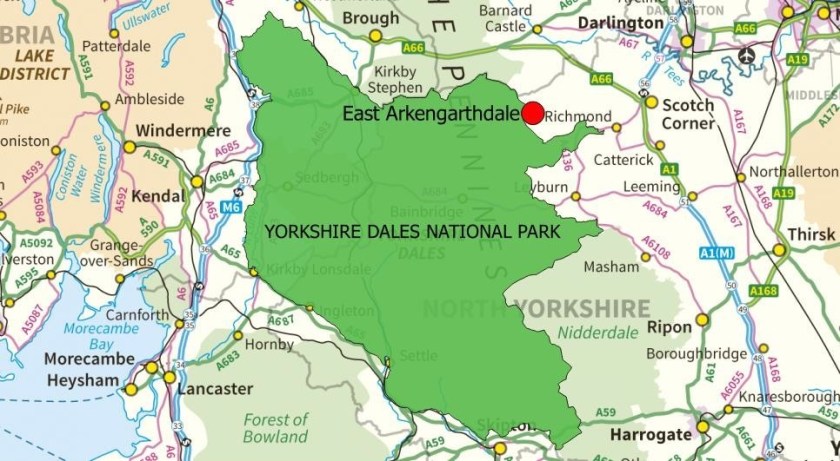
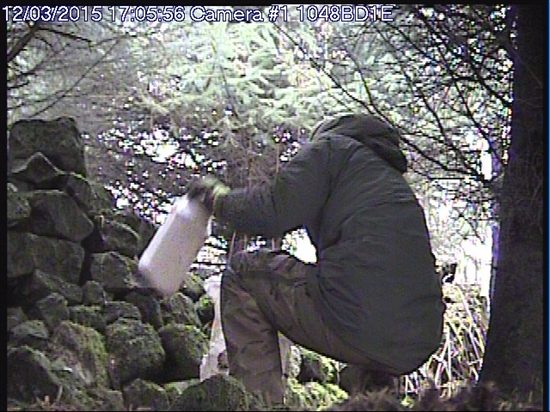
In December 2016 we blogged (here) about the discovery of an illegal poisons cache, buried in a small forestry plantation on Hurst grouse moor, part of the East Arkengarthdale Estate in North Yorkshire.
east-arkengarthdale

The discovery had been made (and filmed) by the RSPB’s Investigations team in December 2014 and March 2015. RSPB Investigator Guy Shorrock wrote a blog about it (here).

We learned that an unnamed gamekeeper had been responsible for the poisons cache but the Crown Prosecution Service had decided not to prosecute due to ‘procedural concerns’. Nevertheless, North Yorkshire Police revoked this gamekeeper’s shotgun and firearms certificates. The gamekeeper appealed this decision (and was represented by the BASC Chairman, no less) and the court decided his certificates should be returned.

So we asked the Rural Payments Agency (as did many of you, thank you) whether the illegal poisons cache was a breach of the conditions under which the Estate had received almost £200,000 of agricultural subsidies (public money) and if so, whether any part of those subsidies would be withdrawn as a penalty, in the same way a penalty had been applied to the Stody Estate in Norfolk for poisoning offences that took place in 2013 (see here).

Here’s the Rural Payments Agency’s response:

You have asked the following questions about the discovery of a hidden pesticide cache on Hurst Moor, North Yorkshire in 2014:

1. Did the CAP subsidies received by the specified business in 2014 cover the land where the poisons cache was discovered?
2. If so, does having a poisons cache, administered by a gamekeeper, qualify as a cross-compliance breach?
3. If so, will the Rural Payments Agency be applying a subsidy penalty?

The RPA has determined that a subsidy penalty was not appropriate, for the reason set out below. It therefore did not need to establish the precise location of land where the poisons cache was discovered.

We considered this case under the cross compliance rules that applied in 2014 and we hope the following will explain why RPA does not have the scope to apply cross compliance penalties for breaches of this nature.

Within cross compliance, all breaches relating to storage of pesticides were provided for by a set of rules known as the sustainable use rules.  These were part of the wider set of rules covered by the plant protection product Statutory Management Requirement (SMR) which, in 2014 was SMR 9. Please refer to page 63 of the Guide to Cross Compliance in England 2014, for further information.

From 1 January 2014 a change to European legislation meant the sustainable use rules were removed from the scope of SMR 9 as far as cross compliance rules applicable to SPS payments were concerned. This meant there was no scope to apply cross compliance penalties to SPS payments for pesticide storage and unapproved product breaches that occurred from 1 January 2014 onwards.

The sustainable use rules continued to apply to rural development schemes covered by cross compliance rules, for example the full range of Environmental Stewardship schemes. This was the case until the end of 2014, after which further changes to European legislation fully removed the sustainable use rules from the scope of cross compliance.

In the rural development legislation that applied in 2014, the obligation to comply with the statutory management requirements did not apply to non-agricultural activities on a holding. In this case the evidence is that the breach was committed in connection with the non-agricultural activity of game shooting. In addition, the evidence is that the cache was not found on agricultural land, but within a small plantation of trees. Therefore it is not possible to apply cross compliance penalties to rural development payments for a breach of this nature.

END

So, no prosecution, no revocation of firearms, and no subsidy penalty.
arken

But what about a positive reaction from the grouse shooting industry itself? Surely, as members of the Partnership Against Wildlife Crime (PAW) and the Raptor Persecution Priority Delivery Group (RPPDG), organisations like the Moorland Association and the National Gamekeepers’ Organisation would want to move swiftly to distance themselves from this Estate and this gamekeeper?

Well, we asked them about this (as did many of you, thank you) two months ago (here) and guess what? We haven’t heard a word of condemnation or any hint of expulsion. Just the standard wall of silence we’ve come to expect.

What we did find, though, was East Arkengarthdale grouse moor being listed as among ‘the best shoots in the UK 2015/2016‘, as recommended by ‘prominent figures and agents’ from the industry. It’s really worth having a look at this list – there are a few other ‘interesting’ names that many of you will recognise.

If ever you wanted evidence of a criminally-riddled industry protecting its own, or evidence of sham partnership working, you’ll be hard pressed to beat this case as an example.

ECCLR Committee’s latest thoughts on gamebird licensing petition

This morning the Scottish Parliament’s Environment, Climate Change & Land Reform (ECCLR) Committee considered how to progress the Scottish Raptor Study Group’s petition calling for the introduction of a state-regulated licensing system for all gamebird hunting in Scotland.

You may recall the petition was submitted to the Scottish Parliament’s Public Petitions Committee last summer. That Committee took evidence in October 2016 from the SRSG and RSPB Scotland (see here) and then evidence from the Scottish Moorland Group and BASC in December 2016 (see here) before deciding to pass the petition to the Environment, Climate Change & Land Reform (ECCLR) Committee for further consideration.

This morning the ECCLR Committee spent 7 minutes discussing the petition and various ways forward. The video of this morning’s discussion can be viewed here (the relevant start time is 1:46.11) and the official transcript can be read here (starts at page 37): ecclr-transcript-31-jan-2017

One Committee member, Alexander Burnett MSP (Scottish Conservative & Unonist Party, Aberdeenshire West), declared his shooting interests before suggesting that the petition should be dismissed outright because, amongst other things, “those who shoot are already licensed by extremely rigorous shotgun and firearms regimes“. He clearly hasn’t been following the case of the East Arkengarthdale Estate gamekeeper who was able to keep his shotgun and firearms certificates, despite admitting his involvement with an illegal poisons cache (see here).

Fortunately, Mr Burnett’s suggestion found no support from other Committee members and a decision was made to:

(a) Write to the Environment Cabinet Secretary to ask when the gamebird licensing review will be published, and to suggest that it be made available pronto so the ECCLR Committee can continue deliberations without further delay. It was suggested that the Committee would like to be in a position to proceed by March. (Remember, the publication of this review is already overdue and this delay is now affecting other areas of Parliamentary process).

(b) Write to the Environment Cabinet Secretary and ask for her opinion on the effectiveness of other measures such as vicarious liability, general licences etc.

(c) After receipt of the gamebird licensing review, and following a short period of time to consider its findings, the ECCLR Committee will potentially invite the Petitioner (Logan Steele of the Scottish Raptor Study Group) and a range of stakeholders to give further evidence.

UPDATE 22 Feb 2017: letter-from-ecclr-convenor-to-cab-sec-re-petition-pe1615_7feb2017

UPDATE 6 April 2017: Cab Sec letter to ECCLR re gamebird licensing_7March2017

Vicarious liability prosecution: Andrew Duncan (Newlands Estate), part 13

Criminal proceedings continued yesterday (24 January 2017) against landowner Andrew Walter Bryce Duncan, who is alleged to be vicariously liable for the crimes committed by gamekeeper William (Billy) Dick in April 2014.

Gamekeeper Dick was convicted in August 2015 of killing a buzzard on the Newlands Estate, Dumfriesshire by striking it with rocks and repeatedly stamping on it (see here). Mr Dick was sentenced in September 2015 and was given a £2000 fine (see here). Mr Dick attempted to appeal his conviction but this appeal was rejected on 15 July 2016 (see here).

Here’s a quick review of the proceedings against Andrew Duncan so far:

Hearing #1 (18th August 2015): Trial date set for 23rd Nov 2015, with an intermediate diet scheduled for 20th Oct 2015.

Hearing #2 (20th October 2015): Case adjourned. November trial date dumped. Notional diet hearing (where a trial date may be set) scheduled for 18th January 2016.

Hearing #3 (18th January 2016): Case adjourned. Another notional diet & debate scheduled for 11th March 2016.

Hearing #4 (11th March 2016): Case adjourned, pending the result of gamekeeper Billy Dick’s appeal. Another notional diet scheduled for 4th April 2016.

Hearing #5 (4th April 2016): Case adjourned, pending the result of gamekeeper Billy Dick’s appeal. Another notional diet scheduled for 3rd June 2016.

Hearing #6 (3rd June 2016): Case adjourned, pending the result of gamekeeper Billy Dick’s appeal. Another notional diet scheduled for 17th June 2016.

Hearing #7 (17th June 2016): Case adjourned, pending the result of gamekeeper Billy Dick’s appeal. Another notional diet scheduled for 15th July 2016.

Hearing #8 (15 July 2016): Case adjourned. Another notional diet scheduled for 2 August 2016.

Hearing #9 (2 August 2016): Proceedings moved to trial. Intermediate diet scheduled for 15 November 2016 and provisional trial date set for 7/8 December 2016.

Hearing #10 (15 November 2016): The case was adjourned for another intermediate diet scheduled for 22 November 2016. Trial date of 7/8 December 2016 is dumped.

Hearing #11 (22 November 2016): The case was adjourned for yet another intermediate diet, scheduled for 6 December 2016.

Hearing #12 (6 December 2016): The case was adjourned for yet another intermediate diet, scheduled for 24 January 2017. A provisional trial date (this will be the third time a trial date has been assigned) is scheduled for 24 April 2017.

Hearing #13 (24 January 2017): Guess what? The case was adjourned for another intermediate diet, scheduled for 11 April 2017. As far as we know, the provisional trial date of 24 April still stands although this could change depending on what happens at the intermediate diet on 11 April.

Vicarious liability in relation to the persecution of raptors in Scotland (where one person may potentially be legally responsible for the criminal actions of another person working under their supervision) came in to force five years ago on 1st January 2012. To date there have been two successful prosecutions/convictions: one in December 2014 (see here) and one in December 2015 (see here).  One further case did not reach the prosecution stage due, we believe, to the difficulties associated with identifying the management structure on the estate where the crimes were committed (see here).

UPDATE 11 April 2017: The Crown Office has dropped all proceedings (see here).

Public funds to promote wildlife criminals in Scotland?

In December 2016 we blogged about the ‘Game for Growth’ strategy, which is a plan to promote Scottish country sports and boost its value to the economy. The strategy, which was launched at a parliamentary reception on 20th December 2016 (here) is being led by the Scottish Country Sports Tourism Group (SCSTG) and is being part-funded by VisitScotland using tax payers’ money (see here).

You may recall that Scottish Greens MSP Andy Wightman lodged a parliamentary question about the use of these public funds, as follows:

Question S5W-05930: Andy Wightman (Lothian, Scottish Green Party). Date lodged: 22/12/2016

To ask the Scottish Government whether it will provide a breakdown of the recipients of financial contributions from VisitScotland to the strategy, Game for Growth Strategy – Country Sports Tourism in Scotland 2016; what information it has regarding how each recipient will use this; what action it has taken to ensure that no money was provided to the owners or managers of landholdings on which crimes against wildlife have been committed; whether it will publish the strategy on its website, and what aspects of this it is supporting or plans to support with public money.

This question has now been answered:

Answered by Fiona Hyslop MSP (Cabinet Secretary for Culture, Tourism & External Affairs) on 11/1/2017:

VisitScotland has approved a grant of £17,925 to the Scottish Country Sports Tourism Group to promote Scotland as the destination of choice for all country sports. The Group will use this to develop content and supporting digital activity to attract visitors from across the UK and Scandinavia. As this money is for a specific project, no funding will be provided to individual estates or land owners. There is no intention to publish the strategy on VisitScotland’s website and so there will be no funding support for this.

It’s an interesting response. It does clarify that public funds (at least these public funds) will not be given directly to individual estates or landowners, but it is also clear that individual estates will still benefit from this public funding, albeit indirectly, because the SCSTG will use the funds to promote these individual estates as part of an online PR campaign.

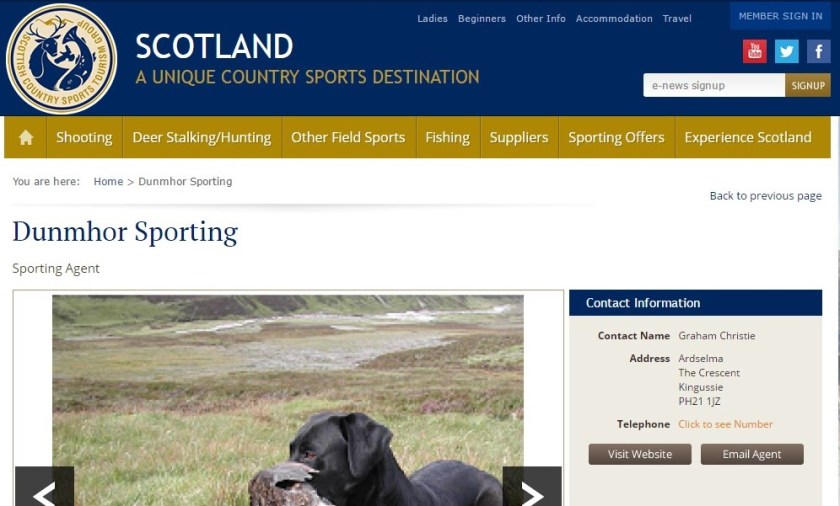
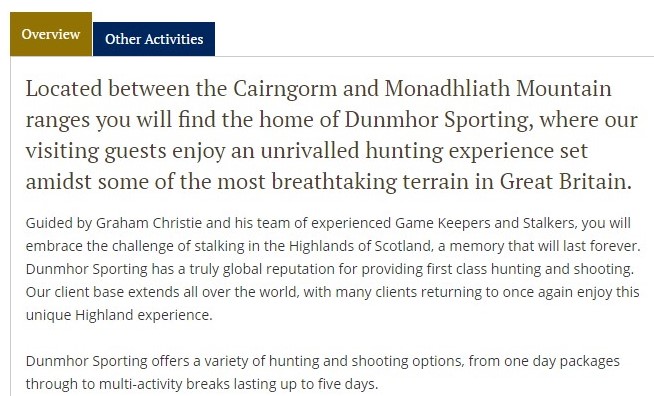
In our December blog, we noted that the SCSTG website was promoting the Dunmhor Sporting Agency as a provider of country sports activities in Scotland:

We were surprised to see Dunmhor Sporting being promoted on the SCSTG website because Graham Christie of Dunmhor Sporting was convicted in December 2015 of being vicariously liable for the criminal actions of his gamekeeper, who had used an illegal gin trap to catch and injure a buzzard on the Cardross Estate. We just looked at the SCSTG’s website again and Dunmhor Sporting is still being promoted as a country sports provider.

So much for the game shooting industry ousting its criminal members.

We wonder whether the Cabinet Secretary for Culture, Tourism & External Affairs, Fiona Hyslop, is aware that a now (part) publicly funded organisation (the Scottish Country Sports Tourism Group) is promoting a convicted wildlife criminal and if so, whether she thinks this is an appropriate use of public funds?

Emails to: scottish.ministers@gov.scot and mark it FAO Fiona Hyslop

Parliamentary reception for group promoting wildlife criminal

Yesterday we blogged about the launch of the Scottish Country Sports Tourism Group’s new initiative, Game for Growth, aimed at promoting the value of country sports to the Scottish economy (see here).

We mentioned that Andy Wightman MSP had lodged a Parliamentary Question asking whether public funds (via VisitScotland as part of the Game for Growth initiative) had been given to the owners or managers of landholdings where wildlife crime had taken place.

We also mentioned our surprise that the Scottish Country Sports Tourism Group’s website is promoting a sporting agent with a current conviction for raptor persecution.

What we didn’t mention was that the launch of the Game for Growth initiative took place at a prestigious parliamentary reception at Holyrood on 20 December 2016, with wide media coverage.

This parliamentary reception was hosted by Edward Mountain MSP (Conservative, Highlands & Islands) and included speeches from Malcolm Roughead, Chief Exec of VisitScotland, and Cabinet Secretary for Rural Economy & Connectivity, Fergus Ewing MSP.

The revelation that the Scottish Country Sports Tourism Group is actively promoting a convicted wildlife criminal will probably be a surprise to Edward Mountain MSP, and undoubtedly a source of deep embarrassment; he surely wouldn’t have hosted them had he known. It’s reasonable to assume he didn’t know because his expertise appears to be in fishing rather than gamebird hunting. Sustainable sport fishing does bring in millions to the rural economy and it isn’t underpinned by wildlife crime, so it’s easy to see why he would lend support to the Game for Growth initiative.

Unfortunately for Edward, as well as the sport fishing industry, the Gift of Grouse is also prominently involved with the Game for Growth initiative (check out that banner in the photo) and this isn’t the first parliamentary reception they’ve been involved with that has led to awkward questions being asked.

We await the Scottish Government’s response to Andy Wightman’s Parliamentary Questions about public funding for wildlife criminals with great interest.

Parliamentary Question: is public money being used to promote wildlife criminals in Scottish shooting sector?

scstg-logoLast week it was announced that the Scottish Country Sports Tourism Group (SCSTG) has plans to boost the value of game shooting, stalking and fishing to the rural economy by £30 million, via its new ‘Game for Growth’ strategy.

The Game for Growth strategy document can be read here: sctsg-game-for-growth-strategy-document-dec-2016

It’s a pretty turgid read, full of tedious marketing soundbites, but basically it sets out how the industry plans to promote Scottish country sports over the next four years to reach a wider national and international market. This will be achieved mostly, it seems, by claiming the industry is sustainable with fabulous conservation benefits and ignoring the vast environmental damage and wildlife crime associated with some activities within this sector.

visit-scotland-1Interestingly, VisitScotland (the national tourism agency linked to the Scottish Government) has apparently committed to boosting the country sports tourism sector and has announced a matched ‘Growth Fund’ to help SCSTG develop its marketing strategy and increase its online presence.

We’re not the only ones to raise an eyebrow at this. Andy Wightman MSP has lodged the following Parliamentary Question about it:

Question S5W-05930: Andy Wightman (Lothian, Scottish Green Party). Date lodged: 22/12/2016

To ask the Scottish Government whether it will provide a breakdown of the recipients of financial contributions from VisitScotland to the strategy, Game for Growth Strategy – Country Sports Tourism in Scotland 2016; what information it has regarding how each recipient will use this; what action it has taken to ensure that no money was provided to the owners or managers of landholdings on which crimes against wildlife have been committed; whether it will publish the strategy on its website, and what aspects of this it is supporting or plans to support with public money.

Expected answer date: 19/01/2017

These are legitimate questions, and especially when you take a closer look at the SCSTG website, which has been developed to connect potential visitors with various country sports providers across Scotland. For example, if you want to pay money to shoot mountain hares in Scotland, you can use the website’s search facility and a number of sporting agents/estates who offer this ‘sport’ will be highlighted.

We used the search facility to look for various ‘sporting’ opportunities and were very surprised to find that sporting agency Dunmhor Sporting was being promoted:

Why the surprise? Well, Graham Christie of Dunmhor Sporting was convicted in December last year of being vicariously liable for the criminal actions of his gamekeeper, who had used an illegal gin trap to catch and injure a buzzard on the Cardross Estate.

Why is the Scottish Country Sports Tourism Group promoting an agent who has a current conviction for wildlife crime? And why is VisitScotland providing match funding to an organisation that is promoting a convicted wildlife criminal?