There’s nothing ‘draconian’ about licensing game shooting estates

There were a couple of articles published in the Scottish Mail on Sunday yesterday about the possibility (probability) of the introduction of game shoot licensing in Scotland.

The first article didn’t bring anything new to the story; it was just a re-hashed version of who’s said what since Cabinet Secretary Roseanna Cunningham announced a package of new measures to address the on-going problem of raptor persecution and unsustainable grouse moor management. Lord David Johnstone of Scottish Land & Estates talked about maintaining the status quo (i.e. no licensing scheme required), James Reynolds of RSPB Scotland talked about the necessity of introducing a licensing scheme because self-regulation by the grouse-shooting industry has failed, and an unnamed spokesman from the Scottish Gamekeepers’ Association talked about how licensing could have serious consequences for gamekeepers and their families. The two journalists who wrote the article described the Government’s proposed review as ‘the latest blow to landowners following draconian land reforms and the abolition of tax breaks’.

What ‘draconian land reforms’ are those, then? And why should multi-millionaire landowners, whose grouse moors are already subsidised by the public purse, be entitled to tax breaks?

Here’s a copy of the article, and for those who struggle to read it, here’s a PDF version so you can zoom in and increase the font size: MailonSunday1_July162017

The second article was a commentary column written by Carrieanne Conaghan, a gamekeeper’s wife who coordinates the ‘Speyside Moorland Group’ – one of several regional moorland groups closely affiliated with the Gift of Grouse propaganda campaign.

The headline begins: ‘As Draconian new land laws loom…’ These words probably weren’t Carrieanne’s but nevertheless, it’s clear from her commentary that estate licensing isn’t welcomed by gamekeepers because, she says, “For the vast majority of estates who have done nothing wrong and are resolute in their fight against wildlife crime, they would be penalised by strict new controls“.

Unfortunately she doesn’t explain why or how she things law-abiding estates would be “penalised by strict new controls“. The fact of the matter is, they wouldn’t be penalised at all, as the penalities would only be felt by those who continue to illegally kill protected raptors. And quite rightly so. Law-abiding gamekeepers, and their employers, have absolutely nothing to fear from the introduction of a licensing scheme, and you’d think they’d be welcoming it with open arms because if anything, it’ll protect them from being lumped in with the criminals.

Here’s the article and here it is as a PDF: MailOnSunday2_July162017

Carrieanne also claims that, “More worryingly, it [licensing] also brings the potential of gamekeepers losing their homes and livelihoods if a licence to operate was withdrawn“. This is just emotional scaremongering, probably encouraged by the same tosh spouted by SGA Chairman Alex Hogg earlier this year (see here). The only reason gamekeepers would potentially lose their homes and livelihoods would be if they’d broken the conditions of the licence and the subsequent withdrawal of that licence. That principle applies to everybody else in society whose activities are licensed. It’s the risk you run if, for example, you’re a professional driver and you commit road traffic offences leading to the loss of your driving licence. Why should gamekeepers be exempt from regulation when everyone else’s lives are governed by such rules?

Carrieanne claims that the licensing proposal has been brought about by “activists who object to the very existence of grouse moors, whether their opposition is based on a dislike of shooting or the ‘toffs’ who they believe are the only ones who participate“. Actually, the proposal was brought about by ordinary members of the public who are sick to the back teeth of criminal gamekeepers and their employers getting away with the illegal slaughter of protected wildlife, particularly on driven grouse moors.

Carrieanne claims that raptor persecution is “in decline” and that “tough new legislation has had a positive effect“. She also thinks, because her gamekeeper husband told her, that gamekeepers “desire to manage moorland for the interests of all species, whether it be grouse, ground-nesting birds, mountain hares or birds of prey“. Good grief.

She must have missed the Golden Eagle Satellite Tag Review, the findings of which were the final straw for Roseanna Cunningham and which led directly to the current proposition of a licensing scheme. She must also have missed the news that the hen harrier population continues to spiral downwards, thanks in large part to illegal persecution, and the news that peregrine populations continue to decline in areas dominated by driven grouse moors, and the news that the northern red kite population continues to suffer from the impact of illegal persecution on driven grouse moors, and the news that five prosecutions for alleged wildlife crime (all involving gamekeepers or their employers) have all been dropped in recent months, and the news that raptors continue to be illegally shot, even in recent weeks (see here, here) or illegally trapped (see here) on grouse moors up and down the country.

Did anyone see any gamekeepers or any moorland groups condemning these incidents? Where was their uproar? Where was their outrage? How many gamekeepers or members of moorland groups have provided information/intelligence to the police about any of these recent crimes? We’ll take an educated guess – none of them.

Carrieanne is right to be concerned about her family’s livelihood, but it’s not at risk from a licensing scheme, which is neither draconian or unnecessary; it’s actually a long overdue and pretty measured response to decades of criminality and unsustainable practices. Carrieanne’s livelihood is only at risk from those criminal gamekeepers and their employers who refuse to reform and continue to stick up two fingers to the law.

UPDATE 25 July 2017: SRSG response letter here
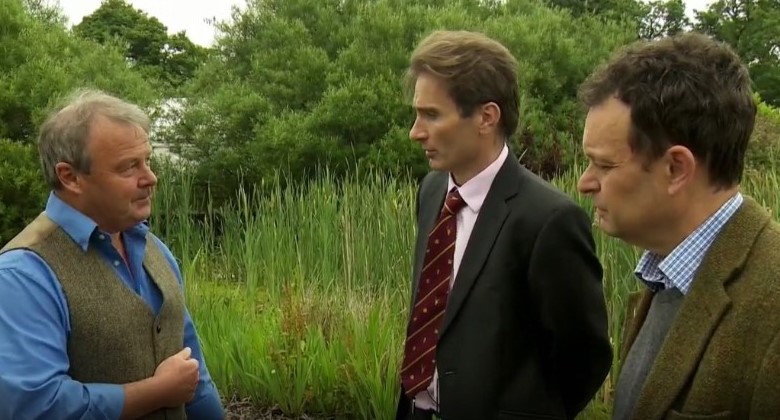
Game shoot licensing discussed on BBC’s Landward programme today

Today’s edition of the BBC’s Landward programme had a small feature on proposals for the introduction of game shoot licensing, including contributions from Duncan Orr-Ewing (RSPB Scotland) and Lord David Johnstone (Scottish Land & Estates).

It is available to watch on BBC iPlayer for the next 29 days (Episode 12, starts at 17 mins – here).

We’ve reproduced the full transcript:

Presenter, Euan Mcllwraith: “The majestic golden eagle, soaring above Scottish hills. It’s an iconic image of wild Scotland. But a Government report has found that almost a third of all golden eagles which have been tracked by satellite died in mysterious circumstances, and the majority of those cases were found on land which is managed for grouse shooting. And the demise of the golden eagles has kick-started a re-examination of the way that game shooting is managed.

Game shooting is a major contributor to the Scottish rural economy and supports jobs in rural areas. But the field sport relies on there being a large population of grouse to shoot. The report’s findings led Scottish Environment Minister Roseanna Cunningham to propose an inquiry in to whether or not shooting estates should need a licence to operate.

But why would a licence protect eagles? Well at the moment, if a gamekeeper for example was caught killing a bird of prey, he might be prosecuted and in extreme cases be sent to jail, but the estate would still be allowed to carry on doing business. But the threat of a removal of a licence to operate could prove a more effective deterrent.

The proposal has delighted some groups and horrified others.

With me now are Duncan Orr-Ewing of RSPB Scotland and David Johnstone of Scottish Land & Estates.

Duncan, from your point of view, what’s the attraction of a licence, ‘cos there’s a lot of penalties at the moment, if a keeper gets convicted he goes to jail. Why a licence?”

Duncan Orr-Ewing: “Well, we very much welcome the Cabinet Secretary’s statement that she will look at options including a licensing system. The reason we support a licensing system is because we believe it will raise standards in the grouse moor sector in particular, which has a whole range of problems that have been highlighted in recent years and we think there is a need to reflect the public interest”.

Euan Mcllwraith: “David, from your point of view, you’re not in favour of licences. Why is that?”

David Johnstone: “There’s a number of reasons within that. There’s the SNH report that came out showing licensing going on around Europe, it clearly demonstrated that licensing, wildlife crime still exists in parts of Europe where licensing also takes place. But also we don’t think that it will actually be effective, we think that there are better ways of doing it that will lead to the higher standards that Duncan was talking about, creating good working relationships between ourselves and other stakeholders within, especially the Government”.

Euan Mcllwraith: “But is it not quite simple? If a nightclub has a licence, they break the rules, they go out of business. If a landowner on an estate was seen to be killing birds of prey, which does happen, you cease to have that right to run a business”.

David Johnstone: “This is a very, very different situation because within a nightclub, when a nightclub finishes business, the doors are shut and nobody else is allowed in to that nightclub at all, you control everything that’s going on. Within an estate on land in Scotland, under the 2003 Act, people have a right to roam anywhere, at any time, which we fully support, therefore you have people wandering across the land you’re managing, doing whatever they may wish to do and we have…”

Euan Mcllwraith: “Yeah, but people aren’t going to walk on to an estate and kill a bird, I mean it may happen, but the vast majority…”

David Johnstone: “I’m sorry but we have examples of people who have been interfering with legally set traps and everything else so it does happen, nefarious activity does go on, and that puts at risk people’s livelihood, their jobs, the economy, everything. You’ve got to prove you didn’t do something, as opposed to somebody proving that you did do something”.

Euan Mcllwraith: “Is that a real worry though? That an estate can go out of business, a vital part of the rural economy will cease to exist, on a very low level of proof?”

Duncan Orr-Ewing: “Look, we’re in this position because of a failure of self-regulation, despite repeated public warnings that the estate sector, particularly driven grouse moors, need to get their house in order. They have failed to deliver, that is why we’re at this point.

We believe a system of licensing can be developed, that has the right checks and balances in place, they do it in other countries, we imagine this won’t be done routinely….”

Euan Mcllwraith: “Duncan, David, I think this debate will rage for a long time to come. At the moment it’s in the hands of the Minister who will make a decision in the months and years to come”.

ENDS

When do you think Scottish Land & Estates will realise that the game’s up? That everybody, even the Scottish Government, now accepts the huge weight of evidence showing that illegal raptor persecution is undertaken as a matter of routine on many driven grouse moors?

Does David Johnstone honestly think that anybody is going to believe his inference that 41 satellite-tagged golden eagles ‘disappeared’ in suspicious circumstances on driven grouse moors as a result of ‘nefarious activity’ undertaken by random members of the public?

If he’s so sure of this (without any supporting evidence), then presumably SLE members won’t have any problem accepting the placement of monitoring cameras at raptor nest and roost sites on driven grouse moors? You’d think they’d welcome this measure, which would clear estate gamekeepers from the frame, right? It’s funny then that certain estates continue to refuse to participate in the placement of cameras by SNH’s Heads Up for Harriers project.

Lord Johnstone has used this tactic of blaming members of the public before, when objecting to the introduction of vicarious liability. In 2012 he was cited as saying there was a risk of estates being set up. Five years on, there hasn’t, as far as we are aware, been a single case of an estate being ‘set up’.

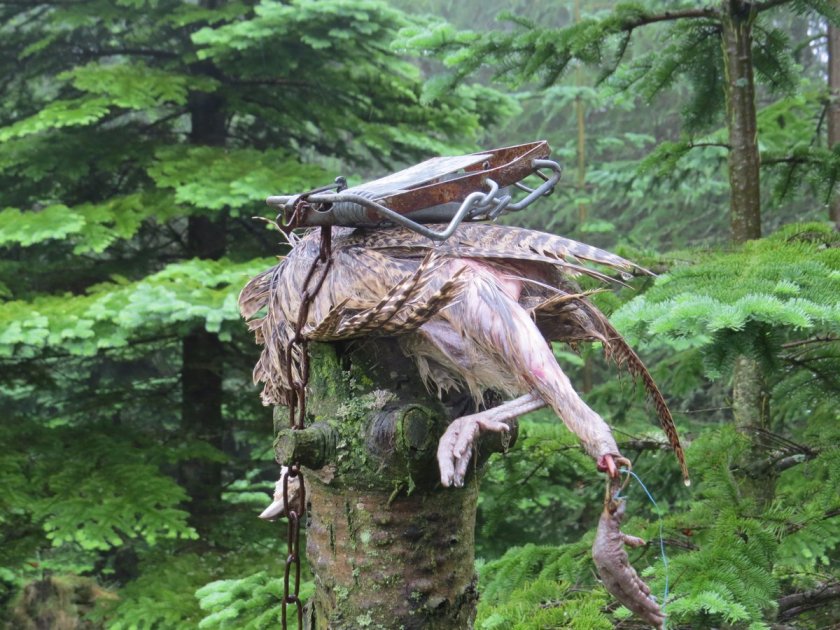
Johnstone talks about instances of interference with legally set traps as an example of ‘nefarious activity’. Yes, it does happen, although not as widely as the game-shooting industry claims (see here) and most, no, all of the examples that we’ve seen show vandalism of the trap (thus rendering it inoperable) as opposed to some random person placing illegally-set traps (e.g. pole traps, as pictured above (RSPB photo)) to infer guilt on the estate gamekeepers.

We should really be congratulating whoever is responsible for SLE’s media strategy (‘deny, deny, deny’) because the longer SLE and the grouse-shooting industry takes to accept responsibility, or continues to blame it on others, the more idiotic, the more complicit, and the more incapable of self-regulation, they look, and then the quicker a licensing regime will be imposed.

Former police wildlife crime officer Alan Stewart wrote a blog recently about the grouse shooting industry’s refusal to accept responsibility for raptor persecution and specifically about SLE’s Moorland Director Tim (Kim) Baynes’ accusations against so-called ‘extremists’ (that’ll be us) for ‘derailing progress’. It’s well worth a read – here.

Edradynate Estate gamekeeper in court for alleged crop poisoning

Well this is absolutely fascinating.

From the Courier & Advertiser (Perth & Perthshire edition), 22 June 2017:

Gamekeeper in court over estate crop poisoning allegation.

A senior gamekeeper has appeared at Perth Sheriff Court accused of poisoning crops on a Perthshire estate. David Campbell was working on the Edradynate Estate, near Aberfeldy, when he is said to have committed the offence.

A charge alleges he maliciously damaged the crops between April 14 and 16 this year by spraying them with an unknown substance, causing them to rot and perish. The 69 year old is also said to have stolen a thermal imaging spotting scope.

He made a brief appearance on petition before Sheriff William Wood at Perth Sheriff Court and made no plea or declaration. Campbell had his case continued. He was released on bail.

ENDS

You might be wondering why we’re blogging about this? The simple answer – we are very interested in the Edradynate Estate and have been for a long time as it has repeatedly been at the centre of police wildlife crime investigations (particularly the alleged poisoning of birds of prey) although nobody has ever been convicted.

Most recently (May 2017) our interest has been in relation to the Crown Office’s refusal to prosecute an unnamed Edradynate gamekeeper for alleged offences relating to the poisoning of several buzzards, despite a plea from Police Scotland to proceed (see here). The Crown Office has not provided an explanation about why this decision was taken (video evidence was not involved), other than to say:

The Procurator Fiscal received a report concerning a 66-year-old man, in relation to alleged incidents between 18 March and 4 June 2015. Following full and careful consideration of the facts and circumstances of the case, including the available admissible evidence, the Procurator Fiscal decided that there should be no proceedings taken at this time. The Crown reserves the right to proceed in the future should further evidence become available.”

As the alleged wildlife crime offences took place in 2015, the case will not become time barred until June 2018 so there may still be a prosecution, although we won’t be holding our breath given the Crown Office’s recent performances in this area (five cases of alleged wildlife crime dropped in the space of two months).

It’s ironic then, that an Edradynate Estate gamekeeper (although we understand this particular gamekeeper left Edradynate at the end of Jan 2017, despite what was reported in the Courier) has been charged with an alleged poisoning offence – not of a protected raptor species, but of a crop. That in itself is fascinating, but even more interesting is that this charge is deemed sufficiently serious for the Crown (prosecutors) to begin proceedings by petition (before deciding whether to prosecute on indictment or by summary complaint). Only serious cases are begun by petition.

We’ll be tracking this case with great interest.

Please note: if you decide to comment on this specific blog, please remember that this case and the alleged wildlife crime offences from 2015 are still ‘live’ and at this stage the offences are only alleged. Please think carefully about your choice of words. Thanks.

Law professor comments on inadmissibility of video evidence in wildlife crime prosecutions

As regular blog readers will be aware, the Crown Office & Procurator Fiscal Service (COPFS), the public prosecutors in Scotland, have, in the space of two months, either dropped or refused to prosecute five cases of alleged wildlife crime. These include:

25 March 2017 – gamekeeper John Charles Goodenough (Dalreoch Estates), accused of the alleged use of illegal gin traps. Prosecution dropped due to paperwork blunder by Crown Office.

11 April 2017 – landowner Andrew Duncan (Newlands Estate), accused of being allegedly vicariously liable for the actions of his gamekeeper who had earlier been convicted for killing a buzzard by stamping on it and dropping rocks on to it. Prosecution dropped due to ‘not being in the public interest’.

21 April 2017 – gamekeeper Stanley Gordon (Cabrach Estate), accused of the alleged shooting of a hen harrier. Prosecution dropped as video evidence deemed inadmissible.

25 April 2017 – gamekeeper Craig Graham (Brewlands Estate), accused of allegedly setting and re-setting an illegal pole trap. Prosecution dropped as video evidence deemed inadmissible.

21 May 2017 – an unnamed 66 year old gamekeeper (Edradynate Estate), suspected of alleged involvement with the poisoning of three buzzards. Crown Office refused to prosecute, despite a plea to do so by Police Scotland.

Two of these cases (Cabrach Estate and Brewlands Estate) were dropped due to the COPFS deciding that the use of RSPB video evidence, on which the prosecutions relied, was inadmissible.

There has been widespread public condemnation and political concern about these decisions, especially in the case of the alleged shooting of a hen harrier on Cabrach Estate in Morayshire. The Crown Office has attempted to explain the decisions but many questions remain unanswered for those of us who don’t have the legal expertise, or all the case details, to challenge the COPFS decisions.

We read with interest, then, a blog that was published yesterday written by Peter Duff, Professor of Criminal Justice at Aberdeen University. His blog, entitled ‘The law of evidence, video footage, and wildlife conservation: did COPFS make the correct decisions?‘ deals specifically with the Cabrach & Brewlands cases and can be read here.

We thoroughly recommend reading it. It’s important to read the perspective of an independent, expert academic who has no axe to grind on either side of the debate. It’s hard for those of us who are either tainted by years of frustration about criminal raptor killers getting away with it, or those with a vested interest in raptor killers avoiding prosecution, to take an unbiased view of the law and its application, so Professor Duff’s opinion is a valuable contribution to the debate. Not only that, it’s great to see this issue receiving wider coverage than the usual commentators.

That’s not to say we agree with his interpretation though! In short, Professor Duff concludes that the COPFS decisions were “perfectly reasonable”, and he explains his reasoning for this, but, crucially, some of what he writes does not take in to account previous case law on this issue, perhaps because he was unaware of such cases?

For example, Professor Duff states: ” In my view also, for what it is worth, I agree that the courts would not excuse such an irregularity in obtaining the video evidence and prosecutions would be fruitless“.

First of all, the Scottish courts HAVE excused the irregularity of obtaining video evidence without the landowner’s permission and far from those prosecutions being ‘fruitless’, they actually resulted in the conviction of the accused (e.g. see the Marshall trial here and the Mutch trial here).

During the Marshall trial, there were several hours of legal argument about the admissibility of the video evidence. The Sheriff accepted the video evidence, commenting that the RSPB presence on the gamekeeper’s estate [from where the video was filmed] was “neither illegal nor irregular, and the intent to obtain evidence did not make it so“.  This is no different to the recent Cabrach case.

During the Mutch trial, again involving several hours of legal argument about the admissibility of evidence, the Sheriff accepted that the RSPB had not placed the video camera with the purpose of gathering evidence for prosecution, but they had placed it as part of a legitimate survey in to the use of traps. This is no different to the recent Cabrach case.

There is also an on-going trial at the moment (concerning alleged fox hunting) that relies heavily on video evidence filmed on privately-owned land without the landowner’s permission. The court has accepted the video evidence as admissible (although we can’t comment too much on this as the trial is still live).

So on that basis, we profoundly disagree with Professor Duff’s opinion that covertly filmed video evidence would not be accepted by the Scottish courts. It already has been, on several occasions, resulting in convictions. The question remains then, why did the COPFS decide it was inadmissible? Somebody within the Crown Office (presumably an experienced lawyer from with the Wildlife & Environmental Crime Unit) decided, when this case was first marked, that the video evidence was admissible. It took nine court hearings over a period of a year before the COPFS decided that the video evidence was inadmissible. We still don’t know the basis for that decision. And the other related question to this is why didn’t the COPFS let the court make the decision? It’s this inconsistency of approach that has caused so much confusion, and as Professor Duff writes, ‘bewilderment’.

Professor Duff also writes: “The actions by the RSPB [of placing a covert camera] are a breach of the right to privacy of both the estate owners and their employees (whilst not quite analogous, imagine if your neighbour installed a secret camera to record everything that went on in your garden)“. Sorry, but it’s quite absurd to compare these two scenarios given the size difference between these two types of landholdings. Nobody could argue that placing a covert camera to film somebody’s back garden wouldn’t be a breach of privacy, as you’d reasonably expect to see the human occupants on a daily basis. But on a multi-thousand acre estate, far from any private dwelling? Come on, “not quite analogous” is one hell of an understatement. And not only that, in the Cabrach case, the camera was aimed at the nest of Schedule 1 hen harrier, which by law cannot be approached/disturbed without an appropriate licence from SNH so you wouldn’t expect to film anybody anywhere near the nest.

All in all then, Professor Duff’s interpretation of the law, whilst useful, still doesn’t explain, or justify, the decisions made by the Crown Office in these two cases.

And questions still remain about the decisions to drop the other three cases (gamekeeper John Charles Goodenough of Dalreoch Estates; landowner Andrew Duncan of Newlands Estate; an unnamed gamekeeper of Edradynate Estate), none of which were reliant upon video evidence.

Crown Office drops 5th case of alleged wildlife crime

Public prosecutors from Scotland’s Crown Office have dropped yet another case of alleged wildlife crime.
According to an article in the Sunday Post (see here), gamekeeper John Charles Goodenough, 32, had been charged after he was allegedly caught with illegal gin traps covered in animal blood, with dead fox cubs found nearby, in May 2016. It is reported Goodenough was employed at the time by Dalreoch Farming & Sporting Estates, owned by the well-connected Wellesley family. It was alleged that Goodenough was using the illegal traps on a neighbouring farm in Ayrshire.

The case was due to be heard at Ayr Sheriff Court on 27 March 2017 but two days prior to the hearing, the Crown Office dropped the case ‘after getting the dates wrong on its paperwork’.

This latest case brings the total of recently abandoned prosecutions for alleged wildlife crime to five. That’s five abandoned cases in the space of two months:

25 March 2017 – gamekeeper John Charles Goodenough (Dalreoch Estates), accused of the alleged use of illegal gin traps. Prosecution dropped due to paperwork blunder by Crown Office.

11 April 2017 – landowner Andrew Duncan (Newlands Estate), accused of being allegedly vicariously liable for the actions of his gamekeeper who had earlier been convicted for killing a buzzard by stamping on it and dropping rocks on to it. Prosecution dropped due to ‘not being in the public interest’.

21 April 2017 – gamekeeper Stanley Gordon (Cabrach Estate), accused of the alleged shooting of a hen harrier. Prosecution dropped as video evidence deemed inadmissible.

25 April 2017 – gamekeeper Craig Graham (Brewlands Estate), accused of allegedly setting and re-setting an illegal pole trap. Prosecution dropped as video evidence deemed inadmissible.

21 May 2017 – an unnamed 66 year old gamekeeper (Edradynate Estate), suspected of alleged involvement with the poisoning of three buzzards. Crown Office refused to prosecute, despite a plea to do so by Police Scotland.

Given how difficult it is to get just one wildlife crime case anywhere near a court, to have five abandoned in the space of two months does not inspire confidence in the criminal justice system.

In fact such was the public concern about some of these cases being abandoned due to the supposed inadmissibility of video evidence, last month the Scottish Parliament’s Environment Committee wrote to the Crown Office to ask for an explanation (see here).

The Crown Office has now responded with this: COPFS letter to ECCLR_EvidenceAdmissibility_May2017

We are not legally qualified to comment in depth about how good or how poor the Crown Office’s response is. If any of our legally-minded readers (Adam?) would like to comment, please do so.

However, what we can say is that this response does not address the question of why the Crown Office made the decision about inadmissibility instead of allowing a court to decide, as has happened in previous cases (e.g. see here).

Nor does this response address the question of why the Crown Office did not believe the RSPB ‘s explanation for their use of video surveillance for monitoring a hen harrier breeding attempt at Cabrach Estate. The Crown Office maintains, without explanation, that the RSPB had installed the video ‘for the purpose of detecting crime’, whereas the RSPB maintains the camera was installed as part of a legitimate monitoring study, an explanation which had been accepted by both the Crown and the court in a similar situation in another case (here).

The RSPB’s case is not so strong in the Brewlands Estate case, where a camera was installed to monitor an illegal pole trap (a trap that the RSPB had since made safe by flicking on the safety catch), although the circumstances might have been different had the police been able to attend the scene as soon as they were notified of an illegally-set trap. Nevertheless, the fact that the Crown Office allowed a year’s worth of court hearings to pass by before deciding to abandon this case, and their unwillingness to communicate their specific concerns to the RSPB, is yet to be adequately addressed by the Crown Office.

The Crown Office’s response also does not explain (although to be fair, it wasn’t asked to) why dropping the prosecution against Andrew Duncan for alleged vicarious liability was deemed to be ‘not in the public interest’, and nor does it explain why a prosecution was not brought against the unnamed Edradynate Estate gamekeeper for the alleged poisoning of three buzzards, despite pleas from Police Scotland to do so.

The Crown Office’s letter to the Environment Committee ends with this:

COPFS remains committed to tackling wildlife crime, including raptor persecution. There is a strong presumption in favour of prosecution in cases reported to the Service where there is sufficient admissible evidence and prosecution is in the public interest‘.

You could have fooled us.

To be honest, as frustrating as it was to see these cases abandoned for what seem to us to be spurious reasons, the Crown Office’s unimpressive performance has probably helped move things along, because these dropped cases came at the time when the Scottish Government was already under severe public pressure to do something other than make vague promises to tackle wildlife crime. That’s not to say we are pleased with the outcome of these cases – far from it – but it’s quite likely that these failed prosecutions helped tip the balance and persuaded the Scottish Government that actually, the current system is failing and they need to find new ways of addressing the problem.

More suspected wildlife crimes on Raeshaw Estate: SNH revokes individual licence

As many of you will know, Raeshaw Estate in the Scottish Borders was one of the first in Scotland to be subjected to a General Licence Restriction Order, issued in 2015, based on clear police evidence that wildlife crimes had been committed although there was insufficient evidence to prosecute any individual (see here). The estate contested the legality of SNH’s decision and this was seen as a test case, which went to Judicial Review in 2016. In March this year, the Court of Session upheld SNH’s decision and the General Licence Restriction Order was considered lawful (here).

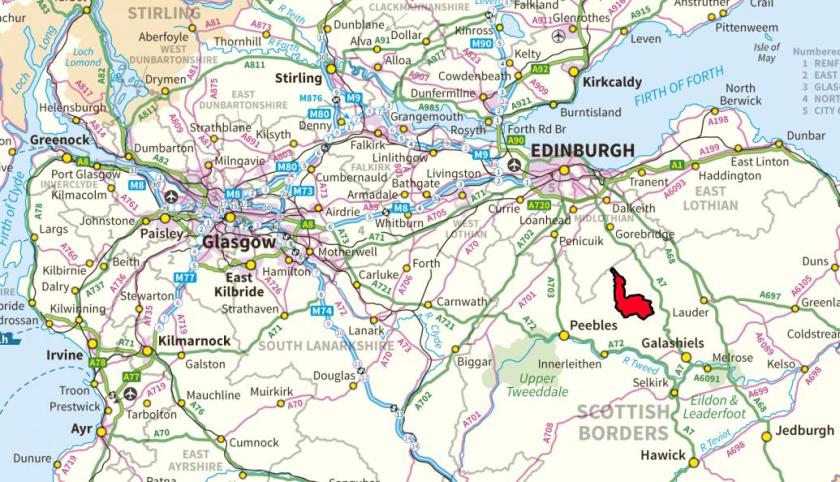
Here is a map showing the location of Raeshaw Estate in south Scotland (estate boundary details sourced from Andy Wightman’s Who Owns Scotland website).

In the meantime, SNH had granted an ‘individual licence’ to several gamekeepers at Raeshaw Estate, allowing them to continue to carry out various ‘management’ activities (killing corvids and other so-called ‘pest’ species) but under closer scrutiny than they would have been subjected to under the General Licence. We, and others, have been strongly critical of this (see here and here), and we were especially sceptical when we learned, via an FoI, that the extent of the ‘scrutiny’ had only extended to a single compliance check by SNH staff (see here). However, having read the full details of the Judicial Review, it became apparent to us that had an individual licence not been issued, the General Licence Restriction Order would probably have been judged to be unfair and SNH would have lost the case.

The first individual licence(s) issued to Raeshaw Estate staff expired on 31 December 2016. It is now apparent that the Estate has applied for a further individual licence earlier this year, which was granted. However, this morning, SNH has issued the following statement:

SNH REVOKES LICENCE ON RAESHAW ESTATE AFTER SUSPECTED WILDLIFE CRIME OFFENCES

Scottish Natural Heritage (SNH) has revoked a licence to control wild birds at Raeshaw Estates as a result of on-going concerns about wildlife crime.

Police Scotland is now investigating the potential offences on the Scottish Borders estate.

SNH imposed a general licence restriction on Raeshaw Estates in 2015 on the basis of clear evidence provided by Police Scotland that wildlife crimes had been committed on the estate. The estate challenged the restriction through a judicial review, but the restriction was upheld in March this year.

During a compliance check this month, SNH staff found multiple instances of breaches of conditions of an individual licence that had been granted to cover essential management activities on the estate. These breaches may also constitute offences under the Wildlife and Countryside Act, so SNH has reported the details to Police Scotland.

General licences allow land owners or managers to carry out certain management actions with minimal bureaucracy, largely relying on trust that land managers will carry out activities legally. This includes controlling common species of wild birds to protect crops or livestock. However, those land managers in which SNH has lost confidence may have their General Licences removed, as was the case at Raeshaw. The estate is then allowed to apply for individual licences to control wild birds, which gives SNH more control and oversight of the activities being carried out.

Robbie Kernahan, SNH’s Head of National Operations, said:

After discovering several failures to comply with the terms, we have no other option than to revoke the licence. In cases like this, we have to take breaches of licences very seriously and will work with Police Scotland as they investigate this case.

We hope this also spreads the message that we will take action to stop wildlife crime whenever possible. We’re committed to working strongly in partnership with Police Scotland, and other members of the Partnership for Action against Wildlife Crime Scotland (PAWS), to stamp out wildlife crime in Scotland.”

END

Photo of Raeshaw Estate (by RPUK)

Wow! First of all, credit where it’s due. SNH has surprised us, first by conducting another compliance check, secondly by responding very, very quickly to multiple breaches, and thirdly by making a public statement. That’s impressive – well done to SNH.

It’s hard to comprehend the level of stupidity of those working under an individual licence. If you know your working practices are already under the spotlight, why on earth would you then make multiple breaches of the conditions of that licence, some of which may also also constitute offences under the Wildlife & Countryside Act? It almost beggars belief, although, given the long history of wildlife crime uncovered in this area (see here), for which nobody has ever been prosecuted, it is perhaps a clear indication of just how little deterrent the current legislation offers and re-emphasises the urgent need for a change of policy.

Even though SNH has now revoked the estate’s individual licence(s), meaning that ‘pest’ control is further restricted, the estate still has the right to shoot grouse, pheasant and partridge when the shooting season opens later in the year, so in effect there’s very little sanction here. That is not good enough. Had a licensing scheme been in place for gamebird shooting, presumably the estate’s licence would now be revoked.

There’s a strong response to today’s news from RSPB Scotland:

Scottish Natural Heritage (SNH) has today announced that it has revoked a licence to control wild birds at Raeshaw Estate as a result of on-going concerns about wildlife crime. In response, RSPB Scotland’s Head of Investigations, Ian Thomson, said: “Unfortunately, this comes as no surprise at all in relation to this particular estate. These latest multiple breaches found by SNH on the Raeshaw Estate can be added to a long list of confirmed poisoning, shooting and illegal trapping cases in this area dating back over more than a decade.

The fact that there is an ongoing criminal investigation here, despite the sanctions previously imposed by SNH, echoes a pattern of repeat offending that occurs in a significant number of areas of Scotland where intensive grouse moor management is the main land use.

While we welcome SNH’s revocation of the individual licenses issued to this estate’s employees, it is clear that current legislation and the available penalties are no deterrent to the continued criminal targeting of protected wildlife. The time has come for a robust regulatory regime, including the licensing of gamebird shoots, where wildlife crimes with a proven link to estate management could lead to a loss of shooting rights.”

END

Today’s news comes at a critical time. We know that an announcement on how the Scottish Government intends to tackle the ongoing crisis of illegal raptor persecution is imminent. This latest example of how ineffective the current system is, in addition to all the other evidence of criminal activity that has been reported in recent months, and in addition to the series of prosecutions abandoned by the Crown Office, and in addition to the findings of the forthcoming raptor satellite tag data review, will surely tip the balance and result in tough measures being introduced. God help the Government if it doesn’t.

Brewlands Estate gamekeeper ‘cries with laughter’ at discontinued prosecution

Following this morning’s publication of an RSPB video showing footage of an alleged gamekeeper setting then re-setting an illegal pole trap on the Brewlands Estate in July 2015, which has been deemed ‘inadmissible evidence’ by the Crown Office (see here), we’ve been interested to see the response from the gamekeeping community.

Bert Burnett (an apparently now former committee member of the Scottish Gamekeepers’ Association) posted clear condemnation on his facebook page (good) before the ‘discussion’ predictably descended in to criticism of the RSPB.

One of Bert’s followers ‘tagged in’ somebody called Chrissy Gray (for those who are unfamiliar with Facebook, ‘tagging’ someone just means alerting that tagged person’s attention to a particular post).

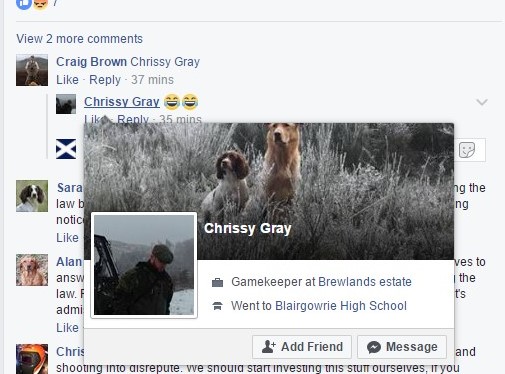
Chrissy Gray responded to the post with two ‘crying with laughter’ emojis:

For those who don’t know what a ‘crying with laughter’ emoji is about, have a read of this.

We were curious about who would be ‘crying with laughter’ about the news that this prosecution had been discontinued and so we clicked on Chrissy Gray’s name to find out who he was. Here’s what we found:

According to his profile details, Chrissy Gray is a gamekeeper at Brewlands Estate.

Interestingly, his comment has been up there for over three hours and nobody has condemned it.

They are figuratively (and literally?) laughing in your face, Roseanna Cunningham.


Brewlands Estate “inadmissible” pole trapping video released

A week after RSPB Scotland published the “inadmissible” video evidence of a hen harrier being shot on Cabrach Estate in Moray (see here), this morning they have released another video from another case that prosecutors decided to drop without explanation.

This case concerned gamekeeper Craig Graham, who was accused of allegedly setting and re-setting an illegal pole trap on the Brewlands Estate in the Angus Glens in July 2015.

Photo of illegally-set pole trap on Brewlands Estate (by RSPB Scotland).

The case called in March 2016 and Mr Graham denied all charges so the case was sent for trial. We tracked this case through the courts, where it was repeatedly adjourned (two trial dates were set and then later dumped). A third trial date was set for 15 May 2017 but then at another hearing on 25 April 2017, we learned that the case had not called as the Crown Office had dropped all proceedings. This was the third case the Crown Office had inexplicably dropped within a two week period.

Here’s the “inadmissible” RSPB Scotland video footage:

It’s worth turning up the sound as part of a conversation has also been recorded: “And then, when we were there, a buzzard went right over the top, if you had a shotgun it’d be dead“. It’s not clear who is speaking to whom, but it’s an indication that more than one person was present at the scene.

Here is the RSPB press statement:

Second discontinued prosecution for alleged raptor persecution offences

RSPB Scotland has expressed its frustration and disappointment after another prosecution of an individual charged with alleged wildlife crime offences was discontinued by the Crown Office in Scotland.

The latest case began on 9th July 2015 when RSPB Scotland staff, walking on the Brewlands Estate in Glen Isla, Angus, discovered an illegally set spring trap placed on top of a pheasant carcass that had, in turn, been placed on a post just a few metres inside a pheasant pen. The trap was in effect a baited “pole trap”, which has been illegal since 1904, and is designed to snap shut and break the legs of a bird of prey, holding the victim until it can be dispatched by the trap operator.

The RSPB team, having no mobile phone signal to allow contact with the police, made the trap safe to ensure no birds would be caught. They then deployed a video camera focussed on the area, with a view to securing the evidence until the police could attend and recover the trap.

A few days later, RSPB Scotland staff accompanied a police wildlife crime officer to the scene, where it was found that the trap had been reset. The police seized the trap as evidence, and the camera was recovered.

Review of the footage filmed by the camera showed an individual resetting the trap twice in the days after which it had been found. On the first occasion it was set, it was seen to later fall off the pheasant bait and trigger itself.

The footage was passed to the police, who subsequently identified the individual setting the trap, and who later charged him with four alleged offences, contrary to the Wildlife and Countryside Act, 1981, and sent a report to the Procurator Fiscal, who marked the case for prosecution.

The case was first called, at Forfar Sheriff Court, on 31st March 2016, with subsequent hearings on 22nd April and 12th May 2016, during which the accused plead not guilty to the charges libelled. Following two further hearings, the Crown Office Procurator Fiscal Service recently notified RSPB Scotland that following consideration of the case by Crown Counsel, the prosecution could not rely on the RSPB video evidence and would be discontinued. No reason for this decision was provided. The case had been scheduled for a trial beginning on 15th May 2017.

RSPB Scotland’s Head of Species and Land Management, Duncan Orr-Ewing said: “For one case, where there was excellent video evidence to support the prosecution, to be discontinued inexplicably by the Crown Office so close to the trial was baffling. For a second case to be discontinued, again with no explanation from the Crown Office, and again without the opportunity for the evidence to be tested in court, is deeply concerning, and significantly undermines our confidence in the ability of Scotland’s justice system to bear down on the criminals who continue to target our protected birds of prey.”

END

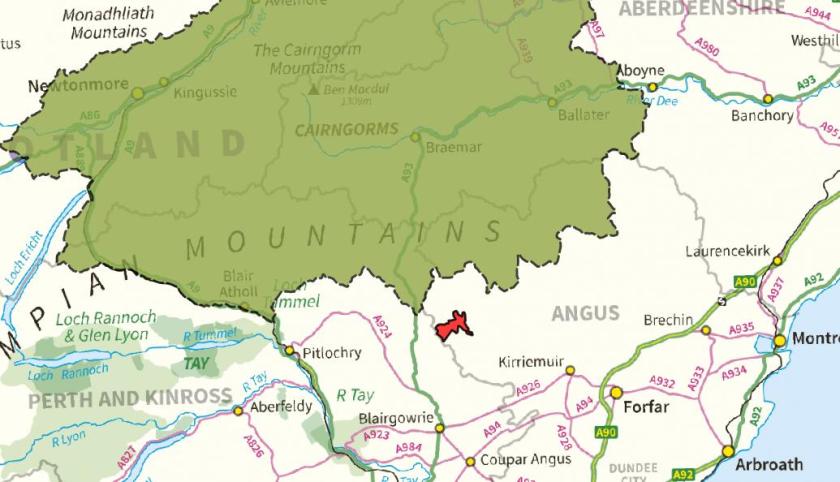
Map showing location of the Brewlands Estate in the Angus Glens (estate boundary based on information from the Who Owns Scotland website).

So, here we are again. There’s not much we can say that hasn’t already been said. Justice has once again not been seen to be done and it looks, to all intents and purposes, that something is seriously amiss with the criminal justice system. How can this case, as with the hen harrier shooting case, get so far down the prosecution route only to be dropped at the last minute? Why did the Crown fiscals deny the opportunity for this evidence to be scrutinised in court? We don’t know, because, yet again, the Crown Office has refused to discuss the decision.

Public anger was very evident last week after RSPB Scotland released the video showing a hen harrier being shot, and this resulted in questions being asked yesterday at First Minister’s Question Time. The release of this latest video footage will only add fuel to that fire.

Again, if you live in Scotland we would urge you to contact your local MSP and ask them to raise this issue with the Lord Advocate and the Justice Cabinet Secretary. We know through correspondence that many of you contacted your MSP last week (thank you) and it’s important that you do so again with this case. You can find your local MSP here. For those of you not in Scotland, please email your concerns to the Convener of the Scottish Parliament’s Justice Committee, Margaret Mitchell MSP (Scottish Conservatives). Email: margaret.mitchell.msp@parliament.scot

We are at a critical point right now, with Environment Cabinet Secretary Roseanna Cunningham due to make two serious decisions concerning illegal raptor persecution in Scotland: the long overdue decision on whether to increase the investigatory powers of the SSPCA, and her intended action in response to the findings of the raptor satellite tag data review. These decisions are expected before the end of June 2017. There is also the Environment Committee’s on-going consideration of the petition to introduce a licensing system for all game bird hunting, although the time-frame for their deliberations is less clear.

What happens between now and the end of June will be pivotal to how we proceed in future. If the Scottish Government continues to prevaricate, in the face of such blatant and persistent criminality, and in the face of such overwhelming evidence, we will be re-thinking our strategy. Enough is enough.

UPDATE 3pm: Brewlands Estate gamekeeper ‘cries with laughter’ at discontinued prosecution (here)

MEDIA COVERAGE

BBC Scotland website here

STV news here

Scottish Gamekeepers’ Association statement here (as last time, no membership interest so very little comment, and no condemnation)

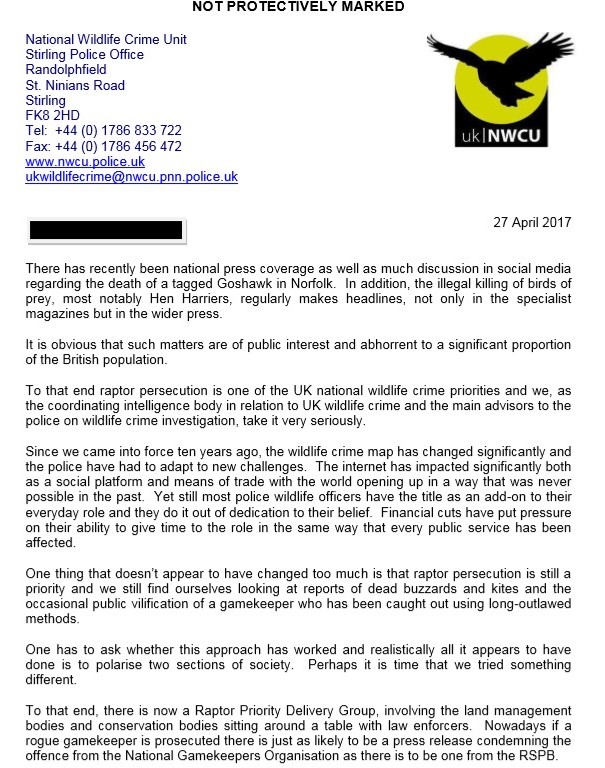
Head of National Wildlife Crime Unit still talking about ‘rogue’ gamekeepers

We’ve been sent some fascinating correspondence from one of our blog readers.

Following the news in February 2017 of the ‘non suspicious’ death of a tagged goshawk on the royal Sandringham Estate in Norfolk (see here), a blog reader wrote to Norfolk Constabulary as follows:

I write in reference to the Mail on Sunday’s coverage (online, Sunday 12 Feb 2017) of the radio-tagged goshawk reported to have been found (first said to be found dead, then said to have been found alive) at Sandringham. Given the confusion that surrounds this case, will the Police be making any further statements to clarify what they believe happened to the bird, to help ascertain what may have caused its decline and then death (important to know as part of the study being carried out on the species) and why its body was incinerated when it had only just died, and was obviously part of a tagging project? A lot of people obviously think there are grounds for suspicion here, and would be interested to know why the Police are said to have taken a different view. I am sure the estate would also welcome the matter to be cleared up. Many thanks for your help in this and for any reassurance you can give the public that the matter is being looked into thoroughly“.

The reply came in the form of a jointly-signed letter from Chief Inspector Martin Sims (Head of National Wildlife Crime Unit) and Inspector Jon Papworth (Wildlife Crime Coordinator, Norfolk Constabulary).

It beggars belief that the Head of the NWCU, the ‘coordinating intelligence body for wildlife crime’ is still talking in terms of ‘rogue’ gamekeepers being responsible for raptor persecution.

How does he explain the virtual extirpation of breeding hen harriers in the grouse moor areas of northern England?

How does he explain the continuing decline of breeding peregrines on the grouse moors of northern England?

How does he explain the repeated reports of shot and poisoned red kites in the grouse moor areas of North Yorkshire?

How does he explain the continued suppression of the golden eagle breeding population in the grouse moor areas of central, eastern and southern Scotland?

How does he explain the continued suppression of the red kite breeding population in the grouse moor areas of northern Scotland?

How does he explain the almost continuous reports of satellite-tagged raptors that ‘disappear’ disproportionately on land managed for driven grouse shooting in England and Scotland?

This isn’t the work of a few ‘rogue’ gamekeepers; this is the result of systematic persecution, affecting entire regional (and sometimes national) raptor populations, at the hands of the game shooting industry. It is industrial scale criminality and the sooner Chief Inspector Sims gets his head around this, the sooner we might see an improvement in enforcement action.

He says that media commentary on these crimes ‘appears to have polarised two sections of society’. Which two sections of society are they, then? The criminals and the law-abiding public? He seems to think we should all stop talking about this criminality and instead place our trust in the game-shooting sector. Yeah, great idea. Let’s not talk about the crimes that criminals commit, whether they be gamekeepers, drug dealers, burglars, rapists, murderers or thieves. Instead, let’s hold support groups, sit around with tambourines and all sing Kumbaya. That’ll sort it.

He talks about trying ‘a different approach’ and refers to the Raptor Persecution Priority Delivery Group (RPPDG) as an example of this. And what has the RPPDG delivered since its inception in 2010? Bugger all. We’ve recently seen some minutes from these RPPDG meetings, obtained via FOI, and all the meetings seem to achieve is to provide an opportunity for the gameshooting industry ‘partners’ to consistently challenge the confirmed persecution data recorded by the RSPB. Presumably that’s why we haven’t seen any national persecution incident maps from the RPPDG since 2011. It’s pathetic.

He talks about the law-abiding gamekeepers within the industry. There must be some, but where are they? How are we expected to tell the difference between the criminals and the law-abiders? How much intelligence on raptor persecution is supplied by gamekeepers to the police? How often do you see gamekeepers and their representative organisations highlighting raptor crimes or calling for tighter regulation?

With views like those of Chief Inspector Sims, it’s no wonder the NWCU hasn’t made even the tiniest dent in addressing illegal raptor persecution. It definitely is time for a different approach.

Here’s a pie chart for CI Sims to contemplate while he’s dreaming up ways of supporting the game shooting industry. It shows the occupations/interests of 176 individuals convicted of bird of prey related offences 1990-2016 (from the RSPB’s 2015 Birdcrime report).


Hen harrier shooting: fury at decision to drop prosecution

Two weeks ago, the public prosecutors in Scotland (Crown Office & Procurator Fiscal Service) decided to discontinue criminal proceedings against a (now former) gamekeeper who was alleged to have shot a hen harrier on a grouse moor at Cabrach Estate in June 2013 (see here).

No explanation was given for this decision.

Earlier this morning, RSPB Scotland released video footage of the incident and issued a press statement (here). Here is the video in case anyone missed it:

After watching this video, it’s hard to find words to express the disbelief, frustration and fury about that decision to discontinue the prosecution. Social media has erupted in outrage and the Crown Office is seen as a laughing stock. Most reasonable, law-abiding people who don’t have a vested interest in driven grouse shooting would be hard pressed to disagree.

The RSPB Scotland statement said that the Crown Office had indicated they could not use the video as evidence, but no further detail was provided. RSPB Scotland quite rightly pointed out that other cases that have relied upon video footage have been used successfully in Scottish courts (the most high profile one being the conviction of gamekeeper George Mutch in 2014), and the RSPB was bewildered by the inconsistency of the COPFS’ approach in this case.

However, this morning, in response to the release of the video, the Crown Office has finally decided to provide an explanation, as published in a BBC news article:

In accordance with the Crown’s ongoing duty to keep prosecutions under review and after carrying out a detailed review of all of the relevant material, Crown counsel considered that the inevitable conclusion was that RSPB investigators entered the land in question and embarked upon evidence gathering for the purpose of prosecution.

Discussions have taken place over a number of years between RSPB and COPFS about the admissibility of evidence obtained through the use of covert surveillance.

The Crown has consistently made it clear that strict legal tests must be met before evidence which has been obtained irregularly, such as the evidence in this case, is admissible. We will continue to have further dialogue with RSPB.

In the whole circumstances, Crown counsel concluded that the evidence would not be admissible in court.

In light of that conclusion it was entirely appropriate that proceedings were brought to an end.”

This statement begs several questions:

  • Essentially, this statement implies that RSPB Scotland was lying about the deployment of the video camera. RSPB Scotland had clearly explained that the camera was positioned as part of a routine research/monitoring study focusing on the breeding success of a threatened species. There’s a Scottish Government project (Heads up for Hen Harriers) that is deploying cameras at hen harrier nests for exactly this purpose for Christ’s sake! The Crown Office apparently disputes the RSPB’s explanation for camera deployment. Why? What evidence do they have that makes them think the RSPB is lying? [NB: see update at foot of blog]
  • If the COPFS believed this camera had been placed “for the purpose of prosecution“, why on earth did it take them three years from the date of the shooting to decide to charge the suspect, and why did it take a further year of court hearings (nine in total) before the decision was made to discontinue proceedings? Why did the COPFS even mark this case for proceedings if they didn’t believe the RSPB’s version of events? What changed in the four years the COPFS have been considering this case?
  • Why is the admissibility of video footage such a controversial issue in cases of alleged raptor persecution, and yet we see it being used in a current court case of alleged fox-hunting? We’ve spoken to one of the investigators who filmed the footage being used in the hunt case and he has confirmed he was filming covertly on private land without landowner permission as part of a wider research project on the behaviour of hunts, whether the hunts were involved in alleged criminal activity at the time or not. That’s no different to the circumstances of this hen harrier case.
  • If the circumstances of how this camera footage was obtained were so controversial, why didn’t the COPFS allow the evidence to be assessed by the court? In a very similar case to this current one, in 2006 a gamekeeper was convicted of stalking a hen harrier and his conviction was based on RSPB video evidence. During that trial, there were several hours of legal argument about the admissibility of the video evidence. The Sheriff accepted the video evidence, commenting that the RSPB presence on the gamekeeper’s estate [from where the video was filmed] was “neither illegal nor irregular, and the intent to obtain evidence did not make it so“.
  • We’ve discussed the issue of the admissibility of video evidence time and time and time again. In 2013, the then Environment Minister Paul Wheelhouse told us that this very issue had been raised with the Lord Advocate (see here). Why then, four years later, is there still such inconsistency and lack of clarity about video admissibility?
  • Why did it take the publication of this video footage, two weeks after the Crown’s decision to discontinue proceedings, for the COPFS to provide an explanation for their decision? Hen harrier persecution is one of the highest national wildlife crime priorities and there is huge and legitimate public concern about it. By remaining silent for two weeks, we would argue the COPFS has displayed an arrogance and contempt for that public concern. It’s not the first time the COPFS has been criticised for poor communications – the Scottish Environment LINK report on wildlife crime enforcement published two years ago was damning on this issue, and this year’s Scottish Parliament’s Justice Committee report on the role and purpose of the COPFS reached a similar conclusion.

The general public, is, quite rightly, furious about how this case has been handled. It seems to us that the Crown Office is more concerned about how the evidence was obtained than the actual alleged crime of killing a protected, national priority species. Of course, the COPFS has to assess the evidential circumstances on a case by case basis, and we don’t question that at all. What we do question is, in this case, on what basis the COPFS decided to disbelieve the RSPB’s explanation for deploying the camera, and why it took so long, at such huge cost to the public purse, to decide to discontinue proceedings.

And let’s not forget that this case is one of three that the Crown Office has recently discontinued, all in the space of two weeks (see here).

For a comical interlude, have a read of the statement issued by the Scottish Gamekeepers’ Association in response to the video footage. They say, “The SGA has no membership interest in this case. It is not our place to comment, therefore, on individuals involved in the alleged incident or to provide a critique of COPFS“. This is the organisation that is supposedly signed up to the Partnership for action Against Wildlife Crime and who serves on the PAW Raptor Group.

Do we have any confidence in the Scottish criminal justice system to address the on-going persecution of birds of prey? On current evidence, the answer is a resounding NO.

What to do about it? We would urge you to contact your MSP (find out who yours is here) and ask him/her to contact the Scottish Government’s Justice Minister, Michael Matheson to complain on your behalf about the handling of this case. The more MSPs that see this video footage, and hear about the public’s serious concerns, the better.

If you don’t live in Scotland but still want to voice your concerns, please email the Convener of the Scottish Parliament’s Justice Committee, Margaret Mitchell MSP (Scottish Conservatives). Email: margaret.mitchell.msp@parliament.scot

Don’t be fobbed off with platitudes or claims of “We can’t comment on individual cases”. Public scrutiny is fundamental to democracy and the public has every right to be asking questions about this ongoing, disgraceful shambles.

UPDATE 14.30hrs: RSPB Scotland has issued a statement in response to the claims of the Crown Office that the camera had been “deployed for prosecution purposes”. Here’s what it says:

In response to the Crown Office’s statement of 5th May as to why the video evidence would not be admissible in court Ian Thomson, Head of Investigations, RSPB Scotland said: “We do not agree with the opinion from the Crown Office that we were attempting to gather evidence for a prosecution. We installed a camera to monitor a protected breeding bird’s nest site, core business for a conservation organisation. We did not share the information about the nest site with anyone, as would be the case with any rare and vulnerable breeding bird species. 

“The fact that an individual came and allegedly shot the female harrier, and that this was captured on film, was an incidental consequence of the camera’s deployment, in the same way that it could easily have captured footage of the nest being naturally predated or failing due to bad weather. It is very disappointing that the opportunity for the court to consider the issue of the admissibility or otherwise of this evidence, as has happened in previous cases, has been removed. Until today, we have received no rationale for the decision to drop the case despite the fact that a number of our staff have provided significant time and expertise in supporting the authorities with the prosecution case.” 

ENDS

UPDATE 8 May 2017: Some more thoughts on the shot hen harrier video (here)

UPDATE 11 May 2017: Cabrach hen harrier shooting reaches First Minister’s Question Time (here)