Last week I blogged about how a major shooting industry organisation, BASC, had attacked Suffolk Police for what BASC perceived to be an ‘offensive’ police appeal for information about the shooting of five young goshawks found dead at the edge of woodland near Thetford (here).
BASC complained that the police’s appeal was “disparaging to the shooting community” simply because the police had asked the shooting community for help to identify the shot gun-wielding criminal(!). Astonishingly, BASC’s complaint resulted in the police’s tweet/appeal for information being deleted.
Later, Suffolk Police released a joint press release with the RSPB, which seemed to enrage BASC even further. Bizarrely, BASC wrote on a blog:
“Can we assume the RSPB has more information on the matter than BASC as they were very quick yesterday to offer a £5,000 reward for information leading to conviction; shortly followed by a similar pledge from Wild Justice? It would be useful to know whether RSPB are complainants, victims, witnesses or have any other relationship with Suffolk Constabulary“.
I would argue that this is a cack-handed but sinister attempt by BASC to try and influence the narrative on raptor persecution crimes. If the police are too scared to publicise a raptor persecution incident or appeal for information about it, because they’re scared of a backlash from the industry who are, let’s not forget, responsible for 73% of convictions for raptor persecution crimes, then it’s job done for the shooting industry. No reports = no publicity = no bad press = no public pressure on politicians to tackle these relentless, systemic crimes.
And it’s not just BASC that appears to be at it. The National Gamekeepers Organisation (NGO) has recently written on its website its dissatisfaction with Lincolnshire Police and the RSPB about the reporting of raptor persecution offences in that county. It’s mostly about a recent incident where the remains of three barn owls, one tawny owl and one red kite were found dumped in a ditch (here), and the NGO incorrectly accuses RSPB Investigations Officer Howard Jones of ‘insinuating that a gamekeeper might be to blame for the Lincolnshire incident‘ in a BBC news article.
Actually, Howard Jones did no such thing, he was talking about raptor persecution crimes in general and he was simply stating facts – the “vast majority” of raptor persecution cases being dealt with by the courts involve gamekeepers. That is a factually accurate statement from Howard, however unpalatable/embarrassing that may be to the NGO. Neither the RSPB or Lincolnshire Police laid any blame on anybody after the discovery of those bird of prey remains in Lincolnshire – they simply said it was an ‘unusual’ case and were appealing for information (here).
The ridiculous NGO, though, has written on its website:
“The NGO are in contact with DC Flint of Lincolnshire Police and are hoping to meet with him in the near future to discuss both this case and to highlight our concerns about the reporting surrounding this case“.
Meanwhile, the NGO has failed (refused?) to publicise the recent conviction of Dorset gamekeeper Paul Allen, who pleaded guilty to multiple wildlife, poisons and firearms offences after the discovery of six shot buzzards, the burnt remains of three more buzzards, and three different types of banned poisons on his pheasant shoot and a loaded shotgun found propped up behind his kitchen door with rounds of unlicensed ammunition in an out-building.
The NGO has also remained silent about the discovery of the five shot goshawks found dumped in Suffolk last week.
Like BASC, you’ll know that the NGO is a member of the Raptor Persecution Priority Delivery Group (RPPDG), a so-called partnership (it’s a sham) whose main objective is to help eradicate raptor persecution by highlighting these crimes and publicly condemning the criminals involved.
Long-term blog readers will know this attempted manipulation of the narrative by the game-shooting industry is nothing new and has been going on for years, mostly behind the scenes and only uncovered via Freedom of Information requests (e.g. see here and here).
I’ve just been sent yet another example of it, this time in the Yorkshire Dales National Park. More on that shortly…
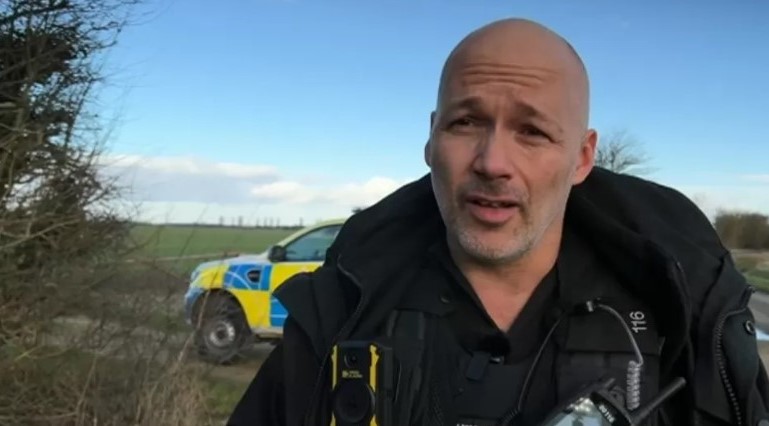
A wildlife crime officer from Lincolnshire Police is warning of the risk to humans, dogs and cats from the dangerous substances used to illegally kill birds of prey.
Detective Constable Aaron Flint, from the Lincolnshire Police Rural Crime Action Team, is quoted in an article published two days ago on the BBC News website (here), where he says he is currently investigating four cases of bird poisonings (some examples here and here).
Detective Constable Aaron Flint from Lincolnshire Police’s Rural Crime Action Team
“It’s too many and it’s only a small proportion of the number of birds killed,” he said.
The wildlife officer said the substances used posed a real danger to dogs and cats, as well as people.
“I honestly think that one day we are going to have a human fatality.”
“Often the offenders will get a pigeon or a pheasant – cut it open and rip out the flesh so the meat is exposed and sprinkle on some poison.
“The poisons are often blue or green – or some other bright colour a child may be attracted to, and I really fear that one day a child is going to come across this, [touch it] and put their fingers in their mouth.”
He said those involved often used poison in an attempt to protect game birds, pigeons and chickens and wild fowl, with offending often fuelled by money.
The BBC article also quotes Howard Jones, an investigator from the RSPB, after the RSPB identified Lincolnshire as a ‘national hotspot’ for bird of prey persecution and reiterated that incidents are often linked to the raptors being targeted to protect pheasants and partridges raised for organised shoots.
“The danger with poisons is that they are completely indiscriminate,” said Howard.
The investigations officer said they had seen a record number of incidents across the UK in recent years, including in Norfolk, Dorset and Yorkshire, with a significant number of reports currently being investigated in Lincolnshire.
According to Mr Jones, the “vast majority” of cases being dealt with by the courts involved gamekeepers.
He said the motivation to kill birds of prey was driven by the fact they were viewed as a predator of game birds, but the sentences handed out were often too lenient to act as a deterrent.
Cases involving poisons or illegal shooting should result in a jail sentence, he said.
“If there is someone out there placing poison baits in the open countryside anything that can come into contact with the poison is at risk,” he said.
“It is highly dangerous – some of the substances being used would be fatal to humans,” he added.
Well done to DC Aaron Flint and his colleagues at Lincolnshire Police. This is exactly the sort of proactive police messaging, and strong partnership-working, that should be routine rather than the exception.
Five days ago, 54 year old gamekeeper Paul Allen pleaded guilty to seven counts of wildlife, poisons and firearms offences, which he committed in March 2021 whilst working on the Shaftesbury Estate in Dorset (see here).
A poisoned red kite had been found dead on the estate in November 2020 (confirmed Bendiocarb poisoning) which triggered a multi-agency search of his premises in March 2021. During that search, investigators found nine dead buzzards (six confirmed shot, the remains of 3 others were pulled out of the ashes of a bonfire), three lots of banned poisons (Bendiocarb, Strychnine and Cymag), a loaded shotgun propped up behind his kitchen door (instead of being inside a locked gun cabinet) and some shotgun ammunition, for which he didn’t have a licence, was found in an unlocked outbuilding.
Four of the nine dead buzzards found by investigators. Photo: RSPB
Allen’s court hearing last week generated widespread local, regional and national media coverage so I fully expected to see full and frank statements of condemnation of his crimes by the game-shooting industry – you know, the industry that claims to have ‘zero tolerance’ of raptor persecution.
I was especially interested in the responses of those game-shooting organisations that serve on the national Raptor Persecution Priority Delivery Group (RPPDG). One of the main stated objectives of the RPPDG is to raise awareness of raptor persecution crimes with the wider public and to encourage people to report such crimes to the police.
Five days on from Allen’s multiple guilty pleas, here’s what those organisations had to say in condemnation:
British Association for Shooting & Conservation (BASC) – nothing
Countryside Alliance – nothing
Country, Land & Business Association (CLA) – nothing
National Gamekeepers Organisation (NGO) – nothing
Oh, no, hang on a minute, something was posted on the National Gamekeepers Organisation website, the day after Allen’s guilty pleas, as follows, under the headline, ‘Gamekeeper has NGO membership suspended‘:
Does this statement of ‘membership suspension’ relate to gamekeeper Paul Allen? Who knows? It’s deliberately cryptic and any casual visitor to the NGO membership wouldn’t have a scoobies to who or what this statement referred. I think that’s the intention. ‘Don’t draw attention to our criminal members and certainly don’t condemn the crimes this one has committed and subsequently admitted to after being caught with all those dead raptors, banned poisons and unsafe firearms and ammunition because it’ll tarnish the image we’ve been so desperately trying to present to the world‘.
It’s been suggested to me that perhaps all these organisations are waiting to make their statements of ‘zero tolerance’ until after Allen has been sentenced next month. Perhaps they are. Although I remember the same excuse was suggested when gamekeeper John Orrey was convicted last year and then sentenced at a later date. How many of them condemned his criminal activities (beating buzzards to death with a stick) after he was sentenced? Take a look for yourselves (here).
I don’t know who’s advising the PR strategy of the game-shooting industry but I suspect the decent, law-abiding members of these shooting organisations will be furious that their so-called leaders are refusing to distance them from the criminals within.
So, the illegal killing continues, the shooting industry organisations say nothing, and public anger grows.
Thanks, BASC, CA, CLA, NGO et al – this is only heading in one direction and you’re all helping it reach the end game so much more quickly than we could get it there on our own. Cheers.
*Multiple illegally killed birds of prey, six of which were confirmed shot and one poisoned, were uncovered by Dorset Police and the RSPB on the Shaftesbury Estate near Wimborne St Giles
*The recently published RSPB Birdcrime report identified Dorset as the second worst county in the UK for confirmed bird of prey incidents in 2021
*The conservation charity is calling for greater regulation of larger scale pheasant shoots in order to help address the climate and nature crises and to reduce these appalling crimes against birds of prey
At Weymouth Magistrates’ Court today (4 January 2023), Paul Allen, 64, of Brockington Down, Wimborne St Giles, pleaded guilty to multiple charges of raptor persecution and related offences.
The Dorset gamekeeper will be sentenced on 16 February.
Dorset Police were first alerted in November 2020 when a member of the public found a dead red kite lying close to a dead rat on a private pheasant shoot on the Shaftesbury Estate, near Wimborne St Giles. Toxicology examinations confirmed the presence of the highly toxic pesticide bendiocarb in both species. Bendiocarb, which in some forms has now been banned, has been persistently abused for the illegal poisoning of birds of prey and other animals for years. It is believed the rat was laced with the poison and deliberately placed as a poisoned bait.
A multi-agency search of Allen’s home and surrounding land was undertaken in March 2021, led by Dorset Police and assisted by the National Wildlife Crime Unit (NWCU), Natural England and RSPB Investigations. Officers discovered six dead buzzards (which, following official post-mortem, were confirmed to have been shot) near the remains of a bonfire, including one that was suspected as having been shot within the preceding 24 hours. Tragically, this bird also contained shot from two previous shooting incidents, which it had survived.
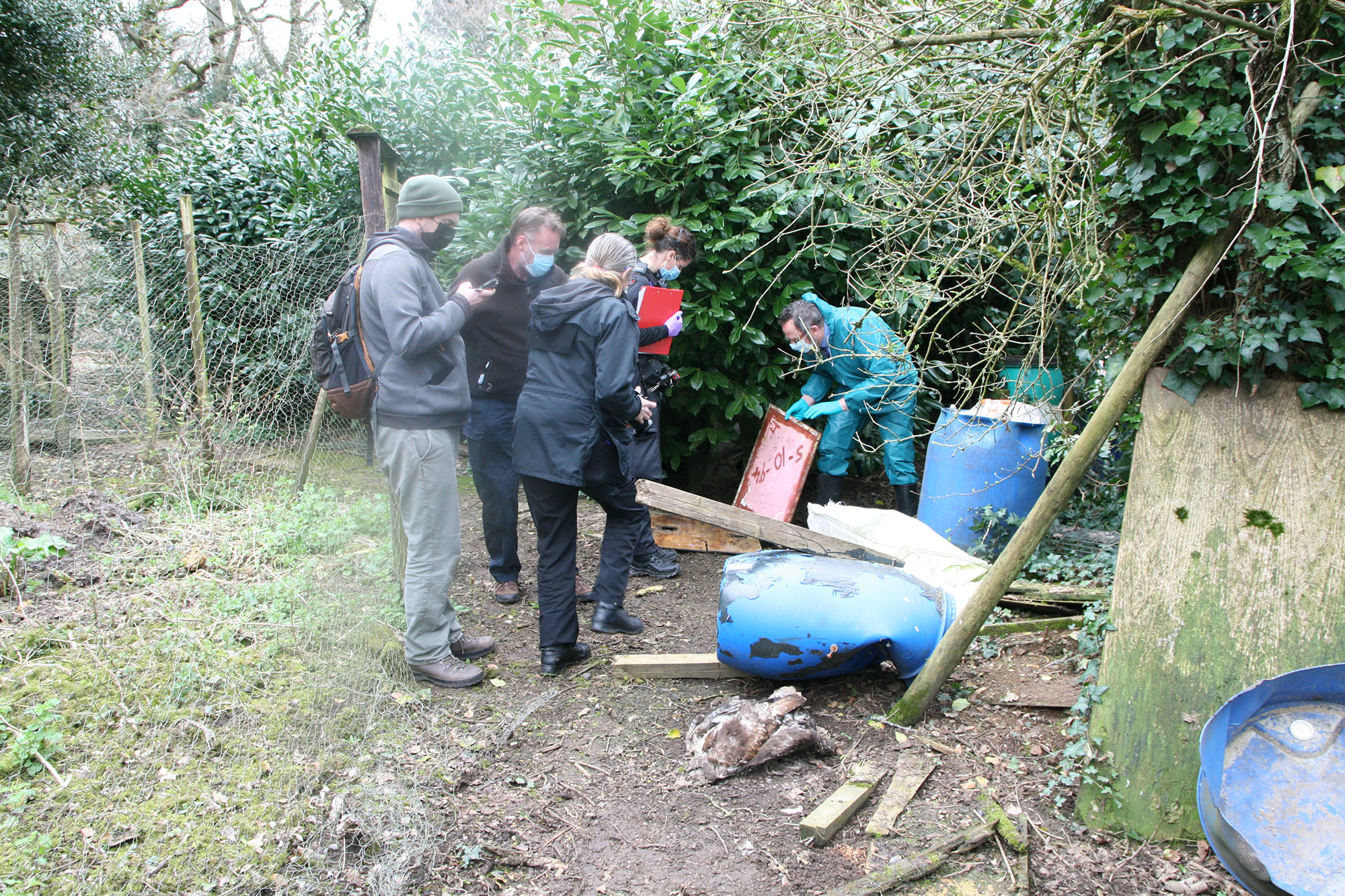
Dorset Police, NWCU, Natural England & RSPB investigators at the scene where four of the nine buzzards were found. Photo: RSPB
Four of the six shot buzzards found by investigators. Photo: RSPB
Two more shot buzzards found during the search. The buzzard on the top was believed to have been shot less than 24 hours before being found. Photo: RSPB
An avian specialist at the Natural History Museum examined the remains of the fire, which was collected by investigators and confirmed the presence of at least three further buzzards.
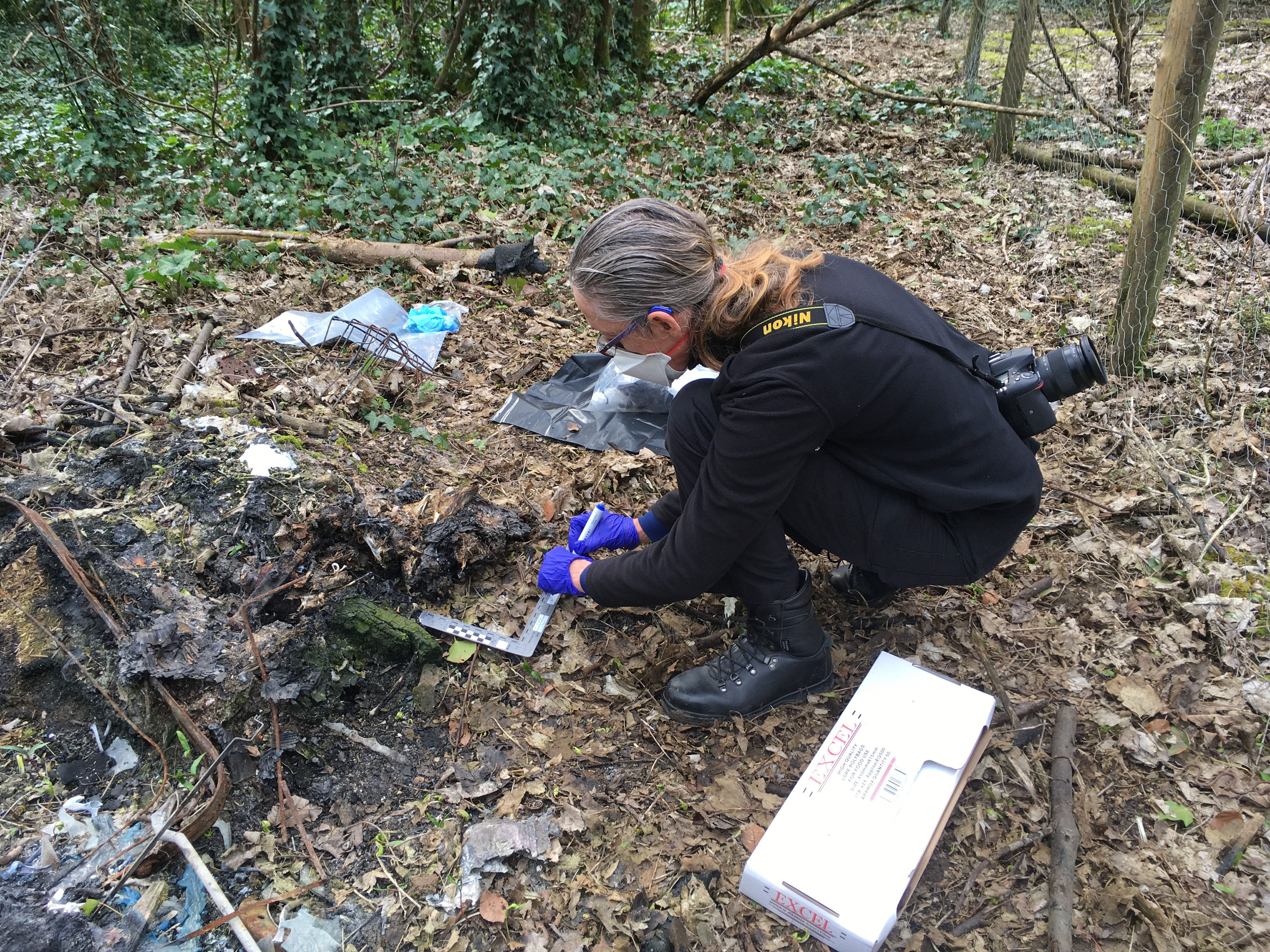
CSI officer from Dorset Police examining the remains of three buzzards on a bonfire. Photo: RSPB
A banned product containing the pesticide bendiocarb was found in Allen’s vehicle and in an insecure outbuilding, along with two bottles of strychnine: another deadly poison banned in 2006. Two full tins of Cymag – a lethal fumigant pesticide banned since 2004 – were also found outside under an upturned pond liner.
Officers from Dorset Police & Natural England with two containers of Cymag. Photo: RSPB
Sachet of banned pesticide Ficam W (Bendiocarb) found in unlocked outbuilding. Photo: RSPB
All birds of prey are protected under the Wildlife and Countryside Act 1981 and killing them is against the law, punishable by an unlimited fine and/or jail.
Thomas Grose, RSPB Investigations Officer, said: “Finding so many illegally killed buzzards was truly shocking. This is yet another example of a gamekeeper being prosecuted in connection with raptor persecution offences on land managed for gamebird shooting.
“In addition to all the agencies involved in this case, we would particularly like to thank Claire Dinsdale, formerly of Dorset Police, and currently with the NWCU, an exemplary officer who has devoted her career to tackling wildlife crime.”
Nationally, the RSPB’s recently published Birdcrime report for 2021 found that over two-thirds of confirmed raptor persecution incidents were in relation to land managed for gamebird shooting and identified Dorset as the county with the second-highest number of confirmed raptor persecution incidents in the UK that year.
Mark Thomas, UK Head of Investigations at the RSPB, said: “Tragically, only days into the New Year, we already have yet another highly significant bird of prey persecution case before a court. This is a national problem which requires urgent Government attention and solutions, as identified in their own report published in December 2021.
“In the time of a climate and nature emergency there can be no place for raptor persecution. We are therefore calling on Government to better enforce existing regulations relating to pheasant shoots, and to consider the introduction of new sanctions to act as a meaningful deterrent to such appalling crimes.”
The guilty pleas were –
· Two charges of possession of six dead common buzzards and remains of three more in March 2021
· Three charges of the keeping of banned pesticides (strychnine, bendiocarb and Cymag) in March 2021
· Two charges of failing to comply with conditions of shotgun and firearms certificates in March 2021
Charges relating to the killing of a red kite were dropped.
ENDS
The RSPB has also released a few minutes of video footage from the search – well worth viewing. You can find it on the ITV News website here
Further to my blog post on January 1st 2023 (here), this morning gamekeeper Paul Scott Allen, 54, of Baileys Hill, Brockington, near Wimbourne in Dorset, has pleaded guilty to seven charges of raptor persecution, poisons and firearms offences whilst he was working on a privately-run gamebird shoot located on the Shaftesbury Estate in March 2021.
Following the discovery of a poisoned red kite on the estate in November 2020, a multi-agency raid led by Dorset Police’s (now former) wildlife crime officer Claire Dinsdale took place in March 2021 (see here) where the corpses of six dead buzzards were found by a pen behind his house (tests later showed they had all been shot, including one that was was estimated to have been shot in the last 24hrs). Officers also found the remains (bones) of at least three more buzzards on a bonfire.
A loaded shotgun was found propped up behind a kitchen door (!) and 55 rounds of ammunition were found in a shed. Both the gun and the ammunition should have been inside a locked cabinet, by law. The ammunition was not covered by Allen’s firearms certificate.
Officers also found a number of dangerous, and banned, chemicals, including two bottles of Strychnine, two containers of Cymag and a packet of Ficam W (Bendiocarb) in various locations, including in a vehicle used by Allen.
Four of six illegally shot buzzards found during the police raid. Photo by RSPB
The seven guilty pleas included two counts of possessing a live or dead bird, or parts thereof, one charge of failing to comply with the conditions of a shotgun certificate, one charge of failing to comply with the conditions of a firearms certificate, one count of possessing a regulated substance without a license, one count of failing to comply with regulations in accordance with the Plant Protection Products (Sustainable Use) Regulations 2012 and one charge of contravening a health and safety regulations.
A number of charges were dropped prior to the hearing. More on that shortly.
Sentencing was adjourned for reports and Allen is due back in court on 16th February 2023.
There is plenty to discuss about this case and I will do that over the coming days. In the meantime, press attendance at court was strong so I’ll add the links to the various reports as they come out, below.
RSPB press statement (includes crime scene photos) here
UPDATE 4th January 2023: The estate that Dorset Police refused to search after discovery of poisoned eagle is the same location where gamekeeper was today convicted of multiple raptor persecution crimes (here)
UPDATE 16th February 2023: Convicted Dorset gamekeeper Paul Allen due to be sentenced today (here)
UPDATE 16th February 2023: Criminal Dorset gamekeeper Paul Allen receives suspended custodial sentence despite committing multiple wildlife, poisons and firearms offences (here)
Dorset Police were never far from the headlines last spring and summer, thanks to their appalling, botched investigation into the poisoning of a white-tailed eagle, found dead on a game-shooting estate and containing seven times the lethal dose of the rodenticide Brodifacoum.
As a recap for new blog readers, the corpse of the young satellite-tagged eagle, which was one of the birds from the high profile reintroduction project on the Isle of Wight, was found on the unnamed shooting estate in January 2022. Dorset Police’s wildlife crime team, led at the time by the exemplary Claire Dinsdale (one of few officers awarded the Queen’s Police Medal for her work), undertook a multi-agency operation to retrieve the corpse, sent it off for toxicology analysis, and when the results came back in early February 2022, she set about organising a warrant for a multi-agency team to search the estate to look for evidence that might identify who was responsible for this serious wildlife crime. She also issued a public appeal for information (here).
The news of this eagle’s death made national news and led to some disturbing criticism of Dorset Police by local Conservative MP Chris Loder, who publicly declared that Dorset ‘wasn’t the place for eagles’ and argued that the police should be focusing their resources on other types of criminality and not on suspected wildlife crime (see here). It also emerged that Chris Loder had some interesting connections with at least one prominent Dorset estate from whom his local party had received considerable donations, although it wasn’t known whether funding had been received from the [unnamed] shooting estate where the eagle had been found poisoned (see here).
By the end of March 2022, Dorset Police issued an astonishing statement, claiming that the toxicology results were “inconclusive” (actually they were anything but!) “and it has therefore not been possible to confirm that any criminal offence has been committed…..As a result, no further police action will be taken in relation to this report“.
This decision to prematurely pull the planned search and close the investigation made no sense whatsoever, including to the RSPB (here) and it even led to questions being tabled in the House of Lords (here). It was a ludicrous situation. For this dead eagle’s liver to contain seven times the lethal dose of Brodifacoum (i.e. seven times the amount needed to kill a bird the size of an eagle), it could only be the result of either (a) mis-use of the rodenticide or (b) deliberate abuse of the rodenticide. Either way, these are both offences and deserved a full investigation, especially given Dorset’s reputation as a bird of prey persecution hotspot (see here). For Dorset Police to effectively pull down the shutters and shout ‘Nothing to see here’, without conducting a search, looked very dodgy indeed.
Around the same time news also emerged that Claire Dinsdale QPM had gone on ‘long-term sick leave’ with stress and, strangely, Dorset Police’s Rural Wildlife & Heritage Crime Team had a name change, which happened just after MP Chris Loder’s Twitter outbursts about Dorset Police spending time investigating wildlife crime. The words ‘wildlife’ and ‘heritage’ were completely and mysteriously removed from the name, which had now become ‘Dorset Police Rural Crime Team’ (see here).
There followed months of protracted aggro, as FoIs were submitted to Dorset Police who first ignored them (e.g. see here) and then subsequently refused to provide the requested information (e.g. see here), even after appeal. Many people were asking whether there was evidence of political interference by Chris Loder MP and the Dorset Police & Crime Commissioner David Sidwick, influencing Dorset Police’s decision to drop the investigation. All parties denied this, of course, and no hard evidence has emerged to answer the questions, but Dorset Police’s refusal to answer FoI questions simply left these concerns hanging in the air like a bad smell.
Dorset Police then attempted a futile damage limitation exercise where they claimed their decision to prematurely close the investigation before conducting a search was ‘proportionate’ (see here) and then they claimed to have undertaken a review (effectively marking their own homework) which concluded that there was ‘insufficient evidence’ and ‘no outstanding lines of enquiry’ to progress the case. Well of course, if you fail to conduct a search you’re not going to find any evidence, are you?!
In August news emerged that Wildlife Crime Officer Claire Dinsdale QPM had left Dorset Police and was now working at the National Wildlife Crime Unit.
On 7th October 2022, Dorset Police published another statement about this botched case, probably in response to the ongoing criticism that simply refused to go away. The new statement, issued by Dorset Police Assistant Chief Constable Rachel Farrell (here), just reinforced the earlier denials of dodgy policing and repeated the line that, “…there was insufficient evidence to prove an offence of wilful poisoning by an individual – so no one person can be proven to have been criminally responsible for the bird’s death“.
On 16th November 2022, coinciding with the publication of the RSPB’s latest annual Birdcrime report, Claire Dinsdale posted a remarkable comment thread on Twitter as follows:
Tweet 1:2020 – a series of concerning incidents in Dorset stood out to me & colleagues from various agencies. Progress was being made with multi agency searches & raising nationally at our Bird Of Prey PDG (Priority Delivery Group) meetings. It is clear to anyone with a basic understanding of wildlife crime that Dorset had a problem.
Tweet 2:Up until early 2022, there was thankfully no-one interfering with these specialised cases. Policing must be objective & not influenced by threats or pressure from other parties or their own officers. Without fear or favour. So no surprise to see Dorset is 2nd worst county in UK Bird Of Prey Crime 2021 data, with only 1 less than the No 1 slot.
Tweet 3:I hope lessons will be learned by those who made serious errors of judgement. Policing needs to respect & listen to those experienced & specialist officers on the ground.
Tweet 4:It needs to have the strength & courage to do what is right without personal regard for ambition or self importance. The public are not fools & will rightly hold us to account for the decisions made. When policing or other public servants get it wrong, they should say so.
Tweet 5:If I can correct the statement for the record here by the Dorset Echo and Natures Voice. The eagle case was shut down prematurely in my view & the planned multi agency search I had arranged was cancelled by a new boss with no understanding of wildlife crime and a very senior officer within days of an MPs rebuke & threats on police funding, got the word wildlife removed from our twitter bio. [Ed: I believe the Dorset Echo article to which Claire was referring was this one]
Tweet 6:The previous Chief Constable (who’d retired before these events) advised me should anyone interfere with one of my cases to come straight to him.
Tweet 7:There has been some great work done by WCOs colleagues in other forces. My last Dorset wildlife crime case myself & other agencies worked so hard on, will hopefully show how you can investigate bird of prey crime with searching being a key part of it.
Claire’s tweets earned her considerable support on Twitter – it takes an incredibly courageous officer to speak out on police failings – but by the end of November all but Tweet #7 had been deleted. We can only imagine what hell some senior officers in Dorset Police are now bringing to her door. Nevertheless, her revelations will lead to even more scrutiny of Dorset Police’s obvious mishandling of this case…more on that soon.
Meanwhile, and also in November 2022, MP Chris Loder’s apparently cosy relationship with Dorset Police was once again in the spotlight. Two Dorset residents and long term anti-sewage campaigners, Beverley Glock and Fran Swan, both received police visits to their homes after they’d registered to attend a public meeting to raise concerns with Chris Loder about sewage pollution in the area (see their press release here). [EDITORUPDATE 4th Jan 2023: the original press release now appears to be unavailable. There is an archived copy (here) and if that also disappears I’ve provided a copy and paste version in the comments section of this blog].
What the actual?!
According to a subsequent article published on the DorsetLive website on 3rd December 2022 (here), Dorset Police & Crime Commissioner David Sidwick (whose astonishing correspondence with Chris Loder (“You and I need to get our ducks in the row on this one“) on the poisoned eagle fiasco was revealed by FoI, here) is now conducting a review about why a uniformed officer visited these two ladies, at night, apparently after police had received an email from Chris Loder’s office about their planned (registered!) attendance at the public meeting.
A spokesperson from Dorset Police is quoted:
“Officers from the neighbourhood policing team wished to understand the intentions of those people to ensure that public safety was preserved and any lawful protest could be facilitated. This approach was well-intentioned without any direction from the local MP“.
And David Sidwick is quoted saying he was given a “satisfactory explanation” (from Dorset Police) about why the two women were visited by police. He noted that it is “routine” that the police are notified of attendances to MP events following the murder of Sir David Amess MP, but has promised a review into the incident.
Public confidence in Dorset Police continues to plummet, and I guarantee there’ll be an even bigger shit storm after revelations emerge about Wednesday’s court case concerning a Dorset gamekeeper facing multiple charges of alleged raptor persecution, poisons and firearms offences dating back to March 2021.
Interesting times.
UPDATE 4th January 2023: The estate that Dorset Police refused to search after discovery of poisoned eagle is the same location where gamekeeper was today convicted of multiple raptor persecution crimes (here)
A gamekeeper is due in court on Wednesday 4th January 2023 to answer multiple charges of alleged raptor persecution, poisons and firearms offences.
This case relates to the multi-agency raid carried out on a shooting estate in Dorset in March 2021, led by the now former wildlife crime officer Claire Dinsdale (see here).
This prosecution is particularly interesting on a number of levels – watch this space.
As this is a live prosecution, comments won’t be accepted until the case concludes. Thanks for your understanding.
Forestry and Land Scotland (FLS) has granted a controversial licence permitting Moy Estate gamekeepers, and others from the Three Straths Fox Control Association, to hunt and kill foxes on Scotland’s national forest estate, partly for the benefit of privately-owned grouse shooting estates, including Moy Estate.
This is the same Moy Estate that has been at the centre of police investigations into alleged raptor persecution crimes for over a decade (e.g. see here) and is currently serving a three-year General Licence restriction, imposed by NatureScot, after evidence of wildlife crime (raptor persecution) was again uncovered on the estate.
This is a map I produced a few years ago showing reported raptor persecution incidents in the region between 2005-2016. There have been many more since.
Wildlife campaigners are understandably furious about this decision, not least because FLS’s own experts strongly advised against it due to, amongst other things, the potential for illegal activity.
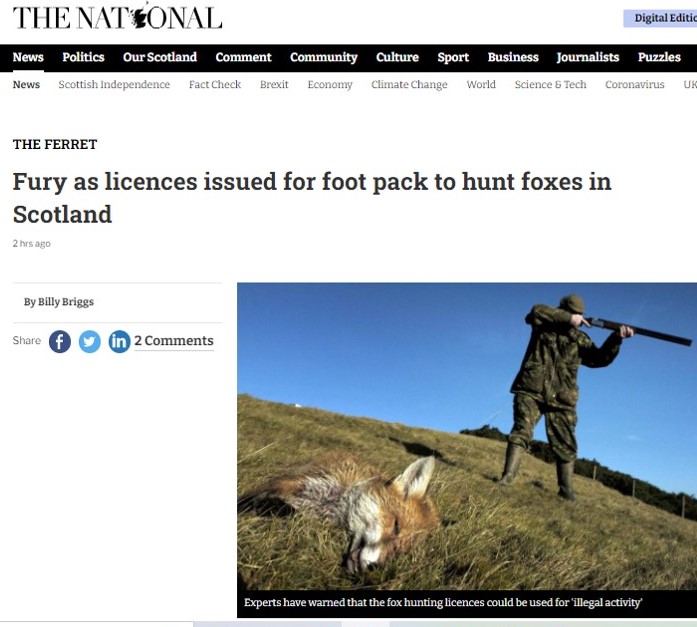
Journalist Billy Briggs has written an excellent article, based on Freedom of Information responses I received this autumn. His article is published today by The Ferret (here, behind a pay wall) and also here in The National, as follows:
LICENCES for a foot pack to kill foxes were issued by Forestry and Land Scotland despite strong objections from internal experts who feared there was potential for “illegal activity” and protected species such as badgers to be disturbed.
A foot pack – in contrast to traditional fox hunting with riders on horses – is where a huntsman, accompanied by colleagues acting as beaters, uses hounds to chase foxes out from cover to then be shot.
Critics who want hunting with packs of dogs banned in Scotland are urging Scottish Government ministers to outlaw foot packs as well as mounted hunts.
The Ferret previously revealed that foxes were being chased by hounds and shot by foot packs in forests used by the public.
Our investigation prompted angry responses from wildlife groups who have condemned Forestry and Land Scotland (FLS) once again for issuing more licences. FLS is responsible for managing and promoting Scotland’s national forest estate.
A freedom of information request was submitted to FLS by campaign group, Raptor Persecution. The reply revealed internal discussions at FLS in September and October after Three Straths Fox Control Association (Three Straths) applied for licences for fox control in the south Inverness area.
The documents, passed to The Ferret, showed that FLS experts strongly advised against the foot pack being allowed to hunt.
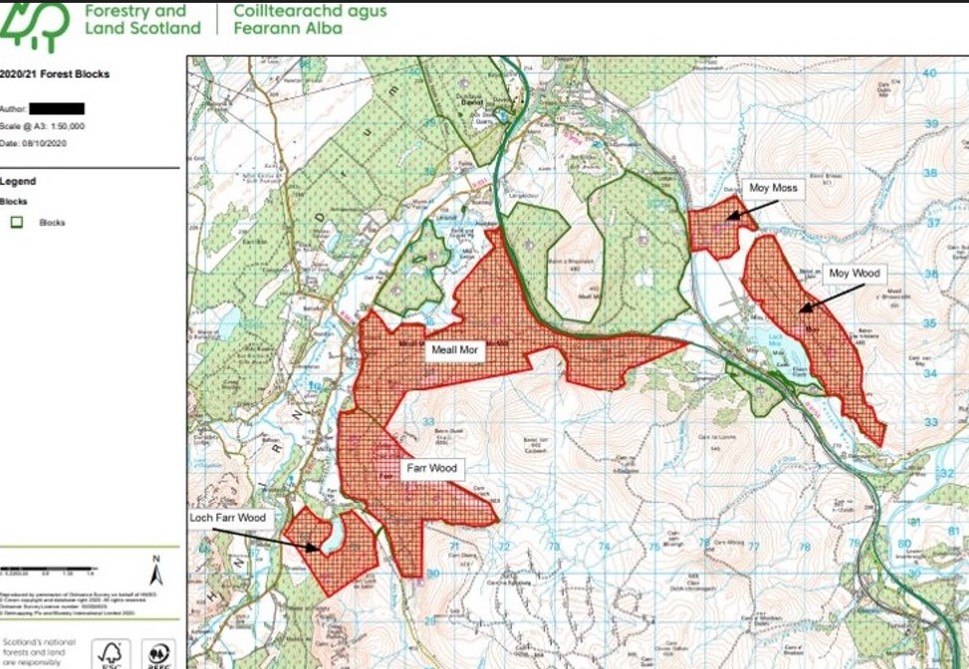
Map showing the woodland where FLS has permitted the hunting & killing of foxes during the 2022-2023 season. Released to RPUK under FoI.
The licences were issued, however, prompting condemnation by critics. They included the League Against Cruel Sports Scotland which said it was “quite staggering” FLS granted permission in the face of “vehement concerns” by its own staff.
In reply, FLS said it appreciates that fox control is a “contentious issue” but under existing legislation the activity is legal in Scotland and “closely regulated”.
Three Straths told The Ferret it always adheres to the law to “ensure public safety and to avoid non-target species”, adding that it provides a “public service at no cost to the public purse”.
The licence application said Three Straths represented a “number of sporting estates” seeking to hunt foxes on the Moy, Farr, and Dalmagarry estates. Each hunt would typically involve 30 people including local gamekeepers, 20 to 30 guns, 15 hounds and a huntsman.
The hounds are used to flush the fox from cover to a line of waiting guns where the animal is shot.
The foot packs are overseen by a wildlife team at FLS, but some staff still opposed Three Straths’ application.
Internal documents revealed one person wrote: “As a minimum we should request a protocol for how the operators (the foot pack) will deal with encounters with protected species. This was asked for at the last permission request but I have not yet seen it. As discussed before, without this I feel the activity cannot be done without potentially disturbing legally protected species and could lead to an illegal activity.”
They added: “As this is a known activity any disturbance could be classed as reckless under the law and would constitute an offence. FLS as the landowners would also be liable for allowing the activity to take place. Given the risks, lack of mitigation information and lack of rationale for why the activity is needed, I would strongly advise it is not allowed.”
Another expert — a species ecologist — also objected and wrote: “As I [sic] have pointed out several times previously, fox ‘control’ at this time of year has no impact on fox density the following spring. This is a matter of scientific fact. If the intention is to reduce (assumed) fox impacts on the shootable ‘surplus’ of grouse in 2020, it is a pointless exercise.”
They added: “Furthermore, I am not aware of any evidence that these foxes actually eat game birds on adjacent estates. To sanction this controversial activity without any evidence of an actual problem is inadvisable. For the record, and for the reasons I have listed in previous communications, I reiterate my advice that we should not give permission for this activity.”
It was also noted that internal concerns had been raised in previous years regarding requests by Three Straths to hunt, which were “not adequately addressed”.
Staff also pointed out that foxes are “part of the forest ecosystem” and “we should not be unsustainably removing any native species”. They said: “As we have no idea of the current population (no surveys have been undertaken) then effectively this could extirpate foxes on our land. We know foxes play a valuable role in keeping populations of other predators in check and in reducing rabbit and hare populations, thereby reducing damage to restock sites.”
Concerns were also raised over public safety and “verbal assurances” given by Three Straths that hounds would only chase foxes. There was a “real risk” that a bolting fox could go down the entrance to a protected species den or sett to escape the dogs, it was noted, and people firing guns on a badger sett “would be a disturbance in itself”.
Dr Ruth Tingay, of Raptor Persecution, who submitted the freedom of information request, pointed out that Moy Estate is currently serving a three-year general licence restriction, imposed by NatureScot, for wildlife crimes against birds. Moy Estate reportedly said it was extremely disappointed by the decision and would be considering an appeal. [Ed: Moy Estate has already lost its appeal against the General Licence restriction – see here].
Tingay said: “The rationale behind the restriction is that NatureScot can no longer trust Moy Estate to comply with the terms of the general licences after evidence of raptor persecution was provided by Police Scotland.
“So why on earth has FLS entrusted Moy Estate to comply with the terms of a licensed fox hunt, in a public forest, with what looks like minimal oversight and scrutiny? Don’t these licensing agencies talk to one another?”
Bob Elliot, director of the animal welfare charity, OneKind, argued that FLS fox control policy should reflect the views of the Scottish public who “overwhelmingly do not support fox hunting”.
He added: “It is incredibly disappointing to see that once again, despite several serious objections raised internally by Forestry and Land Scotland staff, FLS has granted permission to allow foot packs to kill foxes in Scotland’s public forests this winter.
“We know from our previous freedom of information requests to FLS that many of the concerns raised by FLS staff, including the non-necessity of fox hunting foot packs, the importance of foxes to the ecosystem, and the threat to other wild animals, have in fact been raised before.”
His views were echoed by Robbie Marsland, director of the League Against Cruel Sports Scotland, who said it was “quite staggering that despite vehement concerns” the licenses were issued.
He added: “The situation at FLS is yet another reason why it is imperative the new Hunting with Dogs Bill passes through parliament in the most robust form possible, ensuring hunting with dogs is really banned in Scotland once and for all.
“The existing legislation is so full of loopholes it isn’t worth the paper it’s written on and time and time again we’re seeing those who wish to hunt wild mammals with dogs for fun, simply ignoring the fact this activity is supposed to be illegal.”
A spokesperson for Forestry and Land Scotland said that in “all aspects” of its land management activities it has a duty to “follow the law and existing policies” when considering requests. “Only if there was a change in law and Scottish Government policy would we be in a position to review our procedures,” the spokesperson continued.
‘ORDINARILY FLS only controls foxes to meet specific conservation interests. However, we also appreciate that neighbouring land managers’ priorities might differ from our own and will assist where it is deemed appropriate. We continue to have our own staff monitor fox control activities.”
A spokesperson for Three Straths accused FLS experts of having a “personal bias” against predator control, adding that none of the objectors had come out with the foot pack to witness a hunt for themselves, despite being asked.
“We always have FLS staff out with us on days we are in the forest and in the 25 years I have been involved, not one of them has raised any complaint about our practices,” said the spokesperson. “On the point about controlling foxes at the time of year we do, making no difference. That is nonsense, areas where foxes are controlled all year round have a far smaller fox population and ground nesting birds breed far more successfully because of the control.
“We also used to hunt into the spring and summer on FLS land which did do a lot of good but we were stopped by the same ecologist who quotes that we are hunting at the wrong time of year now. His comment about no evidence to suggest foxes eat ground nesting birds just goes to show how far removed from reality some of these people can be.”
The spokesperson continued and said Three Straths controls foxes for the “good of all ground nesting birds”, not just game birds. “Many of these species are in dire straights [sic] at the moment and need all the help to survive they can get,” they added.
“Upland sporting estates are their last stronghold and their last chance of survival.”
A Scottish Land & Estates spokesperson said: “The predation of wild birds such as capercaillie, black grouse, curlew, golden plover, grey partridge, lapwing and oystercatcher continues to be a huge problem, with widespread declines in populations of these birds across Scotland since the 1960s.
“The control of foxes, alongside other predators such as crows and pine martens, is important in improving the breeding success of these birds. Predator control takes place when it is deemed necessary and in accordance with regulations.”
The Hunting With Dogs (Scotland) Bill – published in February and currently going through the Scottish Parliament – seeks to replace a widely criticised 2002 law which aimed to ban fox hunting in Scotland.
Both Farr Estate and Dalmagarry Estate were asked to comment. We were unable to contact Moy Estate directly so made an indirect approach through Three Straths.
ENDS
This isn’t the first time that a licence permitting fox hunting in public forests around Moy has been a source of controversy. Last year, Freedom of Information requests to FLS by campaigners from animal welfare charity OneKind revealed that FLS staff suspected that gamekeepers were visiting the forests to look for fox dens to block up, which also happened to be beside Schedule 1 raptor nests, some of which have been repeatedly attacked in previous years (see here).
And of course it’s not just FLS turning a blind eye to wildlife crimes uncovered on and around Moy Estate (e.g. see here, here, here).
A court hearing has been delayed once again in the case of a Scottish gamekeeper accused of killing a sparrowhawk.
[Sparrowhawk photo by Markus Varesvuo]
The un-named 22-year-old gamekeeper was charged in September 2021 (see here) for the alleged killing on a grouse moor in Inverness-shire and he was due in court on 30th September 2022.
The case was delayed until 10th November 2022 (see here).
The case has now been further delayed and the next court hearing is scheduled for January 2023.
As this is a live case no comments will be accepted on this blog post until criminal proceedings have ended. Thanks for your understanding.
UPDATE 8th February 2023: Scottish gamekeeper charged with killing Sparrowhawk on a grouse moor – new court hearing (here)






 Raptor Persecution UK