Further to the criminal conviction yesterday of gamekeeper Francis Addison from Weeting, near Thetford in relation to the discovery of five shot goshawks in January this year (see here), there was excellent coverage on BBC’s Look East yesterday evening.
It’s available on iPlayer (here, starts 05.53 mins) but only until this evening, so here is a transcript of the two-minute piece:
A part-time gamekeeper who admitted dumping dead birds of prey in a parking area in Suffolk has been given a suspended prison sentence.
The five goshawk carcasses were found in January. Francis Addison who’s 72 and from Weeting, near Thetford, denied shooting them. Our Environment reporter Richard Daniels sent this report from Norwich Magistrates Court.
It was a shocking discovery. Five goshawks dumped in a public area near Wordwell in Suffolk. All had been shot. When police swabbed them for DNA it led them to the home of Francis Addison, an ex-military weapons instructor and part-time gamekeeper.
Today, Addison arrived at court facing 19 charges, including possession of the goshawks and various firearms offences.
Francis Addison arriving at court. Screen grab from BBC Look East
Addison’s defence told magistrates he found the five goshawk carcasses while out walking his dog. He put them in a bag and took them home. [Ed: according to this BBC article, Addison claimed he was intending to give them to the BTO]. But when a friend told him that it was illegal to have them, he took fright and returned them to the spot where he found them.
Once driven to extinction through persecution, goshawks are some of our most protected birds. The court was told there were believed to be as few as 33 living in Suffolk.
[Tom Grose, RSPB Investigations Officer]: “It’s illegal to possess these birds. However, we still don’t know who killed these goshawk and there is a reward available, still, for anybody that comes forward with information leading to the conviction of somebody for that offence”.
When the police searched Addison’s home they found his gun cabinet unlocked with ammunition stored in cupboards and in his car.
Screen grab from BBC Look East
[Sgt Brian Calver, Suffolk Police]: “If the house got burgled then they had access to a rifle, four shotguns, all the ammunition in the world. Gun ownership is a privilege, not a right, that’s one of the conditions on everyone’s licence to make sure that you keep those guns as secure as possible at all times”.
Addison was given a 12-week suspended prison sentence. He was told he’d shown a total disregard and disdain towards his licensing requirements. His firearm and shotgun certificates have been revoked.
Richard Daniel, BBC Look East, Norwich Magistrates Court.
ENDS
I’m so pleased to learn that Addison ‘found’ the five shot goshawks on his dog walk and that their deaths had nothing whatsoever to do with his cage traps, dead woodpigeon and guns. Phew! Seems he’s just an unlucky chap, not a raptor-killing bastard.
UPDATE 30th June 2023: Criminal gamekeepers Addison & Stroud both linked to Fengate Farm in Weeting, Norfolk (here)
At Norwich Magistrates’ court today, Frances Addison (72) a part-time gamekeeper of South Park, Weeting, pleaded guilty to 19 charges in connection with a multi-agency raptor persecution investigation led by Suffolk Police, including possession of five shot Goshawks.
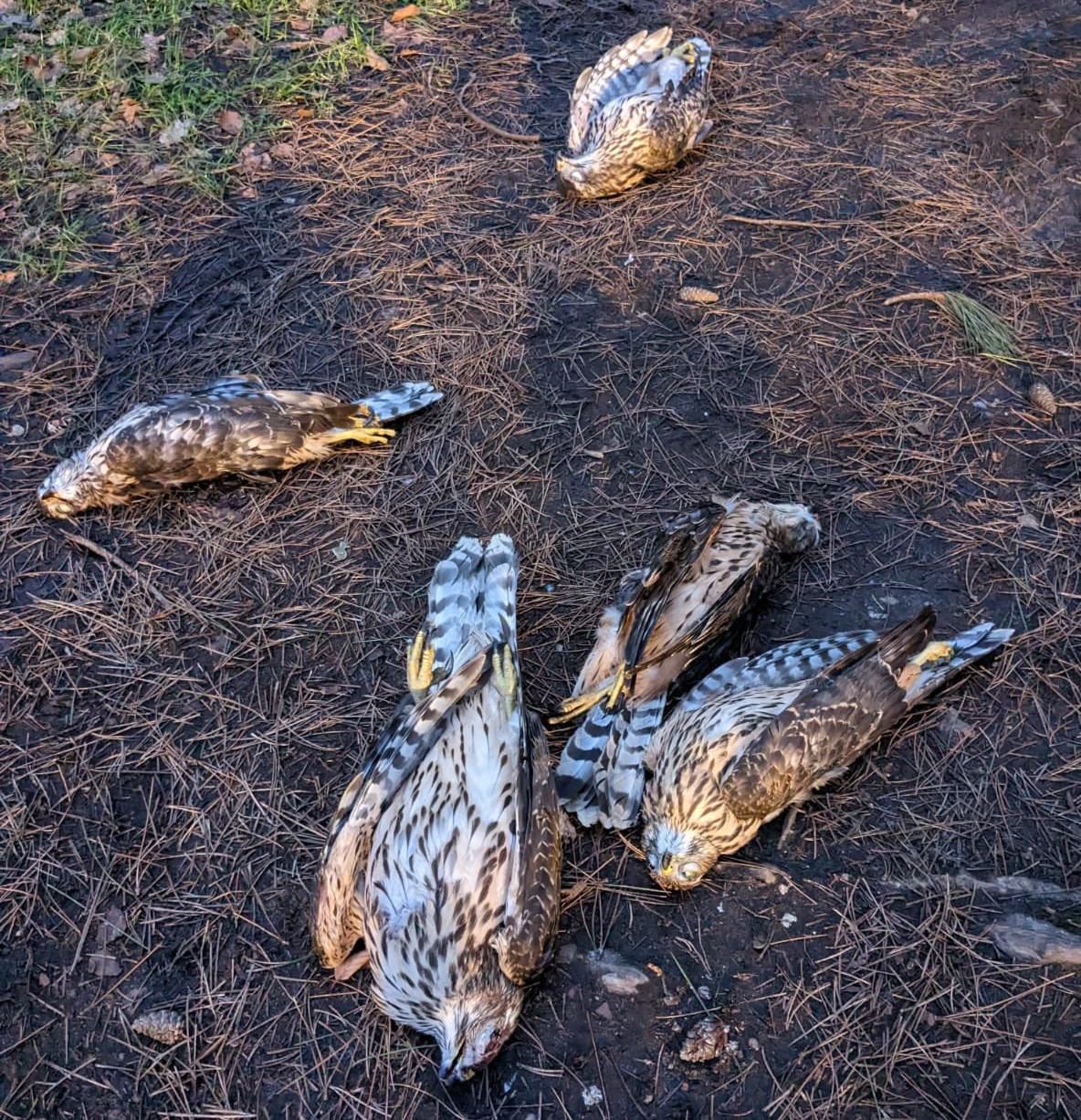
The five birds were found dead together in Kings Forest, near Wordwell, Suffolk on 16 January 2023.
The five shot juvenile goshawks found dumped in car park. Photo: Suffolk Police
The incident was reported to Suffolk Police, who swabbed the birds at the scene for human DNA and then x-rayed them as part of their investigation. All five birds were found to contain multiple pieces of shot and remarkably a human DNA hit was registered from a swab of one of the bird’s legs.
The DNA findings led Suffolk and Norfolk Constabularies, assisted by RSPB Investigations and the National Wildlife Crime Unit, to search the suspect’s home in nearby Weeting, where a number of offences in relation to firearms and traps were uncovered. In interview, Addison claimed that he had found the Goshawks and then put them back and that all gamekeepers were killing birds of prey.
The court dealt with all the offences together and sentenced Addison to 12 weeks imprisonment – suspended for 12 months and ordered him to pay £1080 in compensation and £105 costs.
All birds of prey are protected by law, and to kill or injure one could result in jail and/or an unlimited fine. Yet the illegal killing of birds of prey remains a widespread national problem.
The RSPB’s annual Birdcrime report for 2021 revealed 108 confirmed incidents of birds of prey being shot, trapped or poisoned. However, the true number is likely to be far higher.
The report also found that Norfolk had the highest number of confirmed raptor persecution incidents than any other county in 2021.
It remains unknown who shot the Goshawks despite extensive rewards on offer from RSPB, Wild Justice, and Rare Bird Alert.
Mark Thomas, UK Head of Investigations at RSPB said:
“Goshawks are an exhilarating apex predator, so it was both shocking and appalling to see images of the five shot birds discarded in the Breckland Forest car park, we applaud the efforts and professionalism of Suffolk Police in deploying key forensic techniques that have led to court charges in this case. In 2021, two-thirds of all confirmed UK raptor persecution incidents happened in connection with land used for gamebird shooting, faced with huge public displeasure there is increasingly no place to hide for those who commit these crimes“.
Sergeant Brian Calver, of Suffolk Constabulary’s Rural and Wildlife Crime team, said:
“This is a particularly disturbing case. Bird of prey crime is a national wildlife crime priority, which is taken very seriously by police. We will leave no stone unturned in pursuing criminals that cause deliberate harm to wildlife. This incident has had a significant impact on the Goshawk population in the Brecks and in particular their ability to expand their territory. As well as possessing dead schedule 1 birds, Addison has shown a complete disregard for the security of his guns, which is equally concerning.”
He went on to say “We welcome today’s outcome and I hope the sentence imposed sends a strong message to others that are involved in this type of criminality. We’ll continue to work closely with partners to ensure such crimes become a thing of the past.”
The charges were:
· Five counts of possession of a dead schedule 1 wild bird (Goshawk)
· One count of killing a non-schedule 1 wild bird (Wood Pigeon)
· One count of use of an animal trap in circumstance for which it is not approved
· Two counts of possession of an article capable of being used to commit a summary offence, namely two air rifles and six animal traps
· Six counts of failing to comply with the conditions of a firearm certificate
· Four counts of failing to comply with the condition of a shotgun certificate.
ENDS
Brilliant multi-agency partnership work – very well done to everyone involved.
The sentence is, as usual, insignificant and no deterrent to others.
The Norfolk village of Weeting seems to be somewhat of a hotspot for raptor persecution – last year another gamekeeper, Matthew Stroud, was convicted of multiple wildlife crime offences in the area including the placing of poisonous baits and the killing of buzzards and a goshawk (see here).
I look forward to reading BASC’s condemnation of Addison and his crimes – given their faux outrage when Suffolk Police initially asking the shooting community to help progress the police investigation (see here).
UPDATE 30th June 2023: More on convicted Norfolk gamekeeper Francis Addison (here)
The RSPB has this evening released video footage of an eyewitness’s account of a short-eared owl being shot on the well-known Broomhead Estate in the Peak District National Park last summer.
Screen grab from the RSPB video showing the shot corpse of the short-eared owl.
The eyewitness, who understandably doesn’t want to be identified (probably due to the harassment and intimidation suffered by other eyewitnesses in this region – e.g. see here), watched the owl being shot by an armed man who had arrived on the grouse moor on an all-terrain vehicle, carrying a shotgun and a bag. He shot the owl and shoved its lifeless corpse inside a rabbit hole in an effort to conceal the crime.
Fortunately, this eyewitness was savvy enough to have filmed the event and was able to return to the grouse moor the next day and pinpoint the spot for investigators from the RSPB and South Yorkshire Police.
They retrieved the owl’s corpse and a post-mortem confirmed it had been shot.
A local gamekeeper became the immediate suspect but, as happens so often, there was insufficient evidence to link him conclusively to the crime and so no prosecution could take place. You can read the RSPB’s blog about this case here, including a link to the video.
RPUK map showing location of Broomhead Estate in Peak District National Park
Grouse moors in this part of the Peak District National Park have been at the centre of other police investigations into alleged raptor persecution in recent years, including the suspicious disappearance of a satellite-tagged hen harrier (‘Octavia’) in 2018 (here).
Last year, another satellite-tagged hen harrier (‘Anu’) roosted overnight on a local grouse moor before ‘disappearing’. His tag was found several km away, no longer attached to the harrier and a forensic examination revealed the tag’s harness had been deliberately cut from the bird (here).
Two other hen harriers ‘disappeared’ from their breeding attempts on National Trust-owned grouse moors in the Peak District National Park last year (see here).
I’ve blogged previously about the Broomhead Estate in relation to the apparent mis-use of medicated grit (see here) and the use of gas gun bird scarers (here, here, here and here).
Grouse-shooting butt on Broomhead Estate. Photo: Ruth Tingay
There was an interesting case heard at Banff Sheriff Court yesterday where Scottish gamekeeper Terry Lindsay, 40, was facing a charge relating to the use of a trap that was alleged to have been illegally-set on Fyvie Estate in Aberdeenshire.
The trap at the centre of the trial was a clam trap (also known as a Larsen Mate trap) that had been baited with a pheasant carcass and placed next to a pheasant release pen on 26th August 2020. The use of these traps, baited with meat, is lawful (although highly contentious – see this blog from 10 years ago!) as long as certain General Licence conditions are met.
Here’s a photo of the trap. For readers unfamiliar with how they work, the spilt perch above the bait is designed to collapse when a bird lands on it, which causes the two metal sides of the trap to close (like a clam), capturing the bird inside the trap where it will remain until the trap operator comes along to either release the bird (if it’s a non-target species, such as a raptor) or club it to death if it’s a legitimate target species (e.g. crow).
Set trap on Fyvie Estate, 26th August 2020. Photo: RSPB
A write-up of the case was published yesterday in the Press & Journal (behind a paywall) but unfortunately the article includes a number of inaccuracies. For the purpose of clarification, I’ve reproduced the P&J article (below), followed by my understanding of the case.
Here’s the article published by the P&J yesterday:
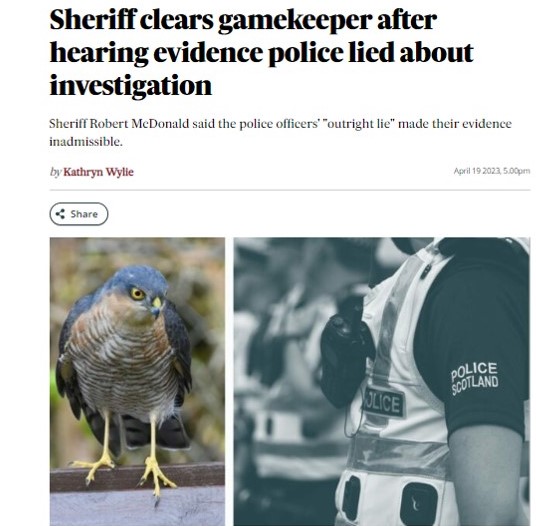
A gamekeeper has been cleared of illegally trapping a protected bird after it emerged police officers lied during the course of the investigation.
The case against Terry Lindsay collapsed when Sheriff Robert McDonald heard evidence that officers misled two people about why they were on the Fyvie Estate.
Police had received a tip-off that a sparrowhawk was “beside” a trap but lied to estate staff about why they were there – instead saying it was to look for a missing person.
Sheriff McDonald said that “outright lie” made the police officers’ evidence inadmissible and acquitted Mr Lindsay, 40, less than an hour after the trial started at Banff Sheriff Court.
“It seems to me that the critical point is the lying,” Sheriff McDonald said.
“I think the evidence of the search is inadmissible. It’s fatal that police have told an outright lie to two members of the public who, as I pointed out, had some authority as to who comes onto the land.
“That compounds it. I find the evidence inadmissible.”
A Police Scotland spokesman said: “We are aware of the outcome in court and the full circumstances leading to yesterday’s trial are being reviewed.”
The verdict was met with “disappointment” by the RSPB, the bird welfare charity which initially came across the trap and reported its whereabouts to police.
Pc Alison Davis told the trial she and her sergeant, Gary Johnston, spent about an hour scouring the estate on August 26 2020 after an RSPB informant made them aware there was a “trap with a bird beside it”.
She told procurator fiscal Gerard Droogan they were approached by a gamekeeper and the laird, Sir George Forbes-Leith, and told both that they were searching for a missing person.
“There was no truth in that as far as I am aware,” Pc Davis said, before adding: “He [Sgt Johnston] said to me afterwards that he was concerned that any evidence would be lost, or words to that effect.”
Mr Lindsay’s defence agent Paul Anderson asked Pc Davis why neither conversation was included in her statement.
She replied: “I didn’t consider them to be witnesses. I didn’t think of that as relevant to the inquiry. That’s why it’s not in my statement. It was certainly not intentionally left out.”
Mr Anderson asked: “Two lies were told in the space of one hour to two separate members of the public?”
“Yes,” replied the officer.
During her evidence, Pc Davis also explained how they eventually found the trap with a sparrowhawk inside around 20 metres from a pheasant breeding operation on the estate.
The bird was alive, she took photos of it and they released it, before placing the trap in the back of the van, she said.
Mr Anderson said this decision to lie, alongside a decision to search the land “without reasonable cause to suspect someone was committing an offence”, made any police evidence “unreliable and uncredible”.
“There were lies told to two members of the public within one hour about why police were on the land,” he told Sheriff McDonald.
“It’s inexcusable. The evidence is so tainted it cannot be considered by the court.”
He added the lies became “fatal to the search” and invited the sheriff to offer an acquittal.
Sheriff McDonald agreed and Mr Lindsay, of North Haddo, Fyvie, was acquitted of the charge under the Wildlife and Countryside Scotland Act 1981.
Speaking after the case, the RSPB said more needed to be done to regulate the use of traps.
Ian Thomson, RSPB Scotland’s head of investigations, told The Press and Journal: “While we are disappointed that this case was dismissed after the court considered witness evidence from the police, we remain concerned that traps authorised by the General Licences issued annually by NatureScot continue to be poorly regulated, with no compliance monitoring, and are widely misused and abused.
“We hope that provisions introduced by the Wildlife Management and Muirburn Bill, currently being considered by the Scottish Parliament, bring better training, accountability and tighter regulation of such devices that are in widespread use on gamebird shooting estates in particular.”
A Fyvie Estate spokesman said: “As per other legally set Larsen traps, a sparrowhawk was caught and upon Mr Lindsay checking the trap, he found the police in attendance. The sparrowhawk was released unharmed by police officers.
“All traps are licensed and tagged, and a meat bait return form is completed as per Nature Scot guidelines showing the release of non-target species caught. The beauty of this type of trap is that they are checked several times a day and birds can be released unharmed.”
ENDS
My understanding is that the main inaccuracy in this article is that the RSPB did not report a sparrowhawk being “beside” a trap to Police Scotland. Rather, the RSPB reported what appeared to be an illegally-set trap. It was suspected to be illegally-set because the trap didn’t appear to have a trap registration number attached to it (this is one of the conditions of the General Licence) so quite rightly, the RSPB reported it to Police Scotland for investigation.
By the time Police Scotland attended the scene, a raptor had been caught in the trap. It’s been reported that this was a sparrowhawk but the photographs suggest it was a goshawk. The species ID isn’t a significant issue though – it’s not unlawful to trap a raptor inside a clam trap, whatever species it is; it only becomes unlawful if the raptor isn’t released, unharmed, as soon as it’s discovered by the trap operator during the daily trap check. In this case, the police officers released the unharmed hawk, so no problem there.
Those are the two main inaccuracies in the article, as far as I’m aware.
What happened in court, according to the article, I’ll have to take at face value.
It seems the fact that the two Police Scotland officers lied to the estate owner and to the gamekeeper about their reason for being on the estate is not disputed. Unfortunately, the article doesn’t examine why the police officers lied about it. If they had reasonable suspicion that a crime may have been committed, they had full authority to enter the estate and conduct an initial land search, without a warrant. There was no reason for them to lie about the purpose of their visit – they had the authority to be there, under Section 19 of the Wildlife & Countryside Act 1981, which states:
‘If a constable suspects with reasonable cause that any person is committing, or has committed, an offence under this Part, he may, for the purpose of exercising the powers conferred by subsection (1), enter any land other than a dwelling or lockfast premises‘.
So why lie about their reason for visiting the estate? Why did they pretend they were looking for a missing person?
The only explanation I can think of (and this is pure speculation because I haven’t spoken to the two officers about it), is that they weren’t specialist Wildlife Crime Officers and so didn’t understand the extent of their powers to access the land and search for evidence.
If that is the case, it still doesn’t justify them lying to the landowner and the gamekeeper, but it perhaps provides an explanation of sorts.
Whatever their reasoning was, however, their actions are an embarrassment to Police Scotland and I hope that the ‘review of the full circumstances’, as stated in the P&J article, leads to lessons being learned.
For clarity, and for the benefit of anyone who might comment on this case, please note that gamekeeper Mr Lindsay was acquitted and any evidence about the alleged illegally-set trap was not put before the court because the Police Officers’ evidence was deemed inadmissible.
Further to last week’s news that Scottish gamekeeper Rory Parker pleaded guilty to committing raptor persecution crime on a grouse moor on Moy Estate in September 2021 (see here), I’ve been looking to see how the game-shooting industry has responded to this conviction.
You’ll recall that this is the game-shooting industry whose organisations routinely state they have a ‘zero tolerance’ policy towards raptor persecution, in which case you’d think they’d be quick to condemn this latest crime and call on their members and the wider shooting public to distance themselves from Moy Estate, and especially as the estate is already serving a three-year General Licence restriction imposed in 2022 after Police Scotland found further evidence of wildlife crime (see here), namely a poisoned red kite and ‘incidents in relation to trapping offences’.
Four days on from Parker’s conviction, I haven’t found any statements of condemnation on the websites of the Scottish Gamekeepers Association, BASC, or the Countryside Alliance.
Their collective silence says a lot, I think. In my opinion it’s related to an ongoing, industry-wide damage limitation exercise as the Wildlife Management & Muirburn (Scotland) Bill begins its passage through the Scottish Parliament. Drawing attention to criminal activity on grouse moors at a time when MSPs are considering the extent of proposed regulation in the form of a grouse-shooting licence is not in their interests, although I’d argue that if they were as resolute about stamping out raptor persecution crimes as they claim to be, they should have been at the forefront of leading the condemnation.
The only game-shooting organisation that has responded to the news of Parker’s conviction is landowners’ lobby group, Scottish Land & Estates (SLE).
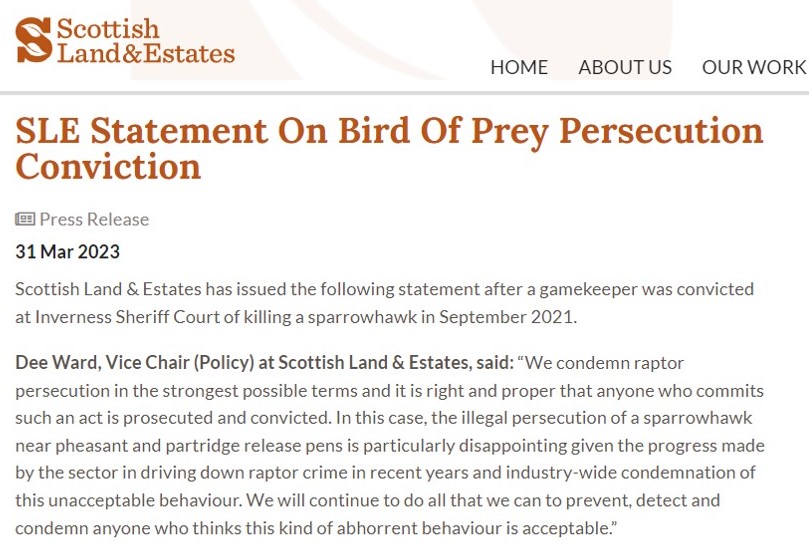
I’ve already written about a media quote attributed to grouse moor owner Dee Ward, who’s also Vice Chair (Policy) at SLE, who seemed keen to distance Parker’s crime from grouse moor management (see here), and this was repeated in a statement that SLE published on its website on the day of Parker’s conviction.
Credit to SLE for not shying away from the news, but its manipulation of the narrative is all too obvious:
I’m not sure what the ‘progress’ is to which Dee refers. I haven’t seen any evidence of ‘the sector driving down raptor crime in recent years‘. What I have seen is an increasing number of shooting estates having General Licence restrictions imposed after Police Scotland has confirmed evidence of continued raptor persecution crimes (there are currently six GL restrictions in place – Leadhills Estate (here), Lochan Estate (here), Leadhills Estate [again] (here), Invercauld Estate (here), Moy Estate (here) and Millden Estate (here)).
The Scottish Government doesn’t appear to have seen the evidence, either, given the Environment Minister’s statement in 2020 when she announced that there could be no further delay to the introduction of a grouse moor licensing scheme because:
“…despite our many attempts to address this issue, every year birds of prey continue to be killed or disappear in suspicious circumstances on or around grouse moors“.
Time will tell if SLE sticks with Dee’s claim that, “We will continue to do all that we can to prevent, detect and condemn anyone who thinks this kind of abhorrent behaviour is acceptable“.
Will that include boycotting the Highland Game Fair, held each year on the Moy Estate? This is an event that SLE, and the other shooting organisations, routinely attend, with apparently total disregard for sanctions imposed on the estate for wildlife crime (see here).
It’s actions, not mere words, that will determine whether the industry’s ‘zero tolerance’ policy is seen as credible, and as far as I’m concerned, the industry’s actions haven’t come close.
On Friday (31st March 2023), gamekeeper Rory Parker, 24, of Drumbain Cottage, Tomatin, pleaded guilty to shooting and killing a sparrowhawk on 16th September 2021 whilst employed on Moy Estate (see here).
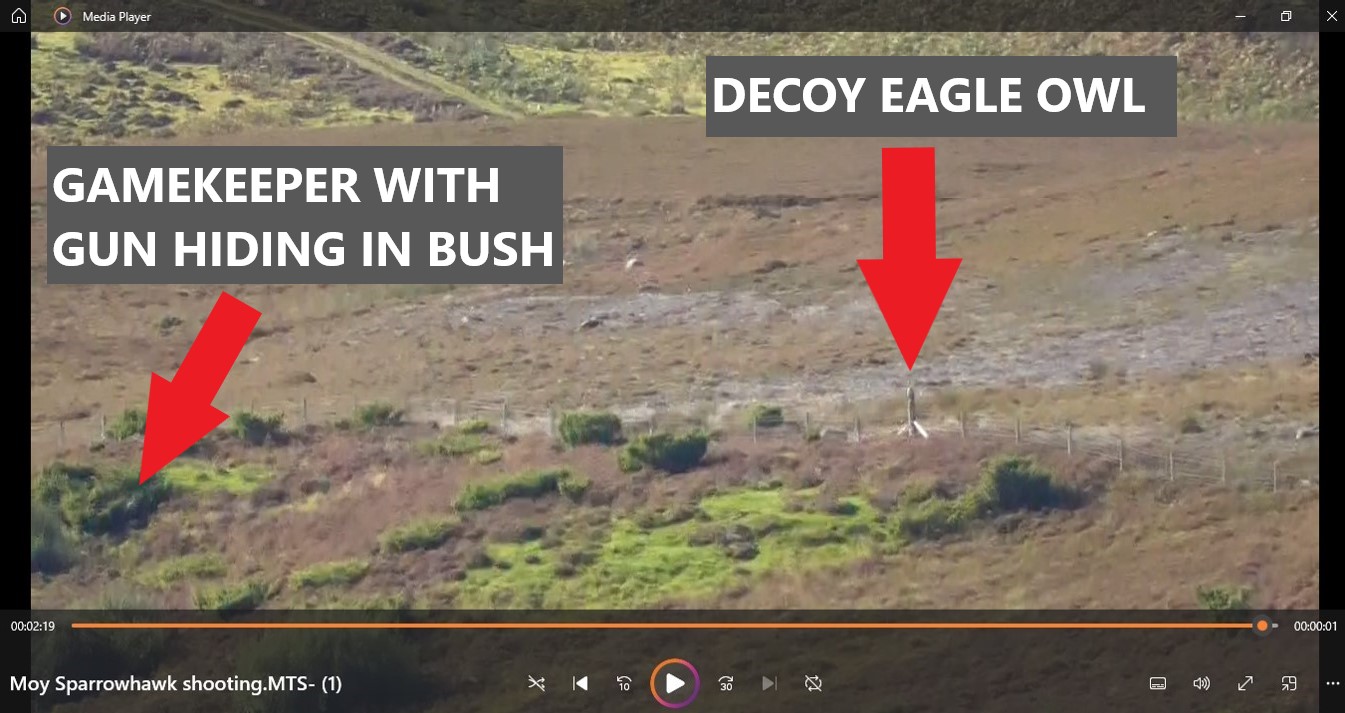
Parker was filmed by an RSPB Investigator as the (at the time 22-year-old) gamekeeper hid in a bush on the grouse moor, a few feet away from a large plastic owl that had been placed on a fencepost. It’s well-known that raptors will be drawn to an owl decoy and will try to mob / attack it. If someone sits quietly nearby with a gun they’ll have a good chance at shooting and killing the raptor whilst it’s distracted by the owl.
We’ve seen this technique deployed on grouse moors many times before, sometimes with plastic decoys, sometimes with live eagle owls (e.g. see here, here, here, here, here, here).
It looks like that’s what happened that September day in 2021. Here’s a screen grab from the RSPB’s video showing the position of Parker and the decoy owl:
If you haven’t yet seen the full video, there’s a copy of it embedded in this tweet below. I’d encourage you to watch it, and take note of Parker’s body language when he goes over to the sparrowhawk he’s just shot, as it’s flapping around, wounded, on the ground. He’s calm and proficient as he stamps his foot/knee on the bird to crush it, before casually picking it up and retuning to his hiding place in the bush. It appears to be quite routine and he does not look at all disturbed at having just committed a serious wildlife crime.
This video, provided by the RSPB, has led to a Scottish gamekeeper pleading guilty to shooting a protected bird of prey 🦅👇 pic.twitter.com/bHC8W5DYyg
In court, Parker was defended by Mark Moir KC. The KC stands for King’s Counsel and denotes an experienced, high-ranking lawyer considered to be of exceptional ability. I wonder who paid for his services? In mitigation for Parker’s offending, Mr Moir KC reportedly told Sheriff Sara Matheson that his client had been in his job since he left school.
“He is deeply shameful of what he has done. He has brought the estate into disrepute and has now resigned.
“His firearms certificate is likely to be revoked as a result of this conviction. He should have been shooting pigeons and crows that day. Feral pigeons are a problem on the estate.
“However, the sparrowhawk flew over and there was a rush of blood. He says it was a stupid thing to do.”
After watching the video, it didn’t look like ‘a rush of blood‘ to me. It looked entirely premeditated.
Apparently the RSPB video wasn’t shown in open court but I’m not sure whether Sheriff Matheson had an opportunity to see it behind closed doors. I suspect she didn’t, given the sentence she handed down to Parker – a pathetic £1,575 fine and three months in which to pay it.
This should have been a test case of the new Animals & Wildlife (Penalties, Protections & Powers) (Scotland) Act 2020; legislation that was introduced to increase the penalties available for certain wildlife crimes, including those under Section 1(1)(a) of the Wildlife & Countryside Act – ‘Intentionally, or recklessly, killing, injuring, or taking a wild bird‘. Parker committed his offence after the enactment of this new legislation.
Prior to the new legislation, the maximum penalty available for the type of offence Parker committed was up to six months imprisonment and/or a fine of up to £5,000.
The new legislation increased the maximum penalty available (on summary conviction, as in Parker’s case) to a maximum of 12 months imprisonment and/or a fine of up to £40,000.
So why was Rory Parker only given a £1,575 fine??*
The penalty increases in the new Act were introduced by the Scottish Government because the previous penalties were not considered sufficient to recognise the seriousness of wildlife crime(s) [and animal cruelty offences].
This view was supported by an independent review by Professor Poustie, published in 2015, which concluded that the then maximum penalties available to the courts may not have been serving as a sufficient deterrent to would-be offenders, nor reflecting the seriousness of the crime(s).
The Poustie Review was first commissioned in 2013 by then Environment Minister Paul Wheelhouse, and as part of a series of measures aimed at tackling the continued persecution of birds of prey (see here). It was his response to growing levels of public concern and a lack of confidence in the judiciary to deal with raptor-killing criminals. Criticisms of the system had often centred around perceived corruption, vested-interests and biased Sheriffs, and we had come to expect unduly lenient and inconsistent sentencing in most cases (e.g. see here).
The new legislation was supposed to address those concerns with a significant increase in the severity of penalties available for courts to hand down to offenders.
I don’t see any evidence of that in the sentencing of raptor-killing gamekeeper Rory Parker.
*UPDATE: Someone who was in court on Friday has just been in touch to provide further insight into sentencing. They told me:
‘When the defence KC was summing up he repeatedly suggested to the sheriff what penalty might be most appropriate, i.e. a fine and maybe a community payback order. He also told her Mr Parker had savings of £2,000. It was therefore no surprise at all she then issued a £1,800 fine (discounted to £1,500 because he wasn’t considered an adult when he committed the crime. Since when is a 22 year old not an adult?!!!) In my opinion, therefore, the Sheriff was basically spoon-fed the sentence by the KC‘.
Further to today’s news that gamekeeper Rory Parker (24) has pleaded guilty to shooting a sparrowhawk on Moy Estate in September 2021 (see here), it’s worth examining the narrative that’s being pumped out by the grouse-shooting industry representatives in a desperate attempt to distance the industry from yet another raptor persecution crime.
This conviction couldn’t have come at a worse time for the industry, as the Wildlife Management & Muirburn (Scotland) Bill begins its passage through the Scottish Parliament. Obviously, the industry won’t like the media attention of yet another raptor persecution crime being committed on a grouse-shooting estate so they’ll want to manipulate the media narrative to influence/minimise the scope of the forthcoming grouse shoot licensing scheme.
And so it begins.
It actually began this morning prior to the court hearing. I received a message from an individual within the industry (I won’t name him, he’s generally one of the good guys and I value his willingness to converse). He told me that, ‘in the spirit of accuracy and transparency’, that the shooting of this raptor hadn’t taken place on a grouse moor (as I’d previously reported) but that it was in fact in an area managed for pheasant and partridge. I told him that wasn’t my understanding but that I’d be happy to clarify this detail once the evidence had been heard in court. He told me this particular issue would be clarified during today’s hearing.
As it turns out, it wasn’t really clarified in court. But the RSPB has since published its video footage of the shooting (see link at foot of the RSPB press release, here) and it looks very much like a grouse moor to me.
Here’s a screengrab I took from the RSPB video, where incidentally I’ve highlighted the position of the gamekeeper, close to a large plastic decoy eagle owl that had been placed on a fencepost, presumably to try and draw in raptors to shoot at close quarters – we’ve seen gamekeepers using this technique many times before (e.g. see here, here, here, here, here, here).
The location of the shooting was given in court as a hill called Tom na Slaite. Here it is on an OS map – complete with a track leading up to some grouse butts:
Now, it’s quite possible that pheasants and partridge have been released on this part of the grouse-shooting estate – it’s becoming a common theme to release these birds for shooting on grouse moors (e.g. see here), either to supplement the grouse shooting days or, in some circumstances, to replace the grouse-shoot days when grouse stocks are too low to attract paying guests. It’s one of the significant faults in the proposed grouse shoot licensing Bill, in my opinion, but that’s a bigger discussion for another day.
The bottom line is that this gamekeeper, Rory Parker, shot this sparrowhawk on an upland grouse moor, not on a lowland game shoot as the industry would have us believe.
The narrative continues with a quote for the media from Moy Estate’s unnamed shooting tenant (I’ll return to the identity of the tenant/sporting agent in a future blog). His statement, quoted in the Scottish Daily Mirror, includes this line:
“As the sporting tenant on this area of land, which is used for pheasant and partridge shoots, we were shocked when made aware of the incident….blah blah”.
It appears to be casual, but that phrase “….which is used for pheasant and partridge shoots…” is carefully and deliberately placed, in my opinion.
As is the phrase quoted in the same article given by Dee Ward from landowners’ lobby group Scottish Land & Estates (SLE), whose statement includes the line:
“In this case, the illegal persecution of a sparrowhawk near pheasant and partridge release pens is particularly disappointing….”
It’s slick PR, designed to be consumed by an unassuming, uninformed audience who wouldn’t otherwise link the crime to grouse moor management.
It’s nothing new. We saw it in 2021 when a poisoned golden eagle was found dead, next to a poisoned bait, on a grouse moor on Invercauld Estate in the Cairngorms National Park. Estate Manager Angus McNicol was quoted in the press, claiming:
“The area where the bird was found is on a let farm in an area which is managed for sheep farming and is on the edge of an area of native woodland regeneration. It is not managed for driven grouse shooting” (see here).
This claim was swiftly rebutted by Ian Thomson, Head of RSPB Investigations in Scotland (who was directly involved in the investigation) who said:
“For the avoidance of doubt, the eagle was found poisoned next to a mountain hare bait, in an area of strip muirburn within 200m of a line of grouse butts and a landrover track” (see here).
The most blatant example of damage limitation by the grouse shooting industry I’ve seen was when SLE issued a statement in response to the appalling crimes committed by gamekeeper Alan Wilson on the Longformacus Estate a few years ago.
In that statement, SLE described the Longformacus Estate as being ‘managed for low ground pheasant shooting‘ (see here). It may well have been, but strangely, they forgot to mention that the crime scene (Henlaw Wood) also just happened to be at the foot of a driven grouse moor! This omission was probably just an innocent, forgetful moment, and nothing whatsoever to do with the fact that the Werritty Review on grouse moor management was imminent.
I’ll write more about today’s conviction of the Moy Estate gamekeeper in another blog, shortly.
UPDATE 1st April 2023: The sentencing of raptor-killing Moy Estate gamekeeper Rory Parker (here)
UPDATE 4th April 2023: Game-shooting industry’s response to the conviction of Moy Estate gamekeeper Rory Parker (here)
Not for the first time, a gamekeeper has been convicted for raptor persecution crime on Moy Estate, a notorious grouse- shooting estate in Scotland.
The RSPB has issued the following press statement:
GAMEKEEPER PLEADS GUILTY TO SHOOTING SPARROWHAWK ON SCOTTISH GROUSE MOOR
Gamekeeper caught by footage taken by RSPB Scotland Investigations team
Fined £1500
The conservation charity is calling for urgent implementation of the Wildlife Management and Muirburn Billwhich will bring in grouse moor licensing, aimed at stopping crimes against birds of prey
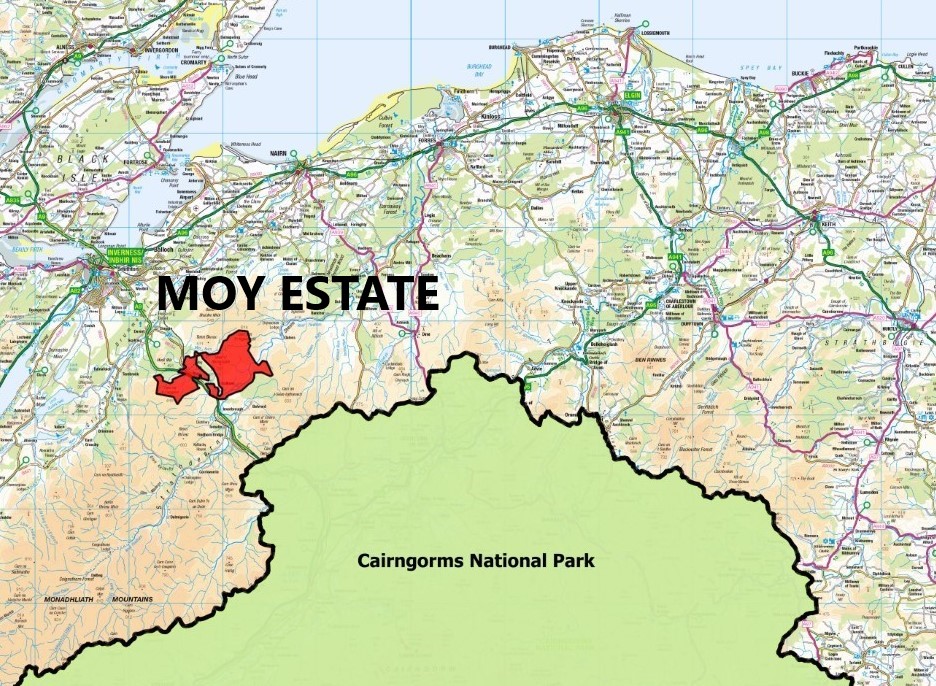
At Inverness Sheriff’s Court today (31 March 2023), Rory Parker (24), pleaded guilty to shooting a Sparrowhawk whilst employed as a gamekeeper on the Moy Estate, Inverness.
He is the 56th gamekeeper to be convicted of raptor persecution offences in Scotland since 1990.
The conviction was secured after the incident was directly filmed by RSPB Scotland Investigations staff on 16 September 2021. Footage shows the bird circling overhead, before a gun is raised by the defendant and then the bird is shot out of the sky, before finally being collected by the gamekeeper. A plastic ‘decoy’ owl can be seen close to the gamekeepers position and is most likely being used as a lure to attract live birds of prey to be shot.
RPUK map of Moy Estate, boundaries provided by Andy Wightman’s Who Owns Scotland website
A search led by Police Scotland of the suspects address and land on the Moy Estate took place on 19 September 2021 when he was arrested and interviewed.
All birds of prey are protected under the Wildlife and Countryside Act 1981 and killing them is against the law, punishable by an unlimited fine and/or jail.
Ian Thomson, Head of Investigations for RSPB Scotland, said: “This conviction was the end result of exemplary partnership working between Police Scotland, RSPB Scotland, the Wildlife DNA Forensics team at Science and Advice for Scottish Agriculture and the Wildlife & Environmental Crime Unit of COPFS.
“It is clear, however, with the shooting of a red kite on another Highland grouse moor earlier this week [Ed: see here], and ongoing investigations into incidents on other estates, that current sanctions appear to be no deterrent to criminal activity by employees of the grouse shooting industry, with their onslaught against protected birds of prey continuing unabated”.
Ian added: “We hope that the Scottish Parliament expedites the passage of laws in the Wildlife Management and Muirburn Bill introducing proper regulation of that industry, where the right to shoot grouse is dependent on operating within the law”.
Nationally, the RSPB’s recently published Birdcrime report for 2021 found that over two-thirds of confirmed raptor persecution incidents were in relation to land managed for gamebird shooting.
ENDS
There’s a lot to say about this conviction, and this estate, and it will probably take several blogs to get through it all.
For those who don’t know, Moy Estate is already serving a three-year general licence restriction (June 2022-2025) after Police Scotland provided the licensing authority (NatureScot) with evidence of wildlife crime against birds of prey on the estate, notably the discovery of a poisoned red kite in 2020 and ‘incidents in relation to trapping offences’. I wrote a blog about it at the time (see here) which also includes details of the long and sorry history of raptor persecution uncovered on this estate over the last decade.
And they’re still at it.
More on today’s conviction shortly.
UPDATE 31st March 2023: Moy gamekeeper convicted – cue damage limitation exercise by grouse shooting industry (here)
UPDATE 1st April 2023: The sentencing of raptor-killing Moy Estate gamekeeper Rory Parker (here)
UPDATE 4th April 2023: Game-shooting industry’s response to the conviction of Moy Estate gamekeeper Rory Parker (here)
The prosecution of a Scottish gamekeeper accused of the alleged killing of a sparrowhawk will resume in court tomorrow.
The un-named 22-year-old gamekeeper was charged in September 2021 (see here) for the alleged killing on a grouse moor in Inverness-shire and he was due in court on 30th September 2022.
The case was adjourned until 10th November 2022 (see here).
The case was adjourned again until January 2023 (see here).
The case was adjourned again until 31 March 2023 (see here).
As this is a live case no comments will be accepted on this blog post until criminal proceedings have ended. Thanks for your understanding.
UPDATE 31st March 2023: Gamekeeper convicted of raptor persecution on Moy – a notorious Scottish grouse-shooting estate (here)
Earlier this year, criminal gamekeeper Paul Allen was sentenced for multiple wildlife, poisons and firearms offences committed on the Shaftesbury Estate in Dorset in 2021 (see here).
He first came to the attention of the police after a member of the public discovered a dead red kite on the estate in November 2020. Tests revealed it contained the poison Bendiocarb and this triggered a multi-agency raid in March 2021 led by Dorset Police’s (now former) wildlife crime officer Claire Dinsdale.
The poisoned red kite found on the Shaftesbury Estate by Dorset resident Johanna Dollerson
Officers found the corpses of six dead buzzards by a pen behind the gamekeeper’s house (tests later showed they had all been shot, including one that was was estimated to have been shot in the last 24hrs). Officers also found the remains (bones) of at least three more buzzards on a bonfire.
A loaded shotgun was found propped up behind a kitchen door (!) and 55 rounds of ammunition were found in a shed. Both the gun and the ammunition should have been inside a locked, specifically-designed gun cabinet, by law. The gun and the ammunition were not covered by Allen’s firearms certificate.
Officers also found a number of dangerous, and banned, chemicals, including two bottles of Strychnine, two containers of Cymag and a packet of Ficam W (Bendiocarb) in various locations, including in a vehicle used by Allen.
Some of you may also recall that Allen was initially charged with killing the red kite, but court records showed that this charge, along with two others, was subsequently dropped minutes before the hearing (see here), probably as some kind of bargaining agreement between the lawyers.
Allen was sentenced in February 2023 and escaped a custodial sentence due to his personal circumstances (see here).
If you recall, the Shaftesbury Estate was also where a young satellite-tagged poisoned white-tailed eagle was found dead, a year later, in January 2022. Tests revealed the eagle’s liver contained seven times the lethal dose of the rodenticide Brodifacoum but Dorset Police refused to conduct a search of the estate, despite already running an investigation into gamekeeper Paul Allen’s crimes on the same estate(!), and they still haven’t provided a credible explanation for that appalling decision (see here).
Now new details have emerged about what was found during the investigation into gamekeeper Allen, thanks to Guy Shorrock, a member of the PAW Forensics Working Group and a former Senior Investigator at RSPB. Guy has written a guest blog for Wild Justice to demonstrate how the Raptor Forensics Fund, initiated by Wild Justice in 2020, has been used to help bring a number of criminal gamekeepers to court.
In that guest blog, Guy discusses the forensic testing undertaken on a ‘cut open’ dead rat that had been found next to the red kite’s corpse. Tests revealed it, too, contained the poison Bendiocarb – in other words, it had been placed as a poisoned bait. Forensic testing also confirmed that the kite had consumed part of a brown rat. You don’t have to be Poirot to piece it all together but even though Allen’s vehicle contained multiple pots of Bendiocarb, this still isn’t sufficient evidence to demonstrate without reasonable doubt that he was responsible for placing the poisoned bait that killed that red kite. This is a very good example of just how high the criminal burden of proof is and why so many prosecutions against gamekeepers have failed.
What has also been revealed is that in addition to being poisoned by Bendiocarb, that red kite also contained NINE times the lethal level of the rodenticide Brodifacoum in its system!! Sound familiar? The dead white-tailed eagle, found on the same estate a year later, contained seven times the lethal dose. To me, this makes Dorset Police’s decision not to search the Shaftesbury Estate even more non-sensical than previously thought.
Wild Justice has asked its legal team to examine Dorset Police’s botched handling of the poisoned white-tailed eagle case and expects to have more news on that in due course.
Meanwhile, I’d really encourage you to read Guy’s guest blog on Wild Justice’s website (here), published this morning, for a fascinating insight into the pain-staking forensic work that goes in to prosecuting those who continue to kill raptors.
The Raptor Forensics Fund, initiated by Wild Justice and supported by donations from the Northern England Raptor Forum, Tayside & Fife Raptor Study Group, Devon Birds, and a number of generous individuals who wish to remain anonymous, is now running low (because it’s been used so often!). Wild Justice intends to top up the fund shortly. If you’d like to donate to Wild Justice’s work, please click here. Thank you.








 Raptor Persecution UK