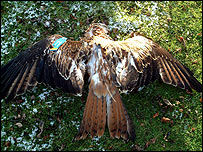
poisoned buzzard and red kite found, cromdale, strathspey.

Two birds of prey found dead on a shooting estate were killed by poison, according to the Royal Society for the Protection of Birds.

The RSPB says tests on a rare red kite and a buzzard revealed that they were killed illegally by the pesticide carbofuran.

The red kite had been tagged as a chick and was being tracked.

It was found in remote woodland near Cromdale in Strathspey by RSPB staff. They say no charges will be brought.

Carbofuran is a powerful insecticide which was once used to protect crops and is dangerous to any living creature. It is now totally illegal to use or store carbofuran in the UK .

Gamekeeper convicted for dead peregrine on Glenfiddich and Cabrach Estate

According to a report in the Scotland on Sunday newspaper, raids on the Glenfiddich & Cabrach Estate in NE Scotland in February and March 1998 revealed widespread poisoning across the 41,500-acre estate owned by London property tycoon, Christopher Moran. Ten rabbits, six pigeons, six grouse and two hares were reportedly laced with the lethal pesticide Carbofuran and left out on the hill. Three illegal pole traps and an owl whose legs had been smashed by a trap were also reportedly found, along with a dead peregrine inside an estate landrover. Tests revealed the peregrine had been poisoned with carbofuran.

The head gamekeeper was convicted at Elgin Sheriff Court in October 1998 and fined £700.

The estate is owned by multi-millionaire Christopher Moran, a businessman with an interesting past: see here and here.

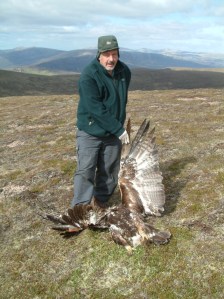
8 buzzards & 1 red kite dead on Corrybrough Estate, Tomatin

8 buzzards and 1 red kite were found dead on the Corrybrough Estate, Tomatin, near Inverness in March 1998. One buzzard was found in a spring trap with its legs chewed up. Many of the dead birds were found on a rubbish dump and later tests showed they had been poisoned with Carbofuran.

http://findarticles.com/p/articles/mi_qn4156/is_19990919/ai_n13941450/

At the time of the discovery, Corrybrough Estate was owned by former English magistrate, John Tinsley. It’s not the first time Tinsley has been in trouble with the police: http://www.heraldscotland.com/sport/spl/aberdeen/english-landowner-cleared-over-struggle-with-police-officers-at-his-highland-estate-laird-feared-kidnap-bid-1.349215

The Corrybrough Estate was sold in 2009. Let’s hope the new owner is a law-abiding one.

Gamekeeper receives pitiful fine for poisoning offences on Fairnington Estate, Kelso

In August 2003, dead pheasant poults covered in blue granules were found on the Fairnington Estate, Kelso (owned by Mr Nigel Salvesen), close to a pen used to rear pheasants for shooting. Later tests showed the blue granules contained the banned pesticide, Carbofuran. Further searches revealed more carbofuran in a vehicle and in an unsecured shed, as well as alphachloralose and strychnine. The gamekeeper was charged with 48 offences under the Wildlife & Countryside Act 1981, the Food and Environment Protection Act 1985 (FEPA), and the Firearms Act.

At Jedburgh Sheriff Court in June 2005, after plea-bargaining, the keeper admitted just 4 offences under FEPA and the Firearms Act. His pitiful fine was £190, after reference was made to his poor health and that it was his first known offence.

http://campaignwithus.rspb.org.uk/Images/legaleagle46_tcm9-132969.pdf

2 peregrines poisoned at Findochty, Morayshire

Dead peregrine

Two dead peregrines were found in June 2003, lying together below cliffs on a beach in an area known locally as the Three Moothed Caves in Findochty, Morayshire. Forensic testing showed that both had been poisoned with Carbofuran, and police believe the birds had been thrown off the top of the cliffs and dumped, as there wasn’t a known peregrine nest at the site.

http://news.bbc.co.uk/1/hi/scotland/2977512.stm

Peregrine poisoned at Strathaven, South Lanarkshire

A peregrine falcon found dead close to its nest in Strathaven, South Lanarkshire in July 2003 had been poisoned with Carbofuran. The male adult was part of a breeding pair. His female mate has not been since and their eggs ‘disappeared’ from the nest.

Peregrines face persecution from several sources. They are targeted by gamekeepers, especially on grouse moors, and also by egg collectors, falconers and pigeon fanciers.

http://www.timesonline.co.uk/tol/news/uk/article1148376.ece

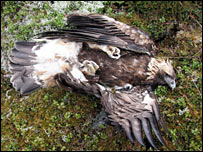
golden eagle found poisoned on glenfeshie estate, Cairngorms

RSPB investigator with the poisoned golden eagle on Glenfeshie Estate.

A golden eagle was found dead on the Glenfeshie Estate, Cairngorms, in June 2006. It was the second golden eagle found this year, after the eagle found poisoned a few months earlier on the Dinnet & Kinnord Estate in nearby Ballater. Both birds had ingested the illegal pesticide Carbofuran.

The RSPB put up a reward for information leading to the conviction of the people responsible for both eagle deaths. No arrests have been made.

http://www.wildlifeextra.com/go/news/news-eaglereward.html#cr

At the time, local raptor workers thought that this eagle had been ‘dumped’ on the Glenfeshie Estate in retaliation for the Estate’s plans to reduce red deer numbers. In recent years, the Glenfeshie Estate has been closely involved with golden eagle conservation projects, in association with Roy Dennis and his eagle satellite-tagging efforts – which makes the theory about the Estate being ‘set up’ in 2006 quite plausible. It is clear that Glen Feshie actively supports golden eagle conservation.

golden eagle found poisoned on Dinnet & Kinnord Estate, Ballater, Aberdeenshire

The poisoned eagle found on the Dinnet Estate

A golden eagle found dead by a hillwalker in June 2006 had been poisoned with Carbofuran. The bird was found on the Dinnet & Kinord Estate near Ballater, Aberdeenshire. No arrests have been made. http://news.bbc.co.uk/1/hi/scotland/north_east/5086162.stm

The eagle, in adult plumage, was likely to have been part of a breeding pair. The region holds approximately 18 pairs of breeding golden eagles, although if persecution wasn’t so high here, there is suitable habitat to support at least twice that number.

Poisoned golden eagle found on isle of lewis

During July 2005 a dead golden eagle was discovered by a hillwalker on top of a hill in Morsgail on the Isle of Lewis.

The poisoned eagle at Morsgail, Isle of Lewis

Analysis showed that it had been poisoned with the banned pesticide carbofuran. Carbofuran is one of eight compounds listed on the Possession of Pesticides (Scotland) Order 2005. Anyone in possession of these poisons commits an offence under section 15 of the Wildlife and Countryside Act.

Staff from Scottish Executive Environment and Rural Affairs Department (SEERAD), and Northern Constabulary police officers conducted searches on four premises on the island. No arrests have been made but enquiries are continuing.

http://www.rspb.org.uk/Images/legaleagle48_tcm9-132971.pdf

Gamekeeper guilty of poisoning at Blythe Farm, nr lauder, Scottish Borders

In August 2006, a police raid on Blythe Farm, near Lauder in the Scottish Borders, led to the discovery of pheasant baits laced with poison (carbofuran) as well as several illegal cage traps baited with live pigeons to lure in birds of prey.

In April 2007, gamekeeper George “Doddie” Aitken was found guilty at Selkirk Sheriff Court. Sheriff Kevin Drummond sentenced him to 220 hours community service. A gamekeeper for 20 years, Aitken, who had turned up to court wearing a black balaclava, was allowed to keep his job. http://news.bbc.co.uk/1/hi/scotland/south_of_scotland/6719505.stm

In January 2008, the owner of Blythe Farm, James McDougal, became the first landowner to be punished for the crimes committed by his gamekeeper. His agricultural subsidies were cut by £7,919 for his failure to protect wildlife. http://www.guardian.co.uk/uk/2008/jan/07/ruralaffairs.scotland