 This is the second blog in the series focusing on presentations made at the recent police wildlife crime conference in Scotland. This time we look at what the new head of the National Wildlife Crime Unit, Nevin Hunter, had to say. (For background info on Nevin, see here).
Nevin Hunter, NWCU
“Ok, you know we’ve got UK priorities, erm, you’ve heard mention already of the national intelligence model and the way in which we try and work and deal with wildlife crime and I’m not going to focus on that too much, I’m going to focus on some other aspects. Erm, you know, everything we’re about now is about harm reduction really in terms of, of, wildlife crime, erm, you know, we’re looking at national crime threats and four distinct areas of work because many of you will be aware of this in terms of its enforcement but as I’ve gone around speaking to a number of people from, erm, a number of different partner organisations over the last few weeks I’ve been trying to stress something really and that, that actually a lot of the prevention, intelligence and enforcement has been having a fourth element to it that, and that’s all around reassurance because if we want to get people to engage with us and support us in the fight against wildlife crime we’ve got to think about that as a virtuous circle if we can, if we can, er, have effective prevention, we get good intelligence, we get effective enforcement, that is going to build reassurance amongst those people who are supporting us, erm, that will then lead in itself to more preventative actions, intelligence, enforcement and that’s what I talk about in terms of virtuous circle, so it’s really important that we continue to build upon that.
Erm, I put this slide up just for one reason alone. We are the UK National Wildlife Crime Unit and, er, it’s really important that everybody understands we’ve got the UK perspective, you know, we’ve shown over the last few years, erm, things like Operation RAMP that we really can deliver at an international level, erm, some of you know me well, in the last three and a half years I’ve spent seconded to, to Animal Health, erm, dealing with CITES endangered species issues, erm, and bird registration issues and have been, you know, I wrote the UK operation order for Operation RAMP that a number of you in the audience will have been involved with, er, albeit that I was working then with the civil service, erm, dealing with, with those types of issues. Erm, but we can do this work, what we’ve got to remember though, erm, you know, we’ve shown we can operate at an international level, er, we can provide operational support, erm, and I’ve got mutual administrative systems and regional mutual assistance treaty, right, we can, we can do that type of work, we’ve shown we can do that and we’ve really built on that and we’ll continue to do so but I look at it a lot of the work we do that at an international level is core business to us now and we know how to deal with that, we, you know, CITES is a priority we can deal with that sort of work but I’m very conscious coming in to this role with the UK National Wildlife Crime Unit it’s really important to me that we start delivering and really thinking about the priorities that we’ve got in the UK.
 Erm, now you can’t, you can’t actually get a picture of a black hole but one of the issues that people regularly, sort of regularly flag to me up that, er, the last several weeks the feeling at times that, that the National Wildlife Crime Unit can be seen as a bit of a black hole in that lots of things come in to us but you guys and girls out there are dealing with things operationally on the ground what you see come out from us. Now that doesn’t mean that we’re not working hard, you know, I, I know how hard the people in the unit worked, I worked really closely with Brian and the team over the last few years, erm, they all work incredibly hard, erm, dealing with a number of priority areas but I’m very conscious that your perception of us out there may not be as good as it could be in terms of where we’re delivering at a UK level. We really do deliver at an international level, that’s quite clear. Erm, and I want to look at, focus about, erm, perhaps things that we ought to be looking at, now these are my perceptions and some of them are my views so please, erm, I hope I’m not going to insult anybody but I think you need to think about these things.
Erm, I think there needs to be a re-focus on the UK wildlife crime priorities, are all of these relevant, erm, are they things that we can deliver on? Erm, we need to perhaps consider and review how we deliver the processes, can we define these better for wildlife crime, erm, those of you who see it and most of you certainly from a policing point of view will get copied in to the strategic and tactical assessments that we make, they are, they’re very long documents and when I’ve gone around speaking to people the vast majority of people have said we don’t read all of them, we read the little bits that are of interest to us, but there’s a huge amount of time spent in the unit putting those documents together. Now, concerns are raised about how relevant they are in terms of how timely they are, er, because we’re trying to process a mass of information, get that into those types of documents, erm, and we are doing it, that, in the best way we can, is it the fact that we’ve got a large number of priorities, the fact we’re being asked to produce very large documents actually as effective are we being as effective as we can be with that?
Erm, I see that role for the head of the unit going ahead now is going to be to drive action by the priority delivery groups, er, and when I talk about that I’m talking about outcomes, erm, I went to a meeting recently with Mr Crompton and Brian Stuart, erm, and Mr Benyon the UK Minister and I know that ministers, you know, across the UK are looking at the whole issues, it’s about outcomes now, we’ve got to be outcome-driven so we’ve got to be looking at how we deliver, we’ve got wildlife crime priorities in the UK and I’ll be making sure we deliver those, er, and I see it as a role for me in the future with my team to help drive through those UK priorities.
Erm, in terms of operation ways, erm, way ahead, erm, I think we need to make sure that we make the priorities relevant to you. We’ve got to be looking at effective disruption of criminality, yeah? If we’re going to use the national intelligence model to its best effect we need to get it in there and disrupting criminality, yeah? It needs to be and there’s a role for me and my team in that. We need to make it relevant to you, erm, so I see now that there should be a role of operational support from the head of unit, erm, you know, when we get large complex investigations, erm, from a policing point of view we’re going to look at silver command type structure, bronze, silver, gold command as you’ll be aware of from a policing point of view, you know, we’ve got to be thinking then about what roles, erm, what roles somebody like a silver commander, a lot of silver commanders are going to be involved, erm, perhaps we’re looking at inspectors, chief inspectors, superintendents probably going to be involved with some of these complex cases with no understanding of wildlife crime. You may have gone and made a business case to them to get the job and to run it, erm, but is there a role for somebody like me to come and provide the tactical advisor bit for an operational silver commander to make sure they’re able to make the best decisions and I don’t think we’ve played that role in the past, erm, but with my sort of background now I bring that into the, into the equation to be able to support and when we may get complex operations, erm, and I think that that’s a way in which we can connect with you.
I think we need to be looking as well at, erm, if we look, if there’s a perception that we might be a bit of a black hole, yeah? You want to see stuff, and this is what people are telling me, you want to see stuff coming out of the unit, er, I know Colin and others within the unit have discussed over the last year or two about whether we could look at something like a weekly dissemination to yourselves. Erm, the national domestic extremism unit produces a weekly update of all extremism issues around the UK, erm, going out to all forces across the UK giving updates of the major issues. Perhaps we need to be looking at that, erm, if you’ve got ideas on that or things you’d like to see us bring in to that type of document please let us know. Now we may have to look at it in terms of integrity within the unit in terms of our staffing because we are challenged at the moment but we want to move towards something where not only are you putting information and intelligence into us, you know we welcome intelligence all the time, but we want to be putting stuff out to you because we need, we need that virtuous circle again, we need you to be linked in to what we’re doing and to see you actually getting stuff coming out of us.
Erm, I think we can look as well at, to consider platforms, erm, such as the police on-line knowledge area, now that’s hosted at the moment by the national police improvement agency, erm, and under something called POKA, that’s as I say the police on-line knowledge area, er, it’s effectively a secure messaging, er, system, message boarding system. Now I’ve been talking about this via email and discussion the last few weeks and that’s an opportunity perhaps if we could put, develop wildlife communities, er, coordinate that according to in terms of the police communities where we can then start to share, er, information, knowledge, understanding, er, will we get any of the sort of developments that the, er, sheriff was talking about earlier on, can we feed things into there, feed peoples experiences so that you’ve got an opportunity to look at things that may be going on across the, er, Scotland and the wider UK, er, where we can learn from because we need to take these opportunities.
Ok, just to finish off, enforcement challenges, erm, I think key for what we do in the future has got to be about support the majority of people to undertake lawful activities, that’s key about what we do. Erm, targeting the minority of those who undermine, er, and, and who operate at local, national and serious and organised levels, you know, we’ve got, we’ve got to look at that and, and I flagged that up and I’ll give you two examples of why I think it’s, ok, we’ve got to mean business and I’m flagging two issues here, poaching, ok? It’s really important that we harness the energy of people like gamekeepers, factors, landowners and others to tackle across Scotland, er, and the rest of the UK with a, with something like potentially a national operation. That’s one of the things that, er, in the last few weeks I’ve been speaking to, er, Scottish Land Estates and, er, National Gamekeepers down in, down in the south of the border now, you know, is there potential for things like operations, national operations and we need to harness those energies. Whilst we want people like gamekeepers on side, erm, and there’s also the potential that when looking at raptor persecution that we, you know, anybody who’s allowed to use, uses or allows to be used things like carbofuran and that sort, that’s a photograph on there from a poisoning incident, erm, erm, that I dealt with several years ago down in Devon, similar types of things, somebody’s been squirting carbofuran granular form on to a pheasant poult, putting it out to try and kill buzzards, erm, people have got to understand that there’s potential that if they’re, if they’re doing that then now, you know, there’s a likelihood they’ll go to jail, now the finger gets pointed all the time at gamekeepers so I’m saying on the one hand well let’s work with gamekeepers to potentially push forward things like anti-poaching initiatives, work with them at the same time saying we need help to deal with the persecution of raptors, erm, so we’ve got to, got to get people on our side, erm, and that I see as something that I’ve got a big part to play in trying to drive things forward and show that we’re tackling the UK priorities.”
[Jesus Christ. Somebody needs to get these NWCU people on to a public speaking training course. Although in all fairness to Nevin, it looks as though he wasn’t properly briefed about his audience. Even so, get rid of the jargon, get rid of the bureaucracy and simplify your message. E.g. “Hello everyone, I think NWCU has a good track record at an international level but I recognise that we’ve been a bit shit at a national level and I intend to address that issue. We need your help to accomplish that”. Who cares about which model is used, or whether the commander has a bronze, silver or gold certificate for cycling proficiency? WE DON’T CARE, NEVIN! What we care about is whether you and your team can get results and bring more of those who continue to persecute raptors and other wildlife, to justice. That’s it. A helpful hint: launching a national operation in partnership with gamekeepers is unlikely to improve your unit’s credibility with the raptor workers. Just saying…]

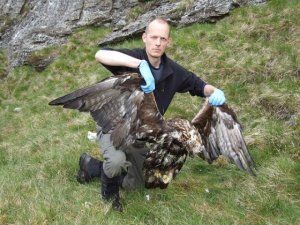 Here we go….
 The 2012 annual police wildlife crime conference took place a couple of weeks ago. Quite a few of this year’s presentations were relevant to raptor persecution so we’ll be commenting on these in due course. To start off the series we’ll focus on what Charlie Everitt had to say. Charlie is the Scottish Investigative Support Officer at the UK National Wildlife Crime Unit (NWCU). See
 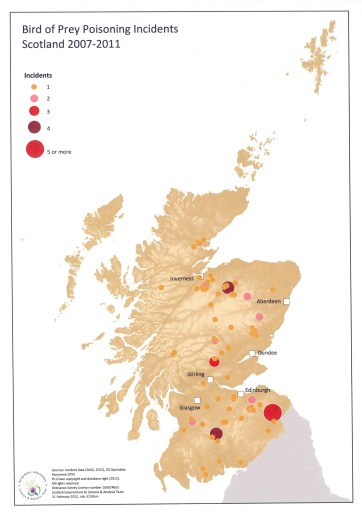 The Scottish Government has today published the 2011 poisoning map (otherwise known as Scotland’s map of shame).
 But let’s suppose, just for a minute, that the latest map IS an accurate representation of all raptor poisoning incidents that took place in 2011. Should we then accept that shooting estates are cleaning up their act and they’ve all suddenly decided, after over 100 years of persecution, that raptors are actually ok and shouldn’t be killed? The only way to measure that will be to look at LONG-TERM TRENDS of poisoning incidents as well as LONG-TERM TRENDS of raptor populations. We’ve blogged about this before (see
  An article in today’s Scotsman has criticised the RSPB’s decision to hold the first-ever Scottish Bird Fair at Hopetoun House near Edinburgh in May.
 In a bid to tackle increasing levels of wildlife crime, Devon & Cornwall Police have teamed up with the RSPB to launch ‘Operation Wilderness’, a new scheme that will see 24 hr nest cameras installed at vulnerable sites across the region.
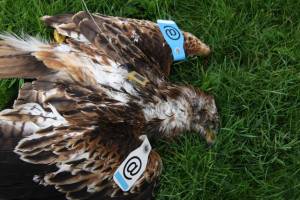 Following the successful release of red kites during the summer in Dublin and Wicklow, it is with disappointment that we report further recent kite deaths in Fingal. Since the release in July, this year, a total of eight (8) kites have now been recovered dead in Fingal since November.
 The substance used to kill the other four kites that have been discovered since November has yet to be confirmed – toxicology tests are on-going. It’s possible they were also unintentionally killed by secondary rat poison, but it’s equally possible that they have been deliberately (and illegally) killed by other poisons. For example, at the beginning of November 2011, it was reported that a red kite and a buzzard had been illegally poisoned in County Wicklow by alphachloralose (see
 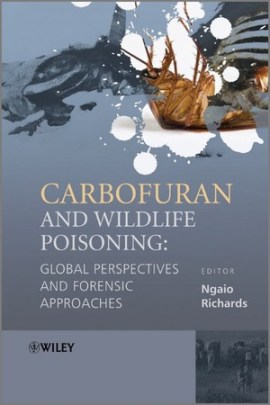 A definitive reference book was published last month that provides a comprehensive guide to the use of the pesticide Carbofuran and its role in wildlife poisoning.
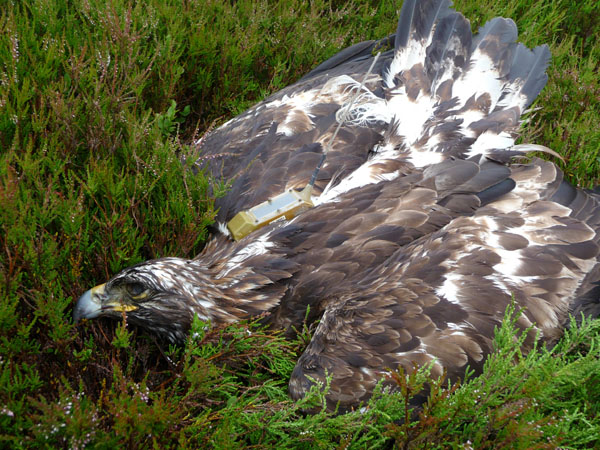 An article in today’s Telegraph reports that Millden Estate, where golden eagle ‘Alma’ was found poisoned in 2009, is no longer up for sale. The estate, owned by investment banker Richard Hanson, was reportedly put on the market earlier this year (see
  Raptor Persecution UK