Political silence in response to missing hen harrier ‘Calluna’

Raptor persecution, and particularly the illegal killing of hen harriers, has been identified as a National Wildlife Crime Priority.

Interesting then, that following last Friday’s news that Police Scotland is investigating the disappearance of another missing hen harrier (‘Calluna‘), who vanished in suspicious circumstances on a grouse moor in the Cairngorms National Park in August, the political response has been total silence.

Roseanna Cunningham MSP, the Environment Cabinet Secretary, said nothing.

Mairi Gougeon MSP, the Hen Harrier Species Champion, said nothing.

Alexander Burnett MSP, in whose constituency Calluna ‘disappeared’, said nothing.

The PAW Scotland website, hosted by the Scottish Government, said nothing.

Alexander Burnett MSP (Conservative), presumably no relation to Bert Burnett of the Scottish Gamekeepers’ Association, has spoken before on the subject of illegal raptor persecution, as well he might, given the high number of reported raptor persecution incidents in his Aberdeenshire West constituency, particularly those recorded on grouse moors areas either within or close to the Cairngorms National Park:

Unfortunately, Alexander doesn’t agree that a licensing scheme for gamebird shooting is required. During the recent deliberations of the Scottish Parliament’s Environment Committee, he said the proposed licensing system was “inappropriate, disproportional and unworkable for the issue of wildlife crime that it seeks to address” and he voted for the licensing petition to be dropped in favour of keeping the status quo.

He also told one of his constituents earlier this summer, in response to a letter about the illegal persecution of hen harriers on grouse moors, that:

Game management on grouse moors can make an important contribution to biodiversity by providing cover for wildlife, and through the creation and care of habitats such as woodland, grouse moors, beetle banks and hedgerows‘.

Hmm, that statement sounds familiar. Where have we heard that before? Ah yes, it was part of a standard response trotted out to constituents by a succession of Westminster Conservative MPs last year in the run up to the Westminster ‘debate’ on driven grouse shooting. As pointed out by Mark Avery at the time:

Grouse shooting does not help create or protect woodland – in fact trees are not welcome on grouse moors. Grouse shooting does not create beetle banks – these are conservation measures in arable fields. Grouse shooting does not protect hedgerows – these are not a feature of grouse moors. Take out those errors and your letter says ‘grouse shooting provides grouse moors’.

Have another look at that raptor persecution map of the Aberdeenshire West constituency. If it is of concern to you, and you are one of Alexander Burnett’s constituents, please consider writing to him and ask him to explain the widespread criminality within his constituency, particularly in areas managed for grouse and pheasant shooting, and ask him how he intends to address your ongoing concerns.

Email: Alexander.Burnett.MSP@parliament.scot

Satellite-tagged hen harrier disappears on grouse moor in Cairngorms National Park

Well that didn’t take long, did it? Just a few weeks after fledging, one of the 2017 cohort of satellite-tagged hen harriers has already ‘disappeared’, with its final signal emitted from a grouse moor on the 12th August, the opening day of the grouse-shooting season.

Hen harrier ‘Calluna‘ (photo RSPB Scotland)

RSPB Scotland press release:

SATELLITE-TAGGED HEN HARRIER DISAPPEARS ON DEESIDE GROUSE MOOR

RSPB Scotland has issued an appeal for information after a young hen harrier, fitted with a satellite tag as part of the charity’s EU-funded Hen Harrier LIFE project, disappeared on an Aberdeenshire grouse moor.

Calluna‘, a female harrier, was tagged this summer at a nest on the National Trust for Scotland’s Mar Lodge estate, near Braemar. Her transmitter’s data was being monitored by RSPB Scotland and showed that the bird fledged from the nest in July. She left the area in early August, with the data showing her gradually heading east over the Deeside moors. However, while the tag data showed it to be working perfectly, transmissions abruptly ended on 12th August, with no further data transmitted. Calluna’s last recorded position was on a grouse moor a few miles north of Ballater, in the Cairngorms National Park.

Hen harriers are one of the UK’s rarest raptors and the 2016 national survey results released earlier this year showed that even in Scotland, the species’ stronghold, these birds are struggling. The number of breeding pairs in Scotland now stands at 460, a fall of 27 per cent since 2004, with illegal killing in areas managed for driven grouse shooting identified as one of the main drivers of this decline.

David Frew, Operations Manager for the National Trust for Scotland at Mar Lodge Estate, said: “It is deeply saddening to learn that Calluna appears to have been lost, so soon after fledging from Mar Lodge Estate. Hen harriers were persecuted on Deeside for a great many years, and we had hoped that the first successful breeding attempt on Mar Lodge Estate in 2016 would signal the start of a recovery for these magnificent birds in the area.

Only one month after fledging, and having travelled only a relatively short distance, it appears that we will no longer be able to follow the progress of our 2017 chick. We hope however that the data her tag has provided will help to inform a wider understanding of the lives and threats faced by hen harriers.”

Ian Thomson, Head of Investigations at RSPB Scotland said: “This bird joins the lengthening list of satellite-tagged birds of prey that have disappeared, in highly suspicious circumstances, almost exclusively in areas in areas intensively managed for grouse shooting. We are pleased that the Cabinet Secretary for the Environment has commissioned an independent group to look at how grouse moors can be managed sustainably and within the law. We look forward to a further announcement shortly on the membership of this group, and we are committed to assist the work of this enquiry in any way that we can.

The LIFE project team has fitted a significant number of tags to young hen harriers this year, with the very welcome help from landowners, including the National Trust for Scotland, who value these magnificent birds breeding on their property. The transmitters used in this project are incredibly reliable and the sudden halt in data being received from it, with no hint of a malfunction, is very concerning. We ask that if anyone has any information about the disappearance of this bird we urge them to contact Police Scotland as quickly as possible”.

ENDS

Here’s a map we’ve created showing the location of the National Trust for Scotland’s Mar Lodge Estate in the Cairngorms National Park, where Calluna hatched, and the town of Ballater, close to where she disappeared.

The RSPB Scotland press release doesn’t name the estate from where Calluna’s last position was recorded, it just says it was “on a grouse moor a few miles north of Ballater, in the Cairngorms National Park“.

Hmm, let’s have a closer look at that. Here’s a map showing the grouse moor area a few miles north of Ballater. According to estate boundary details that we sourced from Andy Wightman’s Who Owns Scotland website, Calluna’s last position could have been recorded on either an Invercauld Estate grouse moor or a Dinnet Estate grouse moor.
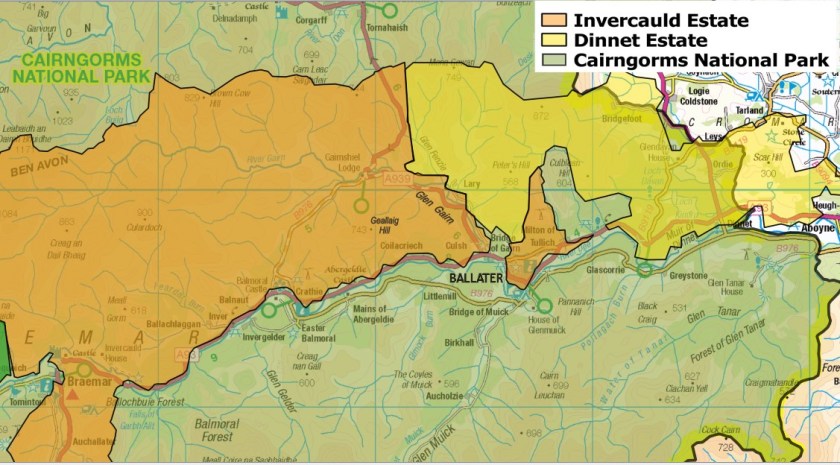
If you’re thinking that this part of the Cairngorms National Park looks familiar, you’d be right, we’ve blogged about it a few times before. There was the discovery of an illegally shot peregrine at the Pass of Ballater in 2011, the reported coordinated hunt and subsequent shooting of an adult hen harrier at Glen Gairn on the border of Invercauld and Dinnet Estates in 2013, and then there were the illegally-set traps that were found nr Geallaig Hill on Invercauld Estate in 2016. This area of Royal Deeside is quite the little raptor persecution hotspot, isn’t it?

The evidence just keeps mounting. Is anyone still wondering why the game-shooting industry is so keen to try and discredit the use of satellite tags on raptors?

We wonder what explanations, to avoid the bleedin’ obvious, they’ll come up with this time? Perhaps they’ll suggest Calluna was sucked in to a vortex created by Hurricane Harvey? Or maybe they’ll say she was hit by a North Korean test missile? They might tell us that Vladimir Putin must have hacked the satellite signals? All just as plausible as the usual tosh they trot out, such as how a fieldworker eating a sandwich at a tagging session causes eagles to die (here), or how non-existent wind farms are responsible for the disappearance of eight sat-tagged golden eagles (here), or how ‘activists’ have been killing sat-tagged raptors as part of a smear campaign against the grouse-shooting industry (here), or how a faulty saltwater switch on tags attached to Olive Ridley turtles on the Indian subcontinent means that all satellite tags are unreliable (here).

We’ll be updating this page throughout the day if and when statements are made by the following:

Response of Environment Secretary Roseanna Cunningham –

Response of Alexander Burnett MSP (Conservative, Aberdeen West) –

Response of Cairngorms National Park Authority – Grant Moir, Chief Exec of CNPA said: “A hen harrier has once again disappeared in the Cairngorms National Park, with a satellite tracker ceasing to transmit. The Park Authority is determined to stop these recurring disappearances. Earlier this week the CNPA met with Police Scotland to discuss how increased use of special constables can help to tackle wildlife crime in the Cairngorms National Park. We also continue to work on other solutions to these issues. The CNPA look forward to the establishment by Scottish Government of the independently-led group to look at the environmental impact of grouse moor management and will feed in to that review“.

Response of Scottish Land & Estates – David Johnstone, chairman of Scottish Land and Estates, said: “Estates in the area have welcomed a number of hen harriers to the area during August and only today one moor reported three harriers. Local land managers reject the inference that the loss of signal from this tag is connected to grouse moor management and are now offering every assistance in searching the area where the last transmission was recorded. They are dismayed that they were not informed earlier that the tag had stopped transmitting nearly three weeks ago, as this would have assisted the search“.

Response of Scottish Wildlife Trust – Susan Davies, director of conservation at the Scottish Wildlife Trust (SWT) said: “It’s extremely disappointing to learn that yet another hen harrier has disappeared over a grouse moor. The most recent surveys show that hen harrier numbers are declining in most parts of Scotland and that illegal persecution is a factor in this decline. Anyone who has information on this bird’s disappearance should contact Police Scotland immediately. 

The Trust has repeatedly called on the Scottish Government to be tougher on wildlife crime and introduce a system of licensing for grouse moor management to encourage sustainable practices. We welcome the recent announcement that a working group will be formed to look at the environmental impact of grouse moors and options for better regulation, and we stand ready to assist this group in any way possible“.

Response of Scottish Gamekeepers’ Association – A spokesman for The Scottish Gamekeepers Association said: “The SGA would urge anyone who saw the bird or knows anything about it to contact Police Scotland. This is the first we have heard of this. Obviously any news like this is very disappointing. The SGA condemns raptor persecution and if any of our members are convicted of a wildlife crime they are removed from our organisation. We have learned from those monitoring tags that birds can move some distance away from where they were last recorded so it is important that, if people know anything, they alert the Police immediately.”

Response of Scottish Moorland Group –

Response of Grampian Moorland Group –

Response of GWCT – Nothing, nada, zilch. But on Twitter they announced the availability of the new GWCT Xmas Cards. That’s nice.

Response of BASC –

Response of Countryside Alliance –

Response of Scottish Association for Country Sports – (from The Times) – Julia Stoddart, head of policy for the SACS, lamented the practice of killing hen harriers to protect grouse. “However, we would remind the RSPB that tag technology can fail for a number of reasons, and that raptors are susceptible to natural causes of death as well as to illegal persecution“, she said.

Other media coverage:

BBC news here

Scotsman here

Press & Journal here

UPDATE 2 September 2017: On cue, Scottish landowners’ rep throws false allegations at RSPB (see here).

UPDATE 4 September 2017: Political silence in response to missing hen harrier Calluna (see here).

UPDATE 5 September 2017: Scottish Land & Estates and their indefensible distortion of the truth (see here).

Scottish Raptor Study Group letter in response to estate licensing scaremongering claims

Earlier this month we blogged about two articles that were published in the Scottish Mail on Sunday about so-called ‘draconian’ proposals to introduce a licensing scheme for game shooting estates (see here).

One piece was just a review of various organisations’ positions and the other one was a fairly lengthy comment piece written by Carrieanne Conaghan, a gamekeeper’s wife and coordinator of the Speyside Moorland Group. Carrieanne claimed that the introduction of estate licensing would ‘penalise‘ law-abiding estates, although she didn’t explain how she thought this would work.

Logan Steele, the estate licensing petitioner (on behalf of the Scottish Raptor Study Group) contacted the Mail on Sunday and asked for the opportunity to provide a comment piece in response, especially as Carrieanne had made a number of unsubstantiated (and inaccurate) claims about his motivation for launching the petition. The Mail on Sunday refused (surprise!) but did say he could write a 150-word letter, an option Logan described in a comment on this blog as “a pretty second rate alternative“.

Nevertheless, Logan did submit a letter and it appeared at the weekend. He says it’s been “butchered” (the published version is only 89 words) and they couldn’t even spell his name correctly. Even so, he makes his points well:

A quick bit of background research has led us to believe that Carrieanne’s husband is employed as a gamekeeper at Glenlochy, near Grantown-on-Spey in the Cairngorms National Park. This estate is no stranger to police investigations into alleged raptor persecution (e.g. see here) although nobody has ever been prosecuted. This history, perhaps well before her husband’s employment, might help explain Carrieanne’s concerns about the introduction of an estate licensing scheme.

Technology challenge launched to solve problem of finding hidden or destroyed satellite tags

The Cairngorms National Park Authority has joined forces with Scottish Natural Heritage to co-sponsor a new CivTech challenge aimed at finding a creative and innovative technology-based solution to the problem of finding ‘disappearing’ satellite tagged raptors.

As you’ll be aware, satellite-tagged raptors are ‘disappearing’ in Scotland and England with increasing frequency. There was a time, in the early years of satellite tagging raptors, that illegally-killed birds would be found as their tags were still emitting signals allowing researchers to pinpoint the location of the corpse and thus evidence of the crime (e.g. poisoned golden eagle Alma whose corpse was found on Millden Estate in the Angus Glens in 2009). However, the raptor-killing criminals got wise to this and in recent years have been making more effort to destroy and hide the tag at the same time as killing the bird.

This lack of hard evidence causes problems for the wildlife crime enforcement agencies because it becomes very hard to prove that the bird has actually been killed. In a small number of cases, the satellite tag could just have malfunctioned, and we have seen evidence of this (e.g. hen harrier Highlander here), although the expected frequency of this happening is very low (the recent golden eagle satellite tag review identified tag reliability, based on studies of the same tags deployed in the US and Europe, as around 98%). Nevertheless, even with the high number of ‘disappearing’ tagged raptors in Scotland but little hard evidence of criminality, researchers have still been able to identify unusual concentrations / spatial clusters of where these birds have ‘disappeared’ in suspicious circumstances.

For example, here is a map showing the significant spatial clustering of ‘disappeared’ tagged golden eagles that just happen to be concentrated in several areas of driven grouse moors in and around the Cairngorms National Park, as identified in the golden eagle satellite tag review:

This identification of ‘suspicious’ persecution hotspots is excellent, and has contributed significantly to the Scottish Government finally accepting that this is an on-going problem that needs addressing, but it doesn’t provide enough information to instigate criminal proceedings against those involved. More hard evidence is required for that.

CivTech is a Scottish Government-led initiative, first piloted in 2016, which challenges creative technologists to come up with a solution to public sector problems. Some of the first challenges included improving flood forecasting and ensuring it is better used, and improving air quality in urban areas.

The joint Cairngorms National Park Authority / Scottish Natural Heritage challenge invites technologists to look at the problem of ‘disappearing’ satellite-tagged raptors and to devise a solution to find those tags, or at least provide ‘indestructible’, real-time information about the tag’s last location before it was tampered with. This probably won’t overcome the long-term problem of identifying an actual individual criminal, especially on an estate that employs multiple gamekeepers, but it might just be enough to create a deterrent. At the very least, it should provide enough information for the Scottish Government to impose civil sanctions on that estate – sanctions that are currently being discussed after Roseanna Cunningham’s announcement last month.

Opening up this challenge to the CivTech community is a very clever idea as it will reach an audience that probably knows nothing of this issue, and who may well come up with a solution that is beyond the expertise of the typical conservationist. Who knows what the technology geeks will come up with? The two instigators of the challenge (Grant Moir from CNPA and Keith Duncan from SNH) are open-minded as to what the solution might look like, e.g. a software-based solution that can be applied remotely to tags that are already deployed, or a new hardware solution that involves fitting a new gadget on to new raptors. Any new solution may be trialled in the Cairngorms National Park, a massive raptor persecution hotspot, and if successful, could be rolled out across the UK.

The closing date for applications has already passed (1 June 2017) and a ‘pitch day’ has been set for 26 July 2017.

Well done Grant and Keith. We look forward to hearing more about this later in the year.

Call to stop mountain hare culling in Cairngorms National Park

Animal charity OneKind is stepping up its campaign to stop the mass slaughter of mountain hares on Scottish grouse moors.

You may remember OneKind organised a protest rally at Holyrood last November (see here), with the ingenious idea of replicating that now infamous photo of a truckload of dead mountain hares, with their own truckload of (soft cuddly toy) mountain hares.

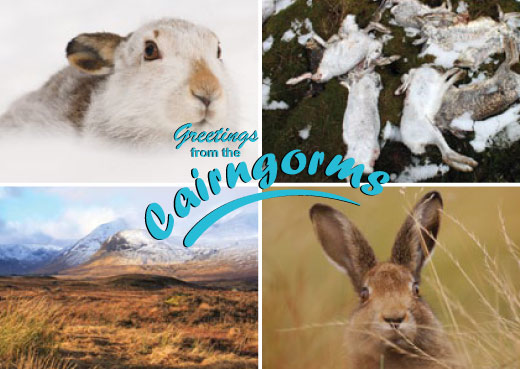
They’ve got creative again and this time they’re asking people to sign a giant postcard, calling for an end to mountain hare culls in the National Park. The postcard will be delivered to the Cairngorms National Park Authority before the open season on killing mountain hares begins all over again in August.

For information about the campaign please see here

To sign the postcard please click here

onekind-postcard

Gamekeepers want sea eagles, kites, buzzards, sparrowhawks & ravens added to General Licences

Further to this morning’s blog about RSPB Scotland’s damning response to SNH’s General Licence consultation (see here), we said we’d write a separate blog about some of the other responses that SNH received.

SNH has now published all the responses, and they’re well worth a read: all-responses-to-snh-general-licence-consultation-2016

There are many organisations and individuals calling for ravens to be added to the General Licences (no surprise) and, yet again, there are a number of requests for buzzards and sparrowhawks to also be added, which would allow these species to be casually killed across Scotland without any monitoring or regulation, although some have suggested these raptors should be on ‘regional’ General Licences to limit the casual killing to a particular area. How thoughtful.

One of the reasons given for adding ravens and buzzards to the General Licences was this: “There are arguably too many of them around and they cloud the skies in our local area“.

Here’s a photograph of some ravens and buzzards clouding the skies:

Actually, this is a photograph (by Richard Barnes) of Dunlin flocking on the coast of North America but it could just as easily be a plague of swarming raptors over a Scottish grouse moor, if you happen to be a pathological raptor hater stuck with an 18th century attitude, that is.

Take a look at the consultation response from Garry MacLennan. Surely not the same Garry MacLennan, Head Gamekeeper at Invermark Estate? Aren’t raptors supposed to be ‘thriving’ there? Perhaps the headline should have read ‘Raptors are thriving on Scottish grouse moors and we want licences to kill them’.

Also have a look at the responses from Iain Hepburn (the same Iain Hepburn as the head gamekeeper at Dunmaglass Estate?), Duncan Mackenzie and Calum Kippen (the same Corrybrough Estate gamekeepers who attended the recent meeting between the Cairngorms National Park Authority & the Scottish Gamekeepers’ Association?). Aren’t these the gamekeepers who want licences to monitor and ring raptors? Don’t they see a bit of a conflict of interest there if they also want licences to kill these raptors?

Best of all though, is the response from Bert Burnett (presumably of the SGA). Bert suggests that ravens should be added to the General Licences and argues that regional general licences “could be rolled out for various species that may start to cause problems like sea eagles and kites etc“. Ah yes, that very serious problem of sea eagles mistaking small children for prey.

Of course, these calls for licences to cull raptors are nothing new. Scottish (and English) gamekeepers and land owners have been asking for these for 20 years (see here, here, here, here, hereherehere). So far, SNH has resisted but given Natural England’s recent capitulation on buzzard-killing licences, how much longer before we see the same in Scotland?

Minutes of meeting between Cairngorms National Park Authority & Scottish Gamekeepers’ Association

ALMDLast month we blogged about a comment that had been made during an official meeting between the Cairngorms National Park Authority (CNPA) and the SGA. The comment came from a CNPA Board member (Eleanor Mackintosh) who was advising the gamekeepers to ‘cover up’ dead mountain hares so that photographs of the corpses couldn’t be published on social media (see here).
That meeting between the CNPA and the SGA was triggered by the SGA’s anger over a blog that had been written by Will Boyd Wallis (CNPA’s Head of Land Management & Conservation) in August, where Mr Boyd Wallis had raised legitimate concerns about some aspects of intensive grouse moor management (see here).

The SGA was furious about that CNPA blog, for a number of reasons (see below). The SGA asked for a meeting with the CNPA to discuss these concerns and the meeting was arranged, apparently after the ‘intervention‘ of Fergus Ewing MSP, who is Cabinet Secretary for the Rural Economy & Connectivity, but whose remit does not cover the National Parks (Cabinet Secretary Roseanna Cunningham has responsibility for the National Parks).

Chairman of the SGA, Alex Hogg, wrote to the CNPA requesting a meeting. We got a copy of his letter via an FoI request and here it is: sga-letter-requesting-mtg-with-cnpa-sept-2016

It’s an entertaining read. In it, Alex claims there’s no need for concern about the potential environmental harm of dumping tonnes of medicated grit on to the grouse moors because there’s no scientific evidence to show any damage. He also suggests that if the CNPA was concerned about potential environmental damage then the CNPA would be looking at the issue of dogs and livestock (which have also been wormed) defecating all over the Park. Hmm. If dogs and livestock had been wormed every day with a drug that was 10-20 x the strength permitted for use in the UK, and those piles of faeces were placed at every 100 metres across the grouse moor, for up to eight months of the year, as are piles of medicated grit put out for red grouse, then he might have had a valid point. Unfortunately for Alex, there is growing scientific evidence that the drug used in medicated grit (Flubendazole) is actually highly toxic to some aquatic organisms (e.g. see here) and, given the extent of its use on intensively managed grouse moors, this is exactly why Leeds University is offering a PhD scholarship to examine this issue in more detail (see here).

Anyway, on to the actual meeting itself. This took place on 29 September 2016 at Glenlochy in the National Park (an interesting choice of venue given the raptor persecution crimes that have been recorded in the area). In attendance were several representatives of the CNPA, several from the SGA, including Bert Burnett, some gamekeepers, and local SNP councillor Geva Blackett, who used to work as the SGA’s Parliamentary Officer many moons ago and who is married to Simon Blackett, the (now retired) Estate Factor at Invercauld Estate.

The minutes can be downloaded here: minutes-cnpa-sga-mtg-29-sept-2016

These minutes are well worth a read, not just because they expose the buffoonery of the SGA, but also because they provide an insight to the astonishing display of deference from the CNPA officials towards the SGA.

The meeting covered many topics and we won’t go in to all of them here because you can read them for yourselves and have a good giggle (whatever you do, don’t diss red grouse by calling them willow grouse!). The main thing we want to focus on is the discussion about gamekeepers getting licences to monitor and ring raptors and waders within the National Park.

Geva Blackett is pushing the CNPA to support this idea, and according to Bert Burnett, “no training is needed”. He really doesn’t have a clue, does he?!  The CNPA seems equally as ignorant, claiming that they’d like to support this initiative because they’d like to know about raptor numbers within the Park. Er, have they not heard of the award-winning Scottish Raptor Monitoring Scheme? A multi-partner scheme that holds all the raptor monitoring data collected across Scotland? Apparently not.

What’s even funnier about the SGA’s demands to get licences is that just this week, Bert Burnett and a couple of his cronies (including a convicted falcon thief) have launched a social media campaign designed to portray raptor fieldworkers in a negative light. They’ve trawled the internet and come up with some old photographs of raptor tagging activities (one photo is at least 13 years old!) and have made wholly unsubstantiated allegations about the behaviour of those featured in the photographs (unbeknownst to Bert, one of the photographs is actually from a project in North America, not from Scotland!). Apparently, these nest visits cause birds to desert. Hmm. And the evidence for that is where, exactly?

Bert has also claimed that raptor monitoring, ringing and tagging is “completely unregulated and those doing it are totally non accountable for their actions”. This exposes Bert’s lack of knowledge about the training and qualifications needed for this work, and also his ignorance about the high level of reporting required by the licensing authorities.

Strange, isn’t it, that if Bert thinks all this monitoring and ringing is ‘bad’, that at this meeting with the CNPA he is pushing for gamekeepers to be issued with licences to do the same work!

And if Bert/the SGA and co are so upset about satellite-tagging, why are they not kicking off about the GWCT’s woodcock satellite-tagging project?

And if Bert/the SGA and co are so upset about the ‘welfare’ of satellite-tagged golden eagles, why do we never see them kicking off about eagles that have been found poisoned, shot or trapped on driven grouse moors?

What is obviously going on here is a desperate little smear campaign designed to coincide with the forthcoming review of raptor satellite tag data, as requested by Cabinet Secretary Roseanna Cunningham (see here). This review, due out in the spring, is expected to be damning. We already know that many satellite-tagged raptors ‘disappear’ on grouse moors, and we also know that many satellite-tagged raptors have turned up either poisoned, shot or trapped on grouse moors. This review will pull all of those data together and it is predicted to be a shocking read.

The SGA knows this, hence these latest tactics to try and discredit the raptor workers.

Now, what was it that Tim (Kim) Baynes of the Scottish Moorland Group told that parliamentary committee last week? Ah yes, it was this:

We would very much like to see greater cooperation between ourselves, the Raptor Study Groups and the RSPB“.

It’s pretty clear the SGA has not received this message, or if it has, it’s chosen to ignore it.

But you carry on, Bert, because what you’re doing is political suicide. By asking your cronies to send (no doubt illiterate, baseless rants) to Roseanna Cunningham, complaining about Scottish Raptor Study Group members, she will see that the SGA is trying to undermine her review of the satellite tag data, and she’ll also recognise that the SGA’s claims of ‘partnership working’ with other members of the PAW Raptor Group are nothing more than lip service. PAW partners? Piss-poor partners, more like.

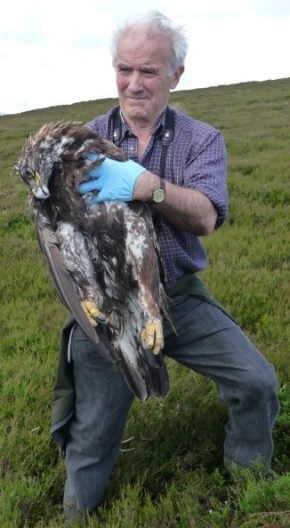
Photograph: dead golden eagle ‘Alma’, found poisoned on a grouse moor on Millden Estate in the Angus Glens. Her corpse was only found because she was wearing a satellite tag, fitted by Scottish Raptor Study Group member and internationally-recognised expert Roy Dennis. It’s no surprise then, that the SGA wants to put a stop to satellite-tagging.

‘More evidence required’ before mountain hare culls are regulated, says Cabinet Secretary

More parliamentary questions about the mass slaughter of mountain hares have been asked recently, thanks to Alison Johnstone MSP (Scottish Green Party).

We were particularly interested in this one:

Question S5W-04501: Alison Johnstone, Lothian, Scottish Green Party. Date lodged: 4/11/2016.

To ask the Scottish Government what measures it is taking to ensure that estates adhere to voluntary restraint on large culls of mountain hare, as called for by the joint position taken by Scottish Natural Heritage, the Game and Wildlife Conservation Trust and Scottish Land and Estates on large-scale culls of mountain hare to reduce louping ill, and what measures it is taking to monitor compliance with this policy.

Answered by Roseanna Cunningham (22/11/2016)

Scottish Natural Heritage is working with key stakeholders to improve transparency and understanding about the reasons why some moorland managers continue to wish to cull mountain hares and the numbers involved.

If evidence emerges that large-scale culls are continuing, the Scottish Government will consider the case for tightening regulation of this issue.

Dear god. ‘Working with stakeholders to improve transparency‘? Who’s she kidding, when the Convenor of the Cairngorms National Park Authority’s Planning Committee, Eleanor Mackintosh, is advising gamekeepers to hide the evidence of mountain hare culls, even though she denies it (see here) and the CNPA Convenor Peter Arygle denies it too (see here). How is hiding evidence improving transparency?!

We’ve been asking for transparency about the mass slaughter of mountain hares for some time. We asked some pretty simple questions back in March (see here) but so far, no response.

And why does the Scottish Government need more evidence anyway? Why isn’t the already-available evidence sufficient to show that large-scale culls are indeed continuing? And what type of evidence does the Scottish Government require before action is taken? Perhaps we should try the ‘I’ve seen it from my kitchen window‘ approach – seems to work in Westminster.

We’ve heard similar excuses about needing more evidence so many times before, usually in relation to an illegal raptor persecution case: e.g. ‘We won’t hesitate to take further action if deemed necessary’, but then when more evidence is produced, i.e. the corpse of yet another illegally-killed raptor, it’s never quite enough for the Government to deem that promised further action ‘necessary’. It’s just a never-ending cycle of ‘Next time we’ll do something’, until the next time comes and then the line is repeated, and then the next time and then the next time after that ad nauseam.

On the subject of what constitutes sufficient evidence, we’d recommend reading the latest article on the always thought-provoking ParksWatchScotland blog (see here). They’ve written an excellent piece called ‘What counts as evidence in our National Parks?’ in which they compare the frankly low grade ‘evidence’ recently used by the Scottish Government to introduce restrictive camping byelaws in the Loch Lomond & Trossachs National Park, with the high grade evidence of large-scale mountain hare culling that is seemingly insufficient to trigger the introduction of byelaws to prevent these mass culls in the Cairngorms National Park. The disproportionality is striking, as are the probable reasons behind it.

Cairngorms National Park mountain hare cover up denied

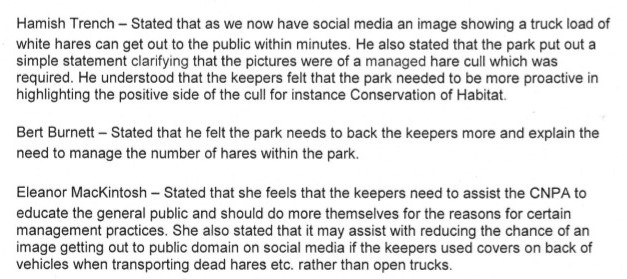
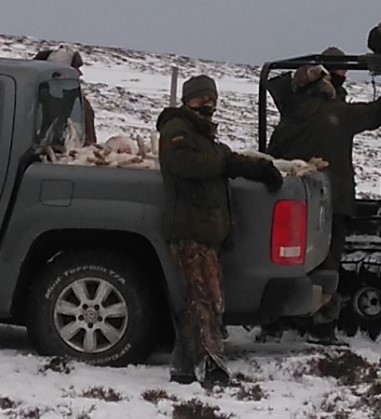
Last week we blogged (here) about an extraordinary comment attributed to Eleanor Mackintosh, a Board member of the Cairngorms National Park Authority (CNPA). During a discussion with the Scottish Gamekeepers’ Association on 29 September 2016, Ms Mackintosh apparently suggested they use covers on the back of vehicles to hide the evidence of mountain hare culls rather than risk photographs being taken of piles of dead hares being transported on open-backed vehicles:

Naturally, most people would expect the CNPA to be clamping down on the mass slaughter of mountain hares on grouse moors within the National Park, not suggesting to gamekeepers that they instead just hide the evidence, so Ms Mackintosh’s comments didn’t go down too well. One of our blog readers, Andy Holden, wrote to Ms Mackintosh to express his disgust and she duly replied as follows:

Dear Mr Holden

Thank you for your recent email in relation to mountain hares in the Cairngorms National Park.

It is my opinion that what I said has been taken completely out of context I am very clear on, and whole heartedly support the CNPA current position on hare culls.

The Cairngorms National Park Authority is clear in its position on mountain hare culling. The CNPA does not support ‘hiding’ in any way the number of hares culled. On the contrary, our advice to land managers is to be more open about the number of hares culled. We recognise that culling hares is legal and that culls can be undertaken for a number of reasons. We do not support large scale culling and endorse the call for restraint made by SNH. We support the ongoing work to develop best practice in counting mountain hare numbers being developed by the James Hutton Institute and GWCT. In the meantime our advice to land managers is to set out clearly why culls are undertaken, share information on the numbers of hares culled and where possible to count hare numbers consistently while waiting for the recommendations on counting methodology from the current research.

The information you refer to is a note by the Scottish Gamekeepers Association of a meeting with CNPA to discuss a number of aspects of the recent National Park Partnership Plan consultation.

Regards

Eleanor Mackintosh

END

Interesting. So Ms Mackintosh doesn’t deny that she made the suggestion, but instead she claims her remarks were taken “completely out of context“. Really? By whom? Not by us – we posted the notes from the CNPA/SGA meeting exactly as they were presented in the FoI response (see photo above).

Perhaps she meant that the notes from the meeting (prepared by the SGA) hadn’t been written up accurately and had reported her comments ‘out of context’? That’s entirely possible, of course, but in this case it seems unlikely.

Why would we say that seems unlikely? Well, because the notes from the meeting, as prepared by the SGA, were emailed to the CNPA on 4 October 2016. The recipients of that email included Will Boyd Wallis (CNPA), Hamish Trench (CNPA), Mike Cottam (CNPA) and someone listed as ‘Eleanor’. Will, Hamish and Mike had all attended the meeting with the SGA, so we assume the person named as ‘Eleanor’ was Eleanor Mackintosh, who was also present at that meeting.

Later that same day, Hamish Trench (CNPA) sent an email back to the SGA (also copied to Will, Mike and ‘Eleanor’) acknowledging receipt of the notes but not accepting them as an accurate reflection of what was said during the meeting by him, Will and Mike. Hamish offered to amend the notes before they were circulated more widely.

On 6 October, Will Boyd Wallis (CNPA) sent an amended version of the notes back to the SGA, and copied in Hamish, Mike and ‘Eleanor’. In this amended version, Will had made several editorial changes to some of the comments, but did not amend the comments attributed to Eleanor. Presumably, as ‘Eleanor’ had been in receipt of all this correspondence, if she thought her comments had been placed ‘completely out of context’ here was the perfect opportunity for her to say so.

She didn’t.

You can read the correspondence between the SGA and CNPA here: cnpa-sga-mtg-29-sept-2016-amendment-of-notes

Now, maybe Ms Mackintosh was away, maybe her internet was down, maybe she didn’t see the notes until they were published on this blog.

Or, maybe, she did suggest that gamekeepers should hide dead mountain hares under covers and now she’s in the middle of a shit storm and she’s looking for a way out.

Cover up in the Cairngorms National Park!

Well done to Scottish animal charity OneKind for organising today’s protest rally at the Scottish Parliament, enabling campaigners to call on MSPs to put an end to the mass unregulated slaughter of tens of thousands of mountain hares on Scottish grouse moors.

Ingeniously, OneKind replicated the now infamous image of that truckload of dead mountain hares (published here and here earlier this year) with their own truckload of (soft cuddly toy) mountain hares:

onekind-hare-rally-stuart-spray

(Photo from the rally by Stuart Spray).

Environment Cabinet Secretary Roseanna Cunningham addressed the rally and said the Scottish Government opposes mass culls, that legislation to protect mountain hares has not been ruled out, but that the Government needs evidence before it can act.

That evidence might be harder to come by in future. A board member of the Cairngorms National Park Authority (Eleanor MacKintosh) recently suggested to members of the Scottish Gamekeepers’ Association that they literally cover up their mass hare-killing sprees by using covers on the back of vehicles to hide the evidence from prying camera lenses instead of having piles of dead hares on display in open-backed trucks!!!

This information (and other fascinating discussions) was revealed in an FoI asking for information about a meeting between the CNPA and the SGA that was held in September this year. We’ll be blogging a lot more about that in due course.