The National newspaper published a special report on Monday 16 December 2024 entitled, ‘Why are birds of prey still being killed in Scotland despite new legislation?’, with a particular focus on the Cairngorms National Park.
It’s reproduced below.
SCOTLAND passed the Wildlife Management and Muirburn (Scotland) Bill earlier this year, introducing a licensing scheme for the grouse shooting industry in a bid to end the illegal killing of birds of prey.
The first licenses were issued this past summer, and while considered a blueprint for tougher legislation across the UK – people are still killing birds of prey on grouse moors, which is not an easy thing to do.
Guilty parties must have access to a vehicle, equipment such as a firearm, opportunity and motive.
“This isn’t people traveling from towns and cities going up onto our hills and randomly killing birds of prey. These are targeted offences,” Ian Thomson, investigations manager for the RSPB, told The National.
But why? And who would do this?
Why are grouse moor shootings still taking place?
A Hen Harrier disappeared in February. A buzzard was shot in Perthshire in mid-May. An osprey was shot in the Glen Doll area in August. A dead golden eagle was found in a plastic bag near Loch Rusky in November.
In the last 15 years, more than 1500 birds of prey have been killed, with 57 convictions. However, the majority of these sentences are suspended, and only one person has been jailed.
Most of the evidence gathered by investigators is from satellite tags, fitted to allow conservationists to monitor the movements around the country.
The technology is estimated to be about 97% reliable, and “very rarely suffers some sort of technical function”, according to Thomson.
“Often we believe that there is strong evidence that supports the fact that these birds are being shot often at night, the tags destroyed, and the carcass is disposed of,” Thomson said.
The RSPB investigations team assists Police Scotland by speaking to local land managers and liaising with the community if a tag stops working. When asked why anyone would target the birds, even with the new legislation in place, Thomson said: “The killings are being undertaken by people who are working on the land.
“That’s the reality, and the vast majority of raptor persecution offenses occurring in Scotland are linked to management for kind of game bird shooting and particularly grouse shooting.
“There are many layers of evidence that support that.
“First of all, the location of the incidents that are found. Whether its birds shot, birds poisoned, or nests destroyed, these are all subject to police investigations.
“A significant proportion of people convicted for raptor persecution offenses have been gamekeepers,” Thomson shared.
RSPB data shows that at least 54% of all confirmed incidents in the last 10 years (2014-2023) have been linked to land managed for pheasant, partridge and grouse shooting.
The association of these crimes with the gamebird industry is also evidenced by criminal court records. Of all individuals convicted of bird of prey persecution related offences from 2009 to 2023, 75% were connected to the gamebird shooting industry and 68% were gamekeepers.
The Angus Glens crime hotspot
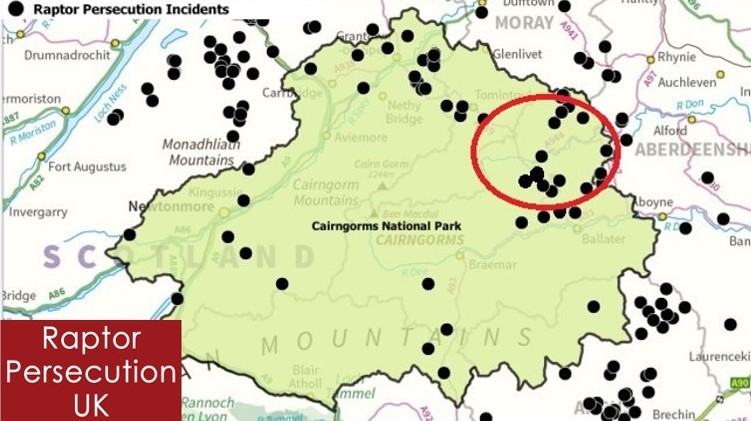
Angus Glens in the Cairngorms is a hotspot for the number of raptor persecution in Scotland, with the Highlands having 69 since 2009.
There have been multiple confirmed incidents occurring on several estates in the area. This includes many poisoning incidents using chemicals whose possession was long banned, repeated illegal misusing abuse of crow traps and pole traps, shootings and destruction of nests.
Earlier this year, NatureScot placed restrictions on an estate on the edge of the Cairngorms National Park for three years following evidence of bird poisoning on the property.
Thomson said there had been 10 suspicious disappearances of satellite tags on birds of prey in the Angus Glen in the last 15 years.
There has been a peregrine, and an osprey shot since the start of the shooting season in Angus Glens this year, which Thomson described as “worrying”.
The law as it has stood since 2012 has been serious liability, which means landowners are responsible for the actions of their employees and the land.
So are landowners aware of the circumstances surrounding raptor persecutions on their land?
A wall of silence
The first licenses under the new bill were approved this past July, but Thomson noted there would have been no need for it had the industry “taken possession of this problem decades ago”.
He added: “I think had the industry rooted out criminals, then we wouldn’t have needed this sort of legislation moved on.
“We are in a situation where some Victorian management practices towards birds of prey persist. It really is time that the shooting industry got into the 21st century.”
Thomson said it was rare for estates to report raptor persecutions.
When asked whether estates may be protecting or turning a blind eye to those who target birds of prey, Thomson said he could not confirm but he and his team frequently hear of peer pressure within estates to keep reporting low, adding that crimes are rarely reported by the industry.
“The problem is the game keeping industry is used to operating a bit like a closed shop,” Thomson said.
“It’s very difficult. There is no whistleblowing culture, and it would be fantastic if organizations representing gamekeepers set up a scheme where people could report incidents taking place and those are passed on to the police.
“But that just never seems to happen. Exceedingly rare truths are told.”
Thomson revealed that gamekeepers come to the team sharing their worries and are “terrified” to come forward.
“They say to us this information can’t come from me because I may lose my job and I may lose my friends and I may lose my hobby. People are under considerable pressure to keep their mouths shut,” he said.
“Either people won’t see anything or there is just a culture of denial.”
Thomson described “efforts to deny or downplay” incidents, and said that when satellite tags start to disappear, people blame “imaginary wind farms” or factors, dismissing science and evidence of crimes.
“It’s a mix of cultural misinformation, a wall of silence and complete denial”, Thomson added.
ENDS
For those who are sick to the back teeth of birds of prey being illegally killed on grouse moors, you might want to sign this new petition from Wild Justice calling for a ban on driven grouse shooting – HERE.
Press release from Police Scotland (28 June 2024):
APPEAL FOR INFORMATION AFTER GOSHAWK NEST FOUND ABANDONED NEAR LOCH GYNACK
Police are appealing for information after a suspected attempt to target birds of prey in the Strathspey area.
On Saturday, 8 June, 2024, officers received a report of an active Goshawk nest having been found abandoned in suspicious circumstances, within a forest near Loch Gynack.
Enquiries were carried out at the site, in partnership with RSPB Scotland, showing the nest had been deliberately targeted with a shotgun. The nest and damaged branches were taken for x-ray with the assistance of staff at the Kincraig Highland Wildlife Park.
Police Constable Daniel Sutherland, Highland and Islands Wildlife Crime Liaison officer, said: “All birds of prey are fully protected under the Wildlife and Countryside Act 1981 and it is illegal to kill them. I am asking anyone in the local community who may be able to help with our enquiries to come forward.
“The area is close to popular walking paths from Newton More. If you were walking in the area during May or early June, and may have seen or heard anything suspicious, then please get in touch.”
Anyone with information is asked to contact Police Scotland on 101, quoting reference CR/0211821/24, or make a call anonymously to the charity Crimestoppers on 0800 555 111.
ENDS
UPDATE 24 October 2025: BBC’s Highland Cops programme features investigation into shot out Goshawk nest in Cairngorms National Park (here)
Police Scotland has issued the following press statement:
RAVEN FOUND DEAD IN ABERDEENSHIRE
An investigation is under way after a raven was found dead in an area of the Invercauld Estate in Aberdeenshire.
On Friday, 12 May 2023, game keepers at the Estate contacted police after they found a dead raven next to a number of broken eggs. Officers attended and removed the bird and the egg shells.
The egg shell and matter has been analysed and has tested positive for pesticide. Officers are awaiting toxicology results for the raven.
Constable Hannah Corbett said: “We take wildlife crime extremely seriously and a number of lines of inquiry are being followed up. However, I would like to appeal to the local community for any information they may have about this matter. Did you see anything suspicious, have you overheard anyone talking about this? Any small piece of information could prove significant in investigating the cruel and callous death of the raven. Please do contact us.”
Anyone with information is asked to call Police Scotland via 101, quoting incident number 1307 of 12 May 2023. Alternatively, you can contact Crimestoppers on 0800 555 111 where information can be given anonymously.
ENDS
Many of you will know that one part of Invercauld Estate is currently serving a three-year General Licence restriction, imposed by NatureScot after the discovery of an illegally poisoned golden eagle and illegal poisoned baits on an estate grouse moor in March 2021 (see here).
It’s not yet clear on which area of Invercauld Estate the latest poisoned baits were discovered – it’s a massive grouse-shooting estate that covers a large area of the Cairngorms National Park. It’ll be interesting to find out if these baits were found on the same shooting ‘beat’ as before or on another shooting ‘beat’ managed by a different party on a different part of the estate.
I applaud Police Scotland’s decision to publicise the discovery of the poisoned baits – not least to warn members of the public who might venture into the National Park and on to the estate with children and dogs, putting them at potential risk of great harm.
The early publicity is a welcome change to what had become a standard practice of complete silence from Police Scotland on raptor poisoning crimes (e.g. here, here, here).
The Cairngorms National Park Authority (CNPA) is advertising a three-year, full time position for a Raptor Conservation Officer, to deliver the actions laid out in the National Park’s latest Partnership Plan (2022-2027) aimed at increasing the home range, occupation and breeding success of golden eagle, hen harrier, merlin and peregrine across the National Park.
This is a promising move by the CNPA, who have previously faced severe criticism for not dealing effectively with ongoing raptor persecution in some areas of the Park, notably on land that’s managed for intensive driven grouse shooting (e.g. see here & here).
Crimes against birds of prey, especially those that take place within the Cairngorms National Park, are often high profile, and quite rightly so. For example the recent poisoning of a golden eagle on a grouse moor within the Park (here) and the poisoning of a white-tailed eagle on another grouse moor within the Park (here) generated widespread outrage and media coverage, as did the sighting of a young golden eagle flying around a grouse moor in the Park with a spring trap clamped to its leg/foot (here).
Last year, the CNPA stated its intention to address intensive gamebird management within the Park as part of its Partnership Plan (here), which was seen as a good move by many of us who know that raptor persecution is disproportionately associated with land managed for gamebird shooting. That, combined with the creation of this new Raptor Conservation Officer post, is indicative of things moving in the right direction.
Make no mistake though, this new post will be a challenging one. There are some fantastic estates in the Cairngorms National Park who have been hosting and protecting breeding raptors (e.g. golden eagles, white-tailed eagles, hen harriers) for some time now, but there are also other estates that stubbornly refuse to tolerate these species and still behave as though it’s the 1890s.
The post is full time for three years, attracting a salary between £33,652 – £40,362. The closing date for applications is Sunday 30th April at 23.59hrs.
A detailed job description and list of essential attributes is provided here:
RSPB Scotland has published a blog today calling for ‘action and delivery’ from the Scottish Government on its promised grouse moor licensing scheme.
The Government announced in November 2020 that grouse shooting businesses in Scotland will need to be licensed to operate, under new proposals to tackle raptor persecution.
It also announced that muirburn will also only be permitted under licence, in order to protect wildlife and habitats, regardless of the time of year it is undertaken and whether or not it is for grouse moor management or improving grazing.
The Government stated there will also be a statutory ban on burning on peatland, except under licence for strictly limited purposes, such as approved habitat restoration projects.
Since that announcement in November 2020, there hasn’t been any further action, but there has been plenty more evidence of illegal raptor persecution, including the poisoning of this golden eagle on a grouse moor at Invercauld Estate in the Cairngorms National Park:
RSPB Scotland writes:
“We have been very patient, but nearly 20 months on from this announcement, we want to see some action and delivery on these promises by the Scottish Government. Proposals must be brought forward in the forthcoming Programme for Government in autumn 2022 for the introduction of grouse moor and muirburn licensing legislation in the next Parliamentary year“.
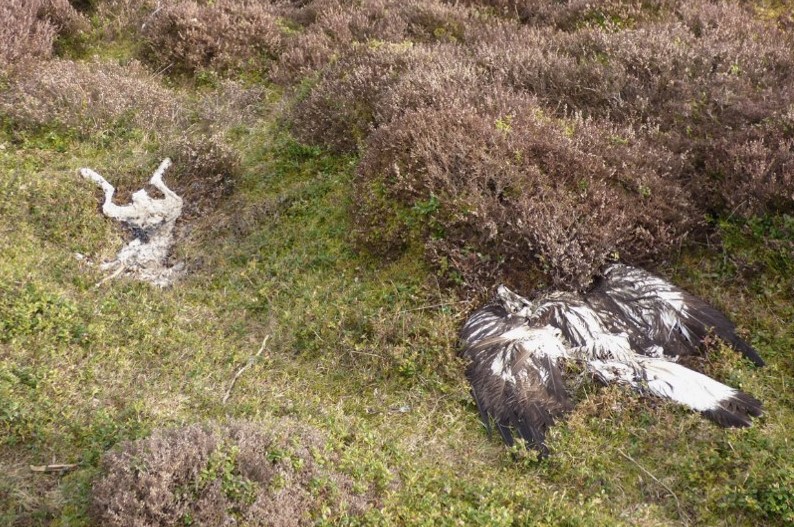
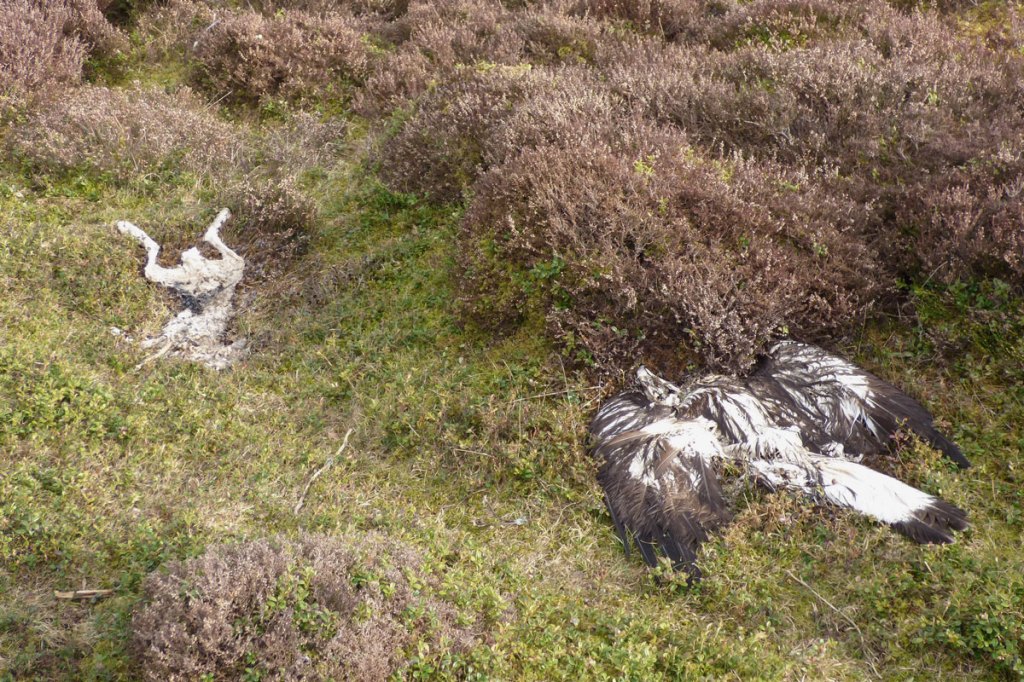
Invercauld Estate in the Cairngorms National Park has lost its appeal against a General Licence restriction that was imposed on the estate in February 2022 (see here) after Police Scotland provided the licensing authority (NatureScot) with evidence of wildlife crime against birds of prey on the estate, notably the discovery of a ‘deliberately poisoned’ golden eagle lying next to a poisoned hare bait in March 2021 (see here).
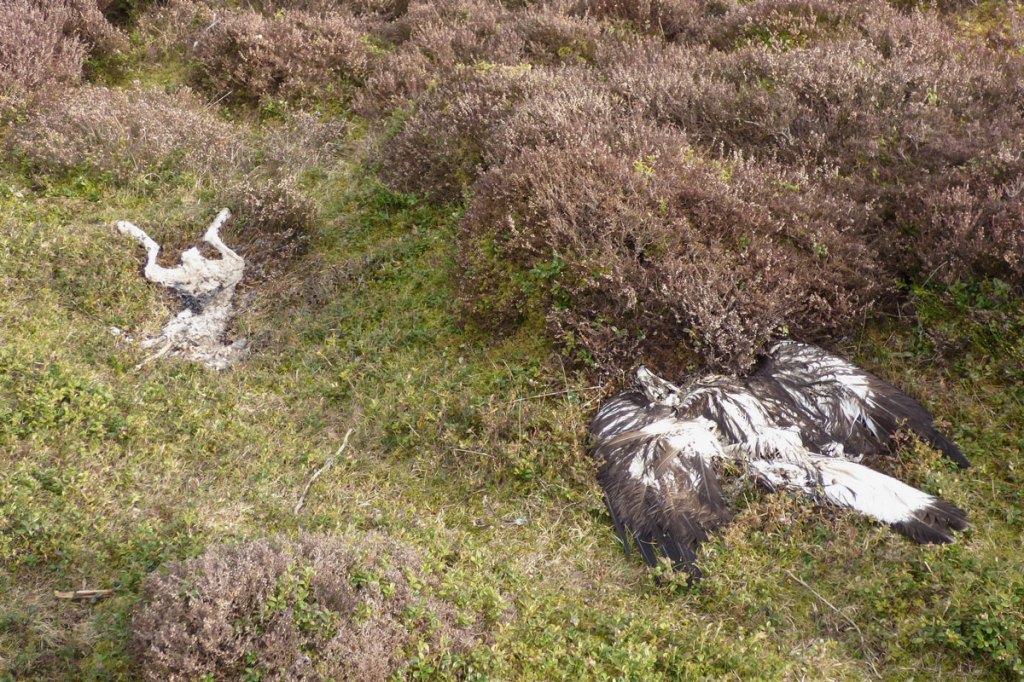
[Photo of the poisoned eagle & hare bait found on a grouse moor on Invercauld Estate in the Cairngorms National Park. Photo by RSPB Scotland]
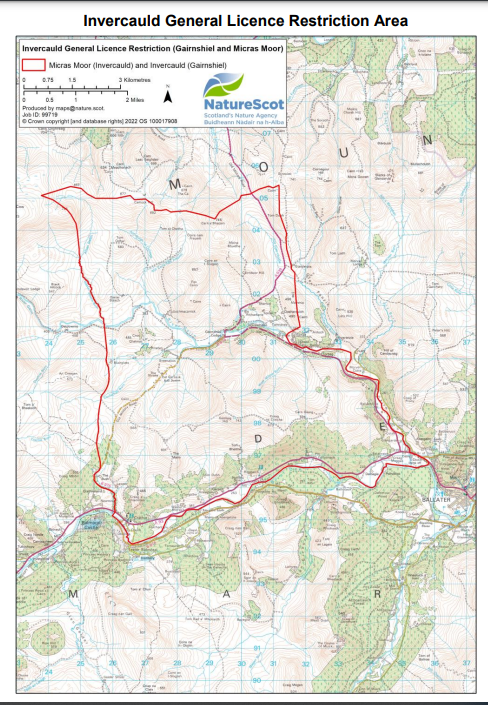
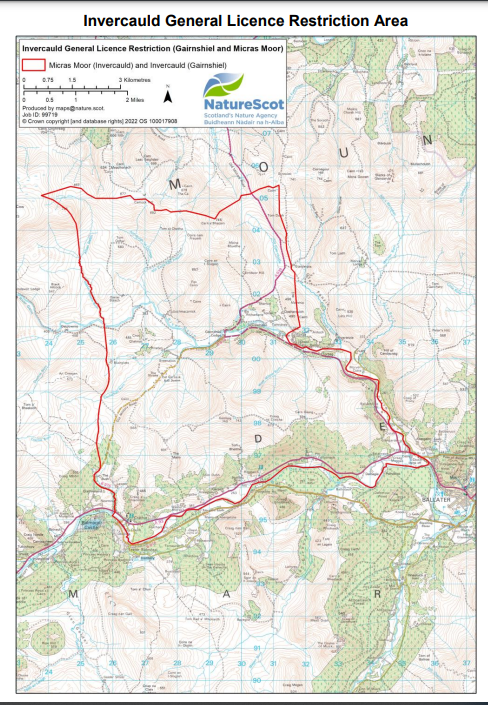
Regular blog readers will know that the three-year General Licence restriction on the Gairnshiel & Micras part of Invercauld Estate took effect on 9th February 2022, prohibiting the use of General Licences 01, 02 and 03 on the estate until 9th February 2025 (see here).
The estate submitted a formal appeal against NatureScot’s restriction decision on 25th February 2022 and the official ‘restriction notice’ was removed from NatureScot’s website. I looked today and the notice has been reinstated, which I take to mean that the estate’s appeal has failed, in the same way that Lochan Estate’s recent appeal against restriction also failed (see here).
Here is the map from Naturescot showing the area of restriction on the Gairnshiel & Micras area of the estate:
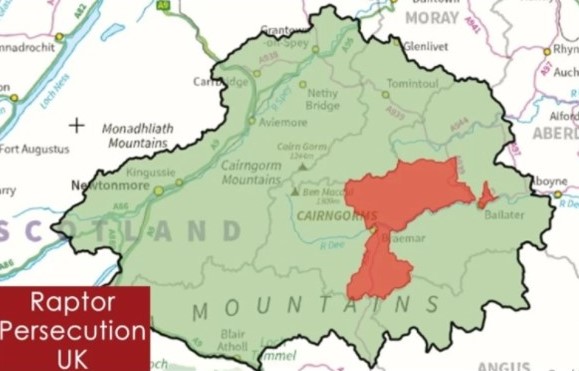
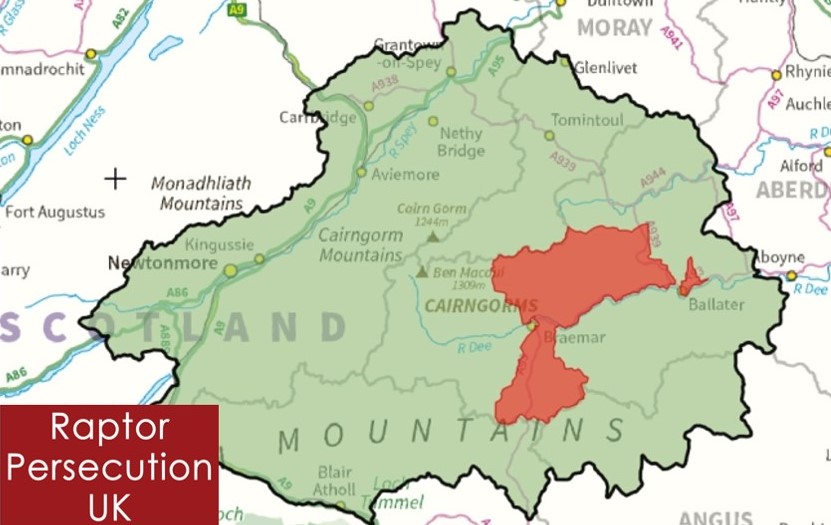
If you’re at all familiar with Invercauld Estate you’ll recognise that this restriction area is only a small part of what is a massive grouse-shooting estate in the Cairngorms National Park (data from Andy Wightman’s excellent Who Owns Scotlandwebsite) rather than the restriction being applied across the entire estate, as seems to have been the case with other sanctioned estates:
I was curious about why the General Licence restriction was, well, restricted for want of a better term, to just the small area of Garnshiels and Micras, so I asked the licensing team at NatureScot about that decision.
The response from NatureScot was prompt (thank you!) and went like this:
‘…The decision was made on the basis that the evidence of crime provided [by Police Scotland] related to this one beat, rather than across the whole estate; and that the separate beats on this estate are managed independently of each other. Hence, the ultimate decision was to restrict to the beats where the evidence of crime occurred‘.
As many of you already know, the three-year General Licence restriction is barely worth the paper it’s written on because the estate can simply apply for ‘Individual licences’ (instead of relying on the General Licences) to continue its activities as before, albeit with the minor inconvenience of having to have a bit of a paper trail. This has been a major criticism of the General Licence restriction process ever since it began in 2014. This, combined with the shooting industry’s apparent reluctance to shun any estates where restrictions have been imposed for wildlife crime, means that the General Licence restriction is an utterly ineffective sanction (e.g. see here).
We were even provided with first-hand evidence of its ineffectiveness when further evidence of suspected wildlife crime was detected on two estates that were already serving a General Licence restriction for wildlife crime! Raeshaw Estate in the Scottish Borders had its Individual licences revoked (here) and Leadhills Estate was given a three-year extension to its original three-year General Licence restriction (here), a decision which it subsequently appealed and lost (here).
You may remember that in February, Scottish Greens MSP Mark Ruskell asked Parliamentary questions about this absurd so-called sanction (see here); more on that shortly.
In March last year a dead golden eagle was found face-down on a grouse moor on Invercauld Estate in the Cairngorms National Park. It had been ‘deliberately’ poisoned with a banned substance, according to Police Scotland, and two poisoned baits were found close-by (see here).
[The poisoned golden eagle, next to a poisoned hare bait. Photo by RSPB Scotland]
[Invercauld Estate inside the Cairngorms National Park. Boundary data from Andy Wightman’s Who OwnsScotlandwebsite]
Today, 11 months after the grim discovery, the Scottish Government’s statutory nature conservation agency NatureScot has imposed a three-year General Licence restriction on part of Invercauld Estate. Here’s the press release:
General Licence restricted on Cairngorms Estate
NatureScot has restricted the use of general licences on part of the Invercauld Estate in the Cairngorms National Park.
The decision was made on the basis of evidence provided by Police Scotland of wildlife crime against birds. This evidence included a poisoned golden eagle found on the estate in March 2021, along with a rabbit and a hare carcass, both baited with poison. The restriction will apply to the Gairnshiel and Micras moor on the estate, where the evidence of poisoning was found.
Donald Fraser, NatureScot’s Head of Wildlife Management, said: ““These poisoning incidents are appalling and an act of animal cruelty. The indiscriminate use of poisons is not only lethal to our iconic Scottish wildlife, but can also pose a serious health risk to people and domestic animals that come into contact with it.
“We are committed to using all the tools we have available to tackle wildlife crime. In this case, there is clear evidence of criminal behaviour. Because of this, and the risk of more wildlife crimes taking place, we have suspended the use of general licences on this property for three years. They may still apply for individual licences, but these will be closely monitored.
“This measure will help to protect wild birds in the area, while still allowing necessary land management activities to take place, although under tighter supervision. We believe this is a proportionate response to protect wild birds in the area and prevent further wildlife crime.
“We work closely with Police Scotland and will continue to consider information they provide on cases which may warrant restricting general licences. The detection of wildlife crime can be difficult, but this is the third time in recent months when we have restricted use of general licences on the basis of evidence of crime taking place. New and emerging technologies, along with a commitment from a range of partners to take a collective approach to these issues, will help us stop wildlife crime.”
General licences allow landowners or land managers to carry out control of common species of wild birds, such as crows and magpies, to protect crops or livestock, without the need to apply for an individual licence.
ENDS
Here is the map showing the restricted areas on Invercauld Estate. The restriction applies from 9th February 2022 to 9th February 2025.
This has been a long time coming for this estate. I wrote about it in May 2021 (here) and I’ll repeat it here.
Invercauld Estate and the surrounding area has been at the centre of many alleged wildlife crimes over the years, including the discovery of three poisoned buzzards on the estate in 2005 (here), the discovery of a poisoned red kite at the Spittal of Glenshee on Invercauld Estate in January 2007 according to former police wildlife crime officer Alan Stewart (in litt. 9 Feb 2022), the discovery of an illegally shot peregrine at the Pass of Ballater in 2011, the reported coordinated hunt and subsequent shooting of an adult hen harrier at Glen Gairn on the border of Invercauld and Dinnet Estates in 2013, the illegally-set traps that were found near Geallaig Hill on Invercauld Estate in 2016, the suspicious disappearance of satellite-tagged hen harrier Calluna ‘on a grouse moor a few miles north of Ballater’ on 12 August 2017, the opening day of the grouse shooting season (here) although it’s not clear whether this was on Invercauld Estate or neighbouring Dinnet Estate, the suspicious disappearance of satellite-tagged white-tailed eagle ‘Blue T’ on Invercauld Estate in May 2018 (see here), the suspicious disappearance of satellite-tagged hen harrier Stelmaria ‘last recorded on grouse moor a few miles north west of Ballater, Aberdeenshire on 3rd September 2018 (see here), the discovery of a golden eagle flying around the area with a spring trap attached to its foot in August 2019 (here), the suspicious disappearance of satellite-tagged hen harrier (Wildland 2) on Invercauld Estate on 24 September 2019 (here) and the discovery of a deliberately poisoned golden eagle and poisonous baits on a grouse moor on Invercauld Estate in March 2021 (see here).
I’m pleased to see this restriction finally imposed on Invercauld, although I’d much rather have seen a series of criminal prosecutions. The restriction will have very little material affect on the game-shooting activities on Invercauld because the estate can simply apply for an individual licence allowing it to continue its activities as if no ‘clear evidence of criminal behaviour’ has been uncovered (more on that ridiculous situation shortly) but it does mean the estate’s reputation is damaged and it also means this can be used to apply pressure on organisations such as Scottish Land & Estates and the Scottish Gamekeepers Association, who both claim to have a zero tolerance of raptor persecution.
Will Invercauld Estate and its gamekeepers remain members of these two organisations?
UPDATE 7th April 2022: Invercauld Estate in Cairngorms National Park loses appeal against General Licence restriction imposed for wildlife crime (here)
Bird crime soared across the UK in 2020, and RSPB believes Scotland’s native birds of prey will continue to be persecuted, according to two new articles published yesterday in The Courier and The Press & Journal:
Birds of prey such as hawks, eagles, kites, buzzards, harriers, falcons and owls are protected by the Wildlife and Countryside Act 1981.
The RSPB’s annual report revealed that 2020 was the worst year on record for bird crime across the UK.
There were 137 known and confirmed incidents of birds of prey being killed, the highest number in 30 years.
This trend has continued in 2021, according to Ian Thomson, RSPB Scotland’s head of investigations.
He said: “Bird crime covers a whole manner of crimes against wild birds, but what is particularly of concern are those crimes that have an impact on the populations and ranges of a variety of species.”
According to Mr Thomson, bird crime, also known as raptor persecution, is particularly rife in the north-east, with the hen harrier population being a fraction of what it was 20 years ago.
He also explained that golden eagles are only occupying around a third of the breeding territories that they ought to; meanwhile, peregrines have largely disappeared from the uplands in the north-east.
Mr Thomson believes that these low population numbers are largely down to the persecution of birds of prey for the intense land management of grouse moors.
Birds of prey are at the top of the food chain and they hunt and eat grouse and pheasants.
In an attempt to maximise the number of game birds available for clients to shoot, grouse moor managers will eliminate any threats to their birds.
This can include burning patches of heather moorland and releasing clouds of smoke into the air, leaving medicated grit out in the open and hare baiting.
The National Golden Eagle Survey shows that across Scotland the population as a whole is doing well and that there are significant increases in the west where there are no grouse moors.
Mr Thomson said it is the east of Scotland where the populations are a fraction of what they should be.
Scientific reports show that the illegal persecution of golden eagles, hen harriers, red kites and peregrines are largely happening in areas managed for game bird shooting.
“Unfortunately, these findings are largely happening in the middle of nowhere,” Mr Thomson said, “out of sight, out of mind, where witnesses are very far and few between.
“But, occasionally, an incident occurs that is detected.
“In 2020, about a week into lockdown when the entire population of the country was told to stay indoors or to exercise within five miles of your house, we had a young white-tailed eagle poisoned on a grouse moor in Strathdon, in an area with an appalling history of crimes against birds of prey going back 10-plus years.”
Mr Thomson explained there have been cases of birds of satellite-tagged birds disappearing under “suspicious circumstances”.
In March a golden eagle was illegally poisoned on the Invercauld Estate, a grouse moor in the Cairngorms.
Last year a satellite transmitter that had been fitted on a golden eagle was found at the side of a river.
It was wrapped in lead sheeting and thrown into the river where it lay for four years until a walker found it on the bank.
Mr Thomson said: “This is the efforts that people are going to cover up these crimes, they don’t want to be caught.
“The problem is, as I say, these crimes are seldom witnessed; to actually get any idea of the scale of it we’re really depending on doing population studies.
“We’re never going to find all the victims because, needless to say, if someone shoots a golden eagle they’re not going to leave it around for the RSPB or the police or a hillwalker to find.
“These crimes are being covered up.”
The RSPB Scotland’s head of investigations explained that there are other factors that have impacted the populations of birds of prey.
He said that all birds face challenges “just surviving”, through natural mortality, starvation, and loss of habitat due to the intensification of land management or agriculture.
Because of this, populations are much lower than what would be ideal, and so deliberate and illegal killing is adding extra strain to the populations.
As well as being important for biodiversity, birds of prey are an attraction for tourists visiting Scotland.
People interested in photography travel from all over the world to capture Scottish wildlife, bringing millions to the economy.
Mr Thomson highlighted that, on the Isle of Mull, around £5 million a year goes into the island from people going to see white-tailed eagles.
The Scottish Government plans to introduce licensing to grouse moors, which Mr Thomson described as a “game-changer”.
He believes the loss of a license to shoot will introduce a significant deterrent to the estates that do persecute birds of prey.
“There are places you wouldn’t want to take your dog for a walk in case it gets caught in a trap or eats something poisonous,” he said. “It’s not just birds that are dying, it’s people’s pets.
“Perish the thought that some day some small child will come into contact with chemicals like this, it could have absolutely devastating effects.
“It’s not only illegal but it’s reckless and indiscriminate.”
Today is the 26th November 2021. It’s been exactly one year since the then Environment Minister Mairi Gougeon announced the Scottish Government’s long-awaited response to the Werritty Review on grouse moor management and a decision to implement a licensing scheme for grouse shooting.
How we got to that position was the subject of a talk I presented at the REVIVE national conference a couple of weeks ago, hosted by Chris Packham at Perth Concert Hall.
[Chris Packham opening the REVIVE coalition for grouse moor reform conference. Photo by Ruth Tingay]
There had been an intention for a recording of the entire event to be made available but we learned subsequently that unfortunately the venue’s audio system had failed. REVIVE’s campaign manager, Max Wiszniewski has since published a conference overview (here) but I thought I’d take the opportunity to share the main points from my talk, to try and put Mairi Gougeon’s announcement in to some sort of context, and it seems fitting to do that today.
My opening slide was a screengrab of Minister Gougeon making that historic statement on 26th November 2020:
“The key recommendation put forward in the Werritty report – is that a ‘licensing scheme be introduced for the shooting of grouse’. This is a recommendation that I accept.
However, while I the understand why the review group also recommended that such a scheme should be introduced if, after five years, ‘there is no marked improvement in the ecological sustainability of grouse moor management’, I believe that the Government needs to act sooner than this and begin developing a licensing scheme now”.
There’s no question that this was a significant statement and although some campaigners were disappointingly dismissive (including several commentators on this blog), I think that when you understand the history of exactly what it took to get there, over many, many years of hard campaigning at substantial personal cost to many, you’ll hopefully appreciate why so many of us celebrated it as a huge victory. It’s not the end point, not by any means, but it is hugely symbolic of the direction of travel.
My next slide is a photo that I use in pretty much every talk I give on raptor persecution in the UK:
This is a photograph of a young golden eagle, found illegally poisoned on a grouse moor in the Cairngorms National Park in 2006. It was photographed by former RSPB Investigator Dave Dick (now retired) who had been sent out to retrieve it for post mortem. He had picked up many other illegally killed birds of prey on grouse moors over the years, but this image epitomises everything in its pitiful, poignant, senselessness.
I asked the audience to hold this image in their head as the talk progressed to cover some of the key moments in this long campaign against criminal activity and for effective law enforcement against those criminals.
I started with the basics – the 1954 Protection of Birds Act which brought legal protection for all raptor species in the UK, with the exception of the sparrowhawk which finally received full protection in 1961. So for most UK birds of prey, they’ve supposedly been protected for 67 years! This isn’t a new law that society needs time to adjust to and for which we should forgive any lack of adherence. This legislation was enacted a lifetime ago and was probably in place before every current working gamekeeper was even born. Ignorance of the law is no defence and that statement applies here, in spades.
In 1998, 44 years after raptors were declared ‘protected species’ in law, the then Secretary of State, Donald Dewar described the level of raptor persecution in Scotland as “a national disgrace“. He promised that following devolution the following year, the Scottish Government would take “all possible steps to eradicate it”.
RSPB Scotland started publishing annual reports in 1994, meticulously documenting raptor persecution. Their 20th report, published in 2004, documented that 779 birds of prey had been confirmed illegally killed between 1994 and 2004. This figure was considered the tip of the iceberg as wildlife crime, including raptor persecution, is widely recognised as being under-recorded for a number of reasons.
During the late 1990s-mid-2000s, and actually continuing to this day, researchers published a suite of scientific papers documenting the impact of illegal raptor persecution. This wasn’t just the odd ‘rogue incident’ here and there; raptor persecution was so extensive and systematic it was having population-level impacts on a number of species, notably the golden eagle, hen harrier, peregrine and red kite. The peer-reviewed evidence was conclusive – much of the killing was linked to game-shooting, and particularly to driven grouse moor management.
[An expanse of driven grouse moors inside the Cairngorms National Park. Photo by Ruth Tingay]
In 2000, the UK Raptor Working Group (established in 1995 and comprising a variety of statutory agencies, conservation NGOs and game-shooting bodies) published a report with a series of recommendations to address the recovery of bird of prey populations and their perceived impact on gamebirds, moorland management and pigeon racing.
In 2002, Scottish Natural Heritage (SNH) advised the Scottish Executive to accept most of the recommendations of the 2000 report and this led to many developments, with a particular focus on partnership working. Most of these so-called partnerships have since proven to be utterly ineffective (e.g. Partnership for Action Against Wildlife Crime Raptor Group, Heads Up for Hen Harriers) mostly due to them being heavily weighted towards game-shooting interests who seem intent on preventing progress by means of constant denial and obfuscation.
In 2004, raptor satellite-tagging began as a novel method of studying the biology and ecology of several species, notably the golden eagle. The significance of this will become apparent later.
[Two young golden eagles fitted with satellite tags prior to fledging. Photo by Dan Kitwood]
In 2005 the Possession of Pesticides (Scotland) Order was enacted, making it an offence for anyone to possess any of the eight highly toxic poisons used most frequently for killing birds of prey. This piece of legislation has proven useful in that it has allowed law enforcement agencies to prosecute for the lesser offence of ‘possession’ in cases where it has been virtually impossible to provide sufficient evidence to prosecute for actually poisoning a bird of prey.
In 2007 an adult golden eagle was found poisoned at her nest site in the Borders. She was part of the only breeding pair in the region. Nobody was prosecuted and the ensuing public outrage resulted in the then Environment Minister Mike Russell ordering a Thematic Review into the prevention, investigation and prosecution of wildlife crime, which led to a series of recommendations to improve enforcement activities.
[Police officer Mark Rafferty holding the poisoned corpse of the Borders golden eagle. Photo by Dave Dick]
In 2010, this blog was launched primarily to raise public awareness about the scale of illegal raptor persecution in Scotland. It was later widened to cover the whole of the UK. It’s had over 7.5 million views to date.
In 2011, the Scottish Government launched a poisons disposal scheme, offering a sort of ‘amnesty’ and the safe destruction of any banned poisons that might have been left over from when it was legal for people to have these toxins in their possession (i.e. pre-2005).
Also in 2011, Peter Peacock MSP put forward an amendment for the Wildlife & Natural Environment (Scotland) Bill to introduce additional powers for the Scottish SPCA to enable them to investigate a wider suite of wildlife crime, including raptor persecution. Then Environment Minister Roseanna Cunningham rejected the amendment but committed to launch a public consultation on this subject.
Later in 2011 the Wildlife & Natural Environment (Scotland) Act was enacted and in 2012 this led to the Scottish Government having to publish its first annual wildlife crime report. The legislation also brought in vicarious liability, providing an opportunity for prosecutions against landowners and sporting agents whose employees had committed certain offences linked to raptor persecution. After almost ten years there have only been two successful prosecutions. That’s not because there haven’t been more opportunities for prosecution – there have been plenty – it’s because for the most part the Crown Office has refused to take the cases. When pushed for an explanation we’ve simply been told ‘it’s not in the public interest to proceed’. One case was not progressed because the landowner / hierarchy of supervision could not be established because the identity of the person was hidden in an offshore trust.
In 2013 the then Environment Minister Paul Wheelhouse ordered a review of the penalties available for wildlife crime and appointed Professor Poustie to lead the review.
Also in 2013, after RSPB video evidence was published showing a gamekeeper allegedly shooting a hen harrier on its nest on a grouse moor in Morayshire, which led to a prosecution that was later dropped because the Crown Office ruled the evidence ‘inadmissible’, huge public uproar led to Environment Minister Paul Wheelhouse having discussions with the Lord Advocate about maximising opportunities for prosecution and the Lord Advocate subsequently instructed the Crown Office to utilise all investigative tools for enforcement against wildlife crime. This had zero impact – several other high profile cases involving RSPB video evidence have also since been dropped due to this apparent inadmissibility.
[A screen grab from an RSPB video showing the alleged shooting of a hen harrier on a grouse moor]
In 2014 Environment Minister Paul Wheelhouse introduced General Licence restrictions for shooting estates where police evidence confirmed that raptor persecution had taken place but where there was insufficient evidence to bring a prosecution against a named individual. This was supposed to be a ‘reputational driver’ to deter crimes but has proven to be utterly ineffective with just a handful of restrictions applied over the last seven years and most ‘sanctioned’ estates simply given an individual licence to allow them to continue the activities which were supposed to have been restricted under the General Licence. It’s just bonkers.
Also in 2014, Paul Wheelhouse ordered a review of gamebird management systems in other European countries to see whether these different management approaches could help address ongoing raptor persecution in Scotland.
Also in 2014, the Scottish Government finally launched a public consultation on increased powers for the SSPCA, three years after first agreeing to set this up.
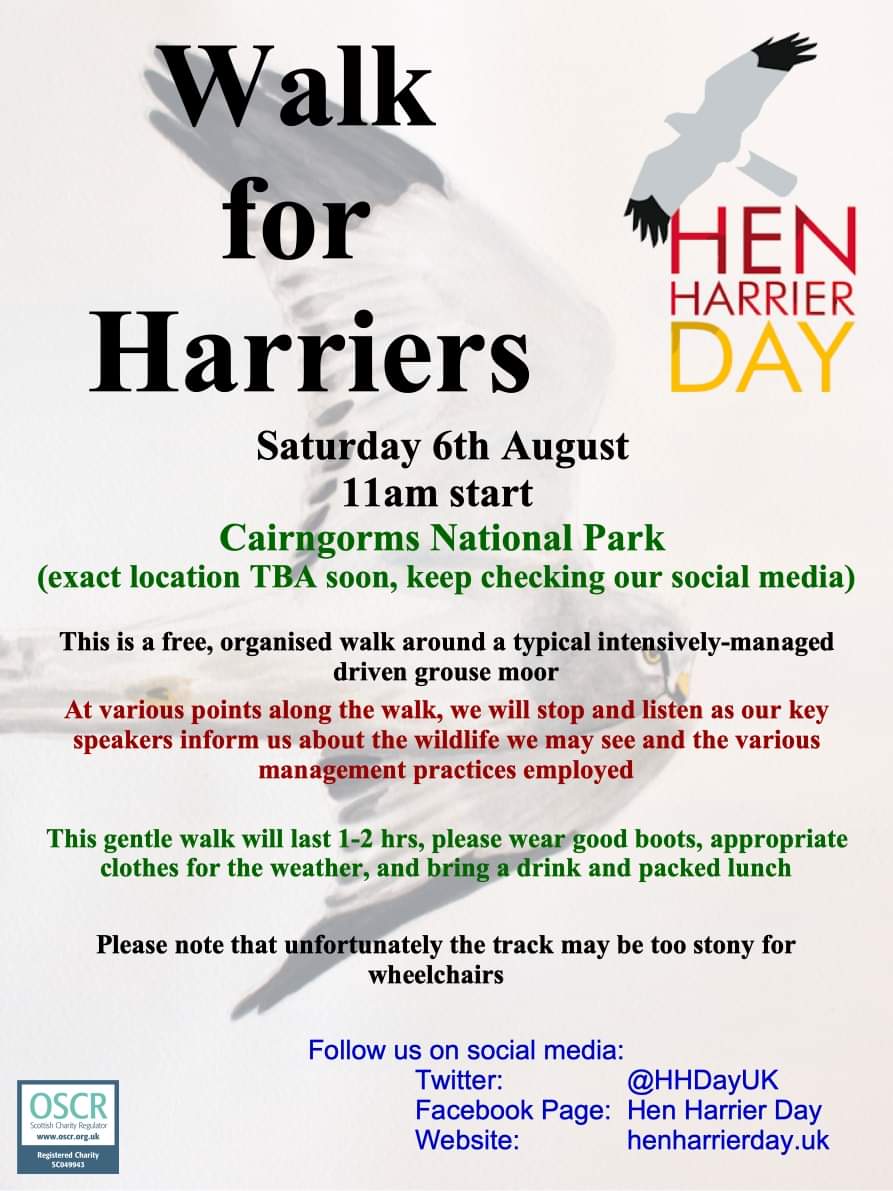
In 2014, Mark Avery and Chris Packham launched the concept of Hen Harrier Day to draw attention to the plight of the hen harrier, timed to coincide with the start of the grouse shooting season on 12th August. Hen Harrier Day has now become an annual event and volunteers Andrea Hudspeth and Andrea Goddard have organised these high profile events in Scotland.
In 2015, with raptor poisoning crimes still occurring, not content that the poisoners had already been given an opportunity to hand in their illegal stashes back in 2011, the Scottish Government launched its second poisons amnesty scheme, ten years after it became an offence to possess these dangerous toxins. How many chances do these gamekeepers get?
Also in 2015, SNH launched its ridiculous Heads up for Hen Harriers project – joining forces with shooting estates to fix nest cameras at hen harrier nests to determine the cause of breeding failures on grouse moors (yes, really!). It was doomed to failure because obviously the gamekeepers on estates where the cameras had been installed would not destroy the harriers/nests (at least not while the birds were within camera range) and the study’s ‘findings’ would then be skewed towards natural predator events and poor weather conditions which the grouse shooting industry would then point to as being the main cause of hen harrier breeding failure on grouse moors. It was nothing more than a greenwashing project.
Also in 2015, Scottish Environment LINK published a damning report demonstrating that wildlife crime enforcement measures were still weak, inconsistent & ineffective, seven years after the HM Inspector of Constabulary published its Thematic Review into the prevention, investigation and prosecution of wildlife crime and its subsequent recommendations to improve enforcement measures. Even today, apart from the RSPB’s meticulous records, it’s virtually impossible to get accurate raptor persecution statistics due to incoherent recording across agencies and Police Scotland’s strange decisions to sometimes withhold information, long after investigations have closed.
Also in 2015, Professor Poustie’s review of wildlife crime penalties was published, making a series of recommendations to substantially increase penalties for certain types of wildlife crime, including raptor persecution.
A year later in 2016, then Environment Minister Dr Aileen McLeod accepted the Poustie Review recommendations to substantially increase penalties for wildlife crime. These were not finally enacted until four years later in the Animals and Wildlife (Penalties, Protections and Powers) (Scotland) Act 2020, increasing the maximum penalty for the most serious animal welfare and wildlife crimes to five years imprisonment and unlimited fines. We have yet to see these utilised by the courts.
Also in 2016 the Scottish Government made a manifesto pledge to establish a Wildlife Crime Investigation Unit as part of Police Scotland. This has not happened and appears to have been quietly dropped.
Also in 2016, the Scottish Raptor Study Group (SRSG) launched a petition to the Scottish Parliament calling for the introduction of a state-regulated licensing system for gamebird shooting. These volunteers who later spoke so passionately and convincingly in front of a televised Parliamentary committee in 2017 were subjected to a barrage of offensive online abuse from a number of gamekeepers and their hangers-on and this hate campaign continues to this day.
[SRSG members Patrick Stirling-Aird, Andrea Hudspeth, Logan Steele and Duncan Orr-Ewing outside the Scottish Parliament building. Photo by SRSG]
2016 also saw what in my opinion was the most significant and important event in the road leading to the introduction of grouse moor licensing. The RSPB published a press release about the suspicious disappearance of eight satellite-tagged golden eagles on grouse moors in the Monadhliaths between 2011-2016. Public outrage about this news, combined with the fact that nobody had ever being successfully prosecuted for killing a golden eagle, led to then Environment Cabinet Secretary Roseanna Cunningham calling for a review of golden eagle satellite tag data to establish whether there was a pattern to the disappearance of tagged eagles and whether there was a link with driven grouse shooting. Of course we all knew there was, but it was significant that the Cabinet Secretary had officially requested the analysis. Predictably, this Government-sponsored review coincided with a concerted smear campaign by the grouse shooting industry to undermine the functionality and reliability of satellite tags and the integrity of the highly qualified and licensed researchers who were fitting the tags to eagles. This continues to this day.
In 2017 the review of gamebird management in other European countries was published, showing that gamebird shooting in the UK was the most unregulated and unaccountable system of all those reviewed. This didn’t result in any direct action from the Scottish Government other than an instruction for the Werritty panel to consider the report’s findings as part of its Grouse Moor Management Review.
Also in 2017 Cabinet Secretary Roseanna Cunningham responded to the public consultation on increased SSPCA powers (3 yrs after the consultation closed!) & rejected it ‘based on legal advice’ which was never explained. As an alternative, she announced a Police Special Constables pilot scheme in the Cairngorms National Park to help detect raptor persecution crimes and bring the offenders before the courts.
The most significant event in 2017 was the publication of the Golden Eagle Satellite Tag Review. This comprehensive and forensic review was devastating, showing that almost one third of satellite-tagged golden eagles (131 of them) had been illegally killed or had ‘disappeared’ in suspicious circumstances between 2004-2016, and there were irrefutable geographic clusters centred on some driven grouse moors:
On the basis of this report, Cabinet Secretary Roseanna Cunningham ordered yet another independent review, this time to assess the environmental impact of grouse moor management and to provide recommendations and options for regulation, including the potential for a licensing scheme. Professor Werritty was appointed to lead the review.
In 2018 REVIVE was launched – a consortium of environmental, social justice and animal welfare groups seeking grouse moor reform in Scotland. The well-attended launch took place in Edinburgh and Chris Packham was the keynote speaker. Inevitably this led to yet another smear campaign by certain elements of the grouse shooting industry which continues to this day.
[Photo by REVIVE]
In 2019 the Police Special Constables pilot scheme in the Cairngorms National Park came to an end in complete failure. They didn’t report a single wildlife crime during this two-year scheme but illegal raptor persecution continued, as evidenced by the RSPB’S annual reports.
In December 2019 the Werritty Report was finally published two and a half years after it was commissioned. It highlighted many of the problems associated with driven grouse moor management but crucially it recommended a further five-year wait before the introduction of a licensing scheme to allow the grouse shooting industry yet more opportunity to oust the criminals within rather than have regulation foisted on it by legislation. This recommendation was clearly a result of having a number of representatives from the grouse shooting industry serving on the so-called independent panel. Meanwhile, the raptor killing continued.
In 2020 MSP Mark Ruskell (Scottish Greens) proposed increased powers for the SSPCA as an amendment in the Animals & Wildlife Bill. The then Environment Minister Mairi Gougeon rejected the amendment but promised to establish a task force later in summer to consider increased powers. Deja vu, anyone?
In November 2020 the Animals and Wildlife (Penalties, Protections and Powers) (Scotland) Act was enacted, increasing the maximum penalty for the most serious animal welfare and wildlife crimes to five years imprisonment and unlimited fines (after the recommendations of the Poustie review published in 2015). This raises the status of some offences to ‘serious’ and thus for the first time allows the Police to seek permission to utilise covert video surveillance in areas where raptor persecution is suspected. I know there is enthusiasm for this from a number of police officers and I look forward to seeing some results.
In December 2020, a year after receiving the Werrity Review, Environment Minister Mairi Gougeon announced the Scottish Government’s intention to introduce a licensing scheme for grouse moors without waiting for a further five years as the review had recommended.
[NB: I understand that Ian Thomson, Head of Investigations at RSPB Scotland will publish a blog later today (26th November 2021) detailing what has happened in the year following this announcement. I will publish the blog here when it’s available]. Update – Ian’s blog available here
In January 2021 the new Environment Minister Ben MacPherson responded to a Parliamentary Question from Mark Ruskell MSP and admits that the promised taskforce to consider increased powers for the SSPCA had not yet formed but was ‘expected later this year’. This is ten years on from when increased powers for the SSPCA was first mooted in the Scottish Parliament.
In September 2021 the Scottish Government published its five-year Programme for Government and it included commitments to deliver the recommendations of the Werritty review, and to establish a taskforce to review increased powers for the SSPCA, to report by the end of 2022. Yet another Environment Minister (the 9th one?) is in post – Mairi McAllan.
In October 2021 the ridiculous Heads Up for Hen Harriers ‘partnership’ project was closed, with SNH declaring it a ‘success’. It wasn’t, at all. I’ll be blogging about this separately in the next few days.
Meanwhile, in May 2021 a young golden eagle was found deliberately poisoned, lying dead next to a poisoned bait, on an Invercauld Estate grouse moor inside the Cairngorms National Park. Sixty-seven years after raptors gained legal protection and 23 years after Donald Dewar declared raptor persecution in Scotland ‘a national disgrace’, golden eagles and other raptors are still being illegally killed on some driven grouse moors.
[The poisoned golden eagle, next to the poisoned hare bait, on a grouse moor on Invercauld Estate in the Cairngorms National Park in May 2021. Photo by RSPB Scotland]
So despite all this campaigning and political movement, nothing has changed on the ground. Golden eagles (and other raptor species) are still being killed on grouse moors, even inside the Cairngorms National Park, and still not one person has been successfully prosecuted.
It’s shameful that we, ordinary members of the public, have to campaign just to have the law upheld, but its even more shameful that despite decades of compelling evidence, the Scottish Government has still not taken effective action against the criminals within the driven grouse shooting industry.
Even so, we should absolutely celebrate how far we have come, and it’s been hard work and at great personal cost to many, but don’t underestimate just how much more work there is to come.