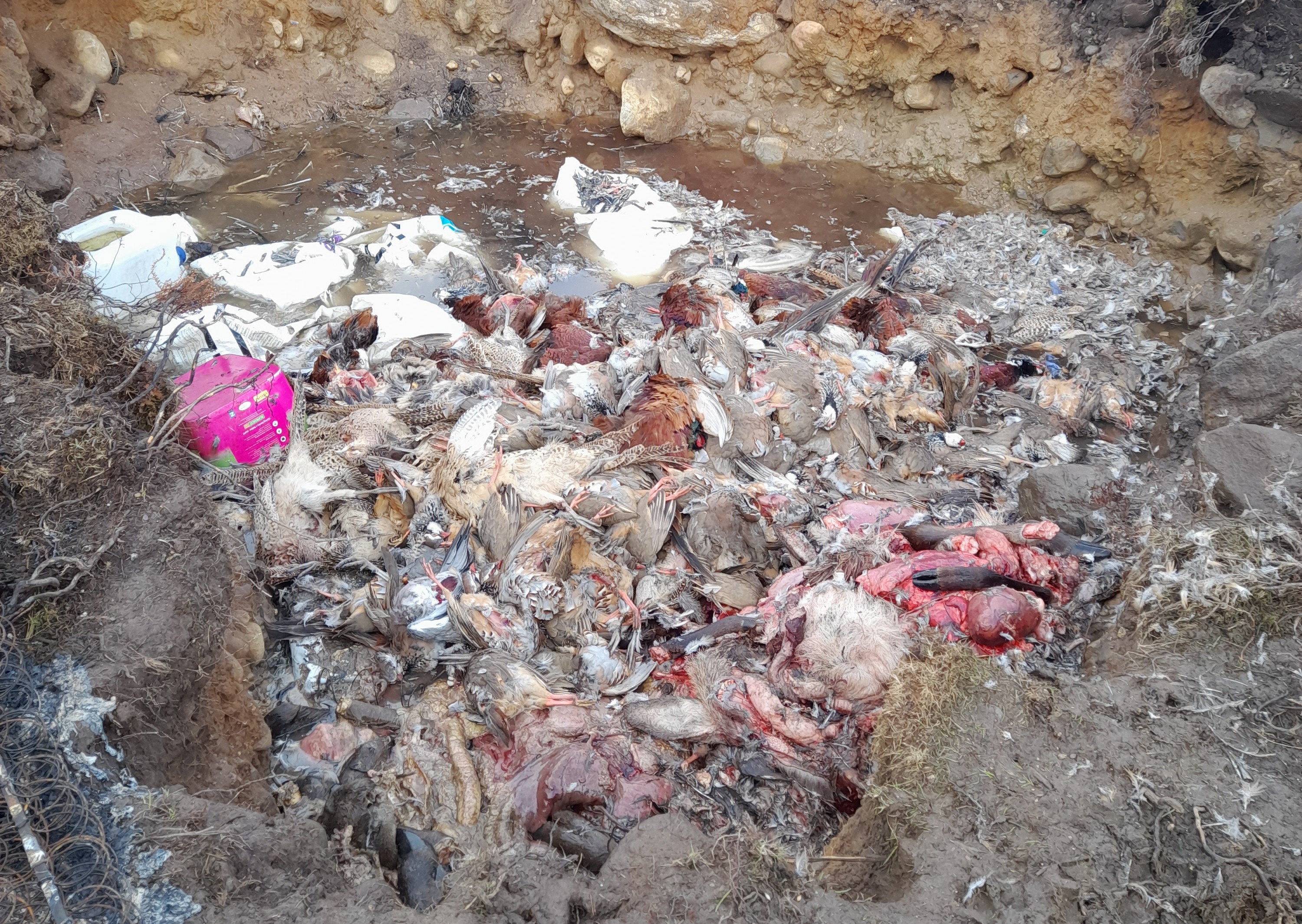
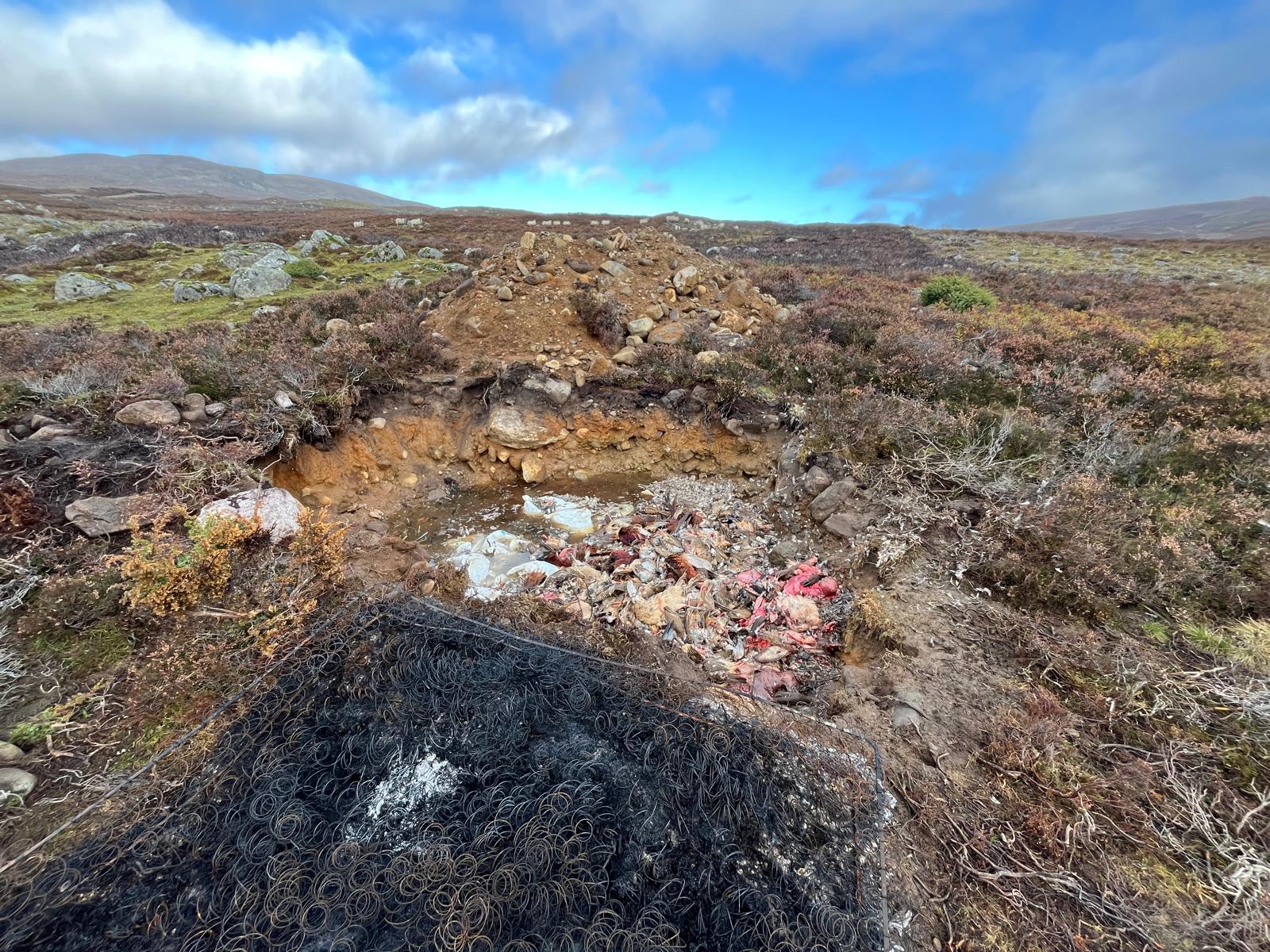
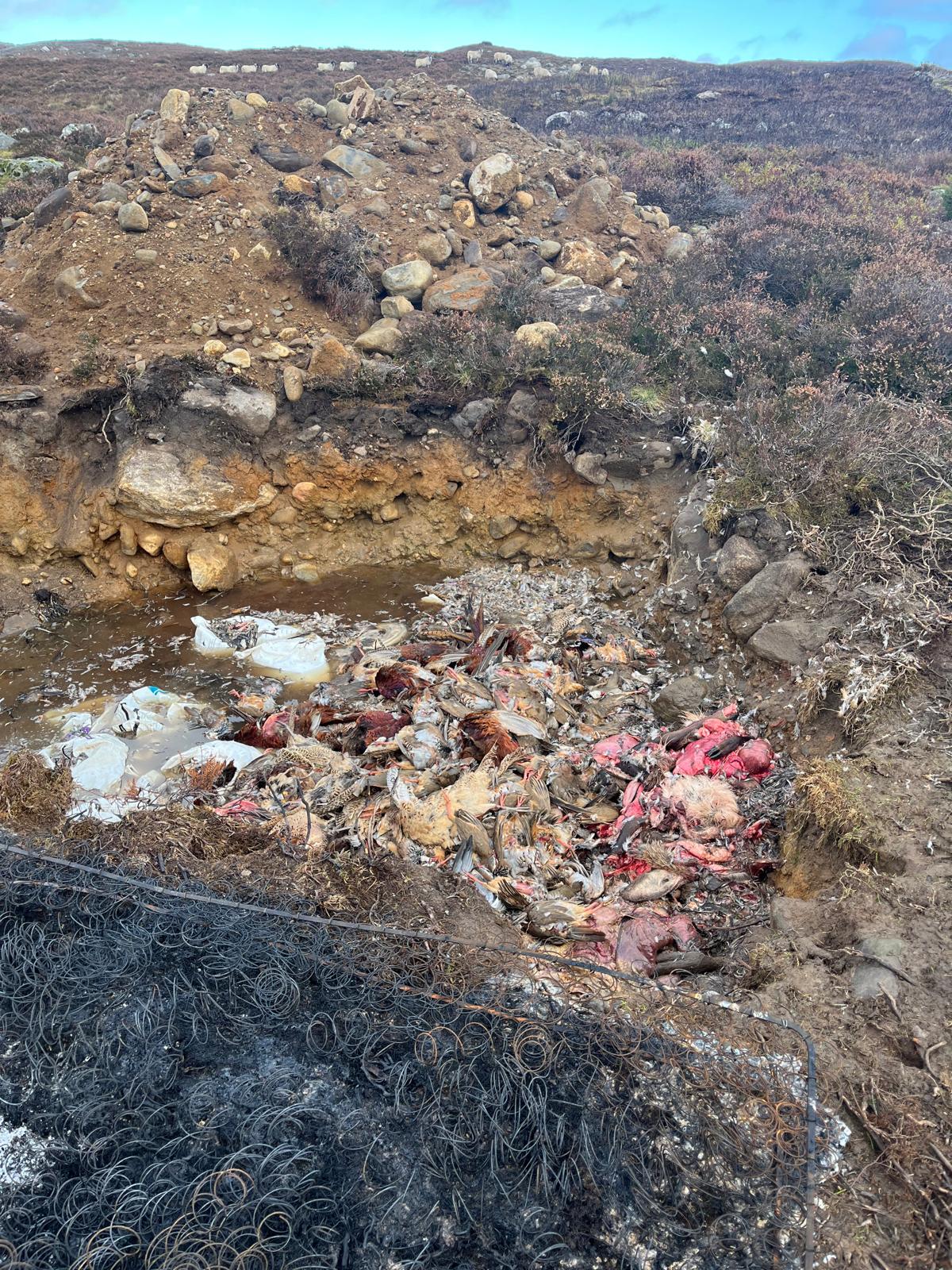
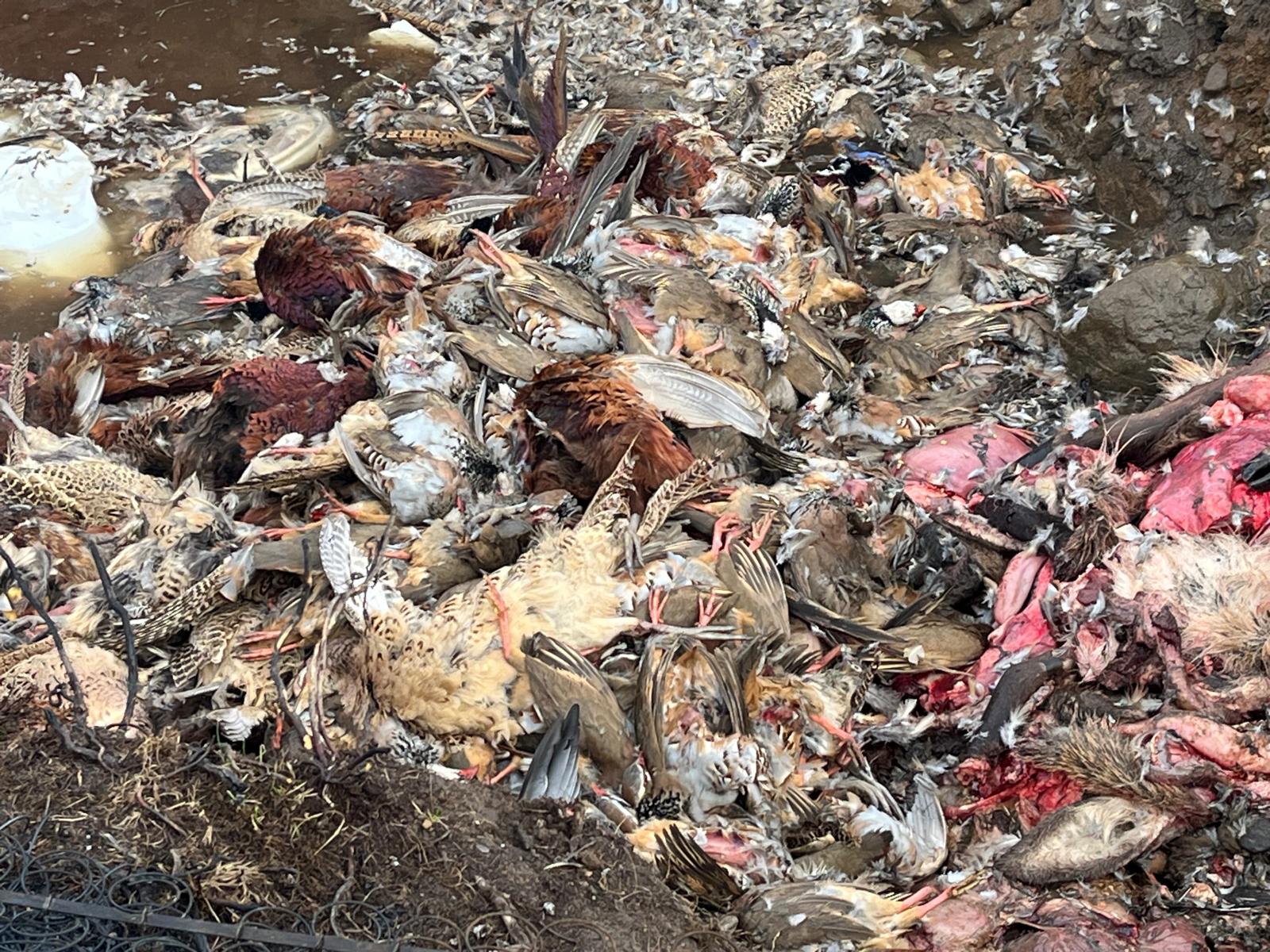
A large pit containing dead Pheasants, Red-legged Partridges, Wood Pigeons, deer parts, and a lot of rubbish, including a burnt mattress, has been found on a shooting estate in the Cairngorms National Park.
Last October, a blog reader was walking on the Glenbanchor and Pitmain Estate, to the north of Kingussie when they saw what they described as “an estate vehicle” tipping dead birds in to an area at the side of a track that was concealed behind a spoil heap.
The walker returned to the site once the vehicle had left and took these photographs:
It appears that at least some of the gamebirds have been ‘breasted out’ – their breast meat removed, presumably for sale/consumption, and the carcasses then dumped in the pit.
Regular blog readers will know that the dumping of shot gamebirds is a common and widespread illegal practice that has been going on for years, despite the repeated denials by the shooting industry. Often they’re fly-tipped by the side of the road (e.g. see here).
In this case, the pile of rubble on site suggests that this is a burial pit, and perhaps the burnt mattress is used to cover the pit temporarily, in between dumping visits.
The blog reader reported this incident to SEPA (Scottish Environment Protection Agency) to see whether an offence had been committed but SEPA apparently thought ‘they’re subject to a waste disposal exemption’ and therefore this doesn’t constitute a crime.
It’s hard to believe that dumping gamebirds for burial is legal, especially when the country is in the grip of Highly Pathogenic Avian Influenza, but the regulations are very confusing.
I’ve done a bit of research on this but I’m still not sure which regulations apply and which don’t.
If the gamebird carcasses are classed as animal by-products (and there are questions around that – it’s complicated!) then disposing of them by burial is unlawful due to the risk of spreading disease through residues in the soil, groundwater or air pollution (Animal By-Products (Enforcement) (Scotland) Regulations 2013).
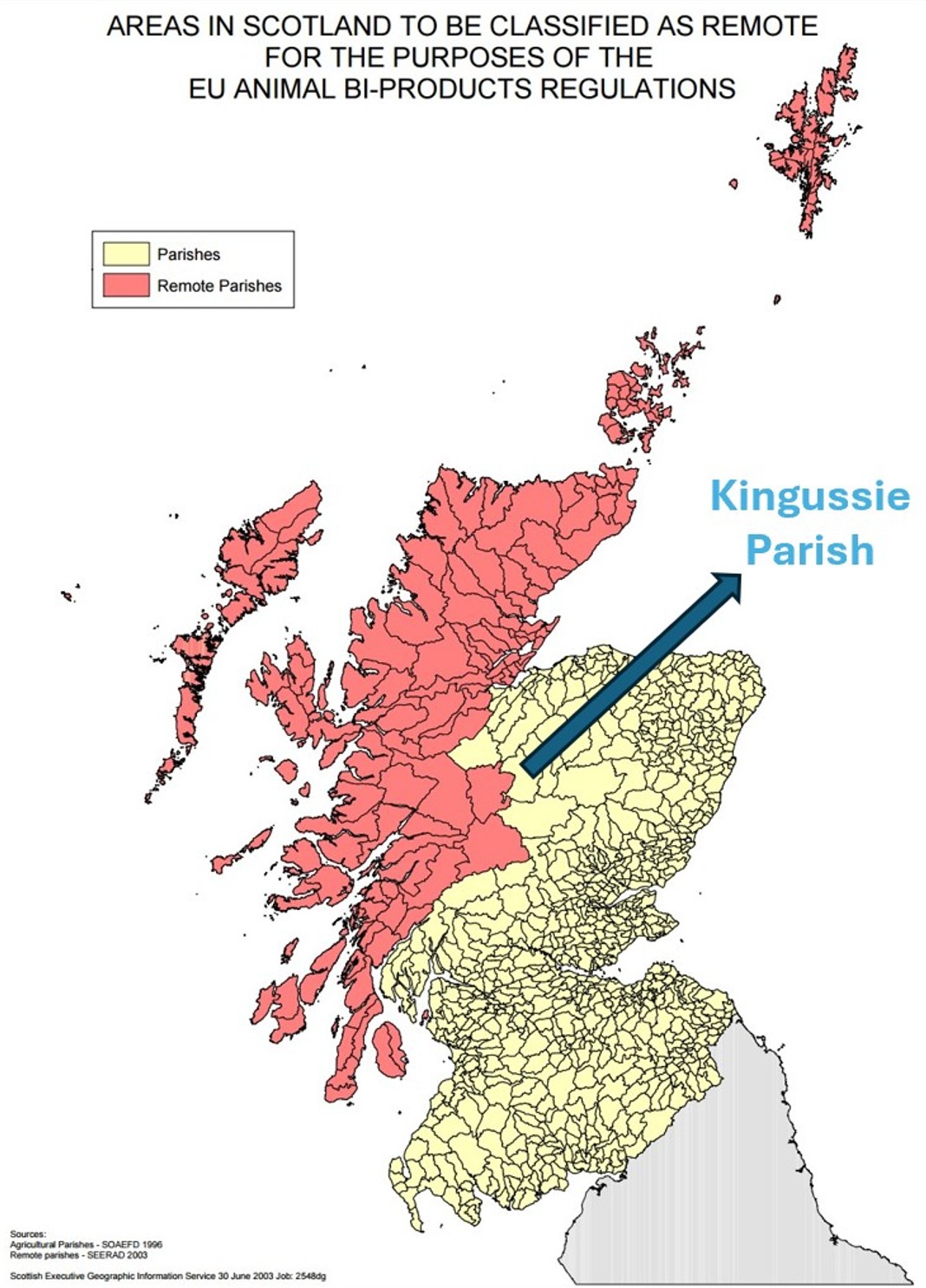
There are exemptions, in areas of Scotland classed as ‘remote areas’. However, the location of this particular pit lies outside the ‘remote area’ and so an exemption wouldn’t apply:
I need to do some more work on this, and talk to the local authority (Highland Council) who I believe would be responsible for enforcement of any breaches of the Animal By-Products legislation.
But whether this is legal or illegal, it’s ethically appalling.
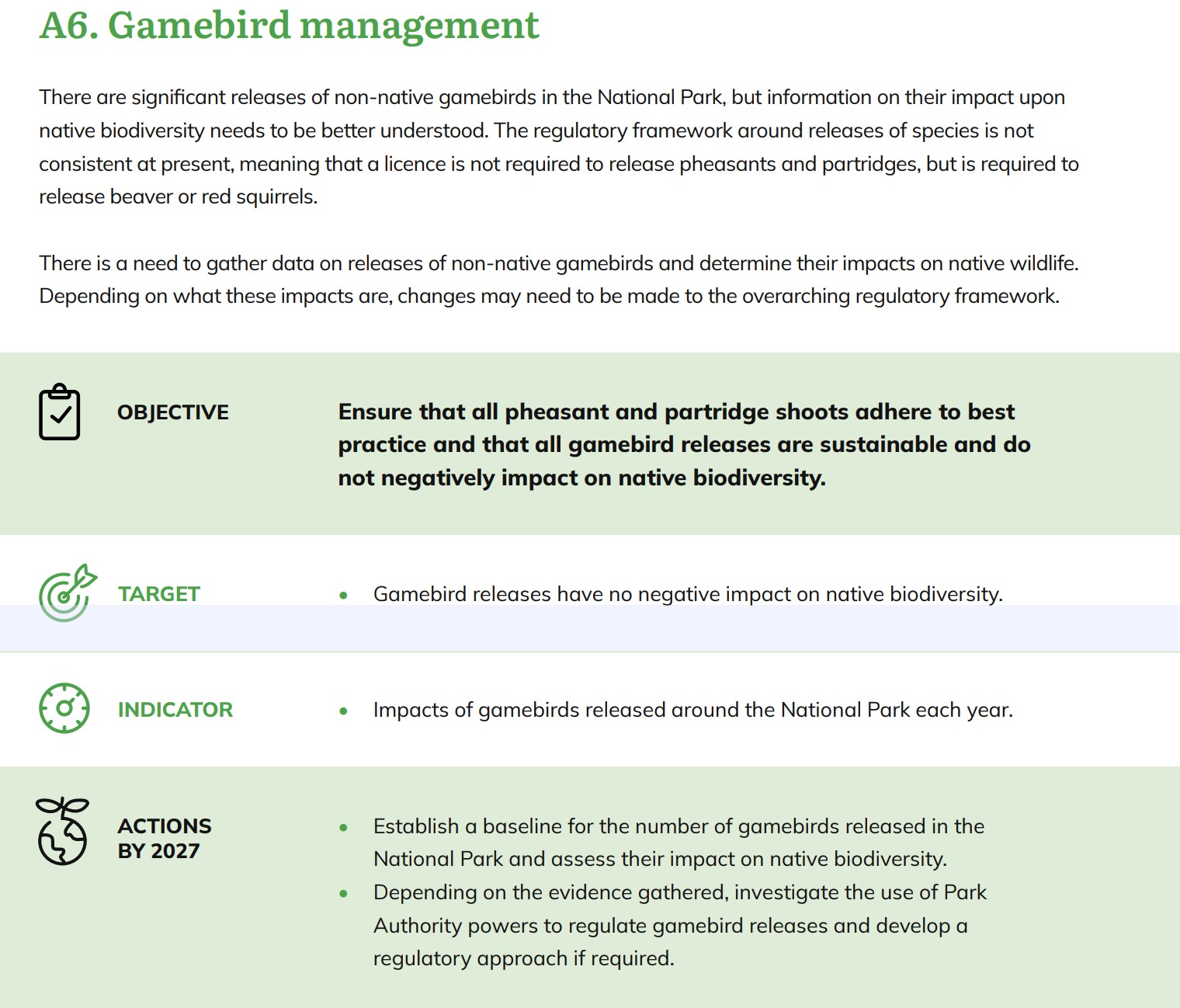
And I dare say the Cairngorms National Park Authority will be taking note, given its stated intention to:
‘Ensure that all pheasant and partridge shoots adhere to best practice and that all gamebird releases are sustainable and do not negatively impact on native biodiversity‘
and
‘Depending on the evidence gathered, investigate the use of Park Authority powers to regulate gamebird releases and develop a regulatory approach if required‘ (see here).
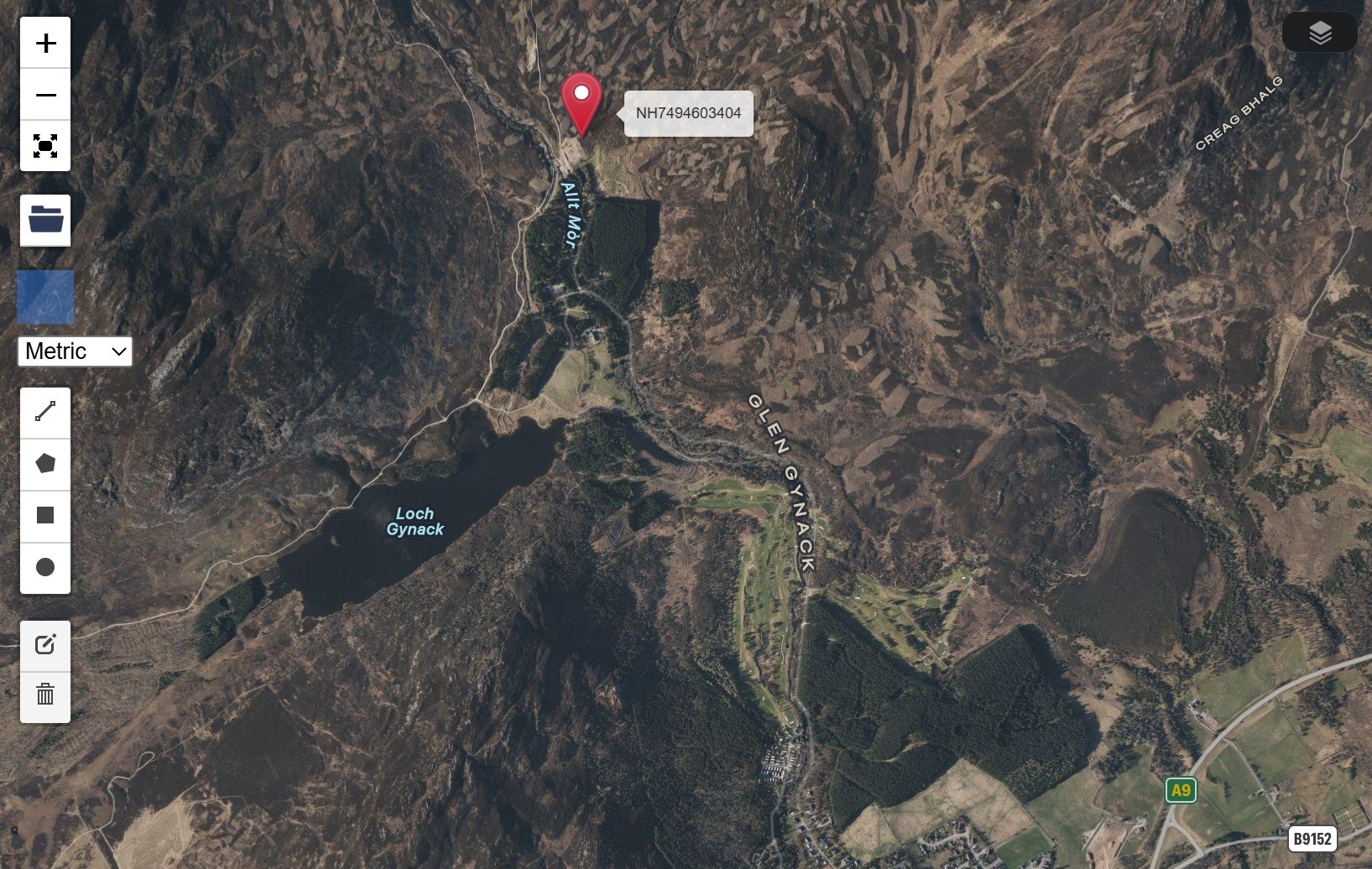
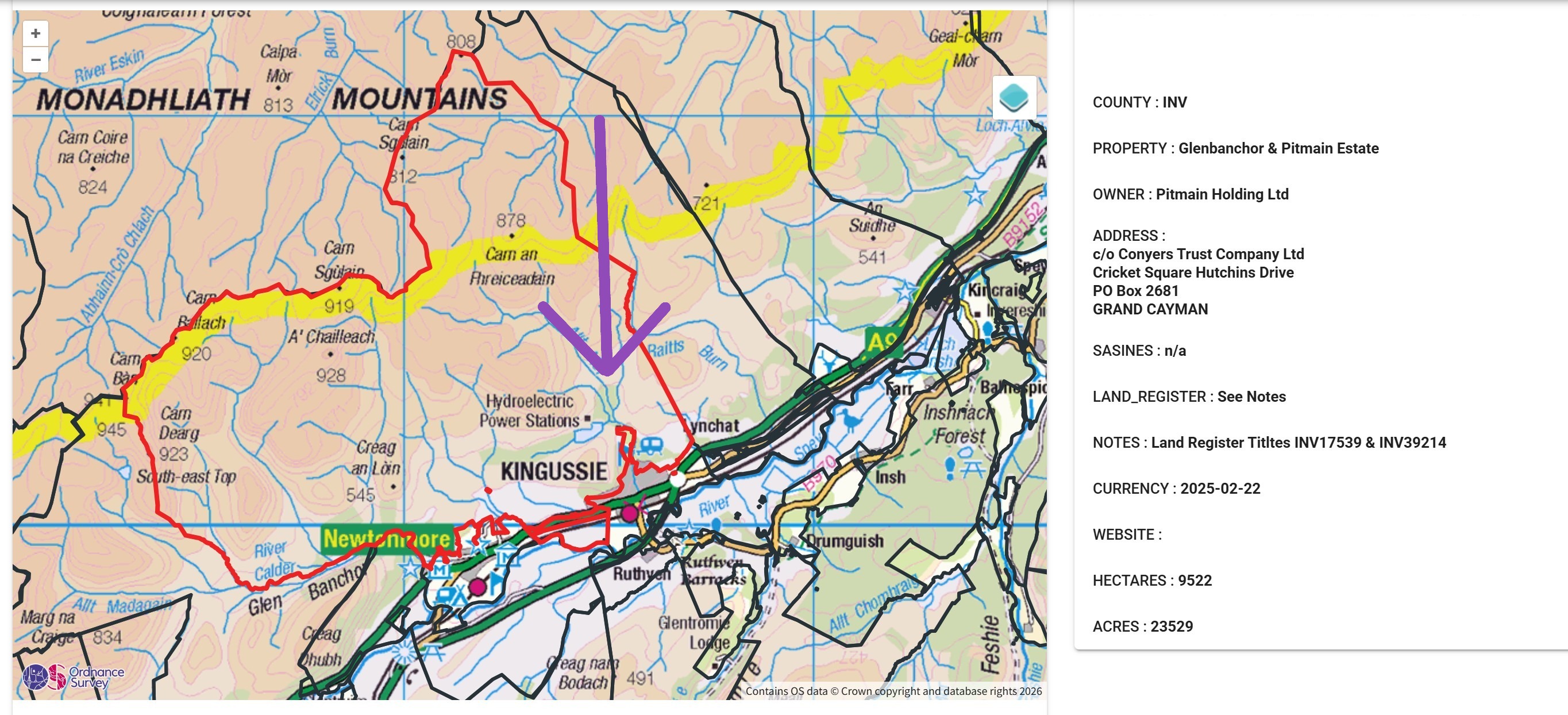
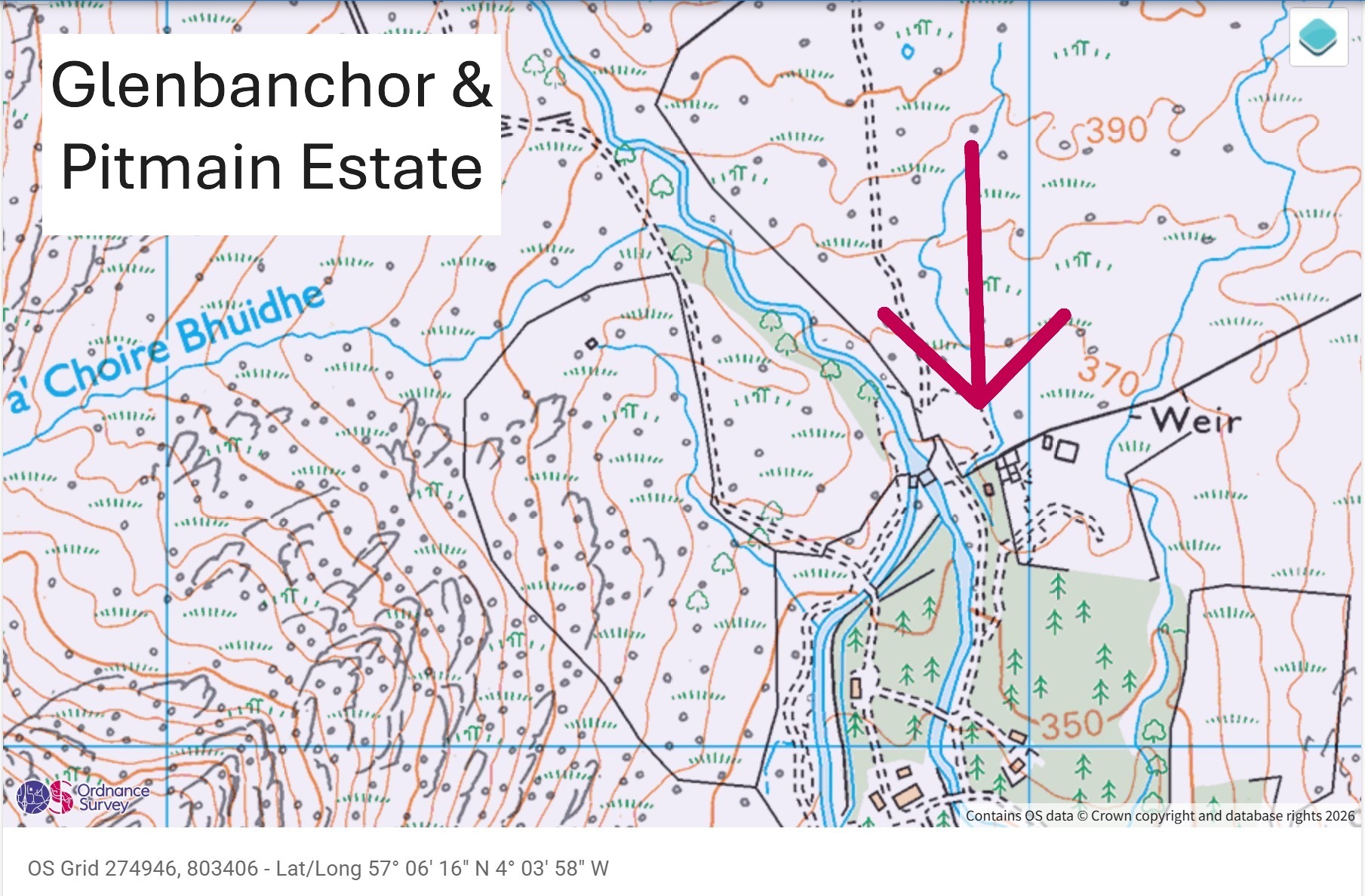
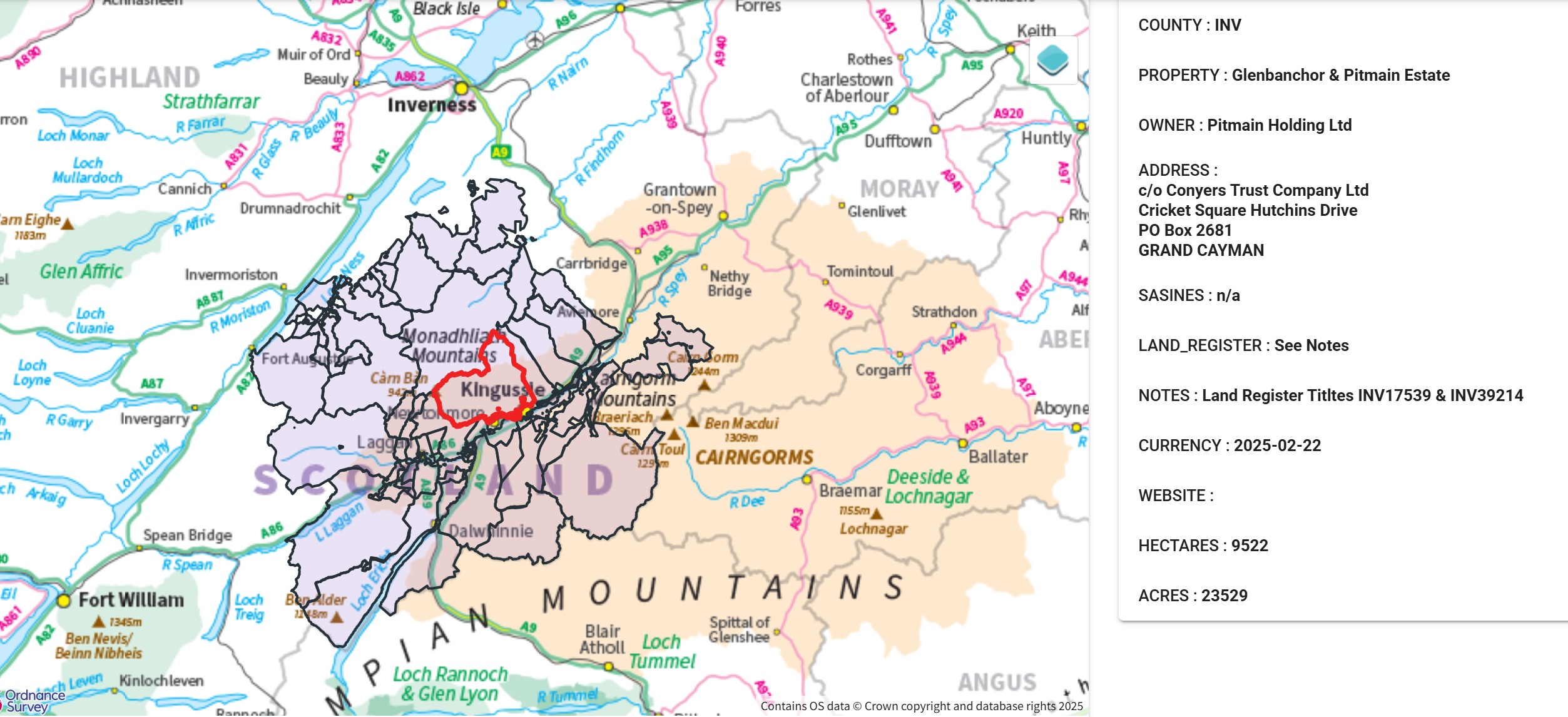
For the benefit of the Cairngorms National Park Authority, and anyone else who wants to take a look, here are the location details of the pit (estate boundary sourced from Andy Wightman’s Who Owns Scotlandwebsite):
It’s my understanding that NatureScot is currently considering whether police evidence about an unrelated alleged wildlife crime on this estate is sufficient to impose a three-year General Licence restriction (see here).
You may also not be surprised to hear that this isn’t the only gamebird-dumping pit that’s been found on a sporting estate in Scotland….details to follow.
Following the appalling news over the last couple of days about the highly suspicious, and almost certainly criminal, disappearance of three satellite-tagged White-tailed Eagles here, here and here, there has, as usual, been complete silence from the land management sector, with the exception of Scottish Land & Estates, who commented that, “land managers in Moorfoots have been helping police with the search and will continue to provide whatever help they can as the investigation progresses“.
As for the other shooting organisations, who so often claim to have a zero tolerance stance against raptor persecution, there’s been no comment and no condemnation. Nix. Nada.
As a reminder, all of those organisations (except the Moorland Association, whose CEO was booted off for spreading misinformation) are members of the police-led Raptor Persecution Priority Delivery Group (RPPDG) – a so-called ‘partnership’ whose function includes ‘awareness raising‘ and ‘raising the profile [of illegal raptor persecution] via media exposure‘. Not a single word.
In contrast, the often very reserved RSPB has not only expressed its disgust, but it has put its money where its mouth is and is offering a reward of £10,000 for information leading to a conviction of those involved. This is welcome news for all of us who have not only enjoyed seeing these birds occupying their rightful place in UK skies, but also for those of us who are sick to the back teeth of the relentless killing of protected birds of prey across our countryside.
Juvenile White-tailed Eagle, photo by Pete Walkden
However, it turns out that it hasn’t just been the three White-tailed Eagles from the England re-introduction project that have disappeared in recent months. The bottom of the RSPB article, linked above, reveals some new information:
‘Further to the suspicious disappearance of these three White-tailed Eagles, a fourth bird, fledged from a nest in Perthshire in 2024, disappeared on a grouse moor in Nairnshire in May this year. A police search took place but neither bird nor tag were found.
This was the latest of nine tagged birds of prey, including two other White-tailed Eagles, whose tags were functioning as expected, to suddenly disappear in the northern Monadhlaith area of Inverness-shire and Nairnshire since 2018. These disappearances have occurred in an area where multiple confirmed incidents of poisoning, shooting and illegal trap use have been recorded’.
FFS.
I can’t see why it’s taken seven months for this news to emerge, but it doesn’t make it any less appalling.
As the RSPB article suggests, this area of Inverness-shire and Nairnshire is horrific for bird of prey killings and for the suspicious disappearances of tagged raptors.
This latest White-tailed Eagle to vanish is the third in the area since 2019 (e.g. see here), adding to a long history of tagged Golden Eagle disappearances here dating back 15 years (and leading to the Scottish Government commissioning its review of the fates of satellite-tagged Golden Eagles back in 2016).
Numerous other incidents have been uncovered in this same area in recent years, close to the NW boundary of the Cairngorms National Park. These have included the shooting of a Sparrowhawk on Moy Estate (for which a gamekeeper was later convicted, here), the discovery of a poisoned Red Kite in the Moy area, here, and the discovery of a shot Red Kite on Lochindorb Estate, here.
Needless to say, the vast majority of those incidents, including the disappearance of the White-tailed Eagle in May, were on grouse moors.
Perhaps the local wildlife criminals were emboldened by NatureScot’s watering-down of the new grouse shoot licence last autumn?
At least that issue appears to have been sorted by a Government amendment to close the loophole, which recently passed Stage 2 of the Natural Environment (Scotland) Bill…but I’ll write about that in another blog.
For now, we have four missing White-tailed Eagles (all vanishing from areas managed for gamebird shooting, whether that be lowland Pheasant & Partridge shooting or upland Grouse shooting), two missing Golden Eagles (also vanishing from areas managed for gamebird shooting), and I’ve lost count of the number of missing Hen Harriers, also vanishing from areas managed for gamebird shooting.
I’ll be updating the Hen Harrier Missing/Dead List over the Xmas period when I’ll have some time…there are still some more to add to the 143 Hen Harriers we already know about.
Following on from this morning’s blog about the start of a two-day trial at Aberdeen Sheriff Court today for two gamekeepers accused of alleged offences relating to the illegal killing of Red Kites in the Cairngorms National Park earlier this year (here), it barely got going before being adjourned until next year.
The Sheriff made a declaration of being a monthly subscriber to the RSPB, which resulted in the two defence KCs (King’s Counsel) lodging a motion that the Sheriff should consider recusing himself because the ‘public might perceive some bias’.
After giving the motion some consideration, the Sheriff agreed to stand down because this case involves RSPB staff members as witnesses for the prosecution.
Unfortunately, no other Sheriff was available immediately to hear the case, so it has been adjourned.
We’ve seen this before, in the trial against another Aberdeenshire gamekeeper back in 2012, where the presiding Sheriff was a member of the RSPB and the defence counsel suggested she should stand down, which she did (see here).
It’s frustrating, and a colossally inefficient use of public money, (and presumably adds extra cost for the defence – KCs don’t come cheap) but inefficiency seems to be a hallmark of the judiciary and it is what it is.
The important issue is that the case is decided on the strength of the evidence, not the perceived bias of a presiding Sheriff.
The case will return to the court in April 2026, this time listed as a four-day trial.
NB: Comments are turned off as legal proceedings are still live.
A trial is underway today at Aberdeen Sheriff Court where two gamekeepers are accused of alleged offences in relation to the illegal killing of Red Kites in the Cairngorms National Park earlier this year.
Red Kite. Photo by Ronnie Gilbert
A Head gamekeeper and an assistant gamekeeper were charged in May 2025 ‘in connection with wildlife offences following enquiries into the death of red kites in the Strathdon area of Aberdeenshire in February, 2025′ (see here).
This is believed to be related to the discovery of a shot Red Kite in the Glenbuchat area of Strathdon between 3rd and 4th February 2025 (see here).
The trial has been scheduled for two days.
NB: Comments turned off as legal proceedings are live.
UPDATE 18.20hrs: Alleged killing of Red Kites in Cairngorms National Park – trial of two gamekeepers adjourned as Sheriff recuses himself due to RSPB membership (here)
In spring 2025, news emerged that the GWCT (Game & Wildlife Conservation Trust) was going to be conducting a pilot study to look at the number of non-native gamebirds (Pheasants & Red-legged Partridges) being released into the Cairngorms National Park (see here).
Unhealthy-looking Pheasant poults being transported to a release site. Photo by Ruth Tingay
This research represents the first step of a commitment made by the Cairngorms National Park Authority in its 2022-2027 Partnership Plan to assess the impact of these non-native species on habitats and native wildlife (see here for an hilarious video of a 2021 Park Board meeting where certain members tried to block the idea).
Here’s the relevant information page from the CNP’s current Partnership Plan:
The GWCT’s report was published in August 2025 but to be perfectly honest, it’s somewhat underwhelming (report available for downloading at foot of this blog).
The most significant limitation, in my view, is that the report only includes data from ten of at least 22 sporting estates known to be rearing and releasing gamebirds for shooting within the Park’s boundary. That’s only 45%, not even half of the estates involved in gamebird releases, and there is no indication of how representative those ten estates are.
That’s not a criticism of the study’s authors – they are upfront about this significant constraint and they had tried to include information from the 22 estates that they had been told were rearing and releasing gamebirds within the Park, but three shoots were in the process of changing management so were unable to answer questions, two shoots were ‘too busy’ at the time the interviews were scheduled, and seven shoots refused to participate.
I do have a criticism of the study design. To identify the estates rearing and releasing gamebirds in the CNP, the authors used their existing contacts as well as a ‘snowball sampling’ strategy, where participants suggest other potential participants. However, since 2006 it has been compulsory to register with the Animal Plant & Health Agency’s (APHA) Poultry Register when more than 50 gamebirds are released. It is entirely feasible to submit FoIs to APHA to access those data based on postcodes or council areas, just as Guy Shrubsole did in England. I wonder why the GWCT didn’t use this approach? Perhaps they suspected that compliance with the Register might be low and they didn’t want to draw attention to it?
Going forward, as more work is most definitely needed, researchers can access the Government’s Scottish Kept Bird Register, which replaced the Poulty Register in Scotland in 2024 and also requires mandatory reporting. There’s no reason that staff at the Cairngorms National Park Authority, or indeed anybody reading this blog, couldn’t request data covering the National Park.
Due to the limited number of estates available/willing to participate in the study, the authors relied on data from the National Gamebag Census (a voluntary reporting scheme used by some shoots to record the number of birds killed during a shoot season) to compare the number of gamebirds they’d been told were being released on ten shoots in the CNP with release densities in the wider Scottish countryside and also in England.
One of the study’s headline claims was that across ‘all’ shoots in the CNP (meaning just the ten participating estates), the total number of birds released in seasons 2022/3, 2023/4 and 2024/5 were 50,900, 61,200 and 49,800 Pheasants and 8,000, 36,000 and 29,240 Red-legged Partridges. The report states that the release densities “are lower than those reported from Scotland as a whole“.
The problem with this headline claim is that the results will be, and have already been, either genuinely misunderstood or deliberately misrepresented, without reference to the pretty big constraints in data sampling as discussed above.
I heard an MSP reference this report several times during a Parliamentary debate earlier this week (more on that shortly because it was really interesting) and it was inferred that the report’s findings related to gamebird releases in the whole of the Cairngorms National Park, not just the small number of estates that actually participated in the study, representing less than half of the known shoots and whose representative value is unknown.
I would like to see the briefing notes given to that MSP by the gamebird shooting industry to see whether they have deliberately misrepresented the study’s findings or whether the MSP has just genuinely failed to grasp the details. I will return to this topic.
Of wider importance, the question now is, what will the Cairngorms National Park Authority do with the findings of this report it commissioned?
One of the ‘Actions by 2027’ outlined in the Park’s 2022-2027 Partnership Plan is to ‘Establish a baseline for the number of gamebirds released in the National Park and assess their impact on native biodiversity‘.
Given that it’s now the end of 2025 and it’s still not known how many non-native gamebirds are released within the National Park boundary, let alone what their impact may be on native species, I’d say meeting this deadline looks unlikely.
Earlier this month the Scottish Government announced a delay, for the second time, of the implementation of muirburn licensing after caving in to pressure from aggressive lobbying by the grouse shooting industry (see here).
The very same day this announcement was made, prescribed muirburn, started (legally) by gamekeepers on a grouse moor in the Cairngorms National Park, got out of control and developed in to a wildfire, causing damage to the neighbouring Muir of Dinnet National Nature Reserve (see here and here).
A blog reader has sent in this photo of the aftermath of that fire, showing part of the torched moorland and an ‘information’ board that stands nearby, apparently produced by the Grampian Moorland Group (gamekeepers) and endorsed with the logos of a number of shooting industry organisations, as well as the Cairngorms National Park Authority. I doubt it’s meant to be ironic, but it is.
The text on that ‘information’ board deserves close attention, so here’s a zoomed-in version for your amusement:
Many other grouse moors have also been torched this month – standard practice at this time of year and set to continue for the next six months until the muirburn season ends on 31 March 2026.
Imagine that! Six months of setting fire to one of the most sensitive and important habitats for carbon sequestration, in the middle of a climate emergency, with the blessing of a Government that is ignoring the will and intent of the Scottish Parliament by delaying the implementation of the Wildlife Management & Muirburn (Scotland) Act 2024. And all because it doesn’t want to upset wealthy landowners. It’s astonishing.
Grouse moor set alight on Invercauld Estate, Cairngorms National Park, Oct 2025 (photo from blog reader)
Grouse moor set alight in the Monadhliaths, Oct 2025 (photo from another blog reader)
Had the Scottish Government adhered to the will of Parliament, the torching of grouse moors, carried out to increase the number of Red Grouse available for shooting, would not be happening.
Muirburn licensing, which would only permit the fires under very limited circumstances (and not for the purpose of increasing Red Grouse stocks for shooting), was supposed to have been in place by the start of the 2025/2026 muirburn season on 15 September 2025, following the Scottish Parliament voting in favour of it 18 months previously.
However, in June 2025 the Scottish Government announced it was delaying implementation until 1 January 2026 because the grouse shooting industry had laughably argued that it wasn’t practical or fair for the licences to begin in September 2025 (see here).
Since then, the grouse shooting industry has continued its lobbying and now wants the licences dropped altogether because of what it calls the ‘need’ for muirburn to ‘control the fuel load’ – the amount of combustible vegetation which could influence the intensity and spread of wildfires. The lobbying was successful, leading to Minister Jim Fairlie’s announcement earlier this month that licensing would now be delayed until the start of next year’s muirburn season in autumn 2026.
But as Scottish Greens MSP Ariane Burgess pointed out,
“During the scrutiny of the Wildlife Management and Muirburn Act we took detailed evidence on the role of muirburn in wildfire risk. There is very little credible evidence to support the hunting and shooting lobby’s ridiculous claim that these practices have any role in preventing wildfires“.
This theme continues today in another excellent blog written by Professor Douglas MacMillan and posted on the Parkswatchscotland website. Professor MacMillan shows compelling evidence that ‘the practice of muirburn actually made no difference to the extent of the Dava mega-fire‘.
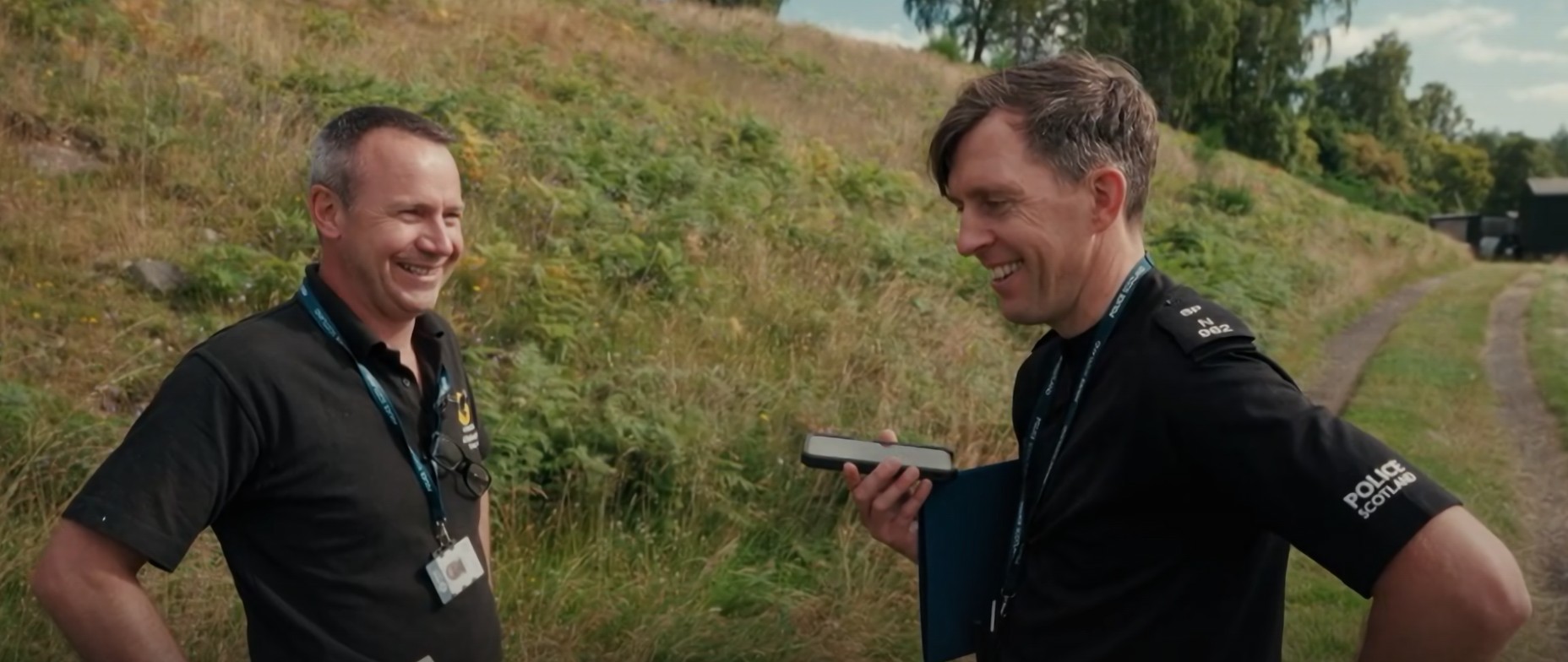
The BBC’s Highland Cops programme has entered its third series and episode 2 features the police investigation in to an active Goshawk nest that had been shot out on a sporting estate near Kingussie, on the western side of the Cairngorms National Park.
This investigation took place in June 2024 – see here for the police’s appeal for information at the time.
Screengrab from BBC Highland Cops programme
Officers had received a report of the active Goshawk nest being found abandoned in suspicious circumstances in a forest near Loch Gynack, and the programme follows experienced wildlife crime officer PC Dan Sutherland throughout his investigation.
The commentary from Dan is excellent – he speaks calmly and with authority about the link between illegal raptor persecution and gamebird shooting estates, and how the criminals have been getting away with their crimes for so long. That’s not opinion or conjecture, it’s based on factual evidence, and I applaud him for being prepared to say it on camera, knowing full well that it will attract vicious retaliation from some within the gamebird shooting industry, including, I have no doubt, official letters to his superior officers demanding punitive action against him.
Dan visits the abandoned Goshawk nest where he finds empty shotgun cartridges at the base of the tree and a shotgun wad is found lodged in the bottom of the nest.
The nest is removed for forensic examination, along with several nearby tree branches. They’re taken to the Kincraig Wildlife Highland Park for x-rays, which reveal a large number of shotgun pellets:
As Dan says, the evidence is damning.
He then teams up with PC Gavin Ross from the National Wildlife Crime Unit (NWCU) and they set out to visit all the people who legally own shotguns in the area, to either rule them out of the enquiry or to see if they can provide assistance.
The first person they visit is a gamekeeper who lives on the estate. They knock at his house and a woman speaks to them through a crack in the door, telling them he’s not in. As the officers leave to go and visit the next person on their list, Dan gets a phone call from a solicitor who tells him that none of his clients will be talking to the police without him being present.
“It’s the nature of the beast”, says Dan.
Dan and Gavin comment to one another that the speed of the solicitor’s phone call is probably some kind of record – coming in less than ten minutes after they’d knocked on the gamekeeper’s door. Their wry smiles tell you this is a common occurrence and was not unexpected. It puts a halt to their investigation until they can organise a time to meet with the shotgun owners and their legal representative.
PC Gavin Ross & PC Dan Sutherland take a call from the gamekeeper’s solicitor (screengrab from BBC Highland Cops).
If someone had shot out a Goshawk nest on my land, potentially killing any adults or chicks present on the nest, and the police knocked on the door to see if I could assist, I’d be welcoming them in with open arms, breaking out the tea and posh biscuits and offering up all the assistance I could muster to help them find the culprit, especially if there was evidence that armed criminals had been active on my property. I certainly wouldn’t be calling in my attack dog solicitor to warn off the cops. Why would I?
At the end of the programme there’s an update on the case – the police did meet with the shotgun owners and their solicitor. The text on the screen says:
‘However, with no new leads the case has been closed‘.
I guess it was probably the usual ‘no comment’ interviews, then.
According to Andy Wightman’s excellent Who Owns Scotland website, Loch Gynack is situated on the Glenbanchor & Pitmain Estate, whose owner, Pitmain Holding Ltd, is registered in Grand Cayman:
It’s not the first time a police investigation has taken place there in relation to suspected wildlife crime. In 2019, four Greylag Geese were found poisoned at Loch Gynack – toxicology results showed they’d ingested the banned pesticide Carbofuran, so dangerous that it’s an offence to even possess this chemical in Scotland, let alone use it.
The birds had been found by estate workers who reported the incident to the police. There wasn’t any information about whether poisoned bait had been discovered and so no information about where they’d come in to contact with the Carbofuran, although given how fast-acting it is and the fact the geese were found dead together in one place, I’d think it unlikely they’d been poisoned far away.
Nobody was charged and the estate was not subject to a General Licence restriction.
Back to the Goshawk case…
The police were first notified about the abandoned Goshawk nest on 8 June 2024. This was after the enactment of the Wildlife Management & Muirburn (Scotland) Act 2024 on 30 April 2024, which introduced a licence for grouse shooting in Scotland.
I don’t know whether the Glenbanchor & Pitmain Estate applied for a grouse shooting licence in 2024. I don’t even know if they still shoot Red Grouse there (they certainly have done previously – e.g. see here and here) or whether they’ve switched to Red-legged Partridges and Pheasants as alternative quarry due to low grouse stocks, in which case they’d be exempt from needing a grouse shooting licence because the Scottish Government refused to include the shooting of RLPs and Pheasants as part of the requirement for a grouse shooting licence, despite being warned about this massive loophole.
It would be interesting to know whether (a) Pitmain Estate did apply for a grouse shooting licence in 2024, (b) if so, did NatureScot grant them a licence even though this wildlife crime investigation was ongoing, and (c) if the estate does have a five-year grouse shooting licence, will the licence be withdrawn following this incident or was the Goshawk nest beyond the area where the licence applicant indicated Red Grouse are ‘taken or shot’ (yet another loophole)?
Aside from the questions around a potential grouse shooting licence, I’ve been interested in whether NatureScot would impose a General Licence restriction following the police investigation in to the shot out Goshawk nest.
In June this year I submitted an FoI to NatureScot to ask about the status of any pending General Licence restriction decisions. My main focus was on the case concerning a Golden Eagle called ‘Merrick’ who had been shot and killed whilst she was sleeping in the Scottish Borders in October 2023.
You’ll already know that NatureScot has still not made a decision on whether to impose a General Licence restriction as a result of that crime, two years after it happened (see here).
But as well as asking about the Merrick case, I also asked how many other cases were pending.
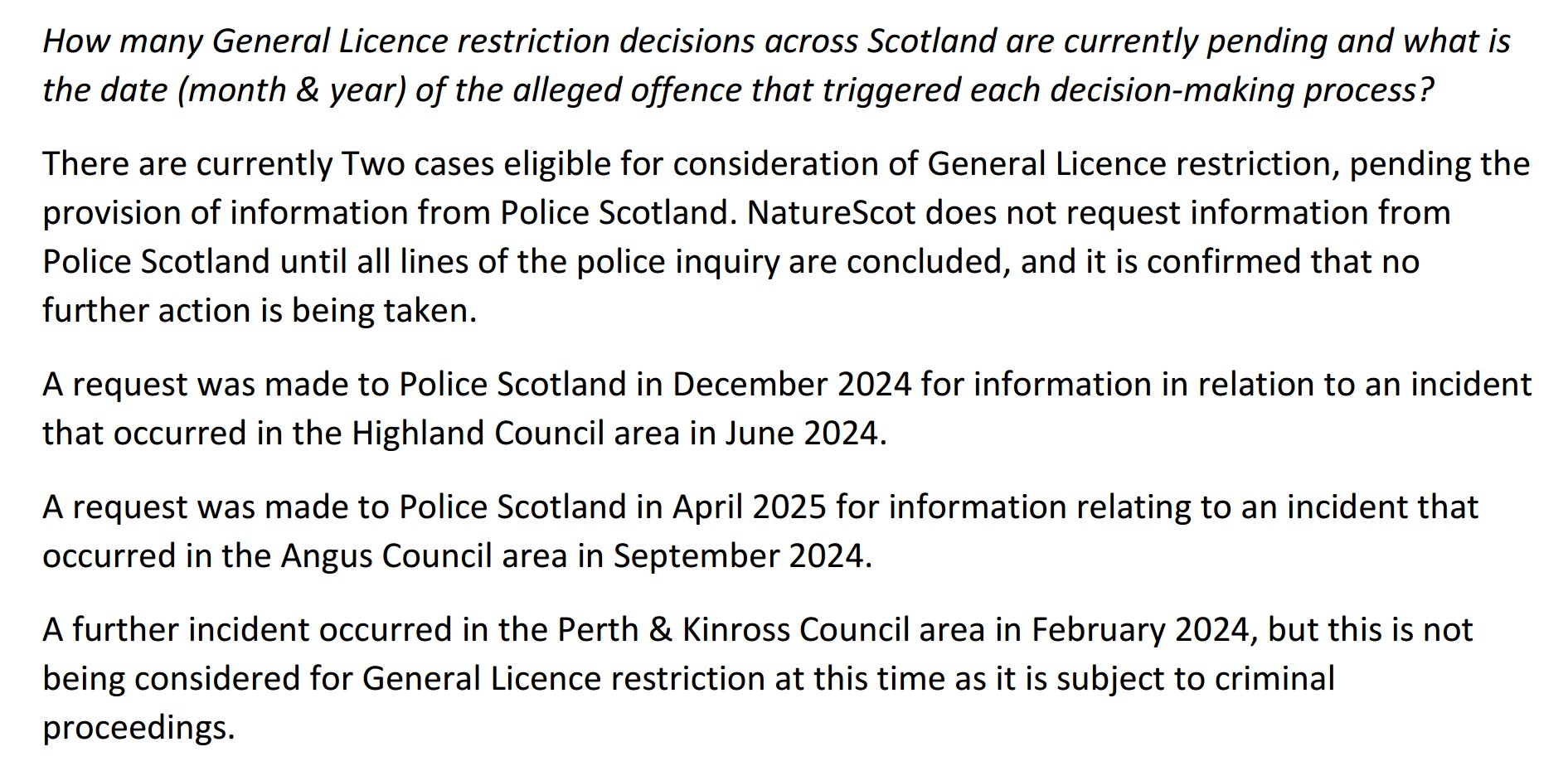
NatureScot wrote back to me in July and said this:
You can see that the case involving the shot out Goshawk nest is included on the list (‘an incident that occurred in the Highland Council area in June 2024‘).
NatureScot says it asked Police Scotland in December 2024 for the information package NS would need to begin the process of considering whether to impose a General Licence restriction.
Seven months on, in July 2025 when NatureScot responded to my FoI, Police Scotland hadn’t provided the information to NatureScot.
The Highland Cops programme demonstrates the evidential difficulties faced by the police when investigating suspected wildlife crimes, particularly those that take place on privately-owned gamebird shooting estates, and the lengths the police will go to to find out who was responsible. It was the very reason that the Scottish Parliament introduced grouse shoot licensing as part of the Wildlife Management & Muirburn (Scotland) Act 2024.
The efforts made by PC Dan Sutherland and his colleagues were exemplary in this case. But someone, somewhere, has dropped the ball in the later stages of the enforcement process by not providing an information package in a timely manner. That’s just not good enough.
The Highland Cops episode (series 3, episode 2) is available on the BBC iPlayer here. It’s well worth an hour of your time.
On 2 May 2025, Police Scotland issued a press statement about how two men had been charged in relation to the illegal killing of Red Kites in the grouse moor-dominated Strathdon area of the Cairngorms National Park in February 2025 (see here).
This general area on the NE side of the Cairngorms National Park has long been identified as a raptor persecution hotspot with several confirmed and alleged offences recorded in the area over a number of years.
The Police said the men would be reported to the Procurator Fiscal but since then there haven’t been any further updates. [SEE UPDATES AT FOOT OF BLOG]
NB:As two men have been charged, criminal proceedings are live so any comments about that case will not be published on this blog until proceedings have ended.
Shortly after the police issued that statement, land reform campaigner Andy Wightman published a fascinating blog about the lengths he has gone to to determine who might be the beneficial owner of North Glenbuchat Estate, one of a number of prominent sporting estates in the area – see here.
Photo by Ruth Tingay
Andy writes that he has submitted a report to Police Scotland about the estate owner’s (North Glen Estates Ltd, registered in the Turks and Caicos Islands) alleged failure to register its beneficial owner as required by recent land reform legislation in Scotland.
Andy published an update to his first blog on 13 May 2025 where he outlines how he was waiting for an interview with a Police Scotland officer about his findings (see here).
Andy’s second blog also provides commentary about someone else’s attempt to lodge a complaint about the alleged failure of another company to register the name of the beneficial owner of Craiganour Estate (see blog here).
All three blogs illustrate the ongoing complications of finding out who owns private estates in Scotland. This is of interest to RPUK readers due to the possibility of holding estate owners vicariously liable if certain wildlife crimes, but particularly raptor persecution offences, are proven to have taken place on an estate.
One investigation into alleged vicarious liability for raptor persecution has already been dropped in Scotland after the conviction of a gamekeeper on Kildrummy Estate in NE Scotland in 2014. The authorities tried to identify the owner but failed (see here). NB: The ownership of Kildrummy Estate has since changed hands and gamebird shooting is no longer permitted..
Since the 2014 Kildrummy case the rules around registering ownership have changed in Scotland and technically it should no longer be possible for beneficial owners to hide their identity behind overseas shell companies.
Andy’s work suggests otherwise.
UPDATE 9 December 2025: Two Scottish gamekeepers on trial today in relation to alleged killing of Red Kites in Cairngorms National Park (here)
UPDATE 9 December 2025: Alleged killing of Red Kites in Cairngorms National Park – trial of two gamekeepers adjourned as Sheriff recuses himself due to RSPB membership (here)
A pilot study to examine the impacts of releasing non-native gamebirds (pheasants & red-legged partridges) into the Cairngorms National Park is due to begin this spring, according to an article published by The Ferret.
Captive-bred non-native pheasants in pretty poor condition being transported for release into the UK countryside. Photo by Ruth Tingay
The pilot study looks to be the start of a wider and long-overdue assessment of the impact of these releases across Scotland, based on FoI documents from NatureScot compiled by journalists at The Ferret (well worth reading those documents, here).
The Ferret suggests that the Game & Wildlife Conservation Trust (GWCT) will be undertaking the study. This is a charity that relies heavily upon funding from the gamebird shooting industry. Talk about marking your own homework!
A GWCT spokesperson is quoted in The Ferret article:
“The pilot project to begin looking at the numbers of gamebirds released within the Cairngorms National Park has not yet taken place, but is due to start this spring once the plan for it has been finalised“.
I’ll be looking forward to seeing the GWCT’s proposed methods and justification for undertaking a pilot study in the spring – a time of year when gamebird numbers will be at their lowest after the end of the winter and the end of the shooting season, instead of planning to do it in the autumn when these birds are released in their millions and thus at their most abundant / causing the most damage.
There’s also a hilarious quote from NatureScot:
“Currently, there is little evidence to show that gamebirds are causing damage to protected areas in Scotland, but we will continue to monitor the situation closely“.
‘We will continue to monitor the situation closely’ can be translated as, ‘We’ve ignored this issue for years so of course we don’t have any evidence of damage, because we haven’t been looking!’.
The issue of releasing non-native gamebirds into the Cairngorms National Park has been the subject of a number of blogs on the excellent ParkswatchScotland website over the years (e.g. here in 2017 and here in 2020). Nick Kempe, the blog’s author, has repeatedly questioned why this issue hasn’t featured in the Cairngorms National Park’s Management Plans.
It was, finally, included in the latest Management Plan (2022-2027) despite objections from some members of the Park Authority’s Board in 2021 who just happened to have strong links to the game-shooting industry (see here – and if you’ve got the time it’s worth watching the video of that Board Meeting).
Here’s what the current CNP Management Plan says about gamebird management:
The Management Plan points out:
‘The regulatory framework around releases of species is not consistent at present, meaning that a licence is not required to release pheasants and partridges, but is required to release beavers and red squirrels‘.
Isn’t it about time this inequity between the release of millions of non-native gamebirds and the restoration of a few native species was addressed?
UPDATE 21 November 2025: New report on gamebird releases in Cairngorms National Park doesn’t tell even half the story (here)
Following yesterday’s news that a red kite has been found shot dead in the Glenbuchat area of Strathdon (here), the Cairngorms National Park Authority has issued the following statement:
STATEMENT ON RED KITE
28th February 2025
The Cairngorms National Park Authority has issued the following statement in relation to the death of a red kite in the Glenbuchat area of Strathdon:
“The Park Authority have been informed by Police Scotland that a red kite was found dead in the Glenbuchat area of Strathdon earlier this month. Police Scotland have confirmed that the red kite had been shot.
The shot red kite. Photo by RSPB Scotland
“The Park Authority condemns the illegal killing of raptors in the strongest possible terms. Raptor persecution has no place in 21st century Scotland but sadly incidents such as this are still taking place. It is an unacceptable crime that not only harms our raptor populations, but also damages the reputation of those land managers that act lawfully and work hard to care for wildlife.
“We are committed to working with partners to make sure the National Park is a safe haven for raptors and to establish the full circumstances of this incident. Anyone with information is asked to contact Police Scotland on 101, quoting incident number 0846 of Thursday 27 February. Alternatively, you can contact Crimestoppers on 0800 555 111 where information can be given anonymously”.









 Raptor Persecution UK