Leadhills Estate granted ‘individual licence’ to shoot crows

As many will recall, in November 2019 SNH imposed a three-year General Licence restriction on the Leadhills Estate in South Lanarkshire following ‘clear evidence from Police Scotland that wildlife crimes had been committed on this estate’ (see herehere, here, here, and here).

Those alleged offences included the ‘illegal killing of a short-eared owl, two buzzards and three hen harriers’ that were ‘shot or caught in traps’ on Leadhills Estate since 1 January 2014 (when SNH was first given powers to impose a General Licence restriction). SNH had also claimed that ‘wild birds’ nests had also been disturbed’, although there was no further detail on this. The estate has consistently denied responsibility, obviously.

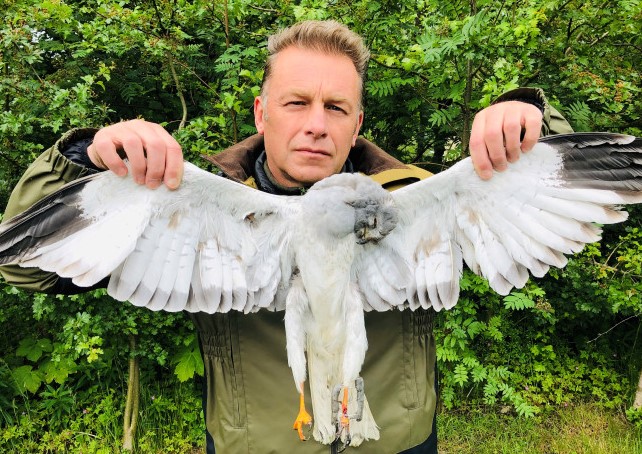
[This male hen harrier was found with its leg almost severed, caught in an illegally-set trap next to its nest on Leadhills Estate in 2019. Despite valiant efforts by a top wildlife surgeon, the bird didn’t survive. Photo by Ruth Tingay]
As many of you will also know, a General Licence restriction is supposed to prevent an estate from killing so-called ‘pest’ species (e.g. crows) that would otherwise be permissible under the General Licences but that estates can still apply to SNH for an ‘individual licence’ to circumvent the General Licence restriction and continue killing birds, albeit with a bit more paperwork to complete.

This ridiculous situation is a legal quirk, outlined in a Judicial Review, and isn’t SNH’s fault (although SNH could be doing a lot more to point out the system failings to the Scottish Government). Basically if a penalised estate isn’t provided with an opportunity to apply for an individual licence the estate could argue the system was unfair and the legality of the General Licence restriction probably wouldn’t stand. If further wildlife crimes are discovered on the estate when an individual licence is in place, SNH can revoke the individual licence but the estate can simply reapply for another one. We’ve discussed how the General Licence restriction is a wholly ineffective deterrent plenty of times in the past, (e.g. see here, here, here, here) and last year we even gave evidence to this effect alongside RSPB Scotland and others to a Scottish parliamentary committee (here).

Since the General Licence restriction was imposed on Leadhills Estate in Nov 2019 we’ve been interested to find out whether the estate has applied for, and been granted, an individual licence.

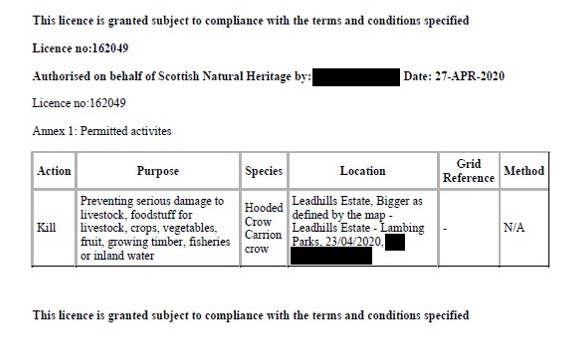
An FoI request has revealed that yes, SNH issued an individual licence that was valid between 27 April – 1 June 2020 but this was far more restrictive than the individual licences (e.g. see licence details here) that were issued to Raeshaw Estate when a GL restriction was imposed on that estate in 2015.

The individual licence at Leadhills Estate only permits the shooting of two species – hooded crow and carrion crow, in a limited part of the estate and apparently to protect lambs.
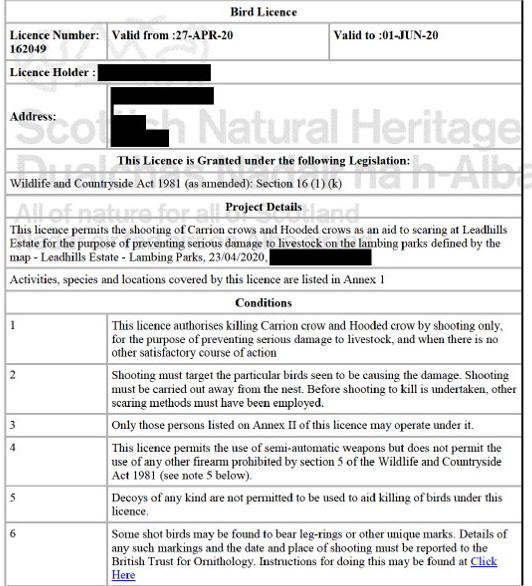
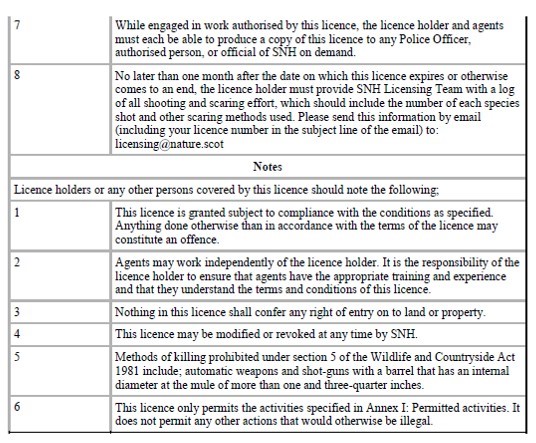
According to condition #8 of this licence, the licensee has to submit a written report to SNH within one month of the licence expiring (so by 1 July 2020) detailing the scaring methods deployed and the number of birds shot. We have submitted an FoI request for this information.

We’ve also asked SNH for details of the compliance checks made for the duration of this licence. SNH has said in the past that compliance checks would form part of the ‘tighter scrutiny’ involved with an individual licence. Let’s see. Presumably this type of environmental monitoring/legal compliance check would have been one of the Government-sanctioned jobs during lockdown.
Infamous Kildrummy Estate sold to new owners

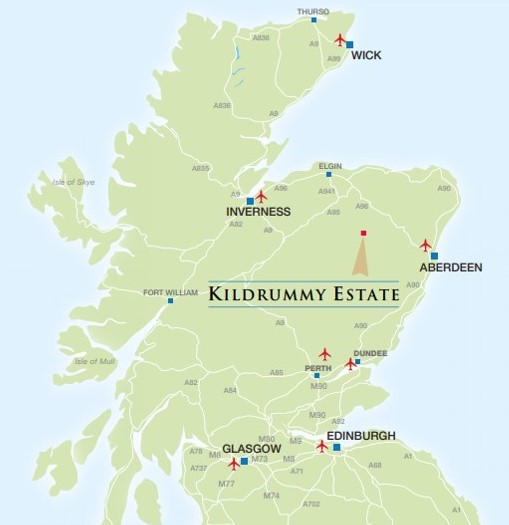
The Kildrummy Estate in Aberdeenshire is infamous for a number of reasons.

Firstly, its gamekeeper became the UK’s first (and so far, the only gamekeeper) to receive a custodial sentence for raptor persecution in 2014 after his conviction on four counts, including the illegal killing of a trapped goshawk which he clubbed to death on the estate in 2012 (see here and here).

Secondly, a vicarious liability prosecution against the gamekeeper’s supervisor/employer wasn’t possible because the police were unable to establish the identity of the management hierarchy because the details of land ownership were concealed in an offshore holding (see here, here and here).

Today it’s been reported on various websites that Kildrummy Estate has been sold for a cool £11 million and the new owners, Americans Chris & Camille Bently, are described as being supporters of ‘animal rights’. For example, see this article on the Insider website, which incidentally also discusses the criminal conviction of the former Kildrummy estate gamekeeper but mistakenly reports he was sentenced to ‘four years for laying poisoned bait’ – that’s wishful thinking, it was only four months and we’re not aware of poisoned baits being laid on this estate.

Blog readers may be interested in reading the sales particulars for Kildrummy Estate, which provide a fascinating insight in to a location that has previously been shrouded in secrecy.

Download the sales document here: Kildrummy Estate sales particulars June 2020

Good luck to the Bentlys – let’s hope their vision for this estate is one centred on rewilding and conservation and not exploitation and criminality.

UPDATE: This blog post was picked up by The Herald 6 July 2020 here

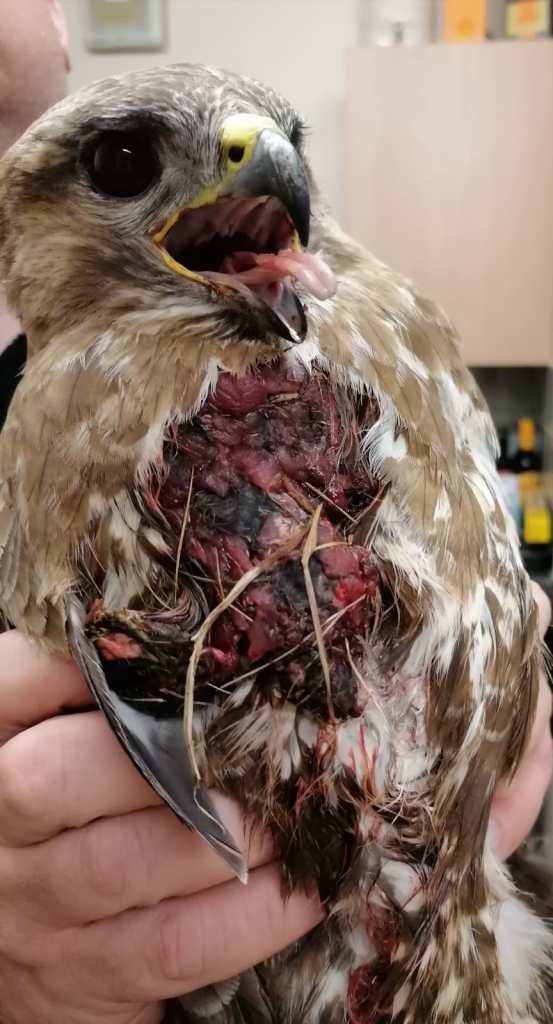
Essex Police investigate shooting of buzzard last week

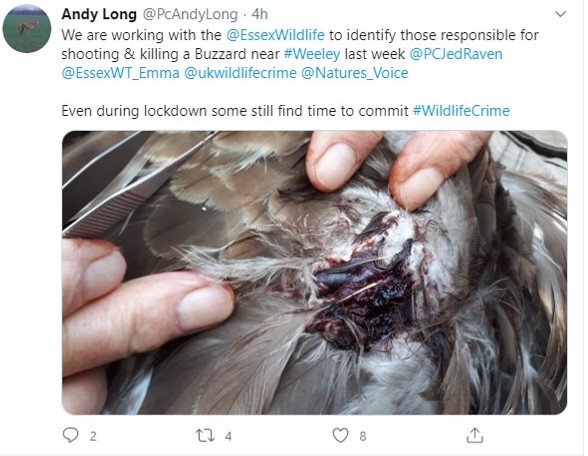
A buzzard was shot and killed last week near Weeley, in Essex, according to PC Andy Long on twitter.

We’ve been unable to find any further details about this incident.

We’ve asked PC Long if he can provide more information on date, location, type of gunshot, crime reference etc. Will publish here is any more info emerges.

UPDATE 10 JUNE 2020: PC Andy Long has been in touch this morning (thanks!) and provided the following information:

Crime Ref number: 42/82646/20

Buzzard found 2 June 2020 at Weeley Hall Wood, Clacton Road, Weeley, Essex.

Awaiting x-ray to determine ammunition used.

‘Bait trays’ sent for analysis after latest suspected buzzard poisoning incident

Article from The Southern Star (Co Cork) (2 June 2020)

Bait trays are found after buzzard killed in Kealkil

By Kieran O’Mahony

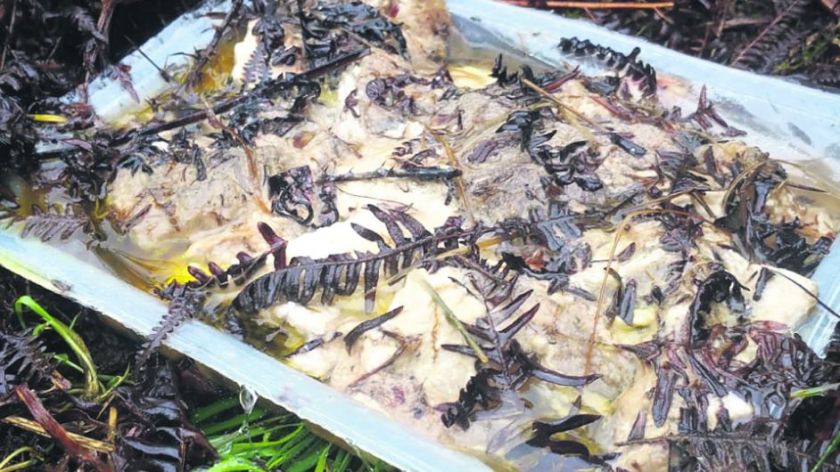
TRAYS containing contaminated meat laid out as bait may be responsible for the killing of a buzzard in the Kealkil area earlier this month.

[One of the meat trays submitted for toxicology analysis]

The National Parks & Wildlife Service (NPWS) were recently notified of the discovery of the dead buzzard by a family who were out walking their dog in the area.

This is the second incident in West Cork this year where buzzards, protected species, have been deliberately killed. It follows the discovery of 23 buzzards on farmland between Bandon and Timoleague in January. In this case, they were poisoned using the banned insecticide, carbofuran. It is not clear if these two incidents are connected.

NPWS staff are involved in an ongoing investigation into whether this was a persecution incident as they have found several trays, which contained meat which would appear to have been laid out as bait,” said a NPWS spokesperson.

The dead buzzard, the meat and the trays, have been sent to the State laboratory for further analysis to determine if there was poison involved.

The trays were placed along a track, which local people use for walking and other recreational activities.

Any poison bait or any meat-based poison, laid out in this way is illegal and indiscriminate. A dog either ingesting the poison or eating another animal that is sick or dead as a result of the bait, is likely to get seriously ill or die.”

The spokesperson also said that children are at risk if they pick up or handle contaminated material.

NPWS is asking any member of the public who has information about the incident or who sees anything suspicious – meat-based poison bait, which might be on a carcass or meat laid out in the open – to contact them or the gardaí immediately.

ENDS

It’s hard to imagine why trays of meat might be laid out other than to poison something, but perhaps there is a legitimate reason? However, if these do turn out to be trays of poisoned meat, the brazenness of the person who placed them would be astonishing.

Other recent poisoning incidents in this region include the killing of 23 buzzards with the banned pesticide Carbofuran (here) and the suspected poisoning of a search and rescue dog (here).

Search & Rescue dog dies after eating suspected poisoned bait

The Search and Rescue Dog Association (SARDA) has announced the death of one of its trainee dogs after consuming what is believed to have been a poisoned bait.

SARDA posted the following statement on social media yesterday:

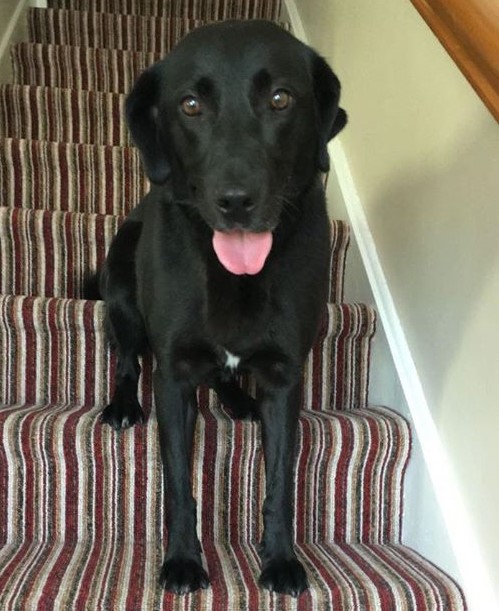
Tragic news in the last few days, as Bonnie, a SARDA Ireland Trainee Trailing Dog died after she ate poison that had been deliberately put out on the hill with the intention of targeting wildlife. She and her handler Jim O’Brien were training in the foothills of the Knockmealdowns when the incident occurred.

Bonnie was a beautiful and talented dog who no doubt would have become one of our first SARDA Ireland Trailing Dogs. A tragic loss for Jim, who has lost his beloved pet, and a huge loss to the SARDA Ireland Trailing Dog Team.

There have also been reports in the media, such as this from Tipp FM:

Investigations are underway following the poisoning of a Search and Rescue Dog in Tipperary.

Bonnie – a Labrador/Collie cross – was being trained by a member of the Search and Rescue Dogs Association of Ireland.

The incident happened last Sunday week in woods on the foothills of the Knockmealdown Mountains near Clogheen. Sadly Bonnie passed away a few days later.

There are just 6 qualified dogs in the country with 4 of them part of the South Eastern Mountain Rescue Association.

Gerry Tobin is a dog handler with SARDA – he says there have been other incidents of poisoning reported in the area.

There are certain individuals who for whatever reason are putting out poisoned baits and targeting wildlife – buzzards, peregrines, badgers you know any animals like this are potentially going to be at risk of poisoning.

And you’re also in a situation where you could have a family dog being exercised on a Sunday afternoon along the Blackwater Way and the following day that family dog could be dead.”

ENDS

The type of poison hasn’t been disclosed in this case but only a few weeks ago we learned that the banned pesticide Carbofuran had been used for the mass poisoning of 23 buzzards in neighbouring County Cork (see here).

Placing poisoned baits to target birds of prey is not only illegal, but it’s also barbaric and indiscriminate. Only last month we heard of the suspected poisoning of two dogs in the notorious raptor-killing hell hole of Nidderdale, a so-called protected area designated as an Area of Outstanding Natural Beauty (AONB) in North Yorkshire. One of those dogs subsequently died (see here).

If you see what you believe is a poisoned bait, DON’T TOUCH IT but call the police immediately.

‘400% increase in illegal killing of birds of prey since lockdown’

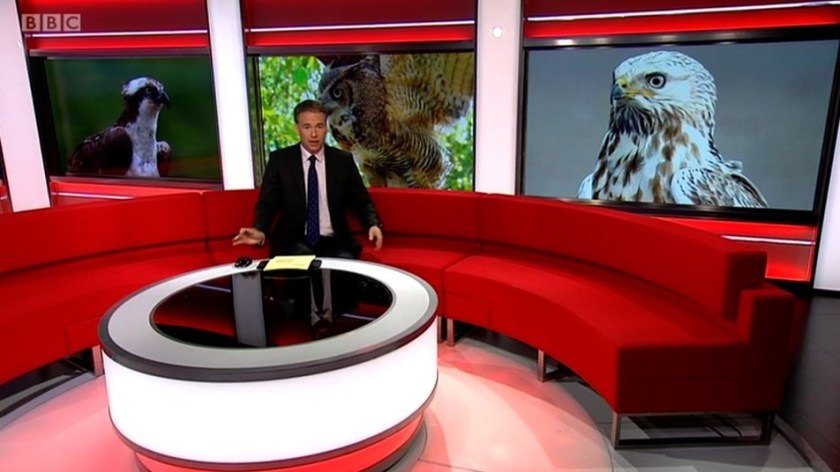
Last night BBC Look Northwest had an excellent feature on the continued killing of birds of prey in the UK. It included interviews with Howard Jones from the RSPB Investigations Team, and everyone’s favourite persecution denier, Duncan Thomas from BASC.

The clip can be viewed here (starts 18.10 mins) but is only available until 7pm this evening (Thurs 4 June 2020). We’ve reproduced the transcript below:

BBC studio presenter: “The RSPB says it’s been overrun with reports that birds of prey have been illegally killed since lockdown began. It’s thought the quieter countryside has made it easier for criminals to target them. A recent case involved a buzzard which had been shot near Saddleworth. Here’s our environment correspondent Judy Hobson.”

Judy Hobson: “A buzzard, found in the Peak District three weeks ago. This x-ray shows it had been shot. It was found here on Saddleworth Moor. The RSPB say since lockdown began there’s been a 400% increase in the illegal killing of birds of prey”.

[The shot buzzard and its x-ray. Photo by Peak District Raptor Monitoring Group]

Howard Jones, RSPB: “Lochdown has kind of emboldened the criminals out there who want to kill birds of prey so they think with the restrictions that have been imposed there’ll be less people out in the countryside and there’s less chance of being caught”.

Judy Hobson: “Two birds were found dead in Cumbria last month, other birds targeted include hen harriers, peregrine falcons and red kites. It’s an issue that’s plagued the countryside for years and the RSPB has consistently pointed the finger at gamekeepers protecting young grouse”.

Howard Jones: “In two thirds of the prosecutions that have ended up in court for bird of prey persecution since 1990, two thirds of those have been gamekeepers”.

Judy Hobson: “The charity says the number of birds found dead since lockdown began equates to a bird being killed every single day”.

Duncan Thomas, BASC: “I really dispute these figures. I would love to have a proper investigation in to exactly where they’re coming from. The RSPB are using birds of prey as a cash cow. It’s not proportionate, effective investigation, we must let the police get on with their job. We will expel anybody who is convicted of a wildlife crime of this nature”.

Judy Hobson: “The RSPB says it stands by its figures and says the police are investigating every single incident. Campaign groups such as Wild Justice also believe more birds have been targeted since lockdown. But a row over figures perhaps distracts from an inherent problem which shows no sign of going away”.

Howard Jones: “These are majestic birds of prey and creatures that people come out in to the countryside to see and despite 65 years of legal protection they are still being targeted”.

ENDS

UPDATE: Comment posted on blog 4/6/20 by Mark Thomas, RSPB Head of Investigations: ‘Whilst there has been 56 confirmed/potential raptor persecution offences during lockdown – RSPB did not make or recognise the 400% comment made by the presenter in this piece. We have sought clarification from the BBC‘.

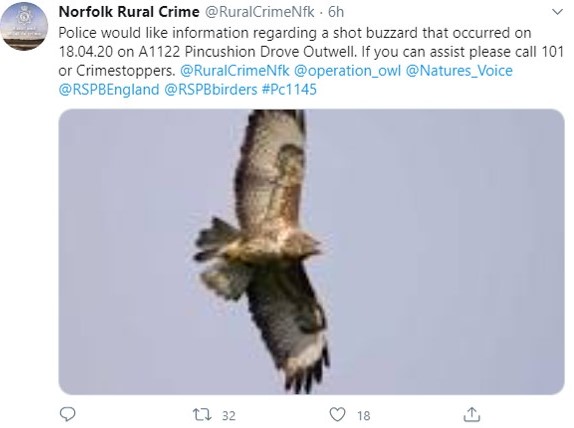
Buzzard found shot in Norfolk during lockdown

Norfolk Constabulary’s Rural Crime Team has posted this on Twitter today:

We haven’t been able to find any further published information – status of the bird, crime ref number etc.

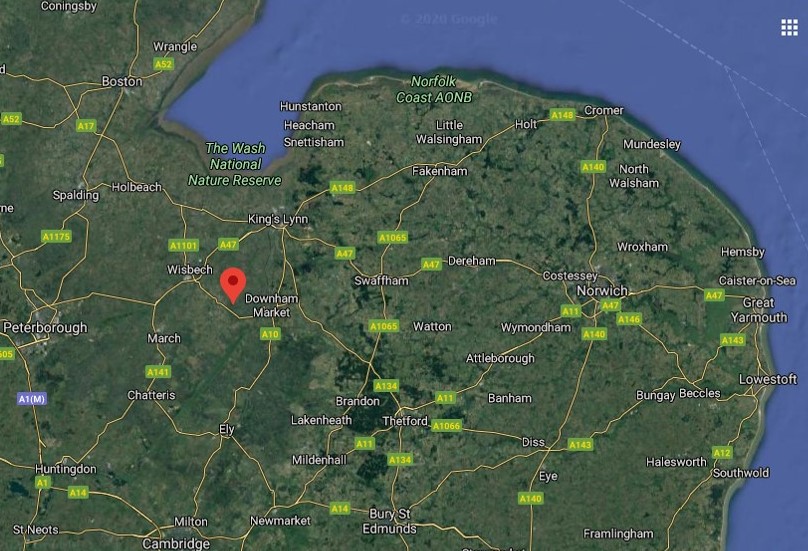
Here’s a map of the location:

4 shot buzzards on a Bransdale grouse moor: shooting industry’s response

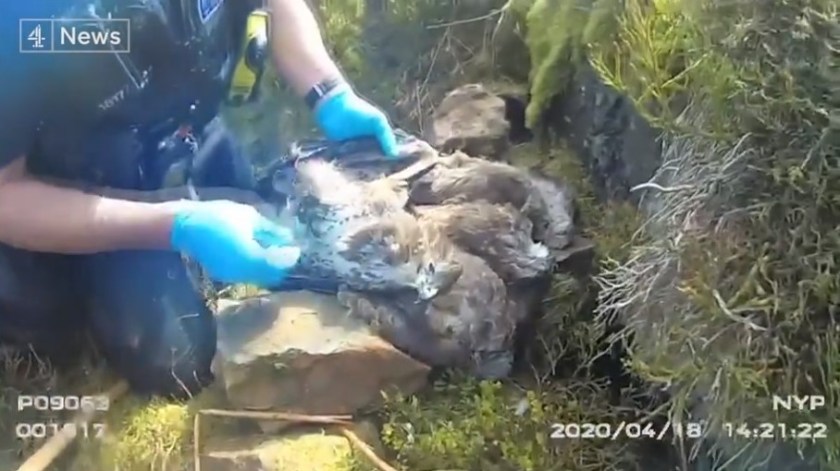
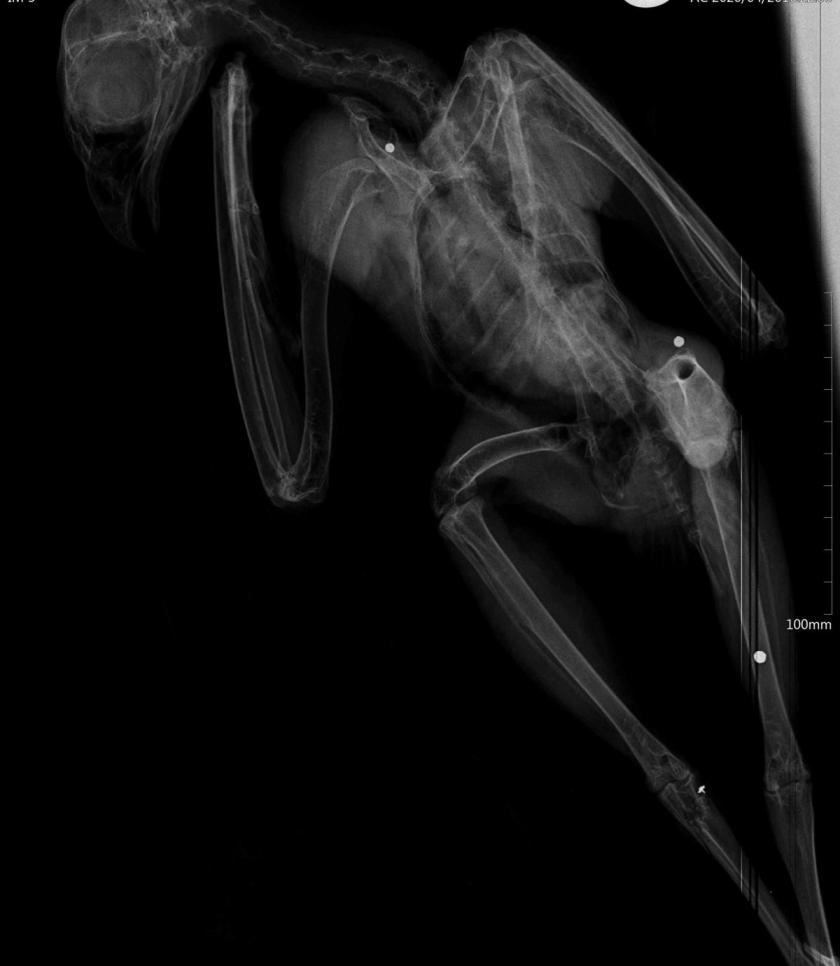
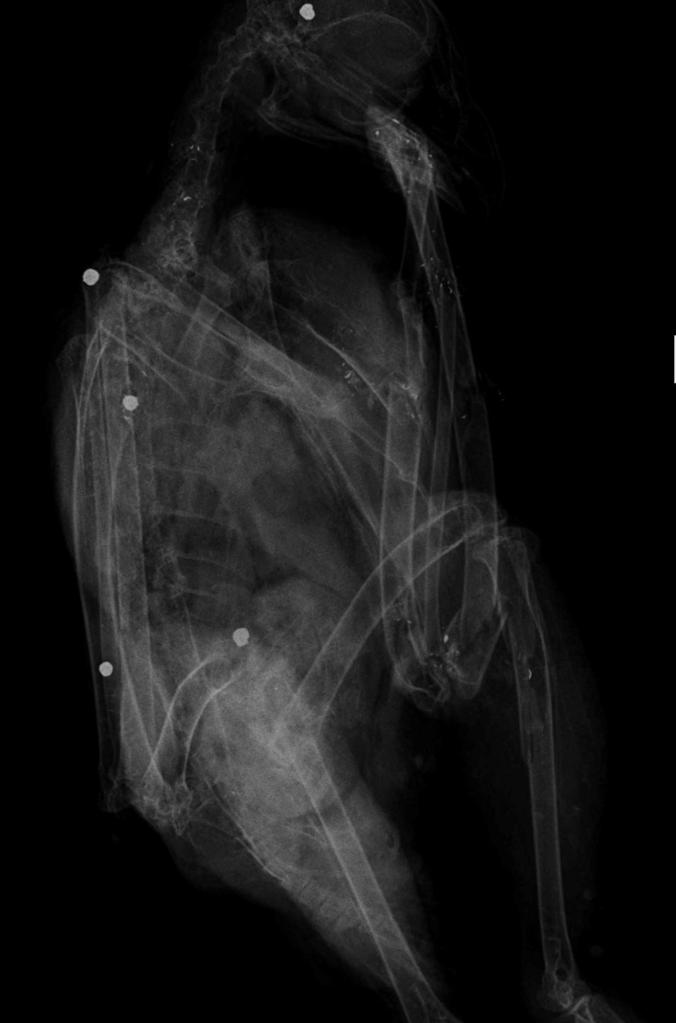
Last Friday afternoon, North Yorkshire Police appealed for information in relation to an ongoing investigation involving the discovery of five dead buzzards that had been shoved in a hole under a rock on an unnamed grouse shooting estate in Bransdale in the North York Moors National Park. X-rays have so far revealed that four of those five buzzards had been shot (see here).

[Police body camera footage captures the moment five dead buzzards are pulled from a hole where they’d been concealed on a grouse shooting estate in Bransdale, North York Moors National Park]

North Yorkshire Police has since released x-rays of three of those shot buzzards:

In relation to this incident and other ongoing investigations into raptor persecution, Inspector Matt Hagen from North Yorkshire Police’s Rural Crime Team told Channel 4 News, “All the shooting investigations that we’ve got going on at the moment are involving gamekeepers on grouse moors” (see here).

Given the game-shooting industry’s claims of a ‘zero tolerance’ stance to illegal raptor persecution (see here), you’d think this would be the perfect opportunity for the grouse shooting industry to offer its full support to the police investigation and encourage its members to step forward with information, especially if there was concern about dangerous unidentified armed criminals, killing protected species and running amok in a National Park, right?

Well apparently not. Having looked at the websites of the industry’s ‘leading’ organisations this morning, here’s what they’ve had to say about this latest crime:

Moorland Association: nothing

BASC: nothing

Countryside Alliance: nothing

National Gamekeepers Organisation: nothing

GWCT: nothing

Impressive, eh?

There is one group from the industry, however, who seems to have plenty to say, and it’s quite extraordinary.

The North Yorkshire Moors Moorland Organisation (NYMMO) is an apparently grassroots umbrella organisation that represents grouse moor gamekeepers in the North York Moors. It’s one of a number of regional moorland groups in the UK, established a few years ago as part of what looks like a propaganda exercise to promote grouse moor management in a favourable light. The NYMMO website doesn’t have a list of grouse-shooting estates on which its members work but we do know it has members that work in Bransdale (more on this in a future blog).

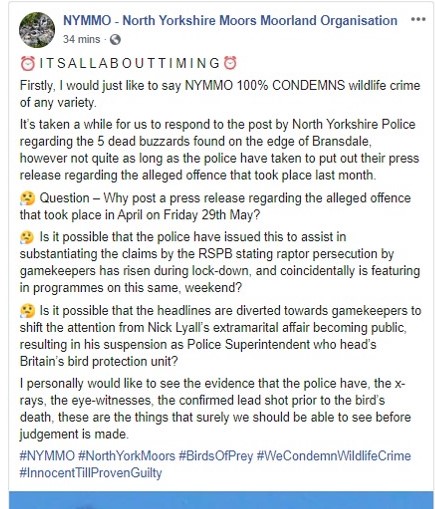
Here’s what the NYMMO posted on its social media channels on Sunday, in response to the news that five dead buzzards, four of which are confirmed as being shot, were discovered concealed in a hole on an unnamed Bransdale grouse shooting estate:

Does this strike anyone as evidence of an industry exhibiting ‘zero tolerance’ of raptor persecution? You can bet that some of those ‘leading’ organisations will be raging at the NYMMO for posting such an incredibly stupid and revealing statement in response to what is an horrific wildlife crime, especially as a number of those ‘leading’ organisations have a close and supportive relationship with the NYMMO. Although at least one BASC staff member (Gary Dockerty, BASC Upland Officer) has ‘liked’ this post on Facebook.

More on the NYMMO shortly….

BBC Countryfile highlights raptor persecution on grouse moors

Last night’s edition of Countryfile on the BBC included a ten minute slot on raptor persecution.

It’s available to watch on BBCiPlayer (here) for the next 11 months (starts 10.40 min).

To be honest, after watching the compelling piece on raptor persecution that featured on Channel 4 News on Friday (see here), Countryfile’s effort was a bit limp and underwhelming.

Having said that, we should bear in mind that to the average Countryfile viewer, the fact that gamekeepers are still killing birds of prey in 21st Century Britain will have been quite a shock so ten mins of exposure on such a prime time programme is to be welcomed. There was also some cracking footage of hen harriers.

But for those of us all too familiar with this subject, this programme grated in some areas.

Presenter Tom Heap pitched the subject as a ‘political war between gamekeepers and the RSPB’ – sorry, Tom, but you’re about ten years out of date. Look around, there’s an ever-increasing community of organisations and individuals who are fighting hard against the grouse shooting industry and not just on the raptor persecution issue.

Tom also repeated the wildly inaccurate but often cited claim that the game-shooting industry is worth £2 billion to the rural economy. It’s worth nothing of the sort – keep an eye on Mark Avery’s blog as we anticipate a forensic dissection of this particular topic. [Update: read Mark’s blog here]

Then we had Steve Bloomfield from BASC who was complaining about ‘sweeping statements’ being made about raptor persecution that, according to him, infer everyone in gameshooting is killing raptors. He might just as well have stamped his feet and said, ‘It’s so unfair!’ The so-called ‘sweeping statements’ that I’ve seen are nothing of the sort – they’re statements of fact. For example, that the RSPB has received an increase in reported raptor persecution incidents during lockdown and the majority of those have been on land managed for game shooting.

Another example, from a senior police officer (Insp Matt Hagen, North Yorkshire Police), who told Channel 4 News and Countryfile that reported incidents had certainly increased since lockdown and that ALL his investigations were currently centred on gamekeepers on grouse moors.

To be honest, I can’t be bothered to write anymore of a review. It’s just going over the same old ground, time and time again. Watch the video if you like but if you watched the Channel 4 News video on Friday you’ll not learn much new from this one.

Meanwhile, let’s get back to the Bransdale case and those industry connections…..

National Gamekeepers Organisation’s pathetic response to Channel 4 programme on rampant raptor persecution

Two weeks ago the RSPB announced that it had seen a ‘surge’ in reported raptor persecution incidents since the Coronavirus lockdown (see here).

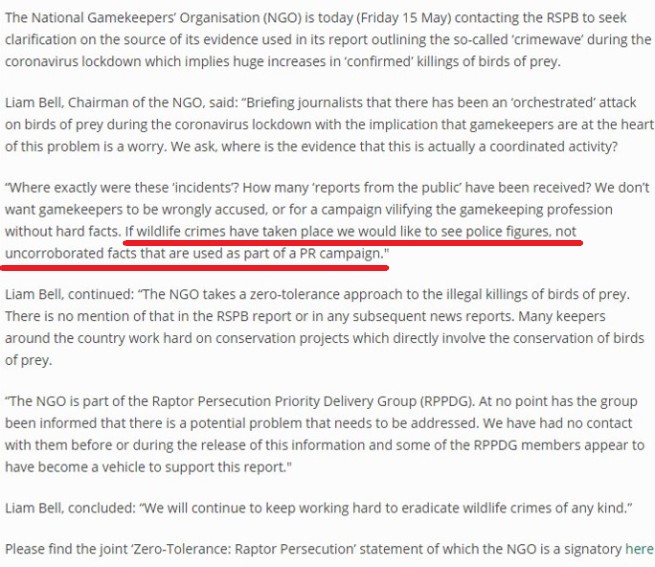
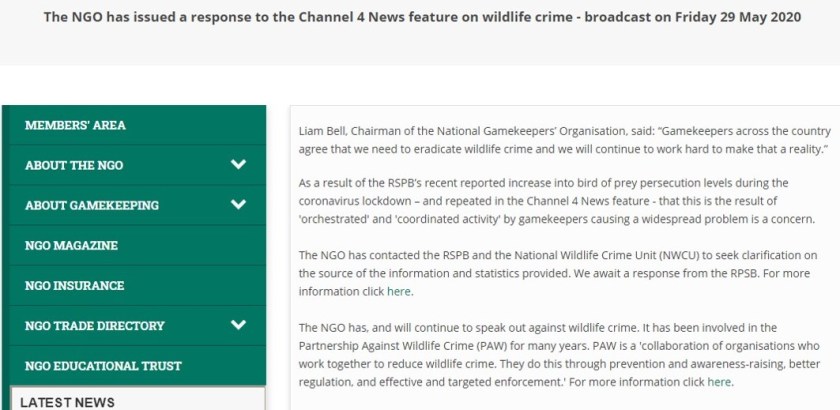
The response from the National Gamekeepers Organisation (NGO) was its usual attempt to undermine the credibility of the RSPB, bleat about being a signatory to an as yet undemonstrated stance of ‘zero tolerance‘ of raptor persecution, and to demand information from the police on recent raptor crimes (see here). Here is a copy of the NGO’s response, copied from it website (red bit highlighted by RPUK):

Fast forward two weeks and we had the excellent Channel 4 News special investigation featuring raptor persecution on North Yorkshire grouse moors (see here), which featured the utterly compelling dialogue between a senior police officer and the CH4 correspondent, as follows:

Alex Thomson (Channel 4 News correspondent): Lockdown has seen a sharp increase in reports of birds of prey found dead. We joined Inspector Matt Hagen of North Yorkshire Police as he followed up reports of a dead bird of prey seen in the Nidderdale area.

Inspector Matt Hagen: I’m absolutely shocked and disgusted at the level of raptor persecution that I am coming across.

Alex Thomson: Inspector Hagen told us that of 30 birds he’s collected in the past six months, only one has died of natural causes and his investigations lead clearly to a single group of suspects.

Matt Hagen: All the shooting investigations that we’ve got going on at the moment are involving gamekeepers on grouse moors.

Alex Thomson: All of them?

Matt Hagen: All of them.

Alex Thomson: Every single one?

Matt Hagen: That’s right.

The National Gamekeepers Organisation has now published a response to the Channel 4 News programme. Bear in mind that the programme delivered exactly what the NGO had previously asked for (i.e. details from the police instead of the RSPB) that placed gamekeepers at the centre of every single current criminal investigation relating to the illegal killing of birds of prey in North Yorkshire. Here’s what the NGO now has to say:

The NGO says the news “is a concern“. The NGO says it is seeking “clarification on the source of the information and statistics provided“. Where’s the condemnation? Where’s the disgust? Where’s the reaction to those shot buzzards being pulled out of a hole on a grouse shooting estate? This response is pathetic.

The NGO says it is part of the Raptor Persecution Priority Delivery Group (RPPDG)  – which came as a bit of a surprise to us given that it resigned ‘permanently’ from the partnership after a massive tantrum in January last year (see here and here). Those decent organisations on the RPPDG who genuinely want to tackle illegal raptor persecution (e.g. RSPB, Northern England Raptor Forum, BAWC, North Pennines AONB, Sheffield Wildlife Trust) really need to start thinking about their positions on this forum. By remaining, they legitimise organisations such as the NGO (and others) who are able to use their membership as a badge of respectability and credibility.  They’re making the good guys look like mugs.