A pre-trial case management hearing due to take place at Lincoln Magistrates’ Court on 29 January 2026 has been delayed.
Brian Chorlton, 87, of Morkery Lane, Castle Bytham, Lincolnshire, was summoned to court in April 2025 following reports that birds of prey were being poisoned in the Castle Bytham area.
Photo by Ruth Tingay
In May 2025, Chorlton appeared at Lincoln Magistrates’ Court and pleaded not guilty to 11 charges relating to the unapproved or unlawful storage of the chemical Aldicarb, possession of a poisoner’s kit, and possession and use of four pole traps. The trial was set to take place in October 2025.
However, on 18 September 2025 a pre-trial case management hearing took place at Lincoln Magistrates’ Court where the defence submitted three separate legal arguments calling for the case to be dismissed.
The District Judge rejected all three legal arguments and the application to dismiss the case was rejected.
The District Judge said he intended for the trial to proceed in October but offered a further case management hearing, due to take place one week later, to allow the defence time to consider the ruling.
That second case management trial took place on 25 September 2025 and the defence announced its intention to apply to the High Court for Judicial Review of the judge’s earlier ruling.
This meant the October 2025 trial date was vacated and the judge ordered a further case management hearing for 29 January 2026 where the defence was expected to provide an update on its application for judicial review.
That case management hearing has now also been vacated as the defence is still waiting for a decision from the High Court on whether its application for judicial review can progress to a full hearing.
This could take some time.
NB: As criminal proceedings are still live, comments have been switched off.
The trial of an 87-year-old man, accused of multiple offences linked to alleged raptor persecution, has been put on hold after his defence lawyer told the court he intends to apply for Judicial Review of the judge’s ruling that the case should not be dropped.
Brian Chorlton, of Morkery Lane, Castle Bytham, Lincolnshire, was summoned to court in April 2025 following reports that birds of prey were being poisoned in the Castle Bytham area.
In May 2025, Chorlton appeared at Lincoln Magistrates’ Court and pleaded not guilty to 11 charges relating to the unapproved or unlawful storage of the chemical Aldicarb, possession of a poisoner’s kit, and possession and use of four pole traps. The trial was set to take place in October 2025.
However, on 18 September 2025 a case management hearing took place at Lincoln Magistrates’ Court where the defence submitted three separate legal arguments calling for the case to be dismissed. I won’t elaborate on those arguments at this stage but they are unusual, and are not related to the use of covert surveillance as is often the case.
The District Judge rejected all three legal arguments and the application to dismiss the case was rejected.
The District Judge said he intended for the trial to proceed in October but offered a further case management hearing, due to take place one week later, to allow the defence time to consider the ruling.
That second case management trial took place at Lincoln Magistrates’ Court yesterday (25 September 2025) and the defence announced its intention to apply to the High Court for Judicial Review of the judge’s earlier ruling.
This means the original trial date (October 2025) has now been vacated. There will be a further case management hearing in January 2026 for the defence to update the court on its application for Judicial Review.
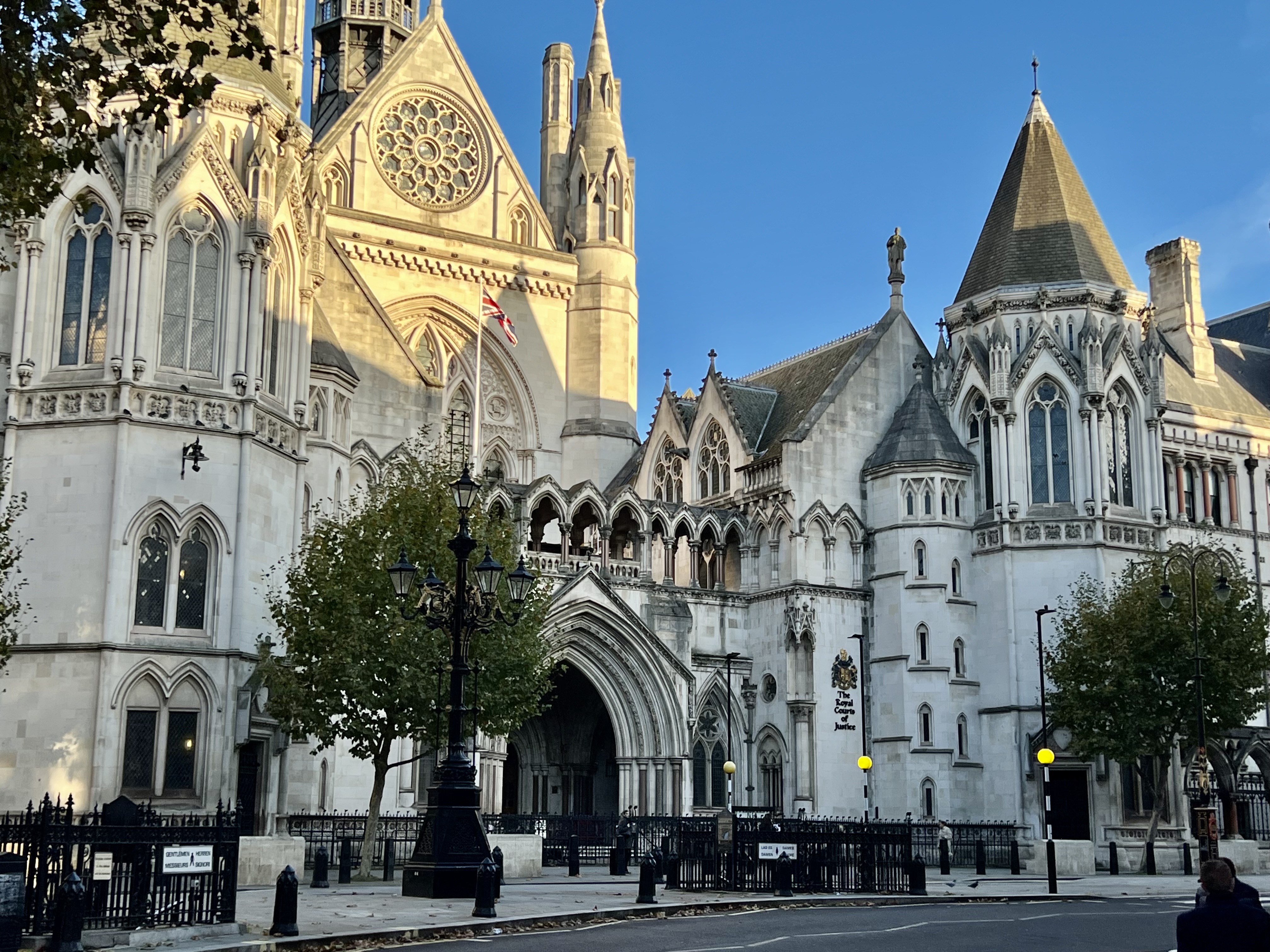
Royal Courts of Justice in London. Photo by Ruth Tingay
The application for Judicial Review is a process whereby the defence will be seeking permission from a High Court judge to proceed to a full Judicial Review. This typically takes between two to six months but can take longer, depending on the court’s schedule and the availability of a judge and also whether the judge wants an oral hearing or is satisfied with the written submissions on which to make a decision.
If permission is granted, the case will then move to a full Judicial Review and that can take up to a year before it’s heard, sometimes longer, and if the judge’s decision is reserved, there can then be a further wait, often months, waiting for the judgement to be delivered.
NB: As criminal proceedings are still live, comments have been switched off.
Press release from Police Scotland (24 September 2025):
BIRD OF PREY FOUND TO BE POISONED IN PERTH & KINROSS AREA
Enquiries into the death of red kite are ongoing.
On 22 June, 2025 a dead red kite was found near to its nest to the north west of Braco, in the Perth and Kinross area.
Subsequent post mortem examination and toxicology testing have shown that the bird had ingested toxic levels of rodenticide.
The red kite was also found to have ingested the banned substance aldicarb. Aldicarb has been illegal in the UK since 2007 and no products containing this substance are approved for use in the UK.
Birds of prey, like all wild birds in Scotland, are protected under the Wildlife and Countryside Act 1981, and it is an offence to intentionally or recklessly kill or injure them.
Wildlife Crime Coordinator, Detective Sergeant David Lynn, said: “This red kite has been poisoned resulting in a very painful and distressing death. Legal rodenticides must be used with extreme caution to avoid the poisoning of non-target species or you may be liable to prosecution. The use of Aldicarb is an illegal and reckless act as this substance can be fatal for both animals and humans.
“Our investigation into this incident is continuing and we will pursue anyone who targets Scotland’s birds of prey. I would encourage anyone with any information in relation to this incident to contact us.
“We ask anyone using the area to be vigilant if they find anything suspicious, don’t touch it, but do take photos and report to Police Scotland immediately on 101.”
Anyone with information is asked to call Police Scotland on 101 quoting incident number 1176 of 23 September, 2025.
Brian Chorlton, aged 87, of Morkery Lane, Castle Bytham appeared at Lincoln Magistrates’ Court yesterday (8 May 2025) to answer 11 charges relating to the unapproved or unlawful storage of the chemical Aldicarb, possession of a poisoners kit, and possession and use of four pole traps.
These charges are a result of a police investigation in to reports that birds of prey were being poisoned in the Castle Bytham area.
Mr Chorlton pleaded not guilty to all 11 charges and this case will now proceed to trial, scheduled for October 2025.
NB: Comments are turned off as this case is live.
Photo by Ruth Tingay
UPDATE 26 September 2025: Trial of 87-year-old man accused of 11 offences relating to raptor persecution is put on hold as defence applies for Judicial Review of judge’s ruling (here)
Statement from Lincolnshire Police (18 April 2025)
SUMMONS TO COURT FOR BIRD OF PREY OFFENCES
Brian Chorlton, aged 87, of Morkery Lane, Castle Bytham has been summoned to court following reports that birds of prey were being poisoned in the Castle Bytham area.
He faces eleven charges relating to the unapproved or unlawful storage of the chemical Aldicarb, possession of a poisoners kit, possession and use of four pole traps.
He has been summoned to appear at Lincoln Magistrates’ Court on Thursday 8 May 2025.
ENDS
NB: Comments are turned off as this case is live.
UPDATE 9 May 2025: 87-year-old man pleads not guilty to 11 charges relating to alleged raptor persecution in Lincolnshire – case now goes to trial (here)
UPDATE 26 September 2025: Trial of 87-year-old man accused of 11 offences relating to raptor persecution is put on hold as defence applies for Judicial Review of judge’s ruling (here)
In April 2023, Barry Nicolle, 67, a wildfowl collector from Dumfries & Galloway, pleaded guilty to 14 charges relating to the poisoning of red kites with banned pesticides, which included the placing of poisonous baits out in the countryside (see here and here).
This morning he was sentenced at Dumfries Sheriff Court and was given a monumentally inadequate community service order – to complete 216 hours of unpaid work within 12 months.
The RSPB has issued the following press release:
DUMFRIES-SHIRE MAN GIVEN COMMUNITY PAYBACK ORDER FOR ‘SERIOUS’ BIRD POISONING OFFENCES
A Dumfries and Galloway wildfowl collector was today (19 May 2023) sentenced to 216 hours of community payback at Dumfries Sheriff Court, after being convicted of multiple charges relating to the use of illegal poisons to target protected wildlife.
At a previous hearing, Barry Nicolle (67) plead guilty to 14 charges, including the illegal poisoning of five Red Kites and 10 Rooks, the placing of poison baits out in open countryside and the possession of banned pesticides.
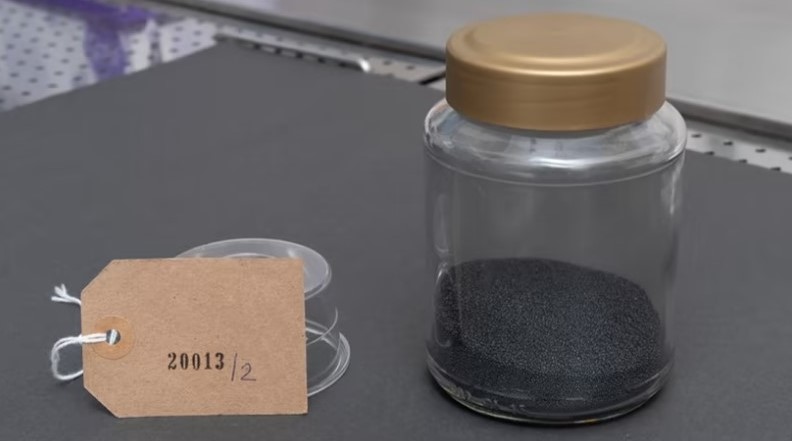
A container of the banned poison Aldicarb, found at Nicolle’s house. Photo: Crown Office
Speaking in court today, the Sherriff said the crimes were serious enough to cross the threshold for prison to be considered, however given that the individual had no previous convictions, in light of his age, and due to sentencing guidelines regarding custodial penalties of less than 12 months, a community order was served.
The case dates back to spring 2019, when several dead Red Kites were found by members of the public in the Springholm area, between Dumfries and Castle Douglas. Toxicology tests by the Science and Advice for Scottish Agriculture government laboratory revealed that all had died after consuming meat laced with poison. More victims were identified over the following months, including a number of Rooks found poisoned in the playground of the local primary school. One kite found killed was lying adjacent to the body of a Mandarin Duck used as a bait and found to have been laced with the same banned pesticide that killed the kite.
Mandarin Ducks are not a native species in Scotland, and the use of this exotic species as a bait drew Police Scotland’s attention to Nicolle who kept a large collection of exotic ducks and geese in an enclosure next to his house. During the execution of a search warrant at his premises in February 2020, police officers found quantities of aldicarb and bendiocarb, both illegal poisons, and both of which had been detected in the victims. Officers also found a Larsen trap being used illegally adjacent to Nicolle’s duck ponds. Nicolle was subsequently arrested and charged.
Ian Thomson, RSPB Scotland’s Head of Investigations, said: “We welcome today’s conviction of a Mr Nicolle for multiple offences linked to the illegal poisoning of Red Kites and Rooks around the village of Springholm. The placing of poison baits out in the open is illegal, dangerous and indiscriminate. It is exceedingly fortunate that Mr Nicolle’s repeated actions did not result in serious injury to a young child.
“The investigation of this case was an excellent example of partnership working. We would particularly like to thank Police Scotland, notably wildlife crime officer PC John Cowan, for their dogged determination to identify the perpetrator of these offences and to see them face justice, and to Procurators Fiscal from the Crown Office’s Wildlife and Environmental Crime Unit, for their diligent work in securing a conviction in such a complex case.”
Red Kites became extinct in Scotland in the 19th century due to persecution, but have been reintroduced in four areas, including Galloway. The reintroduction project here ran from 2001-04. Now, of an established Scottish population of around 450 pairs, Dumfries & Galloway contains about a third of these, making it the most important area of the country for these birds and their future conservation. In addition, the Galloway Red Kite Trail is a significant local tourist route, with over 100,000 visitors coming to the area to see the kites and contributing £8.2 million to the local economy between 2003-2015.
Red kite. Photo: Dick Forsman
Detective Inspector Dean Little, Senior Investigating Officer at Police Scotland, said: “Wildlife crime can be complex to investigate and difficult to prove in court. In this case local officers on the ground were able to promptly gather evidence and work with a number of partners who utilised specialist forensic methods to build a case against Nicolle.
“Scotland’s wildlife is one of its greatest attractions, which is especially true in our local area. Nicolle’s reckless use of illegal poison was not only selfish and damaging to the birds it killed, but also posed a risk to the environment and members of the public who came across them.
“I would like to thank the numerous partners who assisted in this case and members of the public who provided information and assisted police enquiries. Crimes against nature are not unpunishable and we welcome the sentencing today of Nicolle which shows our continued commitment to investigate wildlife crime and bring perpetrators to court.”
ENDS
Given the extent and seriousness of Nicolle’s crimes, I just can’t believe how lenient the Sheriff has been, although obviously he is constrained by sentencing guidelines.
It’s a complete replication of what happened when gamekeeper Alan Wilson was sentenced for his multiple offences at Longformacus in the Scottish Borders in 2019 (see here). Wilson also avoided jail, also avoided a fine and was just given a community payback order of 225 hours. It’s as though the Sheriffs in these cases are considering the offences as individual offences instead of looking at them as a cumulative pattern, which would easily then pass the custody threshold and exceed the 12 months limit.
Unfortunately, Nicolle committed his crimes prior to the enactment of the new Animals & Wildlife (Penalties, Protections & Powers) (Scotland) Act 2020; legislation that was introduced to increase the penalties available for certain wildlife crimes, including those under Section 1(1)(a) of the Wildlife & Countryside Act – ‘Intentionally, or recklessly, killing, injuring, or taking a wild bird‘.
Although, as we saw in a recent test case of this new legislation (the sentencing of a gamekeeper on Moy Estate for raptor-killing), it won’t necessarily lead to a significant punishment (see here).
I feel incredibly sorry for the multi-agency investigators in the latest case, who have clearly worked hard to bring a successful prosecution against Nicolle. In my opinion this pathetic sentence doesn’t reflect their efforts, doesn’t act as a deterrent for others, and certainly doesn’t reflect the seriousness of Nicolle’s crimes, which he knowingly committed, repeatedly, over a period of months.
Despite his conviction, this is a bad day for wildlife crime fighters.
UPDATE: The Crown Office has published the following statement, which provides a few more details:
MAN SENTENCED FOR POISONING WILD BIRDS
A 67-year-old waterfowl enthusiast has been sentenced for killing multiple birds of prey and other birds.
Barry Nicolle, who runs an exotic wildfowl breeding farm in Dumfries and Galloway, has been given a Community Payback Order and ordered to carry out 216 hours of unpaid work after pleading guilty at Dumfries Sheriff Court to the indiscriminate use of banned poisons, which killed five red kites and ten rooks.
This believed to be the first Scottish conviction in which multiple birds of prey have been killed with poison.
He also pled guilty to possession of several highly toxic pesticides, using a crow trap illegally and an air weapon licensing offence.
Between May 2019 and February 2020 Nicolle laced bait including mandarin duckling and a mallard duck with banned pesticides. He also placed poisoned bread on fence posts around his land which is about 150m (164 yards) from Springholm Primary School.
All of this was done to attract and kill scavengers in a bid to protect his own collection of exotic and ornamental waterfowl from a perceived threat.
Speaking after the sentencing, Fiona Caldwell, who leads on wildlife and environmental crime for the Crown Office and Procurator Fiscal Service (COPFS) said:
“Barry Nicolle’s actions led to the illegal killing of multiple Red Kite’s and Rooks.
“The laying of bait laced with poisons was shockingly irresponsible and Nicolle has shown an utter disregard for the wildlife laws which serve to protect these species.
“I would like to thank Police Scotland, RSPB Scotland, the Scottish SPCA, the SRUC Veterinary Investigation Centre and SASA for their part in investigating and gathering evidence of these repugnant offences.
“The law protects wild birds and those who seek to poison them or possess stocks of illegal poison can be assured that the Procurator Fiscal will continue to prosecute such cases and ensure that offenders face the consequences of their actions.”
The court heard that numerous reports of suspicious deaths of red kites in the Kirkpatrick Durham and Springholm areas were made to Police Scotland, RSPB and the Scottish SPCA Inspectors by members of the public.
Springholm is at the heart of the breeding red kite population’s range in South West Scotland making it a key area of the country for these birds and their future conservation.
Several red kite were found lying motionless on the ground in a distressed state and had to be euthanised. The ten poisoned rooks were found on the grounds of Springholm Primary School.
Subsequent post-mortem examinations by Scotland’s Rural College (SRUC) Veterinary Investigation Centre and toxicology analysis by the Science and Advice for Scottish Agriculture (SASA) Chemistry Branch established a pattern and cause of death linked to a banned Carbofuran based pesticide called Aldicarb.
All the deaths centred around Nicolle’s property and as a result of these enquiries police applied for and were granted a warrant to search Wickerty Snook.
On the morning of 4 February 2020 police wildlife officers, along with an RSPB investigator, a SASA scientist and others executed the warrant.
During the search of Nicolle’s home, the poisons Aldicarb, Bendiocarb and Phostoxin, which contains aluminium phosphide, were found.
Poisoned bait and traps, including an untagged and therefore illegal Larsen trap, were found on his land.
Further to yesterday’s breaking news (here) that wildfowl collector Barry Nicolle had pleaded guilty to multiple wildlife crimes relating to the illegal poisoning of red kites in south west Scotland, Police Scotland has issued the following statement:
Man convicted of killing 15 birds, including five red kites, in Dumfries & Galloway Area
A 67-year-old man has been convicted of killing raptors and other wild birds in the Stewarty area of Dumfries and Galloway between 2019 and 2020.
Barry Nicolle admitted numerous charges at Dumfries Sheriff Court today (Wednesday, 5 April, 2023). He is due to be sentenced on Friday, 19 May, 2023.
The charges related to the reckless use of illegal poison resulting in the deaths of 15 birds, including five red kites. They were recovered within a mile radius of Nicolle’s address, some just a few hundred yards from his property.
A poisoned red kite. Photographer: unknown
Robust policing work in conjunction with forensic science found these birds had not died naturally and had in fact been poisoned with banned substances, including Aldicarb and Bendiocarb.
Wildlife Officer, Police Constable John Cowan, said: “Extensive policing work involving a number of partners, along with forensic science, enabled us to build a case against Nicolle who had been killing protected birds over a number of years.
“Not only was there a risk to the rural environment, but also to members of the public handling poisoned birds some of which were found near a primary school.
“Police Scotland and the partners we work with treat all types of wildlife crime very seriously and this conviction is a strong message that those who poison wild and protected birds will be robustly investigated.
“I would also like to thank the public who provided information that assisted our enquiries. This is vital to our work in combatting wildlife crime.
“I would encourage anyone who comes across a protected dead bird or animal to report it to us. Likewise if you have information about wildlife crime please get in touch via 101.”
ENDS
UPDATE 19th May 2023: Monumentally inadequate sentence for Barry Nicolle, serial red kite poisoner in Dumfries & Galloway (here).
Multi-agency searches were conducted last week at a raptor-poisoning hotspot in Derbyshire.
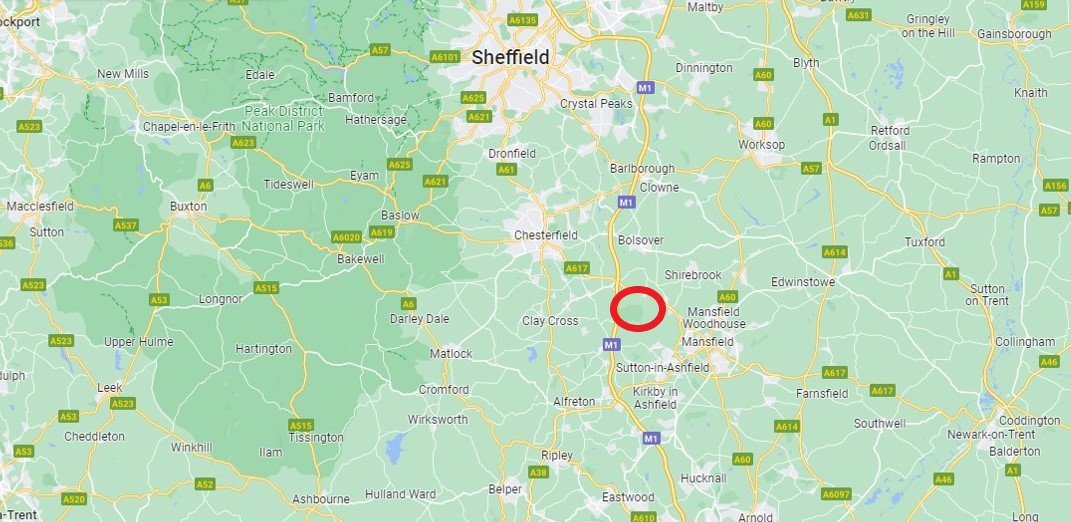
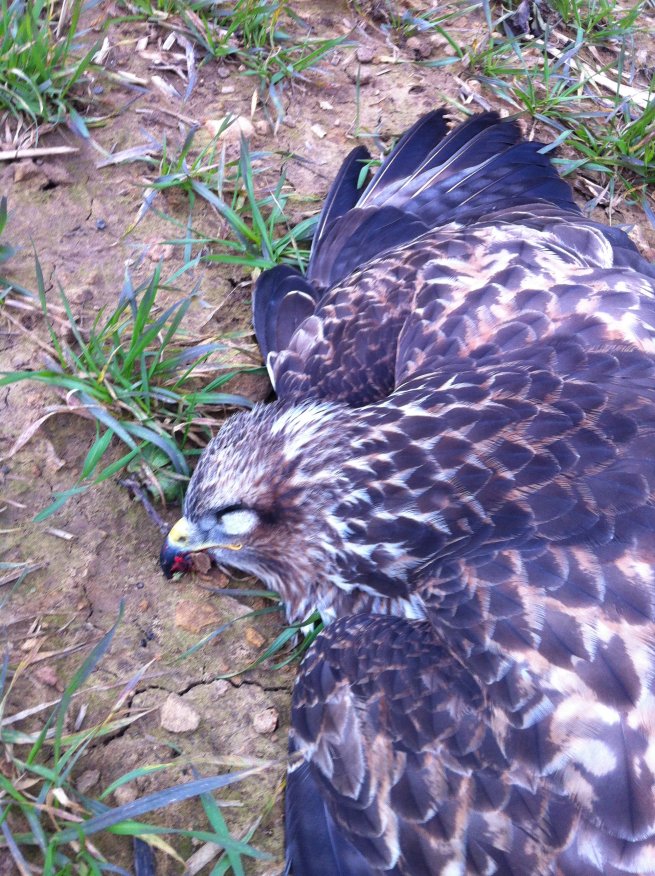
Since 2015, at least eight illegally poisoned birds of prey including buzzards and kestrels, as well as poisoned pheasant baits, have been uncovered on farmland in the Glapwell / Ault Hucknall / Rowthorne / Pleasley area of north east Derbyshire. Toxicology analysis has confirmed they were killed by the poisons Aldicarb and Alphachloralose (see here).
[A dead buzzard found in the area. Photo by Derbyshire Constabulary]
Last week police officers from Derbyshire Police’s Rural Crime Team were joined by staff from the RSPB Investigations Team, Natural England and the National Wildlife Crime Unit to undertake a series of land searches. A number of follow-up investigations are now continuing as a result of those searches.
Derbyshire’s Rural Crime Team posted the following statement on Facebook yesterday:
‘Consider this post both an appeal for information and a public safety warning.
Over recent years there has been a concerning number of dead buzzards found to have died as a result of poisoning on land around the Glapwell / Ault Hucknall / Rowthorne / Pleasley area.
In response to this issue, last week Derbyshire Rural Crime Team, RSPB Birders , the NWCU and Natural England were involved in a day of action in the area. Land searches were conducted and other lines of enquiry pursued in what proved to be a very positive day.
Clearly these beautiful birds are being targeted. Killing birds of prey in any way is ILLEGAL but laying poison on land that can be easily accessed by the public poses a significant risk to public safety.
When out and about, should you find anything suspicious it is important that you contact the Police immediately. DO NOT touch or handle anything and do not let children or animals go near.
If you have any information that may aid this enquiry please contact Derbyshire Rural Crime Team’.
This is the latest in a surge of multi-agency investigations in response to raptor persecution crimes over the last 14 months, including a raid in Suffolk on 18th January 2021 (here), another raid in Nottinghamshire in January 2021 (here, resulting in a conviction of a gamekeeper in 2022 here), a raid in Lincolnshire on 15th March 2021 (see here), a raid in Dorset on 18th March 2021 (here), a raid in Devon on 26th March 2021 (see here), a raid in Teesdale on 21st April 2021 (here), a raid in Shropshire on 2nd August 2021 (here), a raid in Herefordshire on 12th August 2021 (here), a raid in Norfolk on 14th September 2021 (here), a raid in Wales in October 2021 (here), a raid in Humberside on 10th December 2021 (here) and a raid in North Wales on 8th February 2022 (here).
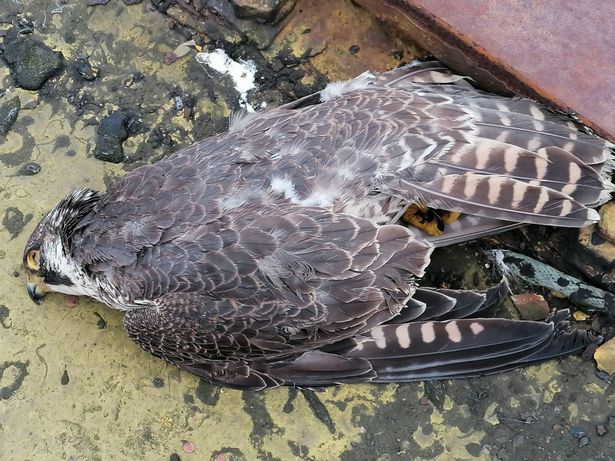
Back in March this year there were reports that two dead peregrines had been found underneath the iconic Samson & Goliath cranes in Belfast. Experts from the Northern Ireland Raptor Study Group suspected the birds had been poisoned but there was also a potential issue with Avian Flu in the area which hadn’t been ruled out.
[One of the poisoned peregrines. Photo by the Northern Ireland Raptor Study Group]
Fast forward four months and an article has appeared today on the Farming Life website as follows:
Police confirm peregrine falcon poisoned
Police have confirmed that a bird of prey found dead in the Queens Island area of Belfast earlier this year was poisoned.
It was reported in March that a Peregrine Falcon was found dead. The bird was retrieved and underwent testing to ascertain the exact circumstances. Enquiries have been ongoing. Today (July 28th), officers, accompanied by colleagues from the Northern Ireland Environment Agency (NIEA), carried out searches at two premises.
Con. Phelan said: “We can now confirm the Peregrine Falcon was poisoned with Aldicarb and Carbofuran. This is very concerning. These are dangerous substances. We would remind the public if there is a suspicion of poisoning on any bird of prey to leave the bird/s and/or bait in situ and call the PSNI as soon as possible.”
PSNI Wildlife Liaison Officer, Emma Meredith, said: “We have been working with our partner, NIEA, and our enquiries are ongoing. If anyone has information then we would be really keen to hear from you.”
Anyone with information can contact police on the non-emergency number 101 or anonymously via Crimestoppers on 0800 555 111.
ENDS
There seems to be some confusion here about whether it was one or two peregrines poisoned, but nevertheless, the detection of Aldicarb and Carbofuran in at least one peregrine is a clear indication of criminal activity.
Presumably the police didn’t release the toxicology results until today as they’d have wanted to undertake their searches without alerting any potential suspects, just in case those poisons were still on the premises.
Peregrines have long been persecuted in Northern Ireland, mostly linked to pigeon racing rather than gamekeeping, and the species has suffered population decline as a result (see here). Undertaking searches is a big step forward there so today’s searches are a very welcome move by the police and their partners at the NIEA.
Hopefully there’ll be some progress that’ll lead to a prosecution in this case. The illegal poisoning of any raptor in this day and age is an outrage, but to do this so close to Belfast city centre, with such dangerous poisons, is reckless beyond belief.
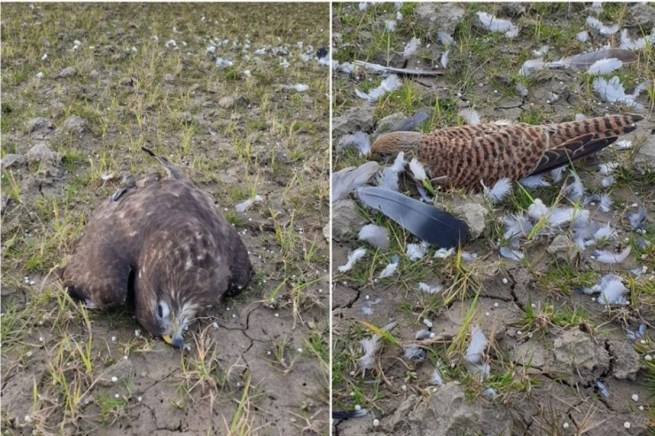
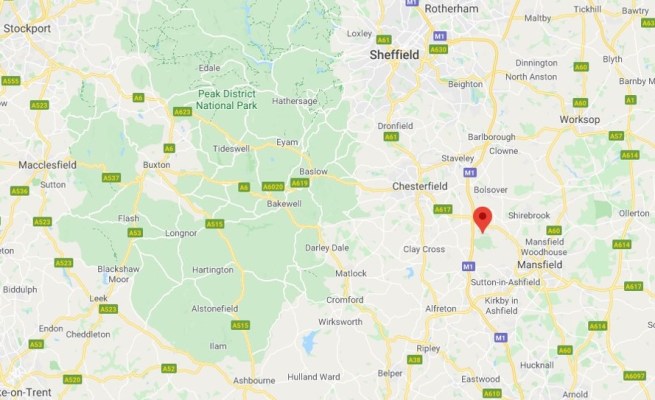
In March 2020, just after the start of lockdown, Derbyshire Constabulary reported the suspected poisoning of a kestrel and a buzzard, both found dead next to the remains of a pigeon at Ault Hucknall near Chesterfield (see here).
[Photo via Derbyshire Constabulary]
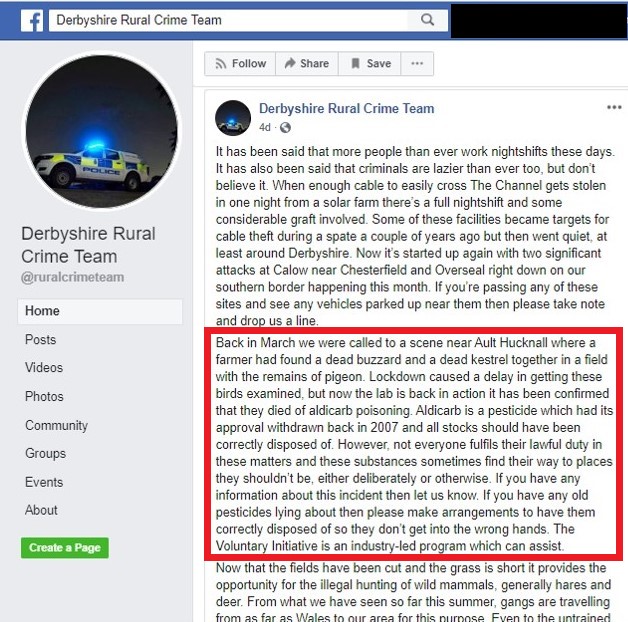
Samples were sent for toxicology analysis and last week the police received the findings. Both birds had been illegally poisoned with the banned pesticide Aldicarb.
This news was published on the Rural Crime Team’s Facebook page (see below). We haven’t been able to find any further news reports, for e.g. on the Derbyshire Constabulary website or in the local press.
These latest illegal poisonings are not the first in this area. A total of six buzzards were also illegally poisoned in neighbouring Glapwell between 2015-2016 (2 x buzzards, March 2015; 1 x buzzard & pheasant bait, February 2016; 3 x buzzards & pheasant bait, March 2016). Alphachloralose was the poison used in those cases.
[Some of the poisoned buzzards and a pheasant bait found at Glapwell in 2016, photos via RSPB]
There is a record of those poisonings in the RSPB’s 2016 BirdCrime report (here) and a short video, here:
It is quite clear that somebody in this area has access to banned poisons and is not afraid to set out poisonous baits that could kill anyone unfortunate to come in to contact with them, let alone wildlife and domestic animals and pets.
Let’s hope we see a continued publicity drive from Derbyshire Constabulary – these crimes warrant maximum awareness and exposure.
UPDATE 15th March 2022: Multi-agency searches in raptor poisoning hotspot in Derbyshire (here)








 Raptor Persecution UK