Ross-shire Massacre: five months on

It’s been five months since the discovery of 22 dead raptors (16 red kites + 6 buzzards) near Conon Bridge in Ross-shire – an incident we have termed the Ross-shire Massacre.

Since then, we’ve learned that 16 of these birds (12 red kites + 4 buzzards) were killed after ingesting an “illegally-held poisonous substance“. That information had to be dragged from Police Scotland in June, following some pretty outrageous allegations from the game-shooting industry (and at least one MSP) that the birds had been ‘accidentally poisoned’ by eating contaminated meat at the Tollie Red Kite Feeding Station.

Other than that, Police Scotland has refused to provide any further information, other than to say last month that the investigation “was continuing“.

In June, a member of the public made an FoI request to SASA (the government lab responsible for undertaking the toxicology anlayses on these birds) to ask for the name of the poison(s) and the name of the species affected, amongst other things. He received a reply from SASA on 30th June and he was told that it wasn’t in the public interest to disclose such information. SASA claimed that the public interest test was “outweighed by the public interest in ensuring that the ongoing police investigation is not jeopardised and that incomplete data are not released“. The member of the public submitted a request for a review of this decision and on 24th July 2014 he received a response from Hugh Dignon, a senior civil servant. Mr Dignon upheld the decision made by SASA and added:

By withholding evidence that might, if prematurely released, prejudice a live investigation, we are maximising the likelihood that a conviction could be secured if a prosecution is taken forward“.

Come on, Hugh! There’s not a chance in hell of getting a prosecution, let alone securing a conviction, so many months after the crime took place. Who are you trying to kid? And since when has releasing the name of a banned poison ever jeopardised a live investigation? Er, that’ll be never. SASA has, for years, routinely published the name of the poisons that were used in crimes that are still subject to on-going investigations – why is this case so different? Why all the cloak and dagger? What’s to hide?

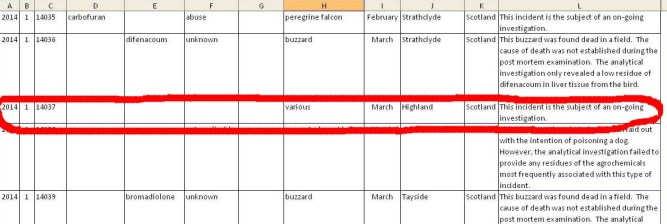
Here’s a screen grab of SASA’s latest poisoning data, which relate to toxicology tests undertaken in the first quarter of 2014. The reference circled in red is the information about the Ross-shire Massacre. SASA has redacted all the detail about the type of poison(s) detected (column 4), whether the incident was ‘abuse/mis-use’ etc (column 6), and they’ve even removed the names of the species they’ve tested – preferring to write ‘various’ instead (column 8). Compare and contrast these redactions to the entry at the top of the image, which relates to a poisoned peregrine found in Strathclyde in February – that case is also an on-going police investigation (ahem) and yet we’re allowed to see the name of the poison (Carbofuran), the type of incident (abuse) and the species affected (peregrine). Astonishing, isn’t it?

 SASA Q1 2014 ROSS-SHIRE MASSACREa

For previous posts on the Ross-shire Massacre click here

Increased powers for SSPCA would be “disastrous”, says SGA

In March this year, the Scottish Government launched a public consultation on the possibility of giving the SSPCA increased powers to investigate more types of wildlife crime (see here).

This is an important proposal that, if accepted by the government, could have a particular impact on the number of criminals successfully prosecuted for illegally destroying our wildlife, especially those carrying out raptor persecution crimes.

The SSPCA already has statutory powers to investigate some wildlife crimes, but not all. Currently, they are restricted to investigating wildlife crime offences that involve an animal in distress. They have legal powers under the Animal Health & Welfare (Scotland) Act 2006 to gather evidence and report their findings directly to the Crown Office without needing to involve the police. They are well trained, highly experienced and have a strong track record of helping to bring offenders to justice.

So why are these proposed additional powers needed? That’s simple – if the additional legal powers are implemented it would mean that the SSPCA could also investigate wildlife crimes where an animal has already been illegally killed, or instances where an animal has not yet been illegally killed but is likely to be.

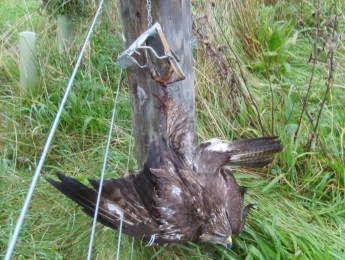
For example, today, if a member of the public found a buzzard hanging in an illegal pole trap (see photo) and called the SSPCA to report it, the SSPCA could ONLY investigate that crime if the buzzard was still alive (suffering/in distress). If the buzzard had already died from its injuries, the SSPCA would not have the authority to investigate the crime and would have to call the police. How stupid is that? The investigation process and procedures would be identical whether the buzzard was alive or dead, but because the buzzard is dead, in law it can’t be categorised as ‘suffering’ because in legal terms a dead animal cannot suffer, and therefore the SSPCA does not have the regulatory powers to investigate. Similarly, if they found another illegal pole trap set nearby (that hadn’t actually caught anything yet), the SSPCA could not investigate that offence – they couldn’t even dismantle the trap – they would have to wait for the police to attend.

Now, if they were given the proposed additional legal powers (under the Wildlife & Countryside Act), the SSPCA would be authorised to investigate any one of the above scenarios.

It’s a no brainer, isn’t it? We all know too well that the police often struggle to investigate wildlife crime, either due to a lack of resources, unavailability of a specialist police wildlife crime officer, or just because senior officers don’t see wildlife crime as a priority. Sometimes the police respond very quickly but more often than not, they can’t attend at short notice which means that crucial evidence is either removed by the perpetrator or it deteriorates to such an extent that it’s no longer useful. Sometimes they don’t even bother to attend at all. The government itself has previously  acknowledged that wildlife crime enforcement by the police can be hit or miss. So why would anyone, with an interest in seeing improved wildlife crime enforcement, object to the addition of 63 fully-trained SSPCA inspectors (at no cost to the tax payer – the SSPCA is funded by SSPCA members – it doesn’t receive any government funding for its work), joining the ranks of those authorised to investigate these disgraceful crimes?

Well, surprise surprise, the Scottish Gamekeepers Association objects. The following message was sent out to SGA members earlier this month (via email – interestingly this information has not been posted on the SGA website) –

Dear Member, help us to help you.

In March, Scottish Government issued a consultation on whether more investigative powers should be handed to SSPCA inspectors in suspected wildlife crime incidents.

The SGA believes the granting of more powers to SSPCA would be disastrous and flies in the face of what would be deemed fair and just. Unlike Police, SSPCA are not publicly accountable, have previously sought convictions of gamekeepers with insufficient evidence and campaign to ban snares. They are also critical of rearing game birds for shooting and carry agendas regarding species protection.

Help us to tell Scottish Government loudly and clearly that this move is WRONG.

ALL responses must be made by September 1st, 2014. There is no room for apathy. Please submit your response by clicking this link

Responses can be emailed or sent hard copy. Details of where and how to send are in File attachments. The first File explains the consultation, the second is the one to complete. On question 3 of Respondent Information Form, please respond as an Individual – the SGA will make a separate submission as an organisation.

How we would want people to answer:

Question 1: NO

[Question 1 is: Do you agree that the law in Scotland should be changed to give the SSPCA the powers as set out in section 4.1?]

Question 2: (in your own words but key points are: 1/ how can a charity with a campaigning role against the use of snares be charged with impartially investigating cases involving snares? 2/ The police are accountable to public – charities are not.) Also, If you know of cases poorly handled by SSPCA, please include. 

[Question 2 is: Please set out your reasons for your answer to Q1]

Question 3: N/A.

[Question 3 is: If you would prefer to see changes to the SSPCA’s powers to investigate wildlife crime other than those set out in section 4.1, please describe them]

END

So let’s look at the SGA’s position in a bit more detail. They say that giving increased powers to the SSPCA to investigate a wider suite of wildlife crimes would be “disastrous“. Disastrous for whom? Disastrous for those carrying out these crimes? Yes, without a doubt! But why would the SGA object? They claim to have a strong interest in fighting wildlife crime, reminding us repeatedly that they are an active member of the Partnership for Action Against Wildlife Crime. So how would bringing in more trained, experienced personnel to investigate wildlife crime be “disastrous”? Surely they’d be pleased to see more criminal gamekeepers brought to justice? Wouldn’t they?

They also say that giving increased powers to the SSPCA to investigate a wider suite of wildlife crimes “flies in the face of what would be deemed fair and just“. Eh? Fair and just for whom? Is it fair and just that criminal gamekeepers keep getting away with their appalling offences? Is it fair and just to society that The Untouchables can continue to illegally destroy our natural heritage without being brought before the courts?

They also say that, “unlike Police, SSPCA are not publicly accountable“. In our experience, the Police are nowhere near ‘publicly accountable’ – repeatedly refusing to account for their inaction or blunders on numerous wildlife crime investigations, hiding behind the old mantra ‘it’s a live investigation so it would be inappropriate to comment’. Besides, the SSPCA presumably has to act within the code of conduct dictated by the Charities Commission or a similar Scottish authority and so they are, essentially, publicly accountable.

They also say the SSPCA “have previously sought convictions of gamekeepers with insufficient evidence and campaign to ban snares“. The first part of this statement reveals a fundamental failure to understand how prosecutions are undertaken in Scotland. As a statutory reporting agency, the SSPCA is authorised to submit a report of an alleged offence to the Crown Office, but it is the Fiscal’s decision alone to determine whether sufficient evidence exists to proceed with a prosecution. The SSPCA (and the police for that matter) do not have the authority to make that decision. So, if, as the SGA claims, previous prosecutions have been attempted with insufficient evidence to support the charge, that’s down to poor decision making by COPFS and nobody else.

The second part of the statement (about the SSPCA campaigning to ban snares) is accurate, but so what? Has this campaigning affected their ability to investigate wildlife crimes that involve snared badgers that have been found in distress? No, of course it hasn’t, so why should it affect their ability to investigate a wildlife crime where a badger has been found already dead in a snare? As discussed above, at the end of the day it’s the Fiscal’s job to decide whether the prosecution should proceed, and that decision will be based on (a) whether a prosecution would be in the public interest, and (b) whether the reporting agency (e.g. SSPCA) has provided sufficient evidence to support the charges. Whether or not the reporting agency also campaigns for a ban on snares is totally irrelevant to the due process of the criminal justice system.

To conclude then, the public consultation for providing increased investigative powers to the SSPCA is due to close on Monday 1st September. That’s a little under two weeks. We strongly support the proposal and have campaigned for three years to get the government to put it on the table. Last year, we calculated that the conviction rate for raptor crime in Scotland was a pathetic 7.3% (see here). Wouldn’t it be good, indeed shouldn’t we expect, that better enforcement measures are introduced to tackle the vast majority of the remaining 92.7% of confirmed raptor crimes? A simple way to address this issue would be to put more trained personnel on the ground, at no cost to the tax payer. You’d have to be pretty stupid, and/or have a vested interest in raptor persecution, not to support this proposal, wouldn’t you?

If you do support the proposal because you’re sick to the back teeth of The Untouchables getting away with the systematic destruction of protected raptors (and other species – including badgers), then here’s your chance to influence government policy:

1. You can participate in the public consultation by downloading the response form from the government’s website (see here), filling it in and emailing it back to them. You can also read the full consultation document through this link.

2. You can also sign this petition, launched earlier this year by a member of the public, calling on the Scottish government to increase the investigatory powers of the SSPCA. This petition is due to close imminently as it’ll be handed in to the Environment Minister this Thursday (21st Aug) so if you’re going to sign it you need to do it quickly.

Thanks.

RSPB finally ditches Hopetoun House as Scottish Birdfair venue

Scottish Birdfair 2014 logoWe visited the British Birdfair this past weekend – an annual three-day birding extravaganza held at Rutland Water. We met quite a few people who’d travelled down from Scotland, either as exhibitors or visitors, and it didn’t take long for conversations to turn to the Scottish Birdfair.

Regular blog readers will know that for the past three years, RSPB Scotland has organised a smaller Birdfair, controversially located in the grounds of Hopetoun House, the stately home of Lord Hopetoun.

The controversy centred on our concerns about the link between Hopetoun and the Leadhills [Hopetoun] Estate in South Lanarkshire. We’ve blogged extensively about those concerns: see here, here, here, here, here, especially here,  and a bit more here, here and here.

In a nutshell, Lord Hopetoun claimed that ‘Hopetoun Estate has no role whatsoever in the management of Leadhills‘. We disputed that, based on our own research (see links above). RSPB Scotland chose to ignore the findings of our research, apparently because they had signed up to a three-year contract, and they continued to hold their event at Hopetoun House. This led to a number of people boycotting the event, notably wildlife artist and raptor research expert Keith Brockie, who stated on this blog that he’d cancelled his exhibitor’s stand at the Scottish Birdfair – well done Keith! We also understand that Mark Avery also turned down an invitation to speak at last year’s Scottish Birdfair, a decision we believe was at least partially based on the Hopetoun/Leadhills connection. If that’s accurate, then well done Mark! The Scottish Raptor Study Group was also reported to have boycotted the event due to its location – if that’s accurate, well done them!

Well the good news, based on various sources, is that RSPB Scotland has finally given Hopetoun House the elbow and the 2015 Scottish Birdfair will be held at a different venue. That really is good news.

The question now is, where is the new venue? Apparently nothing has yet been finalised although the name of one particular site kept cropping up during last weekend’s discussions. Hmmm. We’ll have to wait for the official announcement though…..

Mr Osborne loves hen harriers!

No, not THAT Mr Osborne (he may or may not love hen harriers – who knows?). This is another Mr Osborne, one J. Mark Osborne of Oxford.

Mr Mark Osborne is a grouse moor manager extraordinare. He is feted by the grouse-shooting industry for his ability to turn a ‘poorly performing’ grouse moor in to “something beyond the moor owner’s wildest dreams” (e.g. see here).

Well, it turns out that Mr Osborne loves hen harriers, according to an article that appeared on his website today – see here.

We were surprised to read it. Well, so might you be if you’ve read this and this.

Who knew?!

Rumour has it that Mr Osborne, as well as Mr Baikie (see last link above to find out who he is) have recently taken over the management of a number of neighbouring driven grouse-shooting estates in the Highlands. We’ll probably be blogging about this area in the not-too-distant future….just to report on the number of successfully breeding hen harriers and other raptors, natch!

Hen Harrier photo by Gordon Langsbury

GWCT, the Moorland Association, and their absurd hen harrier pantomime

There’s a very good blog published today on the British Ornithological Union’s website (here). It’s written by Dr Arjun Amar, a leading raptor ecologist who has published widely on the hen harrier following his PhD and post-doc studies on this species.

Arjun’s blog summarises what he calls the ‘terminal decline’ of the hen harrier and discusses the various approaches that are currently being discussed to prevent the inevitable. The three main approaches are:

1. A ban on driven grouse shooting.

2. A grouse moor licensing scheme whereby sporting rights can be removed if illegal persecution continues.

3. A brood management scheme – which basically means removing young harriers from grouse moors, rearing them in captivity and releasing them elsewhere.

In Arjun’s considered opinion, “any one of these three approaches could work well to provide a conservation success (i.e. more harriers) at least in the short term“.

He’s right, of course, in a strictly scientific sense, although he doesn’t address either the ethical, practical or enforcement issues that accompany each approach. But then why should he? He’s a scientist and he’s arguing from a scientific perspective, which is appropriate in the context of the BOU website.

Meanwhile, Andrew Gilruth of the GWCT has jumped on Arjun’s blog and has written an article proclaiming, ‘Leading raptor scientist believes hen harrier brood management could provide success‘ (see here).

Yes, strictly speaking, that’s what Arjun did say. But he also said that the other two approaches could also work well. But then we’d hardly expect GWCT to headline an article with, ‘Leading raptor scientist believes a ban on driven grouse shooting could provide success‘!

Why did GWCT choose to highlight the brood management option and not the banning of driven grouse shooting or a grouse moor licensing scheme? Well, according to Andrew Gilruth, “it would appear to make sense to implement the only approach that is ready right now – brood management“. The thing is, the brood management approach is not ‘ready right now’. In fact it’s far from being ready – read this for a good explanation.

It’s all about the careful cherry-picking of words, of which the GWCT (and others in the game-shooting industry) do so well. If you’ve read the GWCT’s recent articles on hen harriers and taken them at face value (i.e. not bothered to read around the subject), you’d be forgiven for believing that the GWCT loves hen harriers and wants to help them recover. But you have to read the small print to understand that this ‘recovery’ is conditional on the hen harriers being restricted to areas away from driven grouse moors.

It wasn’t so long ago that the GWCT (or Game Conservancy Trust as they were then called) were calling for a cull of hen harriers on grouse moors (e.g. see here), as was the Moorland Association (see here) who are also currently trying to convince us that they love hen harriers. This is the same Moorland Association who claimed there was ‘no evidence’ of gamekeepers persecuting hen harriers and that moorland owners are ‘within their rights and the law to deter hen harriers from settling on their moor to breed’ (see here). This is also the same Moorland Association (along with the National Gamekeepers Organisation) who failed to encourage their members to sign a pledge to accept the laws protecting hen harriers (see here).

Some people may be taken in by the GWCT and Moorland Association’s current absurd hen harrier pantomime, but many of us are not.

E-petition to ban driven grouse shooting: SIGN HERE.

To find out how you can get involved with Hen Harrier Day activities, click here.

Hen Harrier photo by Gordon Langsbury.

Poisoned bird found on former DEFRA Minister’s grouse moor: why no publicity?

In February 2009, a dead raven was found on a Scottish grouse moor. Nothing surprising about that.

The dead raven was sent off to SASA for toxicology tests and their investigation concluded the bird had died from ingesting the banned poison, Carbofuran. Nothing surprising about that.

There wasn’t any subsequent publicity about this incident. Nothing surprising about that.

There wasn’t any subsequent prosecution. That’s kind of what we’ve come to expect so no surprises there, either.

However, this wasn’t just any old Scottish grouse moor. This was a grouse moor on Glenmazeran Estate in Inverness-shire. Glenmazeran Estate is, according to Andy Wightman’s brilliant website ‘Who Owns Scotland‘, owned by the Englefield Estate Trust Corporation Ltd, c/o Englefield Estate Office, Theale, Reading.

According to further information provided by the Who Owns Scotland website, “Englefield Estate Trust Corporation Ltd is a company registered in England No. 02065923. One of the beneficial owners is Richard Benyon, the Environment & Fisheries Minister in the UK Government (data accurate at August 2011)”.

At the time of this poisoned bird’s discovery, Mr Benyon MP was the Shadow Minister for the Environment, Food and Rural Affairs, until the 2010 general election when he entered Government. He was subsequently appointed the Parliamentary Under Secretary of State at DEFRA, with special responsibility for biodiversity and the natural environment, amongst other things, until he was booted out in Cameron’s reshuffle in October 2013.

While Mr Benyon was in post at DEFRA, the government sanctioned the controversial buzzard ‘management’ trial and committed £375k of taxpayers money to help support it (see here), although they swiftly backtracked after a huge public outcry against the plan (see here). However, the following year Natural England, acting on behalf of DEFRA, decided to go ahead and issue a licence (to a gamekeeper with a past conviction for wildlife crime) to destroy buzzard eggs and nests to protect pheasants (see here).

Mr Benyon also decided there was no need to introduce vicarious liability to England because “there are very good laws in place to punish the illegal killing of any animal. If they are not being effectively enforced, they must be and we will take steps to make sure that happens. However, this is a good opportunity to applaud gamekeepers for the wonderful work they do in providing excellent biodiversity across our countryside” (see here and here).

Mr Benyon also refused to criminalise the possession of the poison Carbofuran in England (see here and here).

These actions can be seen in a whole new light given what we now know was discovered on Glenmazeran Estate back in 2009.

Of course, the discovery of the poisoned raven on Glenmazeran doesn’t mean that Mr Benyon or anyone else connected with the estate was responsible. Some gamekeepers on some estates are known to place poisoned baits along the boundary of an estate, presumably to make any police investigation that much more difficult and to potentially deflect attention on to someone else. Glenmazeran is not known to us as an estate where frequent raptor persecution takes place, but it is situated in a notorious raptor persecution area and several other estates in the area are suspected to be regularly involved with criminal activity and some of them even have convictions for these offences.

What’s intriguing about the Glenmazeran incident is the complete silence about this case. Did the police (it would have been Northern Constabulary at the time) investigate? Did they search Glenmazeran or other nearby estates? Why didn’t they issue any media statements about this discovery? Would public knowledge of this incident have jeopardised Mr Benyon’s political career? It shouldn’t have, as he was never implicated in the crime, so why was it kept quiet?

What we do know is that the ‘landowner’ (whoever that was) was informed about the crime. This from the SASA report:

Raven found dead in remote area. The analytical investigation established that carbofuran poisoning was responsible for the bird’s death. The police have informed the landowner of the incident but the source of the chemical has not been established“.

Fascinating stuff.

Hello, Westminster!

WestminsterIt seems that somebody in Westminster is spending a lot of time reading this blog. An awful lot of time, actually.

Take a look at the stats from our ClustrMap – this is an app that keeps track of where our site visitors are coming from. It shows a breakdown of all the countries, and then within each country it shows which cities/areas our visitors have logged in from.

The UK visitor stats show 154,070 visits between 14th September 2013 to date. Of those, 48,609 visits have come from Westminster. That accounts for almost almost one third of all UK-based visits in the last ten months.

It’s in sharp contrast to the number of visits from Orkney (3)!

Hmm, can’t think why anyone in Westminster would be so interested, unless of course they have a vested interest in what happens on driven grouse moors in northern England and Scotland….

BBC agrees “too many quotes from McAdam”

McAdam 3Two days ago we blogged about some disproportionate BBC coverage given to serial raptor persecution denier, Doug McAdam, CEO of Scottish Land and Estates (see here).
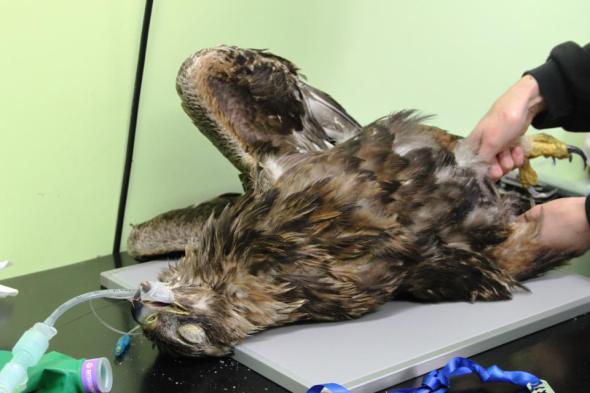
The BBC article in question was about the publication of a new SNH-funded report detailing the recovery prospects for golden eagles in south Scotland (currently clinging on by their talons).

We felt that the article was biased as McAdam was given much more space than the other contributors, and we also objected to at least one of McAdam’s statements in which he tried to downplay the effect of illegal persecution by suggesting it was an historical issue and that the latest government figures show a ‘significant’ decline – which is, as McAdam well knows, patently untrue.

We encouraged blog readers to complain to the BBC and thanks to all of you that did (we reckon, from our site stats, that over 40 of you made the effort). The BBC has now responded:

Thank you for your contact. Your comments were passed to the Editor of News Online Scotland, who has asked that we forward his response as follows:

“Thank you for being in touch about the article called: Golden eagles ‘can return to south of Scotland’ – http://www.bbc.co.uk/news/uk-scotland-south-scotland-28320168

Our Environment Correspondent, David Miller, highlighted that a Scottish Natural Heritage report indicated the south of Scotland could once again become a stronghold for golden eagles. He included the views of Prof Des Thompson of Scottish Natural Heritage; Paul Wheelhouse MSP, The Minister for Environment and Climate Change; Ian Thomson, RSPB Scotland’s Head of Investigations and Douglas McAdam, Chief Executive of Scottish Land and Estates.

During our routine and ongoing review of articles published, we felt that there were too many quotes from Mr McAdam. As a result, we decided to modify his contribution to the piece. Overall, I am happy that we have reported this story in a fair and balanced way.

Thank you, once again, for taking the time to contact us.”

Kind Regards

BBC Complaints.

-END-

So, some success at least, although the modifications that were made did not include the removal of the ‘significant decline’ quote.

Wonder if the PAW Scotland committee members will be having a quiet word with McAdam about the importance of not mis-representing PAW Scotland persecution data….

Golden eagles in southern Scotland: the facts and the fiction

A new report has been published today detailing the recovery prospects for golden eagles in southern Scotland.

The SNH-commissioned report has been written by two undisputed experts (Alan Fielding and Paul Haworth), both of whom were involved with the impressive Golden Eagle Conservation Framework report that was published in 2008.

The report has only just been made available on SNH’s website so we’ve not had a chance to thoroughly digest its findings – although we intend to come back to it in due course.

Having skimmed through it, it looks like a very detailed analysis of the various issues that could affect the recovery of this tiny population (see here for a previous blog entry on the perilous state of the golden eagle population in southern Scotland), including, of course, the effect of illegal persecution. This photo below shows the graphic effect of persecution on golden eagles in south Scotland – this one was found shot and critically injured on a driven grouse moor in 2012 – it later died from its injuries – see here.

Wanlock Head GE Oct 2012

If you haven’t read the new report (and let’s face it, not many people will), you might just base your opinion of it on what has been written in the mainstream media, which would be fine if the media reports were accurate, balanced and didn’t contain any lies.

For example, if you read the BBC report, you’d be forgiven for thinking that golden eagles in southern Scotland are only constrained by impoverished habitat and potentially by climate change, lack of prey (apparently due to a loss of gamekeepers!) and afforestation. You’d read that illegal persecution ‘may have been an historical factor’ but apparently it isn’t any more.

Hmm. Is that what the report actually says? Er, no. The report mentions persecution in several areas (Lowther Hills, Tweedsmuir Hills, Ettrick Hills and Moorfoot Hills) and suggests that it needs to be brought under control if golden eagles are to once again survive in these areas.

So if the report didn’t say that illegal persecution ‘may have been an historical factor’ but apparently isn’t any more, then who did?

McAdam 1No surprises…..Doug McAdam, CEO of the landowners’ organisation, Scottish Land and Estates. We  blogged about SLE’s persistent denial of raptor persecution only yesterday (see here) in relation to comments made by SLE’s Moorland Director Tim (Kim) Baynes during a radio debate. It looks like McAdam was sent the same memo – just deny, deny, deny.

This time, however, we intend to do more than just make fun of him – we’re going to complain to the BBC about publishing such nonsense and we’d encourage as many of you as possible to join in. We’ve even prepared some suggested text that you can simply cut and paste if you’re short of time or not sure what to write. Here it is:

Dear BBC,

I wish to make a complaint about the content of an online article about a new report about Golden Eagles in the south of Scotland:

http://www.bbc.co.uk/news/uk-scotland-south-scotland-28320168

In my opinion, a disproportionate amount of space in the written article is given over to comments made by Mr Doug McAdam, the chief executive of Scottish Land and Estates. This is in complete contrast to the amount of space given to the comments by Prof Des Thompson “who led the research” and Mr Ian Thomson of RSPB Scotland.

In addition I am very concerned that the comments attributed to Mr McAdam reflect a falsehood that is frequently stated by his organisation and others who have a long-term political agenda to downplay the issue of persecution of birds of prey. Mr McAdam is quoted as saying, “Where persecution may have been a historical factor, it is clear from the official government data – published alongside our partners in PAW Scotland in March – that the number of such incidents has dropped significantly in recent years.”

In fact, the figures published by the Scottish Government show the opposite to be the case. In the Scottish Government’s wildlife crime report for 2012:  http://www.scotland.gov.uk/Resource/0043/00434716.pdf thirteen birds of prey are listed as being the victims of persecution.

In 2013, twenty three birds of prey were listed as victims:  http://www.scotland.gov.uk/Topics/Environment/Wildlife-Habitats/paw-scotland/types-of-crime/crimes-against-birds/Poisoninghotspotmaps/2009-2013

These figures are nowhere near being indicative of “a significant” decline – in fact they are wholly contradictory of such a claim.

I urge the BBC to remove these erroneous comments from the article, given that they suggest to its readers a picture which is patently untrue.

Yours faithfully, (your name).

Here’s where to send your complaint: https://ssl.bbc.co.uk/complaints/forms/?reset=#anchor  [click on ‘Make a complaint’]

Some links:

BBC news article (and accompanying video) here

SNH press release about the new golden eagle report here

RSPB Scotland press release here

Download the new report here: Fielding & Haworth 2014_Golden Eagles in south Scotland an overview

UPDATE 17.40: Interestingly, the BBC appears to have retracted some of McAdam’s quote, but not the offending part! (Many thanks to those of you have already complained – we can see from our site stats that quite a few of you have done so).

Here’s McAdam’s quote from this morning:

Douglas McAdam, chief executive of Scottish Land & Estates, said: “We have been involved with Scottish Natural Heritage and other partners in this study since its inception as we felt it was crucial to understand the real underlying reasons why Golden Eagles were struggling in certain parts of Scotland.

This thorough and detailed study makes clear that SNH believes that habitat improvements are needed to encourage more breeding golden eagle pairs in the south of the country. We fully support this conclusion and we will encourage land managers to work in partnership with SNH and other bodies to make improvements to these habitats wherever possible.

Other factors, including climate change, lack of availability of prey base for eagles – often because these areas are no longer actively managed by gamekeepers – as well as expansion of forestry and changing land use may also be inhibiting eagle presence in these areas. Where persecution may have been a historical factor, it is clear from the official government data – published alongside our partners in PAW Scotland in March – that the number of such incidents has dropped significantly in recent years. However, everyone remains resolute that where persecution exists it must be eradicated.

Golden Eagles are iconic Scottish birds, adding greatly to Scotland’s natural landscape and welcomed by estates as part of our natural heritage. This study will add greatly to our understanding of what limits the presence of these magnificent birds and should therefore help us to understand how best they can be conserved.”

And here’s what’s currently online at 17.40: 

Scottish Land and Estates chief executive Douglas McAdam said: “Where persecution may have been a historical factor, it is clear from the official government data – published alongside our partners in PAW Scotland in March – that the number of such incidents has dropped significantly in recent years.

However, everyone remains resolute that where persecution exists it must be eradicated.

Golden Eagles are iconic Scottish birds, adding greatly to Scotland’s natural landscape and welcomed by estates as part of our natural heritage.

This study will add greatly to our understanding of what limits the presence of these magnificent birds and should therefore help us to understand how best they can be conserved.”

Come on BBC editors, get your act together!

“Very little proof” of raptor persecution, says Scottish Land & Estates

There was a radio debate on the BBC’s Good Morning Scotland programme today, with RSPB Scotland Director, Stuart Housden and Scottish Land & Estates’ Moorland Group Director, Tim Baynes.

If anyone still needs evidence that the grouse-shooting industry is in hopeless denial about the link between driven grouse moors and the illegal killing of raptors, this was it.

The debate centred on whether there was a ‘need’ for the introduction of a licensed regulatory system for driven grouse moors, as recently called for by the RSPB, both in England (here) and in Scotland (here).

According to Tim (Kim) Baynes, the RSPB’s data on raptor persecution are “out of date” and there is “very little proof” of raptor persecution. In Tim’s world, driven grouse moors are great because waders do a lot better on them than they do on moorland managed by the RSPB. Unsurprisingly, he failed to acknowledge that if you kill every predator that dares to even look at a driven grouse moor then of course waders (and grouse) are going to thrive but at a significant cost to the wider biodiversity, such as that that you’ll find on an RSPB-managed moor. He also tried to use the woeful rate of criminal convictions as evidence  that persecution wasn’t happening, and ignored the massive pile of scientific papers that tell a different story. Oh dear.

It’s astonishing that such a PR-savvy organisation such as SLE has not yet grasped the idea that the recent up-swell of public interest and anger against driven grouse moor management is largely thanks to the shooting industry’s failure to accept that there is an issue.  Ah well, never mind, you keep denying it, Kim – you’re doing wonders for our cause!

Well done Stuart Housden for not guffawing out loud on national radio.

The radio debate can be heard here (01:52:08) for the next seven days.