Scottish Government makes unlikely claim to be monitoring avian flu in gamebirds

Last week, amid widespread concerns about gamebird-shooting during the current avian flu epidemic, the RSPB called for a moratorium on gamebird releases to help limit the catastrophic spread of this highly contagious virus (see here).

In a typical year, approximately 61 million non-native gamebirds (pheasants and red-legged partridges) are released into the UK countryside to be shot. This year the number has been reduced considerably due to an import ban on gamebird eggs from France, where many of the UK shooting industry’s gamebirds are sourced (see here), although birds sourced from UK game farms are unaffected by the ban and have already been released. How many, and where, is anyone’s guess.

In the run up to the RSPB’s call for a moratorium on gamebird releases, Scottish Greens MSP Mark Ruskell had lodged a number of written questions on the subject.

These have now been answered by Environment Minister Mairi McAllan but her responses are contradictory and the claims made seem highly unlikely.

Apparently, the Government is ‘closely monitoring’ the potential spread of avian flu from gamebirds to wild birds, but there isn’t any detail on what that ‘close monitoring’ entails:

And if you look at the Minister’s next response, that ‘close monitoring’ looks even more unlikely given that the Government is not considering, nor does it intend to consider, a full registration scheme of all non-native gamebird releases:

Mark Ruskell also asked under what circumstances a moratorium on gamebird releases would be considered by the Scottish Government. The answer? ‘Where it would be in the public interest’. That hasn’t been defined either:

It’s hard to have any confidence in the Government’s commitment to this issue, given its complete indifference to the spread of another contagious disease, Crypotosporidiosis, and the known threat it poses to wild birds caused by the overstocking of gamebirds (here).

Botham’s day of grouse shooting halted by Hunt saboteurs

The Hunt Saboteurs Association (HSA) has once again turned its attention to driven grouse shoots and since the season opened on Friday, it has successfully halted three grouse shoots in the Yorkshire Dales National Park and Peak District National Park.

[Photo by Hunt Saboteurs Association]

Ian Botham is reported to be one of those affected after a grouse shoot in the Peak District was targeted. The HSA has posted this image which it says is Botham driving off the moor:

Blogs about these latest sabbing events can be read on the HSA website here and here.

It looks like the HSA is set to continue its activities throughout the grouse-shooting season. A quote from an HSA spokesperson reads:

On the day that drought was declared across the country, grouse shooters have taken to tinder-dry moorland to blast away at our wildlife. What are they thinking? Every year, these selfish, entitled people kill hundreds of thousands of birds, burn precious upland areas and litter the landscape with traps and snares. Our message to grouse shooters is a simple one: expect us’.

Millden Estate’s sporting agent signatory to ‘best practice’ scheme!

Millden Estate, the (now former) employer of depraved gamekeeper Rhys Owen Davies, sentenced to jail earlier this month for his crimes including animal cruelty and some pretty serious firearms offences (see here), is managed for gamebird shooting by a sporting agency called BH Sporting Ltd, which is owned solely by Nicholas Baikie.

Shooting estates under the management of Mr Baikie are the subject of many discussions amongst raptor workers and his name often comes up: “Oh, it’s a Baikie estate” is heard with almost as much frequency as, “Oh, it’s an Osborne estate”. I might come back to this in a future blog.

Anyway, these two individuals are associated with the management of many, many shooting estates across Scotland and England since their time at the notorious Leadhills Estate in the early 2000s. Between 2003-2006 Osborne was listed as a Director of Leadhills Sporting Ltd, a company who held the sporting rights at Leadhills. Baikie is reported to have been one of his gamekeepers before apparently training as a land agent under Osborne (according to this court document) and then setting up his own consultancy on grouse moor management, including taking on Millden Estate in the Angus Glens, which has been on Baikie’s books now for many years.

For someone in such high demand in the grouse-shooting world, Baikie keeps a relatively low online profile.

Now, according to the website of British Game Assurance (formerly the British Game Alliance but rebranded in the last year), BH Sporting is one of a number of sporting agents that have:

COMMITTED TO A GOAL OF OFFERING SPORTING DAYS EXCLUSIVELY ON SHOOTS AND ESTATES THAT ARE MEMBERS OF THE BRITISH GAME ASSURANCE FROM THE START OF THE 2023 SEASON. THIS WILL ENSURE THAT THE PROMOTED VENUES ARE ALL PARTICIPATING IN THE INDEPENDENTLY AUDITED ASSURANCE SCHEME, DEMONSTRATING THAT THE SHOOTING SECTOR IS ADHERING TO BEST PRACTICE AT ALL TIMES‘.

Shurely shome mishtake?

How can BH Sporting (or its sole director, Nick Baikie), be certain that any estate on which it offers shooting ‘is adhering to best practice at all times’?

This is the sporting agency that failed to notice the ‘obvious injuries‘ (quote from the Crown Office) to five of gamekeeper Davies’ dogs. Here’s a photo of two of those mutilated dogs, tied to what looks like an estate vehicle. Pretty hard to miss, I’d say:

This is also the sporting agency that failed to notice the very serious and reckless firearms offences committed by Davies at his tied cottage on Millden Estate.

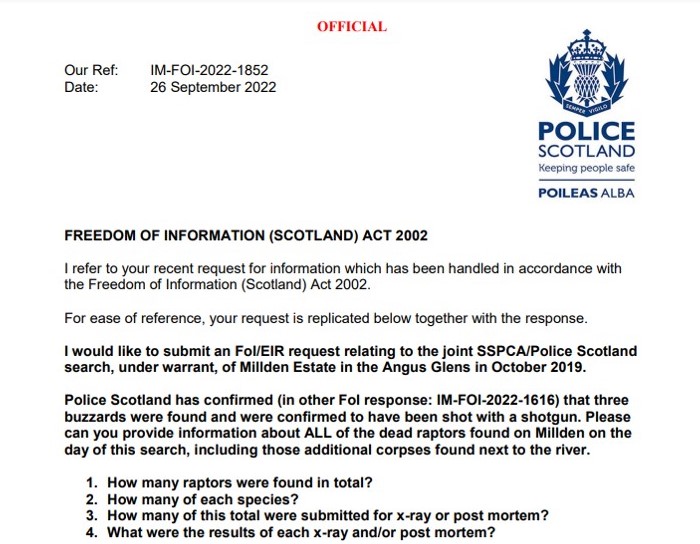
This is also the sporting agency that failed to notice the three bags of dead raptors reportedly found on Millden Estate during a joint SSPCA/Police Scotland raid in October 2019 and apparently containing at least three shot buzzards.

This is also the sporting agency that failed to notice the ‘horrendous catalogue‘ of wildlife crimes uncovered over many years on Millden Estate (for which Millden Estate has repeatedly denied responsibility and for which nobody has ever been prosecuted).

Funny, all these things this sporting agency failed to notice and yet Nick Baikie was reportedly invited to show around Professor Werritty and co during the Govt-commissioned Werritty Review into grouse moor management, where Millden Estate was held as an example of ‘best practice’. Whose idea was that??!

And now we’re supposed to accept that as from the 2023 shooting season, BH Sporting will only offer shooting on estates that have demonstrated ‘best practice’? What due diligence has the British Game Alliance done on this?

Is Millden Estate registered as a British Game Assurance member? We don’t know, because the names of all the BGA-endorsed shoots were removed from the BGA website several years ago, resulting in criticism of the BGA for its lack of transparency and accuracy (here), two fairly important commodities when you’re asking the public to trust your brand, I’d have thought. But maybe that’s just me.

I’m sure it won’t be the last criticism of the BGA. In fact I know it won’t be the last, because there’s another sporting agent listed on the BGA website whose presence undermines the entire credibility of the BGA and what it claims to represent. More soon.

‘Glorious 12th – a grand rural tradition or an outdated outrage?’ – media coverage in today’s Herald

A three-page spread devoted to the carnage wrought by driven grouse shooting has been published in The Herald today, including a lead-in from the front page:

This feature article by journalist Neil Mackay is based on a series of interviews with members of REVIVE, the coalition for grouse moor reform.

It includes details of the hundreds of thousands of animals (e.g. foxes, stoats, weasels, crows) lawfully killed on grouse moors every year in order to increase the number of grouse available to be shot, in addition to the ongoing unlawful killing of birds of prey, again, to enhance the number of red grouse available to be shot for entertainment. And all this in the middle of a biodiversity crisis.

It also covers muirburn (the burning of heather on peatland), surely the stupidest idea in a climate emergency, as well as taking apart the grouse shooting industry’s claims about the so-called economic and employment benefits of this tawdry ‘sport’. REVIVE’s campaign manager Max Wiszniewski is quoted: “If the Scottish economy was the size of Ben Nevis, then the [contribution of the] grouse moor industry would be the size of an Irn Bru bottle”.

Amanda Burgauer, director of think-tank Common Weal and a REVIVE partner, says: “There are a lot better uses for land than grouse moors which would be much more productive for communities, biodiversity and the economy. We should start looking at grouse shooting as something the Victorians did”. She also suggests a public campaign to make grouse shooting “morally abhorrent” as was done around drink-driving.

There’s nothing in the article that regular blog readers won’t already be aware of but having a three-page feature in a national paper will bring this subject to the attention of many new readers, and judging by the reaction I’ve seen on social media, it’s done exactly that.

For new blog readers, welcome, and if you want to find out more about the work of REVIVE and its campaign for grouse moor reform, please visit the website here. If you’d like a more in-depth understanding, have a look at REVIVE’s publications page here.

GWCT disregards police investigation into alleged wildlife crime on Van Cutsem’s Norfolk estate

Last week I wrote about how former Cabinet Secretary Fergus Ewing MSP, the Scottish Gamekeepers Association, and landowners’ lobby group Scottish Land & Estates had shown complete disregard for the sanction imposed on Moy Estate after raptor persecution crimes had been recorded there (see here).

This week it’s the turn of the Game & Wildlife Conservation Trust (GWCT) to seemingly turn a blind eye.

Have a look at this event currently being promoted on GWCT’s website:

Regular readers will know that Hilborough House is the home of William van Cutsem. In May this year, police raided the estate after video footage emerged of alleged raptor persecution.

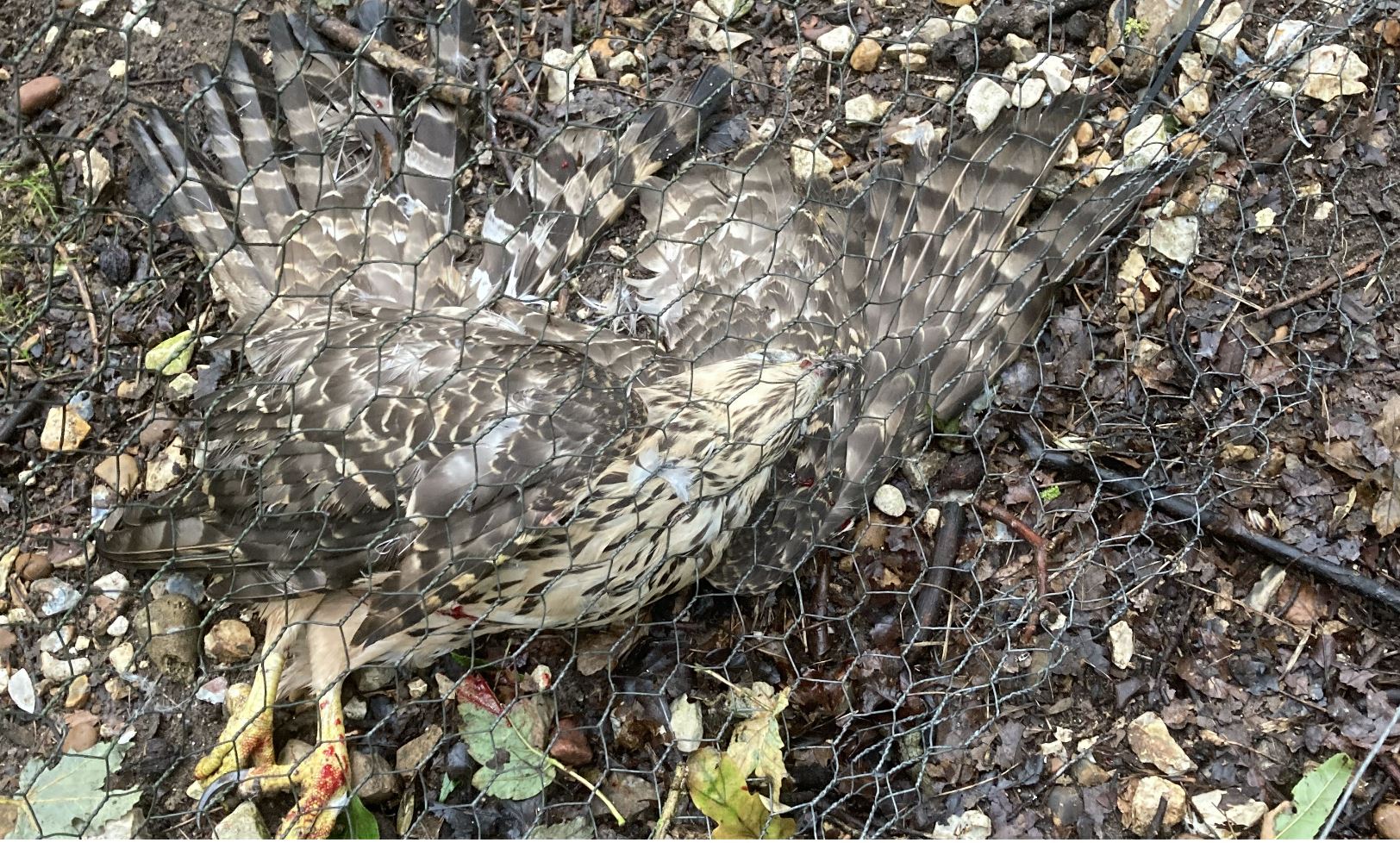
The footage, captured on a secret camera installed by the Hunt Investigation Team, appeared to show a crow cage trap in woodland alleged to be on the Hilborough Estate. The trap had been baited with live pigeons (this is an offence) and a young goshawk was attracted to the bait, entered the trap and then couldn’t escape. A masked man is then recorded entering the trap, pinning the goshawk to the side netting with a stick so he could grab the bird, and then removing it from the trap and walking away with it (also an offence). The goshawk’s fate is not shown.

As far as I’m aware, the police investigation is ongoing.

Mr Van Cutsem hasn’t commented publicly about this investigation although in a classic attempt at diversion, the Mail on Sunday ran a piece quoting ‘an unnamed source close to Mr van Cutsem’ who questioned the relationship between the Hunt Investigation Team and the RSPB:

What also is interesting is how close HIT works with the RSPB. It would be good to understand how a mainstream charity is working with a shady group’. 

Oh the irony!

‘If grouse shooting was a new idea, would you support it?’ Opinion piece from REVIVE, the coalition for grouse moor reform

An opinion piece published in The Scotsman today, written by Max Wiszniewski, Campaign Manager for REVIVE, the coalition for grouse moor reform:

If grouse shooting never existed and large landowners wanted to start it up today, would you be in or would you be out?

Today marks the beginning of Scotland’s grouse shooting season – traditionally known as the ‘Glorious Twelfth’ of August – which is now seen as a highly controversial date in the calendar. From now until December 10, many thousands of grouse are legally allowed to be shot by, what will ultimately be, just a few people for sport.

So, what is grouse shooting, why has the killing of this iconic Scottish bird become a past-time amongst some of our societal elites and why is it rightly seen as so completely controversial today?

Grouse shooting can take place in more than one form including walked-up shooting but it is driven grouse shooting which is the dominant form and which causes the greatest and most significant societal discord.

Driven grouse shooting is the practice of using a line of ‘beaters’ to drive red grouse over the heads of shooters waiting behind shooting ‘butts’ – who attempt to kill as many of these native birds as possible.

The need for ‘high bag numbers’ on shoot days is what drives a circle of destruction that surrounds the industry, and the intensity of those land management practices has significantly increased since Victorian times when the blood-sport was invented.

Early moorland management involved heather burning to provide an enhanced habitat for breeding and predators were totally eliminated, including many of Scotland’s birds of prey.

This led to a rapid increase in the red grouse population with record numbers of over 2,000 birds killed in a single day. These early days of grouse moor management were accompanied by dramatic fluctuations in grouse numbers due to outbreaks of disease.

In 2022, these management practices largely continue with some important differences in the literal and political landscape. While grouse can be shot for some people’s amusement, birds of prey are now legally protected and recent decades have seen the introduction of high-strength medicated grit stations to combat population fluctuations and the spread of disease that is inevitably present in high densities of grouse.

Grouse ingest mineral grit to assist the digestion of heather, so grouse moor managers provide them with an alternative source of grit, coated with the pharmaceutical worming drug Flubendazole. Some estates, unhappy with the results of using double-strength medicated grit, are now using super-strength medication of up to 20 times the concentration of the original anthelmintic drug, according to a well-known grouse moor manager.

The distribution of a toxic pharmaceutical drug that seeps across the landscape and into the food chain represents a level of intensification that transforms moorland from a semi natural-environment into a quasi-domesticated farmed environment – keeping grouse numbers unnaturally high, for sport shooting. This is far from the wholesome and natural countryside experience that grouse moor managers would have you believe it is.

Coinciding with increasingly intensive management practices, while legally protected, it’s the continuing persecution of birds of prey (including golden eagles and hen harriers) that has increased the infamy of the relentless grouse shooting industry.

A 2017 Scottish Government report showed that out of 131 satellite-tagged eagles, about a third had disappeared, presumably died, under suspicious circumstances prompting legislative action that is due in this parliamentary term. Since then, raptor persecution has continued, even amidst a pandemic lockdown.

[This young golden eagle was found deliberately poisoned on a grouse moor on Invercauld Estate in the Cairngorms National Park. The carcass next to it is a mountain hare, used as a poisoned bait. Photo by RSPB]

Grouse moors are due to be licenced by the Scottish Government, which means that if a wildlife crime is committed on a grouse moor then it could lose it’s licence to operate. However, the problems of driven grouse shooting go much further than widespread evidence of illegal activities. The circle of destruction that surrounds grouse shooting even goes beyond the mass chemical medication on our moors.

The muirburn season sees huge swathes of Scotland’s uplands burned, to make the local landscape more suitable for grouse – so more of them can be shot for sport.

This risks the vital peatland that occupies much of our upland moors which emit carbon in a degraded state as opposed to sequestering it. Meanwhile the muirburn monocultures deprive our uplands of a larger mosaic of alternative biodiversity – which would still include heather – keeping the land in a dry and fragile state.

Unregulated bulldozed hill tracks scar the landscape to make life easier for shooters and grouse moor managers. Tons of lead shot is sprayed across the countryside.

Untold thousands of animals like foxes, stoats, weasels and crows still suffer needlessly on grouse moors via snares and traps – just so more grouse can be shot for sport. Does this sound like the modern progressive Scotland we all aspire to?

When the Scottish Government licenses shooting estates, they need to tackle it all. They need to end the entire circle of destruction and get to the heart of the problem – driven grouse shooting. Is the desire of just a few people to shoot more birds justification enough for such damage to our wildlife and the environment? Especially considering the economic returns, to the public at least, are so tiny for all the land it uses up.

If you’re on the fence and you are still to decide whether to support Revive’s reform agenda, then ask yourself the following.

If grouse shooting never existed and large landowners wanted to start it up today – they would make the case for burning the landscape, degrading our peatlands, mass-medicating a supposedly wild bird with high-strength toxic chemicals, killing tens of thousands of other wild animals while spraying grouse with poisonous lead shot for three months, every year – just so more grouse can be shot for sport.

Would you be in, or would you be out?

ENDS

If you want to find out more about the REVIVE coalition’s campaign for grouse moor reform in Scotland, please visit their website here.

Animal welfare charity calls for an end to driven grouse shooting & a ban on snares

Press release from leading Scottish animal welfare charity OneKind:

Animal welfare charity calls for an end to driven grouse shooting and snaring ban on the Glorious Twelfth

Leading Scottish animal welfare campaigns charity OneKind is calling for an end to driven grouse shooting on the first day of the shooting season. It comes as the charity plans to demonstrate outside the Scottish Parliament (17th September 2022), calling for a ban on the manufacture, sale and use of snares in Scotland. 

A significant portion of Scotland’s land is managed for driven grouse shooting. To maximise red grouse numbers and the profit from those who shoot them for fun, gamekeepers routinely kill thousands of wild animals who are seen as a threat to grouse. The methods of killing are cruel and can inflict prolonged suffering upon the animals. Companion and farmed animals may also be injured or killed accidentally. 

While the Scottish Government has committed to licensing grouse moors, only a ban on driven grouse shooting will ensure an end to the widespread suffering of animals. 

OneKind Director, Bob Elliot said: 

There is nothing celebratory about the Glorious Twelfth. What could possibly be considered glorious about a day which marks the start of the shooting of grouse for ‘fun’ and the killing of other wild animals to maximise profit for the ‘sport’

Today is the culmination of the year-long killing of our wildlife on grouse moors. All year predators of red grouse have been subjected to physical and mental suffering whilst caught in traps and snares, before being killed by gamekeepers. The animals persecuted include foxes, stoats, and corvids, such as crows. All this killing takes place in the lead up to the Glorious Twelfth just to ensure there are as many red grouse as possible for the shooting season beginning today

Traps and snares are indiscriminate. Companion animals such as cats and dogs, farmed animals, and non-target wild animals such as badgers, are also sometimes injured or killed by these cruel and antiquated traps. There is little regulation so gamekeepers can kill many animals without justification or scrutiny.” 

On OneKind’s upcoming snare demonstration outside the Scottish Parliament, Bob stated: 

The Scottish Government is currently reviewing the impacts of snaring. This is an opportune time for us to send a strong message to them that the public wants a full snaring ban. Indeed, 76% of Scots wish to see a ban on the use and sale of snares in Scotland.  

On Saturday the 17th of September we will demonstrate outside the Scottish Parliament, alongside our supporters, calling on the Scottish Government to make history and ban snares. We are also delighted to have celebrity support for our demonstration, including from Scottish actor Alan Cumming, Naturalist Chris Packham and Actor Peter Egan

The message is clear. Scottish Government, it is time to consign snares to the history books.” 

ENDS

Grouse shooting season ‘irresponsible’ amid bird flu epidemic

Widespread concerns about gamebird-shooting during the current avian flu epidemic are repeated today in an article in the Press & Journal.

I argue that it’s irresponsible and selfish for grouse-shoots to take place when the full impact of this highly pathogenic virus on our wild bird populations is currently unknown, although we do know that it has killed tens, if not hundreds, of thousands of birds already, impacting on globally significant UK populations of some wild bird species.

In response, the Scottish Government is quoted: ‘…there have been no recorded cases of avian influenza in any grouse species, and there are no restrictions in place on grouse shooting’.

Hmm. And how much monitoring and surveillance has the Scottish Government undertaken to assess the extent of bird flu in red grouse? Given the authorities’ complete disinterest in the monitoring and surveillance of highly contagious Cryptosporidiosis, known to be present in high-density grouse populations on intensively-managed Scottish grouse moors and known to be affecting other species through cross-contamination, I’d say this Government response is poor. Especially when we know that many grouse moors are now infested with non-native pheasants and red-legged partridges which have been released for shooting (e.g. see here).

But don’t worry. Kenneth Stephen of the Scottish Gamekeepers Association told the P&J that the industry would “fully comply” with any restrictions imposed, “and it would be illegal not to”.

That’s reassuring, because gamekeepers are renowned for complying with the law, aren’t they?

Calls to ban gamebird release to avoid ‘catastrophic’ avian flu outbreak

An article in today’s Guardian focuses on the RSPB’s call for an immediate moratorium on the release of birds for shooting, such as pheasants, partridges and ducks, due to the risk of them spreading highly pathogenic avian flu to wild bird populations.

It seems a perfectly reasonable request to DEFRA to me, although there’s a quote in the article from Glynn Evans of BASC who accuses the RSPB of ‘political grandstanding’ and of ‘ignorance about the virus’s behaviour’ and instead wants to talk about ‘the substantial role shooting plays in the countryside’. I’m not sure what that’s got to do with the issue at hand – sounds like he’s doing a bit of political grandstanding himself.

There’s also a quote from Mark Avery of Wild Justice: “Given how little is understood about the spread of avian flu it makes no sense to release tens of millions of captive-bred birds into the countryside for shooting. They constitute an unnecessary threat to wild birds and domestic poultry“.

The full impact of this highly pathogenic virus on our wild bird populations is currently unknown, although we do know that it has killed tens, if not hundreds, of thousands of birds already, impacting on globally significant UK populations of some species, including Gannets and Great Skuas. There are also concerns about the impact the virus is having on a number of raptor species, notably the White-tailed eagle in Scotland. I’d argue that it would be wholly irresponsible, and selfish, for gamebird shoots to take place during such an epidemic.

I can’t imagine for a second that DEFRA will take this precautionary approach to avoid the potential spread of a devastating virus. We’ve been here before, remember? As DEFRA exempted gamebird shoots from Covid-related lockdown restrictions in 2020, despite the very obvious risk of spreading the virus amongst humans in the middle of a global pandemic, they sure as hell aren’t going to bother about a virus spreading from gamebirds to wild birds.

You can read the article in The Guardian here.

Millden Estate – plausible deniability or wilful blindness to gamekeeper Rhys Owen Davies’ crimes?

Further to the conviction and jailing of Millden Estate gamekeeper Rhys Owen Davies earlier this month for his crimes involving animal cruelty and firearms offences (see here), there’s been quite a lot of commentary about the role of the estate.

In the media coverage I’ve read on this case, an unidentified spokesman for Millden Estate has commented as follows:

The estate does not condone or tolerate any illegal activity relating to the welfare of animals or wildlife.

We were shocked to learn of all the allegations when they came to light.

The employee involved was suspended by the estate with immediate effect and resigned a few days later when the police investigation was still at an early stage. At no stage was the estate itself the focus of the investigation. These offences did not take place on the estate but happened at locations some distance away and unconnected to the estate“.

I want to examine the plausibility of the estate’s denial.

First of all, of course the estate is going to state that it ‘doesn’t condone or tolerate any illegal activity relating to the welfare of animals or wildlife‘. It’s hardly going to say, ‘Oh yes, officer, we encourage all our employees to break the law and inflict sadistic cruelty on wildlife‘, is it?! And I would imagine, given the potential for a vicarious liability prosecution for raptor persecution these days, an estate of this size and prominence will have all its paperwork in order (e.g. statements in its employees’ contracts, evidence of on-going training etc) that it could produce to defend itself if an employee was caught committing wildlife crime.

This sort of paper trail is now commonplace on Scotland’s large shooting estates and has been encouraged by various shooting organisations who have provided advice (e.g. BASC here, Scottish Land & Estates here) and in some cases training (e.g. GWCT here). Ironically the document produced by SLE on vicarious liability acknowledges the help of someone believed to be linked to the sporting management of Millden Estate!

Whilst arse-covering paper audits might convince the authorities, what actual effect does it have on the activities of an estate’s employees?

Very little, judging by the criminality undertaken by gamekeeper Rhys Owen Davies, working on a estate that has a ‘horrendous catalogue‘ of wildlife crimes according to Alan Stewart, a former Police Wildlife Crime Officer who’s patch included the Angus Glens.

But the spokesperson from Millden Estate said: “We were shocked to learn of all the allegations when they came to light”.

How plausible is that? How plausible is it that Rhys Owen Davies’ injured and scarred dogs, kennelled next to his cottage on the estate, weren’t seen by any of the estate’s other employees, including the multiple gamekeepers he worked alongside, for the 18 month period when he was using the dogs to inflict sadistic cruelty on foxes and badgers?

In my opinion, that’s pretty implausible. Have a look at this photograph of two of Davies’ mutilated dogs. It was published in the Daily Record and appears to show the dogs tethered to a vehicle that it would be reasonable to assume is a work vehicle:

In court, Davies’ defence barrister told the Sheriff that the dogs’ injuries were as a result of lawful ratting and foxing, which are part of a gamekeeper’s regular duties. It seems implausible to me that his work colleagues didn’t notice these injuries or that the extent of the injuries didn’t raise any suspicion as to their cause. They’d also know, I’d argue, that Davies wasn’t seeking professional veterinary advice on the treatment of those injuries.

Gamekeeping duties often involve the use of the keepers’ own dogs and the multiple gamekeepers employed on Millden Estate would have had ample opportunity to see Davies’ dogs at work and to ask him about what the Crown Office described as ‘obvious injuries’. Any concerns could have been raised with the Head Gamekeeper and /or the sporting agent / estate Factor.

The estate’s statement also included the line:

At no stage was the estate itself the focus of the investigation. These offences did not take place on the estate but happened at locations some distance away and unconnected to the estate“.

The estate WAS the focus of the investigation as the search warrant included a provision to search various sites on Millden Estate looking for evidence of badger sett disturbance. And Davies’ tied cottage and associated outbuildings on the estate were also searched, under warrant, where a number of serious firearms offences were uncovered, specifically, an unsecured Benelli shotgun was found propped up against a wall near the front door; two unsecured rifles were also found: a Tikka .243 rifle on the sofa and a CZ rifle in the hall cupboard next to the open gun cabinet;  and an assortment of unsecured ammunition was found including 23 bullets in a pot on the floor, five in a carrier bag behind the front door and one on top of a bed, according to a statement by the Crown Office.

As Davies was employed as an under-keeper, I’d argue that Millden Estate should bear significant responsibility for these serious breaches on the estate of shotgun & firearms legislation. Where was the supervision from Davies’ immediate supervisor, the Head Keeper? Davies’ estate cottage was unlocked and unattended when the SSPCA and Police Scotland arrived to execute the search warrant. Imagine who else could have walked in, found those firearms, shotgun and ammunition. If, as we’re led to believe by the shooting industry’s propaganda machine, that most if not all illegal behaviour on sporting estates is perpetrated by ‘unknown criminals’ totally unconnected to the estate, you’d think that the security of firearms, shotguns and ammunition would be of uppermost importance, wouldn’t you?

You can draw your own conclusions, of course, but it’s my opinion that Millden Estate’s efforts to distance itself from having any knowledge of Davies’ crimes are predictable but implausible. Especially after I’ve recently learned that there was another investigation into alleged badger baiting on this estate about 13 years ago; an investigation that didn’t go anywhere because apparently the procurator fiscal at that time refused to advance the case.

As for the bags of dead raptors found during the search in October 2019 at three different locations on the estate, and reportedly containing at least three shot buzzards, we now know that the Crown Office is not pursuing a prosecution (although the detailed rationale for this decision has not been divulged, see here) which means that Millden Estate will avoid a prosecution for alleged vicarious liability. I wait with interest to see whether NatureScot imposes a General Licence restriction in relation to the discovery of these dead raptors.