Press release from the Irish Government’s National Parks & Wildlife Service (2nd February 2024):
Results of the 2022 National Hen Harrier Breeding Survey now published
The latest report on the status of breeding Hen Harrier (Circus cyaneus) in Ireland has just been published in the National Parks & Wildlife Service’s Irish Wildlife Manual Series.
The 2022 National Hen Harrier Breeding Survey was completed with a significant contribution of over 7,700 hours of fieldwork by approximately 250 surveyors. The National Parks & Wildlife Service, and survey partners, the Golden Eagle Trust, the Irish Raptor Study Group and BirdWatch Ireland, would like to acknowledge the valuable contribution made by all surveyors, particularly the eNGO volunteer network.
In a change from previous national surveys, the Hen Harrier European Innovation Project (HHP, funded by Department of Agriculture, Food and the Marine), in operation between 2017-2022, undertook the monitoring of breeding hen harriers across the six breeding Hen Harrier Special Protection Areas (SPAs) and contributed those records to the national survey. The Northern Ireland Raptor Study Group also assisted in coverage in the border counties.
The hen harrier is a territorial bird of prey, and known for its spectacular aerial courtship display, the ‘sky-dance’. It typically bred in open habitats such as heath and bog, with areas of low-intensity farmed grassland also favoured. The 2022 results indicate that:
the national hen harrier population has declined by one third since 2015, to an estimated maximum of 106 breeding pairs (i.e. 85 confirmed, 21 possible).
Its breeding range has contracted by 27% for the same period. A review of data for those sites covered in each of the past five national surveys (i.e. 1998/00 to 2022) indicates a 59% long-term decline for those sites.
The magnitude of declines observed for the subset of sites surveyed across all five national surveys would likely prompt the Red-listing of hen harrier on the Birds of Conservation Concern of Ireland.
The conservation of Hen Harrier is considered one of the most urgent bird conservation priorities in Ireland and on January 12th of this year, Minster Noonan launched the Public Consultation on the Hen Harrier Threat Response Plan. The consultation closes on 20th February 2024, having been previously extended from 13th February.
This iconic bird of prey, once regarded as relatively common in the mid-19th century, now breeds in uplands affected by competing land-use pressures including forestry, agriculture, renewable energy and recreation. Such changes have resulted in both losses in extent or area of open habitats and habitat features (e.g. scrub, hedgerows, copses, heather) for breeding Hen Harrier and in the suitability of what remains, with lower food availability, increased predation pressure and poorer overall habitat condition linked to declines.
Conservation challenges include development of effective measures to address sizeable landscape-scale deterioration in hen harrier habitats, caused by the extensive land-use changes that have precipitated lower breeding success, poor juvenile over-winter survival, and lower recruitment into the breeding population.
This report makes a number of recommendations to halt further declines and support much-needed population recovery, all of which will be considered in the finalisation of the Threat Response Plan.
ENDS
The 2022 National Hen Harrier Breeding Survey can be read/downloaded here:
The National Hen Harrier Survey in England, Scotland, Wales and Northern Ireland was conducted in 2023. This research will provide updated estimates of hen harrier population size and regional trends since the last national survey in 2016 (2016 results can be found here). The results of the 2023 national survey are expected to be published in spring 2024.
Further to the blog I wrote yesterday about the conviction of Gary MacFarlane for the illegal sale of peregrine chicks (here), I’ve just received some more information about this case.
I had written that I wasn’t sure whether or not the case related to the laundering of wild peregrines, although Police Scotland’s press release had alluded to it.
However, I’m now reliably informed that the case against MacFarlane was centred on apparently legitimate captive-bred peregrines and his crimes involved admin offences where he’d entered incorrect details on Article 10 certificates about the paternal genetic lineage of some chicks he was selling, simply because he’d guessed at the identity of the sire, having used semen from a number of males to artificially inseminate the female. His case was NOT related to the laundering of wild peregrines and passing them off as captive-bred birds.
To be honest, the financial consequences of MacFarlane’s admin errors (a fine of £2,100 and the confiscation as proceeds of crime of £5,220 in cash found at his house) seem a bit over the top, especially as the Article 10 system as prescribed by APHA seems ridiculous to say the least.
I won’t go into details because I’m not sure I understand it fully but as a quick summary, APHA has allowed some falcon breeders to enter details on Article 10 certificates of up to 80 individual males as the potential sire of a captive-bred chick. MacFarlane apparently didn’t understand the system and as he’d used semen from six males, he thought he had to indicate on the certificate which one of those males sired the offspring, rather than saying ‘it was one of these six’. He guessed at the identity of the purported sire, got it wrong and has now paid the price. He’s also received an automatic five year ban from keeping Schedule 4 birds so he’s also lost his breeding stock.
The APHA system as it stands is useless, if the idea is to be able to keep track of individual captive-bred birds but then allows breeders to include the details of up to 80 potential sires – it’s bonkers. I understand there is ongoing work between a number of agencies to try and resolve and update the system.
But that’s for discussion elsewhere – it’s not really within the remit of this blog and it’s beyond my area of expertise.
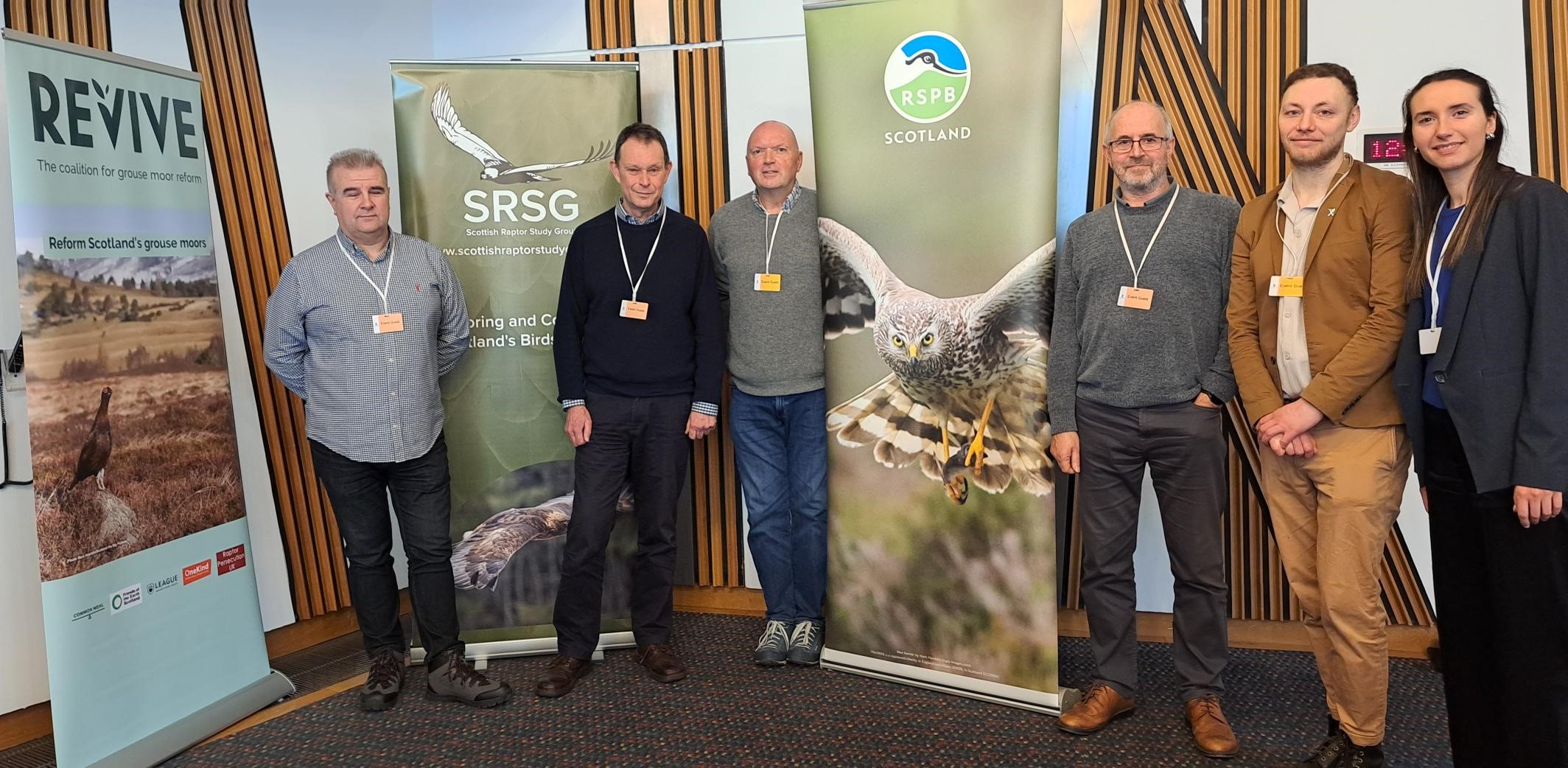
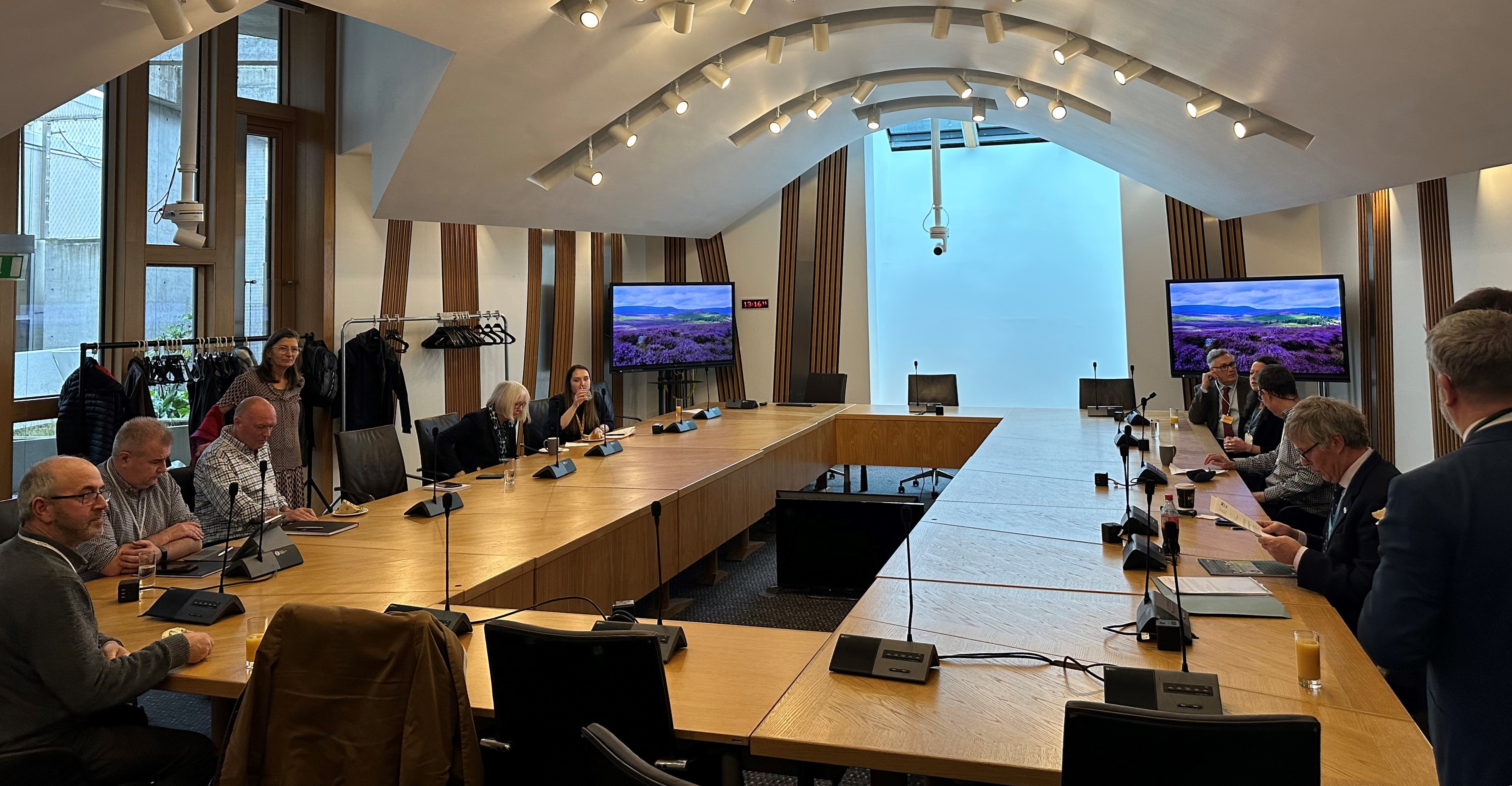
Three conservation organisations held a parliamentary reception at Holyrood yesterday to brief MSPs ahead of the forthcoming Stage 2 of the Wildlife Management & Muirburn (Scotland) Bill.
Members of the Scottish Raptor Study Group, RSPB Scotland and REVIVE, the coalition for grouse moor reform, were joined by many members of the Rural Affairs & Islands Committee (the Committee tasked with voting on the Bill’s Stage 2 amendments) and a few other MSPs also attended.
Representatives from SRSG, RSPB & REVIVE. Photo by REVIVE
Productive round-table discussion. Photo by REVIVE
The timing of this reception was fortuitous, thanks to Rural Affairs Committee Convenor Finlay Carson suddenly deciding on the eve of the Committee’s planned session to delay the consideration of the Stage 2 amendments by two weeks (see here and here). This provided an opportunity for conservationists to further brief MSPs on various issues relating to the Bill, ahead of the Committee’s session which is now scheduled to begin next week.
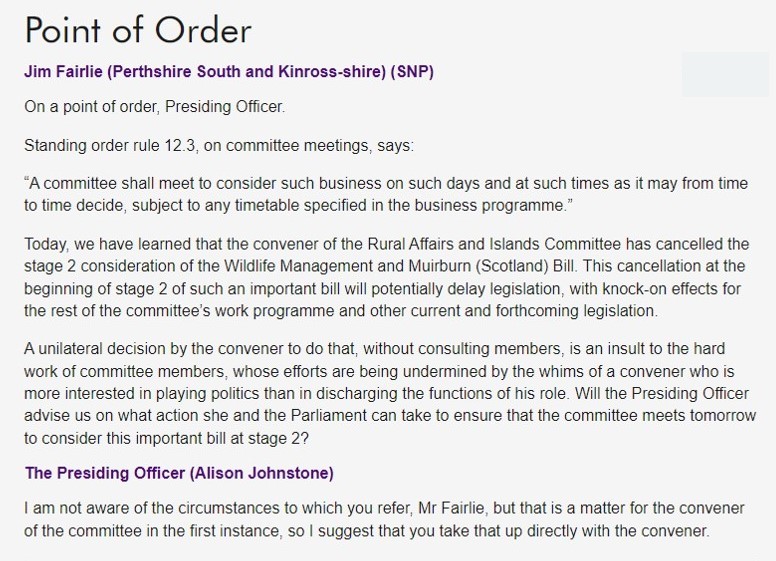
Interestingly, the fall-out from Finlay Carson’s decision to delay proceedings resulted in Committee member Jim Fairlie MSP (SNP) raising a point of order about it with the Parliament’s Presiding Officer (Alison Johnstone) on the day that Mr Carson made his decision (23 Jan 2024). From Alison’s response, it seems that Committee Convenors have a disproportionate yet legitimate level of power which allows them to thwart the will of Parliament. It’s quite an eye-opener:
Another consequence of Finlay Carson’s decision to delay proceedings is that MSPs were allowed an extended period of time in which to lodge amendments to the Bill at Stage 2. I note that Conservative MSPs Edward Mountain and Rachael Hamilton took advantage of that (legitimately) and have lodged further amendments to those they’d already lodged.
I haven’t been through these with a fine-toothed comb because I haven’t had the time, but I did note that Edward Mountain has lodged a further amendment suggesting that the withdrawal of wildlife trap licences should be based on the criminal burden of proof rather than the civil burden of proof (the Bill currently proposes a civil burden of proof which is an easier threshold to meet). Interesting, but not surprising.
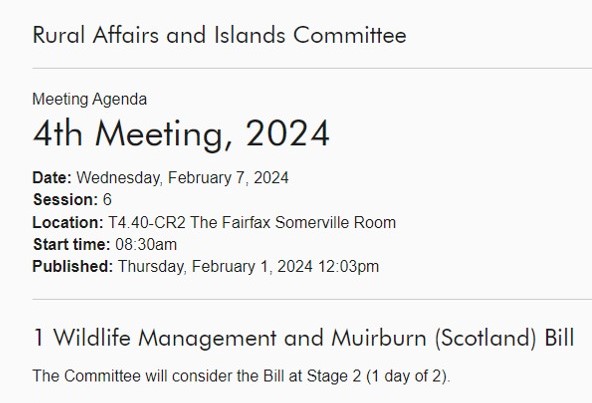
The Rural Affairs & Islands Committee will begin its consideration of the Stage 2 amendments next Wednesday (7 February 2024). It will be one of two sessions (the date of the second session has yet to be announced) and will begin at 08.30hrs; earlier than the usual 9am start and probably a reflection of how many amendments there are to be considered.
It’s expected that the session will be available to watch live on Scottish Parliament TV, as usual.
If I have time I’ll write further about the specific Stage 2 amendments prior to the first Committee meeting next week.
Press release from Police Scotland (1st February 2024):
Man to pay £7,000 in fine & confiscation charges following peregrine falcon case
A 61-year-old man has been ordered to pay over £7,000 in fine and confiscation charges after pleading guilty to advertising and selling peregrine falcon chicks without the required legal documentation under the Control of Trade in Endangered Species Regulations 2018.
Gary MacFarlane from Blackridge, West Lothian, was fined £2,100 when he appeared before Livingston Sheriff Court for sentencing today, Thursday, 1 February, 2024.
He previously pleaded guilty to 11 charges at a hearing at Livingston Sheriff Court on Thursday, 26 October, 2023, where he was ordered to forfeit £5,220 in cash which had been seized from his home address.
The charges included four counts of advertising and selling peregrine falcons without Article 10 certificates being issued, which is a requirement under the legislation for selling such protected species.
He also admitted seven counts of making false declarations in terms of the parent lineage of the chicks.
Detective Constable Steven Irvine, of the National Wildlife Crime Unit, said:
“This case sends a strong message to those who flout regulations in terms of our endangered and protected species that Police Scotland will thoroughly investigate these crimes and bring those responsible to justice.
“Gary MacFarlane sold protected chicks for his own profit and under false pretences which led to an extensive police investigation involving significant support from partner organisations including the SSPCA, the Scottish Government’s SASA forensic unit, the Animal Plant Health Agency, the National Wildlife Crime Unit and raptor specialists.
“Members of the public have a vital role to play in tackling wildlife crime and I would encourage anyone with information or concerns about this type of criminality to contact Police Scotland on 101 or Crimestoppers anonymously on 0800 555 111.”
ENDS
This is a strange press release. I’m assuming it refers to the theft and illegal laundering of wild peregrines being passed off as captive bred birds, (‘He admitted seven counts of making false declarations in terms of the parent lineage of the chicks‘) but if it was the theft and illegal laundering of wild peregrines this hasn’t been stated explicitly, it’s rather just inferred.
Nor does the press release say when the offences took place, nor whether this case is linked to Operation Tantallon – the high profile police investigation into the theft and illegal laundering of peregrines in Scotland which saw part-time gamekeeper Timothy Hall and his son Lewis Hall convicted in December 2023. They are due for sentencing on 12 February 2024 (see here).
However, an article from a court reporter in The Herald (here) provides a bit more detail, saying the offences took place in June 2021 and came to light after buyers tipped off the Animal Plant & Health Agency (APHA) that MacFarlane was selling peregrines without the A10 certificates required for the sale of this species.
UPDATE 2 February 2024: Falconer’s conviction for illegal selling of peregrine chicks in Scotland was NOT related to laundering of wild peregrines (here).
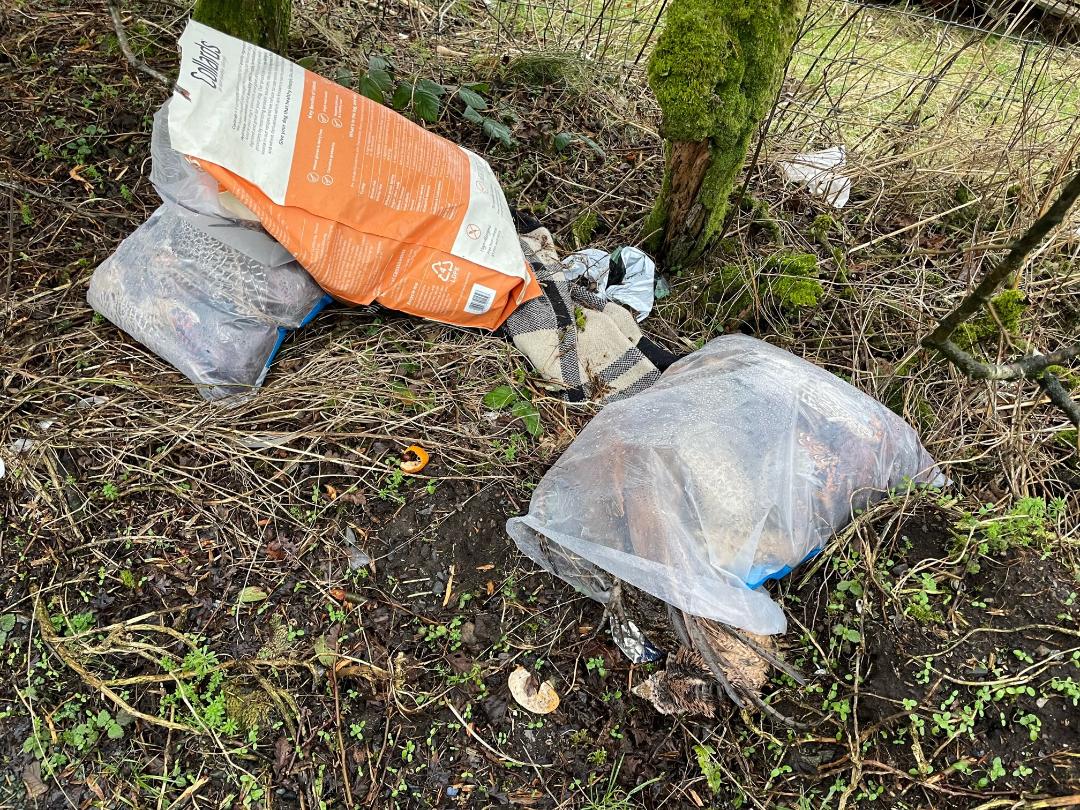
More shot pheasants and red-legged partridges have been dumped by the side of the road, this time shoved inside three large plastic sacks and thrown in a hedge next to a lay-by on the road between Egremont and Cockermouth in West Cumbria. They were found on Thursday 22 January 2024.
Many thanks to blog reader Catherine who sent in these photos. She emptied the sacks and counted 19 pheasant carcasses and 14 red-legged partridge carcasses. She said all had had their breast meat removed.
Regular blog readers will know that this is a common and widespread illegal practice. The disposal of animal by-products (including shot gamebirds) is regulated and the dumping of these carcasses is an offence, whether they’ve had the breast meat removed or not.
Previous reports include dumped birds found in Cheshire (here), Scottish borders (here), Norfolk (here), Perthshire (here), Berkshire (here), North York Moors National Park (here) and some more in North York Moors National Park (here) and even more in North Yorkshire (here), Co. Derry (here), West Yorkshire (here), and again in West Yorkshire (here), N Wales (here), mid-Wales (here), Leicestershire (here), Lincolnshire (here), Somerset (here), Derbyshire’s Peak District National Park (here), Suffolk (here), Leicestershire again (here), Somerset again (here), Liverpool (here), even more in North Wales (here) even more in Wales, again (here), in Wiltshire (here) in Angus (here), in Somerset again (here), once again in North Yorkshire (here), yet again in West Yorkshire (here), yet again in mid-Wales (here), even more in mid-Wales (here), more in Derbyshire (here), Gloucestershire (here) and more in Cheshire (here).
Unless someone was seen dumping these shot gamebirds, there’s no way of knowing who did it or from which gamebird shoot they originated. There’s no requirement for shoot managers to fit identifying markers to their livestock, which would make them traceable, because gamebird ‘livestock’ absurdly changes legal status to ‘wildlife’ as soon as the birds are released from the rearing pens for shooting (see Wild Justice’s blog on Schrodinger’s Pheasant for details).
For anyone who still wants to pretend that the grouse shooting industry isn’t responsible for the systematic extermination of hen harriers on grouse moors across the UK, here’s the latest catalogue of crime that suggests otherwise.
[This male hen harrier died in 2019 after his leg was almost severed in an illegally set trap that had been placed next to his nest on a Scottish grouse moor (see here). Photo by Ruth Tingay]
This is the blog I now publish after every reported killing or suspicious disappearance.
“They disappear in the same way political dissidents in authoritarian dictatorships have disappeared” (Stephen Barlow, 22 January 2021).
Today the list has been updated to include the nine most recently reported victims, all satellite tagged by Natural England and all ‘vanished’ between September and November 2023, including four more brood meddled harriers (here).
I’ve been compiling this list only since 2018 because that is the year that the grouse shooting industry ‘leaders’ would have us believe that the criminal persecution of hen harriers had stopped and that these birds were being welcomed back on to the UK’s grouse moors (see here).
This assertion was made shortly before the publication of a devastating new scientific paper that demonstrated that 72% of satellite-tagged hen harriers were confirmed or considered likely to have been illegally killed, and this was ten times more likely to occur over areas of land managed for grouse shooting relative to other land uses (see here). Incidentally, a further scientific paper published in 2023 by scientists at the RSPB, utilising even more recent data, echoed these results – see here).
2018 was also the year that Natural England issued a licence to begin a hen harrier brood meddling trial on grouse moors in northern England. For new blog readers, hen harrier brood meddling is a conservation sham sanctioned by DEFRA as part of its ludicrous ‘Hen Harrier Action Plan‘ and carried out by Natural England (NE), in cahoots with the very industry responsible for the species’ catastrophic decline in England. For more background see here and for a critical evaluation of the trial after 5 years see this report by Wild Justice.
Brood meddling has been described as a sort of ‘gentleman’s agreement’ by commentator Stephen Welch:
“I don’t get it, I thought the idea of that scheme was some kind of trade off – a gentleman’s agreement that the birds would be left in peace if they were moved from grouse moors at a certain density. It seems that one party is not keeping their side of the bargain“.
With at least 122 hen harriers gone since 2018, and 27 of those being brood meddled birds, there is no question that the grouse shooting industry is simply taking the piss. Meanwhile, Natural England pretends that ‘partnership working’ is the way to go and DEFRA Ministers remain silent.
*n/a = no hen harriers were brood meddled in 2018
‘Partnership working’ according to Natural England appears to include authorising the removal of hen harrier chicks from a grouse moor already under investigation by the police for suspected raptor persecution (here) and accepting a £75k ‘donation’ from representatives of the grouse shooting industry that prevents Natural England from criticising them or the sham brood meddling trial (see here). This is in addition to a £10k ‘donation’ that Natural England accepted, under the same terms, in 2021 (here).
So here’s the latest gruesome list. Note that the majority of these birds (but not all) were fitted with satellite tags. How many more [untagged] harriers have been killed?
February 2018: Hen harrier Saorsa ‘disappeared’ in the Angus Glens in Scotland (here). The Scottish Gamekeepers Association later published wholly inaccurate information claiming the bird had been re-sighted. The RSPB dismissed this as “completely false” (here).
5 February 2018: Hen harrier Marc ‘disappeared’ on a grouse moor in Durham (here).
9 February 2018: Hen harrier Aalin ‘disappeared’ on a grouse moor in Wales (here).
March 2018: Hen harrier Blue ‘disappeared’ in the Lake District National Park (here).
March 2018: Hen harrier Finn ‘disappeared’ near Moffat in Scotland (here).
18 April 2018: Hen harrier Lia ‘disappeared’ in Wales and her corpse was retrieved in a field in May 2018. Cause of death was unconfirmed but police treating death as suspicious (here).
8 August 2018: Hen harrier Hilma ‘disappeared’ on a grouse moor in Northumberland (here).
16 August 2018: Hen harrier Athena ‘disappeared’ on a grouse moor in Scotland (here).
26 August 2018: Hen Harrier Octavia ‘disappeared’ on a grouse moor in the Peak District National Park (here).
29 August 2018: Hen harrier Margot ‘disappeared’ on a grouse moor in Scotland (here).
29 August 2018: Hen Harrier Heulwen ‘disappeared’ on a grouse moor in Wales (here).
3 September 2018: Hen harrier Stelmaria ‘disappeared’ on a grouse moor in Scotland (here).
24 September 2018: Hen harrier Heather ‘disappeared’ on a grouse moor in Scotland (here).
2 October 2018: Hen harrier Mabel ‘disappeared’ on a grouse moor on the edge of the Yorkshire Dales National Park (here).
3 October 2018: Hen Harrier Thor ‘disappeared’ next to a grouse moor in Bowland, Lanacashire (here).
23 October 2018: Hen harrier Tom ‘disappeared’ in South Wales (here).
26 October 2018: Hen harrier Arthur ‘disappeared’ on a grouse moor in the North York Moors National Park (here).
1 November 2018: Hen harrier Barney ‘disappeared’ on Bodmin Moor (here).
10 November 2018: Hen harrier Rannoch ‘disappeared’ on a grouse moor in Scotland (here). Her corpse was found nearby in May 2019 – she’d been killed in an illegally-set spring trap (here).
14 November 2018: Hen harrier River ‘disappeared’ on a grouse moor in the Nidderdale AONB (here). Her corpse was found nearby in April 2019 – she’d been illegally shot (here).
16 January 2019: Hen harrier Vulcan ‘disappeared’ in Wiltshire close to Natural England’s proposed reintroduction site (here).
28 January 2019: Hen harrier DeeCee ‘disappeared’ in Glen Esk, a grouse moor area of the Angus Glens (see here).
7 February 2019: Hen harrier Skylar ‘disappeared’ next to a grouse moor in South Lanarkshire (here).
22 April 2019: Hen harrier Marci ‘disappeared’ on a grouse moor in the Cairngorms National Park (here).
26 April 2019: Hen harrier Rain ‘disappeared’ on a grouse moor in Nairnshire (here).
11 May 2019: An untagged male hen harrier was caught in an illegally-set trap next to his nest on a grouse moor in South Lanarkshire. He didn’t survive (here).
7 June 2019: An untagged hen harrier was found dead on a grouse moor in Scotland. A post mortem stated the bird had died as a result of ‘penetrating trauma’ injuries and that this bird had previously been shot (here).
5 September 2019: Wildland Hen Harrier 1 ‘disappeared’ on a grouse moor nr Dalnaspidal on the edge of the Cairngorms National Park (here).
11 September 2019: Hen harrier Romario ‘disappeared’ on a grouse moor in the Cairngorms National Park (here).
14 September 2019: Hen harrier (Brood meddled in 2019, #183704) ‘disappeared’ in the North Pennines (here).
23 September 2019: Hen harrier (Brood meddled in 2019, #55149) ‘disappeared’ in North Pennines (here).
24 September 2019: Wildland Hen Harrier 2 ‘disappeared’ on a grouse moor at Invercauld in the Cairngorms National Park (here).
24 September 2019: Hen harrier Bronwyn ‘disappeared’ near a grouse moor in North Wales (here).
10 October 2019: Hen harrier Ada ‘disappeared’ on a grouse moor in the North Pennines AONB (here).
12 October 2019: Hen harrier Thistle ‘disappeared’ on a grouse moor in Sutherland (here).
18 October 2019: Member of the public reports the witnessed shooting of an untagged male hen harrier on White Syke Hill in North Yorkshire (here).
November 2019: Hen harrier Mary found illegally poisoned on a pheasant shoot in Ireland (here).
November 2019: Hen harrier Artemis ‘disappeared’ near Long Formacus in south Scotland (RSPB pers comm).
14 December 2019: Hen harrier Oscar ‘disappeared’ in Eskdalemuir, south Scotland (here).
December 2019: Hen harrier Ingmar ‘disappeared’ in the Strathbraan grouse moor area of Perthshire (RSPB pers comm).
January 2020: Members of the public report the witnessed shooting of a male hen harrier on Threshfield Moor in the Yorkshire Dales National Park (here).
23 March 2020: Hen harrier Rosie ‘disappeared’ at an undisclosed roost site in Northumberland (here).
1 April 2020: Hen harrier (Brood meddled in 2019, #183703) ‘disappeared’ in unnamed location, tag intermittent (here).
5 April 2020: Hen harrier Hoolie ‘disappeared’ on a grouse moor in the Cairngorms National Park (here)
8 April 2020: Hen harrier Marlin ‘disappeared’ on a grouse moor in the Cairngorms National Park (here).
19 May 2020: Hen harrier Fingal ‘disappeared’ on a grouse moor in the Lowther Hills, Scotland (here).
21 May 2020: Hen harrier (Brood meddled in 2019, #183701) ‘disappeared’ on a grouse moor in Cumbria shortly after returning from wintering in France (here).
27 May 2020: Hen harrier Silver ‘disappeared’ on a grouse moor on Leadhills Estate, Scotland (here).
2020: day/month unknown: Unnamed male hen harrier breeding on RSPB Geltsdale Reserve, Cumbria ‘disappeared’ while away hunting (here).
9 July 2020: Unnamed female hen harrier (#201118) ‘disappeared’ from an undisclosed site in Northumberland (here).
25 July 2020: Hen harrier Harriet ‘disappeared’ on a grouse moor in the Yorkshire Dales National Park (here).
14 August 2020: Hen harrier Solo ‘disappeared’ in confidential nest area in Lancashire (here).
7 September 2020: Hen harrier Dryad ‘disappeared’ on a grouse moor in the Yorkshire Dales National Park (here).
16 September 2020: Hen harrier Fortune ‘disappeared’ from an undisclosed roost site in Northumberland (here).
19 September 2020: Hen harrier Harold ‘disappeared’ on a grouse moor in the Yorkshire Dales National Park (here).
20 September 2020: Hen harrier (Brood meddled in 2020, #55152) ‘disappeared’ next to a grouse moor in North Yorkshire (here).
24 February 2021: Hen harrier Tarras ‘disappeared’ next to a grouse moor in Northumberland (here)
12th April 2021: Hen harrier Yarrow ‘disappeared’ near Stockton, County Durham (here).
18 May 2021: Adult male hen harrier ‘disappeared’ from its breeding attempt on RSPB Geltsdale Reserve, Cumbria whilst away hunting (here).
18 May 2021: Another adult male hen harrier ‘disappeared’ from its breeding attempt on RSPB Geltsdale Reserve, Cumbria whilst away hunting (here).
24 July 2021: Hen harrier Asta ‘disappeared’ at a ‘confidential site’ in the North Pennines (here). We learned 18 months later that her wings had been ripped off so her tag could be fitted to a crow in an attempt to cover up her death (here).
14th August 2021: Hen harrier Josephine ‘disappeared’ at a ‘confidential site’ in Northumberland (here).
17 September 2021: Hen harrier Reiver ‘disappeared’ in a grouse moor dominated region of Northumberland (here)
24 September 2021: Hen harrier (Brood meddled in 2021, R2-F-1-21) ‘disappeared’ in Northumberland (here).
15 November 2021: Hen harrier (brood meddled in 2020, #R2-F1-20) ‘disappeared’ at the edge of a grouse moor on Arkengarthdale Estate in the Yorkshire Dales National Park (here).
19 November 2021: Hen harrier Val ‘disappeared’ in the Lake District National Park in Cumbria (here).
19 November 2021: Hen harrier Percy ‘disappeared’ in Lothian, Scotland (here).
12 December 2021: Hen harrier Jasmine ‘disappeared’ on a grouse moor (High Rigg Moor on the Middlesmoor Estate) in the Nidderdale AONB in North Yorkshire (here).
9 January 2022: Hen harrier Ethel ‘disappeared’ in Northumberland (here).
26 January 2022: Hen harrier Amelia ‘disappeared’ in Bowland (here).
10 February 2022: An unnamed satellite-tagged hen harrier ‘disappeared’ in a grouse moor dominated area of the Peak District National Park (here). One year later it was revealed that the satellite tag/harness of this young male called ‘Anu’ had been deliberately cut off (see here).
12 April 2022: Hen harrier ‘Free’ (Tag ID 201121) ‘disappeared’ at a ‘confidential site’ in Cumbria (here). It later emerged he hadn’t disappeared, but his mutilated corpse was found on moorland in the Yorkshire Dales National Park. A post mortem revealed the cause of death was having his head twisted and pulled off. One leg had also been torn off whilst he was still alive (here).
April 2022: Hen harrier ‘Pegasus’ (tagged by the RSPB) ‘disappeared’ on a grouse moor at Birkdale in the Yorkshire Dales National Park (here).
May 2022: A male breeding hen harrier ‘disappeared’ from a National Trust-owned grouse moor in the Peak District National Park (here).
May 2022: Another breeding male hen harrier ‘disappeared’ from a National Trust-owned grouse moor in the Peak District National Park (here).
14 May 2022: Hen harrier ‘Harvey’ (Tag ID 213844) ‘disappeared’ from a ‘confidential site’ in the North Pennines (here).
20 June 2022: Hen harrier chick #1 stamped to death in nest on a grouse moor in the Yorkshire Dales National Park (here).
20 June 2022: Hen harrier chick #2 stamped to death in nest on a grouse moor in the Yorkshire Dales National Park (here).
20 June 2022: Hen harrier chick #3 stamped to death in nest on a grouse moor in the Yorkshire Dales National Park (here).
20 June 2022: Hen harrier chick #4 stamped to death in nest on a grouse moor in the Yorkshire Dales National Park (here).
17 August 2022: Hen harrier (brood meddled in 2022, #R1-M1-22) ‘disappeared’ on moorland in the Yorkshire Dales National Park (here).
September 2022: Hen harrier ‘Sullis’ (tagged by the RSPB) ‘disappeared’ on a grouse moor in Cumbria (here).
5 October 2022: Hen harrier (brood meddled in 2022, #R3-M2-22) ‘disappeared’ on moorland in the Yorkshire Dales National Park (here).
10 October 2022: Hen harrier ‘Sia’ ‘disappeared’ near Hamsterley Forest in the North Pennines (here).
October 2022: Hen harrier (brood meddled in 2021, #R1-F1-21) ‘disappeared’ in the North Sea off the North York Moors National Park (here).
December 2022: Hen harrier female (brood meddled in 2020, #R2-F2-20) ‘disappeared’ on moorland in Cumbria (here).
1 December 2022: Hen harrier male (brood meddled in 2021, #R1-M1-21) ‘disappeared’ on moorland in the Yorkshire Dales National Park (here).
14 December 2022: Hen harrier female (brood meddled in 2022, #R3-F1-22) ‘disappeared’ on moorland in the North Pennines AONB (here).
15 December 2022: Hen harrier female (brood meddled in 2022, #R2-F1-22) ‘disappeared’ on moorland in the Yorkshire Dales National Park (here).
30 March 2023: Hen harrier female (brood meddled in 2022, #R1-F3-22) ‘disappeared’ in Yorkshire (here). Notes from NE Sept 2023 spreadsheet update: “Final transmission location temporarily withheld at police request“.
1 April 2023: Hen harrier male (brood meddled in 2022, #R2-M1-22) ‘disappeared’ in Yorkshire (here). Notes from NE Sept 2023 spreadsheet update: “Final transmission location temporarily withheld at police request“.
April 2023: Hen harrier ‘Lagertha’ (tagged by RSPB) ‘disappeared’ in North Yorkshire (here).
April 2023: Hen harrier ‘Nicola’ (Tag ID 234078) ”disappeared’ in North Yorkshire (here).
April 2023: Untagged male hen harrier ‘disappeared’ from an active nest on RSPB Geltsdale Reserve in Cumbria (here).
April 2023: Another untagged male hen harrier ‘disappeared’ from an active nest on RSPB Geltsdale Reserve in Cumbria (here).
April 2023: Untagged male hen harrier ‘disappeared’ from an active nest in Durham (here).
4/5 May 2023: Satellite-tagged male hen harrier called ‘Rush’ ‘disappeared’ from a grouse moor in Bowland AONB in Lancashire (here).
9/10 May 2023: Hen harrier male called ‘Dagda’, tagged by the RSPB in Lancashire in June 2022 and who was breeding on the RSPB’s Geltsdale Reserve in 2023 until he ‘vanished’, only to be found dead on the neighbouring Knarsdale grouse moor in May 2023 – a post mortem revealed he had been shot (here).
17 May 2023: Satellite-tagged hen harrier called ‘Wayland’ ‘disappeared’ in the Clapham area of North Yorkshire, just north of the Bowland AONB (here).
31 May 2023: Hen harrier male (brood meddled in 2022, tag #213932, name: R2-M3-22) ‘disappeared’ in Northumberland (grid ref: NY765687) (here).
11 June 2023: Hen harrier male (brood meddled in 2021, tag #213922, name: R2-M1-21) ‘disappeared’ at a confidential site in the Yorkshire Dales National Park. Notes from the NE spreadsheet: “Final transmission location temporarily withheld at police request“ (here).
12 June 2023: Hen harrier male (brood meddled in 2020, tag #203004, name: R1-M2-20) ‘disappeared’ on a grouse moor in Co. Durham (grid ref: NY976322) (here).
6 July 2023: Satellite-tagged female hen harrier named ‘Rubi’ (tag #201124a) ‘disappeared’ on a grouse moor in Co. Durham (grid ref: NY911151) (here).
23 July 2023: Hen harrier female (brood meddled in 2023, tag #55154a, name: R1-F1-23) ‘disappeared’ on a grouse moor in Co. Durham (close to where ‘Rubi’ vanished), grid ref: NY910126 (here).
29 July 2023: Hen harrier female (brood meddled in 2020, tag #55144, name: R2-F2-20) ‘disappeared’ at a confidential site in the North Pennines. Notes from the NE spreadsheet: “Dead. Recovered – awaiting PM results. Final transmission location temporarily withheld at police request“ (here).
9 August 2023: Satellite-tagged hen harrier called ‘Martha’ ‘disappeared’ on a grouse moor (Westburnhope Moor) near Hexham in the North Pennines (here).
11 August 2023: Satellite-tagged hen harrier called ‘Selena’ ‘disappeared’ on a grouse moor (Mossdale Moor) in the Yorkshire Dales National Park (here).
11 August 2023: Hen harrier female (brood meddled in 2023, tag #201118a, name: R3-F1-23) ‘disappeared’ in Co. Durham (grid ref: NZ072136) (here).
15 August 2023: Satellite-tagged hen harrier called ‘Hepit’ ‘disappeared’ on a grouse moor (Birkdale Common) near Kirkby Stephen in the Yorkshire Dales National Park (here).
24 August 2023: Hen harrier female (brood meddled in 2023, tag #55155a, name: R1-F2-23) ‘disappeared’ at a confidential site in Northumberland. Notes from the NE spreadsheet: “Final transmission location temporarily withheld at police request“ (here).
August-Sept 2023: Satellite-tagged hen harrier called ‘Harmonia’ ‘disappeared’ in the Yorkshire Dales National Park (here).
September 2023: Hen harrier female ‘Saranyu’, tagged by the RSPB in Cumbria in June 2023, ‘disappeared’ in Durham in September 2023 (no further details available yet – just outline info provided in 2022 Birdcrime report) (here).
September 2023: Hen harrier female ‘Inger’, a female tagged by the RSPB in Perthshire in July 2022, ‘disappeared’ on a grouse moor in the Angus Glens in September 2023 (here).
15 September 2023: Hen harrier male called ‘Rhys’, tagged in Cumbria on 1st August 2023, ‘disappeared’ on a grouse moor in the Yorkshire Dales National Park. Grid ref: SD798896 (here).
24 September 2023: Hen harrier female (brood meddled in 2023, name: ‘R2-F2-23’) ‘disappeared’ in the North Pennines, grid ref: NY888062 (here).
25 September 2023: Hen harrier female (brood meddled in 2022, name: ‘R1-F4-22’) ‘disappeared’ on a grouse moor in the Yorkshire Dales National Park, grid ref: SE077699 (here).
26 September 2023: Hen harrier female called ‘Hope’, tagged in Cumbria on 21 July 2023, ‘disappeared’ next to a grouse moor in the Yorkshire Dales National Park, grid ref: SD801926 (here).
4 October 2023: Hen harrier male (brood meddled in 2020, name: ‘R1-M3-20’) ‘disappeared’ in Co Durham, grid ref: NY935192 (here).
4 October 2023: Hen harrier female (brood meddled in 2023, name: ‘R4-F1-23’) ‘disappeared’ on a grouse moor in the Yorkshire Dales National Park, grid ref: SE003981 (here).
14 October 2023: Hen harrier male called ‘Cillian’, tagged in Cumbria on 1 August 2023, ‘disappeared’ in south west Scotland, grid ref: NY051946 (here).
15 November 2023: Hen harrier female called ‘Hazel’, tagged in Cumbria on 21 July 2023, ‘disappeared’ on the Isle of Man, grid ref: SC251803 (here).
27 November 2023: Hen harrier female called ‘Gill’, tagged in Northumberland on 10 July 2023, ‘disappeared’ at a confidential location in Teeside (here).
To be continued…….
Not one of these 122 incidents has resulted in an arrest, let alone a prosecution. I had thought that when we reached 30 dead/missing hen harriers then the authorities might pretend to be interested and at least say a few words about this national scandal. We’ve now reached ONE HUNDRED AND TWENTY TWO hen harriers, and still Govt ministers remain silent. They appear not to give a monkey’s. And yes, there are other things going on in the world, as always. That is not reason enough to ignore this blatant, brazen and systematic destruction of a supposedly protected species, being undertaken to satisfy the greed and bloodlust of a minority of society.
And let’s not forget the response from the Moorland Association Chair (and owner of Swinton Estate) Mark Cunliffe-Lister, who told BBC Radio 4 in August 2023 that, “Clearly any illegal [hen harrier] persecution is not happening” (here).
Nor should we forget the response from the Game and Wildlife Conservation Trust’s (GWCT) Director of Policy Dr Alistair Leake who wrote a letter to the Guardian newspaper in November 2023 stating that the hen harrier brood management [meddling] scheme “is surely a shining example of human / wildlife conflict resolution that would be the envy of other countries trying to find similar solutions“ (I kid you not – here).
With 33 hen harriers now known to have gone ‘missing’/been deliberately killed in 2023, this has been the worst year for hen harrier persecution since brood meddling began in 2018.
In December 2023 I wrote a blog post about how 2023 had been the worst year for the persecution of Hen Harriers on UK grouse moors since the Government’s brood meddling sham trial began in 2018 (see here).
That blog was based on updated persecution figures provided by the RSPB, but it had a caveat – we were still waiting for updated figures from Natural England for the period between September – December 2023.
Today, Natural England has published an update to its Hen Harrier Satellite Tag Database (here), with details of the fates of all of its satellite tagged hen harriers up to December 2023.
I’ve just been through this database and tallied the details against my own running tally and have discovered that a further NINE satellite-tagged Hen Harriers have ‘disappeared’ in suspicious circumstances between Sept – Dec 2023. These ‘disappearances’ have not previously been reported.
The ‘missing’ birds are as follows:
Male Hen Harrier ‘Rhys’, tagged in Cumbria on 1st August 2023, last known transmission from a grouse moor in the Yorkshire Dales National Park on 15 September 2023. Grid ref: SD798896.
Female Hen Harrier ‘R2-F2-23’ brood meddled in 2023, last known transmission in the North Pennines on 24 September 2023. Grid ref: NY888062.
Female Hen Harrier ‘R1-F4-22’ brood meddled in 2022, last known transmission from a grouse moor in the Yorkshire Dales National Park on 25 September 2023. Grid ref: SE077699.
Female Hen Harrier ‘Hope’, tagged in Cumbria on 21 July 2023, last known transmission next to a grouse moor in the Yorkshire Dales National Park on 26 September 2023. Grid ref: SD801926.
Male Hen Harrier ‘R1-M3-20’ brood meddled in 2020, last known transmission in Co Durham on 4 October 2023. Grid ref: NY935192.
Female Hen Harrier ‘R4-F1-23’ brood meddled in 2023, last known transmission from a grouse moor in the Yorkshire Dales National Park on 4 October 2023. Grid ref: SE003981.
Male Hen Harrier ‘Cillian’, tagged in Cumbria on 1 August 2023, last known transmission from south west Scotland on 14 October 2023. Grid ref: NY051946.
Female Hen Harrier ‘Hazel’, tagged in Cumbria on 21 July 2023, last known transmission Isle of Man on 15 November 2023. Grid ref: SC251803.
Female Hen Harrier ‘Gill’, tagged in Northumberland on 10 July 2023, last known transmission 27 November 2023 on Teeside (site location confidential).
I’ll add these additional nine Hen Harriers to the other 113 Hen Harriers known to have been killed/’disappeared’ since 2018 (see here).
In total then, by my reckoning, 33 Hen Harriers ‘disappeared’ in suspicious circumstances/were killed in 2023, and thirteen of those were brood meddled birds. This is the highest (known) number since 2018:
*n/a = no brood meddling took place in 2018
The total number of Hen Harriers (that we know of) that have ‘disappeared’ in suspicious circumstances / been killed since brood meddling began in 2018 has now reached 122 birds, and 27 of those were brood meddled birds.
Natural England has published a blog today (here) outlining these ‘higher thannormal losses‘ and says: “We are concerned about this apparent increase in mortality, and are, as always, working with the police who investigate any possible illegal persecution“.
Funny, I haven’t seen a single press release/appeal for information about any of these nine birds from any of the police forces supposedly ‘investigating’ the suspicious disappearances of these harriers.
The Natural England blog also states that NE has “heightened concerns aboutillegal persecution” but then says “…we value our continued good working relationships with landowners who allow our fieldworkers access to carry out monitoring work“.
I note that the blog doesn’t include any hint that Natural England may be considering pulling the brood meddling licence, so its concerns can’t be that ‘heightened’.
How many Hen Harriers have to ‘disappear’, or have their wings pulled off, or their heads and legs twisted off whilst still alive, or their chicks stamped to death in the nest (on a grouse moor directly involved with the brood meddling trial!), or have their satellite tag harnesses deliberately cut off, before Natural England acknowledges that the brood meddling trial is a sham, that its ‘partners’ are sticking up two fingers, that its partners continue to deny that persecution is even happening, and that its partners are even claiming that brood meddling “is surely a shining example of human / wildlife conflict resolution that would be the envy of other countries trying to find similar solutions“??!!
Are those ‘donations’ to Natural England from the grouse shooting industry (here and here) really worth Natural England forfeiting its integrity? It would seem so.
This year is the final year of the (currently extended) brood meddling licence and Natural England will be making a decision about whether to extend it, again, for another two years.
I, and I dare say many others, will be demanding full transparency on that decision-making process.
It is blindingly obvious that one of the main objectives of the brood meddling trial has not been met, nor even come close to being met: (to test whether grouse moor managers would stop illegally killing Hen Harriers if nestlings were removed from grouse moors, under licence, reared in captivity and released elsewhere). On the basis of Natural England’s own data, and in conjunction with the RSPB’s satellite tagging data, the evidence couldn’t be clearer – the illegal killing hasn’t stopped, or even been reduced.
And it’s unlikely to, because as I’ve written previously, the grouse shooting industry can afford to be so audacious about its crimes because it knows that (a) the Hen Harrier killers are NEVER caught, (b) NEVER prosecuted, and (c) NEVER convicted.
122 Hen Harriers and counting, Natural England. You are presiding over one of the most shameful and idiotic greenwashing scams of our time, and for what?
UPDATE 31 January 2024: 122 hen harriers confirmed ‘missing’ or illegally killed in UK since 2018, most of them on or close to grouse moors (here)
A prominent gamebird breeder is due in court this week to face multiple charges following the discovery of a poisoned buzzard and two poisoned baits at Ashley Game Farm in Chulmleigh, Devon in October 2020.
The dead buzzard and the two pheasant carcasses, which were discovered by a member of the public, all tested positive for Carbofuran.
Following these toxicology results, Devon & Cornwall Police led a multi-agency raid at Ashley Game Farm in March 2021 with assistance from Natural England, RSPB and the NWCU (see here) which identified a number of pesticide and veterinary medicine offences at the address.
Multi-agency search team attended Ashley Game Farm in March 2021. Photo: RSPB Investigations
Ashley Game Farm is an exceptionally large breeding facility that, according to its website, ‘specialises in supplying pheasants and partridges to shoots in the west country and all areas of the UK and Europe‘. It claims to have ‘a hatching capacityfor 410,000 eggs per week along with further investment in a second location atTarrington, Hereford‘ and ‘retains around 80,000 chicks at Ashley Game Farm every week‘.
Ashley Game Farm Director and owner Christopher Hodgson, 69, is due in court in Barnstaple on Friday 2 February 2024 to face multiple charges in relation to the alleged use of Carbofuran and the alleged possession, storage and use of various plant protection and veterinary medicine products without authorisation at the game farm.
I think this is Hodgson’s first appearance so he hasn’t yet entered a plea.
As this case is now live, comments won’t be accepted on this blog until criminal proceedings have concluded. Thanks for your understanding.
UPDATE 9 February 2024: Prosecution continues against Ashley Game Farm Director Christopher Hodgson after discovery of poisoned buzzard, baits & other pesticide offences (here).
The owner of Caerphilly Bird Rescue in Wales has been handed a suspended prison sentence and a lifetime ban from keeping animals after pleading guilty to six animal welfare offences.
Carol Gravenor, 67, of Coed Main, Caerphilly, was charged after 26 birds, including pigeons, blackbirds, crows, jackdaws, a peregrine falcon, and a buzzard, were found in an unsuitable and unhygienic environment.
An RSPCA inspector found the birds with injuries and illnesses which had not been treated properly, including fractured wings and damaged eyes and legs.
This peregrine was found in a small filthy cage with no water. Photo: RSPCA
Mrs Gravenor appeared at Newport Magistrates’ Court on Thursday January 11, where she was given a 14-week prison sentence suspended for 12 months. She was also ordered to pay £300 and a £154 victim surcharge.
This article in the Caerphilly Observer (dated 12 January 2024) provides a report from the RSPCA inspector about what was found at the sanctuary and an explanation from Mrs Gravenor’s solicitor about how she’d become ‘overwhelmed’ and ‘swamped’ following the death of her husband in 2021.
The birds were removed from the premises on 11 April 2023 and most had to be euthanised on welfare grounds.
The Wildlife Management & Muirburn (Scotland) Bill, currently at Stage 2 of its progression through the Scottish Parliament, makes a provision that when assessing whether to issue a grouse shooting and/or muirburn licence the relevant authority (in this case, NatureScot) must consider whether the licence applicant is complying with the relevant new codes of practice.
These new codes of practice, designed to support the new legislation, are anticipated to include detailed guidance on issues such as the use of wildlife traps, medicated grit, muirburn specifications etc and to clarify what will be a statutory requirement and what will be considered guidance as ‘best practice’.
Under the leadership of NatureScot, two working groups have been established to draft these new codes of practice – one group for general grouse shoot management and one group for muirburn. The terms of the new codes will be thrashed out by these groups.
Minister for Environment Gillian Martin MSP has recently written to the Rural Affairs & Islands Committee to provide an update on the formation of these two working groups and the progress they’ve made so far. Here’s her letter:
I was amused by the Minister’s claim that ‘there is broad agreement amongst the members of each Group as to what should be included in the Codes‘.
Really?
Given the organisations involved in the working groups (see the annex at the end of the Minister’s letter), I’d be utterly amazed if there is ‘broad agreement’ about anything!
All the usual suspects from the grouse shooting world are there (BASC, Countryside Alliance, GWCT, Scottish Land & Estates, Scottish Gamekeepers and the Regional Moorland Groups (which are basically subgroups of the SGA and SLE)) and many of them have been vocally opposed to the Bill since it was first introduced last year (e.g. see here).
Are we really expected to believe that they’re now working in harmony with pro-Bill groups such as the RSPB, the Scottish Raptor Study Group, Scottish Wildlife Trust and Cairngorms National Park Authority without making any attempt to water down the terms of the new codes?




 Raptor Persecution UK