
Three conservation organisations held a parliamentary reception at Holyrood yesterday to brief MSPs ahead of the forthcoming Stage 2 of the Wildlife Management & Muirburn (Scotland) Bill.
Members of the Scottish Raptor Study Group, RSPB Scotland and REVIVE, the coalition for grouse moor reform, were joined by many members of the Rural Affairs & Islands Committee (the Committee tasked with voting on the Bill’s Stage 2 amendments) and a few other MSPs also attended.
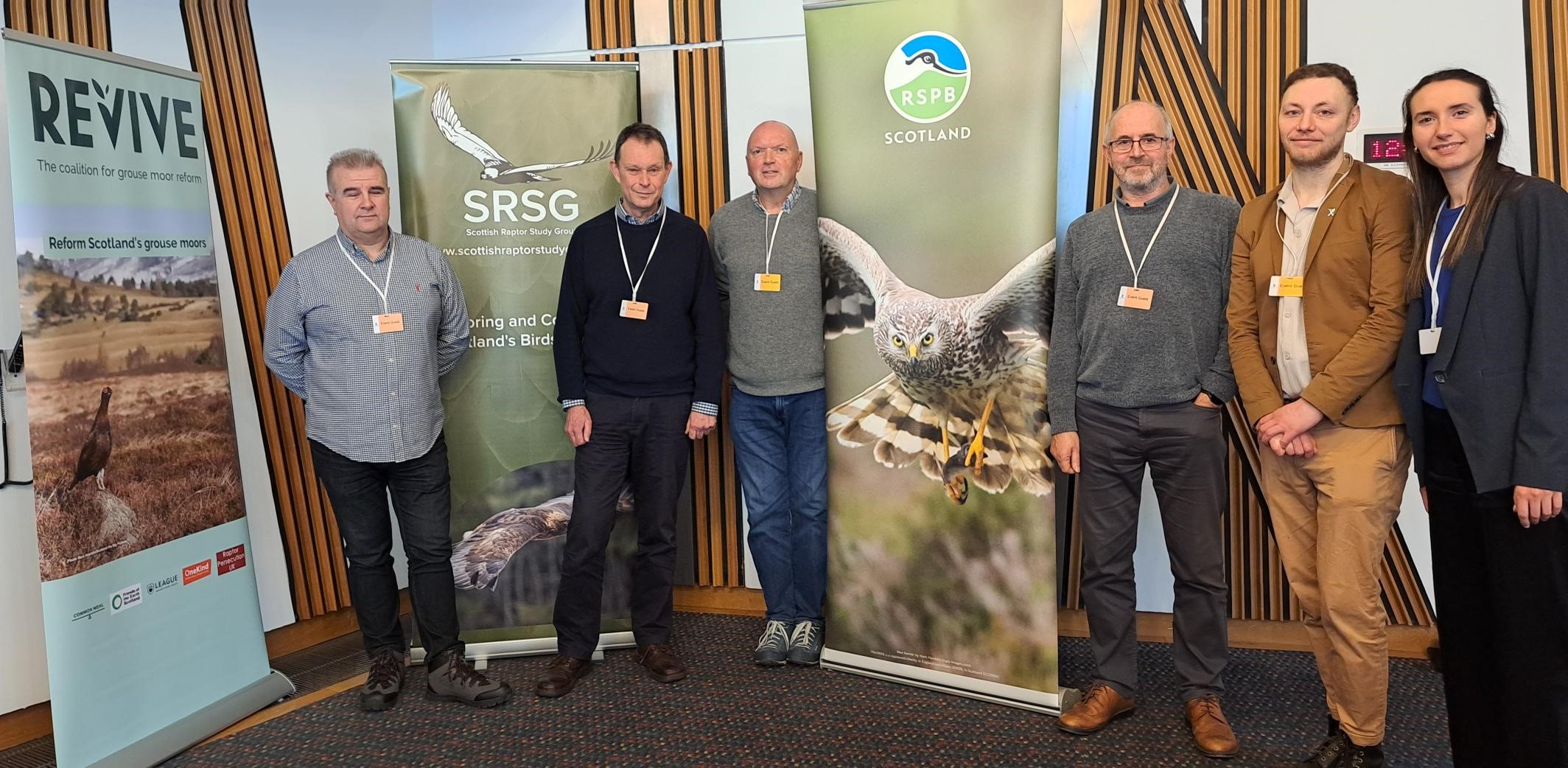
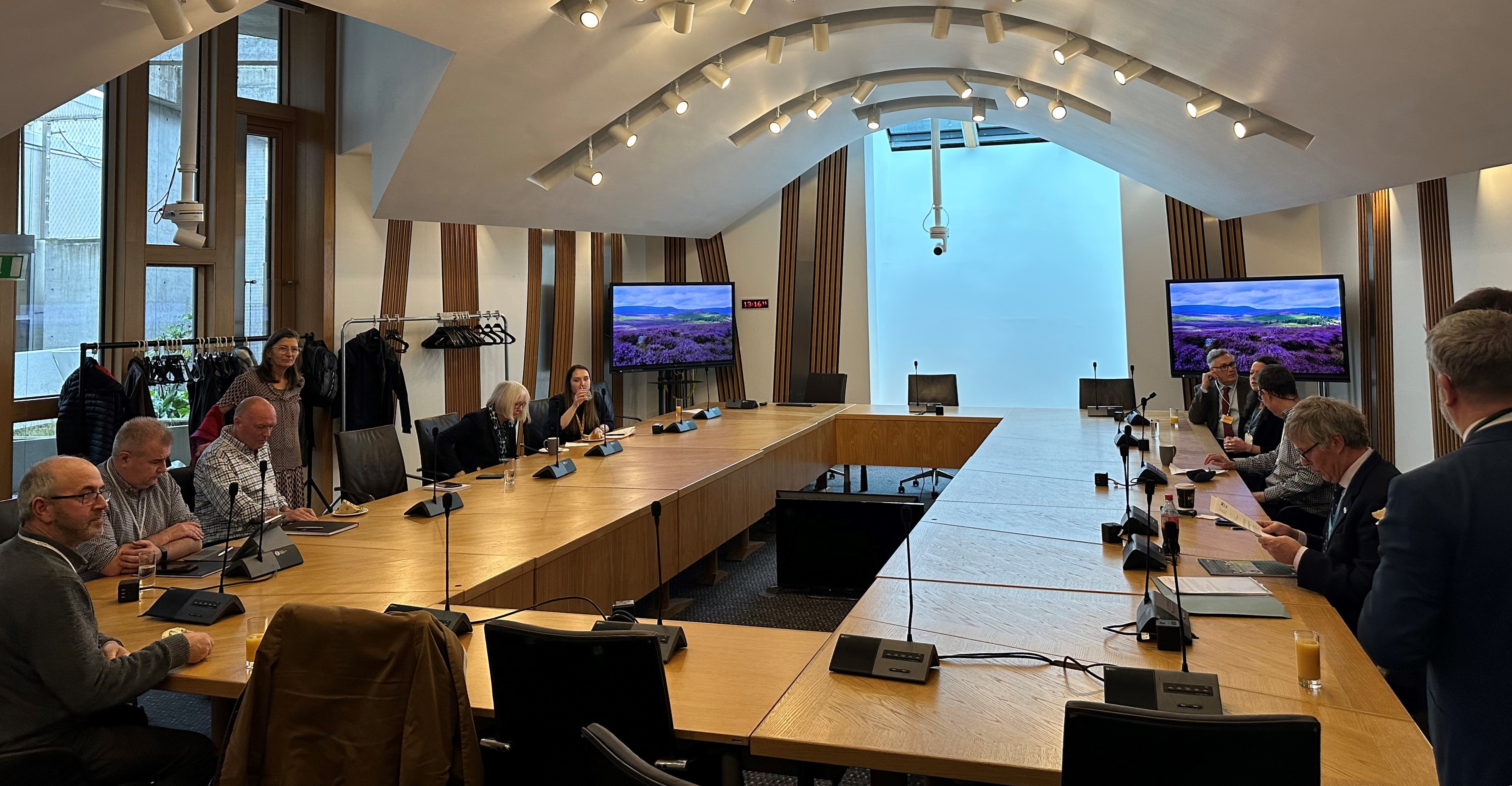
The timing of this reception was fortuitous, thanks to Rural Affairs Committee Convenor Finlay Carson suddenly deciding on the eve of the Committee’s planned session to delay the consideration of the Stage 2 amendments by two weeks (see here and here). This provided an opportunity for conservationists to further brief MSPs on various issues relating to the Bill, ahead of the Committee’s session which is now scheduled to begin next week.
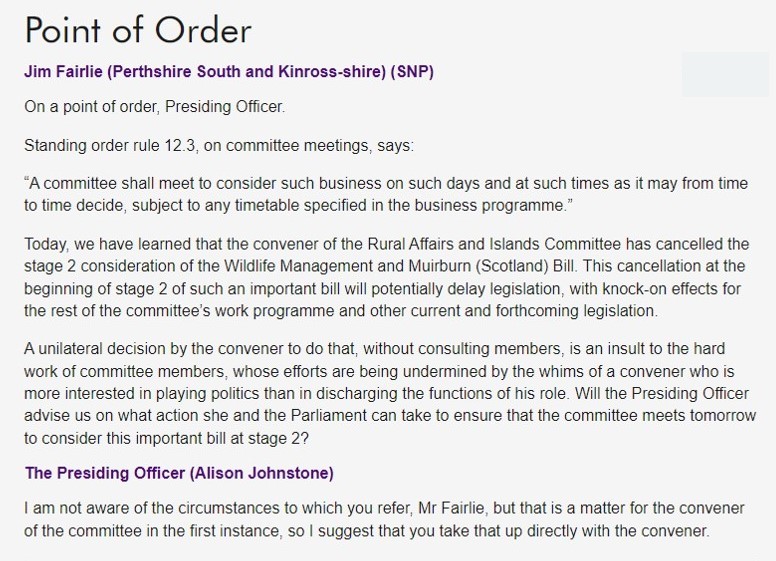
Interestingly, the fall-out from Finlay Carson’s decision to delay proceedings resulted in Committee member Jim Fairlie MSP (SNP) raising a point of order about it with the Parliament’s Presiding Officer (Alison Johnstone) on the day that Mr Carson made his decision (23 Jan 2024). From Alison’s response, it seems that Committee Convenors have a disproportionate yet legitimate level of power which allows them to thwart the will of Parliament. It’s quite an eye-opener:
Another consequence of Finlay Carson’s decision to delay proceedings is that MSPs were allowed an extended period of time in which to lodge amendments to the Bill at Stage 2. I note that Conservative MSPs Edward Mountain and Rachael Hamilton took advantage of that (legitimately) and have lodged further amendments to those they’d already lodged.
I haven’t been through these with a fine-toothed comb because I haven’t had the time, but I did note that Edward Mountain has lodged a further amendment suggesting that the withdrawal of wildlife trap licences should be based on the criminal burden of proof rather than the civil burden of proof (the Bill currently proposes a civil burden of proof which is an easier threshold to meet). Interesting, but not surprising.
The Rural Affairs & Islands Committee will begin its consideration of the Stage 2 amendments next Wednesday (7 February 2024). It will be one of two sessions (the date of the second session has yet to be announced) and will begin at 08.30hrs; earlier than the usual 9am start and probably a reflection of how many amendments there are to be considered.
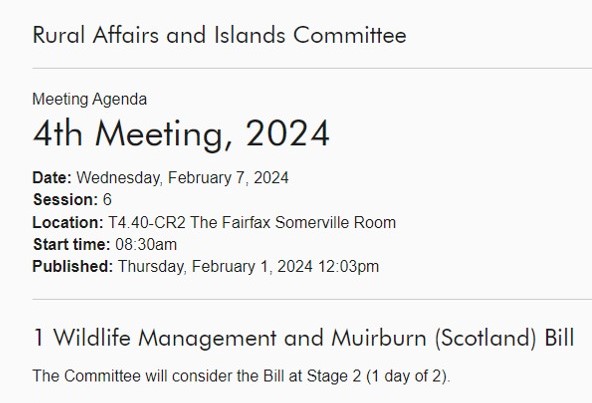
It’s expected that the session will be available to watch live on Scottish Parliament TV, as usual.
If I have time I’ll write further about the specific Stage 2 amendments prior to the first Committee meeting next week.


I think, as I mentioned earlier, there *may* be no Standing Orders which prevent the convenor of a committee endlessly ‘rinsing and repeating’ this mechanism (ie continually postponing a committee meeting until the end of that Parliament). I am not fully familiar with Holyrood’s constitution…
The same sort of delaying tactics can happen between the House of Commons and the Lords, and is called Parliamentary ping pong. See https://en.wikipedia.org/wiki/Parliamentary_ping-pong for an explanation.
In this way, a Bill can be delayed until it is lost – with a General Election coming up – unless the opposition agree to its passing, in what is known as the ‘wash-up’ period. The only exceptions are ‘money bills’ where the House of Commons has ‘financial privilege’ over the Lords.
Bad news indeed, Keith. Ony the naive wouyld think that this was fortuitous and not always known as a backstop from the minute Conservatdive MSP Finlay Carson as Convener of the Committee.
i remember how suspicious I was in regards to the Werrity Report which was also defanged by the mechanics of the procedure. I wonder who decided to appoint Finlay?
“I wonder who decided to appoint Finlay?”
From Wikipedia:
In Westminster, “The chairs of committees are allocated to political parties on the basis of their numerical strength in the House of Commons. Negotiations between party managers determine which party will hold which committee chair. By convention, the Public Accounts Committee is chaired by a member of the main opposition party, while the Treasury Select Committee is chaired by a member of the governing party. The remaining places on the committee are allocated in proportion to the numerical strength of the parties in the House of Commons.”
For Holyrood, from https://www.parliament.scot/-/media/files/parliamentary-guidance/guidance-on-committees.pdf
“Appointment
2.37 It is for the Parliament to decide, on a motion of the Bureau, the political
party whose members are eligible to be the convener of each committee (or that
the eligible members are those not representing any political party). The Bureau
must have regard to the balance of political parties in the Parliament when making
such proposals.
2.38 In practice, the distribution of convenerships among the parties is done
using a version of the “d’Hondt” formula. This is an algorithm that can be applied
objectively to achieve fair distribution among parties according to their numerical
strength. The first “round” allocates the first choice of convenership to the political
party with the most MSPs; in the next round that party’s numerical strength is
divided by 2 (i.e. the number of convenerships it has already secured +1),
meaning that the second choice of a convenership is likely to go to the secondlargest party, and so on. The only formal restriction is that the convener of the
Public Audit Committee cannot be a member of a Scottish Government party
(Rule 6.7.2).”
Having now read too much about how Scottish Parliamentary Committees work, I *think* the Parliamentary Bureau could deal with a non-functioning Convener/Committee. But it doesn’t look straightforward to thwart a determined attempt at sabotage…
The Parliamentary Bureau has the power, for example, under Rule 6.12 Duration of committees, “The Parliament may decide, on a motion of the Parliamentary Bureau, that any other committee be disbanded.”
The Parliamentary Bureau consists of the Convener, and someone from any party with at least 5 MSPs. But the Convener did decline to intervene when the Rural Affairs and Islands Committee meeting was postponed for spurious reasons…